


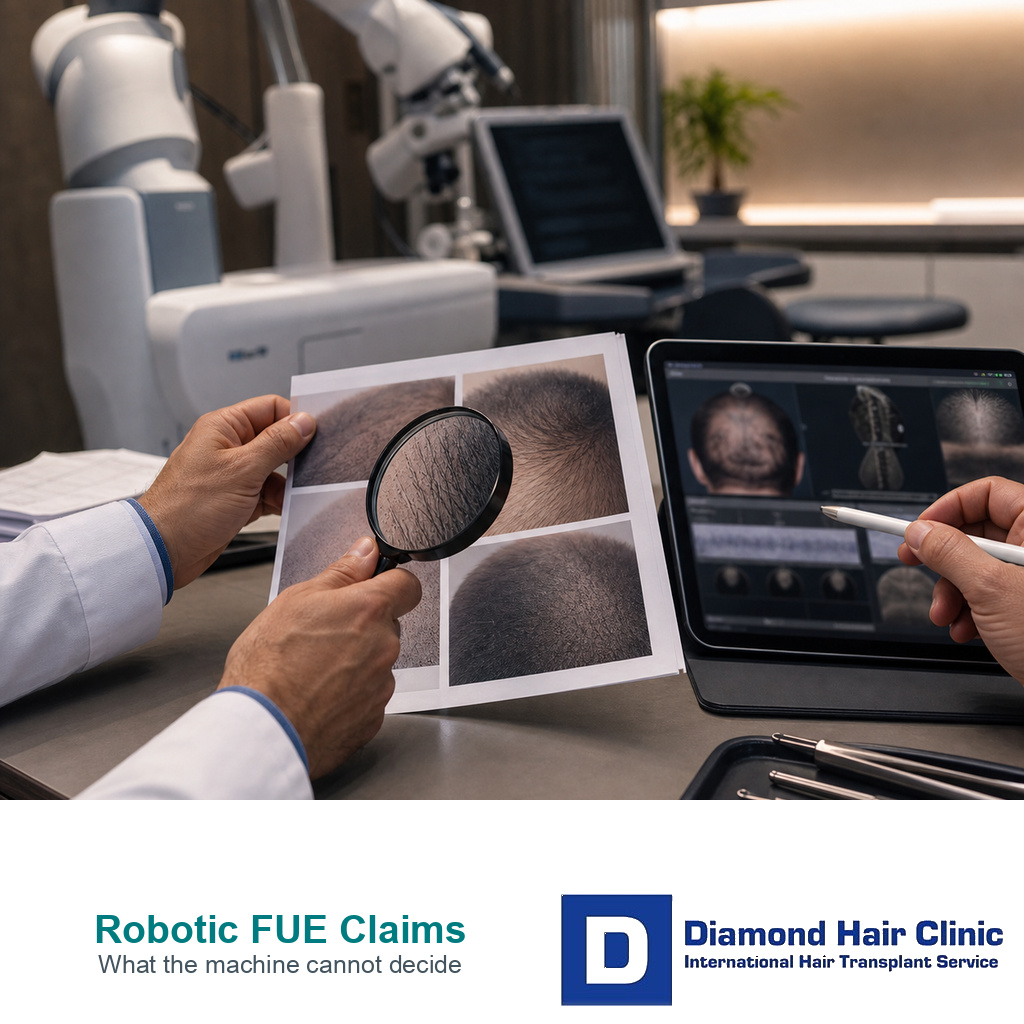
ARTAS Robotic Hair Transplant and Manual FUE
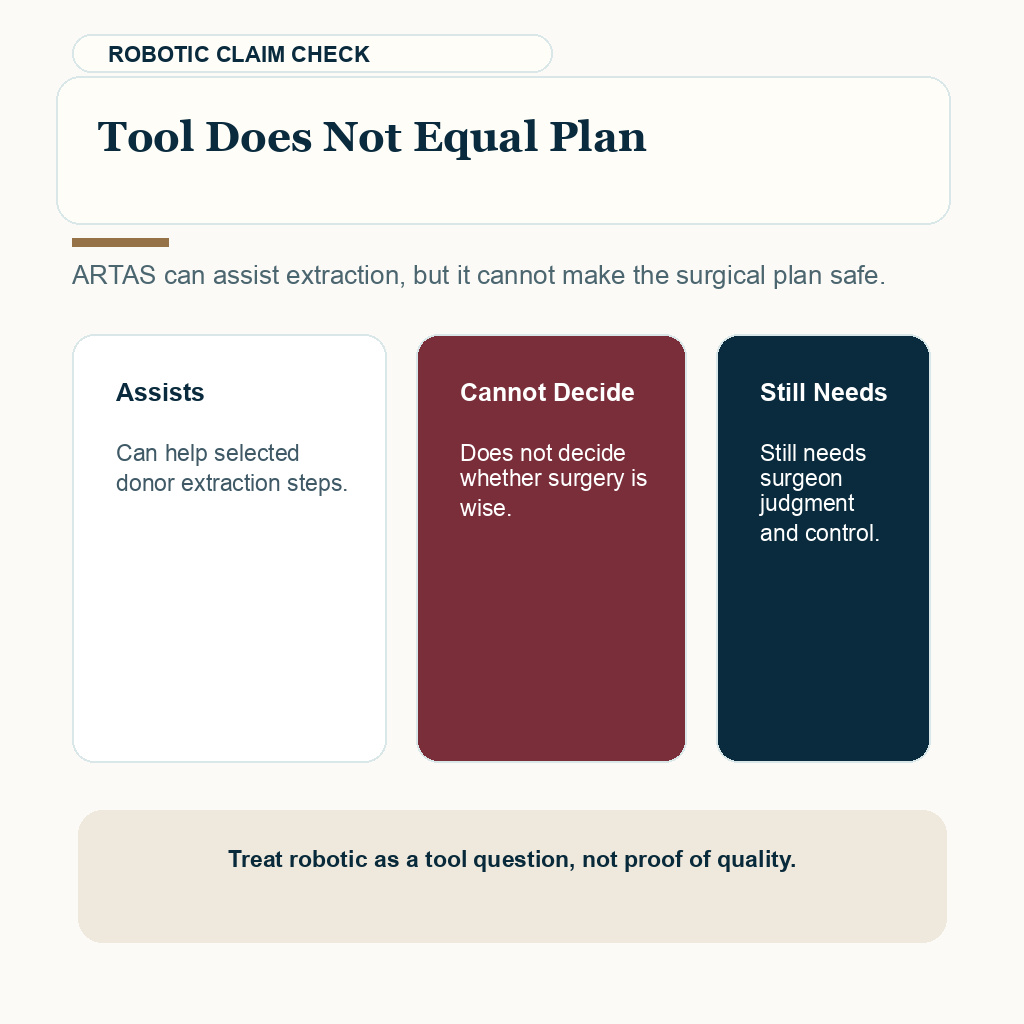
Not by itself. ARTAS can assist selected FUE steps, especially around donor extraction, but it does not make a hair transplant better just because a robot is involved. It cannot decide whether surgery is wise, how much donor hair can be spent, where the hairline should sit, how the recipient area should be planned, how grafts are handled, or how the plan should protect you ten years from now. I look at robotic FUE claims as a tool question, not as proof of a better hair transplant.
The appeal is easy to understand. A machine sounds precise. A plan on a screen can look objective too, so I do not let AI hair transplant planning or robotic claims replace a full surgical explanation. The word robotic can make surgery feel less dependent on human judgment. But a hair transplant result is not produced by extraction alone. The final appearance depends on diagnosis, donor planning, graft selection, incision angle, density distribution, hairline softness, graft hydration, recovery instructions, follow up, and the decision to say no when the donor area or expectations are wrong.
Robotic extraction assistance is not the same as a robot deciding the surgery. If a clinic uses ARTAS or another robotic system, do not stop at whether the device is modern. Ask who controls the diagnosis, plan, extraction limits, recipient area, graft handling, and follow up.
During the operation, someone should be watching graft quality, hair angle, and donor behavior as extraction continues. Robotic help with removal does not replace the decision to slow down, change technique, or stop.
A device is not the safety plan when donor pattern, scar, curl, or hair angle makes extraction unsuitable. The safest robotic plan still needs a surgeon who can slow down, switch technique, or stop extraction.
Robotic transplant claims sound convincing
Many people hear that a robotic system is more accurate, less dependent on human error, and better at selecting grafts. The claim feels attractive because the fears are real. Donor scars, poor growth, overharvesting, and unnatural hairlines are serious concerns. If a machine appears to reduce uncertainty, it can feel safer before you understand what the machine actually does.
That feeling can be useful when it encourages better measurement and documentation. It becomes risky when technology language hides the basic surgical questions. A polished device does not show whether you are a suitable candidate. It does not show whether the clinic treats one case carefully or many cases quickly. It does not show whether the donor area is being protected or used aggressively to create a large graft number.
Marketing often turns a tool into a complete answer. In hair transplantation, that is too narrow. Even if the extraction step is helped by a robotic platform, the rest of the operation still needs a clear medical plan.
Steps robotic FUE systems can assist
ARTAS was first known for assisting follicular unit extraction in the donor area. In suitable cases, it can use imaging and a robotic arm to identify and harvest follicular units from selected donor zones. Newer ARTAS platforms may also assist recipient area site creation or implantation, depending on the system, the patient, and the clinic protocol. But the important word is assist. The device is still working inside selected conditions and settings chosen by the medical team. It is not automatic case selection, and it is not an independent transplant plan.
This distinction matters. Extraction is important, but FUE has many decisions before and after extraction. The surgeon still needs to examine the donor area, select the safe zone, decide the extraction pattern or robotic settings, review hair angle and curl, monitor transection, control the total graft number, and respond when the first grafts show that the tissue behaves differently than expected. The plan also needs a stop rule. If hair angle, curl, skin response, or early transection makes the robotic harvest unsafe, the promised graft number should not be forced. A clinic should be able to explain who can reduce the number, switch technique, or stop the harvest on surgery day.
A device can support consistency inside a defined task. It cannot decide whether that task should be performed in that way for you. A strong FUE plan starts before the punch touches the skin. Device clearance tells you what the machine is allowed to assist with. It does not mean your personal surgical plan is automatically safe.

The device assists a defined task. The surgeon still controls the case plan.
Decisions ARTAS cannot make for the patient
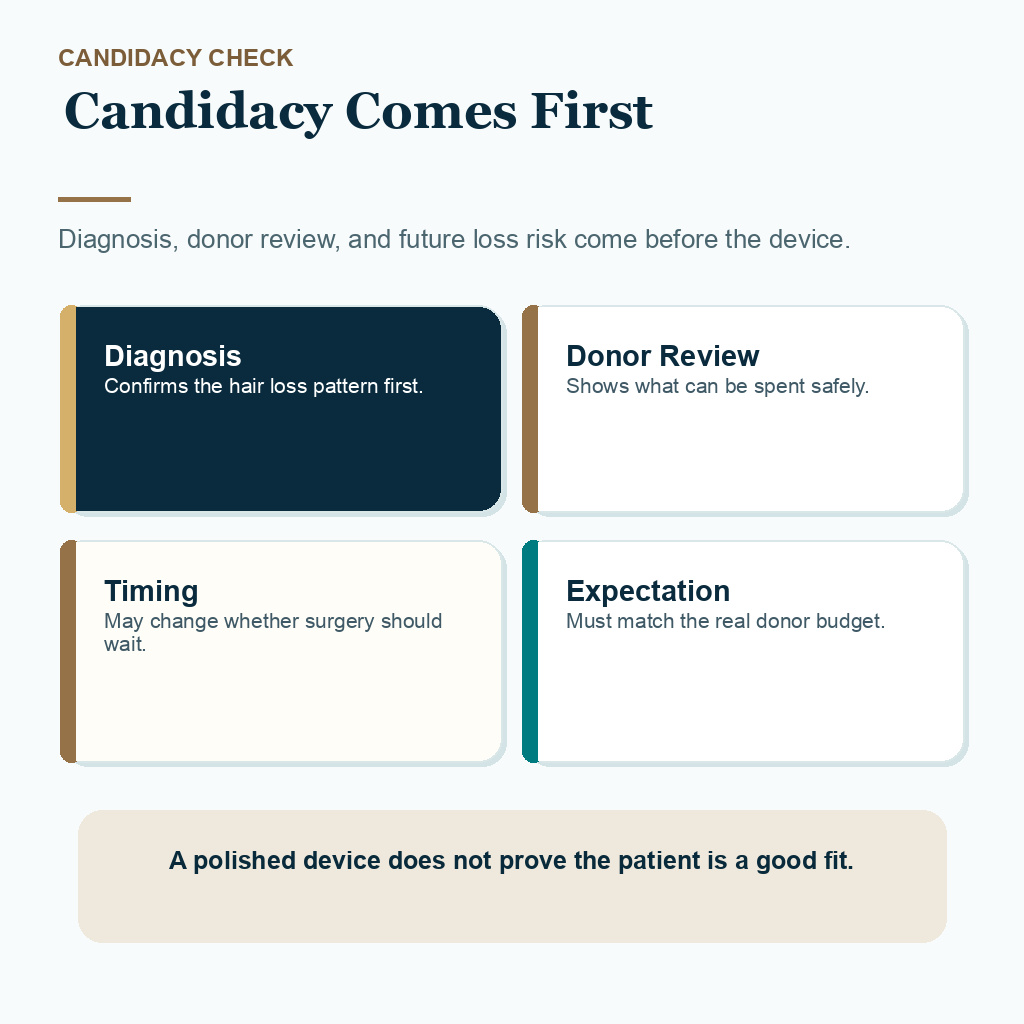
ARTAS cannot decide whether the hair loss pattern is stable enough for surgery. It cannot diagnose diffuse thinning, retrograde donor weakness, scarring alopecia, unrealistic expectations, or a medical condition that makes surgery a poor choice. It cannot decide whether delaying surgery and stabilizing hair loss first is wiser for a young man. Those decisions begin with candidacy, not with technology.
It also cannot design the final cosmetic result. The front hairline needs facial proportion, age judgment, temple recession control, irregularity, direction, graft size selection, and conservative planning. A robotic system, even when it helps with recipient area steps, does not by itself create a natural front border. If the system is used for site creation, the physician still has to decide the hairline drawing, density plan, depth, angle, and when a planned site pattern should be changed.
Candidacy, hairline design, donor budget, and recipient area planning remain human decisions. If those decisions are weak, a technically impressive extraction system cannot rescue the result.
Donor management still needs a surgeon
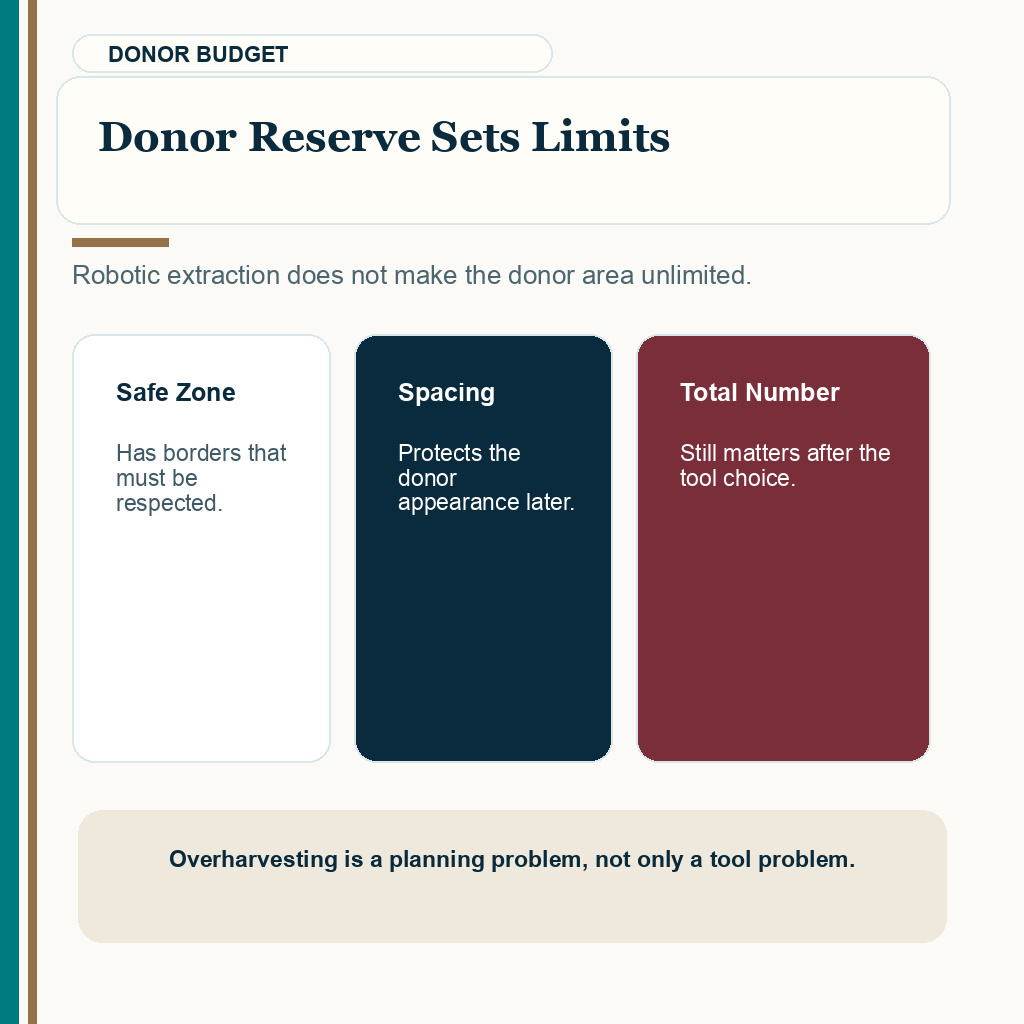
The donor area is limited. Once grafts are removed, that donor supply is spent. The hair does not grow back at the extraction points. Strong donor density, thick hair caliber, stable hair loss, and modest coverage goals create a different plan from fine hair, crown loss, weak sides, or a history that suggests future progression.
Donor planning is never only a counting exercise. It includes density, miniaturization, hair shaft caliber, contrast between hair and skin, age, likely future loss, repair risk, and how short you want to wear the sides. When technology names are compared before donor strategy, the central issue can be missed. The extraction method must serve the long term plan.
Donor area planning and FUE punch size and donor scarring matter for the same reason. A device, a punch size, and a graft number are only safe when they fit the donor area in front of us.
Use the carousel below to separate device assistance, candidacy, donor reserve, hairline design, graft handling, scar risk, poor fit cases, and the questions to ask beyond the marketing word. Move through it with the arrows, one image at a time.

A robot does not prevent donor scars or overharvesting
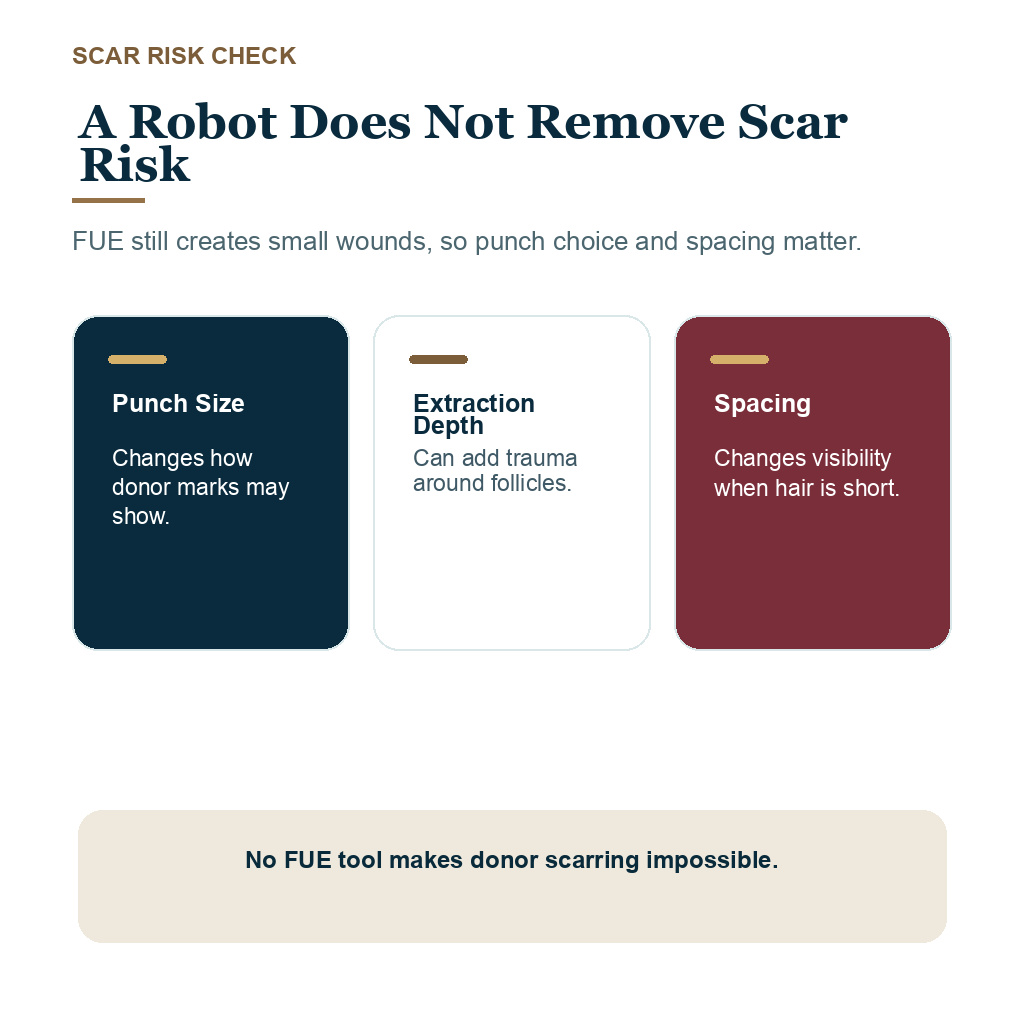
No extraction method makes FUE scarless. FUE avoids a linear strip scar, but each harvested follicular unit still creates a small wound. The visibility of those marks depends on punch size, extraction depth, spacing, skin healing, total graft number, hair length, hair caliber, and whether the extraction was spread intelligently.
A robotic system may help standardize part of the harvesting step, but it cannot make an excessive graft request safe. If too many grafts are taken, or if the extraction pattern ignores future donor needs, the result can still be visible thinning, patchy donor appearance, or fewer repair options later.
Separate the promise of a cleaner tool from the risk of an aggressive plan. Overharvesting rarely comes from one isolated punch. It comes from the total plan, the spacing, the case selection, and the clinic’s willingness to protect tomorrow’s donor supply instead of chasing today’s number. I treat donor overharvesting as a planning failure before I treat it as a device failure.
Robotic extraction does not improve graft survival by itself
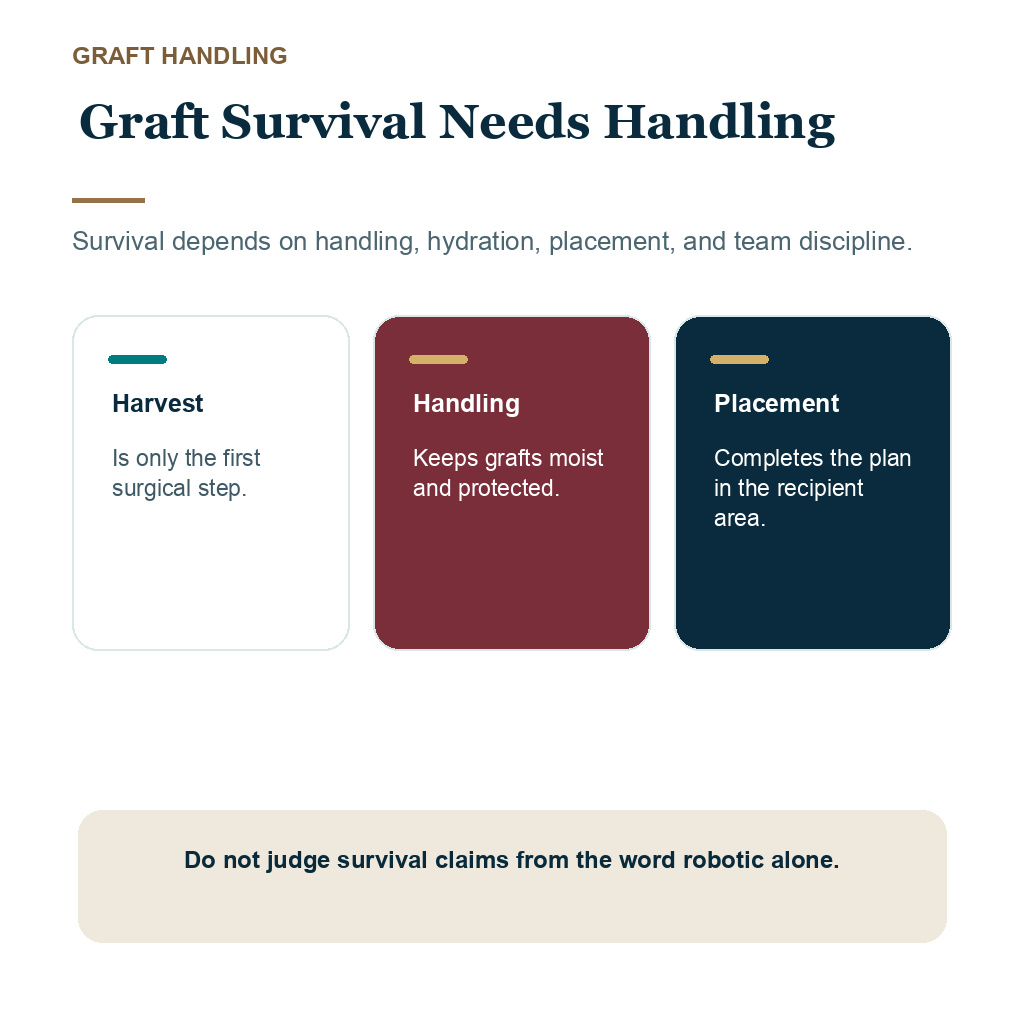
Graft survival depends on more than the extraction tool. The follicular unit must be released without excessive injury, kept moist, sorted gently, protected from heat and drying, stored for a reasonable time, and placed into the recipient area with the correct angle, direction, depth, and density. A graft can be extracted well and still be harmed later if handling or implantation is poor. The robot does not protect grafts while they are outside the body. Careful clinical handling does.
A robotic system can be useful in selected cases, but that does not mean every clinic using a robot produces better growth than every clinic using manual FUE. Technique, case selection, team training, graft handling, and surgeon control still affect the outcome. A device cannot erase weak planning or poor graft handling.
Growth is a chain of decisions, not a single machine step. A practical review asks who monitors transection, who counts usable grafts, how grafts are hydrated, who creates the recipient area, and how many patients the team is managing that day.
Who designs the hairline and recipient area?
The recipient area is where artistry and anatomy meet. The hairline must frame the face without looking drawn on. The first rows need softer graft choices and irregularity. The angle has to follow natural growth. The density must be enough to look natural without spending grafts that may be needed later.
A robotic platform does not decide these details. Even if it assists with recipient area incision creation, it does not know whether a lower hairline will age badly on a young man. It does not decide whether the temples should be conservative. It does not balance crown coverage against frontal framing. It does not decide the final direction and distribution that make the result look natural.
Any claim about robotic hair transplantation needs to be tested against hairline design and recipient area responsibility. If the clinic cannot explain who designs the hairline and who plans and controls the recipient area incisions, the technology name is not enough.
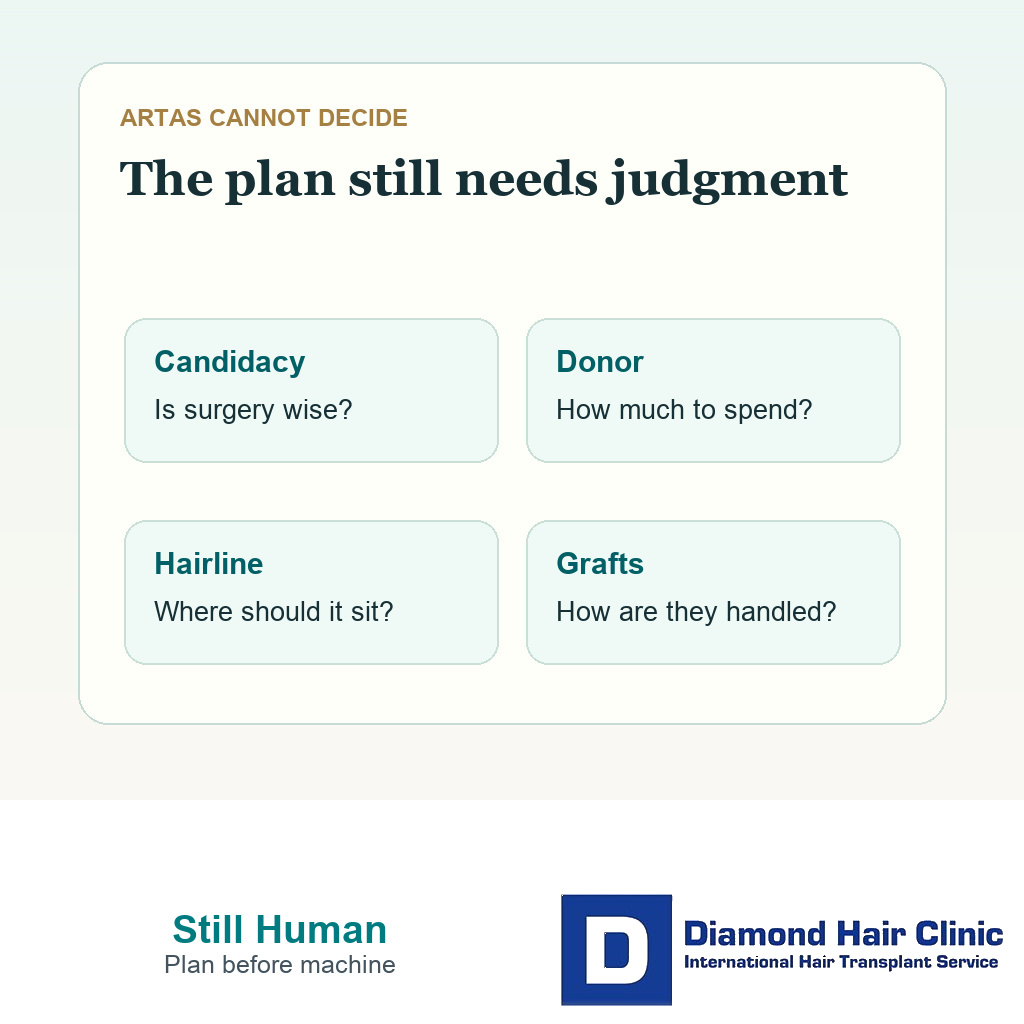
A machine does not decide candidacy, donor budget, hairline design, or graft handling.
Patients who may be poor fits for robotic FUE
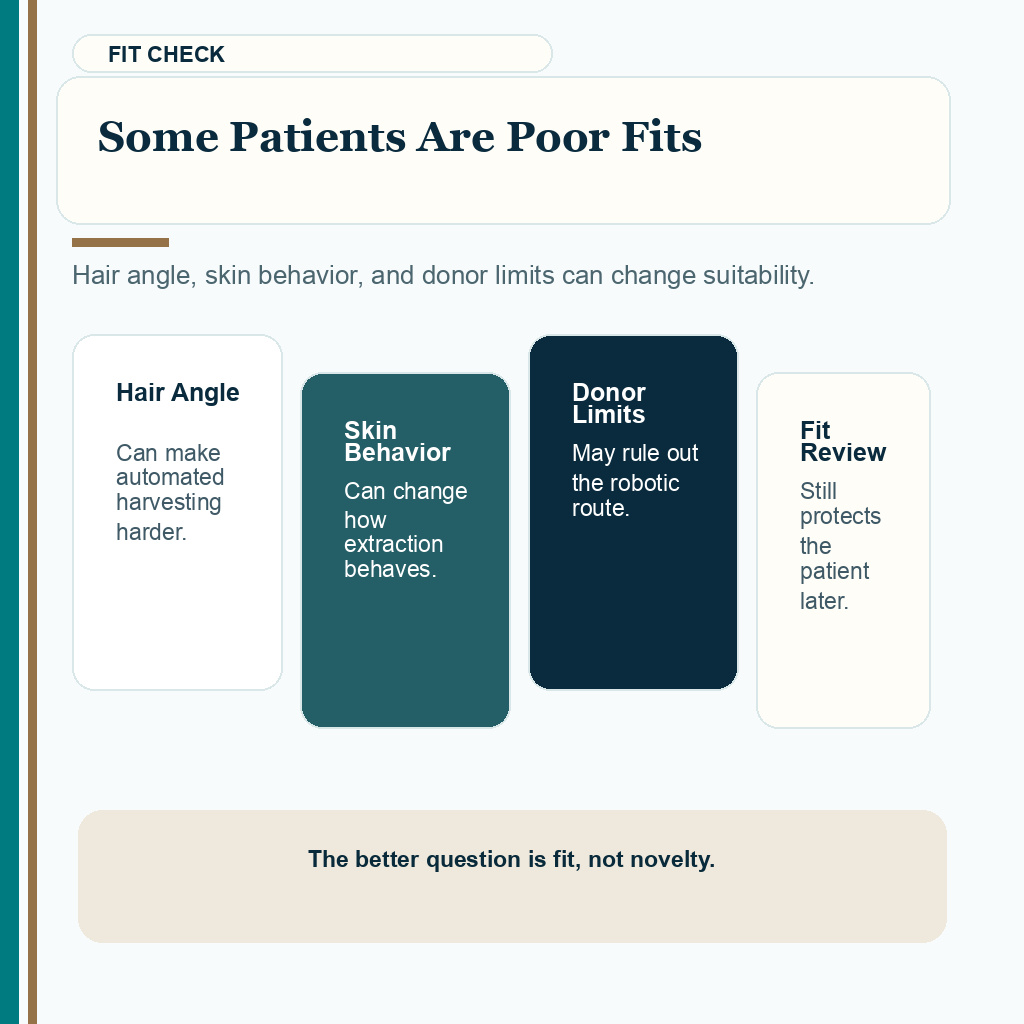
Some cases need extra caution before any FUE method, robotic or manual. A very young man with rapid progression may need medical stabilization and observation before surgery. Diffuse thinning in the donor area may mean there is no safe reserve. Scarring or inflammatory scalp disease may need diagnosis and treatment before cosmetic planning. The question is not whether the robot can harvest hair. It is whether those harvested grafts should be used at all.
Hair character also matters. Curl, graft angle, skin thickness, hair color, skin contrast, fine caliber, and previous surgery can all change extraction difficulty and the cosmetic plan. Device indications and real world performance depend on use conditions, and real scalps vary outside marketing language. If the hair or donor pattern does not fit the device well, the device should not be forced just because it is available. A narrow technology promise cannot replace examination.
If you are comparing robotic FUE, you need a candidacy explanation, not only a device explanation. The clinic should be able to say why surgery is suitable, why the donor area can support the plan, and what would make the plan change after an in person exam. A hair transplant plan from photos can begin the conversation, but it should not lock the final surgical decision. A stronger explanation names where a method is weaker as well as where it helps.
Decision points before choosing a robotic clinic
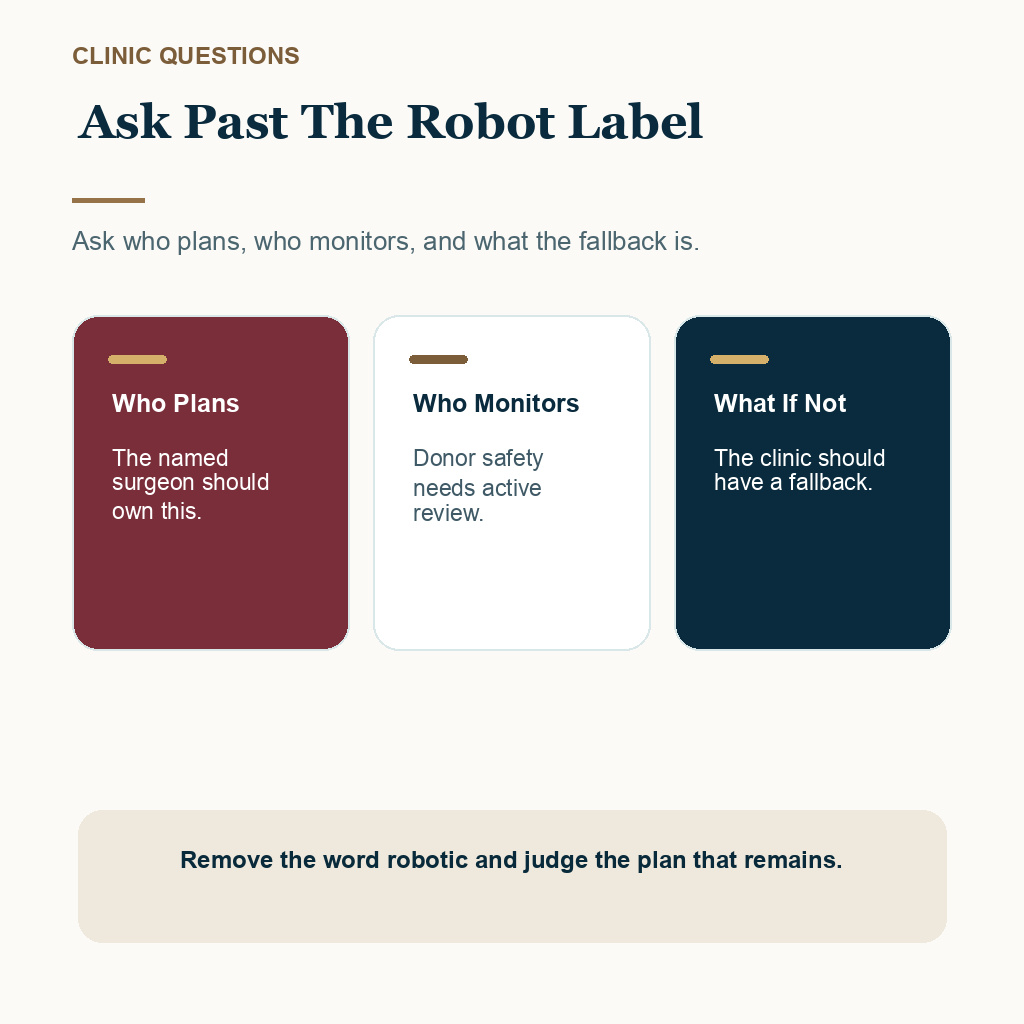
Before choosing a robotic clinic, the donor examination, extraction limits, system supervision, and transection checks should be clear. The clinic should also explain the stop rule if hair angle, curl, skin response, or transection makes the robotic harvest unsafe. The same conversation should cover hairline design, recipient area incisions, graft hydration and placement, and the backup plan if the donor assessment changes on surgery day.
These questions are not hostile. They are normal medical questions. If the clinic can answer clearly, the technology can be discussed clearly. If the clinic becomes vague and keeps returning to the robot as the main proof, I slow down.
Surgeon involvement and who performs your hair transplant surgery matter here because tools can change, but responsibility must remain clear.
Technology versus marketing
Technology is useful when it improves a defined surgical step inside a controlled plan. It is marketing when it becomes a substitute for explaining the plan. A clinic can use a modern device and still plan poorly. Another clinic can use manual FUE carefully and achieve a stronger result because the diagnosis, donor protection, hairline design, recipient area, graft handling, and follow up are better controlled. The device name should never be allowed to replace the surgical explanation.
That does not mean technology is bad. I am not against useful tools. I am against using tools to distract you from the decisions that shape the result. The device should be one part of the conversation, not the whole conversation.
Modern equipment is useful only when the medical plan is already sound. A clinic that sells certainty through a robot, a guarantee, a maximum graft package, or a perfect gallery should still explain the details behind the promise. A hair transplant guarantee and before and after examples from patients with hair like yours deserve the same scrutiny.
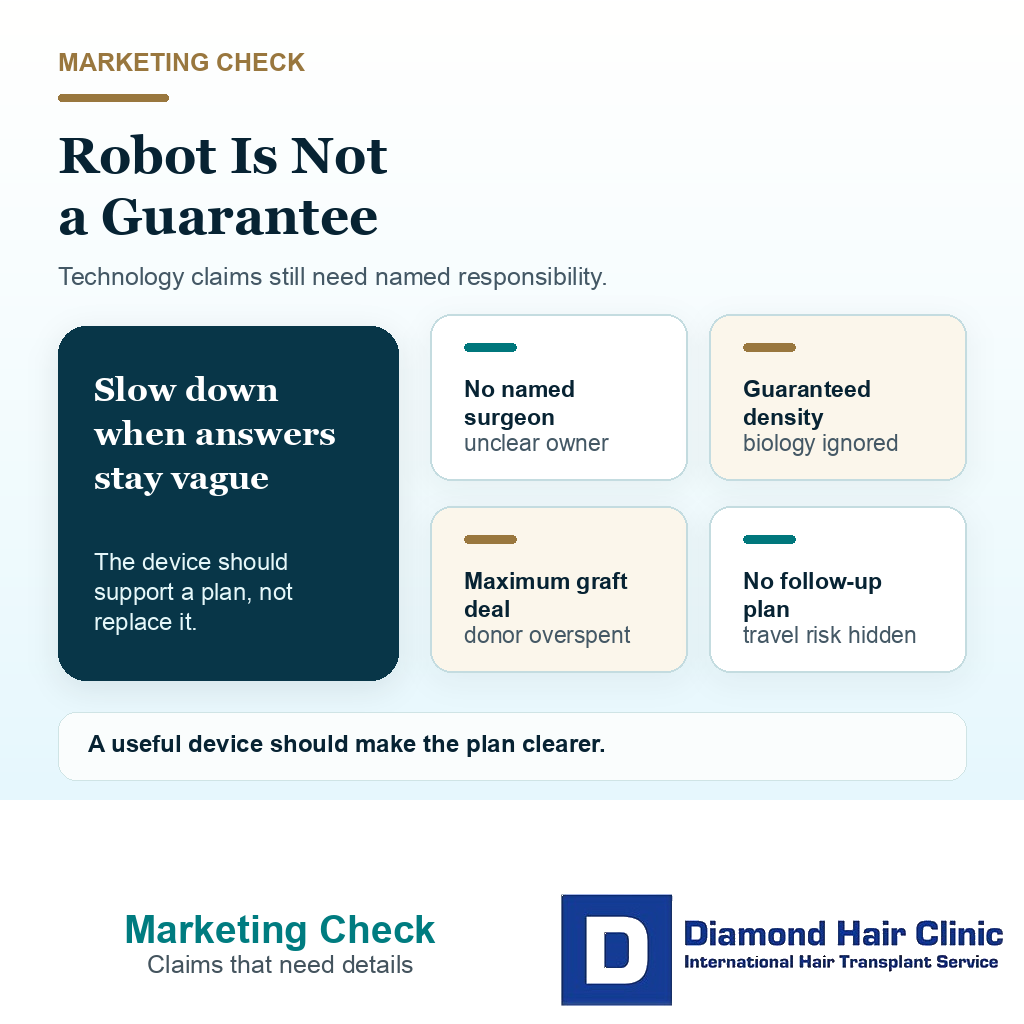
A robotic hair transplant claim should not replace clear answers about the responsible surgeon, density promises, donor limits, and follow up.
Comparing robotic FUE with surgeon led manual FUE
Motorized FUE is not the same as robotic FUE. With a handheld motorized punch, the clinician guides the instrument by hand while the motor turns or oscillates the punch. That differs from a robotic arm assisting the cutting step, so ‘automatic’ alone does not tell you which method is being offered.
Do not compare the machine name with a technique name alone. Compare the full surgical system. The person accepting or refusing the case, setting the donor budget, measuring miniaturization, choosing punch size or robotic settings, controlling the hairline, planning recipient area incisions, protecting grafts outside the body, and following the patient after travel all matter. Also compare long term results in patients with similar hair caliber, curl, skin contrast, donor density, and hair loss pattern, not only the device demonstration.
If a robotic clinic answers those questions well, the device may be a reasonable part of the plan. If a manual FUE clinic answers those questions better, the manual method may be the stronger choice for that case. The comparison is not robot versus hand in isolation. It is complete surgical judgment versus incomplete surgical judgment.
If you are choosing Turkey, separate travel convenience from surgical quality. A package can be organized, a hotel can be comfortable, and a device can look advanced while the real medical responsibility remains unclear. A careful clinic selection process in Turkey should still begin with the person responsible for the operation.
The machine is only one part of the room
I judge ARTAS or any robotic system inside the full surgical setup. The question is not whether a clinic owns technology. The question is whether the clinic can still explain donor limits, hairline design, graft handling, surgeon responsibility, and when the day has to be adjusted.
A device can support careful surgery in the right hands. It can also become a sales headline that hides weak planning. The difference is visible when the clinic describes who examines you, who makes the medical decisions, and how graft quality is protected.
If the explanation becomes vague once the robot is no longer the headline, the patient has not been given enough information. Technology should make the surgical logic easier to inspect, not harder.

Read this review excerpt
Every single one of my questions was answered and they made sure I had all the details I needed to make an informed decision.