


Hair Transplant Glossary for Patient Planning
A useful hair transplant glossary should explain the words that can change your decision, not only the words that sound technical. When patients understand terms such as graft, donor area, density, shock loss, and safe donor zone, they can ask better questions and avoid being impressed by numbers that may not protect their long term result.
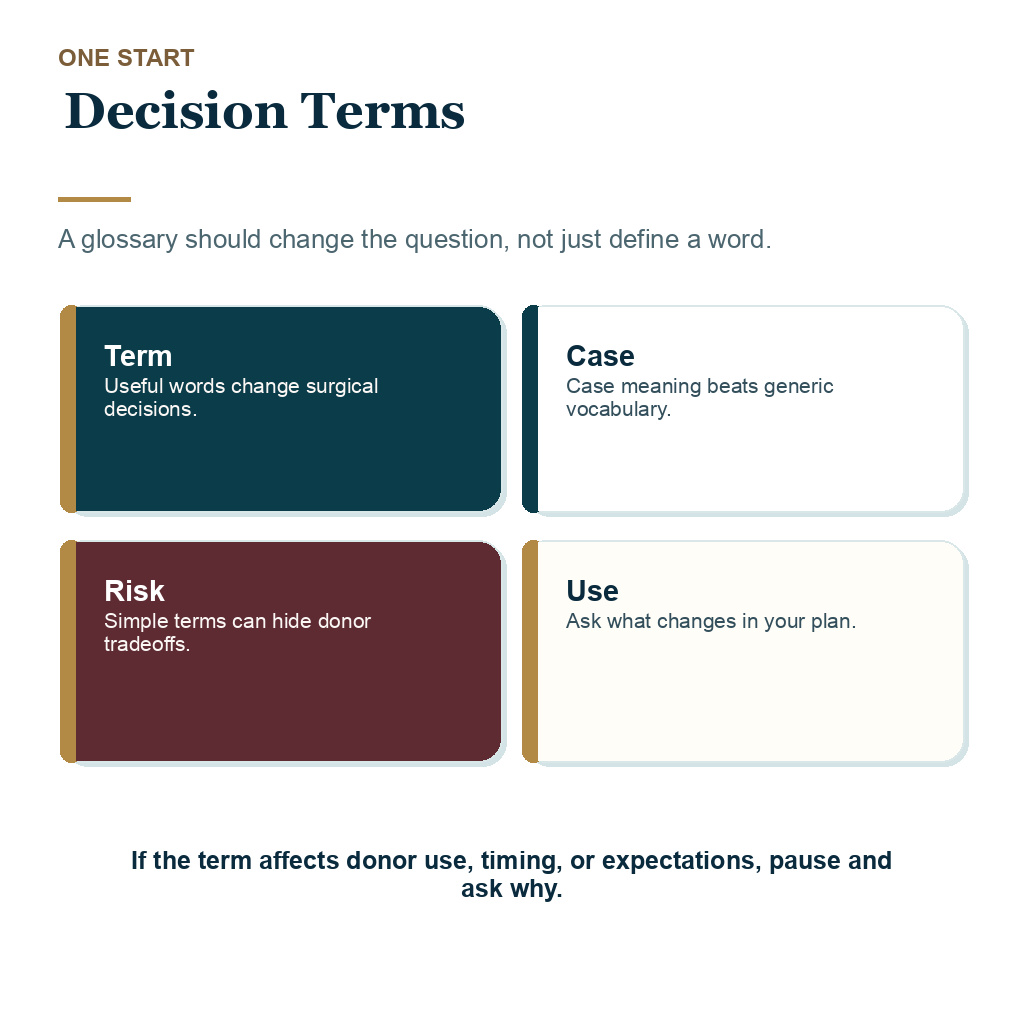
I wrote this glossary the way I explain these words during consultation. Some terms are straightforward, some are misused, and some become dangerous when a clinic uses them to make surgery sound easier than it really is. If a word does not change the plan, it is just vocabulary. If it changes donor use, timing, safety, or expectations, it deserves attention.
When a term is connected to a decision, the definition should say so plainly. A definition alone is not enough in hair restoration. The same word can be harmless in one patient and very serious in another, depending on donor capacity, age, miniaturization, hair caliber, previous surgery, and the way the surgical plan is made.
A quote should state whether the number is grafts, hairs, or follicular units. If groups with more than one hair are counted as hairs, the plan can sound larger than the surgery really is. The same unit should appear in the consultation and the invoice. A switch between grafts, hairs, or sessions changes the meaning of the number and should be corrected in writing.
Why terms confuse patients before surgery?
Hair transplant language can confuse patients because many terms are used casually online, commercially in clinic advertising, and medically during consultation. A patient may hear the same word from three different places and receive three different impressions. In consultation, I slow the conversation down and explain the meaning in plain language.
The most dangerous misunderstanding is when a patient thinks a term is only descriptive, while I see it as a planning warning. For example, the word donor area sounds harmless. In reality, the donor area is a limited lifetime resource. If it is used carelessly, the problem may not appear immediately, but it can limit every future correction.
Another common problem is that patients often compare words without comparing cases. One person says 3,000 grafts was enough. Another says 5,000 grafts was needed. Without understanding donor strength, hair thickness, baldness pattern, crown demand, and the size of the recipient area, those numbers can mislead you.
Use this glossary together with a proper assessment. It can help you understand the language. It cannot replace examination, scalp photography, donor evaluation, and a surgeon who is willing to say no when surgery is technically possible but strategically unwise.
If you are still deciding whether you are a good candidate for a hair transplant, do not only collect definitions. Use those definitions to clarify your own hair loss pattern. A term becomes useful only when it changes the quality of your decision.
The words used in consultation should make the plan easier to understand, not more impressive. If a clinic uses complicated language to avoid clear answers, that is not education. That is often confusion dressed as expertise.
Basic hair loss terms to understand first
Alopecia means hair loss. It is a broad word, not a diagnosis by itself. When I hear alopecia, I still need the type of hair loss, how long it has been progressing, and whether the scalp shows signs of inflammation or scarring.
Androgenetic alopecia means pattern hair loss. In men, it often affects the temples, hairline, mid scalp, and crown. In women, it may appear as diffuse thinning. This diagnosis matters because a transplant can move hair, but it does not stop the surrounding native hair from miniaturizing over time.
Miniaturization means that hair shafts become thinner, weaker, and shorter under the influence of progressive hair loss. It is one of the words I listen for carefully in consultation. A patient may still see hair in the mirror, but if much of that hair is miniaturized, the surgical plan must be more cautious.
Native hair means the hair you still have before surgery. It may be strong, weak, miniaturized, or unstable. I always think about native hair before I think about transplanted hair, because a result can look good at first and then look thinner later if native hair continues to disappear around it.
Donor hair means the hair that can be moved from the back and sides of the scalp, and in selected repair cases from beard or body areas. Donor hair is valuable because it is usually more resistant to pattern hair loss. It is not unlimited, and it should not be treated like an endless supply.
Recipient area means the area where grafts are placed. This may be the hairline, frontal zone, mid scalp, crown, beard, eyebrow, or a scar. I use recipient area because it sounds clear and patient friendly. It also reminds the patient that the area must be planned, not simply filled.
Norwood scale is a classification used to describe male pattern hair loss. It can help communication, but it should not control the whole plan. Two patients with the same Norwood level may need completely different strategies because their donor capacity, age, hair thickness, and expectations are not the same.
Ludwig scale is often used to describe female pattern thinning. In female patients, I am especially careful before surgery because diffuse thinning can make donor selection and long term predictability more complex.
Diffuse thinning means thinning across a broader area instead of a sharply receded hairline. Diffuse thinning can be difficult because transplanted hairs may need to be placed among existing hairs. This increases the importance of careful incision making and realistic expectations.
Stabilization means that hair loss has become more predictable or better controlled. It does not always mean hair loss has completely stopped. Often, it is better to see whether medication, time, and observation can stabilize the pattern before committing too much donor hair too early.
Progressive hair loss means hair loss that is continuing. It matters because a transplant designed only for today may look unnatural later. Long term planning is not a luxury in hair restoration. It is part of responsible surgery.
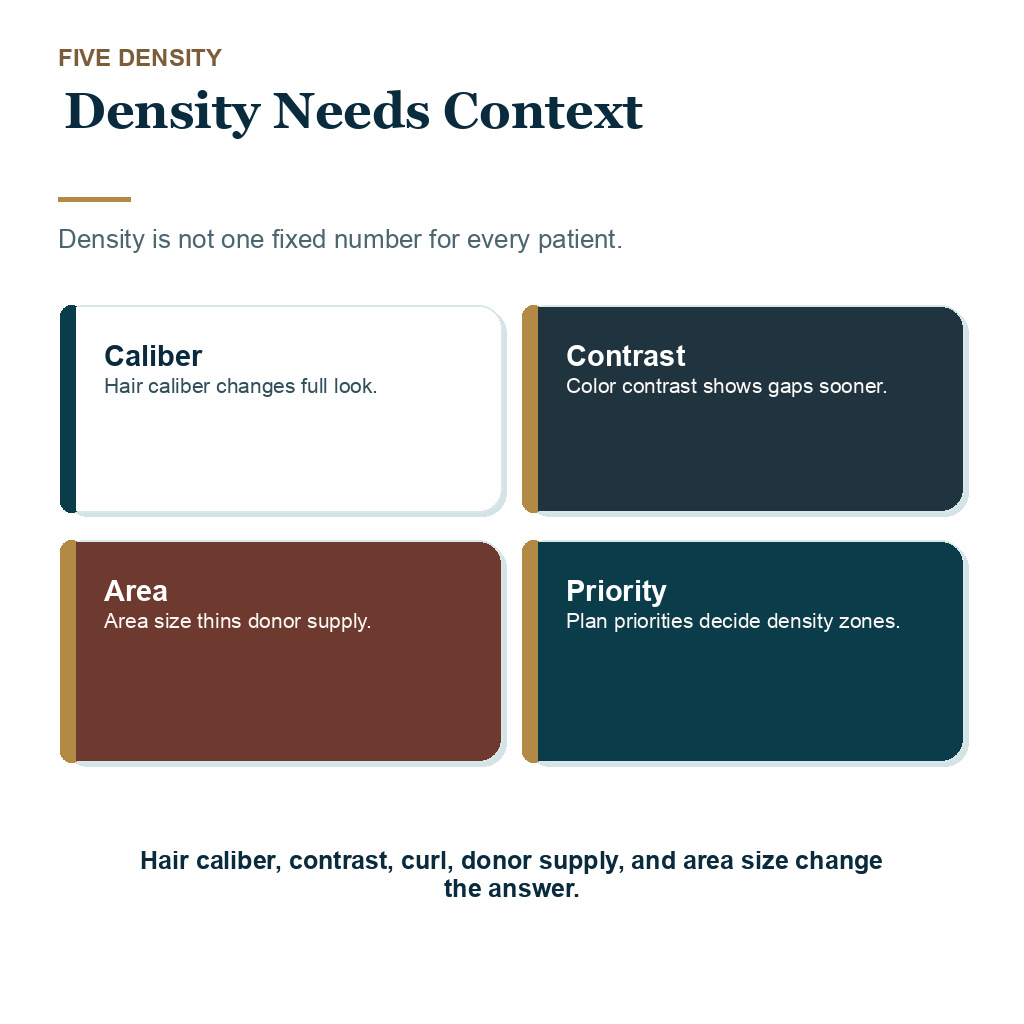
Hair caliber means the thickness of each individual hair shaft. Thick caliber hair can create more visual coverage than fine hair with the same number of grafts. Graft numbers alone do not tell the full story.
Hair to scalp contrast means the color difference between your hair and your scalp. Dark hair on pale skin often reveals thinning more easily. Lower contrast can make a result look fuller even when the graft count is the same.
Coverage value is the practical visual value created by your hair type, curl, caliber, density, and styling. I use this idea often during planning because two patients can receive the same graft number and still look very different.
Terminal hair means thicker, mature hair that gives real visual coverage. Vellus hair means very fine, soft hair with little cosmetic strength. This distinction matters because a patient may see hair on the scalp and assume the area is strong, while I may see many miniaturized or vellus hairs that cannot safely support an aggressive transplant plan.
Surgical planning terms that matter before a transplant
Surgical plan means the full strategy for how donor hair will be used, where grafts will be placed, what should be prioritized, and what should be saved for the future. A surgical plan is not the same as a graft quote. A quote tells you a number. A plan tells you why that number is safe or unsafe.
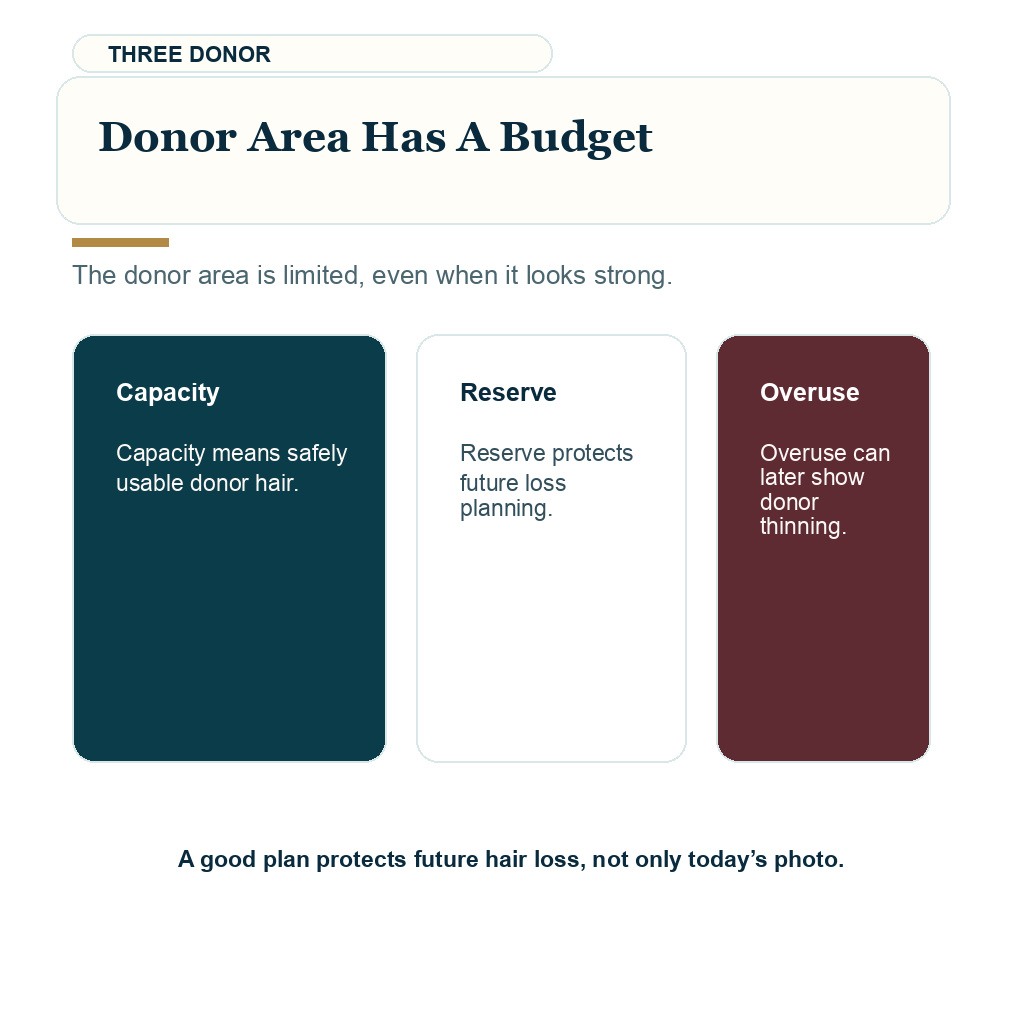
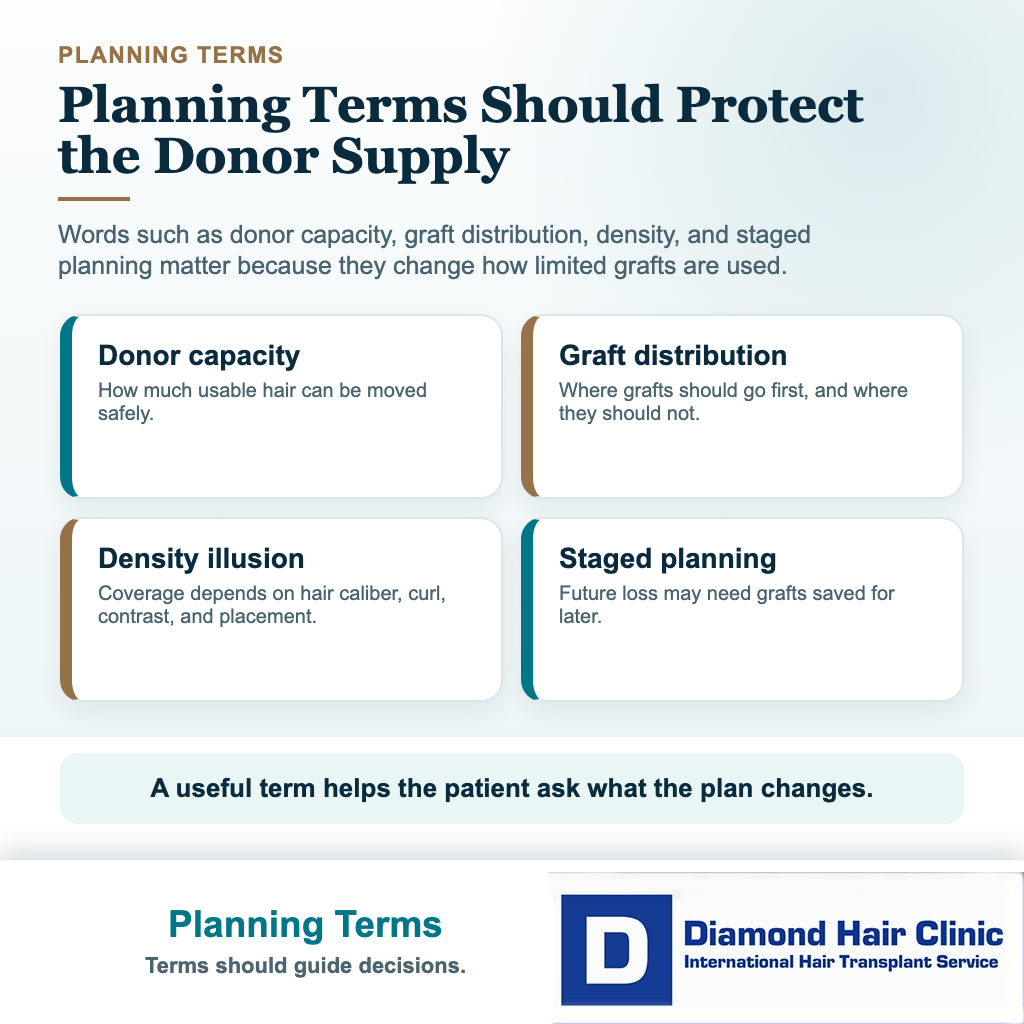
Donor capacity means how much usable donor hair can be taken over a lifetime without creating visible thinning or limiting future options. I sometimes call this the donor reserve because it helps patients understand the seriousness of the decision. Every graft used today changes what remains available for the patient’s future.
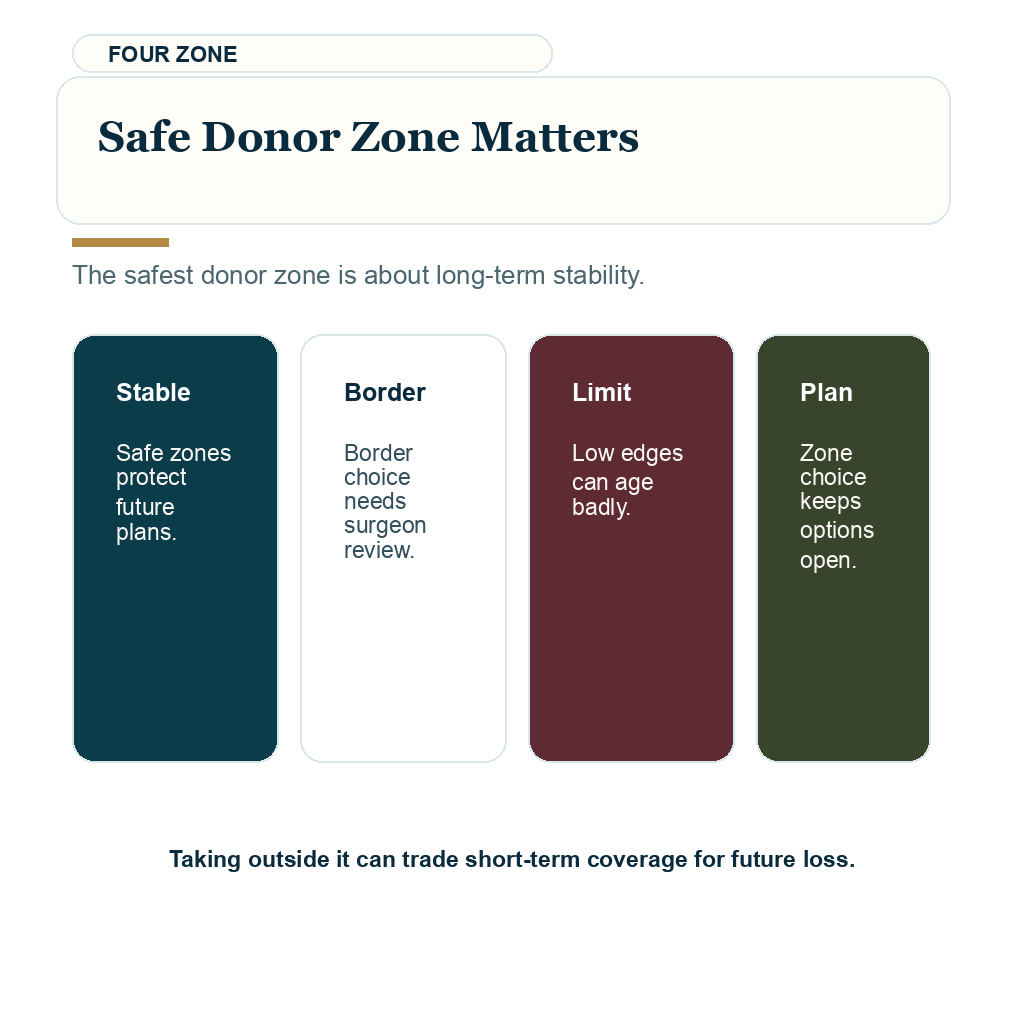
Safe donor zone means the part of the donor area that is expected to remain more stable over time. This is not a perfect guarantee. The safer zone depends on the patient, family history, hair loss pattern, and donor quality. Taking grafts too far outside this area can create future thinning in transplanted hairs.
Donor management means protecting the donor area while still creating the best possible result. The principle is patient protective. Winning the first surgery while damaging future options is not a success.
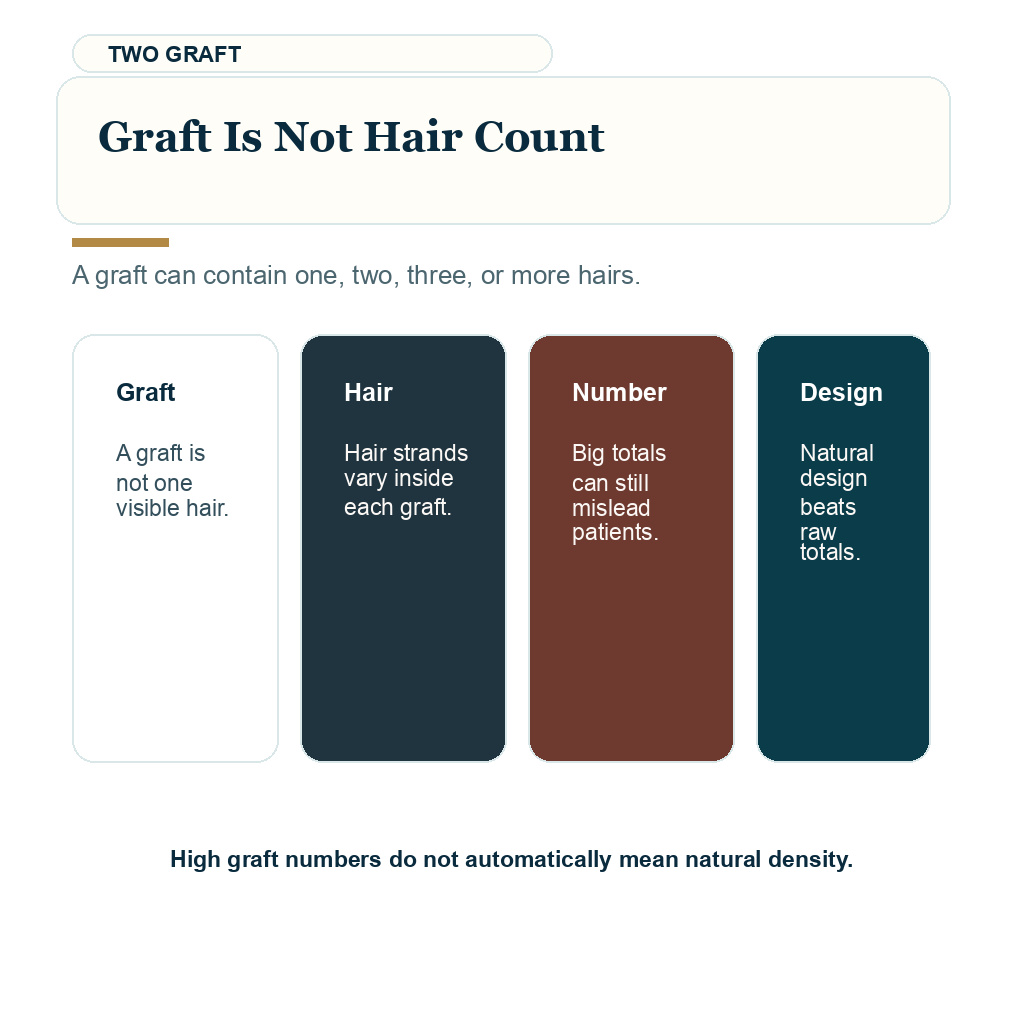
Graft number means the number of follicular unit grafts planned or transplanted. It is one of the most misunderstood terms in hair restoration. A high number may sound impressive, but if it is not matched to donor capacity, recipient area size, and future loss, it can be a weak plan.
Hair count means the number of hairs inside the grafts. One graft may contain one, two, three, or sometimes more hairs. A patient who receives 3,000 grafts with many two- and three hair grafts may have more coverage potential than a patient with the same graft number made mostly of single hair grafts.
Graft distribution means where the grafts are placed and how many are used in each zone. Surgical judgment matters here. Hairline, frontal zone, mid scalp, crown, and future reserve should not compete blindly for grafts. The priority should match the patient’s face, age, donor reserve, and long term pattern.
Density means how close the hairs appear or how much coverage the patient sees. In surgery, density is not only about putting grafts close together. It also depends on blood supply, graft size, hair angle, existing hair, and the need to protect the donor supply. High density can still look weak if the grafts are pushed beyond what the tissue can support, which is why some hair transplant results look thin even after a large operation.
Visual density means the impression of fullness, not the original natural density of the scalp. A transplant usually creates the appearance of coverage by using angle, direction, hair caliber, graft placement, and contrast wisely. In harsh light, a result can still look thin if the plan promises more density than the donor area can safely provide.
See through density means the scalp is still visible in certain lighting or styling conditions after growth. It does not always mean the transplant failed. Sometimes it means the graft supply was limited, the hair caliber was fine, the crown was wide, or the patient expected original teenage density from a limited donor reserve.
Dense packing means placing grafts close together in a planned area. It can be useful in selected cases, especially the frontal zone, but it should not be treated as a universal goal. Dense packing in the wrong patient can waste grafts, increase trauma, or create a result that cannot be maintained later.
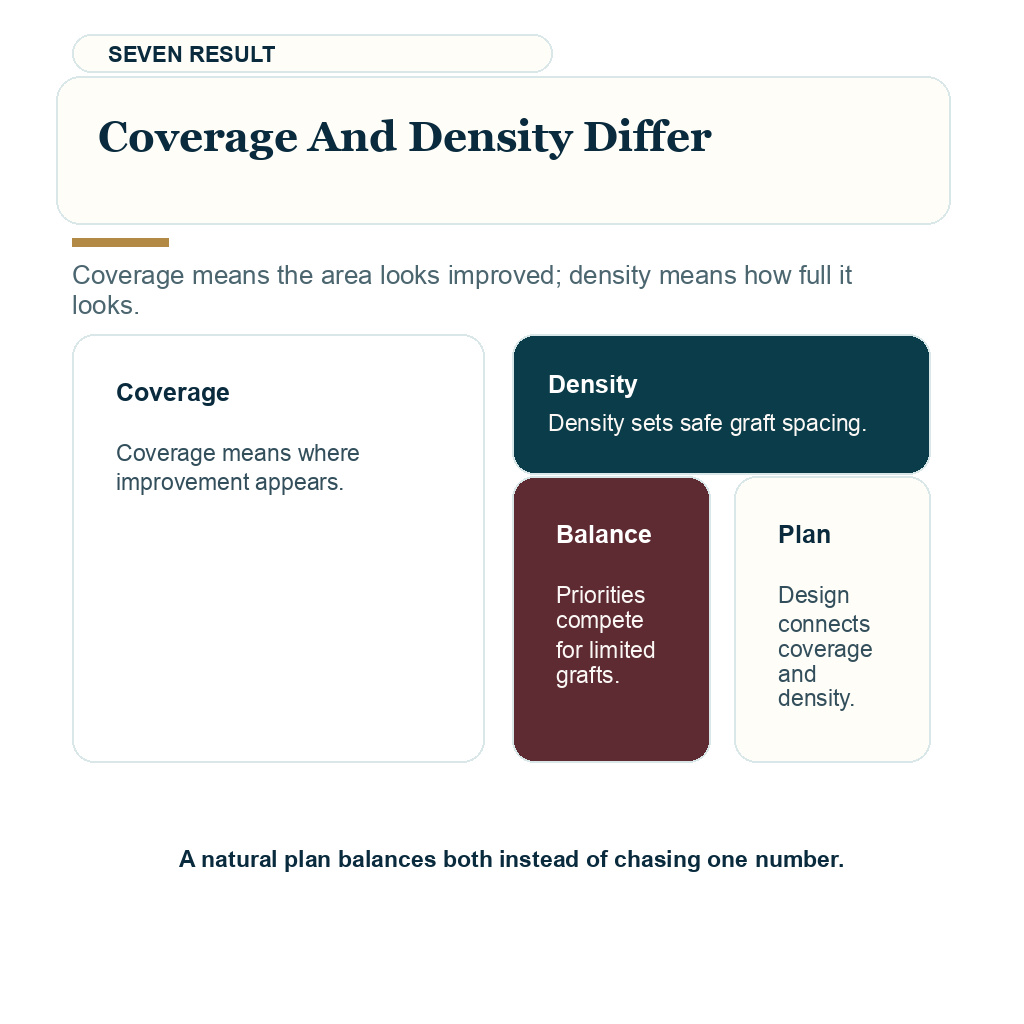
Coverage means how much area is addressed. It is different from density. A patient may choose broader coverage with lower density or a smaller area with stronger visual density. This trade off is very common in advanced hair loss, and it needs review before surgery.
Priority zone means the area that matters most for the patient’s appearance and should receive first attention. For many patients, this is the frontal hairline and frontal third. For others, crown visibility or mid scalp thinning may be the main concern. A good plan does not treat every area equally if the donor reserve cannot support it.
Session planning means deciding whether one surgery is enough or whether a staged approach is safer. Planning should avoid trying to solve every problem at once when the donor area, crown demand, or age makes that unrealistic.
Long term planning means thinking beyond the first year result. At this point, many poor decisions happen. A low aggressive hairline may look exciting in the beginning but become difficult to support if the patient loses more hair behind it.
Graft number calculation should consider hair loss area, hairline design, donor strength, hair caliber, and future loss, because simple marketing numbers often mislead patients at this stage.
These 8 slides explain the glossary terms that most often change a hair transplant plan. Swipe sideways, use the arrows, or choose a number below the image.

Graft and donor area terms
Graft means a small naturally grouped unit of hair follicles that is moved from the donor area to the recipient area. A graft is not always one hair. This is the first distinction patients need to understand when comparing numbers.
Follicular unit means a natural group of one or more hairs that grow together. Modern hair transplantation is built around respecting these natural units. When follicular units are handled well, the result can look more natural because the hair is placed in patterns that match normal scalp growth.
Single hair graft means a graft with one hair. These grafts belong in the front hairline because they help create softness. If thicker multi hair grafts are placed too far forward, the hairline can look harsh or pluggy.
Multi hair graft means a graft that contains two, three, or more hairs. These grafts are useful behind the hairline where more visual density is needed. The strongest grafts should not be wasted in the wrong place. Placement matters as much as counting.
Transection means damage to a follicle during extraction or preparation. This is a technical term, but it has a very practical meaning. If grafts are damaged before they are implanted, the final result can suffer even if the written graft number looks attractive.
Graft survival means how many implanted follicles keep living and later grow after surgery. It should not be used as a sales percentage. Survival depends on extraction quality, graft handling, time outside the body, recipient area creation, bleeding control, aftercare, and biology. If a clinic talks about growth guarantees before explaining these details, that is a reason to slow down.
Overharvesting means too many grafts are removed from the donor area, or they are removed in a poorly distributed pattern. It can create visible thinning, patchiness, or a moth eaten appearance. This can be very difficult to repair because the donor area has already been depleted.
Donor depletion means the donor supply has been used too aggressively or inefficiently. A depleted donor area may still have some hair, but not enough safe usable reserve to solve the patient’s remaining cosmetic problem. A patient can avoid many repair problems when donor area overharvesting is prevented from the first operation. Donor hair is a lifetime budget, not a single operation resource.
Extraction pattern means how grafts are removed across the donor area. Even distribution matters. Removing too many grafts from one concentrated zone can create a visible patch even if the total graft number does not sound extreme.
Punch size refers to the size of the circular instrument used in FUE harvesting. Smaller is not always better. The punch must match the hair type, skin, follicle angle, and surgeon’s control. A tool is only as good as the judgment behind it.
Hypopigmented dots are tiny light marks that may remain after FUE extraction. In many patients they are not visible at normal hair lengths, but they can matter if the patient wants to shave very short. The shaving question needs review before surgery, not after regret appears.
Linear scar is the scar associated with FUT strip surgery. It can be acceptable in carefully chosen patients who wear longer hair, but it is not ideal for every lifestyle. Scar planning should always consider the patient’s future haircut preferences.
Beard grafts are grafts taken from the beard area, usually for repair or advanced cases. They can add coverage, but they do not behave exactly like scalp hair. I use them selectively because texture, growth, and visual blending matter.
Body hair grafts are grafts taken from areas such as chest hair in selected cases. They can help in repair or advanced donor depletion, but they are not a simple replacement for scalp donor hair. A clinic that presents body hair as an unlimited rescue option is oversimplifying the problem.
Donor shock loss means temporary shedding or thinning in the donor region after surgery. It can happen, but it must be separated from true overharvesting. Temporary shedding may recover, while aggressive donor damage may not.
Donor shock loss and overharvesting are not the same thing. Donor shock loss is usually temporary shedding after surgical stress. Overharvesting means the donor area has been structurally thinned too much or extracted in a poor pattern. Patients often confuse these two problems during early recovery, but the long term meaning can be very different.
A weak donor area means the supply is already limited before surgery. This may be due to low density, fine caliber hair, retrograde thinning, diffuse thinning, previous surgery, or aggressive prior extraction. In this situation, the safer approach is often smaller, staged, and more selective.
A graft is not only a number. It is living tissue, taken from a limited area, handled under time pressure, and placed into a plan that must still make sense years later.
FUE, FUT, DHI, and Sapphire FUE terms
FUE is often explained as follicular unit extraction. More accurately, many surgeons now use follicular unit excision because the graft is surgically incised and then removed. That distinction matters because FUE is not a simple pulling technique. It is surgery.
Individual trim FUE is an unshaven donor approach in which only the follicular units selected for extraction are shortened before excision, while the surrounding donor hair stays long. It is not the same as long hair FUE, where the graft hair shafts remain long through extraction and implantation. A clear plan names what will be shaved or trimmed in both the donor and recipient areas. My no shave FUE planning guide explains why that distinction affects visibility and case selection.
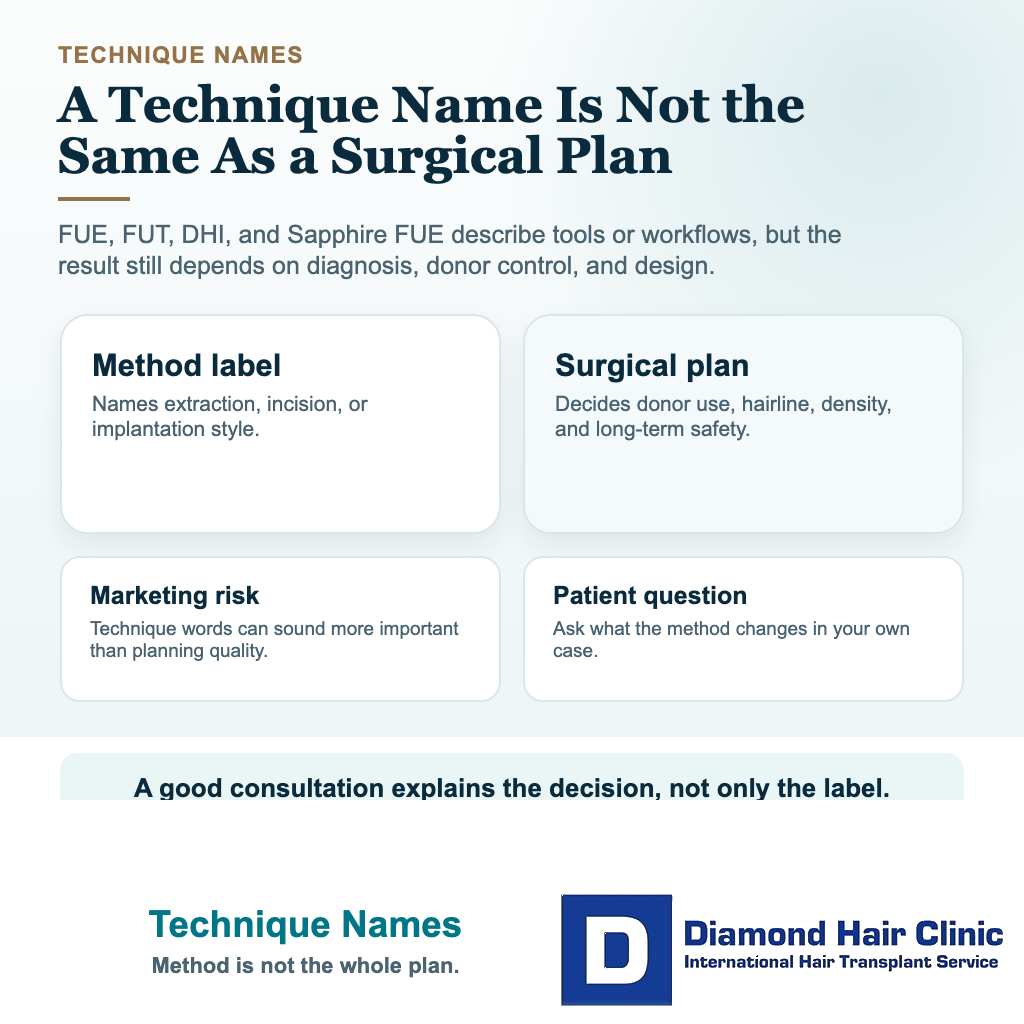
A proper FUE hair transplant depends on donor selection, extraction angle, punch control, graft handling, and recipient area planning. The word FUE does not guarantee quality by itself. It only tells you the harvesting method.
FUT means follicular unit transplantation through strip surgery. A strip of donor tissue is removed and dissected into follicular units. FUT can still have a role in selected cases, but it leaves a linear scar. Patients should not compare FUE and FUT only by popularity. They should compare them by donor strategy, scarring, lifestyle, and future needs.
If you are comparing methods, FUT hair transplant deserves a separate discussion. Strip surgery is not simply outdated, but it is also not the right choice for many patients who want short hairstyles.
DHI means direct hair implantation. In most patient conversations, it refers to using an implanter pen to place grafts. It does not remove the need for good graft extraction, hairline design, or surgical planning. A DHI label should not distract you from who makes the plan and who performs the critical steps.
The DHI and FUE comparison is useful only when patients understand that these names describe tools and sequences, not a guarantee of a better result. Poor planning with a modern tool is still poor planning.
Sapphire FUE usually refers to using sapphire blades during recipient area incision making. I use sapphire blades because they can be precise in the right hands, but patients should not think the blade creates the result alone. The surgeon’s angle, direction, density planning, and donor management remain central.
My explanation of Sapphire FUE goes deeper into this point. The tool matters, but the tool cannot replace judgment. A skilled surgeon can use a tool well. A weak plan can make any tool look impressive in advertising and disappointing in reality.
Incisions are the tiny openings made in the recipient area where grafts will be placed. Incision angle and direction affect naturalness. I place great importance on the surgeon creating the recipient area incisions.
Implantation means placing grafts into the recipient area. It must be gentle, organized, and consistent with the direction of surrounding hair. The team matters here, but the plan and supervision matter too.
Recipient area creation is one of the most artistic and technical steps. It controls angle, direction, density distribution, and the way the final result frames the face. A patient may not see this step clearly, but they will live with its consequences every day.
Technique shopping is when a patient chooses a clinic mainly because of a method name. I understand why this happens. Marketing makes method names sound like brands. The clinical issue is who is designing, extracting, making incisions, and protecting the donor area.
Recipient area and hairline design terms
Hairline design means planning the shape, height, irregularity, and age appropriate appearance of the frontal hairline. This is not only drawing a line. It is a facial framing decision that must still look natural as the patient ages.
Natural hairline design should respect the patient’s face, donor capacity, age, future hair loss risk, and native hair pattern, because an aggressive hairline can be one of the most expensive mistakes to repair later.
Temporal points are the side corner areas that help frame the face. They are difficult to design well because the hair angle, direction, and density must be very precise. Overbuilding the temples in a young patient can look unnatural if the rest of the hair loss progresses.
Frontal third means the front part of the scalp behind the hairline. It often gives the strongest cosmetic improvement because it affects the face most directly. For some patients, I prioritize the frontal third before chasing full crown coverage.
Mid scalp means the area between the frontal region and the crown. It can act like a bridge. If it is ignored in the wrong patient, the result may show a gap later as native hair continues to thin.
Crown means the swirl area at the back top of the scalp. Crown transplantation can be valuable, but it often consumes many grafts because the area is circular and the hair changes direction. In crown hair transplant, conservative planning often protects the donor supply better than chasing full coverage in one session.
Whorl means the spiral direction of crown hair. It must be respected during implantation. If the crown direction is ignored, even a dense transplant can look unnatural.
Angle means the direction in which hair exits the scalp. Hairline hairs usually emerge at a very low angle. Crown hairs rotate. Temple hairs have their own direction. A natural result depends on matching these angles, not simply adding hair.
Direction is closely related to angle, but it describes where the hair points. Wrong direction can make transplanted hair stand out even if growth is good. The hairline and temples are the least forgiving areas for this mistake.
Irregularity means small natural variation in the hairline. A perfectly straight line is usually not natural. I am not trying to make the design messy for its own sake. The goal is controlled softness that looks human.
Softness means the front edge does not look harsh. Single hair grafts, correct angle, and careful spacing help create softness. A dense but harsh hairline can still look artificial.
Row pattern means grafts or incisions appear arranged in visible lines instead of a natural irregular distribution. This can make even growing hair look artificial because the eye catches repetition quickly.
Randomized incision distribution means the openings are planned with controlled variation so the result does not look stamped into the scalp. It is not careless randomness. It is planned irregularity that respects natural hair direction and avoids the row effect patients often notice after poor work.
Pluggy appearance means the hairline or transplanted area looks like clumps or plugs rather than natural follicular units. This can happen from old techniques, poor graft selection, or wrong placement of multi hair grafts in the front.
Framing the face means using the hairline to restore balance without pretending the patient is a teenager again. A mature and natural frame is usually safer than a low dramatic hairline that spends too much donor hair too early.
Recovery and growth timeline terms
Post operative instructions means the instructions after surgery. These instructions matter because the grafts, scalp, donor area, and recipient area are healing. Follow the clinic’s own instructions instead of mixing advice from many places.
Graft anchoring means the process by which grafts become secure in the recipient area after surgery. Patients often worry about every scab or hair that falls. In most cases, what falls later is a hair shaft or scab, not the whole graft, but the exact timing needs judgment with the surgeon’s instructions.
Scabs are dried crusts that form around grafts after surgery. They are expected. They should not be picked aggressively. The washing routine must be gentle and consistent. If scabs remain too long or are removed too roughly, the patient can create unnecessary anxiety or irritation.
Redness means visible pink or red skin in the recipient area. It can last longer in some skin types. Mild redness alone is not necessarily a sign of infection. Redness with increasing pain, swelling, heat, pus, or black tissue needs medical attention.
Swelling can happen in the forehead or around the eyes after surgery. It usually relates to fluid movement and inflammation. It is not the same as graft loss. Sleeping position and aftercare instructions are used to reduce it.
Itching is common during healing. It may come from dryness, scabbing, nerve recovery, or skin sensitivity. The grafts should not be scratched aggressively. If itching is severe or comes with rash, oozing, or worsening redness, the clinic should evaluate it.
Shock loss means shedding of existing native hair after the stress of surgery. It can occur in the recipient area and sometimes around donor areas. This can be temporary but still emotionally difficult. That also matters for native hair shock loss.
Shedding phase means the transplanted hairs fall after surgery before regrowth begins. This can be frightening if the patient is not prepared. The transplanted hair shaft may shed while the follicle remains under the skin.
Ugly duckling phase is the informal name patients use for the early months when shedding has happened but growth has not matured. I understand the phrase, but patients should not panic during this phase. It is a normal part of the timeline for many patients.
Early growth means the first visible new hairs that begin to appear after the quiet period. Early growth can be uneven. One side may start before the other. The crown may lag behind the hairline. This is not by itself failure.
Maturation means the hair becomes thicker, longer, and more natural in texture over time. A hair transplant result is not judged only by first growth. Texture, caliber, direction, and blending continue to improve.
Final result means the mature cosmetic outcome. Many patients need patience for up to 12 to 18 months, especially with crown work or slower growth. Realistic timelines matter because early judgment can create unnecessary fear and poor decisions.
Follow up means the clinic continues to monitor healing and growth. A clinic that disappears after surgery leaves the patient alone during the most anxious months. Follow up is not a luxury. It is part of responsible medical practice.
Medication and treatment terms
Finasteride is a medication used to reduce the effect of DHT on susceptible hair follicles. It may help stabilize hair loss in suitable patients. It is not mandatory for every patient, but the decision should be made medically, not from fear or pressure.
Dutasteride is another medication that affects DHT, often more strongly than finasteride. It may be considered in selected cases. I review this carefully because side effects, age, fertility concerns, and medical history matter.
Minoxidil is a treatment used to support hair growth and hair thickness. It can be topical or oral, depending on the patient and physician assessment. Stopping or starting minoxidil around surgery needs careful planning because shedding can confuse the patient’s interpretation of the transplant.
DHT means dihydrotestosterone. It is one of the hormonal drivers of androgenetic alopecia in genetically susceptible hair follicles. A transplant moves more resistant hair, but DHT sensitive native hair may still continue to thin.
Medical therapy means non surgical treatment used to stabilize or improve hair loss. It may include finasteride, dutasteride, minoxidil, PRP, or other carefully selected options. The purpose is not to replace surgery in every patient. The purpose is to protect the long term plan when appropriate.
Medication stabilization means giving treatment enough time to show whether hair loss can slow down or improve before surgery. In young or diffuse thinning patients, waiting can be wiser than rushing. A transplant done too early can create a moving target.
PRP means platelet rich plasma. It is prepared from the patient’s own blood and used as a supportive treatment in selected cases. PRP should not be presented as a guarantee. It may help some patients, but it does not replace donor management or good surgery.
Exosomes are marketed by some clinics as regenerative treatments. Patients should be cautious with strong promises. If a treatment is sold as a guarantee for growth, donor recovery, or permanent protection, that is a reason to slow down and ask for clear medical reasoning.
Mesotherapy is a broad term for injections into the scalp. The content and quality of these treatments vary. The word itself does not tell you whether the treatment is useful for your diagnosis.
Laser therapy refers to low level light devices used by some patients as supportive treatment. It may have a role in selected cases, but it should not distract from proper diagnosis and long term planning.
Supportive treatment means a treatment that may help the environment around hair growth but does not correct a poor surgical plan. No add on treatment can fully rescue careless donor use, wrong hairline design, or damaged graft handling.
Medication after surgery should be individualized. Medications after hair transplant depend on healing, diagnosis, risk tolerance, and the patient’s long term pattern.
Side effect discussion means explaining the possible benefits and risks of medication in a balanced way. I am deliberate about fear based prescribing, and I am also careful with fear based avoidance. Both can lead to poor decisions.
Clinic and safety terms that deserve caution
A surgeon led procedure means the surgeon is actively involved in the planning and the critical surgical steps. It matters because a hair transplant is not only a technical service. It is a medical and aesthetic decision that affects the patient for life.
Technician led surgery means technicians perform most or all surgical steps while the surgeon is minimally involved. Some teams are excellent when properly supervised, but the patient needs to know who is doing what. A clinic cannot hide this information.
Hair mill is a term patients use for clinics that run many surgeries in a high volume model with limited surgeon involvement. I use the term carefully, but the concern behind it is real. When the business model rewards quantity, the patient’s donor area can become the victim.
One patient per day means the surgical day is focused on one patient. In my clinic, this is how I protect planning time, donor harvesting, recipient area creation, graft handling, and follow up.
Consultation means the medical assessment before surgery. It should include donor evaluation, recipient area planning, hair loss history, medication discussion, expectations, and the possibility that surgery may not be the right choice yet.
Photo assessment means evaluating a patient through photographs. It can be useful for early planning, especially for international patients, but it has limits. Photos can hide miniaturization, donor weakness, scalp disease, and density differences.
In person assessment means examining the scalp directly. I rely on it more when the case is complex, the donor looks weak, the patient has diffuse thinning, or the patient has had previous surgery.
Guarantee is a word that should make you cautious. No ethical surgeon should treat a hair transplant guarantee as a promise of perfection, exact density, or a risk free result. We can plan carefully, reduce risk, and work with discipline, but surgery still depends on biology and healing.
Unlimited grafts is not a responsible promise. The donor area is limited. If a clinic speaks as if grafts are endless, the donor plan should show how the donor will look after extraction and what will remain for the future.
Mega session means a very large graft session. It can be appropriate in carefully chosen patients, but it can also be risky when used to sell dramatic coverage. This is not only about how many grafts can be taken. The detail that matters is whether they should be taken.
Discount urgency means pressure to book quickly because of a temporary price, limited place, or special offer. I take urgent sales pressure seriously in surgery. A patient making a permanent decision should have time to think.
Package price means the clinic sells surgery as one fixed offer rather than explaining the medical plan in detail. A clear price is not the problem. The problem begins when price, discount, hotel, transfer, and graft promises become louder than donor management, surgical responsibility, and medical safety.
Price per graft means the cost is presented according to graft number. This can sound logical, but it can also push patients to think more grafts always means better value. In hair restoration, a cheaper unnecessary graft is not a saving if it damages the donor area or creates a result that later needs repair.
Before and after photos can be useful, but they can also mislead if lighting, hair length, angle, wetness, product, and donor condition are not comparable. A careful clinic will be willing to discuss weak cases and limitations, not only dramatic examples.
Medical clearance means confirming that the patient is safe for surgery. Blood pressure, diabetes, bleeding risk, medications, skin disease, and other conditions can change the plan. Aesthetic desire should not outrank medical safety.
Repair case means a patient needs correction after a previous transplant. A hair transplant repair is usually more limited than first surgery because donor hair has already been used. The first plan should be careful. A poor first surgery can make every later option harder.
Using this glossary during consultation
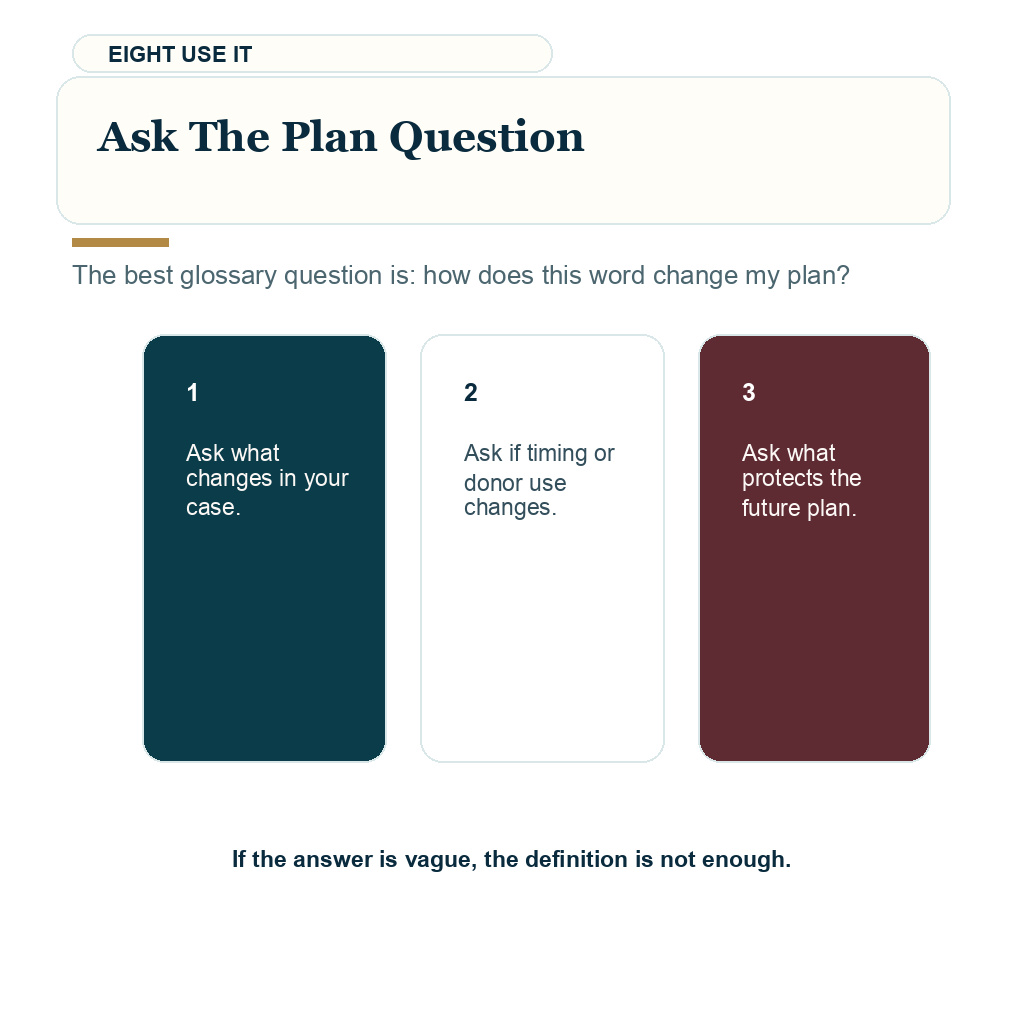
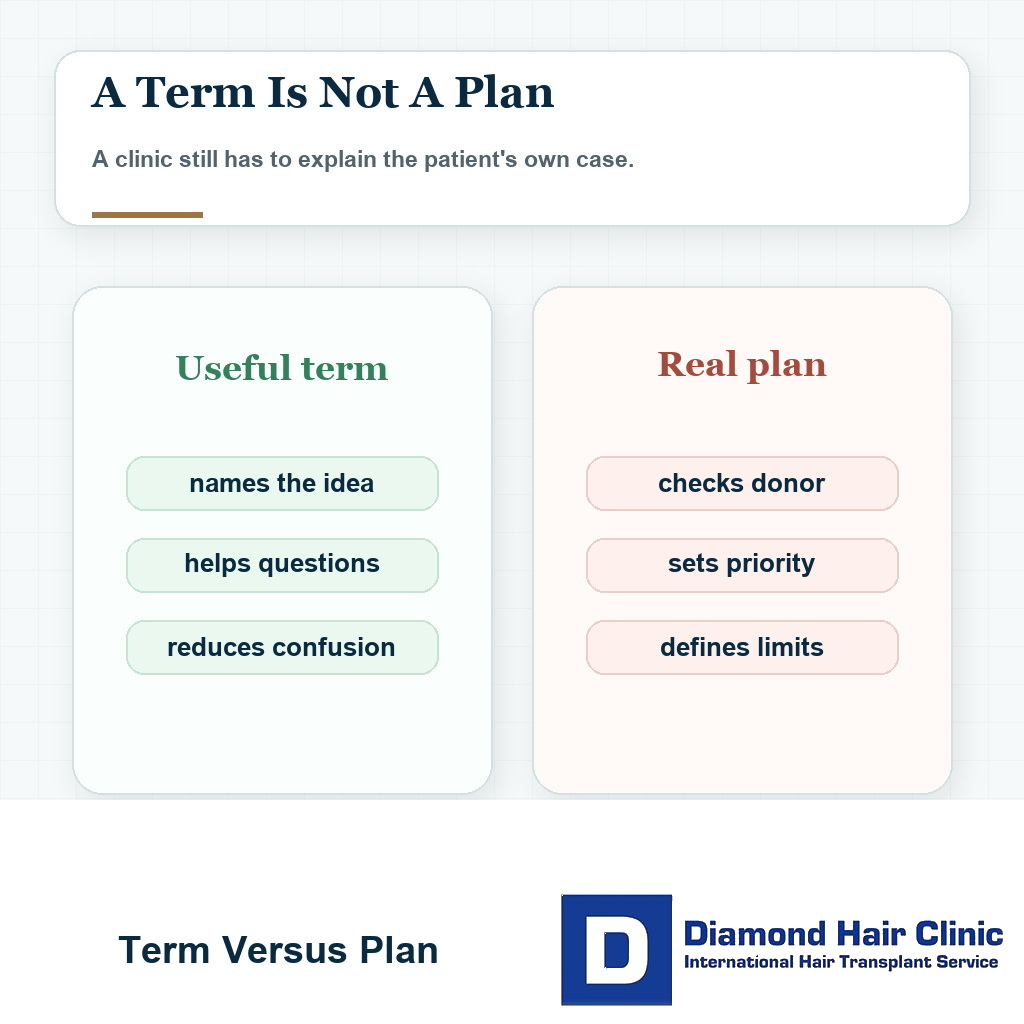
Use this glossary as a way to make the consultation clearer, not as a way to challenge every word a surgeon says. A good surgeon should welcome informed patients. When a patient understands the basics, we can spend more time on the real decision.
Before consultation, choose the terms that actually apply to your case. A patient with a high forehead should focus on hairline design, donor capacity, and long term planning. A patient with crown thinning should focus on crown coverage, graft distribution, and realistic density. A patient with previous surgery should focus on donor depletion, repair, and expectations.
During consultation, each term should become practical. FUE should lead to a discussion about extraction, donor protection, and surgical responsibility. Density should lead to a discussion about hair caliber, blood supply, future loss risk, and what the scalp can safely support.
After consultation, be careful if you remember only the exciting words. Full coverage, maximum density, impressive technique names, painless surgery, and guaranteed growth can sound comforting, but they do not prove that the plan is safe. The words that protect you are usually less glamorous. Donor management, conservative planning, natural hairline, proper candidacy, and follow up usually tell you more about the quality of the plan.
The glossary should help you understand donor capacity, graft safety, native hair stability, hairline design, crown planning, one session limits, and follow up during growth. When these points are explained in plain language, the patient is no longer reacting to impressive terminology. They are judging the quality of the plan.
If the answers become vague, rushed, or sales focused, pay attention. This matters before travel, especially when judging how to choose a hair transplant clinic in Turkey. Confusion before surgery often becomes regret after surgery. You do not need to understand every technical detail like a surgeon, but you should understand the logic of your own plan.
Learn the terms, but do not fall in love with terminology. A hair transplant is not successful because the clinic uses modern words. It is successful when the diagnosis is correct, the donor area is respected, the recipient area is designed naturally, the grafts are handled well, and the plan still makes sense years later.
When you understand the language, you become harder to pressure and easier to manage properly. That is the real value of a patient focused hair transplant glossary.

Read this review excerpt
He was very thorough in every little detail and I never felt pressure to do anything I wasn’t sure of.