




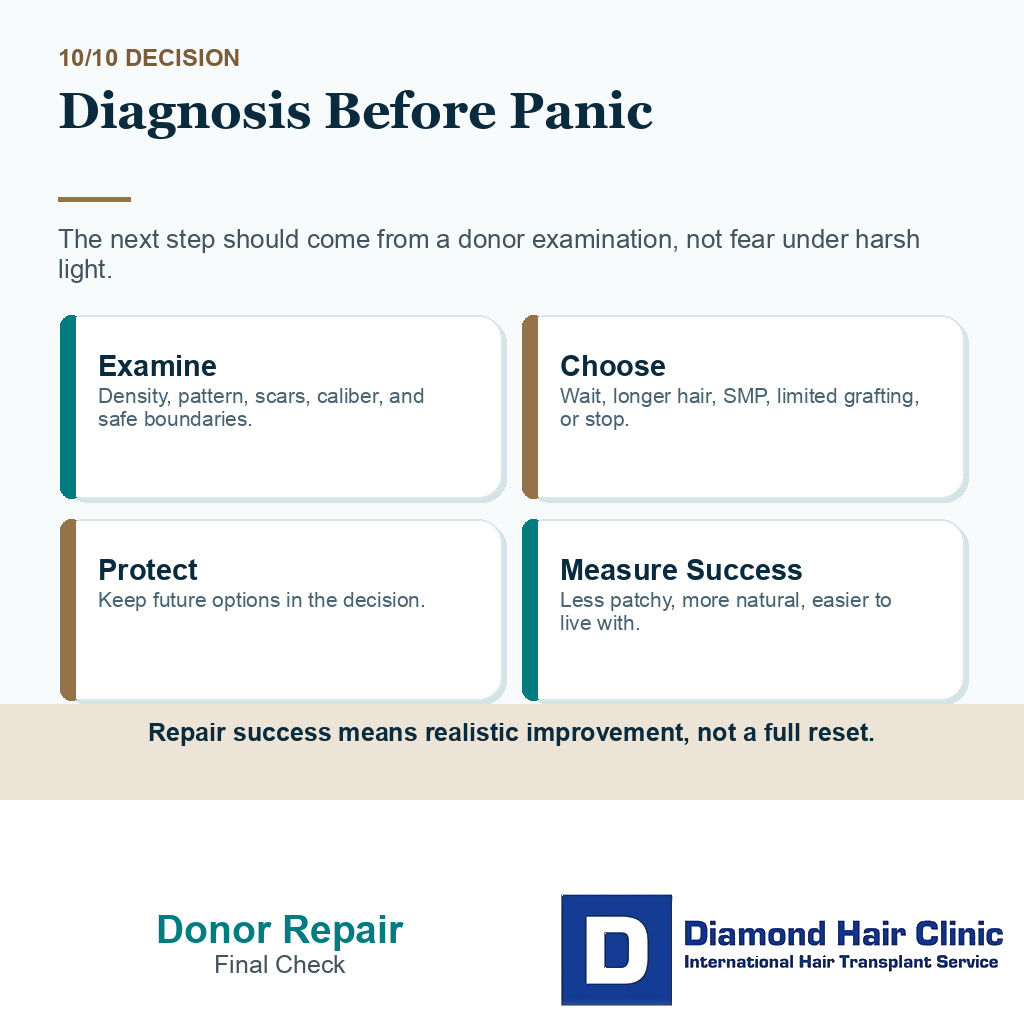
Shock loss and true donor depletion look different
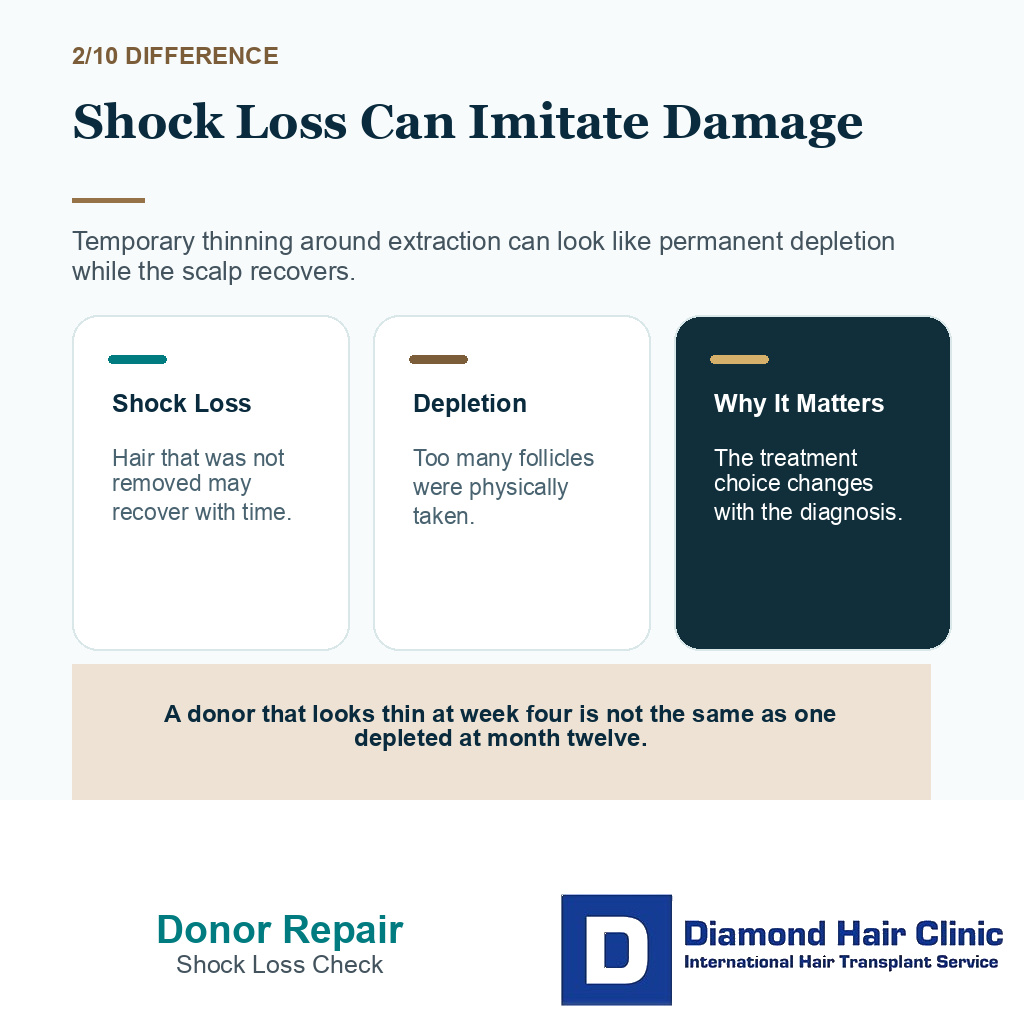
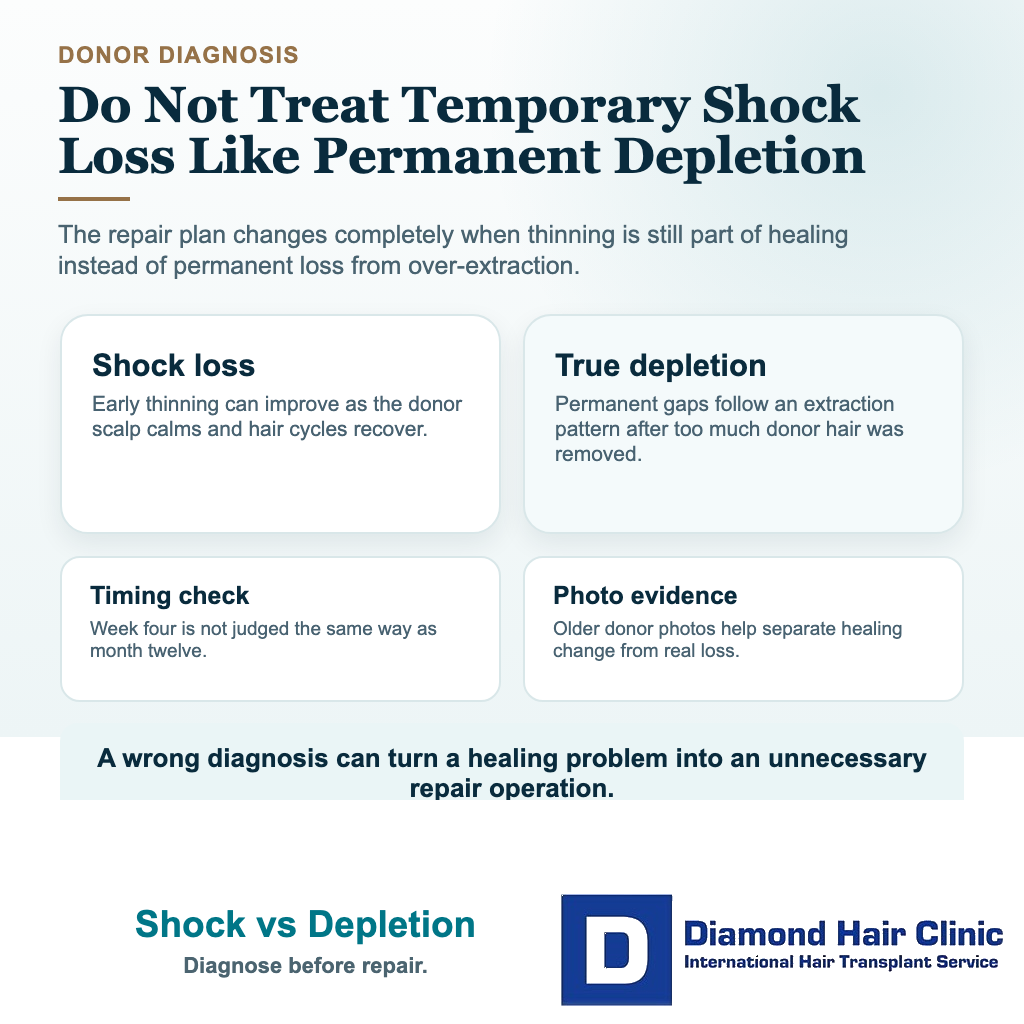
Shock loss usually looks like temporary thinning around the extraction area while the skin is still recovering. It can be patchy, frightening, and very visible with short hair, but the follicles that were not removed may recover with time. Real depletion is different because too many follicles were physically taken or the extraction pattern permanently reduced the ability of the remaining hair to cover the scalp.
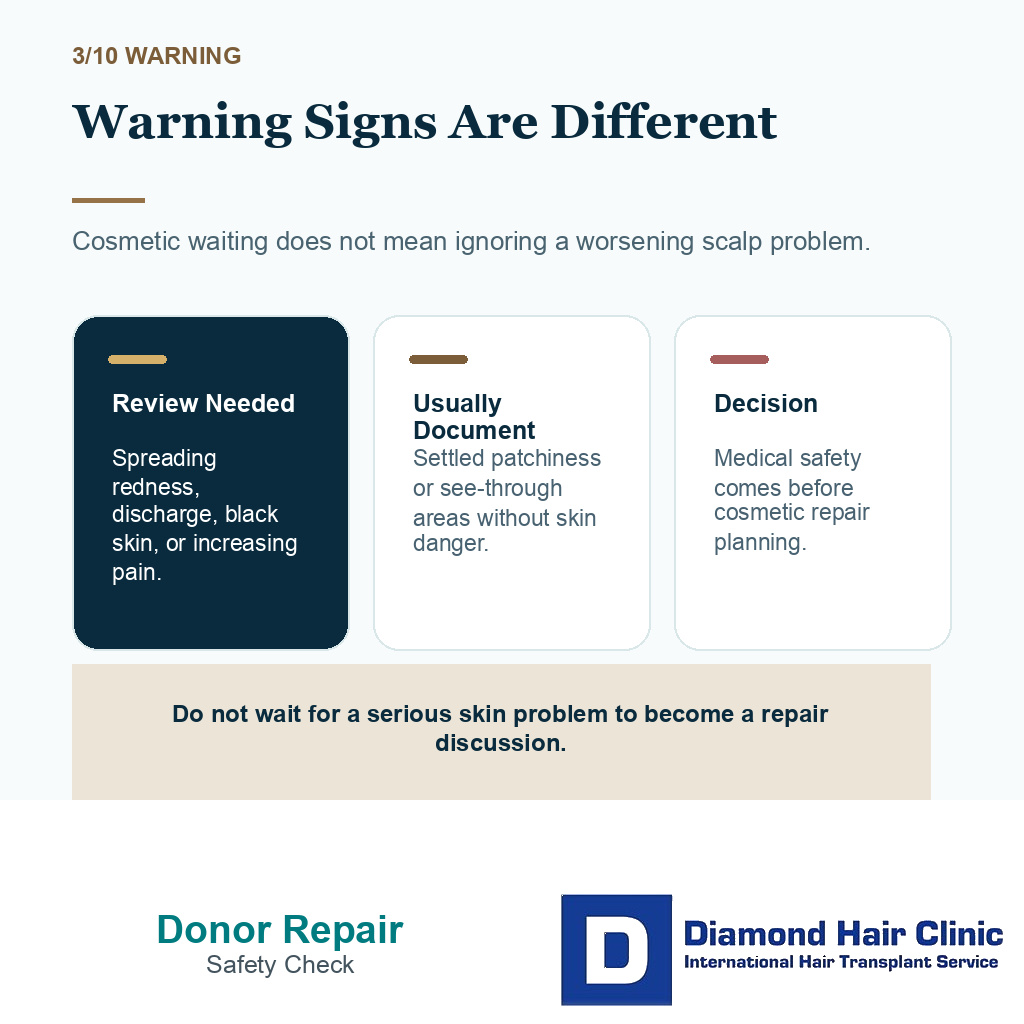
I look at timing, scalp condition, extraction pattern, hair length, and older photos. A donor that looks thin at week four is not the same as a donor that still looks depleted at month twelve. Even at twelve months, one harsh close-up is not enough by itself. I compare consistent donor photos, haircut length, extraction distribution, visible scar dots, donor miniaturization, and whether the area has stabilized. I also check whether redness, irritation, or donor inflammation is making the area look worse than the true density.
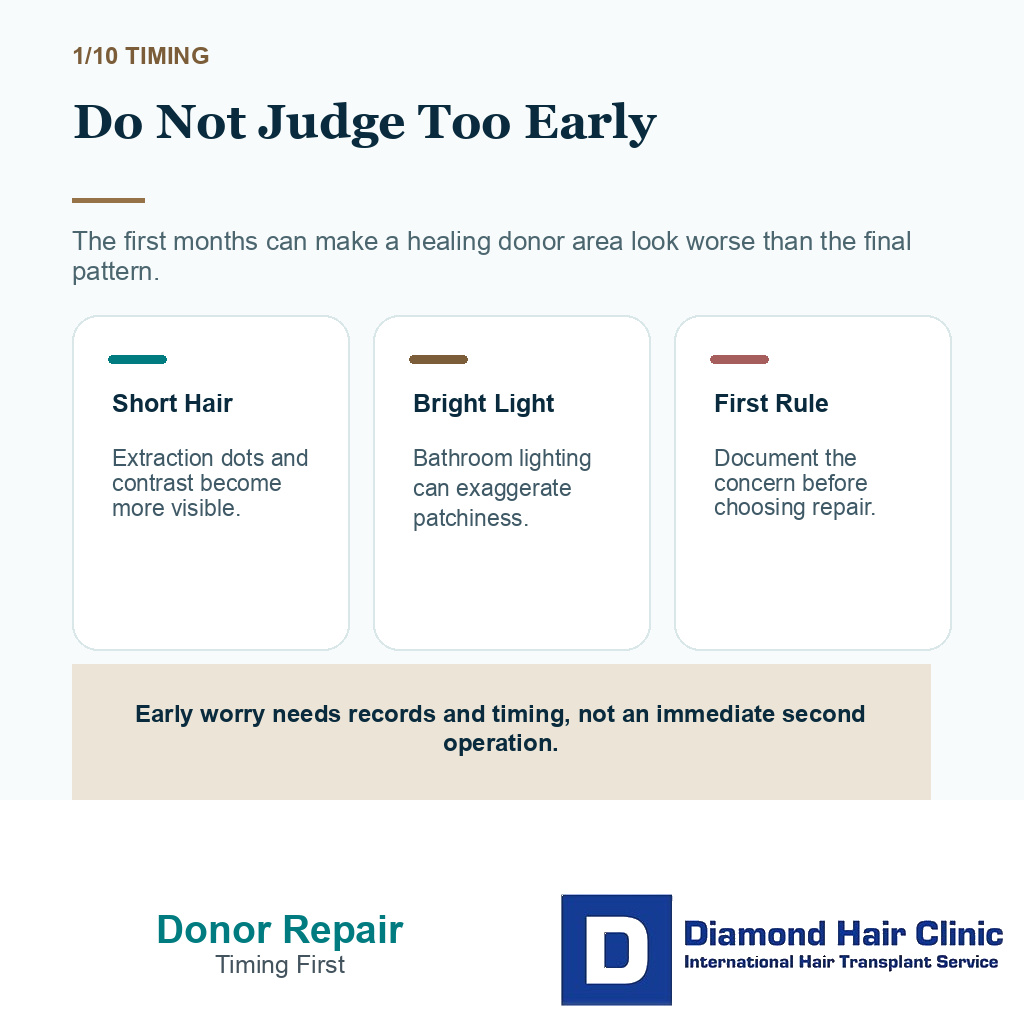
For a donor worry late in the first year after a very large FUE session, I do not judge the donor from the session size alone. I review photos from before surgery, the immediate extraction pattern, the current haircut length, and the way the donor looks in normal daylight. Fine straight hair, a low fade, and strong bathroom light can make a settled donor look more see through, while a sharply uneven pattern that stays visible at normal length deserves a proper repair review.
When you send donor photos for repair advice, include the haircut you can actually live with. A donor that looks acceptable at one length may still limit short fades, SMP choices, or a second surgery.
Separate what can make the donor look better from what truly repairs it. Longer hair, SMP, and softer contrast can camouflage a pattern, while another surgery needs enough safe donor and a reason the first extraction pattern will not be repeated.
The treatments are not the same. Shock loss usually needs time, gentle aftercare, and observation. True overharvesting may need camouflage, SMP, limited grafting, or acceptance of a longer haircut. If the diagnosis is wrong, the repair plan will be wrong too.
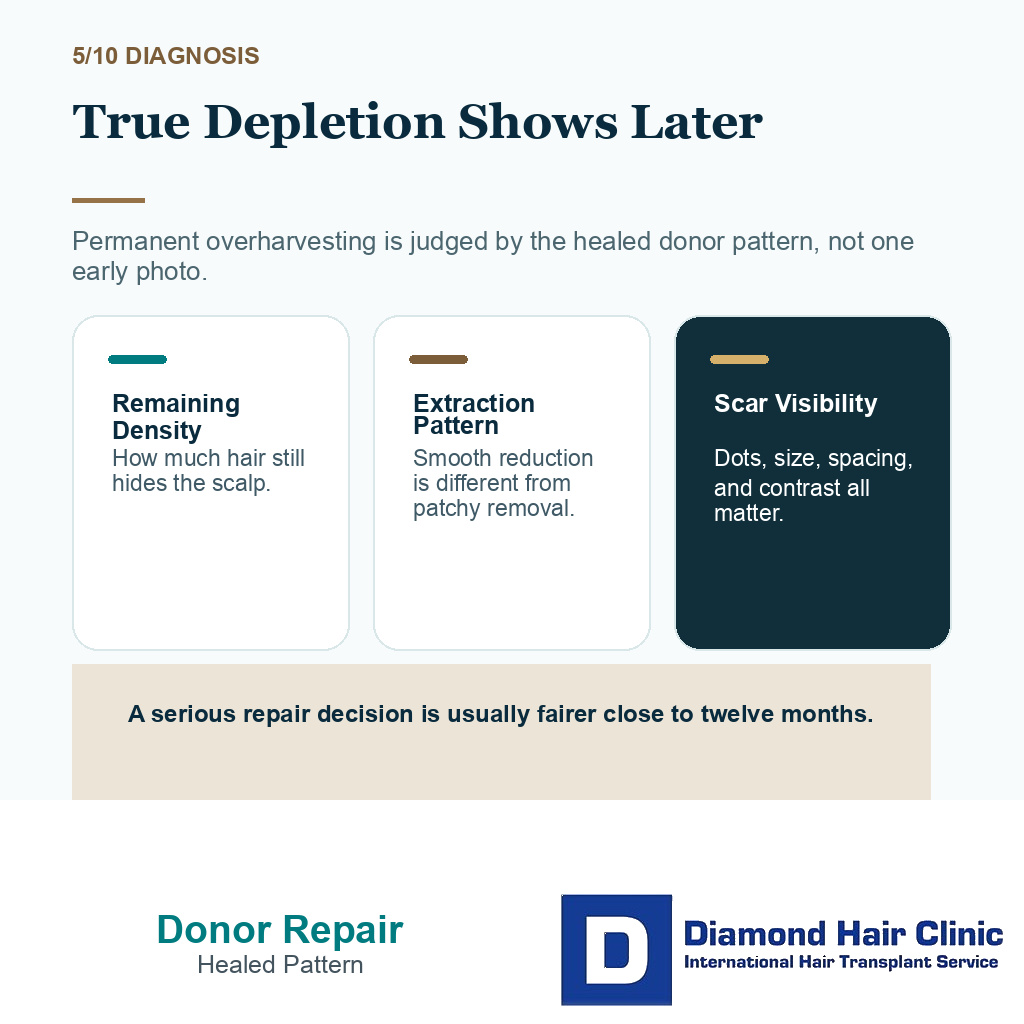
True overharvesting shows after healing
True overharvesting means too many grafts were removed from the safe donor zone, or they were removed in an uneven pattern that the remaining hair cannot hide. The back and sides may look thin, patchy, see through, or divided into zones with different density. Sometimes the difficulty is obvious only when the hair is cut short. Sometimes it is visible even with longer hair.
I also separate surgical overharvesting from retrograde alopecia or DUPA. A donor area can look thin because too many grafts were removed, but it can also look thin because the donor hair was already miniaturizing or unstable before surgery. The repair plan changes completely. If the remaining donor hair is still weakening, another procedure may expose the problem further instead of correcting it.
The back and sides can also look damaged when extraction was concentrated too much in one region. A sharp contrast between one depleted zone and the surrounding hair is especially concerning. That pattern is different from a smooth reduction in density. Smooth reduction may be easier to blend. A patchy extraction pattern is usually harder to hide.
Scarring also matters. FUE does not mean scarless surgery. It means many small scars instead of one linear FUT scar. If the dots are small and evenly distributed, they may be almost invisible at a practical hair length. If the extraction was too dense, too large, or too concentrated, the scars can create a pale, empty, dotted look.
I treat the donor zone in a hair transplant as a lifetime budget, not a warehouse of unlimited grafts. Once grafts are removed, they do not grow back there. Any corrective planning must respect that reality. Claims about donor regrowth should not be used as a rescue shortcut when the existing donor area has already been thinned.
Donor repair differs from a normal second transplant
A normal second transplant usually means we are adding coverage to the recipient area. Repair in the back and sides is different because the difficulty is in the zone that normally supplies the grafts. The surgeon is trying to improve a depleted resource by using another limited resource.
This kind of repair is never routine. If more scalp grafts are taken from an already limited supply to fill another damaged part of the same supply, the problem may only move from one zone to another. The patient may gain some blending in one place and lose density in another.
Repair also has a different emotional weight. A poor hairline can be hidden in some ways, but the donor zone affects how short a patient can cut the hair, whether the back of the head looks natural, and whether future surgery is still possible. For that reason, a bad hair transplant repair must begin with donor assessment before discussing what can be added on top.
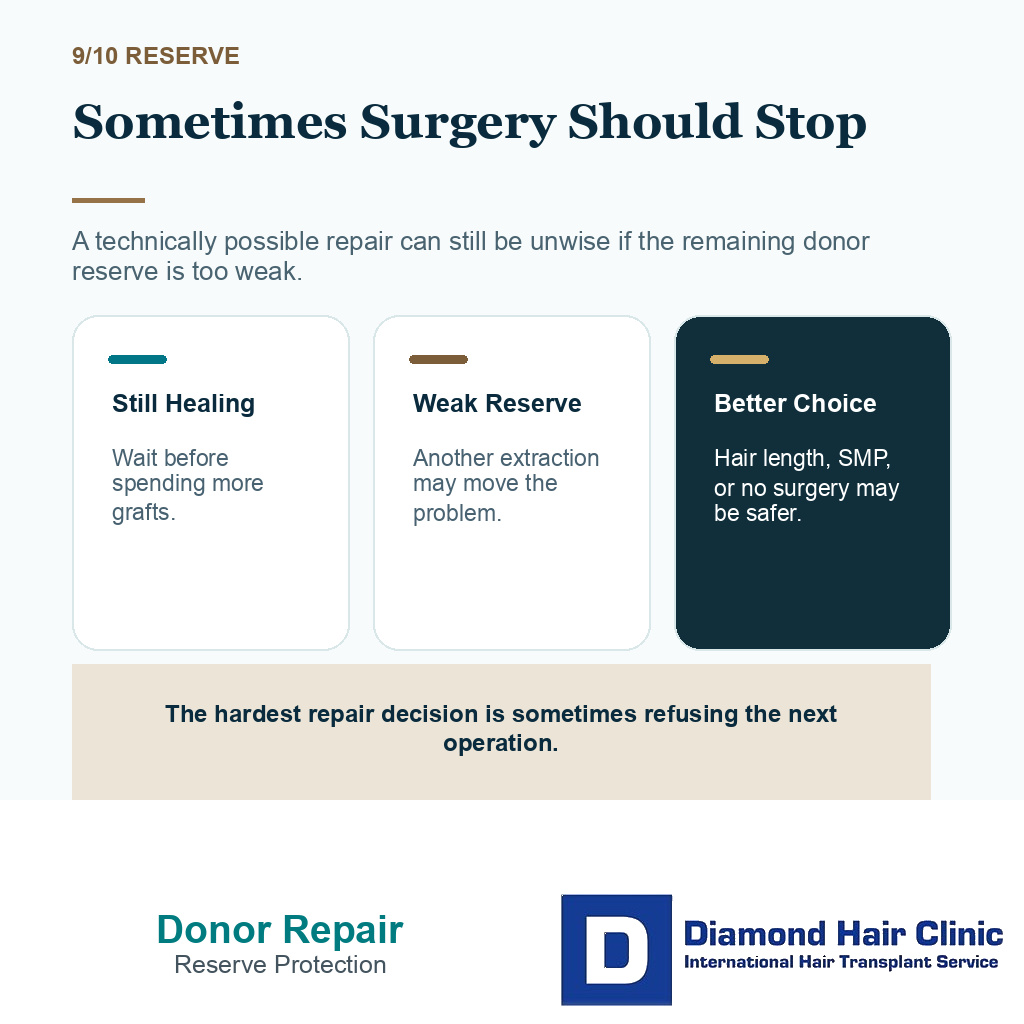
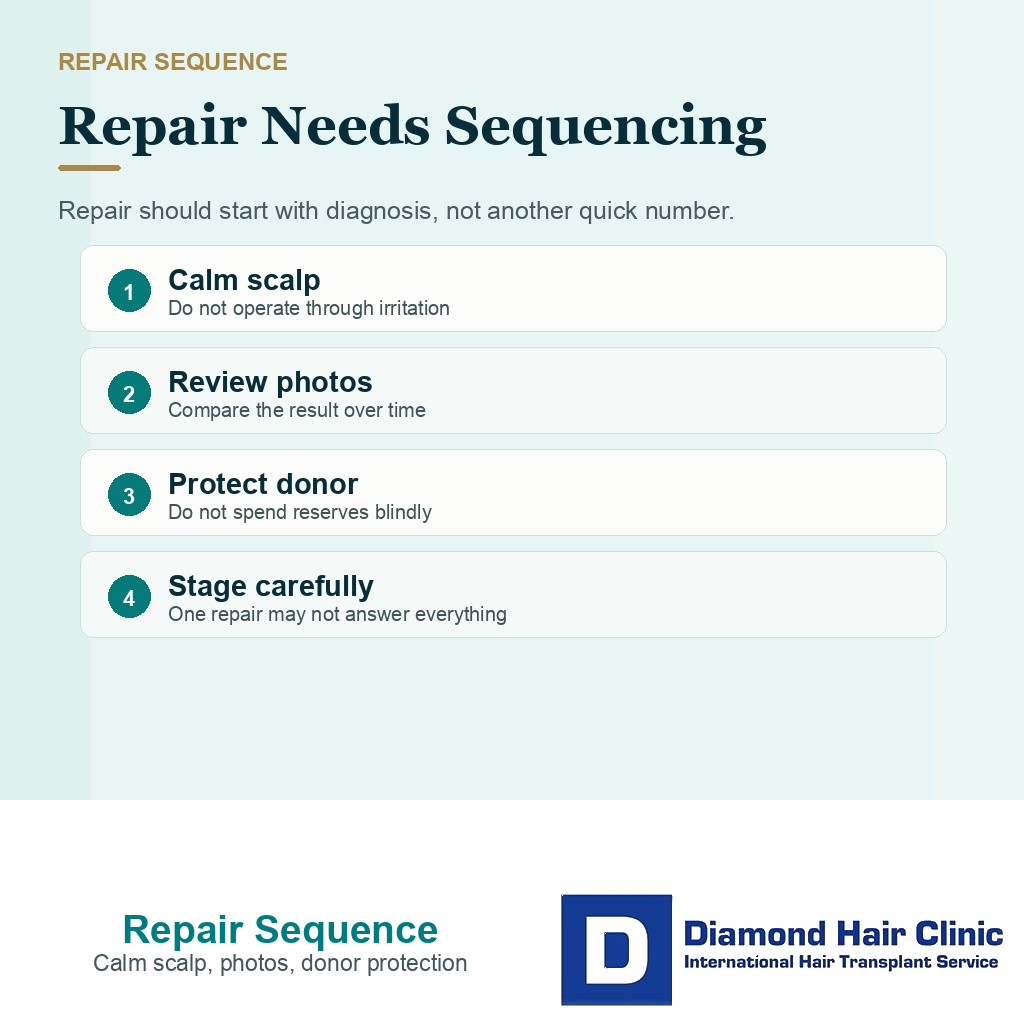
Sometimes the responsible repair is not another operation. It may be hair length control, density blending, SMP, medical support for surrounding hair, or simply allowing more healing time. A technically possible repair can still be unwise if it spends the last useful donor reserve for a small cosmetic gain.
Hair length can hide mild donor depletion
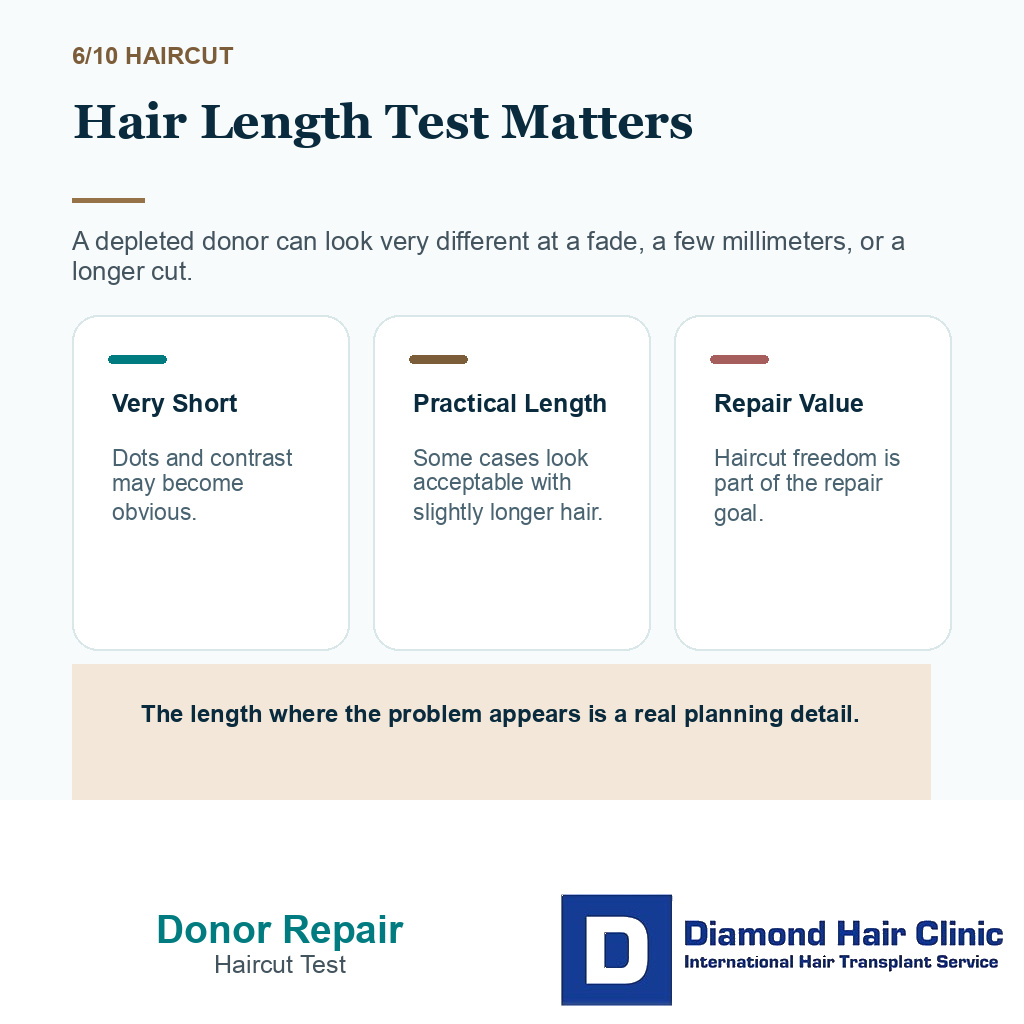
In many mild or moderate cases, hair length is the least risky way to improve the appearance. A depleted area that looks very thin at a skin fade may look acceptable when the hair is left slightly longer. This does not repair the tissue biologically, but it may reduce the visible contrast enough for daily life.
The key detail is the length at which the problem becomes visible. Some patients can hide the donor area at 1 cm but not at 3 mm. Others need more length because the extraction pattern is too patchy. This practical haircut test often tells me more than a dramatic close-up photo.
Future hairstyle needs review before the first surgery for the same reason. If a patient wants to keep the sides very short, aggressive FUE extraction is more risky. That is the same practical issue behind whether you can shave your head after a hair transplant, because donor management and hairstyle freedom are linked.
Hair length is not a small detail. It can decide whether a patient feels normal in public or feels exposed every time a barber cuts too short. A good correction strategy should include this everyday reality, not only surgical possibilities.
Scalp micropigmentation can help selected cases
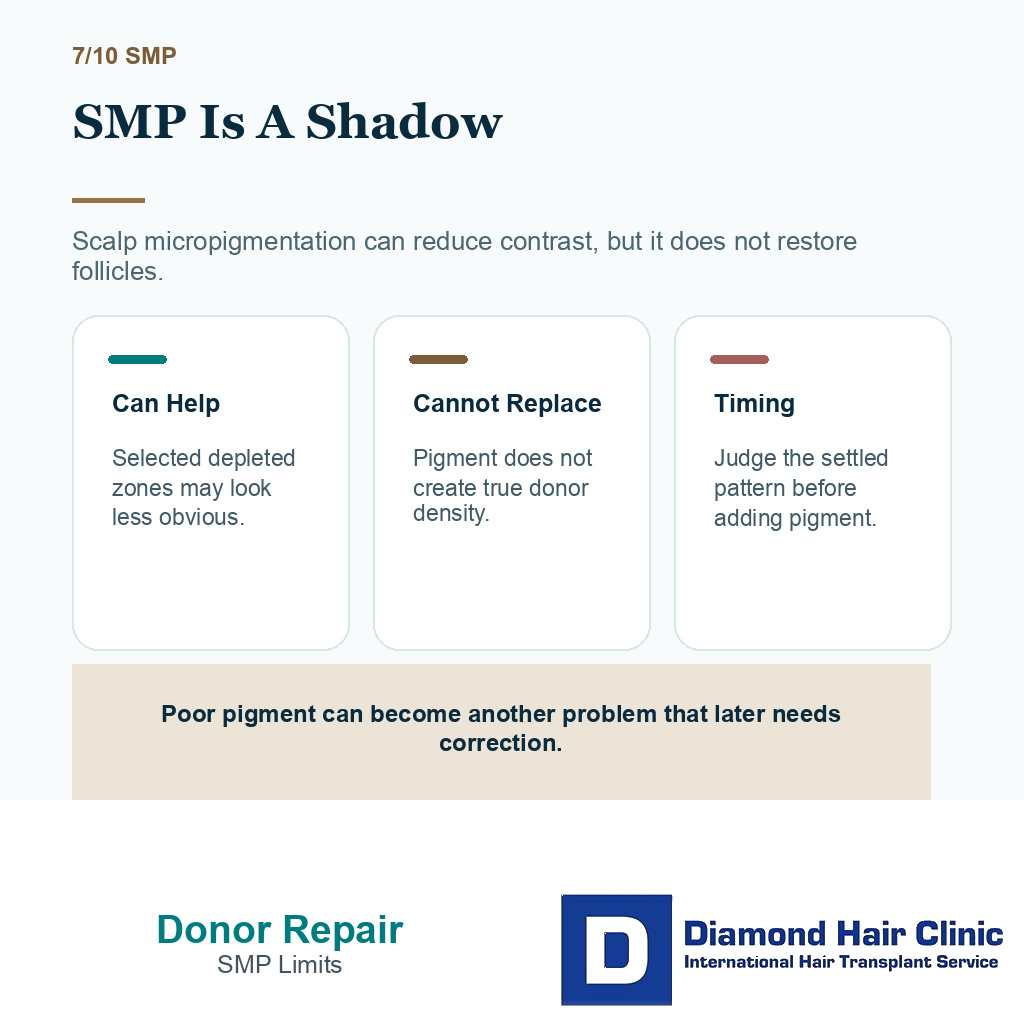
Scalp micropigmentation can help selected overharvested zones by reducing the contrast between pale scalp and remaining hair. It creates a shadow effect, not new density. That can make the area less obvious, but it cannot restore follicles that were removed.
SMP tends to work better when the patient keeps the hair very short or when the thinning area needs contrast reduction rather than true density. It can be less convincing when longer hair moves over visible dots, especially if the pigment is too dark, too large, or placed without artistic control. Poor SMP can become another problem that later needs correction.
When I discuss scalp micropigmentation after a thin hair transplant, I explain it as a shadow, not a replacement for growth. That limit matters here. Pigment may improve appearance, but it cannot restore follicles that were removed.
SMP is better considered after the extraction zone has settled enough to judge the real pattern. If the patient is still early in healing, SMP may be planned for a problem that would have improved. If the patient may need future surgery, the pigment also needs to be considered carefully because it can affect how the back and sides are visually evaluated later.
Beard or body hair has a limited repair role
Beard or body hair can sometimes be used to soften an overharvested zone, but it is not a universal solution. Beard hair is usually thicker and has a different character from scalp hair. Chest or other body hair may have different curl, caliber, growth cycle, and coverage value. This is not only about whether these grafts can grow. The decision depends on whether they will blend naturally.
In some repair cases, beard grafts may help reduce contrast in scarred or depleted zones. But this idea needs caution. If the damage is wide and the remaining scalp hair is fine, adding coarse beard hair may create texture mismatch. If the patient also needs future recipient area work, spending beard hair in the back and sides must be weighed against other priorities.
Beard and chest hair should not be described as a magic reserve. They can be useful in patients whose case fits, but they do not behave exactly like scalp grafts. They should be used to improve the overall plan, not to chase the idea of full restoration.
Repairing a donor area with hair from outside the scalp is often a blending operation. The goal may be to reduce obvious patchiness, soften pale scars, or make a practical haircut possible. If the patient expects the donor to return to untouched density, the expectation needs to be corrected before surgery.
Repair surgery should sometimes be avoided
Another operation should be avoided when the donor zone is still healing, when the remaining supply is too limited, or when the patient is trying to fix anxiety before the pattern is stable. I use careful wording here because donor damage can feel very upsetting. But a rushed correction can make the situation harder.
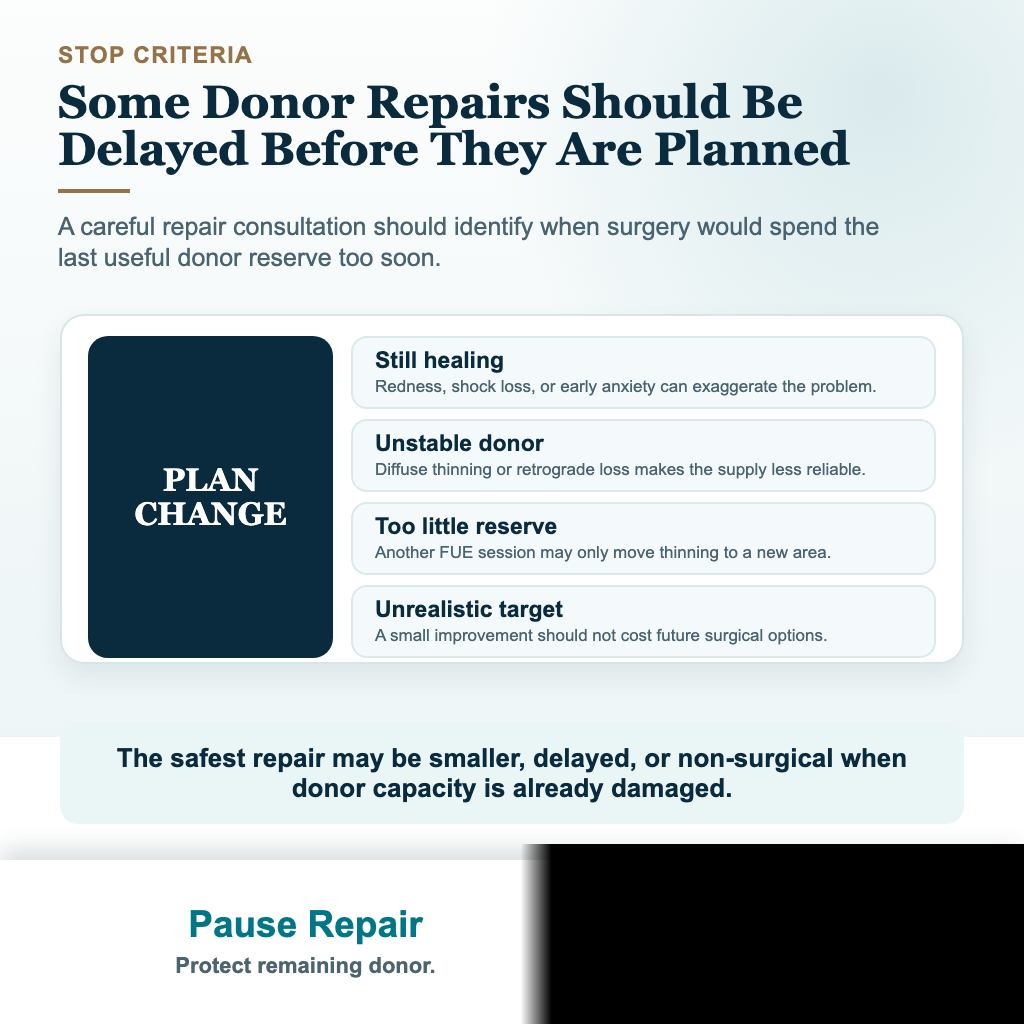
The decision should also slow down when the patient has progressive hair loss that has not been stabilized, a very weak donor area, unrealistic density expectations, or a previous history of multiple aggressive surgeries. In these cases, the next operation may reduce options instead of improving them.
A limited supply does not always mean surgery is impossible, but it changes the goal. The goal may need to become smaller, more conservative, or non-surgical. Some patients need to accept that repair can improve the appearance but cannot give back the capacity that was lost.
Few conversations in hair restoration are harder than this. The patient wants a correction. The surgeon must decide whether another operation is a true repair or another loss. Careful surgical judgment matters most when the donor has already been harmed.
What do I want written before donor repair?
An overharvested donor review should separate true lost density from temporary shock loss before choosing camouflage, hairstyle change, SMP, or a very limited repair.
The plan also has to show where I will stop. If the remaining donor is too thin, the scars are too wide, beard or body hair would not blend, or the patient expects untouched density, surgery should be reduced or refused. A plan that promises to restore the donor to its original state is not a safe plan.
Donor homogenization does not create new donor density. It borrows a small number of grafts from relatively stronger donor zones to soften the contrast around a depleted patch. That may improve balance, but it also spreads the donor cost into an area that was previously stronger. Before considering it, I want a map showing where every graft would come from, how short the patient hopes to wear the hair, and what reserve must remain for the recipient area. If the surrounding donor cannot spare those grafts, camouflage or no further surgery may be the safer route.
Donor examination comes before repair planning
Before I discuss correction, I need standardized photos, a real donor examination, and a clear timeline. I look at the back and sides under normal light, strong light, short hair, and practical daily hair length. I check how many grafts were taken, where they were taken from, whether the pattern is even, and whether the patient has donor miniaturization or retrograde thinning.
Numbers alone are not enough. A patient may say 3000 grafts were taken, but the donor can look worse than expected if the extraction was concentrated or if the punch size and spacing were poor. Another patient may have a large number removed but still look acceptable because the extraction was spread with better planning.
For me, overharvesting is not judged only by a graft count. It is judged by the remaining density, extraction pattern, scar visibility, hair caliber, safe boundaries, and future needs. Any plan that ignores these details is not a plan. It is another gamble.
I also examine the recipient area. If the front and crown still need work, every graft used for donor camouflage has an opportunity cost. In some patients, the wiser strategy is to protect the remaining donor for the most visible recipient area problem. In others, the donor appearance itself is the main problem. The plan changes depending on which problem affects the patient most.
Some donor repair promises need caution
Be cautious if a clinic promises to completely repair overharvesting without examining you properly. Be cautious if they say SMP will solve everything, beard grafts will solve everything, or another large FUE session will make the back of the scalp look normal again. In repair work, absolute promises are often a warning sign.
A donor repair consultation needs clear limits. It should tell you whether the donor is still healing, whether shock loss may recover, whether scar tissue is present, whether hair length will matter, and whether surgery could make another zone thinner. You should leave the consultation clearer about trade offs, not simply more excited.
I warn patients about hair mill clinic promises for the same reason. The mindset that causes donor overuse before surgery can also sell unrealistic repair after surgery. Urgency, discount pressure, vague graft numbers, and no direct medical responsibility should make you slow down.
If a clinic avoids the limitation conversation, be very cautious about the recommendation. The back and sides are already the injured part of the story. They deserve more caution, not another fast package.
Match repair to the donor pattern
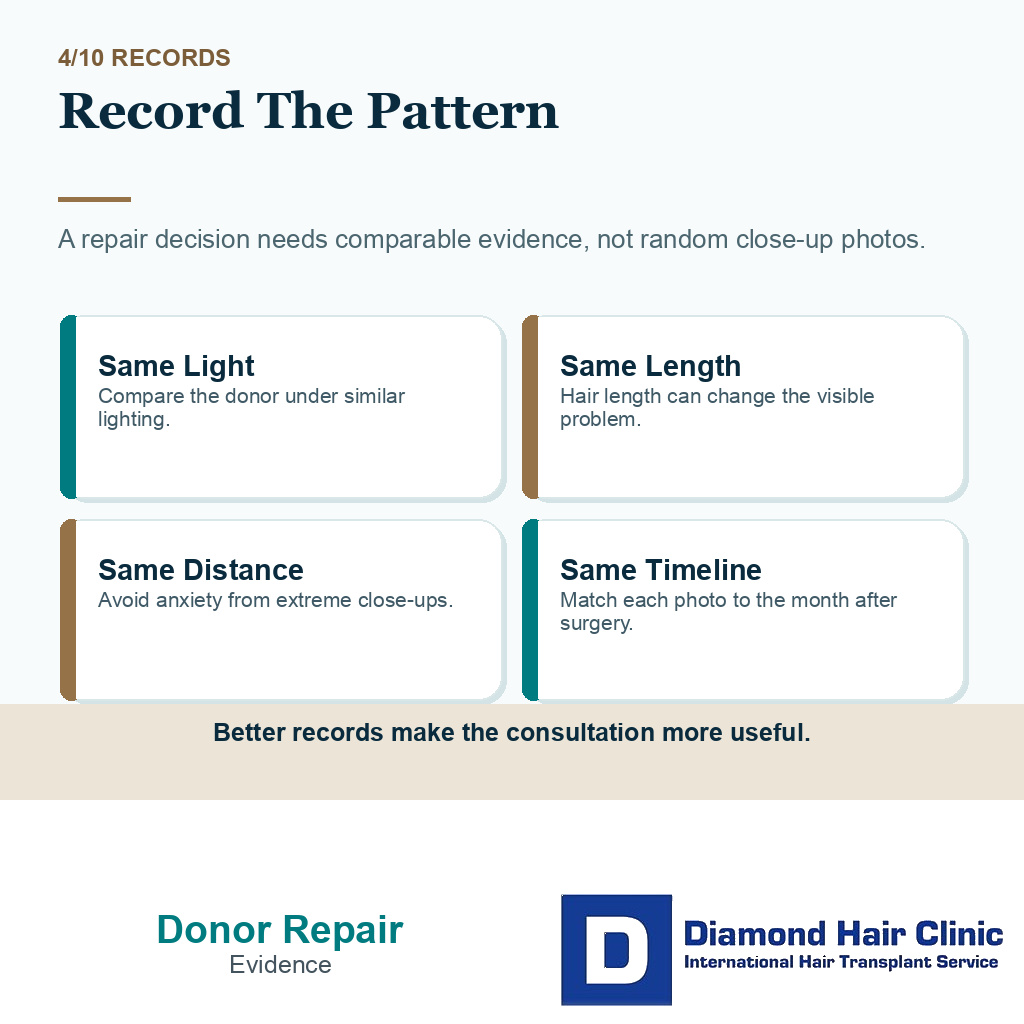
If you are early after surgery, your first step is to document the back and sides consistently and wait long enough for healing to declare itself. Use the same lighting, same distance, and similar hair length for comparison. Random close-up photos under harsh light can increase anxiety without improving your decision.
If you are close to 12 months or beyond and the donor still looks depleted, a proper corrective consultation is the correct starting point. That consultation should clarify whether the most sensible path is longer hair, SMP, limited grafting, beard or body hair blending, or no further surgery. It should also check whether the recipient area result is stable enough before spending more donor resources.
If you are considering another surgery, the practical issue is whether a second hair transplant is worth it in your situation. A second procedure can be useful, but only when it protects the donor and improves the whole plan. It should not be chosen just because the first surgery left you distressed.
Fear should not push you into the next operation, and a clinic should not turn your anxiety into another sale. Repair success is not measured by whether the donor looks untouched. It is measured by whether the donor looks less patchy, more natural, easier to live with, and whether your remaining options are protected.
An overharvested donor zone is one of the clearest examples of why hair transplantation must be planned with surgical discipline from the beginning. When repair is possible, it should be conservative, realistic, and carefully staged. When repair is limited, the patient deserves to hear that clearly before more grafts are spent.
Read this review excerpt
We also had a levelled conversation about my hairline and results I could expect based on my donor density area.