



Patchy Donor Areas Need Timing and Pattern Review
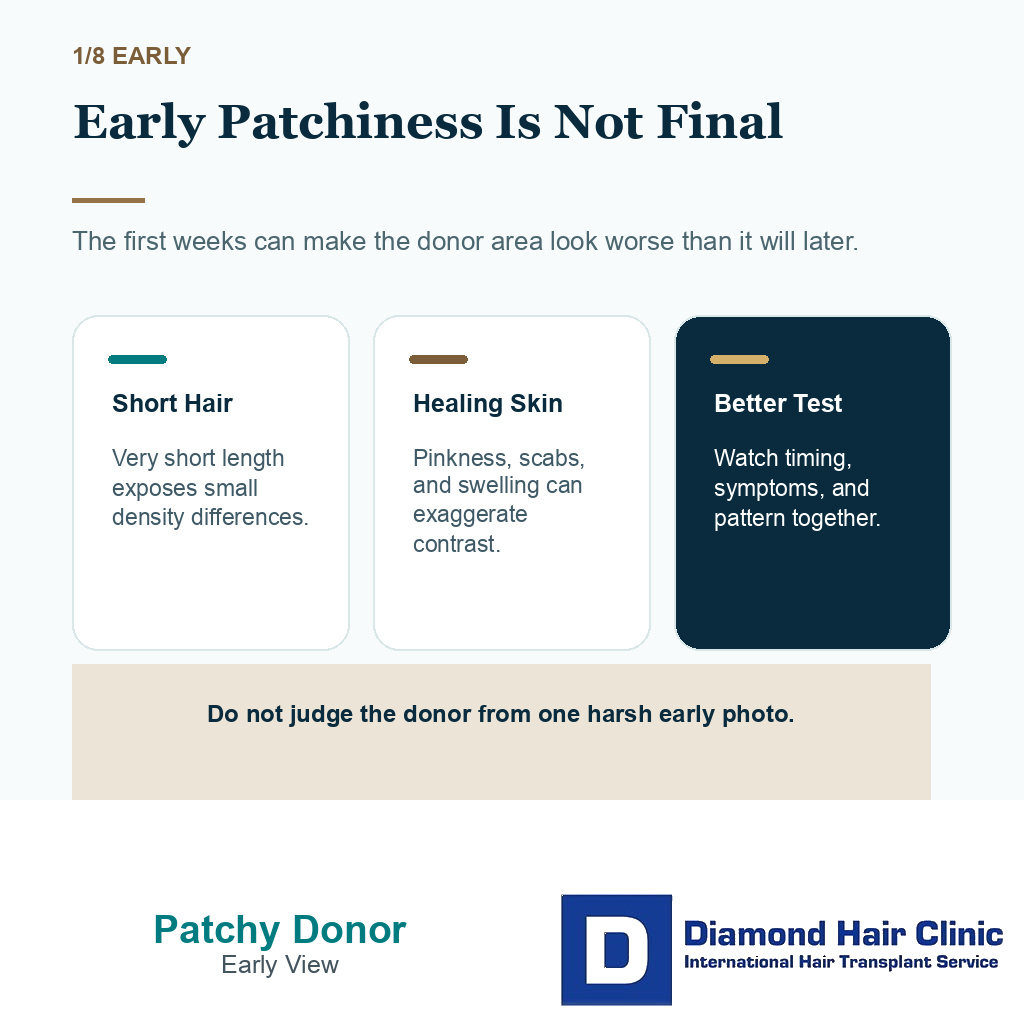
Early patchiness after FUE is not always overharvesting. In the first weeks, short hair, redness, swelling, scabs, and temporary shock loss can make the back and sides look worse than they will finally look. I become more concerned when the patchiness stays visible after the hair has grown, when the extraction pattern looks concentrated in one zone, or when the donor looks uneven after a very high graft number. One early photo can start the review. It should not become the diagnosis by itself.
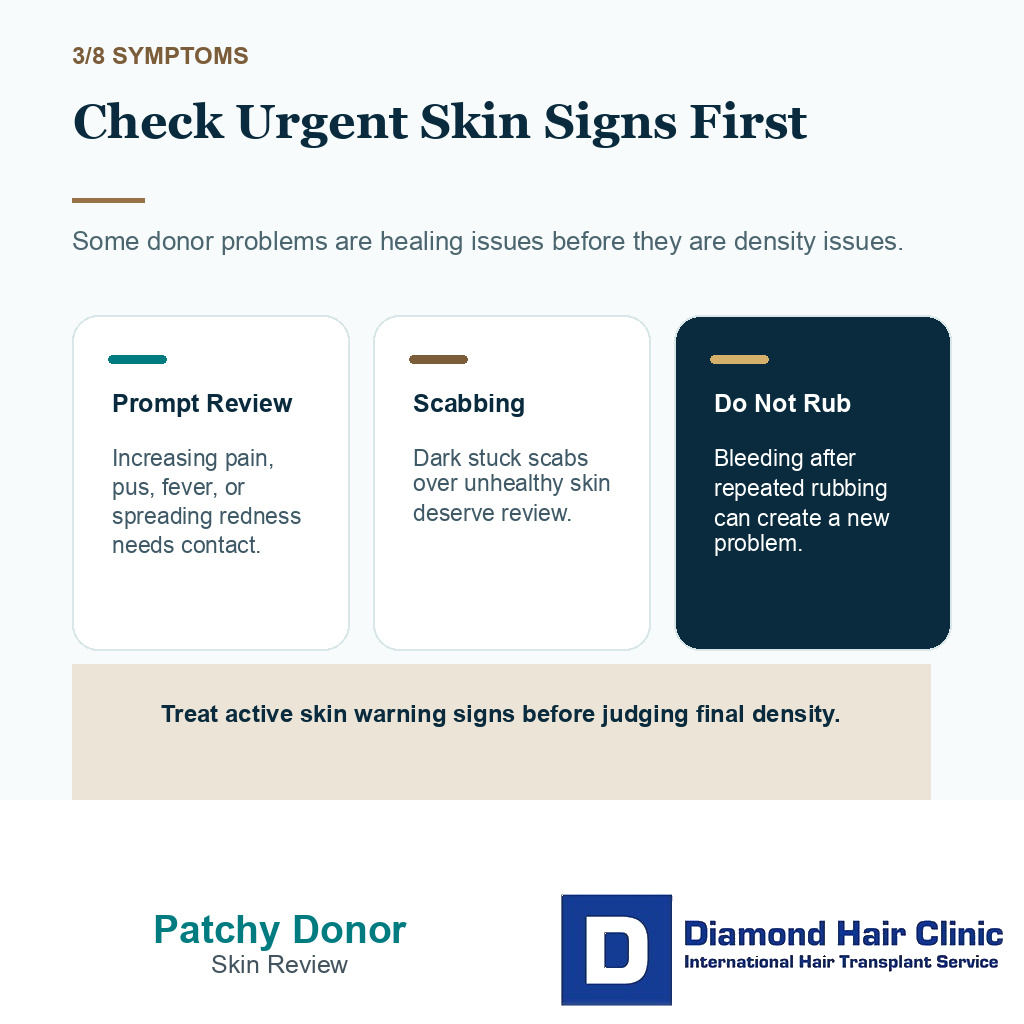
A broad, soft thinning that changes with hair length and lighting is different from a sharply depleted patch that stays visible in normal light. Skin symptoms also change the answer. Increasing pain, spreading redness, pus, fever, bleeding after rubbing, or dark scabbing over unhealthy skin should be reviewed as a healing problem before anyone debates final density.
One harsh donor photo is not enough, but real warning signs still matter. Timing, haircut length, extraction pattern, donor strength, skin symptoms, and the original graft plan all matter. If you normally wear a fade, the separate question of short hair after FUE and donor scar visibility is best judged after the donor has had enough time to settle. If the final pattern is stable contrast rather than active healing, the separate decision is whether SMP with hair transplant results can help without pretending the donor was never damaged. If the final concern is stable scalp contrast, donor SMP camouflage limits should be reviewed before pigment is chosen.
Photograph the donor at the haircut length you actually wear. A close view can help, but shaving shorter only to expose the patch can make the photo less useful for judging everyday visibility.
The donor area can look patchy in the first weeks
In the early period, the donor area is healing from thousands of small extraction points. Even when the surgery is planned well, the skin may look pink, uneven, shiny, or lighter in some places. Short hair also exposes every small difference in direction and density.
Many people look at the back of the head under bathroom lighting and think the donor has suddenly been emptied. At that stage, density alone is not enough to judge the result. The pattern matters. A smooth, evenly distributed change is different from a sharp patch where too many grafts seem to have been removed from one zone.
With FUE hair transplant, follicles are removed one by one from the donor area. The follicles that were moved do not grow back in the donor area. The surgeon has to choose the FUE punch size and spread extraction intelligently so the remaining hair still covers the donor region when it grows. If the next suggestion is FUT after FUE, the patchy pattern has to be reviewed before another harvest is considered.
Donor shock loss can look like overharvesting
Temporary shock loss can happen around the donor area after surgery. It can be related to surgical trauma, swelling, inflammation, local circulation changes, and the stress of extraction. The donor may look empty or uneven before the remaining hair has recovered.
When I suspect donor shock loss, I look for timing and distribution. A patchy look in the early weeks can still be temporary, especially if the pattern is broad and soft rather than sharply carved out.
Shock loss does not give permission to ignore everything. If the area is painful, increasingly red, crusted, infected, or bleeding after rubbing, the skin needs proper review. A donor area that is healing badly may create its own problem even when the extraction plan was acceptable.
Could a new donor patch in the early weeks be alopecia areata?
A new smooth patch in the donor area can raise the question of alopecia areata during early recovery. I do not judge it from timing alone. I look at the shape, the edge, the skin surface, symptoms, and whether the patch follows the extraction pattern.
Donor shock loss usually looks softer, broader, and connected with the donor zone, haircut length, redness, swelling, scabs, and lighting. Alopecia areata and hair transplant timing is a different discussion. It becomes more suspicious when the patch is smooth, sharply bordered, expanding, outside the extraction pattern, or appears with other patches, nail pitting, eyebrow loss, beard loss, or body hair changes.
A previous history of alopecia areata matters, but no history does not fully rule out a first episode. I also do not say the transplant caused it just because the timing is close. Surgery creates controlled skin trauma and inflammation, and that may unmask a problem in a susceptible person, but causation needs clinical assessment.
If the diagnosis is unclear, dermoscopy is often more useful than guessing from photos. In selected unclear cases, a scalp biopsy may help when the diagnosis remains unclear. The aim is to separate temporary donor shedding from a real scalp diagnosis before creams, steroid injections, repair planning, or panic treatment begin.
Patchy donor area signs that need urgent review
Most donor patchiness is not an emergency. Skin symptoms change the situation. Contact the clinic promptly if the donor becomes more painful instead of more comfortable. If redness spreads, pus appears, fever develops, bleeding starts after repeated rubbing, or dark scabbing seems attached to damaged skin rather than sitting as ordinary dry crust, send clear photos and ask the clinic to review it.
I treat that type of problem as a healing issue first and a density issue second. If the skin is hot, wet, increasingly tender, or producing discharge, the question is no longer only whether the donor will look full later. I check whether inflammation or infection after a hair transplant is interfering with normal healing.
Dark scabbing deserves special caution when it spreads, becomes painful, or sits over skin that looks unhealthy. This is uncommon, but early clear photos are safer than missing the warning signs of hair transplant necrosis. Do not try to treat these signs with alcohol, harsh antiseptics, pressure washing, or constant scratching. Keep the area clean, send photos, and get medical guidance.
Patchy patterns that suggest overharvesting
Overharvesting means the clinic removed more grafts than the donor area could safely give, or removed them in a pattern that leaves visible thinning. The typical warning is not mild unevenness in the first weeks. It is a patchy or visibly thin donor area that remains obvious after the hair has had time to grow to a normal length.
I pay attention to very high graft numbers, extraction outside the safer donor zone, uneven concentration on one side, visible rows, and a plan that treated the donor as if it had no future limit. These are planning problems, not just healing problems.
If more grafts were taken from one side, I do not judge that side from the first few weeks alone. Early swelling, redness, short hair, and donor shock loss can make it look patchier than it will finally look. I become more concerned when the same side still looks clearly depleted after the hair has grown, or when the extraction pattern looks concentrated without a clear donor plan.
The number alone never tells the whole story. Four thousand grafts from a strong, coarse, stable donor may leave a very different appearance than four thousand grafts from fine hair with early thinning at the sides. The same operation can be reasonable for one donor and too aggressive for another.
A weak donor area has less margin for error. Fine hair, low density, retrograde thinning, previous surgery, and future hair loss all reduce the donor budget. If a clinic takes a large number from that donor, patchiness becomes more likely.

Patchiness is judged by timing, distribution, hair length, and the extraction pattern, not by one harsh early photo.
Fair timing for judging the donor area
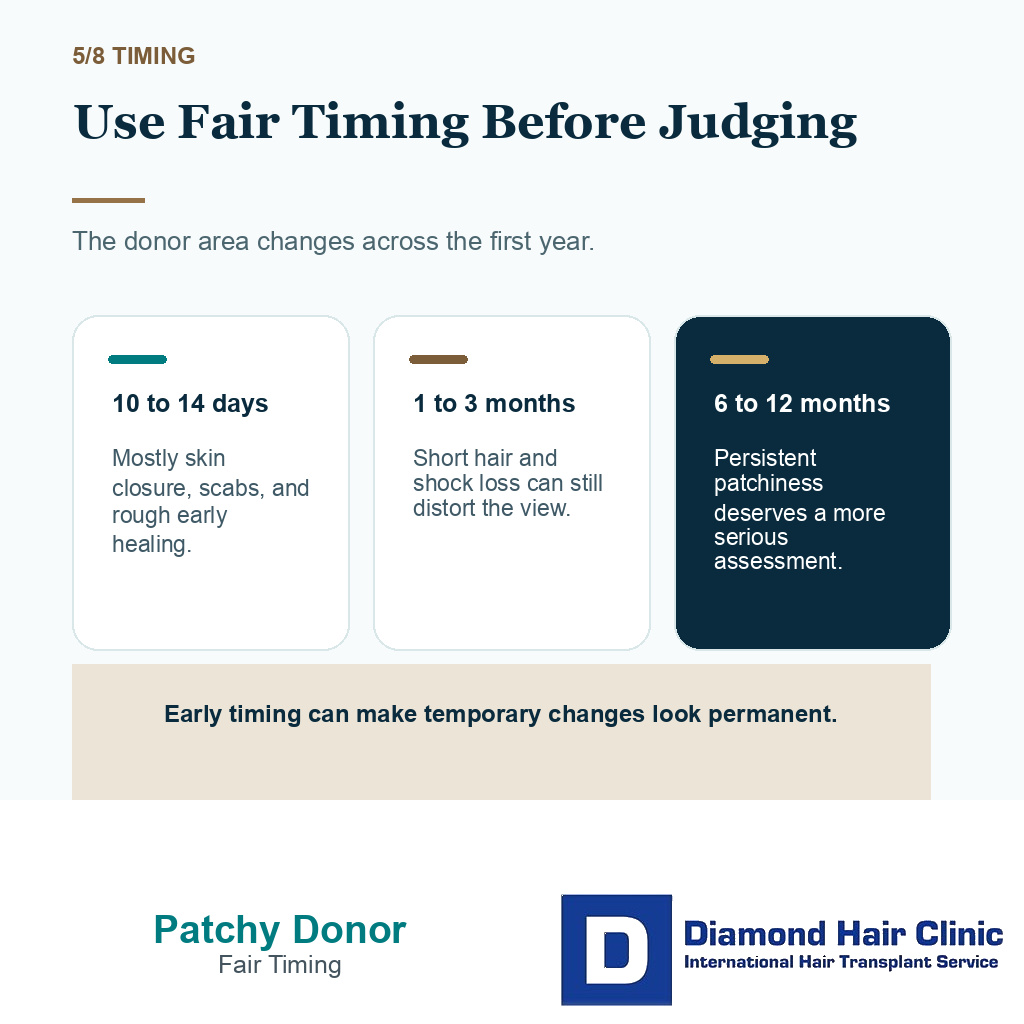
In the 10 to 14 day early healing window, skin closure, scab removal, and donor recovery are still in progress. The donor area can still look rough during that time. I do not make a final judgment from that period unless there are signs of infection, necrosis, heavy scarring, or obvious extraction abuse.
From one to three months, the donor can still look uneven because the hair is short and shock loss may be active. I have explained separately why the donor area can look uneven at one or two months after FUE, because that early window can make temporary changes look permanent.
At three to six months, the picture becomes more useful, but hair length still changes the appearance. At six to twelve months, persistent visible patchiness deserves a more serious assessment. At an early stage, I separate the donor question from the recipient growth question before judging whether the whole transplant has failed. The recipient area matures slowly, and the donor area has its own recovery pattern.
Hair length and lighting change donor appearance
The donor area often looks worse after a very short haircut. A skin fade, harsh clipper length, wet hair, bright overhead light, or flash photography can reveal contrast that is not visible in normal daily lighting. A donor area photographed at 3 millimeters cannot be fairly compared with older photos where the hair was 2 or 3 centimeters long.
That comparison is not fair. Short hair removes the camouflage created by overlapping hair shafts. Fine hair also offers less coverage at the same density than thick coarse hair. Two donor areas can have the same number of extractions and look very different.
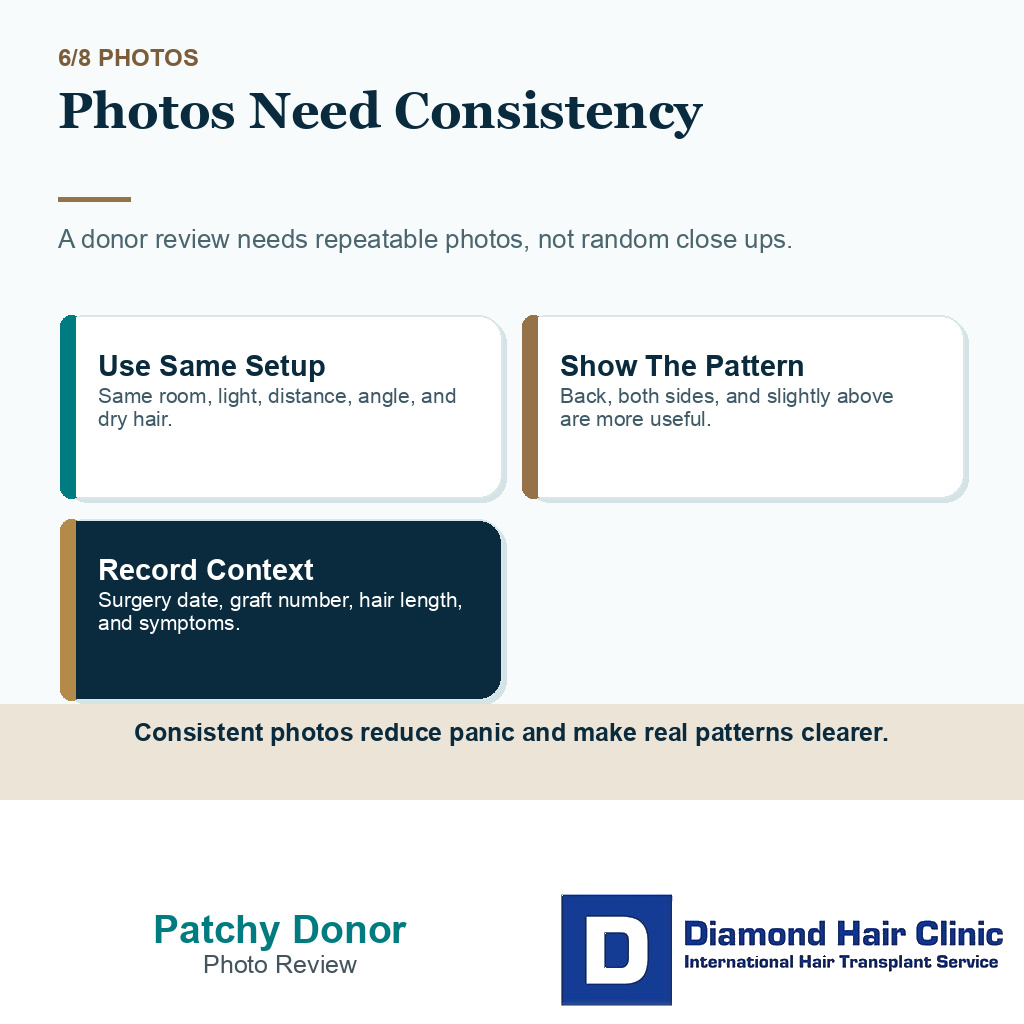
When the donor is still healing, a consistent photo series is more useful than one anxious close up before calling the result damaged. The same room, same light, same angle, dry hair, and similar hair length are more useful than random phone photos. If the hair has just been cut into a fade, I often wait for more length before judging.
If the donor still worries you late in the first year, match the haircut length before calling the patch permanent. A broader back and side view in ordinary light is more useful than one close crop. Patchiness that improves when the hair is left slightly longer is not the same problem as a fixed extraction pattern that remains visible in normal conditions.
Timing around a haircut after a hair transplant matters here. A haircut can make the donor easier to inspect, but it can also make temporary unevenness look more dramatic than it really is.
Photos that help a donor area review
Donor review needs more than one close up photo, because haircut length and extraction pattern can change the story. Clear photos from the back, both sides, and slightly above are more useful. The hair should be dry and combed naturally. The same distance and lighting should be used each time so the comparison is meaningful.
Very close photos can exaggerate small gaps. Very distant photos can hide real thinning. I also like to know the number of grafts taken, the extraction zones used, whether this was a first or later surgery, and whether there was fine hair, retrograde thinning, or previous donor depletion before surgery.
The pattern tells me a lot. Even extraction with a soft overall density change is more reassuring. A concentrated empty zone, visible stripes, sharp holes, or obvious asymmetry raises concern. Good hair transplant tools and techniques help, but technique alone cannot save a poor donor plan.

A proper donor review needs repeatable photos, similar hair length, and a clear view of the extraction pattern.
One close up photo can create more fear than clarity. I do not diagnose the donor from a single angle because haircut length, flash, swelling, shock loss, and camera distance can all change the picture. Repeatable views are what make the discussion useful.
Immediate post-op donor photos can be useful later because they show where the grafts were actually removed. If the donor looks uneven during early recovery, compare the same haircut length and lighting before deciding whether you are seeing temporary shock loss, concentrated extraction, or a mix that needs to be checked in person. Keep one wider photo from the back of the head as well. A close patch photo can hide whether the extraction pattern is local or part of the whole donor plan. Request the clinic’s donor photographs and operation record before deciding what a later change means.
Patchy donor areas can recover depending on the cause
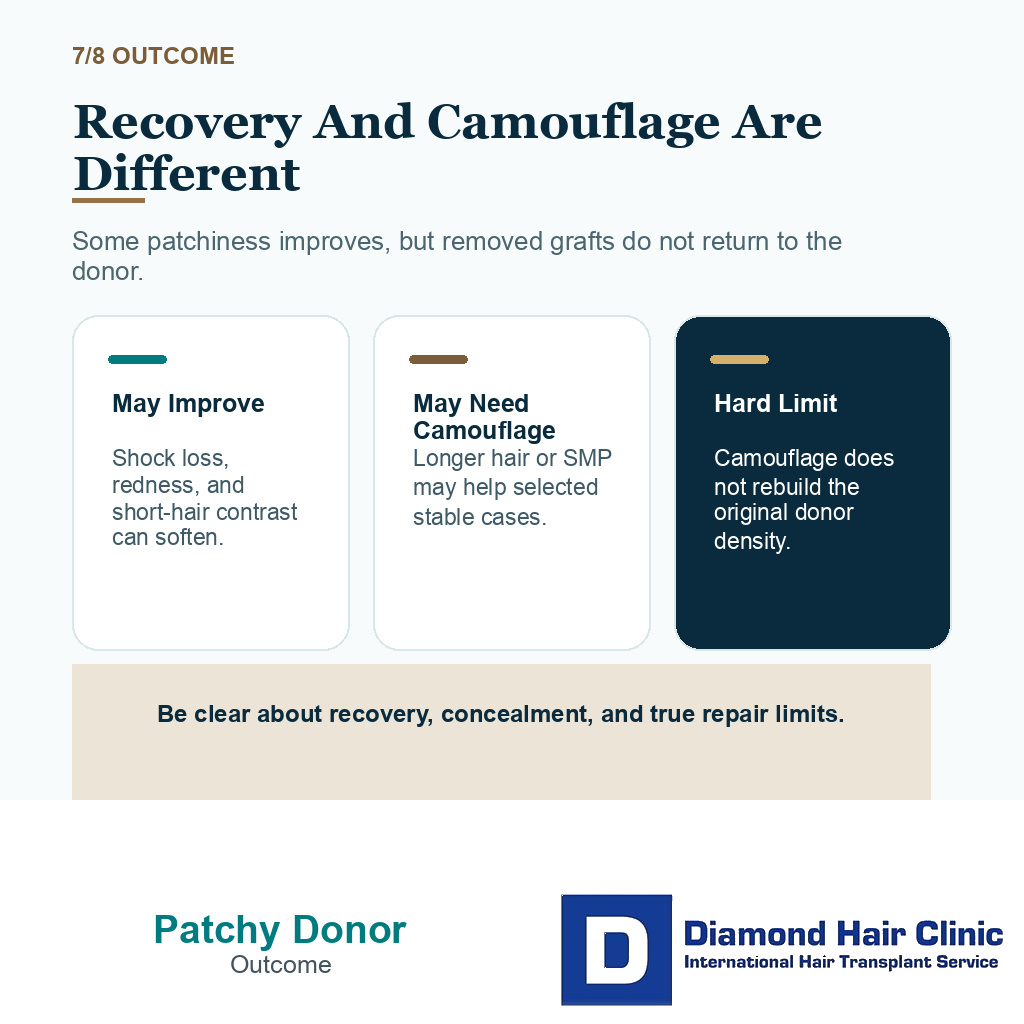
Some donor patchiness improves without a repair procedure. Temporary shock loss can recover, redness can fade, hair can grow longer, and the contrast between extraction points and surrounding hair can soften. Patience is often the correct first step when the timing is still early.
Recovery is less likely when the issue is true overharvesting. Removed grafts do not return to the donor area. Longer hair may conceal the thinning, and scalp micropigmentation may help selected cases, but those are camouflage strategies. They do not rebuild the original donor density.
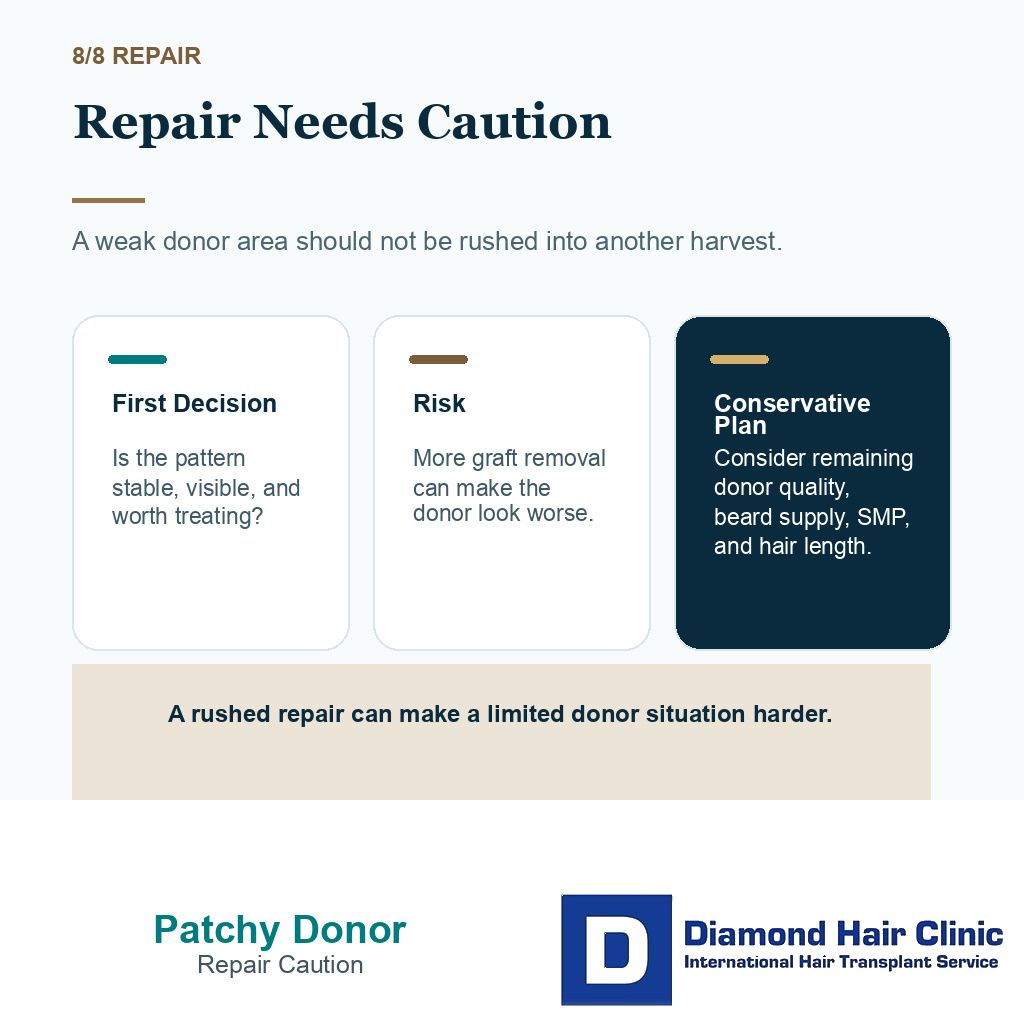
If the donor was damaged by excessive extraction, a second hair transplant must be considered very carefully. Using more grafts from an already weak donor can make the back and sides look worse while still not solving the main cosmetic concern.
A corrective operation needs its own donor review, not only an apology for the first result. Before more grafts are taken, I want the old extraction pattern, current donor density, scar visibility, recipient growth, and remaining reserve reviewed together. The repair plan should explain what will change this time, because adding grafts without understanding the first donor problem can make both the donor and the result harder to fix.
Things to avoid while the donor area heals
During early healing, avoid scratching, hard rubbing, aggressive massage, harsh clippers, sun exposure, and cosmetic products that irritate the skin. If the donor area itches, pressing or rubbing until it bleeds can create inflammation that makes the area harder to judge.

Gentle washing matters. The donor area often tolerates washing earlier than the recipient area, but rough movement still irritates healing skin. The safest habit is clean, gentle handling and a low threshold for follow up if the skin becomes hot, painful, increasingly red, or pustular.
The same idea applies to washing after a hair transplant. Cleaning should protect healing skin instead of turning into a test of force. If you are worried about donor patchiness, daily rubbing and repeated inspection can create extra irritation while you are trying to understand the problem.
I also avoid repeated skin fades while the donor is being judged. Very short hair can make temporary unevenness look worse, and frequent clipping can keep you trapped in the most unforgiving view of the area.
Repair after donor overharvesting
Repair is sometimes possible, but it has limits. A donor area that has been thinned by overharvesting cannot be restored to its original state. Repair may involve longer hair styling, scalp micropigmentation, carefully selected graft redistribution, beard or body hair in limited situations, or a decision not to operate again. If beard or chest hair might become one of those reserves, it should be reviewed before broad laser hair removal.
The hardest part is expectation. Many people want the donor area to look untouched again. That is rarely realistic if too many grafts were removed. I first decide whether the donor problem is visible enough to justify treatment, and whether treatment would create a new problem elsewhere.
When the pattern is truly depleted, I treat it as a repair planning problem, not a cosmetic quick fix. The separate question of whether an overharvested donor area can be repaired depends on remaining donor quality, beard availability, scar pattern, hair length preference, and tolerance for compromise.
Preventing donor patchiness before surgery
Prevention starts before the first extraction. The surgeon must examine donor density, hair caliber, miniaturization, safe zone boundaries, future hair loss, and the likely need for later surgery. A graft number is not a trophy. It is a withdrawal from a limited donor budget.
Very high graft numbers can look attractive in a package offer, but the donor area pays the price when planning is careless. Fine hair, low density, or early retrograde thinning should not be treated like thick stable donor hair.
The consultation itself matters too. If the graft number was given before proper donor examination, the number is not a medical plan. It is only a promise. The donor area deserves more respect than that, because every graft removed from it changes what remains for the future.
Good donor management is visible in the logic of the plan. The extraction should be spread intelligently, the safe donor zone respected, and the recipient area planned with the future in mind. That is the same reason I discuss donor area overharvesting as a planning failure rather than only a bad cosmetic outcome.
Use these 8 patchy donor review slides to separate early healing changes from warning signs that need closer assessment. Swipe sideways, use the arrows to move one slide at a time, or choose a number below the image to jump to a specific slide.


Sensible steps if you are worried now
First, take repeatable photos and stop judging the donor under the worst possible lighting. Note the surgery date, graft number, hair length, symptoms, and whether the patchiness is improving, stable, or worsening. If there is pain, pus, spreading redness, fever, black scabbing, or bleeding after repeated rubbing, contact your clinic promptly.
If you are still within the first few months, the most sensible step may be observation with proper follow up. If you are six to twelve months out and the donor still looks visibly thin at a reasonable hair length, ask for a clear donor assessment rather than a quick reassurance.
The donor area is the reserve for your whole hair restoration plan. Protecting it matters more than winning a short-term graft number. If the donor has only temporary shock loss, time may improve the picture. If the donor was truly overharvested, the next decision must be conservative, because a rushed repair can make an already limited donor situation even harder.

Read this review excerpt
told me the quality of my donor hair and what he could take out and advised me what will the be best outcome with what donor hair I had.