



Retrograde Alopecia, DUPA, and Hair Transplant Candidacy
A hair transplant with retrograde alopecia is only possible if there is a truly safe donor area left and the plan is conservative enough to protect your future. With confirmed true DUPA, my answer is usually much more cautious because the donor area itself may not be dependable. Surgery may need to wait, stay very small, or be refused.
Retrograde thinning and true DUPA do not create the same donor problem. Retrograde thinning can narrow the donor zone from below or from the sides, so the safe area may be smaller than it appears in a single rear photo. True DUPA can involve the areas we normally rely on as safer donor hair. One problem may leave a smaller safe zone for extraction. The other may leave no reliable safe zone at all.
The factor that changes the decision most is not the bald area you want to cover. It is whether the donor hair is stable enough to behave well after it is moved. If the donor zone is weak or unstable, moving more grafts does not solve the problem. It may move weak hair and create a weaker future result.
I understand why this question creates anxiety. Patients look at the back and sides of the scalp and think, if even this area is thinning, do I still have any chance? The answer needs a proper donor diagnosis, including a safe zone check for donor miniaturization. It depends on the pattern, donor strength, speed of change, medical history, and whether the goal is realistic.
Photos of only the center back of the scalp can miss the problem. I want to see the nape, sides, area above the ears, and donor under magnification before treating a graft number as safe.
Part the donor hair in more than one place. A dense patch in the middle can hide weaker lower or side areas that change the safe extraction plan.
Retrograde alopecia changes the donor area decision
Retrograde alopecia usually means thinning that moves upward from the nape or from the lower sides around the ears. It matters because the lower and outer borders of the donor area are often less safe than patients imagine. Not every hair on the back and sides is reliable permanent donor hair. This is the same reason nape hair for hairline transplants belongs in a selective donor plan rather than an easy shortcut.
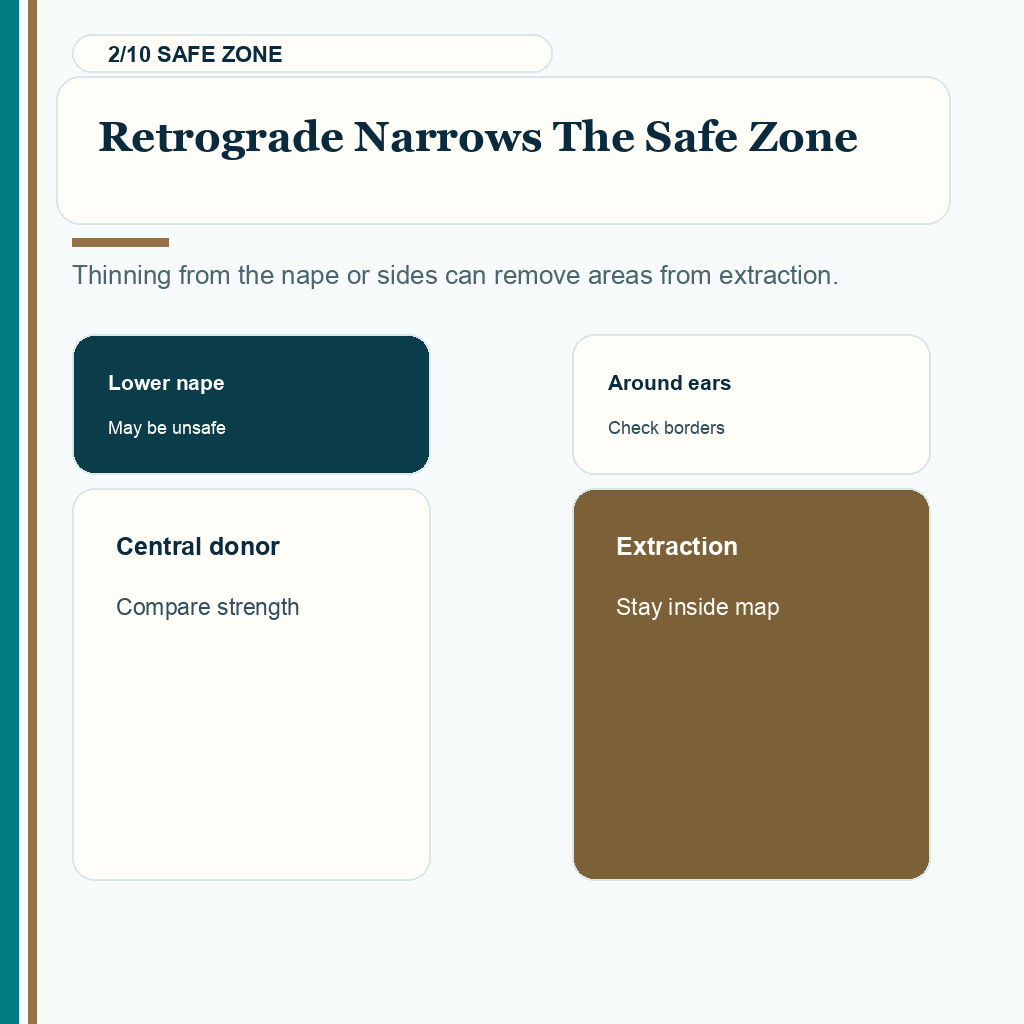
When I examine the donor area, I am not only checking whether hair is present. I am checking whether that hair belongs to a stable zone. If the thinning is moving upward, the usable donor area may become narrower. That can reduce how many grafts I can safely extract and where I can safely extract them from.
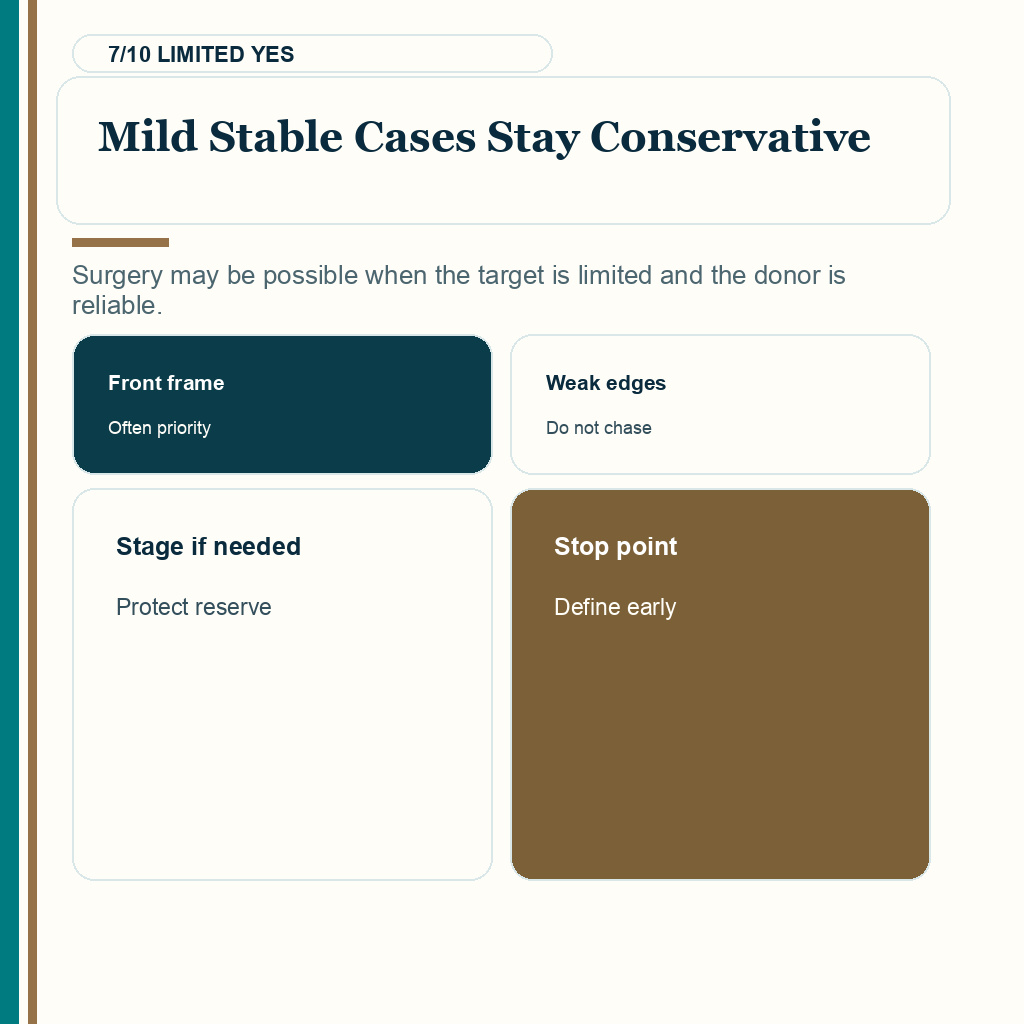
A mild retrograde pattern does not always make surgery impossible. Some patients still have a strong central donor area. But it changes the planning. I may avoid the lower nape, reduce the graft number, raise the priority toward the frontal frame, or stage the treatment instead of trying to cover too much in one session.
The unsafe decision is to ignore the pattern because the patient wants a big transformation. If the donor border is not stable, aggressive extraction from that border can make the donor look thin and can also move weaker hairs into the recipient area.
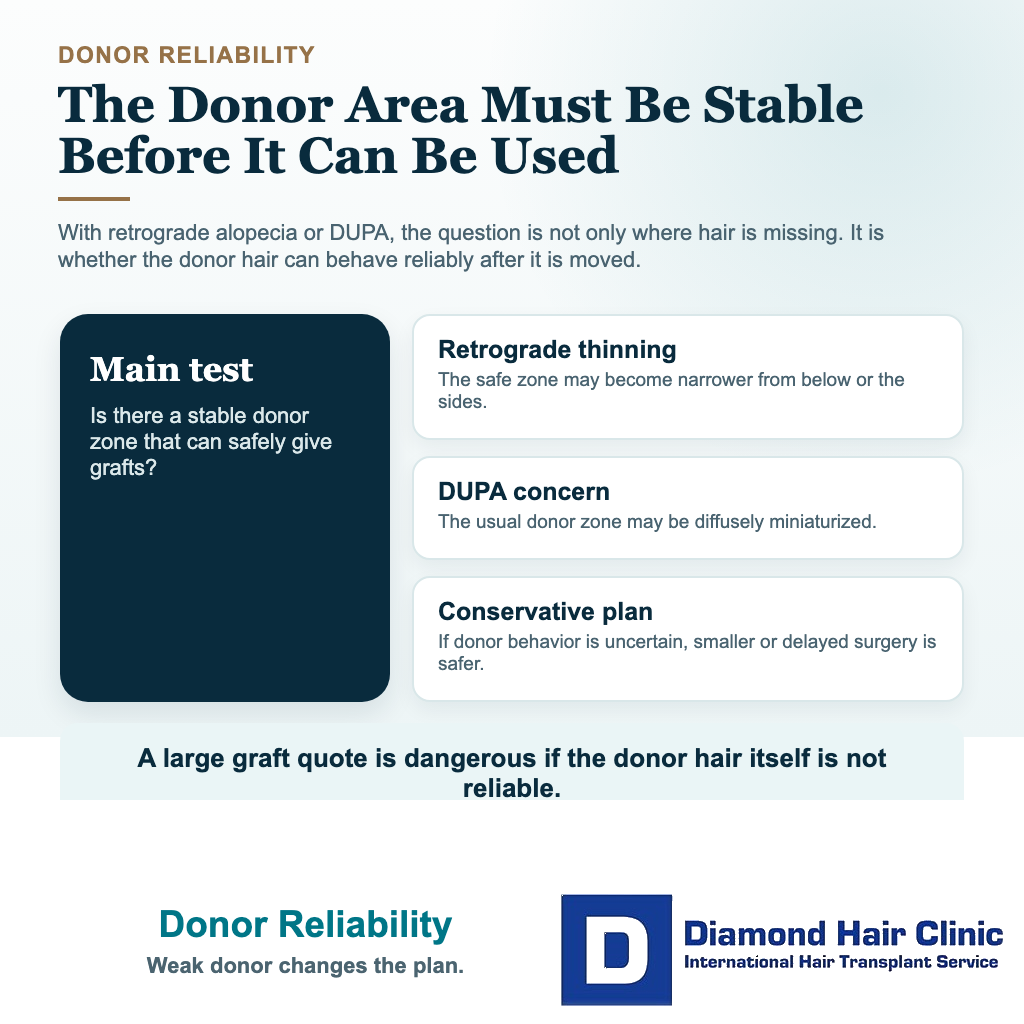
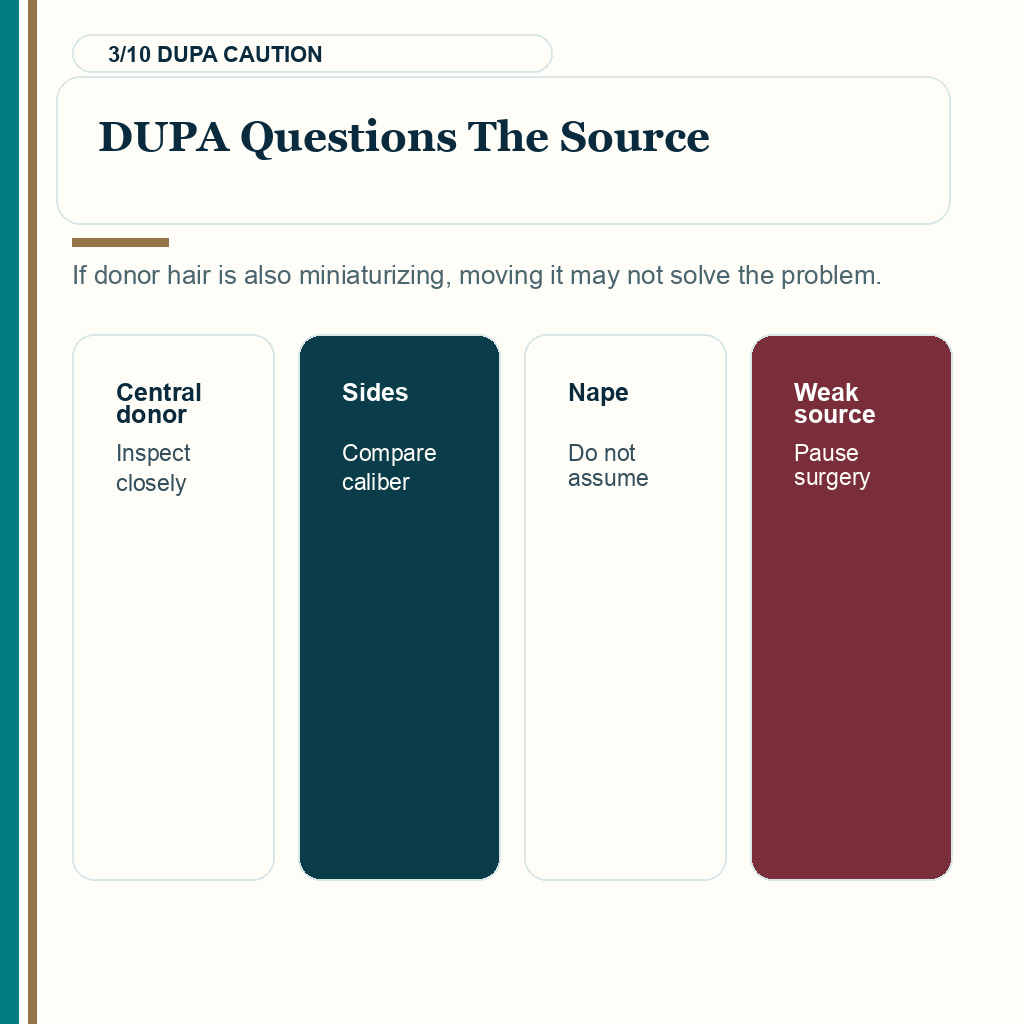
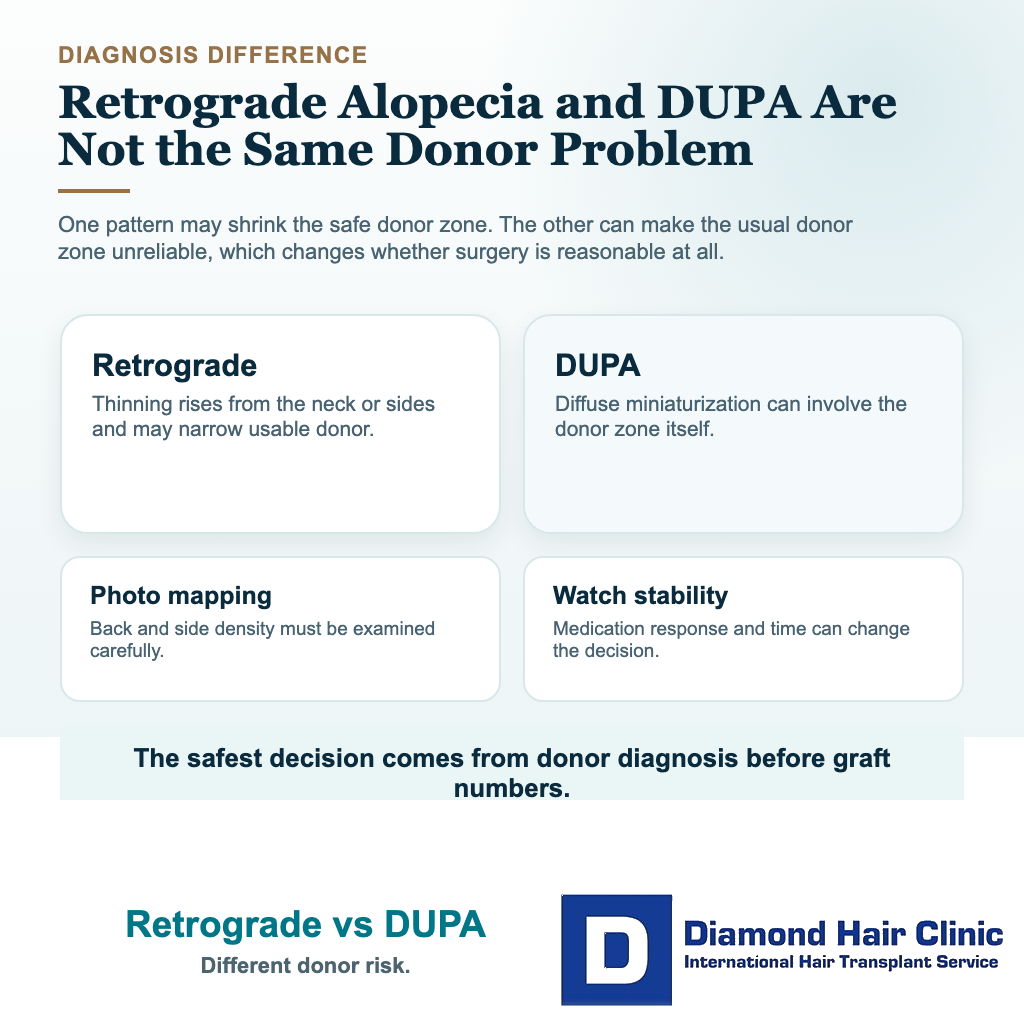
These donor reliability slides explain why retrograde thinning and DUPA must be checked before graft numbers are discussed. Swipe sideways, use the arrows for one slide at a time, or choose a number below the image.
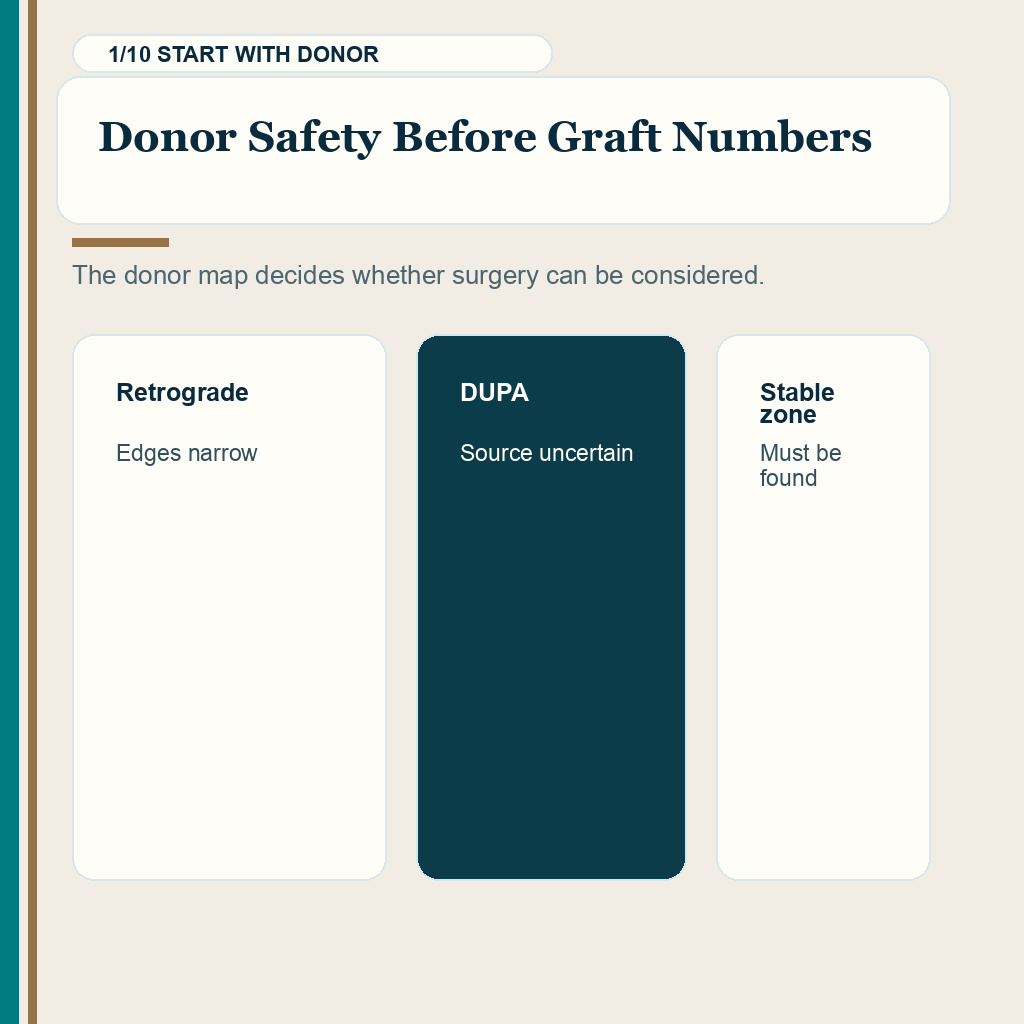



DUPA is different from ordinary diffuse thinning
DUPA means diffuse unpatterned alopecia. In simple words, thinning is not limited to the usual top, front, or crown pattern. The donor region may also be affected. That makes DUPA more serious for surgery than ordinary diffuse thinning in the recipient area.
In a patient with diffuse thinning, I may still find a stable donor area at the back and sides. The challenge is often how to place grafts between fragile native hairs without causing unnecessary shock loss or wasting grafts. With DUPA, the concern is deeper. The source of the grafts may not be dependable.
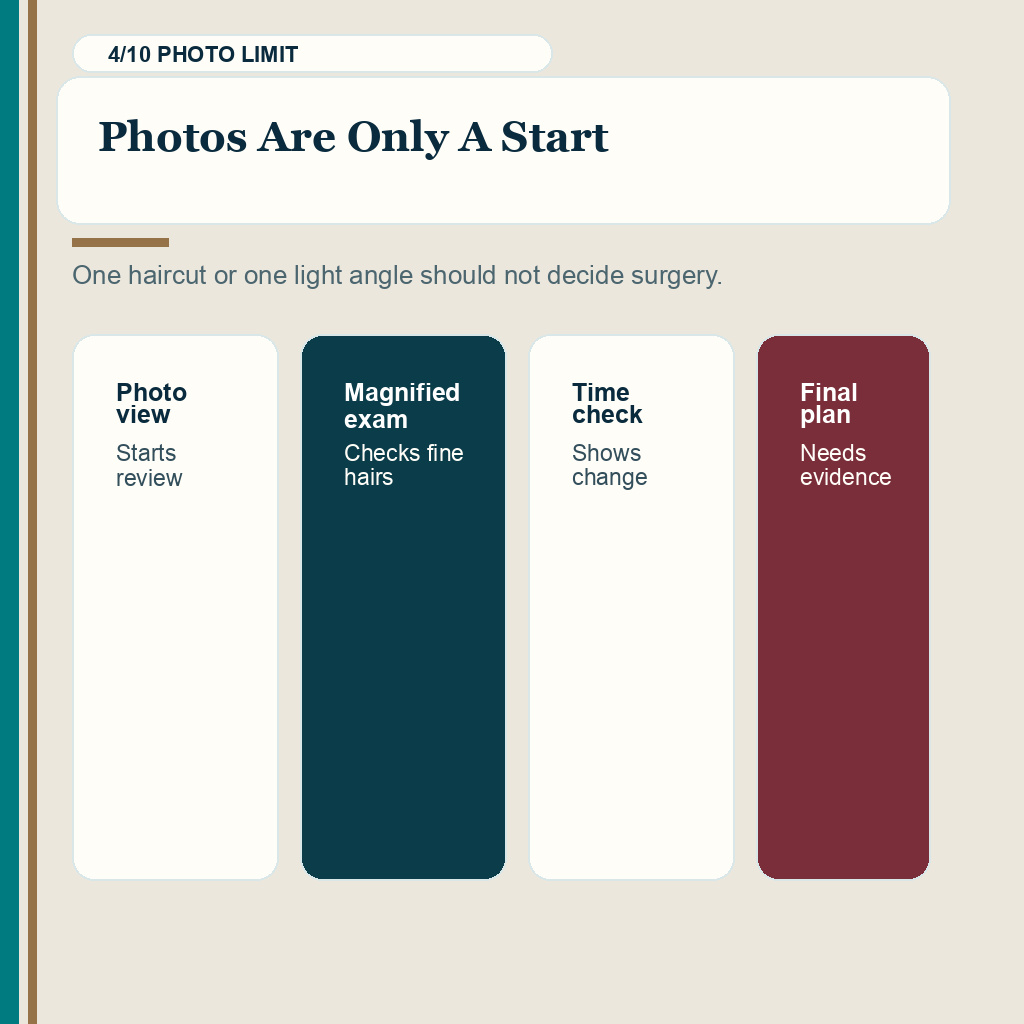
Photos alone can be misleading. A donor area may look acceptable in one haircut, one light, or one angle. With magnified examination, I may see many fine and miniaturizing hairs mixed among stronger hairs. This is the practical distinction patients often miss. A donor can look full enough in a mirror and still be unsafe as a surgical source if too many of those hairs are miniaturizing.
DUPA cannot be diagnosed from one photograph or one nervous haircut comparison. A magnified donor examination should compare the central donor, sides, nape, and thinning areas, and sometimes the pattern needs time under treatment before I decide whether the donor is safe enough to use.
I am careful not to frighten patients with the word DUPA. Many people worry they have it when they only have fine hair, a short haircut, poor lighting, or temporary shedding. But I also do not dismiss the concern without proper examination. The donor area must be judged with patience, not with a quick promise.
A fade can expose lower donor thinning that longer hair was hiding. Cutting the hair shaft does not create retrograde alopecia.
Examining donor zone stability
I look at the donor area as a map, not as one broad block of hair. The central occipital area, the sides, the lower nape, and the zones around the ears may not have the same reliability. A patient can have a strong center and weak lower borders.
I also compare hair shaft thickness, density, the number of single hair units, miniaturization, scalp visibility, and how the hair looks under different lighting. I pay attention to variation, because a donor with many fine miniaturizing hairs mixed among stronger hairs is not the same as a dense stable donor. If the donor seems questionable, a plan made from photos is only a starting point, not a final surgical decision.
Technique does not remove this diagnosis. FUE, Sapphire FUE, and FUT all still depend on a stable donor zone. FUE can overharvest weak donor hair if the map is wrong, and FUT can leave a linear scar through hair that may thin later. The method matters, but donor mapping comes first.
Repeated assessment over time is sometimes the safer way to decide. A single photo can exaggerate thinning or hide it. What matters is whether the same donor zones stay stable when they are checked again, not whether one image looks reassuring.
Medication can make surgery safer before a decision
Medication can sometimes make the decision safer, but not because it magically creates a new donor area. Its value is that it may stabilize ongoing hair loss, improve some miniaturized hairs, and show whether the pattern is still changing. If the donor improves or stays stable, that can change how cautiously we plan. If it keeps weakening, that information may prevent a surgery that would age badly.
When I discuss medication before a hair transplant, I am thinking about the patient’s future as much as the present. If medical treatment reduces progression in the native hair, the patient may need fewer grafts. If it improves the crown or middle scalp enough, surgery can focus on the area that gives the strongest visual improvement.
In suspected retrograde alopecia or DUPA, medication decisions should be individualized. Some patients tolerate treatment well and may benefit from waiting to see whether the donor and native hair stabilize. Other patients cannot or do not want to use certain medications. That must be respected, but the surgical plan then has to become even more careful.
Medication is not automatic permission for surgery. That would be too simple. If donor reliability is questionable, I need evidence of stability and a conservative extraction plan before I spend grafts from it.
Watching the pattern before surgery
If the hair loss is changing quickly, I often prefer 6 to 12 months of observation or medical stabilization before making a final surgical decision. This is especially true in young patients, patients with rapid progression, and patients whose donor area looks weaker than expected.
The waiting period is not empty time. It helps me see whether the donor is getting thinner, whether medication is helping, whether the crown is changing quickly, and whether the patient is asking for a result the donor cannot support.
A patient may feel that waiting means losing time, but in this situation waiting can protect the donor area. A rushed operation with unstable donor hair can create a permanent problem that is harder to repair than the original hair loss.
Surgery can still be possible in mild and stable cases
Surgery can still be possible when the diagnosis is mild, the central donor area remains strong, the hair loss is not rapidly progressing, and the goal is limited. In that case, the decision is not only whether I can transplant hair. It is how small and precise the plan should be.
Being a good candidate for a hair transplant becomes more specific here. A patient with retrograde thinning may be a candidate for a modest frontal improvement but not for full hairline, middle scalp, and crown coverage. Another patient may be better served by waiting until the pattern is clearer.
I review hair caliber, curl, scalp contrast, age, family pattern, previous surgery, donor density, and emotional expectation. Fine straight dark hair on light skin gives less camouflage than thicker wavy hair with lower contrast. The same graft number can look very different in two patients.
If surgery is possible, the plan needs a clear stopping point. I avoid creating a design that only looks acceptable if the patient later accepts more surgery that the donor may not support. A protected plan must still make sense if it is the only surgery the patient ever has.
Reasons I may advise waiting or refusing surgery
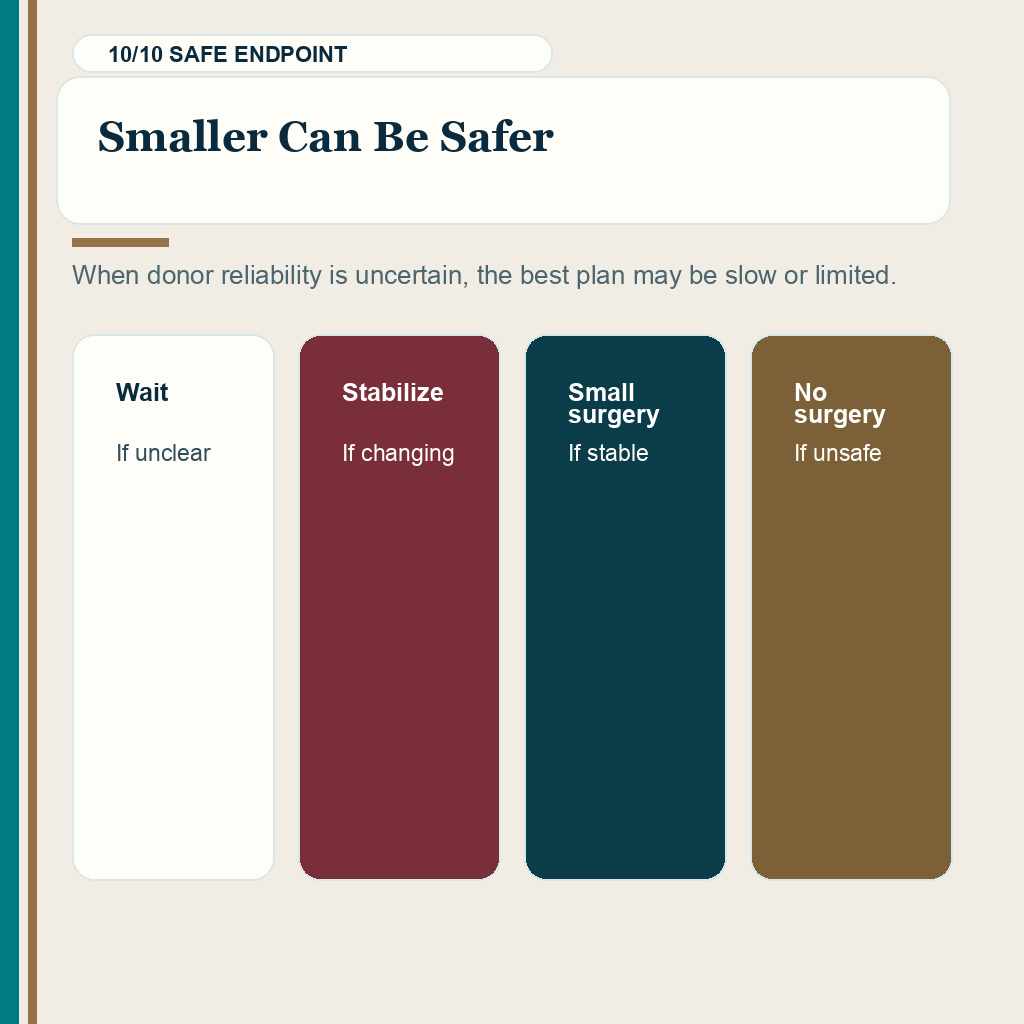
I advise waiting when the donor looks unstable, when the patient is very young with rapid progression, when the diagnosis is unclear, or when the requested result needs more grafts than the donor can responsibly provide. Waiting is not weakness. In this situation, waiting can be good surgical judgment.
I may refuse surgery if donor supply is diffusely miniaturizing and there is no dependable safe zone. I may also refuse if the patient wants a low dense hairline, full crown coverage, and a large transformation while the donor is already warning us to be careful. Saying yes to that plan would not be kindness.
Many patients are afraid that refusal means they have no options. That is not always true. It may mean medical stabilization, a smaller goal, a different timing, scalp micropigmentation in selected situations, a hair system, or simply avoiding a surgery that would make later repair harder.
The hardest part is emotional. A patient may feel time is being lost. But a rushed operation with an unstable donor can turn a difficult hair loss situation into a permanent donor problem. Disappointing a patient before surgery is difficult, but it is better than creating a result that becomes a larger regret later.
Large graft quotes can be dangerous in this situation
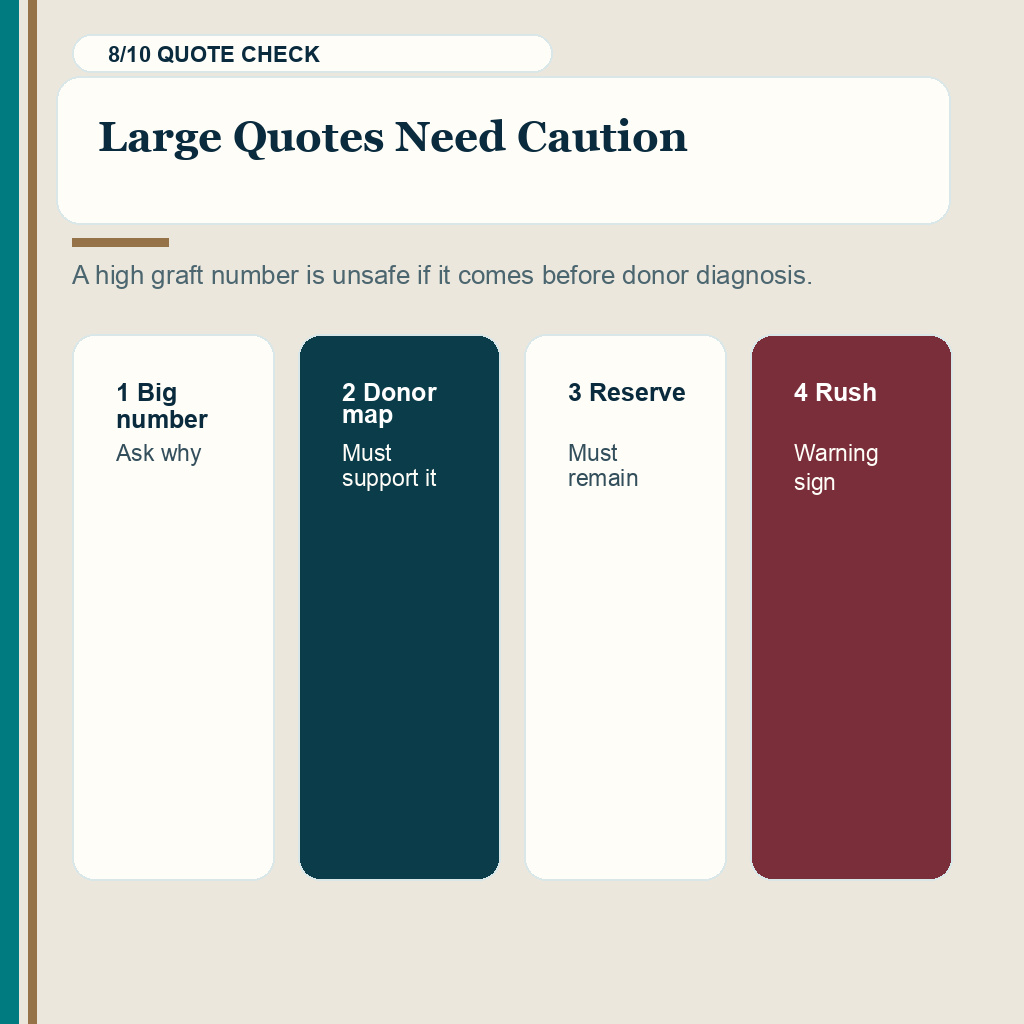
A large graft quote can be dangerous when it is offered before the donor has been properly evaluated. In retrograde alopecia or DUPA, the issue is not only how many grafts can be removed today. The question is how many should be removed from a donor that may already be shrinking or weakening.
This connects closely with donor area overharvesting. If a clinic harvests too low, too wide, or too aggressively from unsafe zones, the donor can become visibly thin. The patient may then have both an incomplete result in the recipient area and a donor area that is harder to wear short.
Before I accept any number, I need to understand why that number is right for this patient. I think about the safe zone, the future crown demand, the patient’s age, the risk of continued loss, and whether the grafts being counted are truly worth extracting. How a surgeon calculates graft numbers should be explained in context, not used as a sales number.
In a questionable donor, a smaller surgery may be the better surgery. That is not a lack of ambition. It is careful planning that keeps future options open. If a plan spends too much of the donor area early, it may remove the patient’s ability to correct, add density, or adapt later.
Hairline or crown treatment order
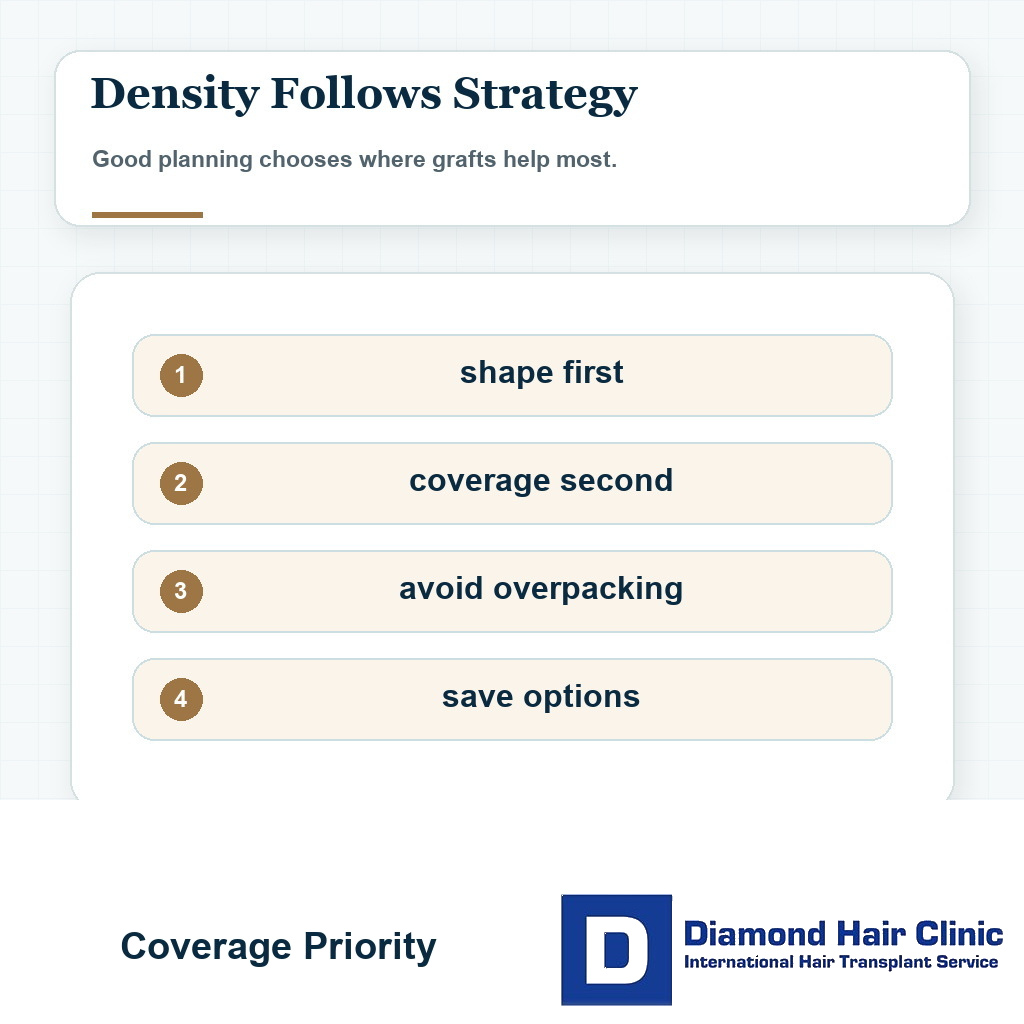
In many patients with limited donor capacity, the hairline and frontal frame deserve priority over the crown. The front frames the face and usually gives the strongest visual change with the most controlled use of grafts. The crown can require many grafts and still look thin because of its spiral pattern and larger surface area.
The question of hairline or crown first in a hair transplant becomes especially serious when retrograde alopecia or DUPA is suspected. If the donor is limited, treating every area at once may weaken the result everywhere.
I am deliberate about the crown because it can quietly consume grafts. A patient may want the crown filled because it is visible in photos, but if the donor is not strong, heavy crown work can reduce what is available for the front or for future loss. A crown hair transplant needs planning with realistic limits, not with pressure to cover everything.
If the donor is excellent, we may have more room to discuss a broader plan. If the donor is questionable, every graft matters more. It must be placed where it gives the patient the most stable and natural improvement.
Beard or body hair may help only with careful donor planning
Beard or body hair can help in selected cases, but it cannot erase an unstable scalp donor diagnosis. I sometimes consider extra donor sources when a patient has advanced baldness, previous surgery, or limited scalp reserve. But I do not use them as an excuse to ignore donor instability.
Extra donor sources need their own consent discussion because body hair as a donor source behaves differently from scalp hair. Beard hair can be thicker and useful for adding bulk in some zones. Chest or body hair can be more variable in length, texture, growth cycle, and visual blending.
In suspected DUPA, the first priority is diagnosis and stability. If scalp donor hair is unreliable, replacing the whole plan with body hair is not a simple solution. The frontal hairline still needs soft natural graft selection. The crown still needs realistic coverage planning. The patient still needs to understand that body hair is support, not a miracle.
When used well, extra donor sources may help a carefully selected patient. When used as a sales promise, they can create a false sense of safety, and that needs to be clear before surgery.
If you try not to use finasteride
Some patients do not want to use finasteride, or they cannot use it comfortably. I respect that. But if donor reliability is already questionable, refusing medical stabilization changes the risk discussion.
Having a hair transplant without finasteride usually means the operation must become more conservative when ongoing loss is not medically controlled. In retrograde alopecia or suspected DUPA, that caution becomes stronger.
If a patient does not want medication, I may still consider surgery in selected mild cases, but the goal has to be smaller and donor protection becomes even more important. The absence of medication should not be used as a reason to rush a large operation.
How I protect patients from a false donor quote?
With retrograde alopecia or DUPA, a high graft quote can be dangerous because it may count hair that is not stable enough to move. I do not judge the donor zone as one block. I compare the center, lower nape, sides, areas around the ears, shaft thickness, miniaturization, and how the borders behave over time.
I reduce or refuse the plan when the safe zone is narrow, the sides are thinning, the lower border is moving upward, or the patient wants a dense low hairline and crown coverage from a donor that is already warning us to be careful.
The written plan should say where grafts can safely come from, where extraction should be avoided, what role medication or observation has, and why beard or body hair does not erase an unstable scalp donor diagnosis.
Signs to check before trusting a clinic plan
Listen less to how confident the clinic sounds and more to how carefully it explains the limits. A good plan should tell you what can be done, what should not be done, and why. If donor reliability is questionable, the explanation should become more careful, not more dramatic.
Before committing, the donor must be examined as a safe zone, not just treated as a broad area with hair. The clinic should be able to explain why the lower nape or thinning sides are safe or unsafe, and why the graft number matches donor quality rather than only the bald area.
Also notice whether the clinic is willing to slow the process down. If a patient may have retrograde alopecia or DUPA, fast acceptance from photos alone can be a warning sign. The plan should not depend on excitement, urgency, or a package number. It should depend on examination and surgical reasoning.
The consultation should leave you more informed, not merely more hopeful. Hope has a place, but in surgery it must be connected to biology.
Protecting future hair when the donor is uncertain
A protective decision starts by accepting that donor hair is a lifetime graft budget. If the budget is strong, the plan can be more flexible. If the budget is weak, narrow, or unstable, the plan must become smaller, slower, and more selective.
If you suspect retrograde alopecia or DUPA, do not chase the clinic that gives you the biggest graft number first. Look for the surgeon who explains the donor risk most clearly. This is often the difference between a plan that protects the patient and a plan that only sounds impressive.
Sometimes the right decision is surgery. Sometimes it is medication and observation. Sometimes it is a very limited frontal plan. Sometimes it is no surgery. The useful detail is that the decision fits your donor area, your age, your future loss pattern, and your emotional expectations.
A hair transplant should not spend unstable donor hair just because the patient is anxious today. It should use stable donor hair with a clear purpose, a natural design, and enough judgment to respect what may happen later. That is how I think about retrograde alopecia, DUPA, and donor safety.
If the plan that protects your donor area is smaller than what you hoped for, take that seriously. A smaller responsible plan can age better than a large fragile one. Protecting donor reserve is not caution for the sake of caution. It is how we reduce avoidable risk, the patient’s trust, and the options that may still matter years from now.

Read this review excerpt
Every single one of my questions was answered and they made sure I had all the details I needed to make an informed decision.