


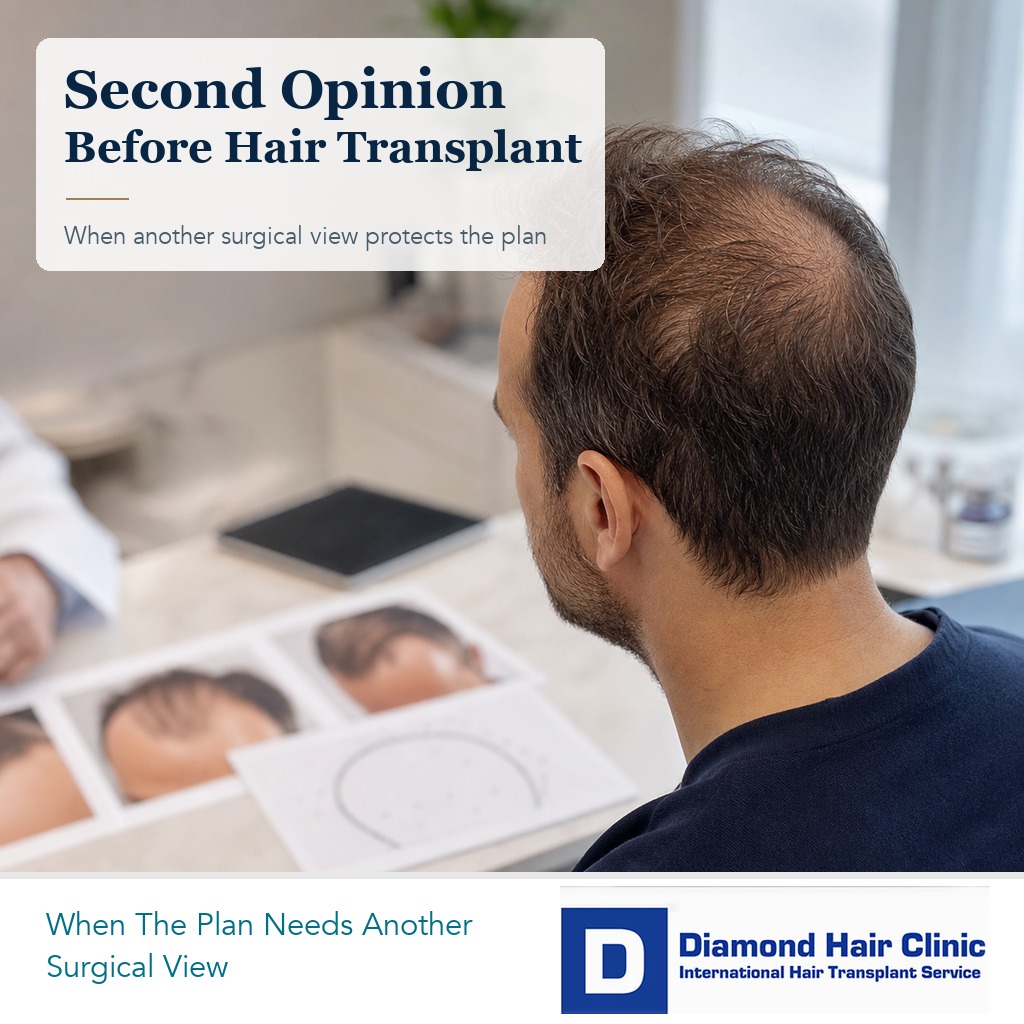
Second Opinions When a Hair Transplant Plan Feels Wrong
You should get a hair transplant second opinion when the plan feels rushed, the graft number changes sharply between clinics, the donor area has not been examined properly, the hairline looks too aggressive, or nobody medically responsible can explain why the plan is safe for your future hair loss.
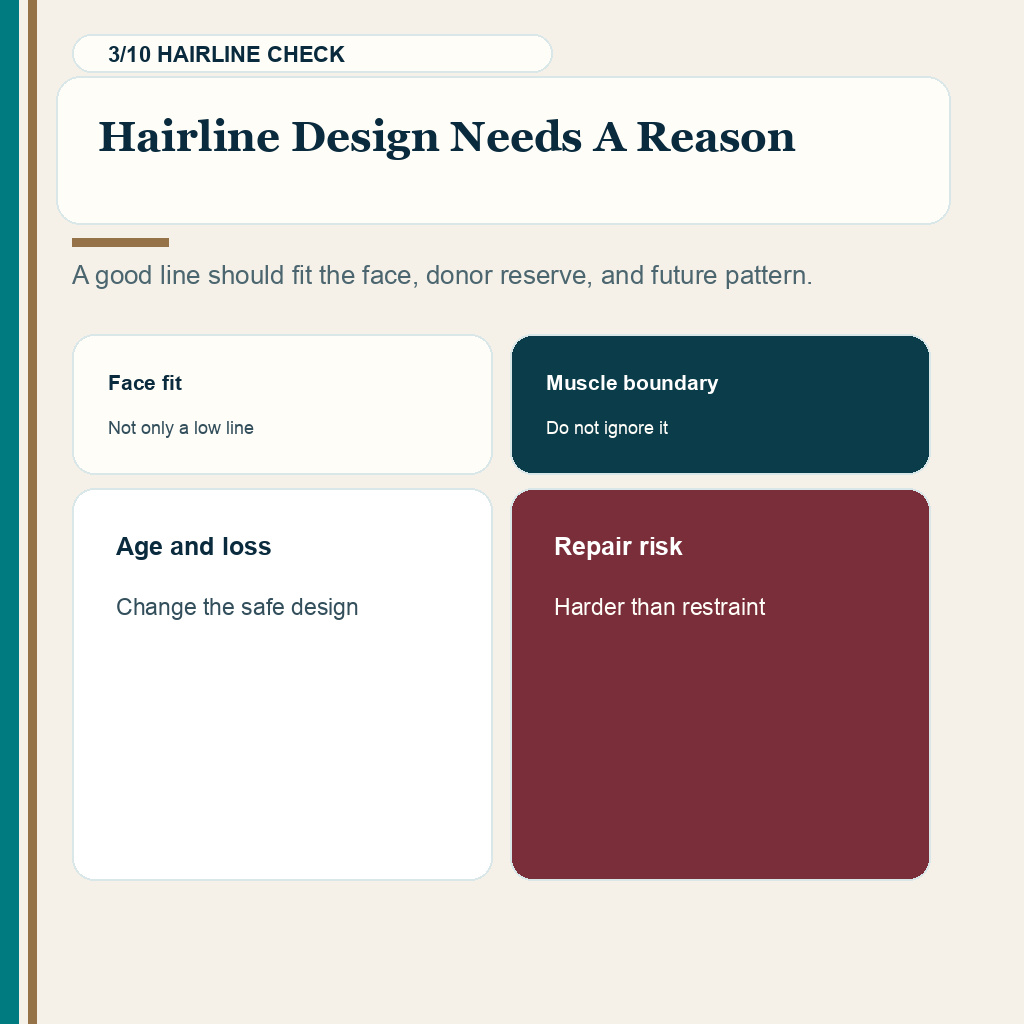
The purpose is not to collect opinions until someone says yes. The purpose is to protect your donor area, your hairline, and your future options before anything permanent is done. If the proposed line is very low, the second opinion should also check the forehead muscle and hairline lowering boundary.
If two clinics give different advice, that does not by itself mean one is careless. It does mean you need to understand the reason. When clinic trust is the main concern, judge any clinic’s best in Turkey promise by the same medical reasoning. Hair transplantation is not only a question of how many grafts can be moved. It is a question of whether the result will still make sense as hair loss continues.
If the worry began with a public comment, use online feedback to form one narrow clinical question before asking another surgeon, so you separate a useful signal from a verdict.
Practical guide
Plan the trip around
the medical decision
International patients need more than a surgery date. Use the route that matches the practical question you are trying to settle before travelling, paying, or returning home.
When does another clinical review protect you from a risky plan?
Ask for another surgical review when the proposed plan does not match what you see in the mirror, what another clinic told you, or what your own judgment is warning you about. A common example is a large difference in graft numbers. One clinic may suggest 2,500 grafts, another may suggest 4,500, and another may promise full coverage in one session.
At that point, do not simply choose the clinic that offers the biggest number. A higher graft count can sound more complete, but it may also create more risk for the donor area. A deeper explanation of why two hair transplant clinics can give different graft numbers can help you judge whether the difference is protective or careless. If the disagreement is a weak donor warning against a high graft quote, the donor measurement belongs before the decision.
The other common reason is pressure. If the consultation moves quickly from photos to price, date, discount, and deposit without a careful medical discussion, that is not a complete surgical assessment. You need to understand the plan before agreeing to the operation. An earlier slot is not a second opinion by itself, because the diagnosis, donor review, hairline, and surgeon role still have to make sense.
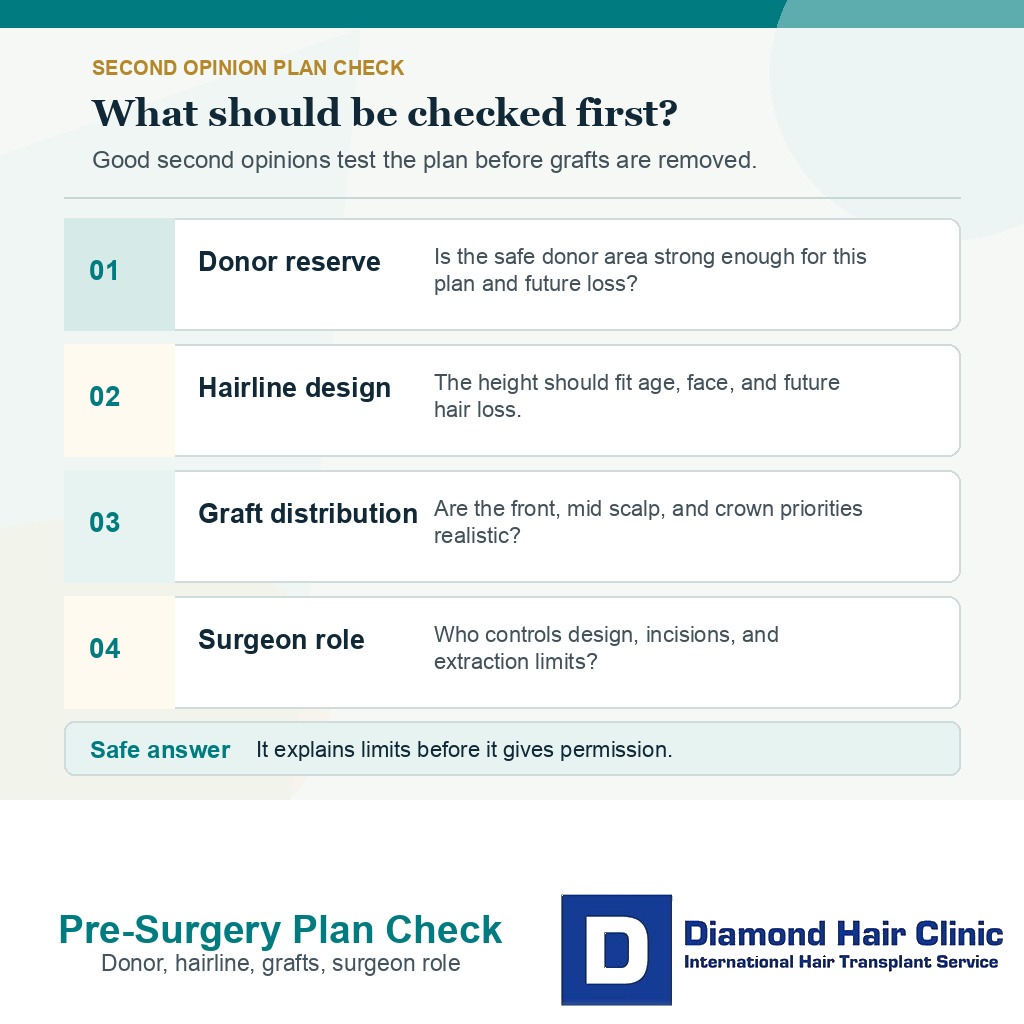
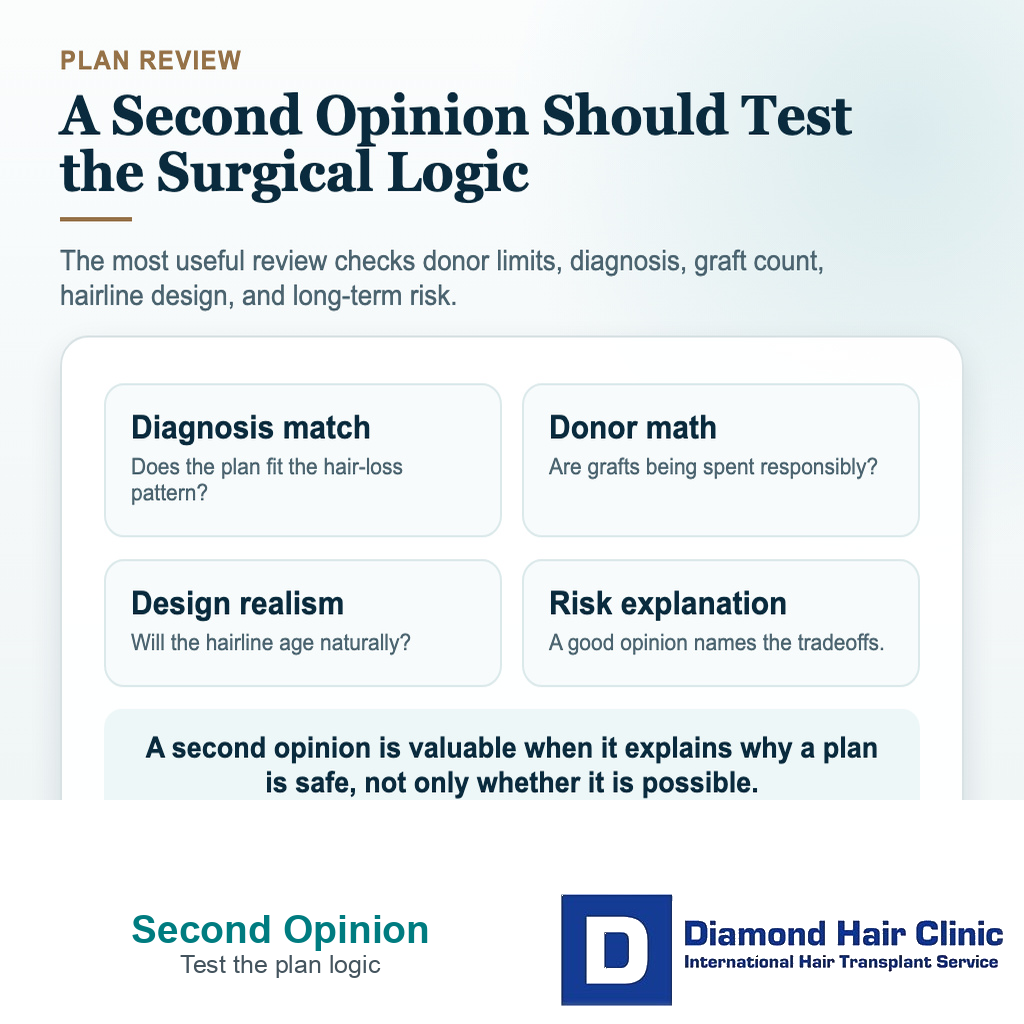
A second opinion should check donor limits, design, and long term planning
A useful second opinion checks the diagnosis, hair pulling history when relevant, donor area, recipient area, hairline design, graft distribution, medication situation, future hair loss risk, and the clinic’s proposed role of the surgeon. It should not only give one fixed answer. It should explain what is safe, what is uncertain, and what would be unwise.
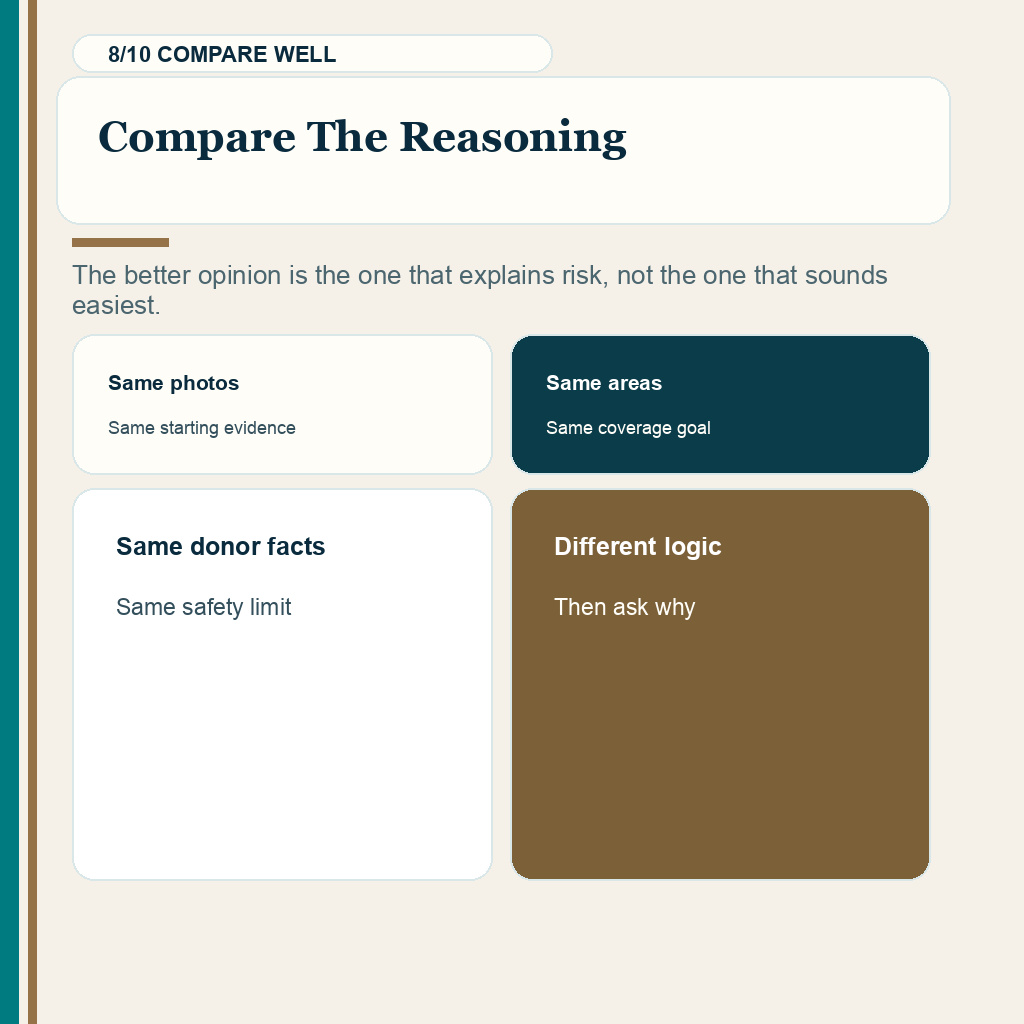
Use the same facts for each opinion. If one clinic sees a different hairline drawing, donor photo set, or medication history, you may be comparing inputs rather than judgment.
Send the first clinic’s written plan, not only the graft number you remember. A second opinion is stronger when the reviewer can see the proposed areas, hairline drawing, price pressure, and what was actually promised.
If you were declined for hair transplant first, the second opinion should explain whether the refusal was protective or whether another plan is genuinely possible. If the doubt began with a chatbot, simulator, or photo estimate, bring the AI hair transplant plan as a question list rather than a conclusion.
Several surgical refusals are not a reason to use the next consultation only to search for the first yes. Ask each clinic to write the reason for refusal and what would need to change before the case becomes safer to review again. That may include medication stability, donor measurements, age, diagnosis, blood work, hairline goal, or a longer observation period.
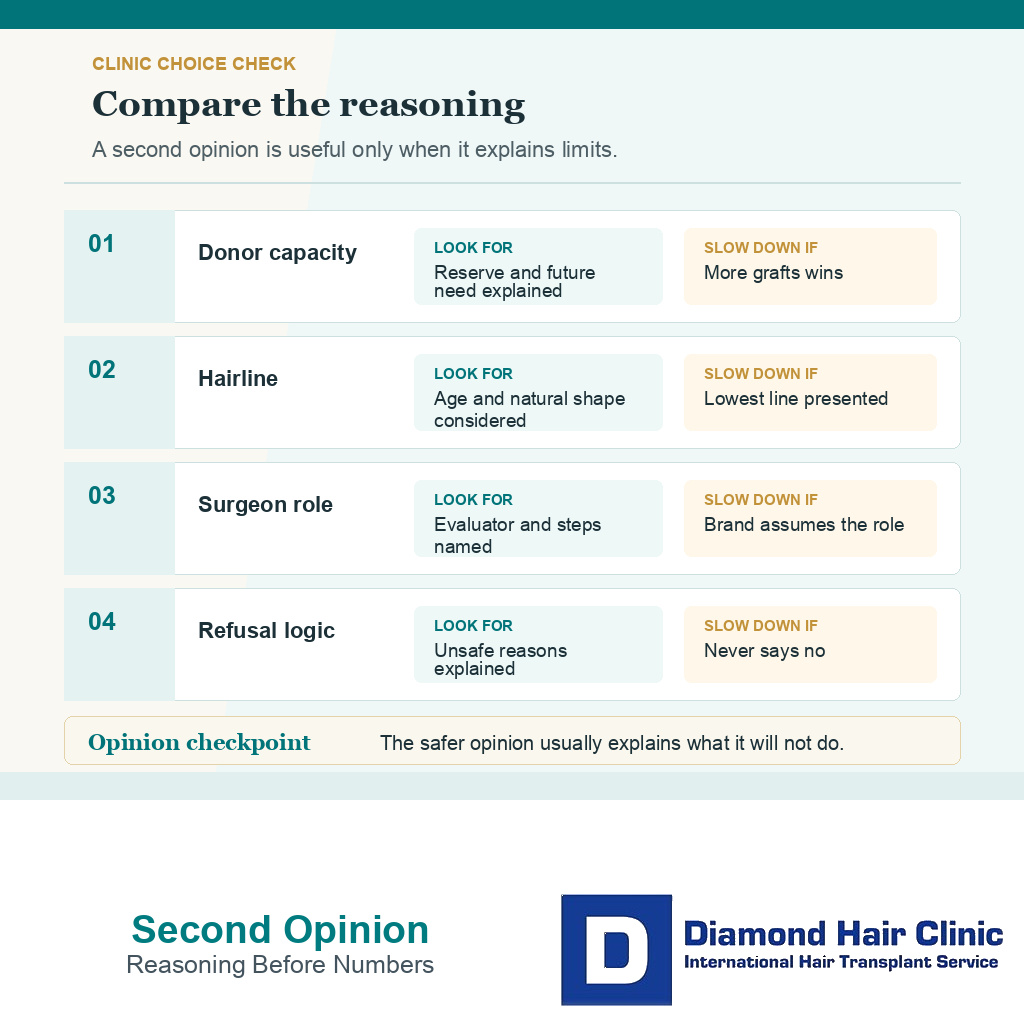
A serious second opinion should also explain what would make the surgeon reduce the graft number, raise the hairline, stage the operation, or postpone a hair transplant before surgery. If the opinion only says yes without explaining limits, it is not protecting you enough.
Several options from one clinic should be compared against the same end goal. Put the treated zones, graft range, expected visual change, donor reserve, and follow up responsibility side by side. If one option splits the work, the staged plan should also state what would make the later operation worthwhile and whether the first result still makes sense if that later step never happens.
For patients seeking the opinion before travel, the review should test the written scope rather than the most comforting promise. It should name the original diagnosis, priority zones, graft range, donor reasoning, hairline or crown tradeoff, surgeon responsibility, and the finding that would make the operation smaller or delayed after examination.
Donor examination matters most. The donor supply cannot be refilled. Once grafts are extracted, they do not grow back in the donor area. If the extraction pattern is too aggressive or taken from weak zones, you may lose options for a second session, crown work, or repair surgery later.
A serious plan has to look beyond today’s hairline. The surgeon has to judge donor density, hair caliber, miniaturization, safe extraction zones, and the amount of bald or thinning area that may need coverage in the future. I do not separate a second opinion from lifetime hair transplant graft planning.
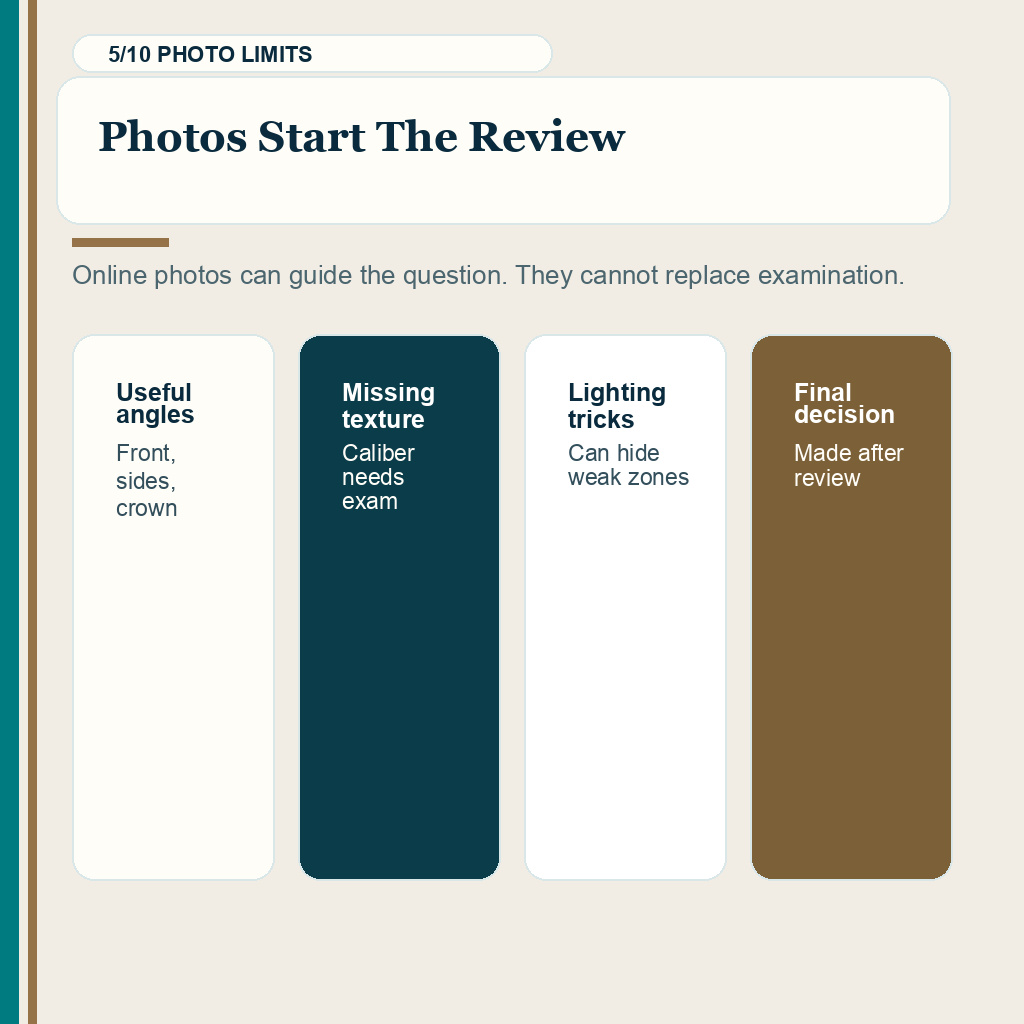
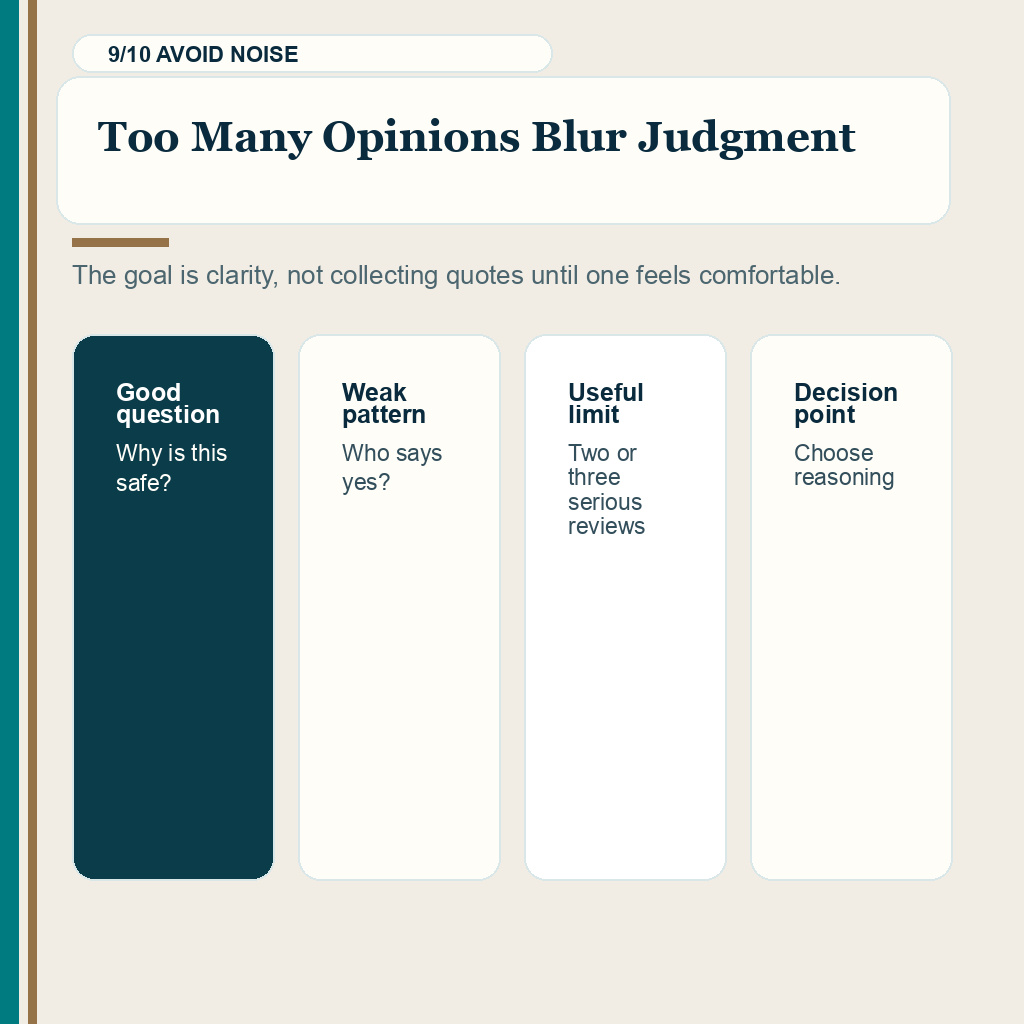
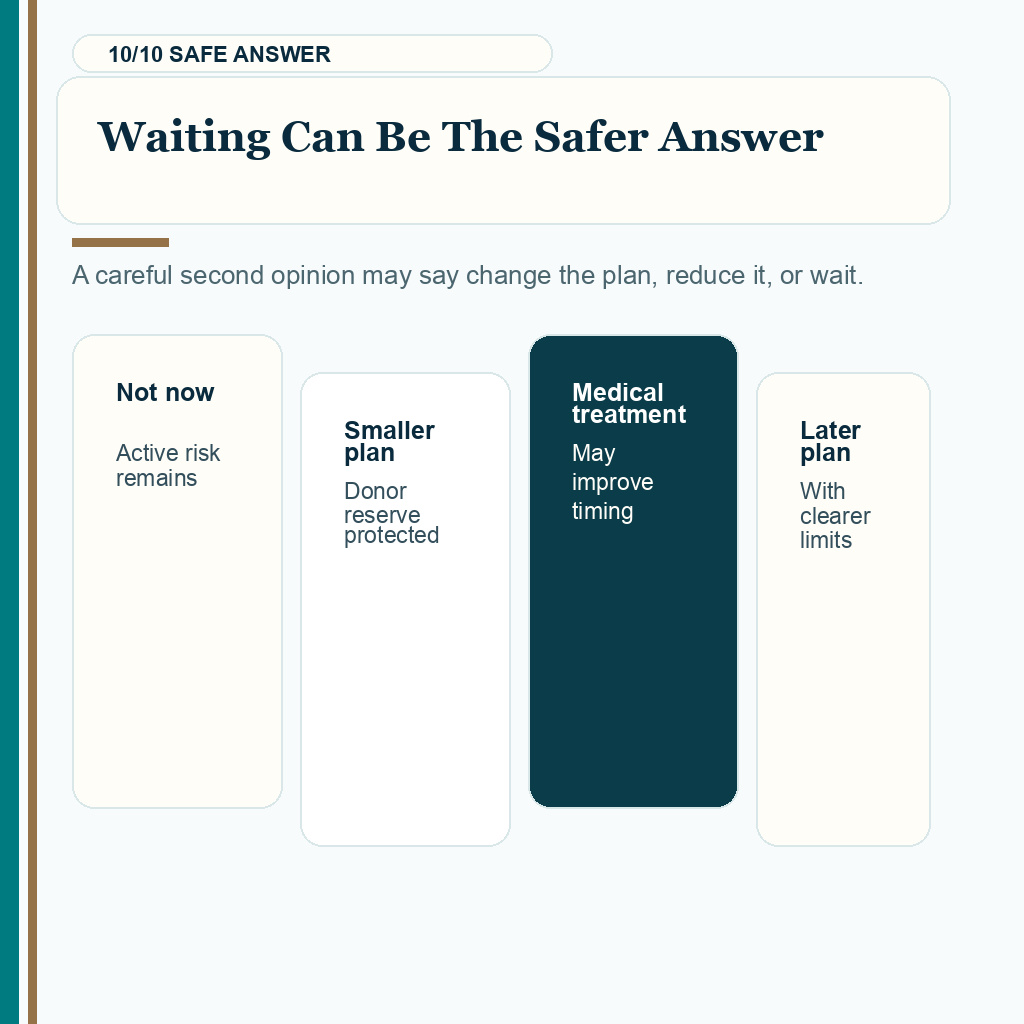
Use the second opinion to test donor reserve, hairline design, graft logic, photo limits, surgeon involvement, red flags, and whether waiting is safer. Swipe sideways, use the arrows for one slide at a time, or choose a number below the image.




Graft numbers differ because clinics judge risk differently
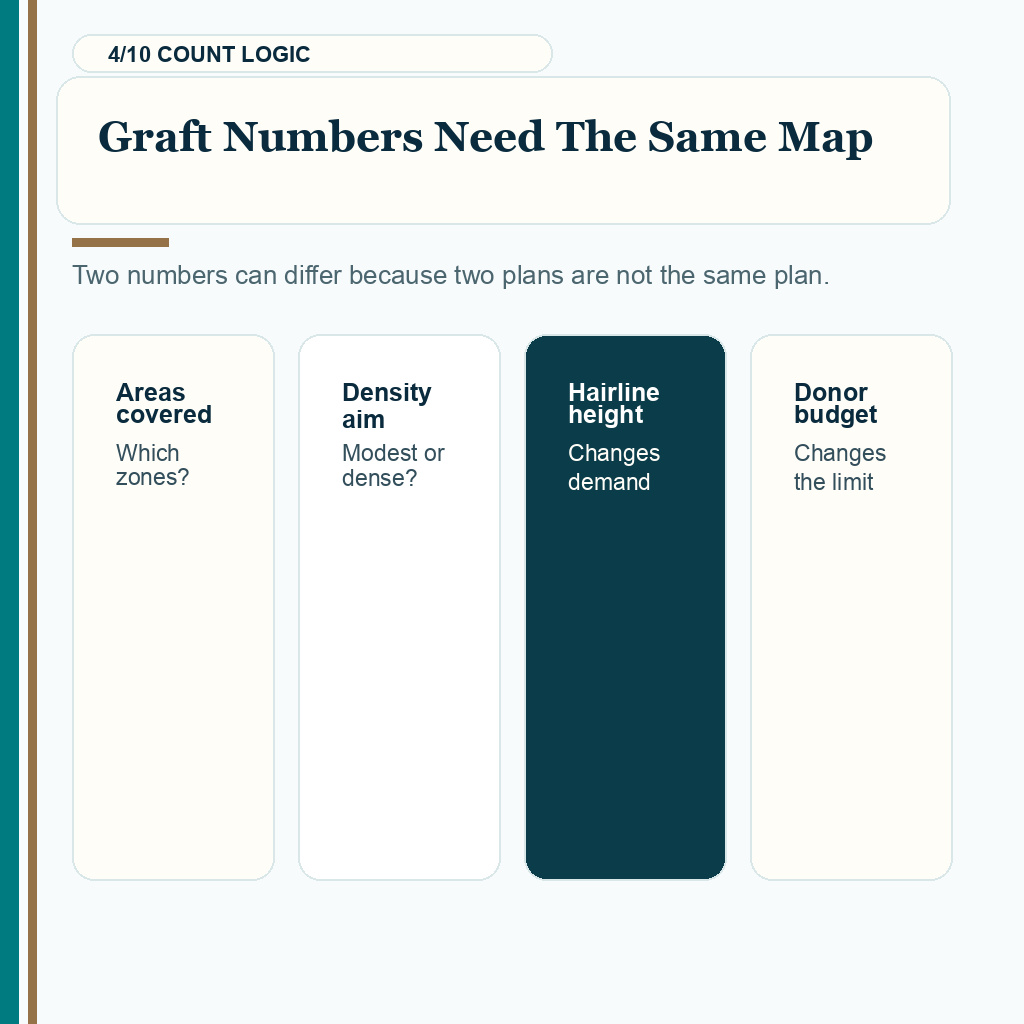
Clinics give different graft numbers because they may be planning different areas, different densities, different hairline positions, or different levels of donor risk. Sometimes one clinic is being careful. Sometimes another clinic is trying to sell a bigger package. The number alone does not tell you which plan is better.
In my graft calculations, I do not start with the package. I start with the face, hairline, recipient area, crown, donor strength, future hair loss pattern, and what can realistically be maintained. A plan that looks impressive in a message can be weak if it ignores these details. That is the basis for calculating the required graft number.
A lower number can be safer when the goal is frontal framing and donor preservation. A higher number can be reasonable in selected cases if the donor supply is strong, the surgical team is capable, and the distribution is sensible. The second opinion should explain the logic, not only approve or reject the number.
Wide graft estimates should be mapped, not voted on. Place each number beside the area it covers, the density it assumes, the donor measurement, and the crown strategy before deciding which opinion is safer.
The second opinion filter for a high graft quote
A much higher graft recommendation does not become better or worse just because the number is larger. I compare the areas being covered, the hairline height, the crown priority, and the amount of donor reserve each plan leaves for the future.
The number becomes unsafe when the donor explanation is weak. A high quote needs measured donor density, hair caliber, miniaturization review, safe extraction zones, and a clear reason for why that number can be removed without thinning the donor area. If those details are missing, the plan is not ready.
I would also slow down when the quote tries to cover the hairline, midscalp, and crown densely in one sitting, especially in a young patient or in someone with active hair loss. More grafts can mean more coverage, but they also mean more extraction, more time, more tissue handling, and less reserve for the future. Before you accept a higher number, review how too many grafts can damage a hair transplant in your specific donor area.
A safer second opinion may reduce the graft number, raise the hairline, stage the crown, or advise waiting. That can feel disappointing, but it may protect the donor area from a mistake that cannot be fully repaired later. If another clinic has already called the donor weak while a different clinic offered a large number, compare the plan with the weak donor warning against a high graft quote.
When a quote changes after direct examination, I want the explanation to show donor protection and a visible priority. Matching the first estimate matters less than knowing what the smaller number can safely achieve.
Mixed source quotes need the same second opinion standard as a large scalp only quote. The review should separate scalp, beard, and chest grafts by zone, because one total can sound reassuring while hiding which hair is doing which job.
If one review says the donor is too limited and another offers a large session, do not count it as a tie. Ask each surgeon what finding would make them reduce, stage, or refuse the plan.
Photo planning has real limits
Photos can start a conversation, but they should not be treated as the final surgical plan. Photos can hide miniaturization, donor weakness, scalp inflammation, crown swirl direction, hair caliber, and the true size of the thinning area. Lighting and hair length can also change the impression dramatically.
A fixed graft number from a few photos should raise one direct question. What will be checked in person before extraction begins? A photo estimate can be useful as a range, but the surgical plan must be confirmed after direct examination. The separate question of whether a hair transplant plan can be trusted from photos alone matters here.
The second opinion should make the plan more precise, not more confusing. It should clarify whether the photo plan is provisional, what might change on surgery day, and whether the donor area can safely support the suggested number. If you are using the second opinion before flying, compare it with case review before travel. Donor capacity, hairline priority, graft range, refusal risk, and follow-up should all be visible.
Surgeon involvement changes the value of the opinion
A second opinion has more value when the person giving it is medically responsible for hairline design, donor management, recipient area planning, and surgical risk. A coordinator may be helpful with scheduling, photos, travel, and general information, but the surgical plan should not become a sales conversation.
If you never speak with the surgeon, accountability becomes unclear. The hairline is not a graphic drawn on a screen. The donor supply is not a package number. The recipient area is living tissue, and the plan must respect blood supply, hair direction, future thinning, and natural appearance.
Good communication is not about long speeches. What matters is whether you understand who is making the medical decisions, who designs the hairline, who creates the recipient area incisions, and why those decisions are reasonable.
A useful opinion needs both listening and surgical judgment. The surgeon should first show that your concern and priorities were understood, then explain which requests are realistic, which should change, and why. A doctor who imposes a preferred design without addressing your concern is not listening. One who agrees to every request without testing donor limits, future loss, or repair risk is not exercising enough surgical judgment either.

Read this review excerpt
He had my photos up on his laptop and really spent time with me to learn about how I came to lose my hair and what I ultimately wanted.

Read this review excerpt
Dr. Demircioglu spoke fluent English since this enabled him to really understand my needs and wants for the procedure and allowed us to have a much deeper consultation about everything associated with it.
Reasons to pause before booking
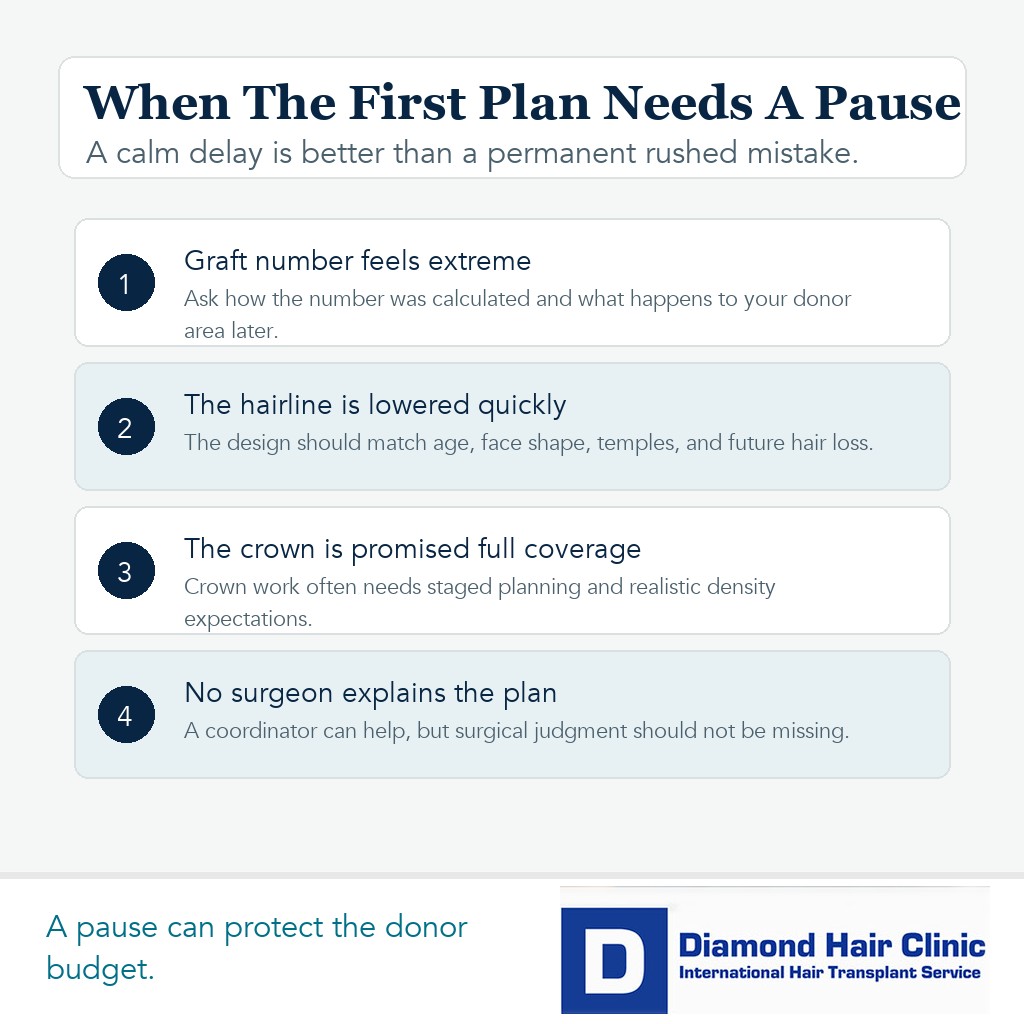
Pause if the clinic promises full coverage without discussing donor capacity, if the hairline is lowered aggressively, if the crown is treated as easy, if the graft number is used mainly as a sales tool, or if the consultation creates urgency instead of clarity.
I also pause when someone is very young, hair loss is moving quickly, medication has not been discussed, or the donor area looks thin. Surgery may still be possible, but timing and design need more judgment. The review should test real candidacy, not just find a way to sell the operation.
I also become cautious when surgery is presented as the only meaningful answer before the medication history has been understood. A short topical minoxidil pause for a cleaner scalp is not the same decision as stopping finasteride or dismissing medical stabilization. The plan should separate scalp condition, native hair risk, donor reserve, and future loss before the booking decision.
A pause is not failure. Sometimes waiting protects you. Sometimes it prevents a low hairline that will look wrong later. Sometimes it prevents donor depletion before the future pattern is visible.
Second opinion filter
High quote signals that deserve another review
Use this when one clinic offers a high graft count and another clinic is more cautious. Pick the signal that worries you most, then check what should be explained before you travel, pay, or accept the number.
Ask each clinic to mark hairline, midscalp, crown, and density goal. A higher number is not proof if it covers more area or spends grafts future loss may need.
The answer should include density, hair caliber, miniaturization, and safe extraction zones. If the proof is only a photo impression, the high quote is not ready.
Crown coverage can consume many grafts. A safer plan may frame the front first and stage the crown after growth, medication stability, and donor response are clearer.
The second opinion should test age, facial frame, forehead muscle movement, donor reserve, future thinning, and the reason the line stops at that height before the design becomes permanent.
Separate the medical plan from the package, discount, deposit, hotel, and flight timing. The graft number should make sense before booking pressure starts.
This filter is not for choosing the biggest quote. It is for finding the point that must be explained before the first graft is taken.
Comparing two opinions requires the same clinical details
The comparison should not stop at the graft number, price, or technique name. The stronger opinion explains the donor area, accounts for future hair loss, gives a realistic crown plan, and shows why the hairline height fits your age and face.
When one opinion says no FUE and another proposes a different method, the technique name should not lead the decision. The opinion that matters is the one that explains donor reserve, scar tradeoffs, recipient area priority, and what will stay untreated for later.
A slower, more careful opinion is not always less ambitious. It may be protecting donor reserve, crown progression, and repair options that a faster promise leaves unclear.
For clinics abroad, this caution matters more. Price matters, but it should not replace surgical judgment. If you are comparing options in Istanbul, read about choosing a hair transplant clinic in Turkey with the same attention to surgeon involvement and planning quality.
Opinion comparison sheet
| Compare this | Why it changes the decision |
|---|---|
| Donor reserve | A large first session can remove options needed for future thinning or repair |
| Recipient priority | Hairline, mid scalp, and crown do not carry the same visual value for every patient |
| FUE and FUT tradeoffs | The technique choice should match donor safety, scarring tolerance, and long-term planning |
| Untreated zones | A responsible opinion says what will remain thin on purpose |
| Follow-up ownership | The same medical logic should continue after surgery, not stop once the deposit is paid |
If the disagreement started from photos, include the limits of planning a hair transplant from photos before treating either opinion as complete.
Too many opinions can create confusion
A second opinion should reduce confusion, not turn you into a collector of graft estimates. If you keep searching until one clinic agrees to the lowest hairline, largest graft number, or fastest date, the second opinion has stopped protecting you.
After two or three serious consultations, do not chase the most attractive answer. Look for the explanation that protects the donor area, respects future hair loss, and makes sense when you repeat it back in your own words. That is also the spirit of what belongs in the plan before committing to a hair transplant.
If the opinions are still completely different, slowing the decision is safer than choosing the most exciting offer. Confusion before surgery is a warning sign. It should be resolved before any graft is taken.
A second opinion can reduce regret
A second opinion cannot guarantee the outcome, but it can reduce avoidable regret. Many regrets begin before surgery, not after it. You accept a hairline that is too low, a graft number that is too high, a crown promise that is unrealistic, or a clinic structure that leaves the surgeon unclear.
Once the operation is done, the options become narrower. Repair can help some people, but repair surgery uses more donor hair and cannot always erase the first mistake. Careful planning before surgery is better than trying to manage why some patients feel regret after a hair transplant later.
If you already feel uneasy, that feeling deserves attention. It may be anxiety, but it may also be your own judgment noticing that the explanation is incomplete. The second opinion should separate ordinary nerves from a plan that genuinely needs correction.
Guarantees should not override clear doubts
A guarantee should not replace a proper plan. Hair transplantation involves biology, healing, graft handling, donor limits, and future hair loss. No clinic can guarantee perfect density, a natural hairline for life, or full coverage without future planning.
If a guarantee is used to make you ignore doubts about the plan, slow down. Ask what the clinic will do to reduce risk before surgery. That includes proper donor assessment, realistic graft distribution, careful hairline design, and direct medical responsibility. Whether a hair transplant guarantee can be trusted depends on the details behind the wording.
A clear surgical plan makes the guarantee less central.
Waiting can be the better decision
Waiting is better when the hair loss pattern is still changing quickly, donor strength is questionable, uncertainty feels intolerable, or the proposed hairline depends on future hair staying stable. It is also better to wait when pressure, discount timing, or fear of missing availability is doing more work than the medical explanation.
In some cases, a weaker donor area changes the entire strategy. The plan may need fewer grafts, a more careful hairline, medical stabilization, or no surgery at that moment. A cautious answer is better than spending grafts that cannot be replaced. The article about hair transplant planning with a weak donor area is directly connected to this decision.
A good second opinion should leave you clearer, even when the answer is not what you hoped for. Clarity is not always permission to operate. Sometimes clarity is the reason to delay.
The opinion should also say who follows the case
A useful review should not stop at operate, wait, or choose a different graft number. It should also tell you who will review early recovery, which photos should be sent, what cannot be judged remotely, and when local medical care is safer than waiting for an online answer.
For an international patient, this belongs before travel. If the new opinion recommends surgery, the aftercare route should match the same clinical reasoning because donor reserve, hairline design, graft distribution, crown priority, and medical risks all affect how recovery photos are interpreted later.
If nobody can explain the follow-up responsibility, the second opinion has found another gap. I would pause until the plan includes both the operation and the months after it.
Details to bring to a second opinion
Bring clear photos in consistent lighting, the first clinic’s proposed graft number, the planned areas, any hairline drawing, medication history, age, family hair loss pattern, previous transplant history, any operation report from earlier surgery, and your main concern. If you have an AI hair transplant simulation, bring it too, but label it as a preference reference rather than a graft number plan. Donor photos with short hair are especially helpful.
The review becomes more valuable when the question is specific. Instead of stopping at “Is this clinic good?”, bring the graft number, hairline, donor plan, crown plan, and future strategy into the review. The answer should help you decide, not just reassure you.
In my own planning, the plan must be clear before surgery. If another opinion gives you a bigger number, a lower hairline, or a faster promise, compare the reasoning carefully. A hair transplant is easier to plan well before the first graft is taken than to repair after the safe donor supply has already been spent.
The same review becomes important when a quote or graft number changes at the last moment. The revised quote before surgery guide lists the documents, photos, and scope details that make that review more useful.
Read this review excerpt
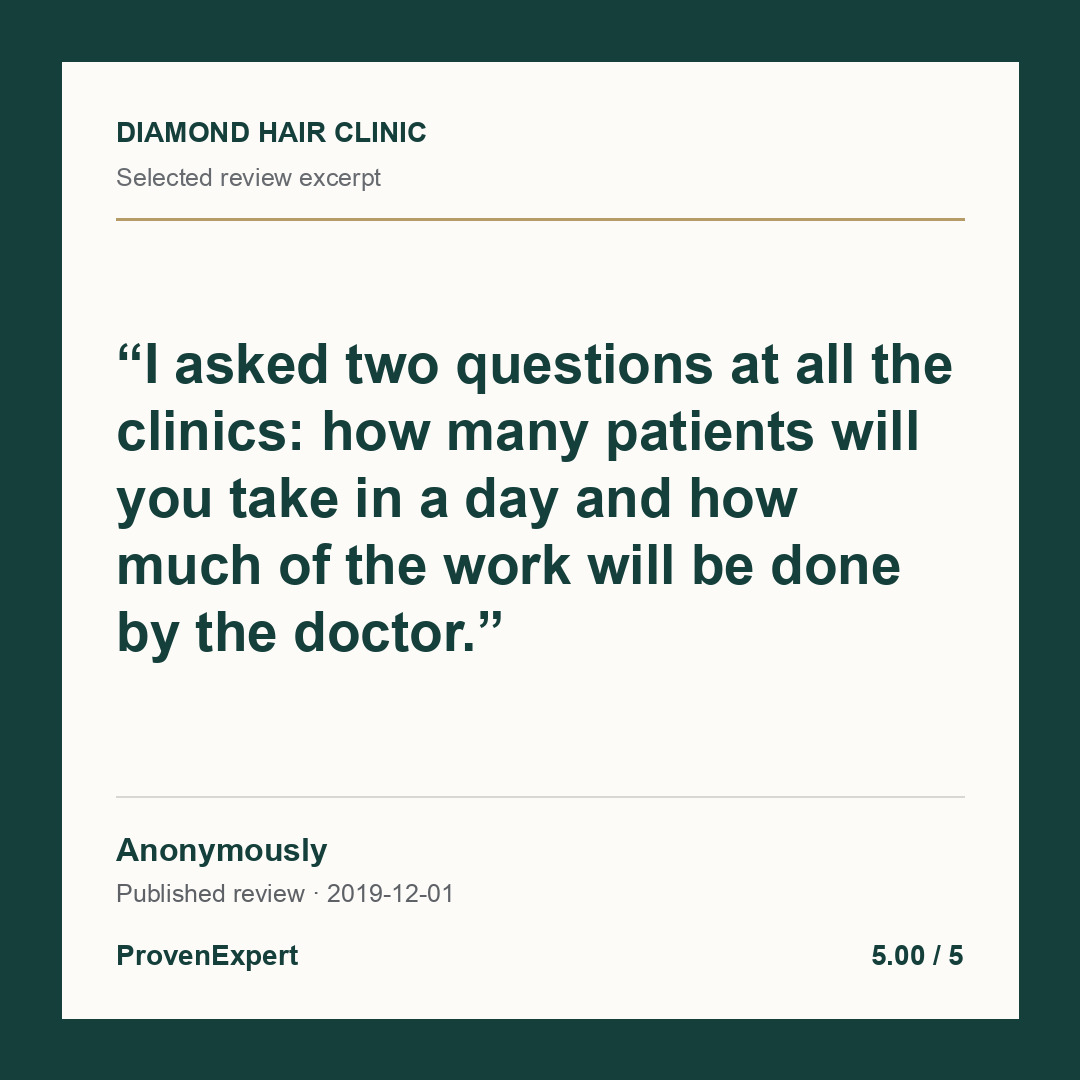
I asked two questions at all the clinics: how many patients will you take in a day and how much of the work will be done by the doctor.

Read this review excerpt
Dr Demircioglu and support professionals were responsive, informative and clearly took the time to review my pictures.