



Price Per Graft Can Mislead Hair Transplant Patients
I would not choose a hair transplant clinic by price per graft alone. A graft only has value when it is taken from the correct donor area, handled gently, placed in the right direction, and used inside a plan that still protects future hair loss. A cheap graft can become expensive if it wastes donor hair or creates repair work.
An expensive graft can still be poor value if the plan is weak. It can also hide what will be left untreated. I compare the quality of the surgical plan before I compare the price line, because the number on the quote does not show what happened to your donor area.
Two quotes that look impossible to compare need slower review. The quote should explain what counts as a graft, which areas will be treated, who is responsible for the operation, how the final number will be recorded on surgery day, and what donor hair will remain if you need more work later. I use that sequence in Turkey hair transplant without the sales lens before a quote or graft price becomes the main deciding point. A 4,500 euro quote can be reasonable or risky depending on what medical responsibility sits behind the number.
A low graft price is not neutral when it mainly encourages a higher graft count. The quote starts pulling surgery toward the invoice instead of the donor plan.
Graft numbers come before the price table
The graft number should come from the medical plan, not from the price table. I estimate what the visible area truly needs, then compare that need with safe donor capacity, hair caliber, future hair loss risk, and the patient’s priority area. If the donor cannot support the requested number, lowering the number is not a sales failure. It is the safer surgical decision. For a young Norwood 3 pattern, I price the surgery only after the design is safe enough to defend.
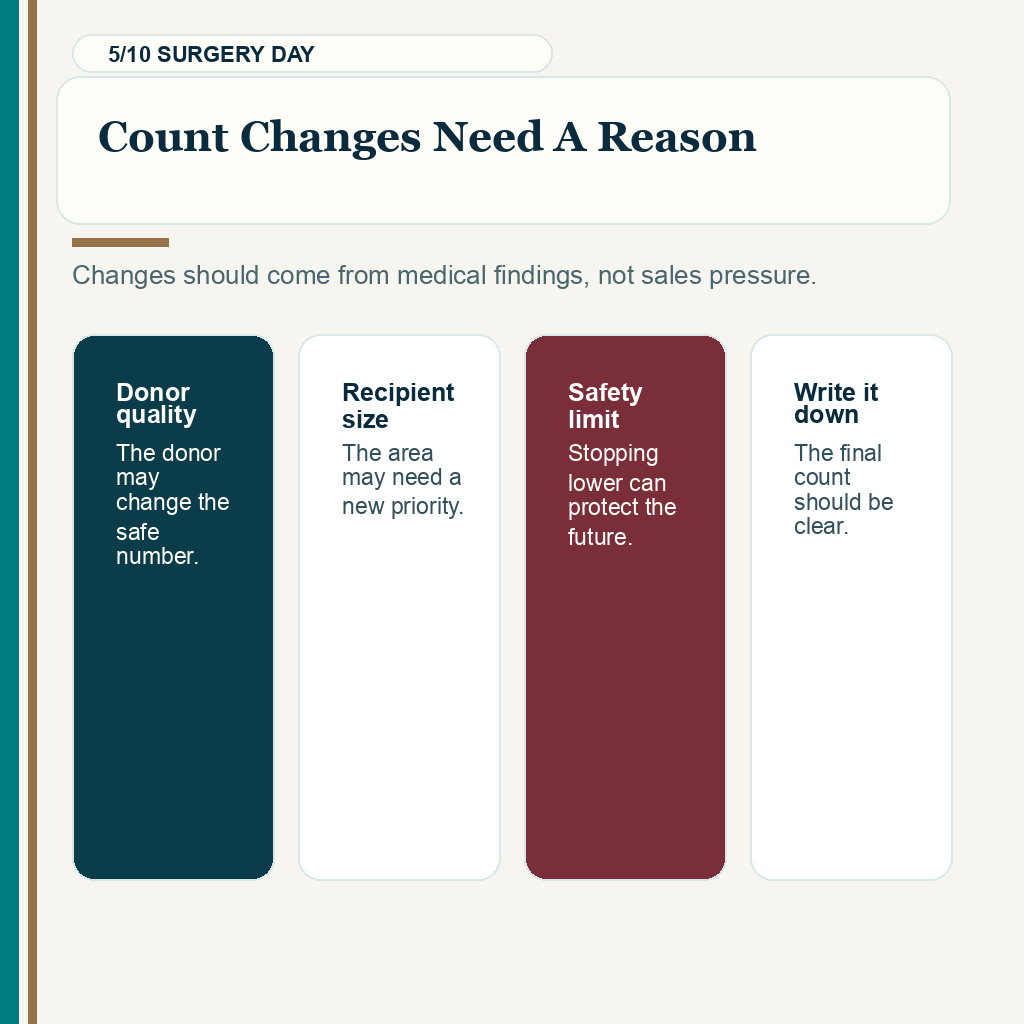
A graft number change on surgery day needs a clear explanation. Low graft pricing means little if donor safety and surgical responsibility are weak. A written quote still needs room for a medically responsible graft number change on surgery day.
Price per graft hides planning tradeoffs
A quote priced by graft hides the parts of surgery that are hardest to see before you arrive. It does not tell you who designs the hairline, who examines the donor area, who performs or supervises the extraction, how grafts are stored, how many people are treated that day, or whether the clinic is planning for your future hair loss. Small sessions can also make the unit price look unusually high. The operating room, sterile setup, clinical staff, and surgeon’s time still have to be reserved when the graft count is modest. That does not justify taking extra grafts to make the quote feel better. Compare the total fee and the reason for the smaller plan, then keep the graft number tied to the recipient need and safe donor capacity.
The same unit price can hide very different work. One plan may protect donor reserve while another spends it quickly, so the price only becomes useful after the graft map is explained.
One graft is not a product on a shelf. It is living tissue. If it is taken from outside the safe donor zone, damaged during extraction, left too long before placement, or used in the wrong part of the hairline, the low price becomes irrelevant. I first look at the medical structure behind the quote, not the number alone.
Budget questions such as hair transplant cost in Turkey and financial planning are separate from the surgical judgment inside the quote. A calculator can help with budget expectations, but it cannot tell whether the grafts are being used safely.
Hair transplantation is elective. If paying for it means a loan with costly interest or leaves no reserve for travel, medicines, follow-up, or an unexpected medical visit, I would delay surgery and rebuild the budget first. Price per graft can also hide how the clinic defines and records the number. The quote should say whether it is based on follicular units, hairs, a planned range, usable grafts after extraction, or the final implanted count. I also want the number broken down by hairline, frontal third, middle scalp, and crown, because 3,500 grafts used with discipline is not the same as 3,500 grafts spread thinly everywhere.
A quote that sounds precise before donor supply is examined may still be only a sales estimate unless it explains how the final count is documented on surgery day. The distribution matters as much as the number.
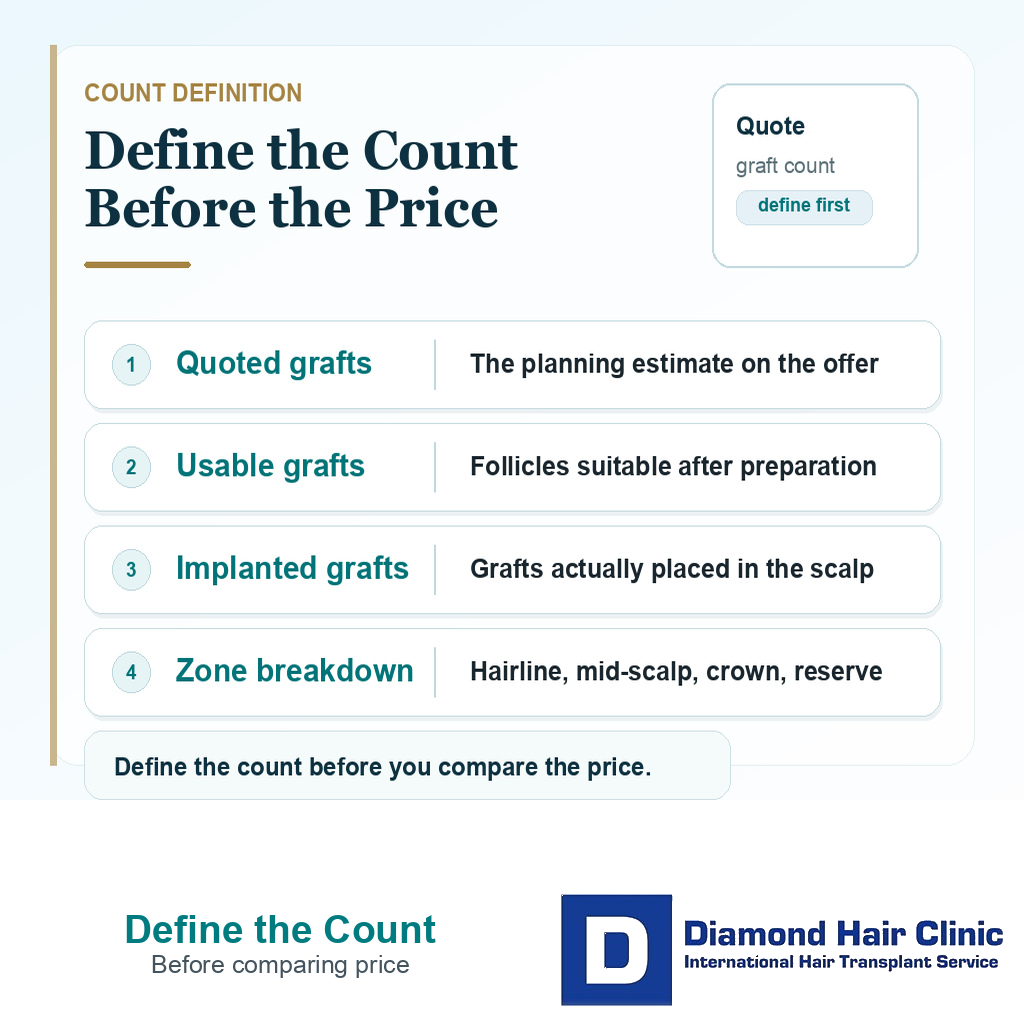
Before comparing price per graft, define whether the quote means planned, usable, or implanted grafts and how they are distributed by zone.
The 10 slides here show how to read a graft quote as a surgical plan, not only a price line. Swipe sideways, use the arrows for one slide at a time, or choose a number below the image.
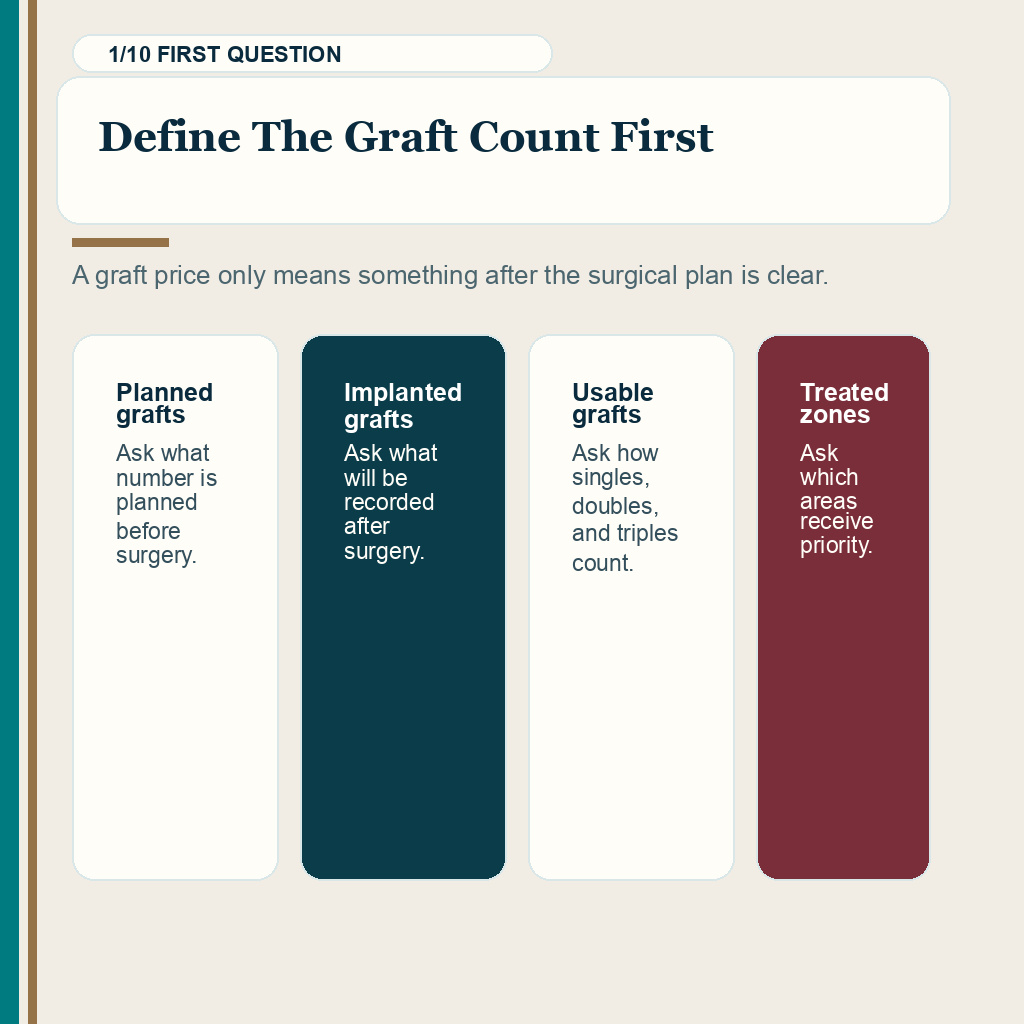
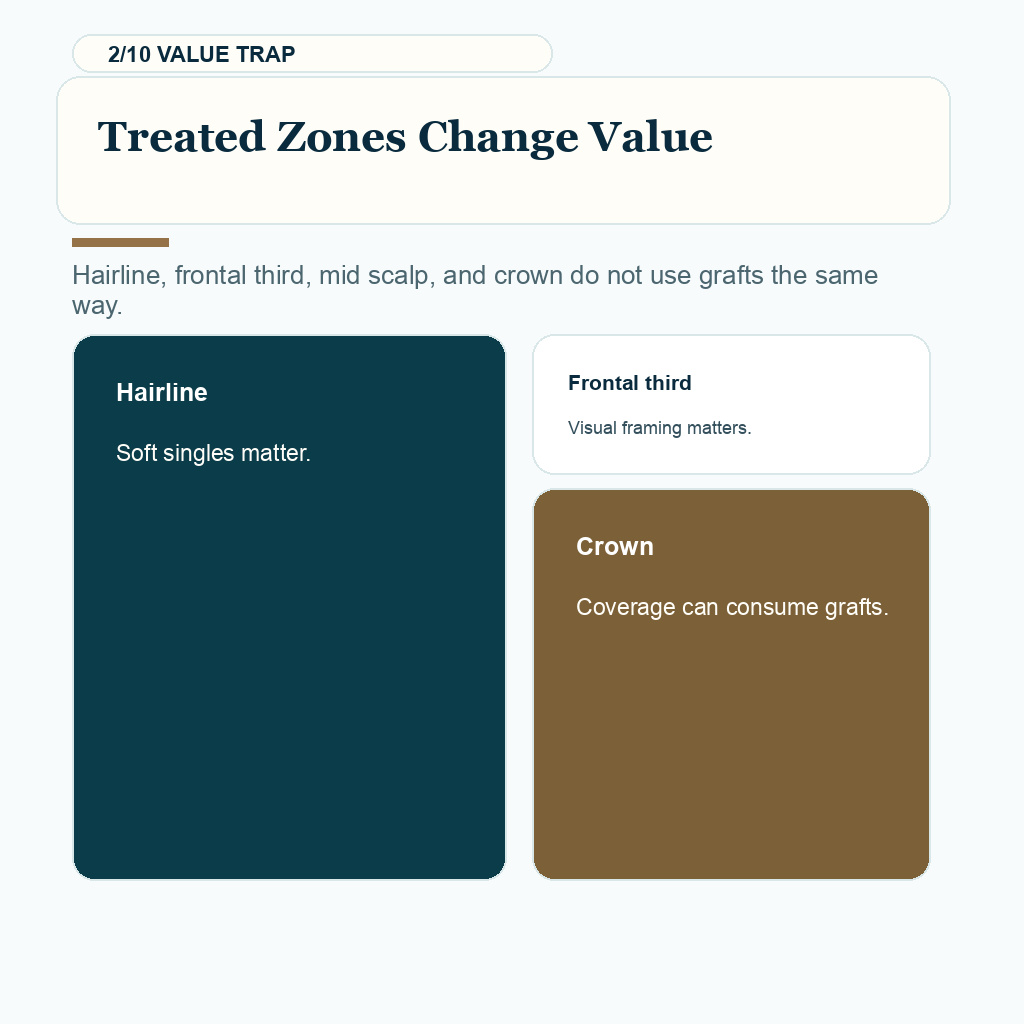
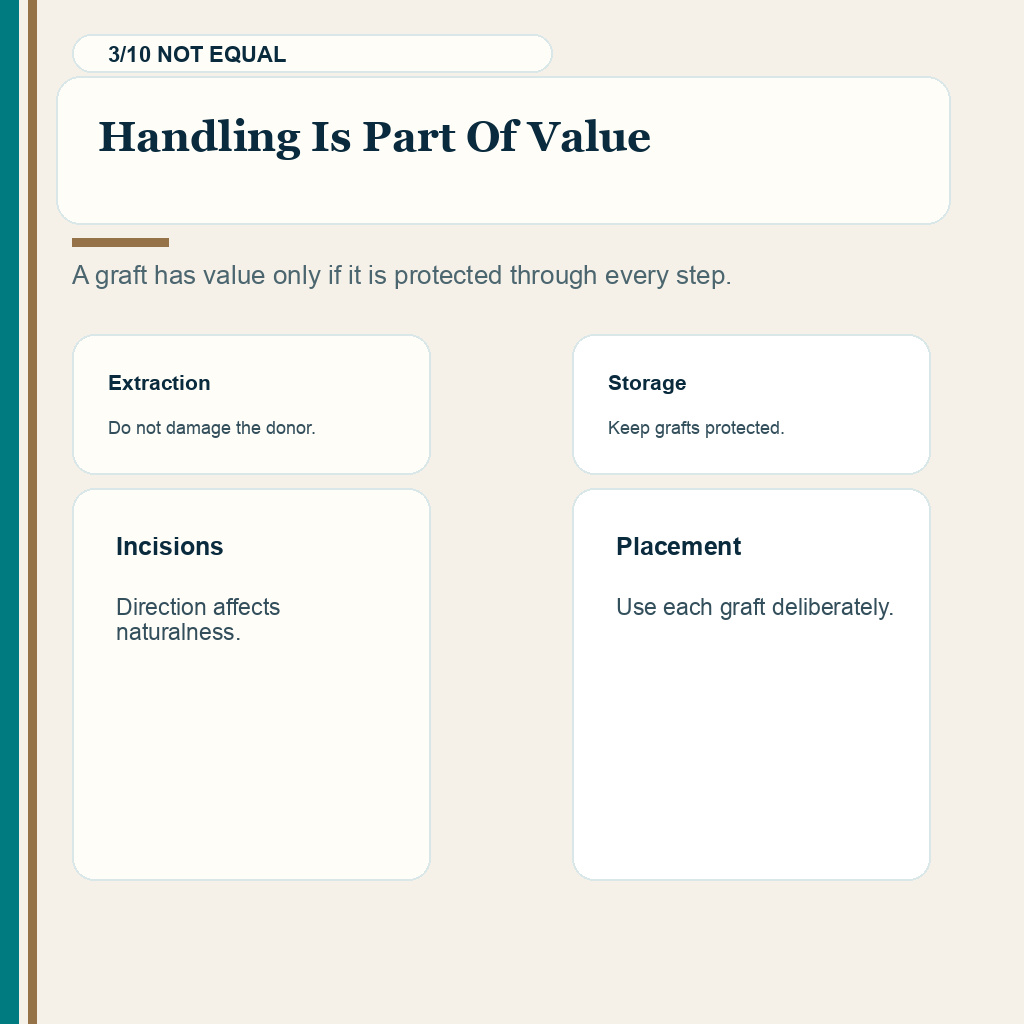
Different graft quotes need surgical explanation
Two clinics can quote different graft numbers because they may be solving different problems. One may focus on the frontal third and hairline. Another may try to cover the hairline, middle scalp, and crown in one operation. One may preserve donor hair for future loss, while another may try to impress you with a larger number.
Some differences are clinically reasonable. Hair shaft thickness, curl, donor density, recipient area size, skin contrast, age, medication history, and future loss pattern all change the plan. I discuss these variables when I explain how graft numbers are calculated.
The problem starts when the quote is large but the explanation is thin. If the clinic cannot explain why you need that number, which areas receive priority, and what will remain in reserve, a graft number without a reason is not a plan. It is only a sales figure.
A cheaper graft price is not always a safer plan
I become cautious when the price depends on accepting a larger graft number before donor strength has been properly judged. A low price per graft can move the conversation toward quantity, even when the patient needs a smaller hairline, staged coverage, or no surgery yet.
A premium quote does not make the surgery safer by itself, and a cheaper graft price does not make it reckless by itself. Value comes from the work behind the number, including donor examination, graft range selection, staged area choice, graft counting, and follow-up responsibility.
The safer question is not only what one graft costs. It is whether the graft number protects future donor reserve, whether the hairline design can be supported with the available hair, and whether the clinic can explain what would make the number lower after examination.
Result photos do not solve that question by themselves. A photo that looks dense may hide lighting, hair length, styling, or a different donor situation. The price only has meaning after the plan is medically believable.
Low graft prices become warning signs in context
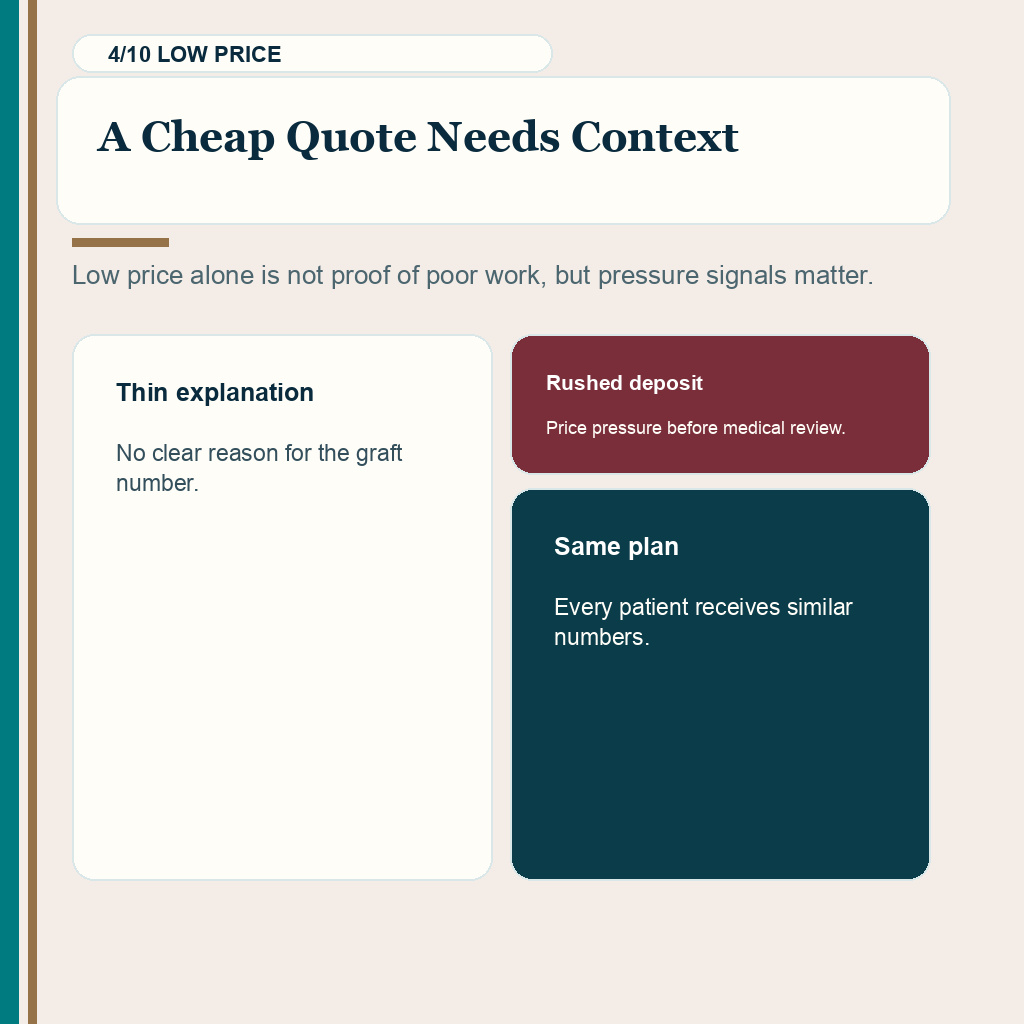
A low graft price becomes a warning sign when it is paired with speed, pressure, and vague responsibility. I become cautious when the clinic advertises a very large graft number, avoids naming who performs the key surgical steps, pushes a fast deposit, or describes the operation as a package before it describes the donor area.
Low price alone is not proof of poor work. A clinic can have different local costs, staffing costs, currency conditions, and business structure. The real warning is different. If the lower price depends on treating many people in one day, limiting surgeon involvement, rushing extraction, or using the same plan for everyone, you may pay later through poor growth, unnatural design, or donor depletion.
For medical tourism patients, package details need the same kind of scrutiny as the graft price. Transfers, hotels, and an attractive graft number cannot replace surgical planning.

A useful quote explains who plans, where grafts are taken, and what happens if hair loss continues.
Can an expensive clinic still make a poor plan?
A higher price does not protect you by itself. A clinic can be expensive and still design a hairline too low, promise too much crown coverage, ignore future hair loss, or delegate the parts of surgery that need direct medical judgment.
Price and accountability have to be judged together. If the clinic is expensive, it still needs to explain the plan clearly. If the clinic is cheaper, it still needs to explain the plan clearly. The standard is the same. You need a plan that can survive questions.
Using price as the main signal of quality can move people from one mistake to another. Some choose the cheapest option and ignore risk. Others assume that a high invoice means everything is medically controlled. Neither assumption is enough.
Surgeon involvement changes the value of a graft
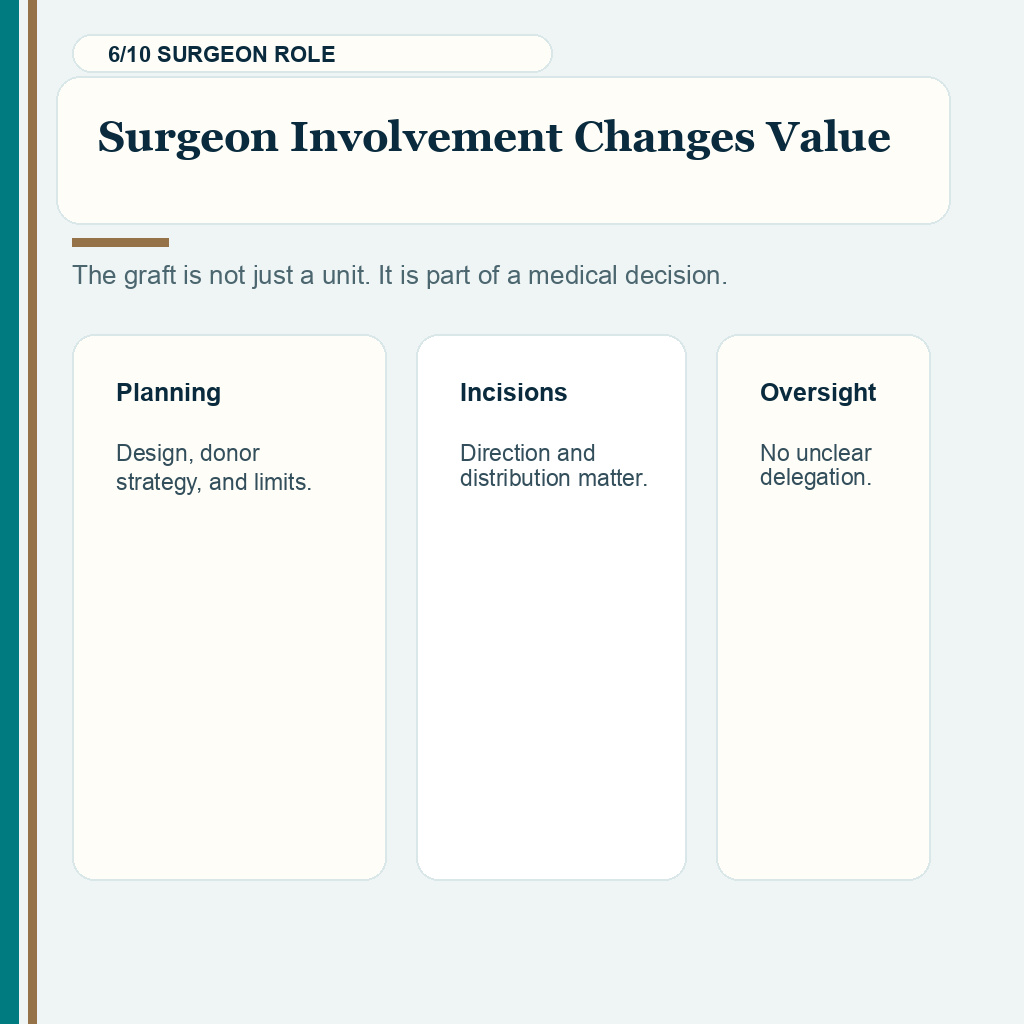
Surgeon involvement changes the value of a graft because planning is not only counting. The surgeon has to judge the donor area, the recipient area, the natural direction of hair, the density that can be safely achieved, and the long-term pattern of loss. Two clinics can quote the same number and still be offering very different surgery.
If the surgeon is only a name on the website, the price per graft does not tell you who is protecting the donor area. It does not tell you who adjusts the hairline if the skin, caliber, or donor findings differ from the photographs. It does not tell you who decides whether a large session is reasonable.
Surgeon involvement in hair transplant surgery belongs inside the quote itself. You are not only buying grafts. You are trusting judgment.
Donor limits should come before price
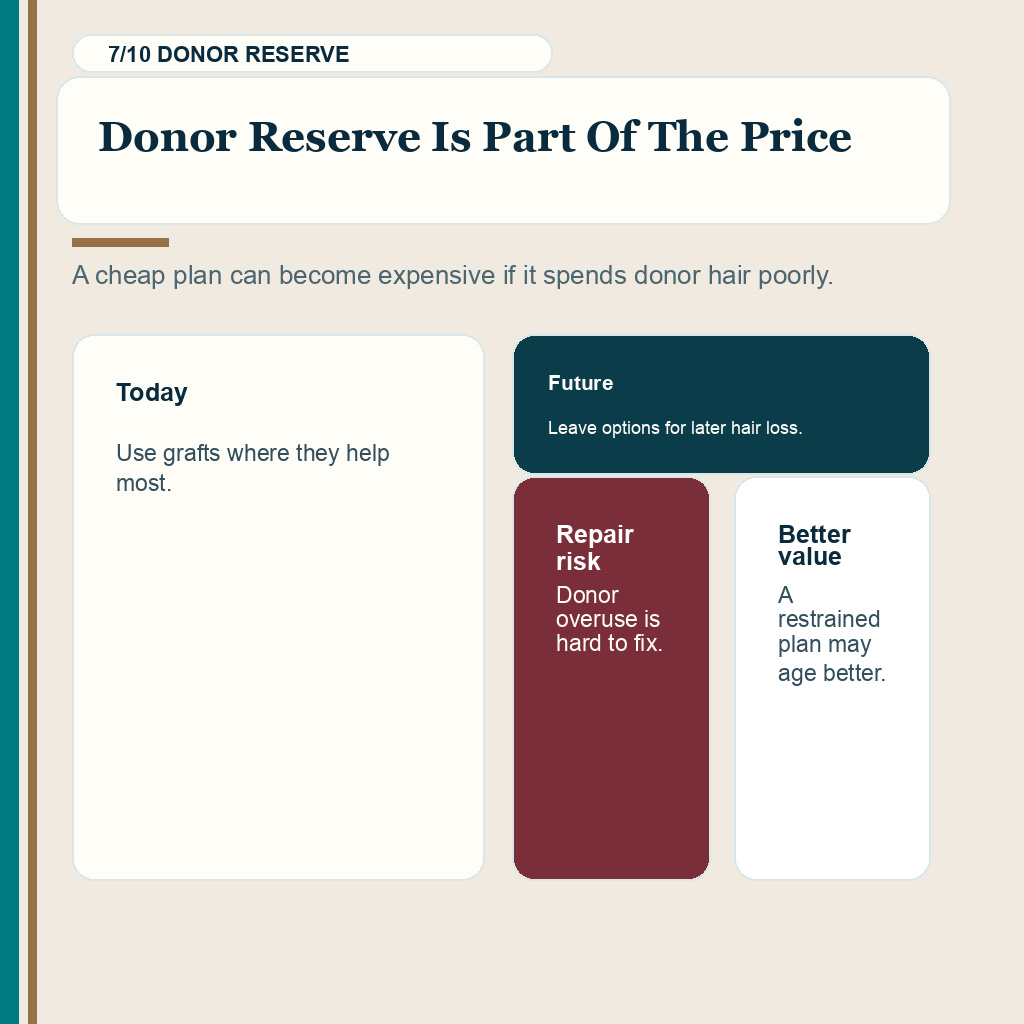
Donor supply is finite. Once grafts are removed, they are no longer available for another plan. A clinic that speaks confidently about thousands of grafts but does not discuss donor limits is leaving out the part that protects the future.
Before I compare price, I want to know whether the donor area has been checked for density, miniaturization, caliber variation, scars, and realistic safe donor boundaries. I also want the plan to explain how it will change if the examination in person shows a lower safe graft number than the photo estimate. The plan should be reduced, staged, or delayed instead of forcing the advertised count. Donor reserve is part of the value. A dramatic first operation can sound attractive, but the scalp may need a staged plan.
I discuss the donor area and lifetime graft planning before price because a low quote can tempt a patient to spend donor hair too quickly.
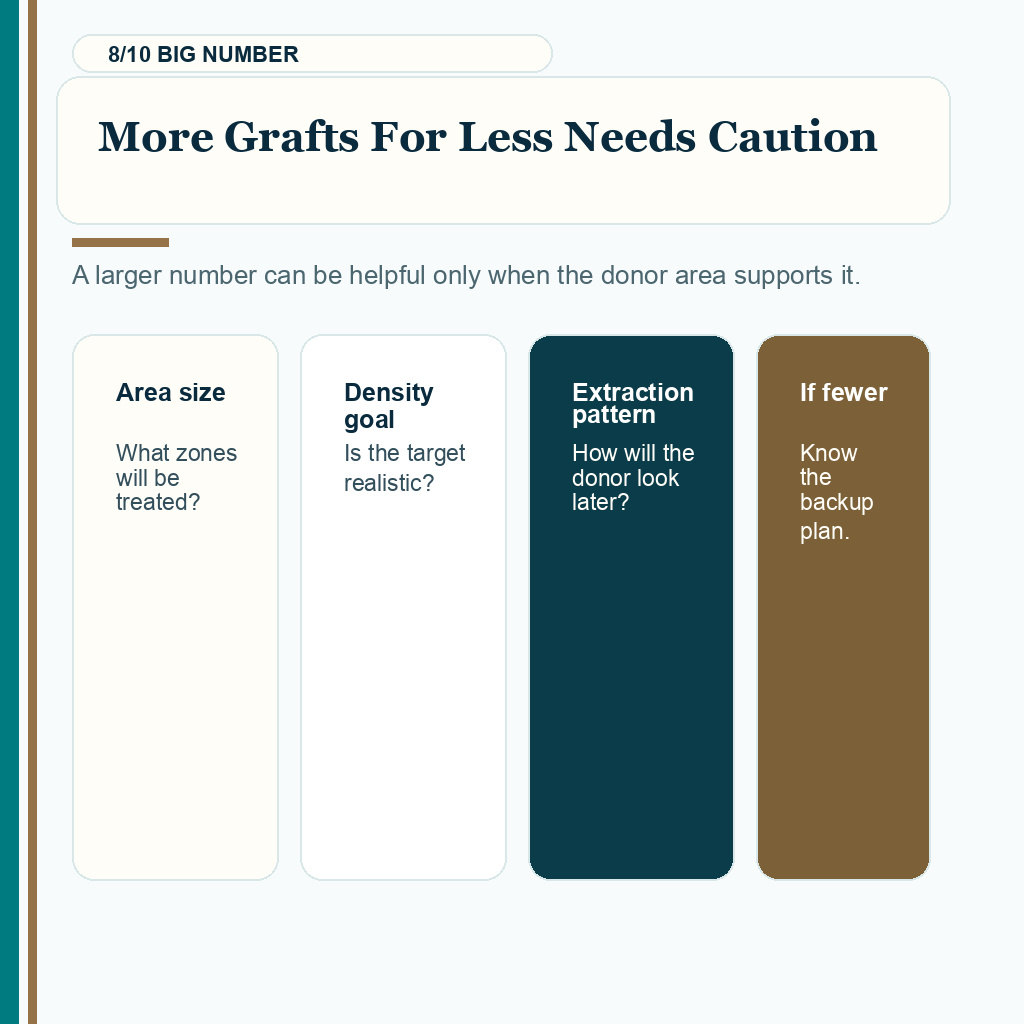
More grafts for less money needs caution
If one clinic offers more grafts for less money, pause the decision. The larger number needs a medical reason, a safe extraction plan, and a clear limit on how many areas are being treated in one session.
Sometimes a larger session is appropriate. Someone with advanced loss, strong donor density, thick hair shafts, and a carefully planned distribution may need a larger operation. But the explanation has to be specific. “More grafts” is not enough.
A quote that tries to fill the hairline, temples, middle scalp, and crown at once while also promising a very low price deserves caution. The danger is not only financial. It may be an exhausted donor area, weak density everywhere, or a result that needs repair work after a cheaper hair transplant abroad.
An unnecessary graft is not a bonus just because it is cheap. If the extra grafts are taken from areas that should be preserved, the apparent saving may become a donor problem later. The real comparison should include repair cost, lost donor reserve, months of waiting, and the possibility that a corrective operation has fewer good grafts left to use. A smaller number used with discipline can be better value than a larger number used to make the package look generous.
What I want written before payment?
Before price becomes the deciding factor, I want the medical plan written clearly. It needs to name the diagnosis, the treated zones, the graft range, the donor limit, the hairline or crown priority, and who is responsible for each surgical decision.
I want the same document to explain what would lower the number or stop the surgery. Weak donor findings, active loss, diffuse thinning, a low hairline request, unrealistic crown coverage, or unsafe session size should change the plan before payment pressure makes the patient ignore the warning.
Price can be compared only after that. A lower quote with unclear doctor involvement and no refusal boundary is not cheaper in a meaningful way. It is simply a price attached to an unfinished plan.
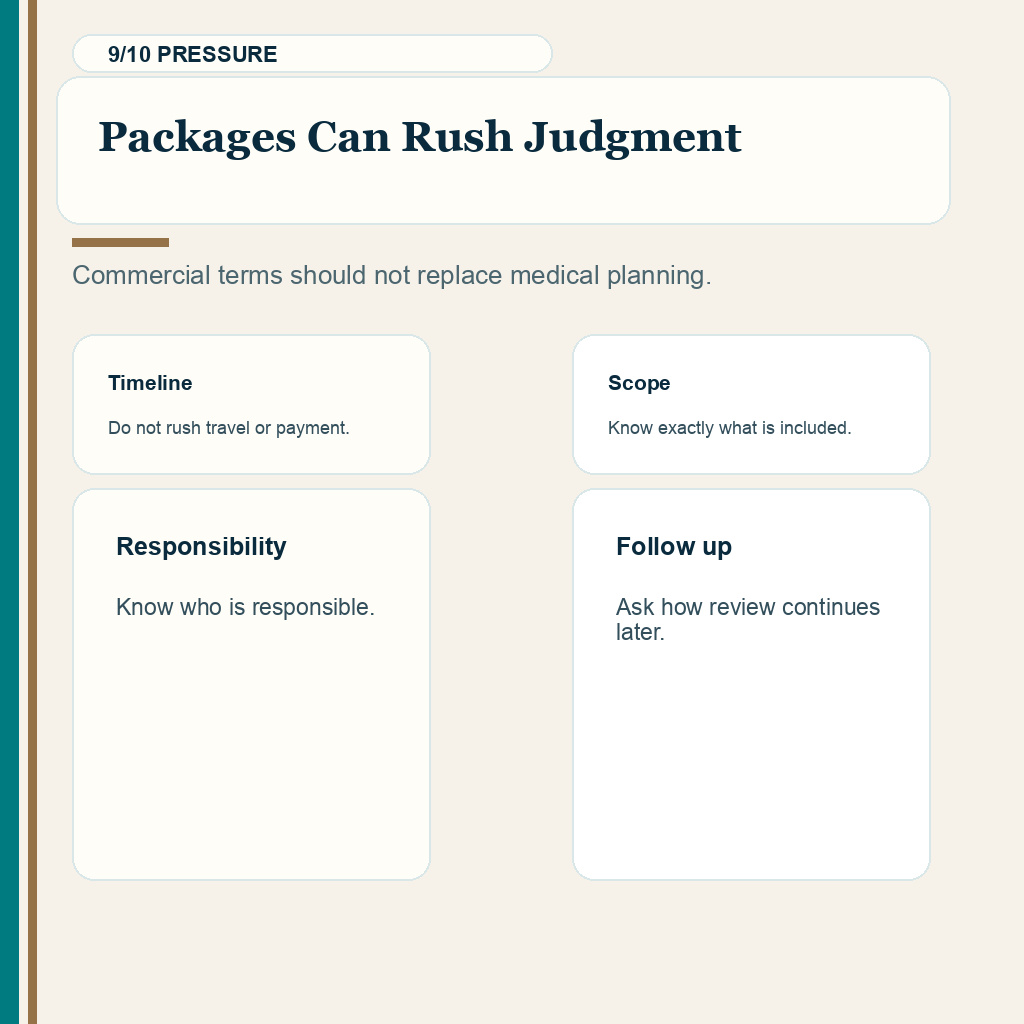
Packages and deposits can rush judgment
Packages and deposits can make the decision feel urgent. You may be told that the price is available only today, that the date will disappear, or that the graft number is included if the deposit is paid quickly. That pressure can move attention away from the medical plan.
Separate the quote into two parts. The first part is the travel, hotel, deposit, payment method, and schedule. The second part is the surgical plan. A package can be convenient and still be medically incomplete if it does not explain donor limits, surgeon role, graft handling, and follow-up. If the second part is unclear, the first part should not carry the decision.
Ask for the total written quote, not only the headline graft price. It should be clear what is included, what is excluded, which currency is used, how the deposit works, whether the fee changes after an examination in person, and what happens if the safe graft number is lower than the marketing estimate. That answer needs to be in writing before payment. Refund, reduction, or rescheduling terms should be clear before you feel locked in. A smaller staged plan should also be clear before the quote becomes pressure.
If the fee can rise because more grafts are proposed, the quote should state when that decision is made and require your written approval before extraction begins. An extra graft charge should not first appear once you are prepared for surgery and feel unable to walk away. The final invoice should separate the original plan from any approved change and match the documented implanted count.
I become more cautious when red flags of Turkish hair mills appear together with booking pressure. A discount is not a medical indication.
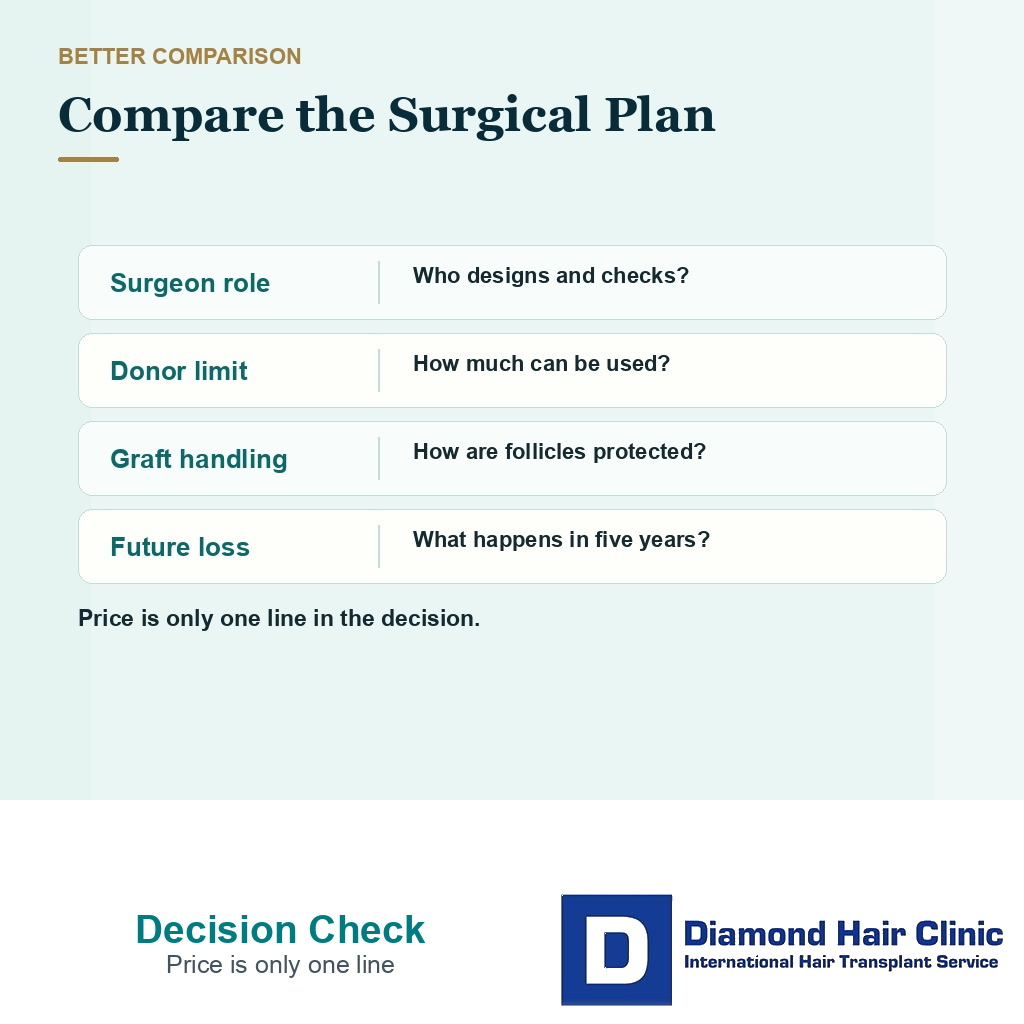
Compare the plan behind the grafts, not the graft price alone.
Compare the surgical plan, not only price per graft
Compare the consultation quality first. A useful consultation explains diagnosis, donor condition, recipient priorities, hairline design, medication context, graft range, session size, and follow-up. It also explains what the operation will not solve.
Then compare the surgical responsibility. Ask who designs the hairline, who creates the channels, who extracts grafts, who places grafts, who checks the grafts during the day, and who has the authority to lower the graft count if the donor findings are weaker than expected. If the answers are vague, the price per graft cannot rescue the plan.
Then compare the result logic. Look for natural hairline direction, age-appropriate design, realistic density, careful crown planning, and clear discussion of future native hair loss. A clinic that cannot discuss limits before surgery may also struggle when recovery questions appear later.
A staged plan can be better value
A staged plan can be better value when you have a large area to cover, uncertain future loss, weak donor density, fine hair, diffuse thinning, or a crown that could consume many grafts for limited visual gain. The first session can protect the frame of the face, then later review decides whether more work is worth it.
The staged plan may look more expensive in the short term because it avoids the dramatic “everything now” offer. But it can protect donor hair, reduce overharvesting risk, and give the patient time to judge medication response and real growth.
During hair transplant graft count verification, the number should be tested against donor capacity, session safety, and whether the result will age well.
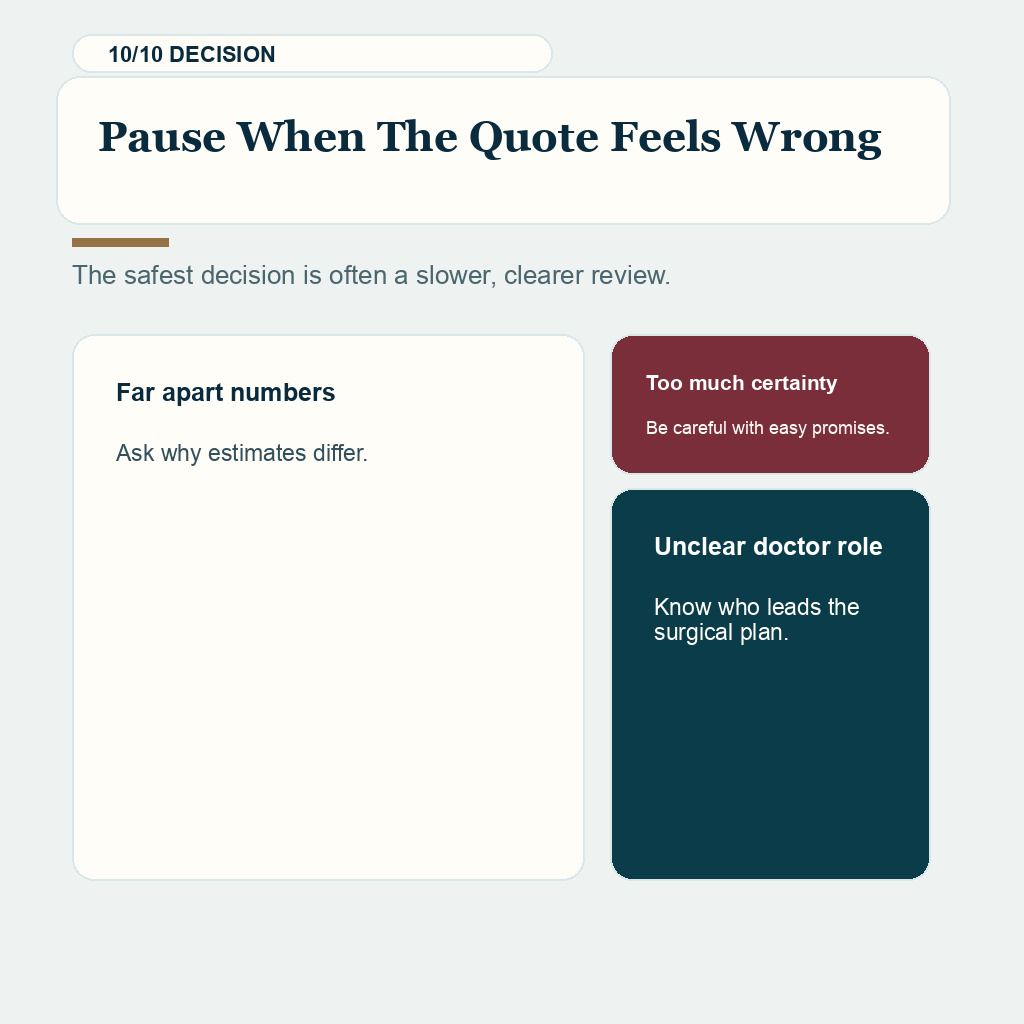
Get a second opinion before pressure decides
Get a second opinion when the graft estimates are far apart, the clinic promises very high density, the quote changes after you hesitate, the hairline feels too low, the crown promise sounds too complete, or the explanation relies on price more than planning.
A second opinion does not need to insult the first clinic. It can simply test the plan. The useful review asks whether the graft number is reasonable, whether the donor reserve is protected, and whether the priorities match your age and future loss risk.
For many people, a second opinion before hair transplant surgery simply slows down a decision that can use donor hair permanently.
Judge the price after donor limits are clear
Read the quote as a medical plan, not as a shopping receipt. If the clinic can explain the diagnosis, donor limit, graft number, session size, surgeon role, handling process, follow-up, and long-term plan, the price can be judged more fairly.
If the price changes after photographs, video review, or an examination in person, ask why. A medical adjustment based on donor density, scalp condition, or a safer session size can be reasonable. A sudden switch from an advertised price to a more expensive package without a better plan is a different warning sign.
If the quote depends mainly on a low graft price, a large graft promise, a fast deposit, or unclear doctor involvement, pause before committing. Hair transplant surgery is a decision about how much limited donor hair to use, where to place it, and who is responsible for the result years later.
If you are still early in research, review what must be clear before booking, then treat the quote as provisional until the plan is clear. The stronger the questions before surgery, the less likely the patient is to regret the quote later.
Compare price only after the plan is clear. The graft that protects your donor area and looks natural is worth more than the graft that only looks cheap on paper.
If a quote still leaves you unsure about surgeon responsibility, donor limits, graft distribution, written count, or follow-up, the number is not ready to decide from. Ask again, get a second opinion, or pause before the price becomes the reason you accept a weak plan.

Read this review excerpt
told me the quality of my donor hair and what he could take out and advised me what will the be best outcome with what donor hair I had.