


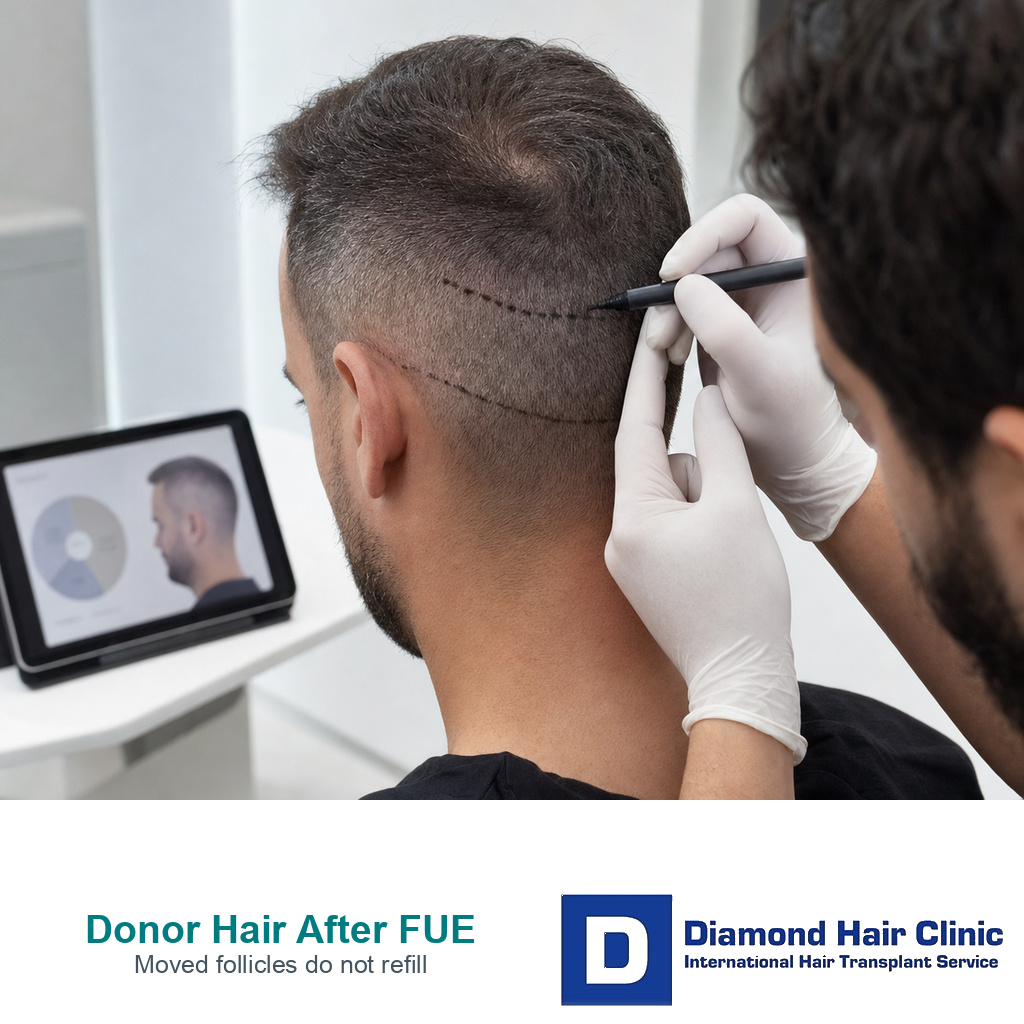
Donor Hair Removal Is Permanent in Standard FUE
In standard FUE, donor hair that has been extracted does not grow back in that exact donor spot. The follicular unit has been moved to the recipient area. If it survives, it grows where it was placed, not where it was taken from.
The donor may still look full later because redness settles, tiny extraction points heal, and the remaining hair grows long enough to cover the spaces. That is healing and camouflage, not true replacement of the harvested follicles. If a clinic tells you that the donor will refill itself, or that almost all donor hair will return, slow down and ask exactly what they mean. Standard FUE moves follicles rather than refilling the donor. It does not create new donor hair. The donor area is a limited resource, and every graft removed today changes what remains for future hair loss. If that camouflage is not enough after healing, donor SMP camouflage can be considered only with realistic limits.
Donor hair does not refill after FUE
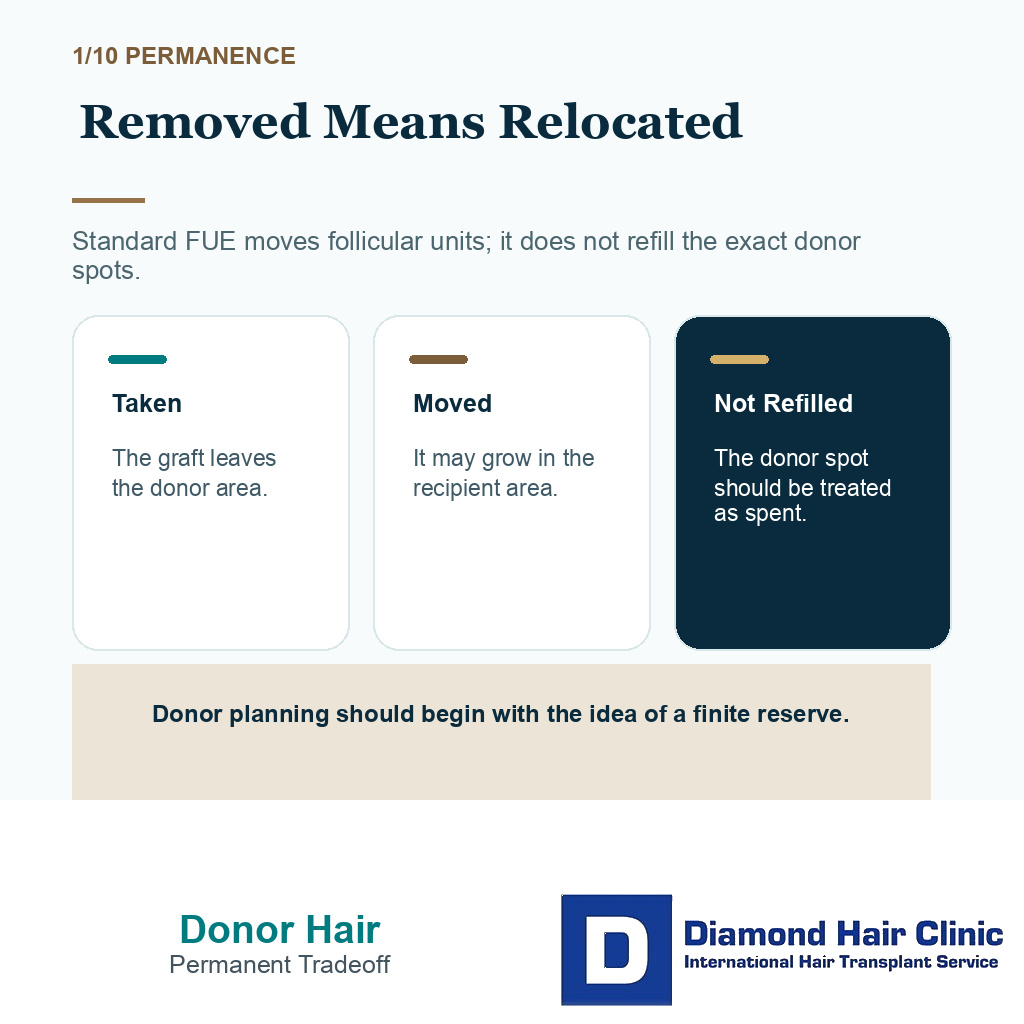
In FUE, the follicular unit is cut around and removed from the donor area. The graft is then placed into the thinning or bald area. If it survives and grows, it grows where it was placed, not back in the donor zone.
Many people get confused at this point after shaving. When donor hair starts growing after the operation, most of that visible stubble is the remaining donor hair that was never removed. The extracted grafts are not returning to the donor area. If they survive, they grow from the recipient area.
The small extraction site in the donor area heals with skin. Nearby hairs can grow over it, and the spacing can look acceptable when the extraction is conservative. But the removed follicular unit has been spent from that donor location.
I never plan donor hair as an unlimited supply, because standard FUE permanently spends follicular units. Even when the donor looks strong, I still plan the number, distribution, punch size, safe zone, hair direction, and future reserve. A donor area can forgive careful work. It is much less forgiving when too many grafts are taken too early.
A full looking donor area is not the same as regrowth
Healed FUE photos can make the donor look as if it has grown back. Most of the time, something else is happening. The remaining donor hair has grown longer, the skin color has settled, swelling has reduced, and the extraction pattern is spread widely enough that the eye does not notice the missing units. Healing closes the tiny extraction points. It does not recreate the follicular units that were moved.
That is exactly what good donor work tries to achieve. The donor does not need to look untouched under every haircut and every light. It needs to look natural for your real hair length, donor density, hair caliber, contrast between hair and skin, and future needs.
Remaining hair can hide extraction points, but it cannot replace harvested follicles. The same graft number can look safe in one donor and damaging in another. A thick, coarse donor with low skin contrast may hide extraction better than a fine, dark haired donor with pale skin. The surgical plan has to respect that difference.
One cropped photo is not enough for donor safety. I look at donor density, hair shaft caliber, miniaturization, skin contrast, curl, scar visibility, and the haircut length you want to keep. A donor that looks safe at 3 cm may not look safe under a tight fade.
Camouflage can be mistaken for regrowth
Regrowth would mean the removed follicle returns to the donor area and produces hair again. Camouflage means the donor looks better because the remaining hairs cover the extraction sites. In routine FUE planning, I rely on camouflage, healing, and careful spacing. I do not rely on the removed follicle growing back in the same place.
A useful way to think about it is simple. Stubble after surgery can show that unharvested hairs are growing again. It does not prove that extracted grafts have returned to the donor.
This matters when you compare graft offers. A plan that removes 2,500 grafts and a plan that removes 4,500 grafts are not just different numbers on paper. They spend a different amount of the donor budget. If the extra grafts are concentrated in one zone, borrowed from unstable edges, or used for an overly low hairline or crown promise, the donor may be weaker when you need a second procedure.
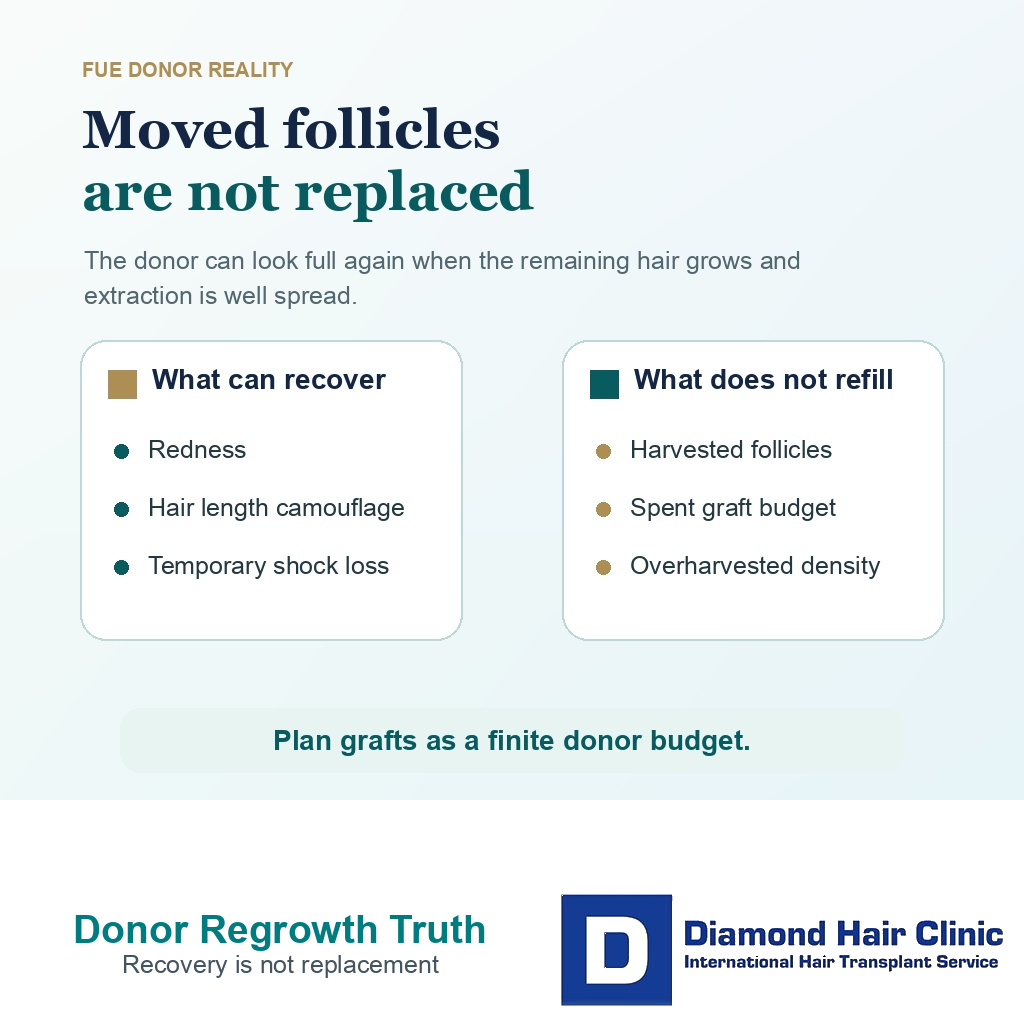
A donor area can look calmer and fuller after healing, but harvested follicles do not refill the donor zone.
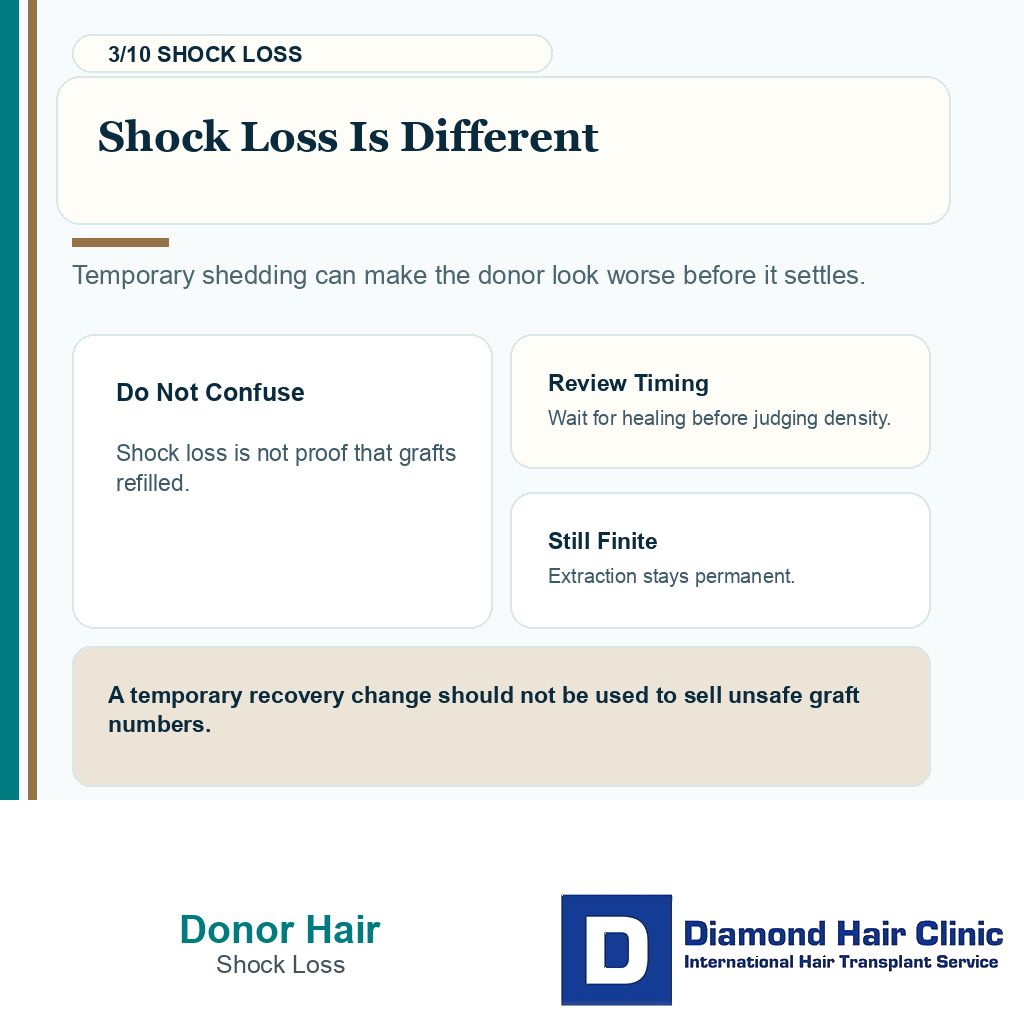
Shock loss can make the donor look worse at first
Temporary donor shock loss can make the donor area look thinner in the early weeks or months. Redness, short hair, scabbing, uneven shaving, and lighting can also exaggerate the appearance. A frightening early photo is not the same as a final donor diagnosis, so I avoid judging the donor too harshly from one image.
But temporary shock loss is not the same as unlimited donor recovery. Temporary donor shock loss is different from a spent donor budget. If the surrounding hairs recover, the donor may look much better. If the extraction was too dense, too high, too low, or spread into unstable donor zones, the loss may remain visible under short hair.
When you send early donor photos, I look at timing, haircut length, redness, pain, bumps, infection signs, and whether the pattern follows extraction distribution. If there is severe pain, discharge, spreading redness, fever, open wounds, or worsening swelling, that is not only an appearance issue and needs medical review.
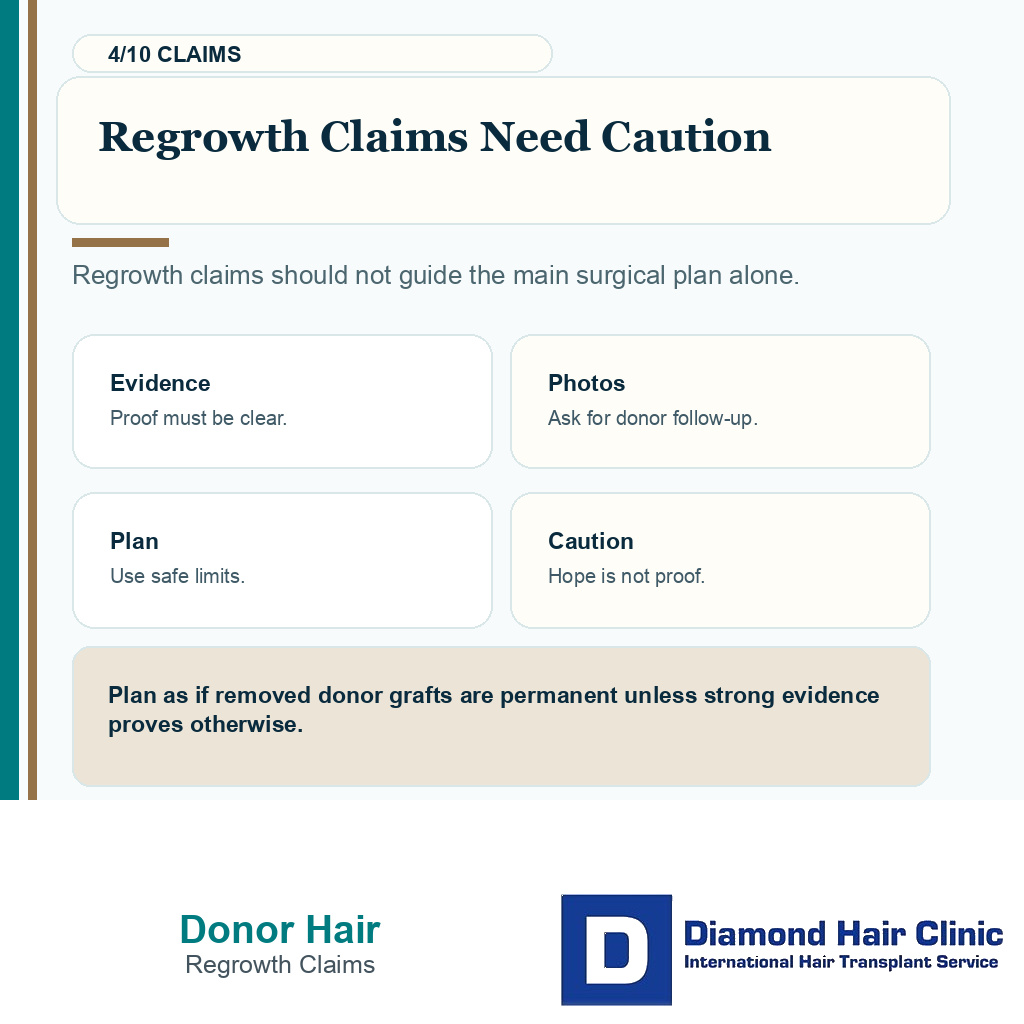
Donor regrowth claims need caution
Donor regrowth promises can make a risky plan sound harmless. You may accept a very high graft number, a low hairline, or crown coverage too early because you believe the donor will refill later. That is the danger.
I am cautious with any claim that turns donor management into marketing. If a clinic says the donor will grow back, the claim must separate ordinary healing and coverage from remaining hair from a true follicle regeneration method. Those are not the same thing. If the clinic cannot explain the difference clearly, the claim should not guide your surgery decision.
Do not build your plan on a donor regrowth promise. Build it on measured donor density, safe donor boundaries, hair caliber, age, family history, medication tolerance, future hair loss risk, and the amount of donor reserve that must remain after the first procedure.
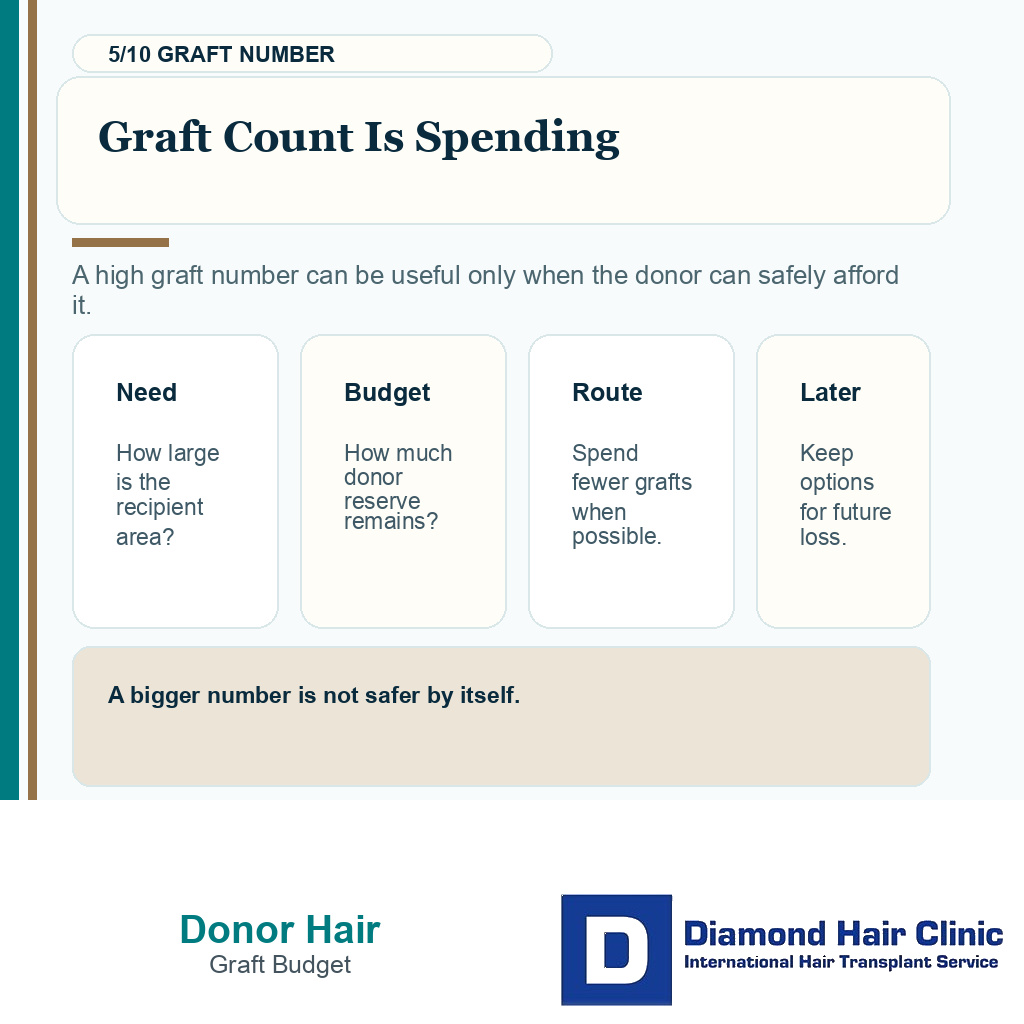
Safe graft numbers respect a finite donor
Graft planning starts with the recipient need, but it must end with donor safety. I do not ask only how many grafts can be taken. I ask how many can be taken while leaving the donor natural and useful for the future. A safe estimate uses measured donor density, visible miniaturization, extraction zone boundaries, and remaining reserve, not just the largest number that can be harvested in one day.
A consultation that only gives a big graft quote is incomplete. A proper plan shows the calculation, the hairline or crown priority, the extraction distribution, and the donor reserve that remains. When the numbers feel unclear, I want the plan to explain how graft numbers are calculated, why graft numbers can differ between clinics, and how graft count verification is handled. I also need to know which donor zones will be avoided, not only how many grafts will be taken.
Once a graft has been moved from the donor area, it is not a reserve graft for later. When a second surgery or repair is discussed, the old extraction pattern matters because the donor has already paid for the first plan.
An impressive graft count is not a safety signal by itself. Sometimes it reflects a large recipient area. Sometimes it reflects aggressive planning. Sometimes it reflects a clinic trying to make the offer sound stronger than it is. The number being impressive matters less than whether the donor can safely pay that number and still leave options later.
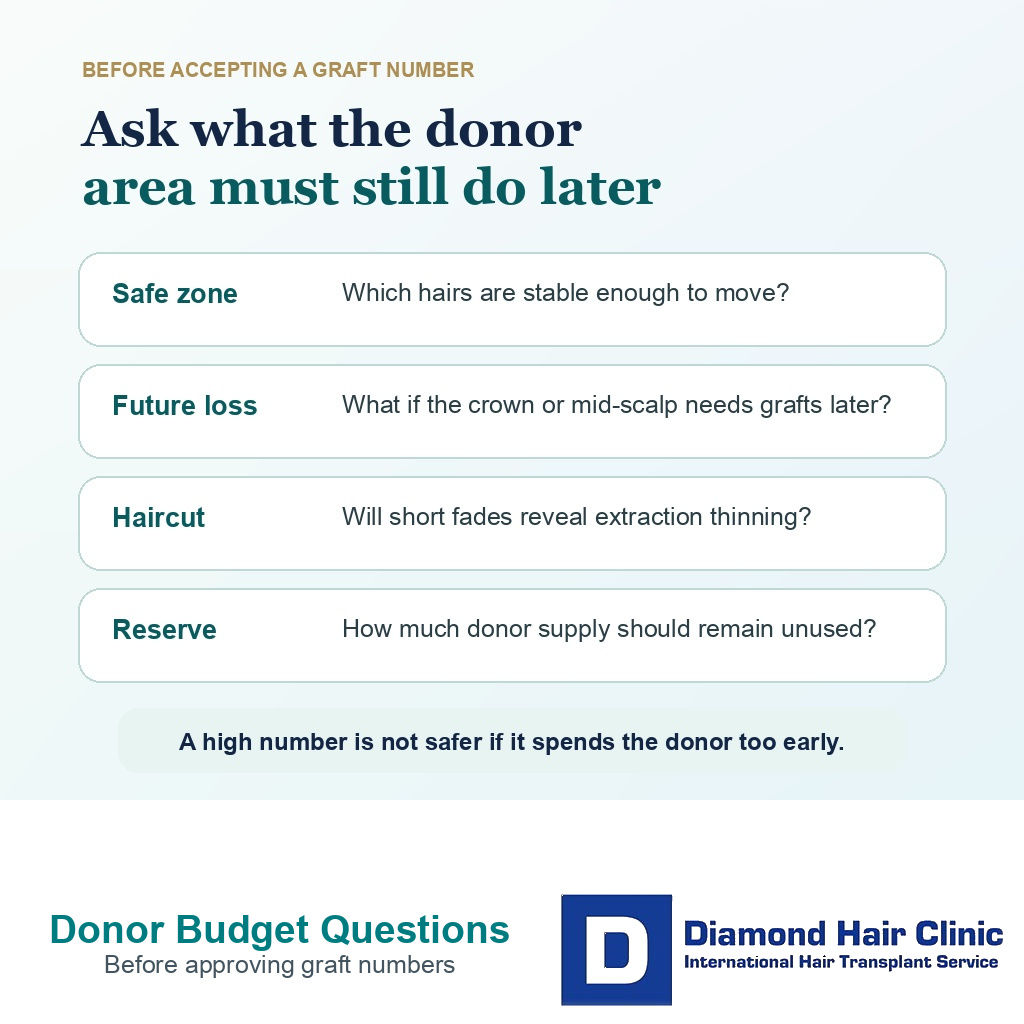
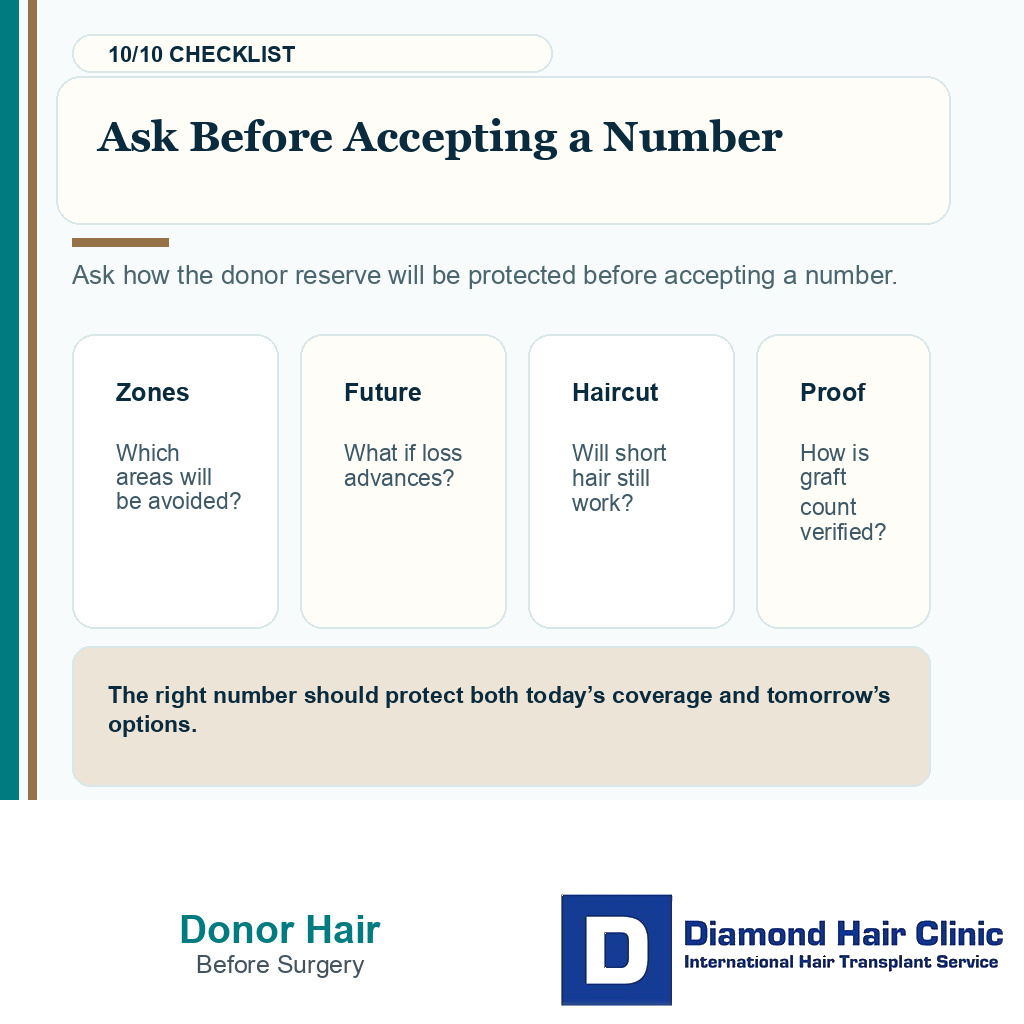
Before accepting a graft number, the donor area must still protect the safe zone, future loss, haircut choice, and reserve.
These 10 slides separate the donor reserve decisions, including what removal means, why camouflage is not regrowth, and what must be clear before accepting a graft number. Swipe sideways, use the arrows one slide at a time, or choose a number below the image.


Donor signs that should slow down the plan
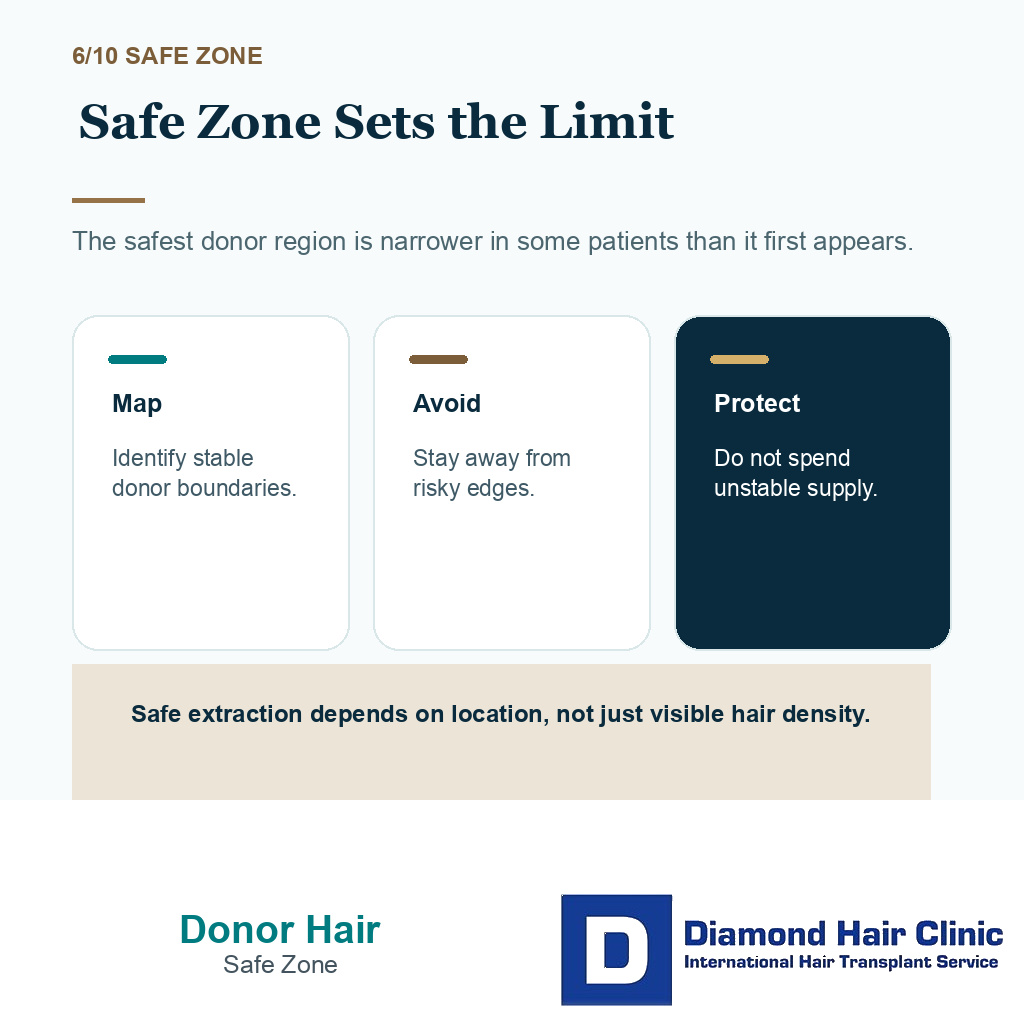
I slow the plan down when the donor looks thin, see through, patchy, or miniaturized, especially in the lower nape, sides, or above the ears. I also slow down when you are young, the family history is aggressive, the crown is already opening, medication is not tolerated, or the first request is a very low hairline with a large graft number. The safe donor area is not the same shape on every scalp. Borrowing from low nape hair or high unstable zones can make the donor look better on paper and worse in real life.
Some people need a smaller first session. Some need medication stabilization first. Some need a diagnostic review before surgery. A person with a weak donor area, retrograde alopecia or DUPA signs, or a high future graft demand cannot be planned with the same confidence as someone with a strong stable donor.
Donor planning also affects the order of work. In the guide to whether to address the hairline or crown first, I explain why the first procedure must not spend donor hair in a way that blocks later priorities.
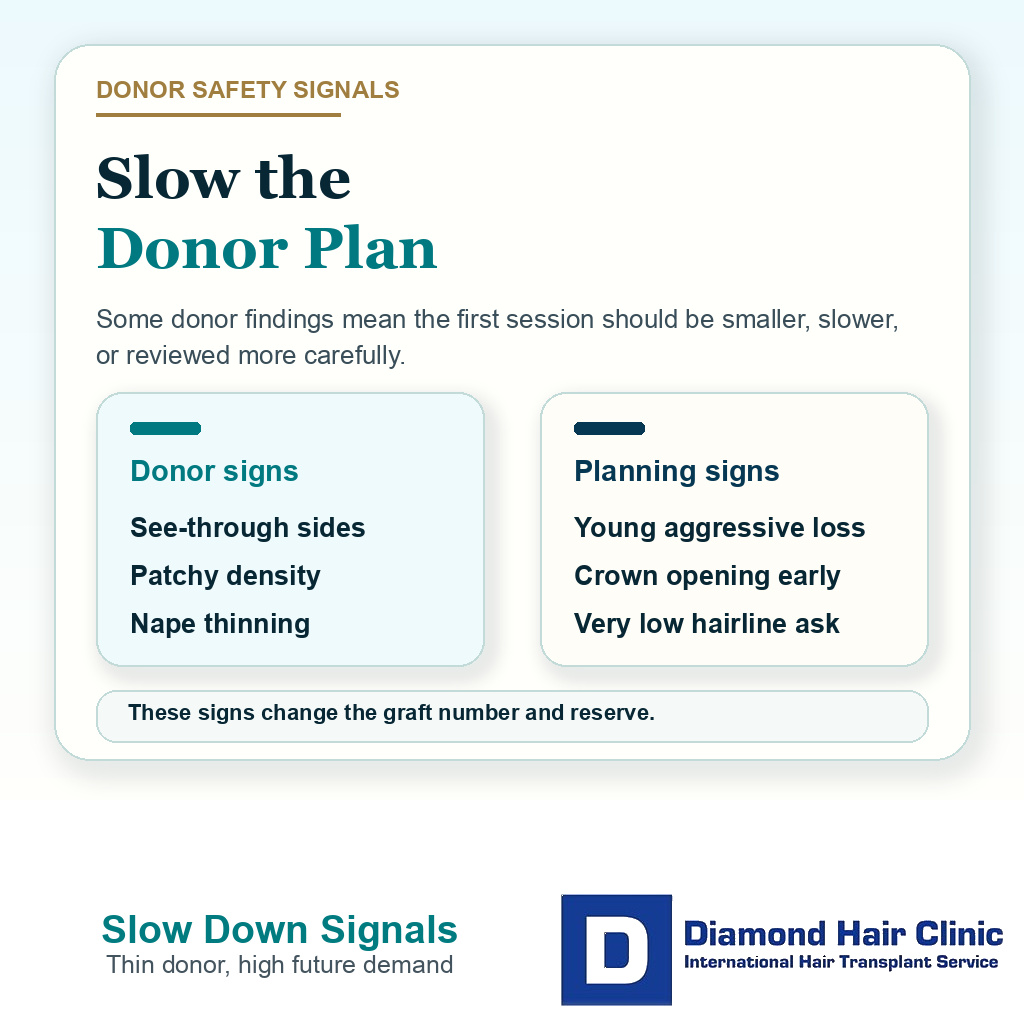
Thin donor signs, aggressive future hair loss, or a very low hairline request should slow graft number planning.
Haircut choice changes donor planning
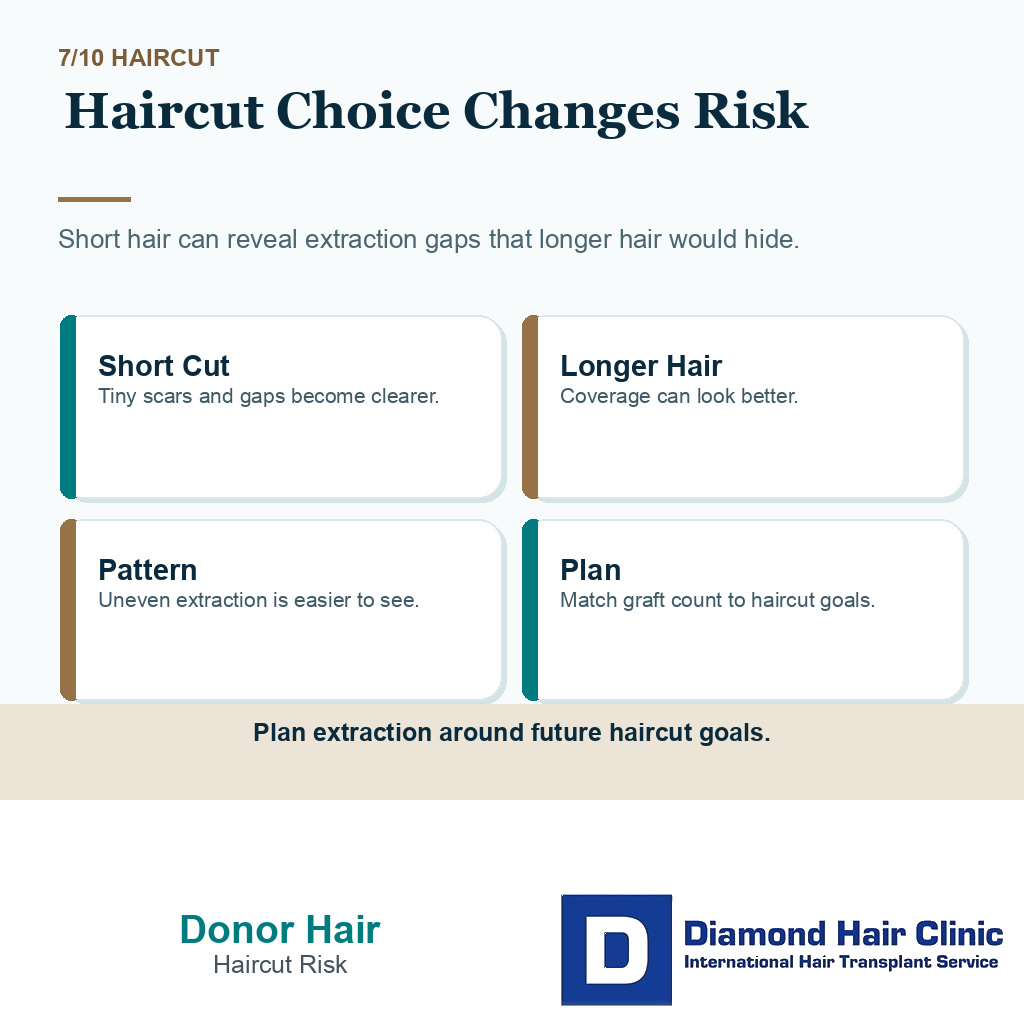
Haircut choice matters because FUE extraction is easier to hide under some lengths than others. A donor area that looks natural at medium length may show dots, spacing, or thinning under a very short fade. That does not always mean the work was poor, but it must be discussed before surgery if you want to keep the sides very short.
The shorter the haircut, the less camouflage the donor has. Donor planning has to include real lifestyle, not only graft count. If you want sharp fades after FUE, the extraction distribution has to be more cautious than it would be for someone who keeps the donor longer.
Donor regrowth expectations also connect with FUE punch size and donor scarring and with how short hair can reveal FUE donor scars. Graft count matters, but so does how the donor will look at the haircut length you actually want.
Partial follicle and regenerative claims should not guide planning alone
Partial follicle extraction, donor regeneration, stem cell claims, and donor preservation methods need careful wording because terminology can be used loosely. There is a difference between a limited or experimental technique and the standard FUE plan most people are being offered.
The boundary is similar for topical metformin after FUE donor scar claims and for verteporfin donor regrowth claims. Early wound healing research cannot be used as a donor regrowth planning promise.
If a technique is presented as experimental, limited, or case dependent, it should not become the foundation of a normal graft count plan. If a clinic presents donor regrowth as routine and near complete, the claim needs a precise explanation, long term evidence, and a donor protection plan for the possibility that promised regrowth does not happen.
For standard FUE, I plan as if the grafts removed from the donor area are gone from that site. Beard or body hair can help selected repair plans, but it does not recreate the same scalp donor density, texture, or haircut tolerance. If a clinic’s plan only looks safe because of an optimistic donor regrowth assumption, I do not treat that as a stable plan.
Realistic improvement after overharvesting
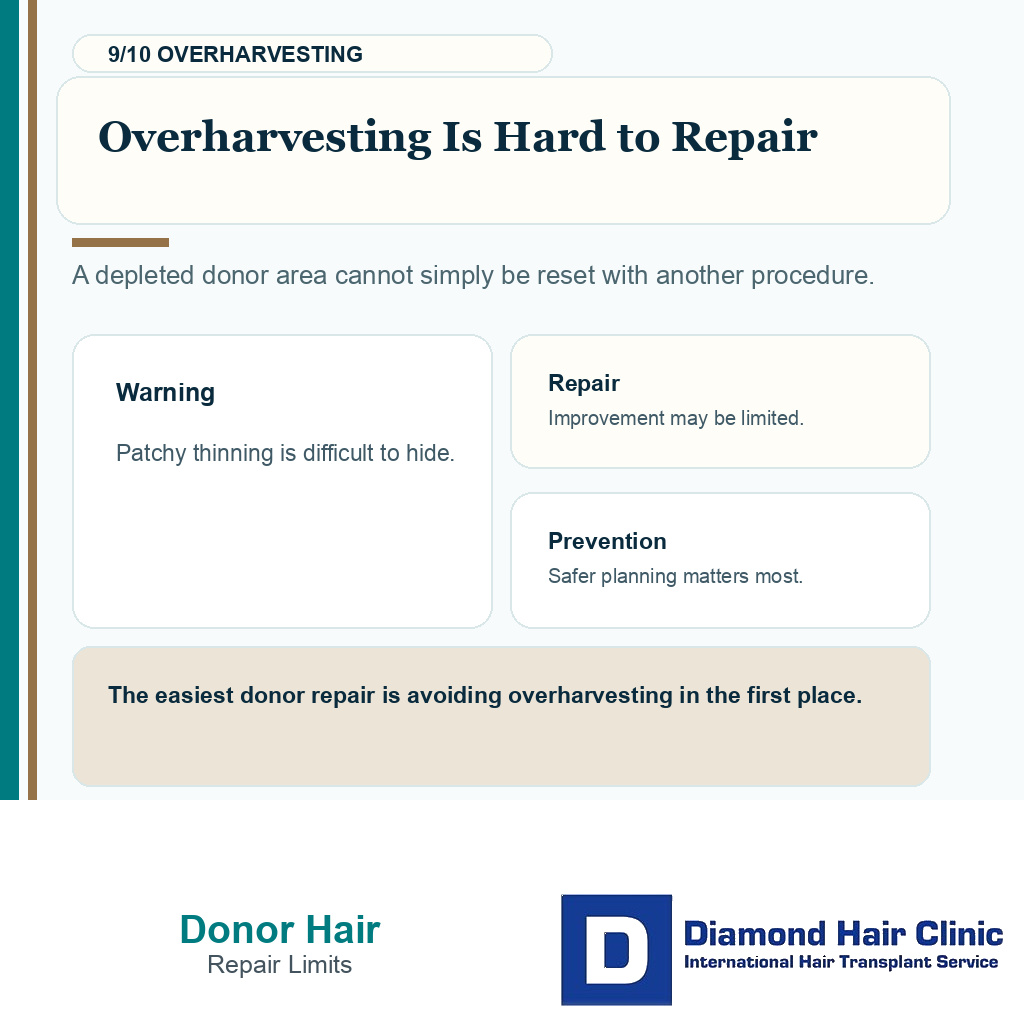
If the donor has already been overharvested, the options become narrower. Sometimes longer hair, better styling, or time can soften the appearance. Sometimes scalp micropigmentation can camouflage contrast, but it does not add donor hair or repair poor extraction spacing. In selected cases, beard or body hair may help with repair planning, but texture, growth cycle, and yield are different from scalp donor hair. It does not give back the original scalp donor that was spent.
Repair is harder than prevention. A depleted donor limits density, restricts a second session, and may force compromises between the hairline, mid scalp, crown, and donor camouflage. Visible donor area overharvesting can limit repair options when you compare aggressive offers.
I also separate a poor donor appearance from a poor recipient result. In lifetime graft planning, I explain why every procedure uses part of a limited reserve. If that reserve is spent poorly, the repair conversation can become more difficult than the first surgery.
Hairline and crown decisions change with donor limits
The finite donor principle changes how I think about hairline height, temple corners, and crown coverage. A very low hairline may look attractive on a screen, but it can take grafts away from the future mid scalp or crown. A crown can absorb many grafts without creating the same visual impact as a well planned frontal frame.
Around Norwood 3, donor regrowth misunderstanding can push the plan too far too early. In Norwood 3 hair transplant planning, I explain why corners, future loss, and donor reserve have to be planned together.
The donor area must still serve the future scalp. A slightly more conservative first plan is better than spending grafts on a design that only looks good for the first year or two.
Decision points before accepting a graft number
Before accepting a graft number, the donor map should show where grafts will be taken from, how the safe donor area was judged, how extraction will be distributed, and how much reserve is being left. Donor density, hair caliber, miniaturization, the first session extraction percentage, future native thinning, and the clinic’s donor regrowth assumptions should be clear before the number is trusted.
Also ask what the donor may look like with your preferred haircut. If you wear the sides very short, that detail belongs in the surgical plan before extraction starts, not after the donor has healed. A donor that looks acceptable at medium length may still show a see through pattern under a tight fade. If the explanation is only a large number and a promise that the donor will recover, the consultation has not addressed the main risk.
Absolute result promises can be misleading for the same reason. A hair transplant guarantee can sound comforting, but the real protection is careful planning before grafts are removed. Once donor hair is spent, the promise does not restore the donor budget.
Donor regrowth claims before choosing a clinic
I explain it plainly. The donor area can heal. The remaining hair can cover. The redness can fade. Some temporary shedding can recover. But the grafts removed during standard FUE are moved to another area, and I must respect that from the first plan.
Recovered is an easy word to misunderstand in donor photos. Smooth skin, less redness, or better coverage from longer hair is not the same as extracted follicular units returning to the donor area.
For the right person, FUE can still leave a donor area that looks natural. That result comes from discipline in the graft number, careful spacing, stable donor selection, realistic hairline design, and direct discussion about future loss. It does not come from pretending the donor is unlimited.
If you are comparing clinics, donor protection after the grafts are gone matters more than the largest number offered. That tells you much more about the quality of the plan than a large number ever will.

Read this review excerpt
told me the quality of my donor hair and what he could take out and advised me what will the be best outcome with what donor hair I had.