


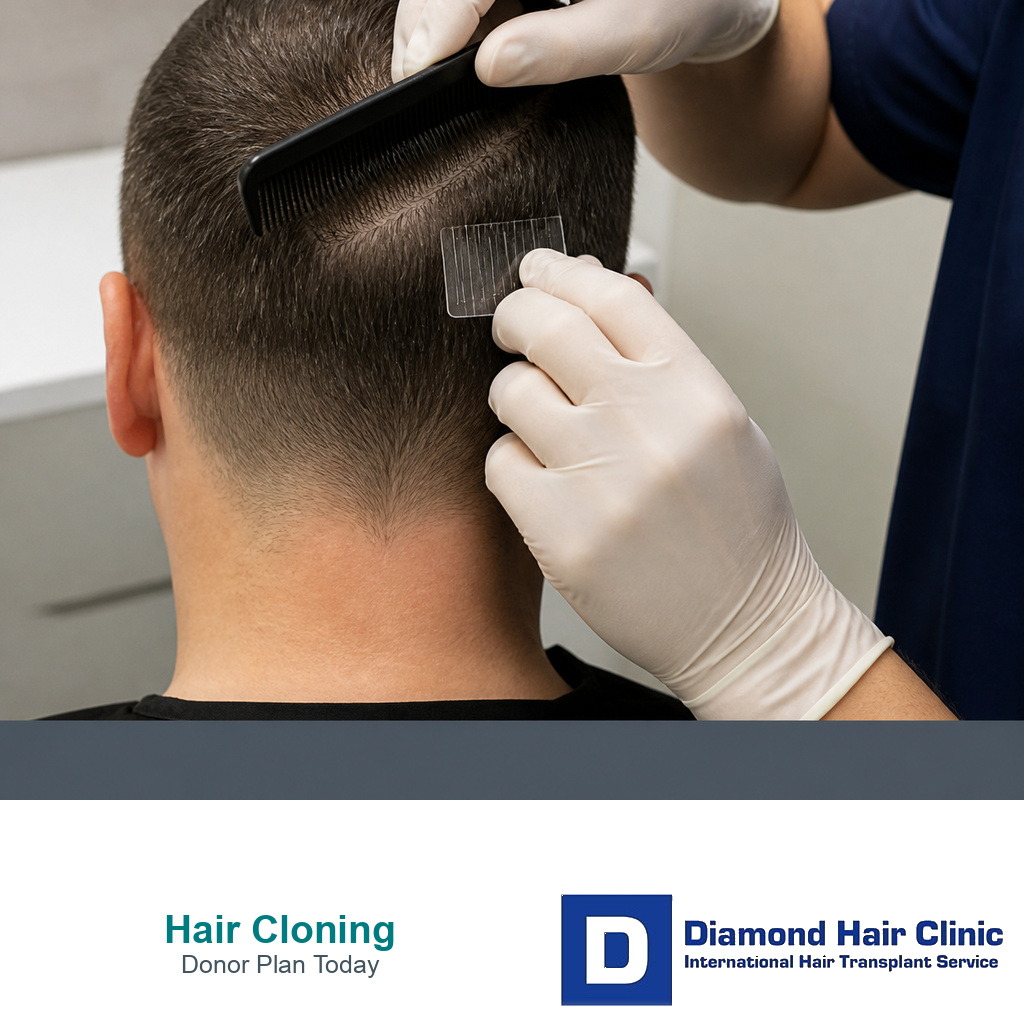
Hair Cloning Should Not Change Today’s Donor Plan
Many patients ask me whether they should save donor hair because hair cloning, follicle regeneration, or stem cell research may soon change everything. I understand the question. If you are worried about using a limited donor supply, the idea of future extra hair sounds comforting. But I would not use it to decide today’s graft number.
Routine transplant planning cannot use hair cloning as donor supply for today’s graft plan. If you are deciding whether to delay surgery, use fewer grafts, or accept a higher graft quote because cloning may arrive later, I still base the decision on the donor area I can examine now. A careful FUE plan has to be built around the hair that can be safely harvested today, the pattern of future hair loss, and the amount of coverage that can look natural without emptying the donor area too early. The donor accounting rule applies to androgenetic alopecia before FUE, because a label or future research hope does not create extra donor hair or stop native hair loss.
Hair cloning cannot supply donor hair today
In a consultation, I do not count future cloned follicles as reserve. I count the patient’s real donor area. That means examining density, hair caliber, miniaturization, scalp laxity, previous scars, and the area that must remain untouched so the back and sides do not look overharvested later. A future promise should not make today’s donor plan more aggressive.
Do not count future or outside follicles
The donor limit applies to questions about sibling hair or outside donor follicles. Another person’s donor hair is not a normal transplant option, so today’s plan still starts with the patient’s real donor area.
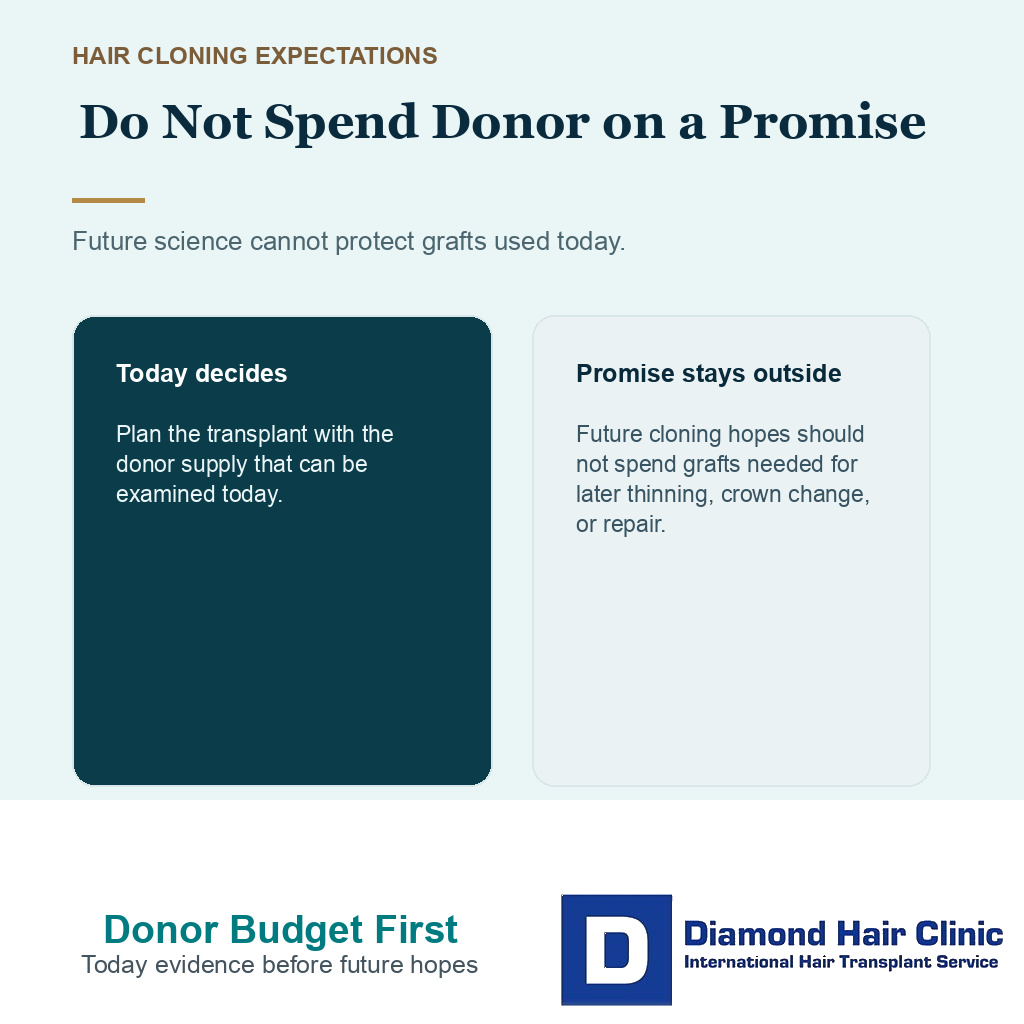
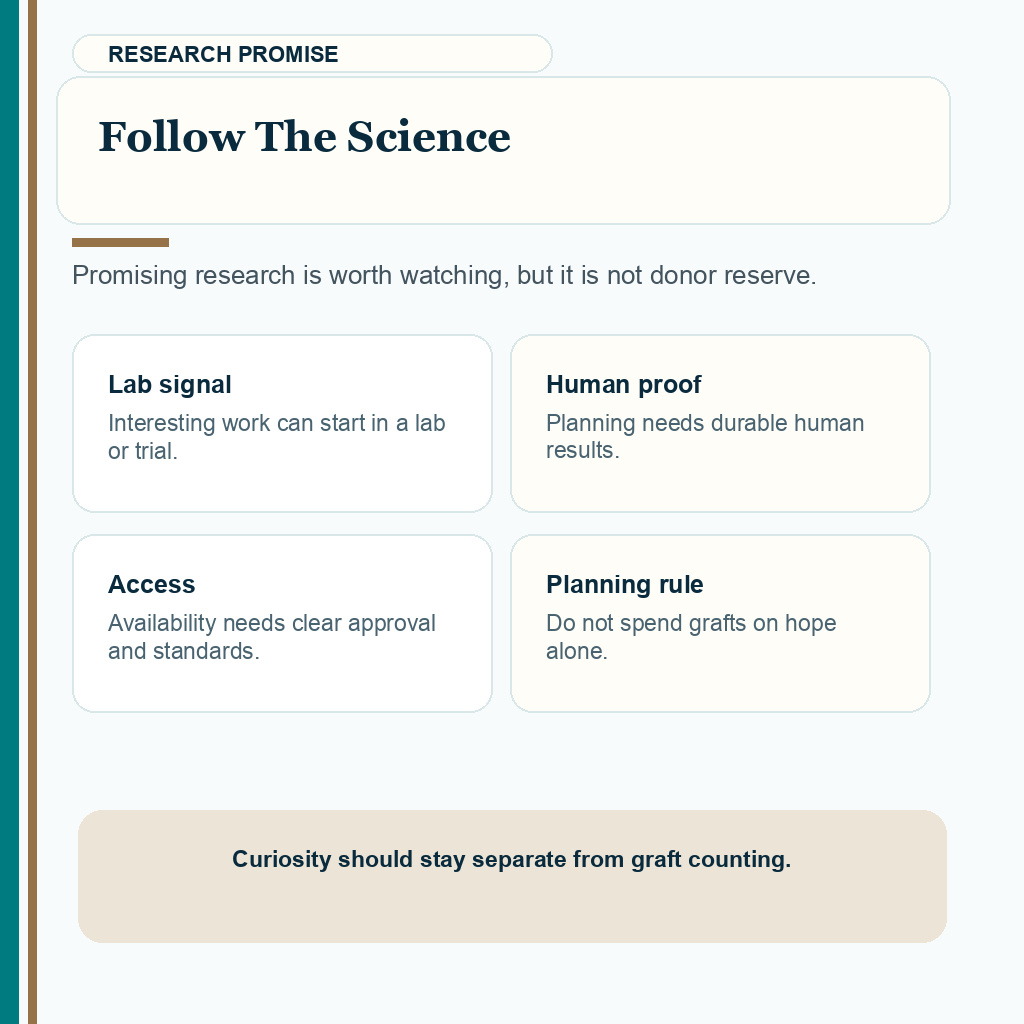
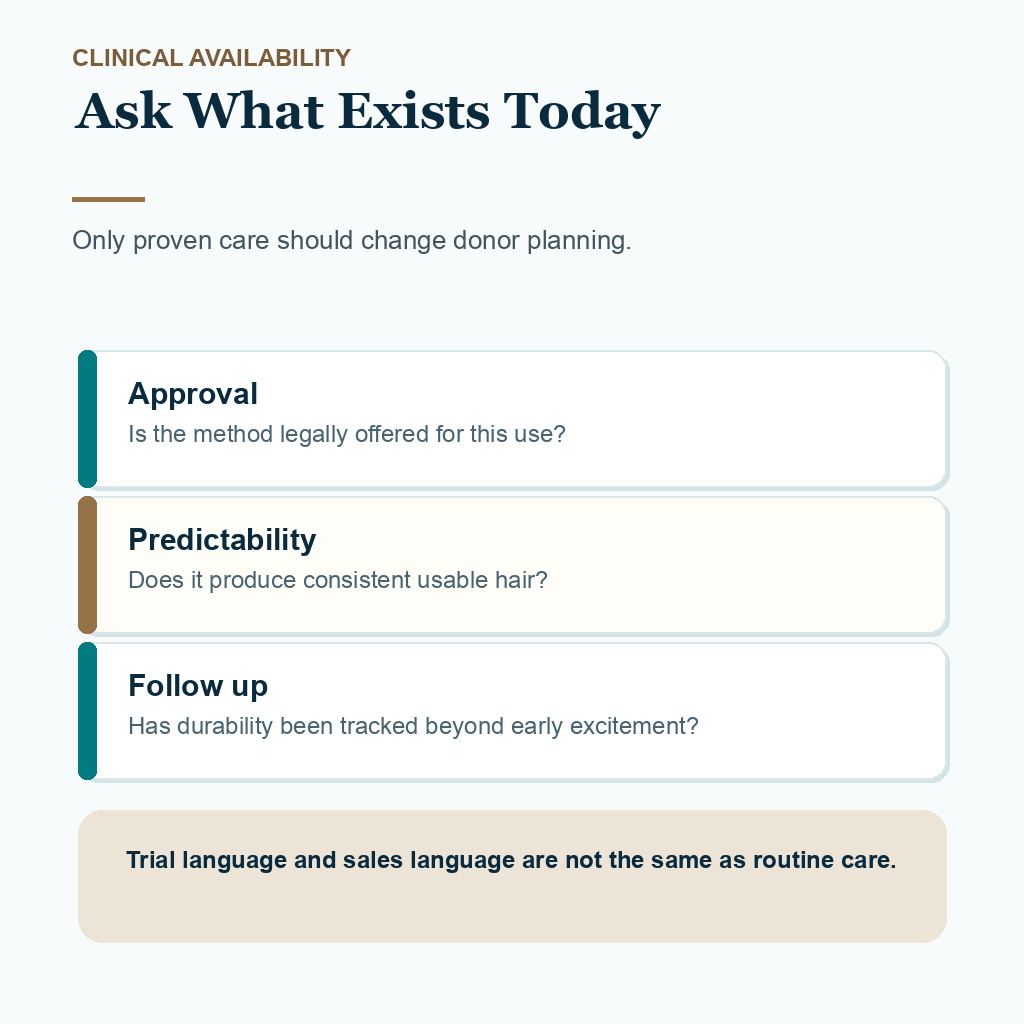
Research can be promising and still not be ready to guide a donor plan. A clinical trial, a laboratory result, or a company update does not mean a treatment is available in routine care, approved for the claimed use, predictable, safe, or durable enough for a patient booking surgery now. The difference matters because FUE spends real grafts. If a plan spends too many grafts today because it assumes future cloning will rescue the donor later, the patient carries the risk.
I separate the hair cloning question from broad optimism about technology. I follow progress in hair restoration research, but I do not let it loosen donor planning.
Cloning and regeneration are often mixed together
Patients often hear several terms used as if they mean the same thing. Hair cloning, follicle multiplication, donor regeneration, exosomes, stem cell treatments, peptides, and experimental topicals are very different claims. The first question I ask is simple. Does this create hair I can safely transplant, or is it only trying to support existing hair?
One treatment may be early research. Another may be a marketed extra. Another may only aim to improve growth signals in existing follicles. None of that gives me extra donor grafts for today’s operation. When those differences are blurred, patients may start making surgical decisions around a future treatment that does not exist for them.
Verteporfin is being studied as an experimental approach to wound healing, not as a way to clone hair. The early human reports describe its use during donor incision healing or after deliberately created scalp wounds. They do not establish that a donor area depleted by an older FUE or FUT can be restored or reliably yield extra grafts for transplantation.
I use the donor limit with stem cell treatments after hair transplant and experimental topicals after FUE. Curiosity is fine. Letting an unproven idea loosen the donor plan is not.
FUE still spends real donor hair
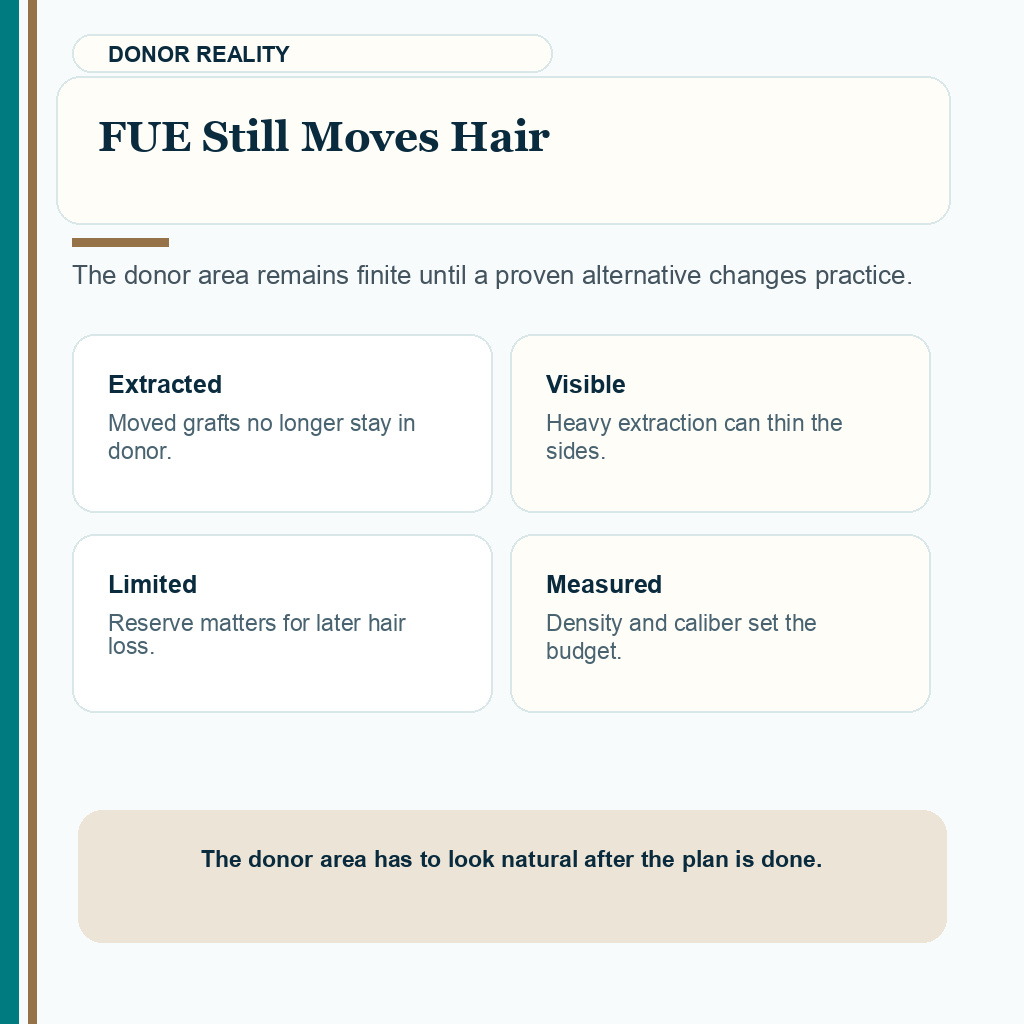
FUE moves hair. It does not create new hair. Every graft removed from the donor area is a graft that must be used with purpose. Even when extraction and implantation are done carefully, the donor area remains finite. The question is not only how many grafts can be taken in one session. The question is how many grafts can be taken while keeping the donor looking natural over time.
The donor accounting rule applies to donor hair does not grow back after FUE. A follicle moved from the donor area cannot be counted there again. Future research does not change that fact for today’s standard FUE operation.
The donor plan also has to consider where loss may continue. A young patient with active hair loss, a weak donor area, or an aggressive hairline request should not use future cloning as a reason to spend more grafts now. The safer approach is to plan within the patient’s lifetime hair transplant grafts, not beyond them.
What evidence would have to change the plan?
Before I let hair cloning change a donor plan, I would need reliable human results, not only a lab signal, a small cosmetic change, or a company update. I would need to see predictable growth, realistic density, long follow-up, safety monitoring, and clear approval for the setting where it is being offered. It would also need to show that it can create usable transplant planning value.
That is a high bar, and it should be. Patients are not research headlines. They are making decisions with their real donor area, their real hair loss pattern, and their real expectations. Until the evidence reaches that practical level, hair cloning belongs in the research discussion, not in the graft calculation.
Hair Cloning Evidence Map
I use each claim to test the plan. If the promise is not a usable clinical option, it should not change the graft number. The donor plan has to work even if cloning never becomes available for this patient.
Research idea
A research idea can be worth following.
I still do not spend donor hair against it.
Human proof
Real patients need durable results.
I need proof that lasts.
Clinical access
A clinic offer is not approval.
Marketing should make the plan stricter.
Donor plan
Today’s FUE still uses finite grafts.
The safe donor budget decides.
Follow the research without borrowing from it
A promising idea can be encouraging, but it should not be counted as donor reserve. The plan still needs a graft number that stands on its own.
- Do not add grafts because a future option sounds close.
- Keep hairline design conservative.
- Preserve donor for known future loss.
Separate a signal from a surgery plan
Some claims may refer to growth signals, wound healing, or early studies. That is not the same as a reliable new supply of transplantable follicles.
- Name the measured outcome.
- Show how long the follow up lasted.
- Only change the FUE graft number when the result changes the plan you can make now.
Treat urgency as a warning sign
If a clinic sells future sounding treatments as certain today, I become more cautious with the surgical part of the plan, not less cautious.
- Do not accept vague product names.
- Do not accept unlimited graft language.
- Do not let add ons justify overharvesting.
Build the plan that still makes sense alone
The plan should still be defensible even if no cloning option becomes available for the patient. That is the standard I use.
- Measure donor capacity.
- Choose a realistic density goal.
- Leave options for the next stage.
Future technology should not justify a risky graft number
A high graft quote can feel reassuring because it sounds decisive. It can also be a way to avoid the harder conversation. If the donor area is weak, if the hair loss is still active, or if the patient wants a low juvenile hairline, adding more grafts may make the first result more fragile rather than safer.
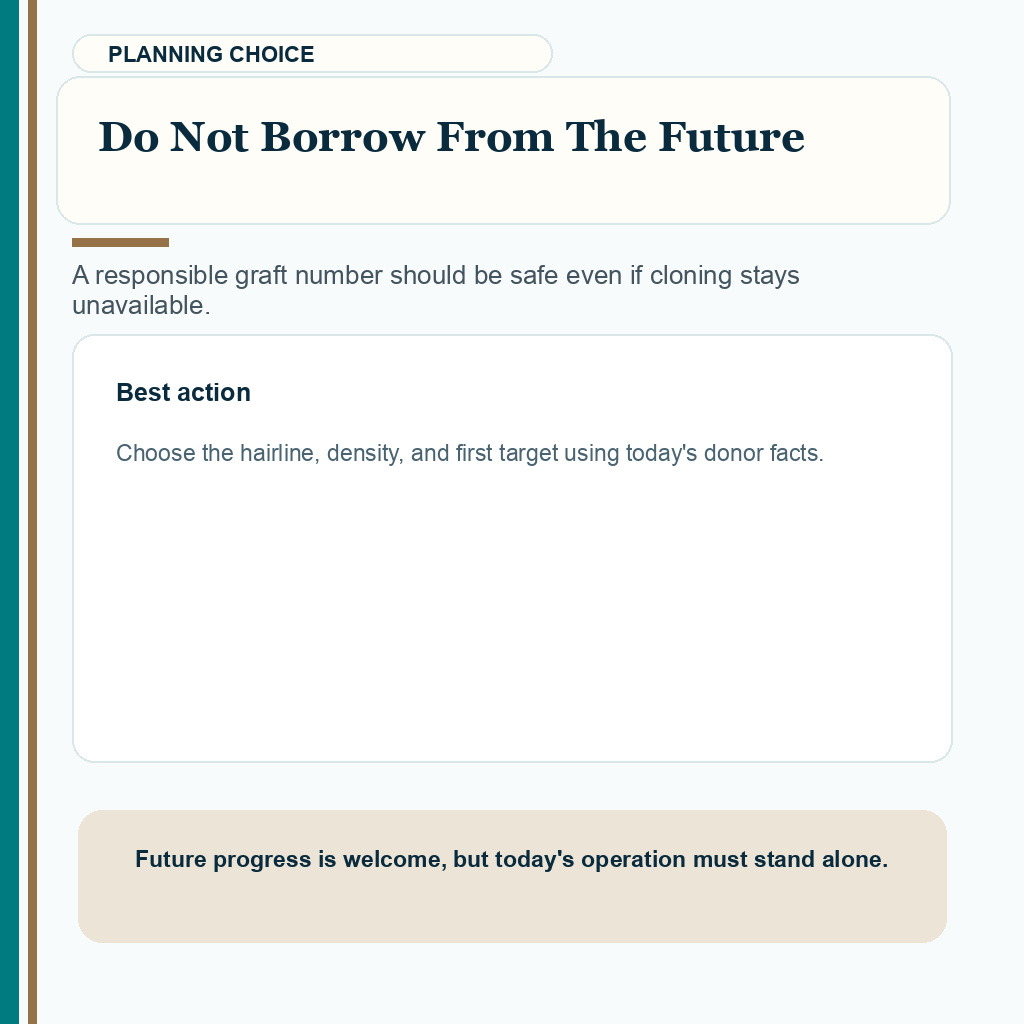
I am especially cautious when a patient says, “I can use more now because cloning may come later.” That is not how I plan. If a number is not responsible without hair cloning, it is not responsible with hair cloning as a future hope. The donor area still has to look natural after extraction, and it still has to support possible future work. Future research cannot make today’s donor spending reversible, so the first plan still has to stand on its own.
Waiting for research should not make today’s operation looser. The first graft number still has to make sense with the donor that exists now.
The planning problem is even clearer when there is donor miniaturization before hair transplant or a weak donor area. In those cases, future research should make us more disciplined. It should not become a reason to ignore today’s warning signs or accept donor area overharvesting risk.
Waiting can protect the donor plan
Some patients should wait, but not because cloned donor supply is assumed to be around the corner. Waiting can be right when the hair loss pattern is changing quickly, when the donor area is unclear, when the requested design would use too many grafts, or when the first operation does not have a precise job.
My delay standard is practical. If the patient is too early with active hair loss, waiting protects the plan. If the donor is too weak, waiting may prevent harm. If another serious surgeon has a clear reason for saying no, the patient may need a proper review before surgery. That is different from waiting only because online speculation says cloning is almost ready.
Sometimes the correct outcome is not to wait for a new technology. It is to narrow the first operation, adjust the hairline, treat ongoing loss where appropriate, or accept that surgery is not safe enough now. I describe that boundary more directly in cases where a patient is declined for hair transplant.
Future options stay open through a conservative first plan
Keeping options open starts with a measured first plan. I choose a hairline that can age naturally, avoid chasing the crown too aggressively in young patients, and use grafts where they create the strongest framing benefit. This gives the patient a result that can stand on its own while leaving room for later decisions.
I also explain the difference between donor protection and fear. Protecting the donor does not always mean doing nothing. Sometimes it means making a smaller first operation that still makes sense if no new technology arrives. The plan should make clear what we are treating, what we are leaving alone, and why hope for future technology is not loosening the graft budget.
Research may change the field one day. If it does, a patient who preserved donor supply and avoided overharvesting is more likely to keep better options than a patient who spent too much too early. That is the practical value of careful planning.
Cloning research cannot spend today's donor
Hair cloning is worth following, but it does not give a patient extra donor hair today. FUE still moves finite grafts from the back and sides to the areas where they are needed most.
The hairline, crown strategy, and graft number need to make sense even if cloning arrives much later than expected. If the first operation only works because future technology might rescue it, the design is too dependent on hope.

Read this review excerpt
told me the quality of my donor hair and what he could take out and advised me what will the be best outcome with what donor hair I had.