


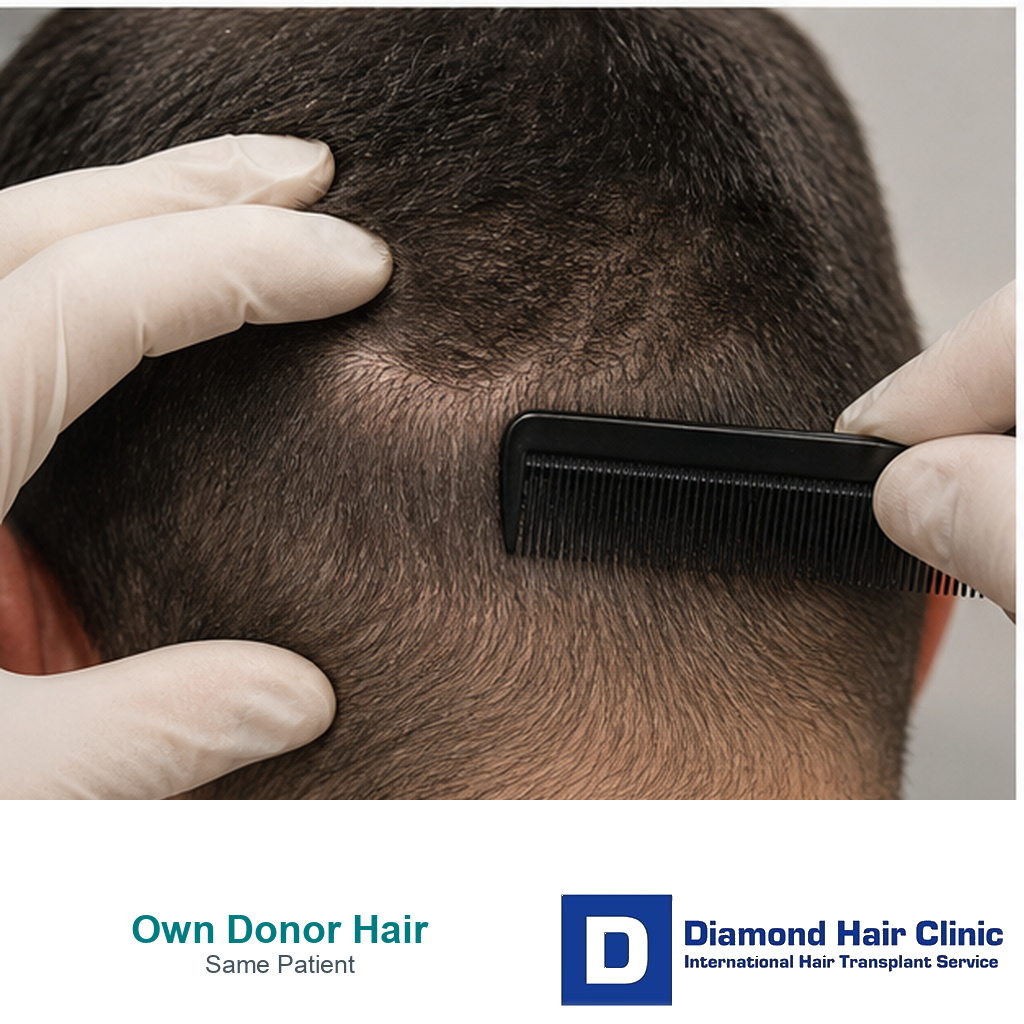
Someone Else’s Donor Hair Is Not a Hair Transplant Shortcut
In a routine hair transplant, donor hair means your own follicles. The grafts are taken from your own safe donor zone, or in selected cases from another part of your own body. Someone else’s donor hair is not a normal shortcut for FUE planning. A friend, sibling, or tissue match may sound useful when your donor area is weak, but the question changes from hair design to immune system medicine.
I understand why patients ask. If your own donor supply feels limited, another person’s thick hair can sound like the missing piece. But living follicles are tissue, not spare parts. My starting point is always the same. I ask what your own donor area can safely support now, and what should be protected for the future.
Donor hair means your own follicles
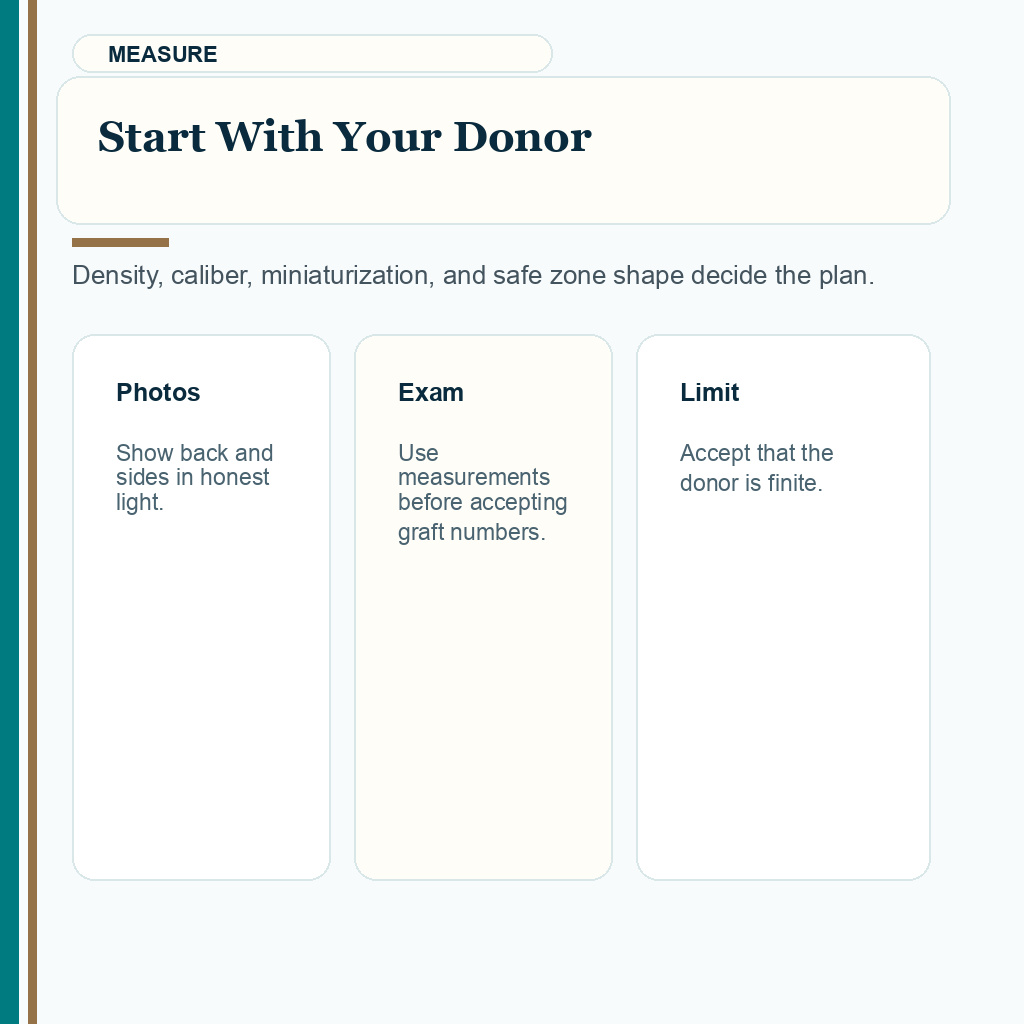
When I say donor hair in a normal consultation, I mean hair that belongs to the same patient. In scalp FUE, this usually comes from the more stable hair at the back and sides. That area still has to be examined. Density, hair caliber, miniaturization, extraction history, scars, hair contrast, curl, and preferred haircut all change the safe plan.
This is also why I do not separate the donor question from the design question. A dense looking donor area can still be unsafe if the hair is fine, the safe zone is narrow, or the patient wants a very short haircut after surgery. A modest looking donor area can sometimes work well when the plan is measured and the hairline is designed with restraint. The plan should stay within the real limits of your own donor supply rather than borrow better hair.
That is where donor hair permanence becomes more than a slogan. The donor has to be your own reliable donor. Another person’s lifetime graft budget does not become yours because the hair color, texture, or family pattern looks useful.
Matching hair texture is not enough
A brother, parent, friend, or willing donor can share visible traits with you and still be another immune system. Hair restoration is not only a cosmetic material match. The follicle is living tissue. In transplant medicine, tissue from another person raises matching, immune response, medical indication, and long term treatment questions. Hair systems can use prepared hair as a cosmetic cover, but surgical grafts are living tissue placed into your own skin.
Donating cut hair for a wig is a different process. Those donations provide hair shafts that can be made into a removable hairpiece. They do not provide living follicles for surgical implantation. A family member can help with cosmetic hair donation without becoming a donor for your FUE operation.
Blood type, hair color, and family similarity do not make the follicles yours. An explanation that sounds like ordinary donor matching is a warning sign, because outside donor hair is tissue transplantation rather than cosmetic FUE.
That is a very different decision from elective hair restoration. I would not build an ordinary FUE plan around a sibling’s follicles because they have similar curl or thickness. The clinical question is not whether the hair could be physically placed into small recipient sites. The question is what medical risk would be needed to make another person’s tissue behave as if it belongs there.
Rare allogeneic stories need a boundary
Some patients find rare allogeneic hair transplant reports or read about transplant recipients and wonder whether the rule has changed. That boundary matters here. A rare medical report is not a consumer treatment menu. It does not make outside donor hair a routine cosmetic option for a patient who simply wants more grafts.
In medicine, a case report can be useful because it shows what happened under a very specific set of circumstances. It is not the same as a repeatable, elective treatment pathway for ordinary patients. If the reason a graft survives depends on immune suppression or a separate medical condition, that belongs in a different risk category from hairline planning.
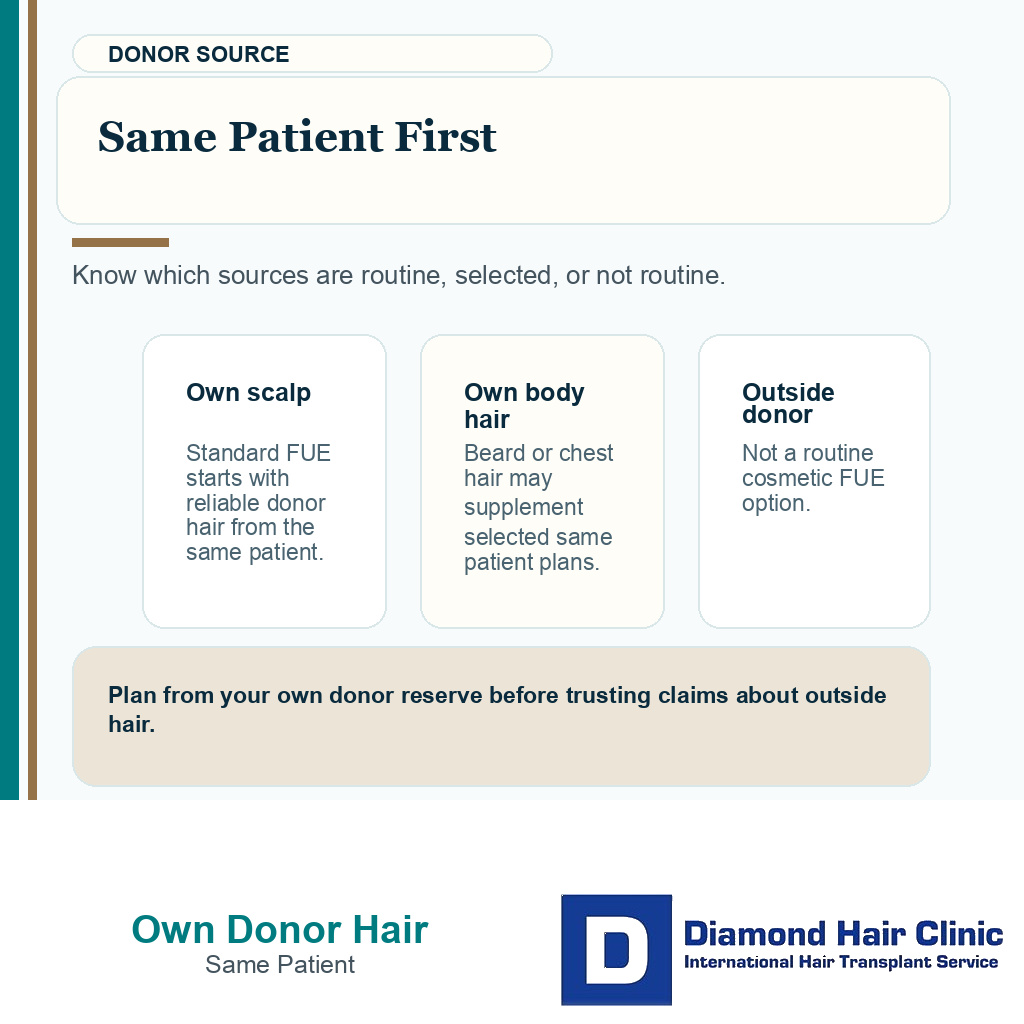
If a clinic uses unusual research language to make outside donor hair sound available, slow the decision down. Ask whether the plan is ordinary FUE, experimental medicine, same patient body hair, synthetic material, or something connected to transplant medicine. Those are not small wording differences. They change the risk, responsibility, and evidence needed.
Is your donor supply the real limit?
The real issue behind this question is often limited donor reserve. If your own donor area is weak, borrowing hair is not the solution. The donor should be measured more carefully, and the plan should be reduced until it respects what the donor can give. Donor miniaturization matters because hair that looks present today may not be safe to treat as permanent donor hair. If another person’s hair sounds tempting, bring the conversation back to your own donor limits and what can be improved without creating a new problem.
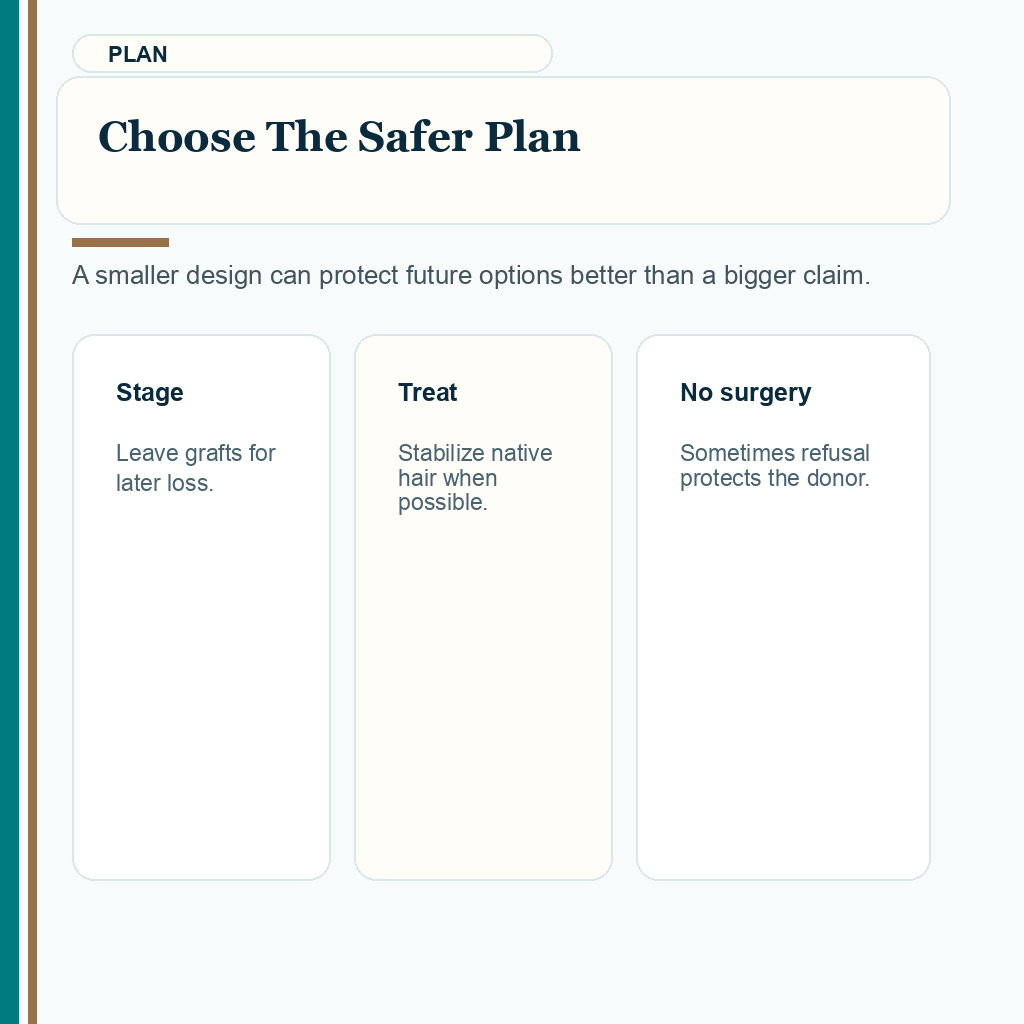
A good plan also has to protect the future. Lifetime graft planning is personal because every graft spent now is a graft unavailable later. If the donor cannot safely cover the front, mid scalp, and crown, the answer may be a smaller design, staging, stabilization with medicine, or no surgery. Pretending another person can refill the donor bank does not protect you.
The consultation should make the tradeoff visible. I want to know which zone matters most to the patient, how much native hair may still be lost, whether medical treatment is appropriate, and how the donor will look after extraction. Those answers are more useful than a large number written on a package, because the number alone does not show whether the donor area can carry the result.
Donor option boundary
Which donor choice changes the answer?
- Own scalp donorRoutine FUE starts here
- Own beard or chest hairSame patient, different texture
- Sibling or outside donorNot a routine option
- Experimental exceptionResearch is not a booking promise
Routine FUE starts here
Boundary Use the back and sides only when the safe donor zone is reliable.
Planning action Proceed only if the donor can support the design without creating a second problem.
Same patient, different texture
Boundary Body hair can sometimes supplement selected cases, but it is not a replacement for scalp donor hair.
Planning action Use only when the area, texture, yield, and expectation make sense.
Not a routine option
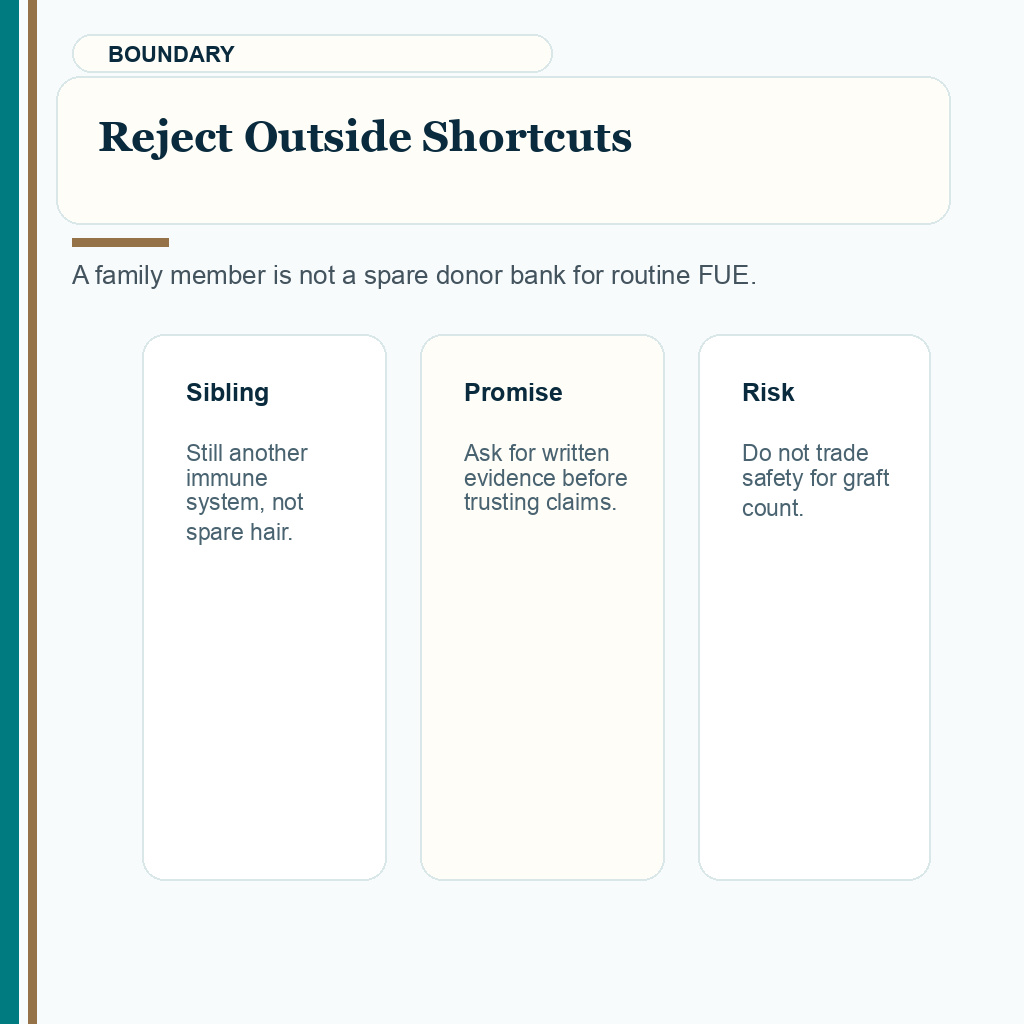
Boundary A family member is still another immune system, not a spare donor bank.
Planning action Do not plan ordinary cosmetic FUE around another person’s follicles.
Research is not a booking promise
Boundary Rare allogeneic reports or transplant medicine contexts do not create a standard patient option.
Planning action Written medical evidence matters more than shortcut marketing.
Use your own donor options carefully
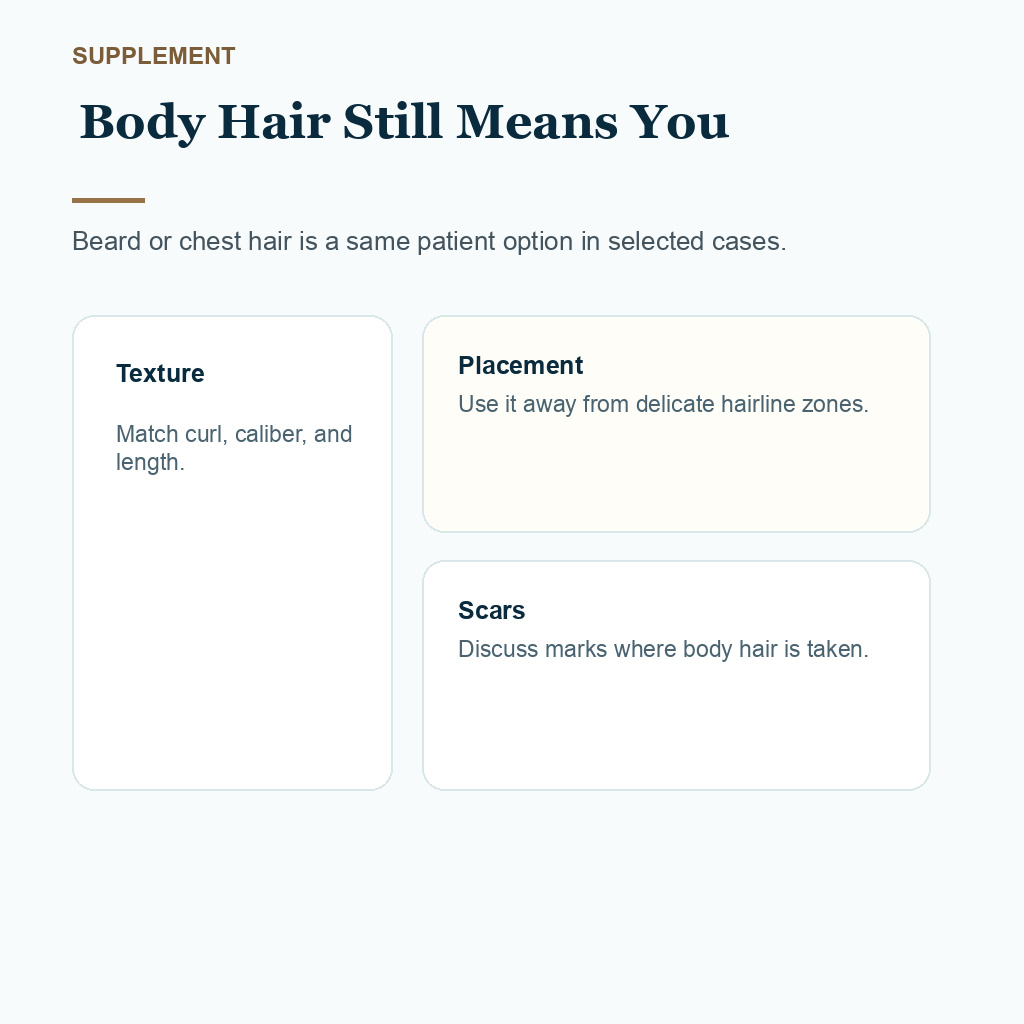
There are cases where donor planning goes beyond scalp hair, but the important phrase is still your own. Beard or body hair in the hairline is a cautious discussion because body hair has different texture, length, and behavior. It can sometimes support selected zones, but it is not a universal replacement for scalp donor hair.
The crown needs its own caution. Beard hair for the crown may be useful in selected planning because the crown can tolerate different blending choices than a soft hairline. It is still same patient donor hair. It does not make another person’s follicles a normal option.
Use these 4 slides to keep the donor option question practical before graft numbers.
What should a high graft quote prove?
A high graft quote should not be used to quiet donor concerns, because the supply still has to come from you. It should prove that the donor has been measured, that the extraction pattern is safe, and that enough reserve remains for future loss. A graft quote should follow donor measurement, not the patient's wish for maximum coverage.
If one clinic warns that the donor is weak and another offers a very large number, treat that as a reason to pause. A weak donor and a high graft quote should be reconciled with photos, measurements, hair caliber, miniaturization review, and a clear future loss plan. Another person's donor hair should not be used as the emotional escape from that hard conversation.
A serious quote should also tell you what is being left untouched. I care about the grafts we do not remove because they may be needed later, or because taking them would make the donor look thin. If the plan cannot explain the reserve, the extraction map, and the visual priority, it is not made safer by adding talk about outside follicles.
Can no surgery protect the donor?
Some patients can have a modest, well planned transplant. Some should stage the work and protect crown coverage for later. Some should not operate because the goal is larger than the donor can support. In advanced patterns, Norwood 6 or 7 planning has to be especially strict because the donor reserve is already under pressure.
Options outside surgery can protect weak donor hair better than exhausting it. Scalp micropigmentation with thin hair can help selected patients create the look of density without spending grafts. A hair system or hair transplant discussion can also be appropriate when surgical coverage would be too limited. Saying no to surgery is sometimes how we protect the donor area from permanent damage.
This can be disappointing to hear, but it is better to be disappointed before surgery than trapped after an aggressive extraction. A weak donor area can be made worse permanently. A conservative plan, a non-surgical option, or a delayed decision can preserve choices that a rushed surgery would remove.
Outside follicles are not routine cosmetic FUE
If another person's donor hair is offered, the first question is what treatment is really being described. Ordinary cosmetic FUE uses the patient's own donor hair. Outside follicles bring transplant medicine, immune risk, medication questions, and responsibility questions that do not belong inside a quick hair transplant quote.
Photos of the front, top, crown, donor back, donor sides, and lifted hair still matter, but they matter for a different reason. They show whether the patient's own donor supply can support a realistic goal. If that supply is not enough, the answer may be a smaller operation, staged coverage, scalp micropigmentation, a hair system discussion, or no surgery.
A firm limit is better than making outside follicles sound normal. A weak donor area does not become stronger because someone adds a shortcut to the conversation.

Read this review excerpt
told me the quality of my donor hair and what he could take out and advised me what will the be best outcome with what donor hair I had.