


Choosing Between a Hair System and Transplant
If you are choosing between a hair system and a hair transplant, do not judge the choice only by which option gives more hair today. A hair system can give immediate visible density without spending donor grafts. A transplant uses your own growing hair, but it is surgery, it has a recovery period, and the result depends on donor area, future hair loss, medication tolerance, and realistic density.
Choosing a hair system first can be a protective decision in advanced loss. If the density a patient wants would consume too much donor hair, a system, scalp micropigmentation, or no surgery can preserve options better than a transplant that chases fullness everywhere.
Surgery spends donor hair. A hair system does not. Start with that difference before comparing the mirror result. Before choosing, decide what you are trying to protect, such as instant coverage, long term natural growth, donor reserve, privacy, or freedom from daily maintenance.
I see this question most often when a man is tired of waiting. He may have tried medication, fibers, shorter haircuts, or styling tricks, and he wants a clear path. The mistake is to compare an ideal hair system with an ideal transplant. Neither option works that way in real life. The fair comparison is between the maintenance you can accept and the surgical limits your scalp can actually support. If you are using a system now, judge surgery after you know how much native hair and donor hair would still be useful without the system.
Hair system or transplant decision check
Choose the option that protects your next decision
I do not compare only the mirror result today. A hair system gives immediate coverage without spending donor hair. Surgery uses limited grafts and needs healing. The right path depends on donor reserve, scalp condition, maintenance, medication tolerance, and whether a combined plan would be safer.
Coverage check
A system can protect donor grafts when coverage must be immediate
Large visible thinning, need for fast density, public work, styling needs, and whether surgery would require an oversized graft plan.
Immediate fullness is treated as proof that the system is the easier medical choice.
What are the maintenance, skin, edge, replacement, and long term cost rules?
Before choosing the system route, picture an ordinary week rather than the first fitting day. Sleep, sweat, exercise, cleaning, edge checks, and replacement costs decide whether the instant density will still feel manageable. If a system is used as a bridge, removal has to be planned as carefully as attachment, including how the scalp will be reviewed without adhesive or edge tension.
If a system is used while you wait for growth or repair, the removal method and adhesive contact should be planned before it touches healing skin.
A system can be a good first step when it gives coverage without spending donor reserve.
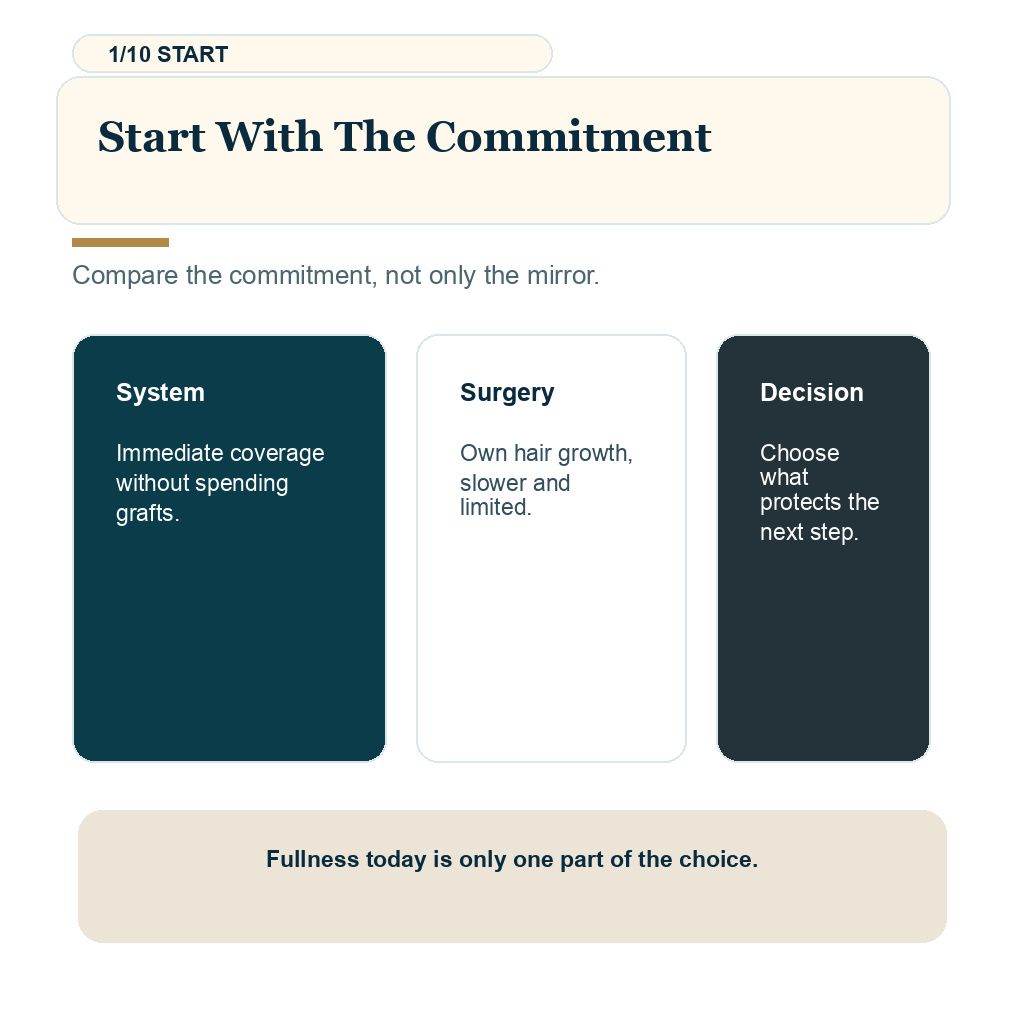
Fullness today is not the whole decision
A hair system usually wins if the only measurement is instant fullness. It can cover a large bald area at once, create strong density, and change the reflection in the mirror immediately. That is powerful for a patient who has been hiding thinning hair for years.
A hair transplant works differently. It moves grafts from the donor area to the thinning area. It cannot create unlimited new hair, and it cannot stop native hair from continuing to thin. A transplant also needs months before the result can be judged. Early shedding, uneven growth, and slow thickening can create anxiety even when the surgery is healing normally.
The surgical advantage is not instant density. It is that the grown result can become part of your own scalp when the plan is realistic. The hairline can be designed around age, direction, temple shape, facial proportion, and long term donor planning. That matters if you want to live without attachment changes, glue, tapes, or the fear that a system edge may be seen.
When I assess this choice, I first separate appearance from biology. A system changes appearance. Surgery changes the scalp and donor reserve. Those are very different commitments.
A hair system can make sense first
A hair system can be a reasonable first step when the bald area is large, the donor supply is limited, medication is not acceptable, or you need visible coverage now while still thinking about surgery later. It can also help a younger man test how he feels with a lower or denser look before spending grafts on a permanent surgical design.
Some people are not ready for the slow year of transplant growth. Work, relationships, photos, or public facing responsibilities can make the ugly duckling stage difficult to tolerate. A system may give control while you learn whether the maintenance is acceptable. If you dislike it, you can stop. That reversibility is a real advantage.
There is also an important donor protection reason. In advanced hair loss, surgery may improve the front but still leave the crown thin. A system can cover a wide area without taking more grafts. For patients with a weak donor area, diffuse thinning, or a high Norwood pattern, that may protect options that would be damaged by an aggressive operation. Dense coverage today can hide a weak surgical plan.
A hair system has to fit the routine you can sustain, not just look convincing on fitting day. Note who will attach and clean it, how often the edges need attention, what happens when you sweat, whether the curl and color can be maintained, and the monthly replacement and product cost. When that routine makes you monitor the hairline throughout the day, instant density may lose much of its appeal.
Starting with a lighter, more mature unit can make the change from thinning hair feel less abrupt than moving straight to a dense, low hairline. The blend still needs review over time. Native hair at the sides and back may become finer or lighter, so a system that once matched well may later need lower density, a different color, or a different base.

The first decision should compare instant coverage, donor limits, medication tolerance, and maintenance.
Existing hair system use needs clean scalp assessment
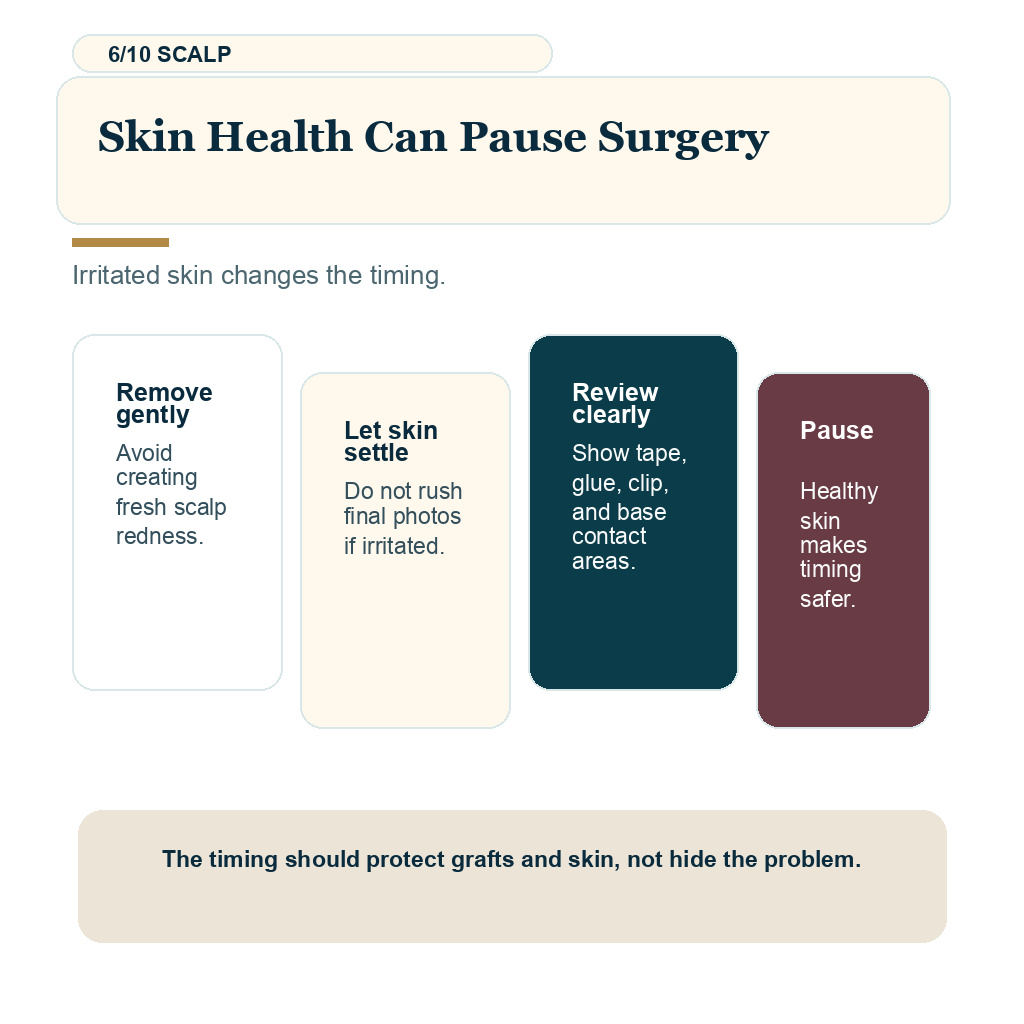
If you already wear a hair system, it should not hide the medical assessment. Remove it before final planning so the donor area, recipient area, hairline position, miniaturization, and skin condition can be examined directly. A system can make the bald area look smaller, make density expectations unrealistic, or hide redness under adhesive. The clinic also needs to see the scalp after adhesive or tape residue has been removed gently, not immediately after a rough removal that creates fresh redness.
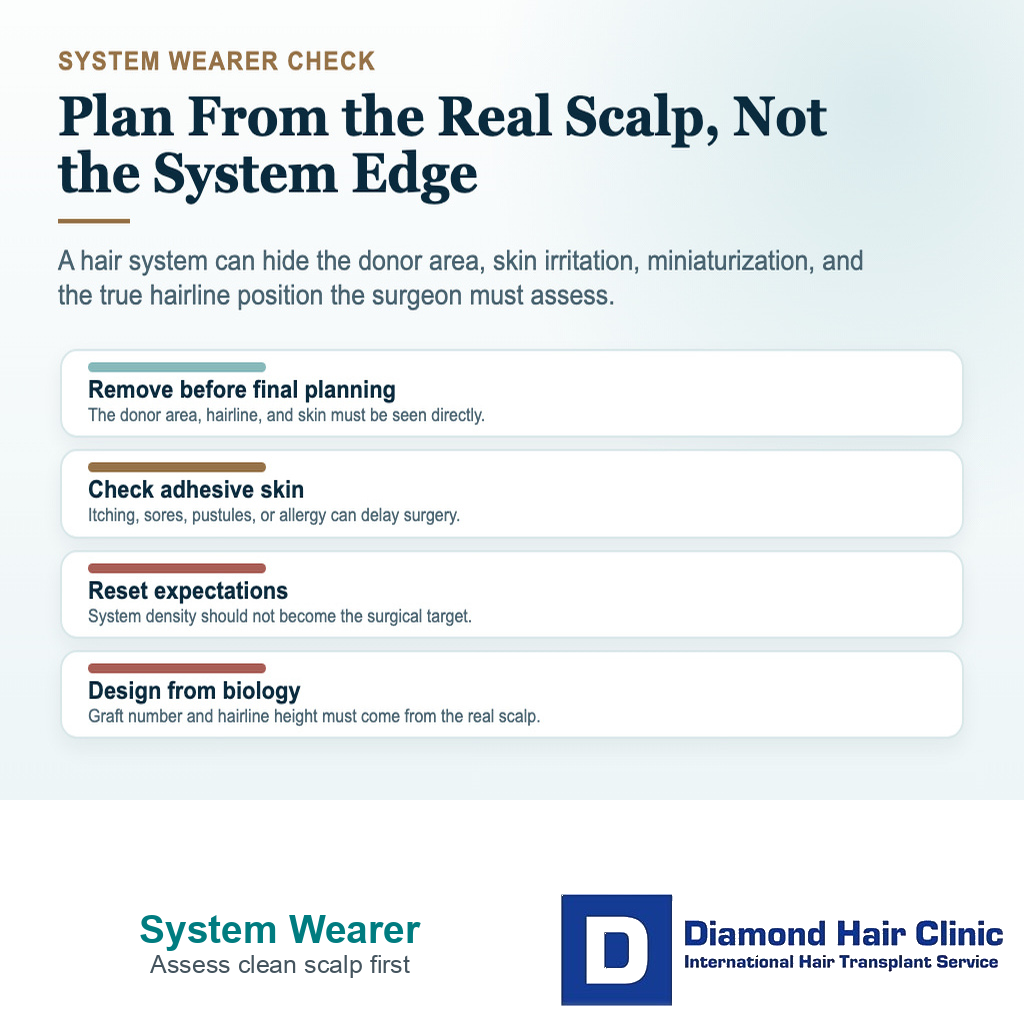
If there is itching, crusting, sores, pustules, contact allergy, or irritation from clips, tape, or glue, the scalp may need time to settle before surgery. Tell the clinic where tape, glue, or clips sit, how often they are removed, and whether removal pulls native hair. The surgical plan should come from clean photos and direct examination, not from the current system edge. A system can still be part of a longer plan, but it should not decide the hairline height, graft number, or incision pattern for the surgeon.
Transplant surgery becomes stronger with the right limits
Transplant surgery becomes stronger when donor reserve is reliable, the hair loss pattern is understood, recovery is acceptable, and the goal is surgically modest. It is especially useful when the main problem is a receding frontal hairline, weaker temples, or an area that can be improved without pretending to restore teenage density.
You should not need the transplant to solve every insecurity in one session. A good plan may improve the frame of the face while leaving some thinning behind. That can feel less dramatic than a system at first, but it may age more naturally if the hairline is not placed too low and the donor is not overused.
Surgery is also more attractive when the patient wants freedom from routine attachment work. There is no system to remove, clean, replace, or blend. The tradeoff is that surgery has a fixed biological budget. If too many grafts are used for a low hairline or dense crown, the patient may have fewer options later.
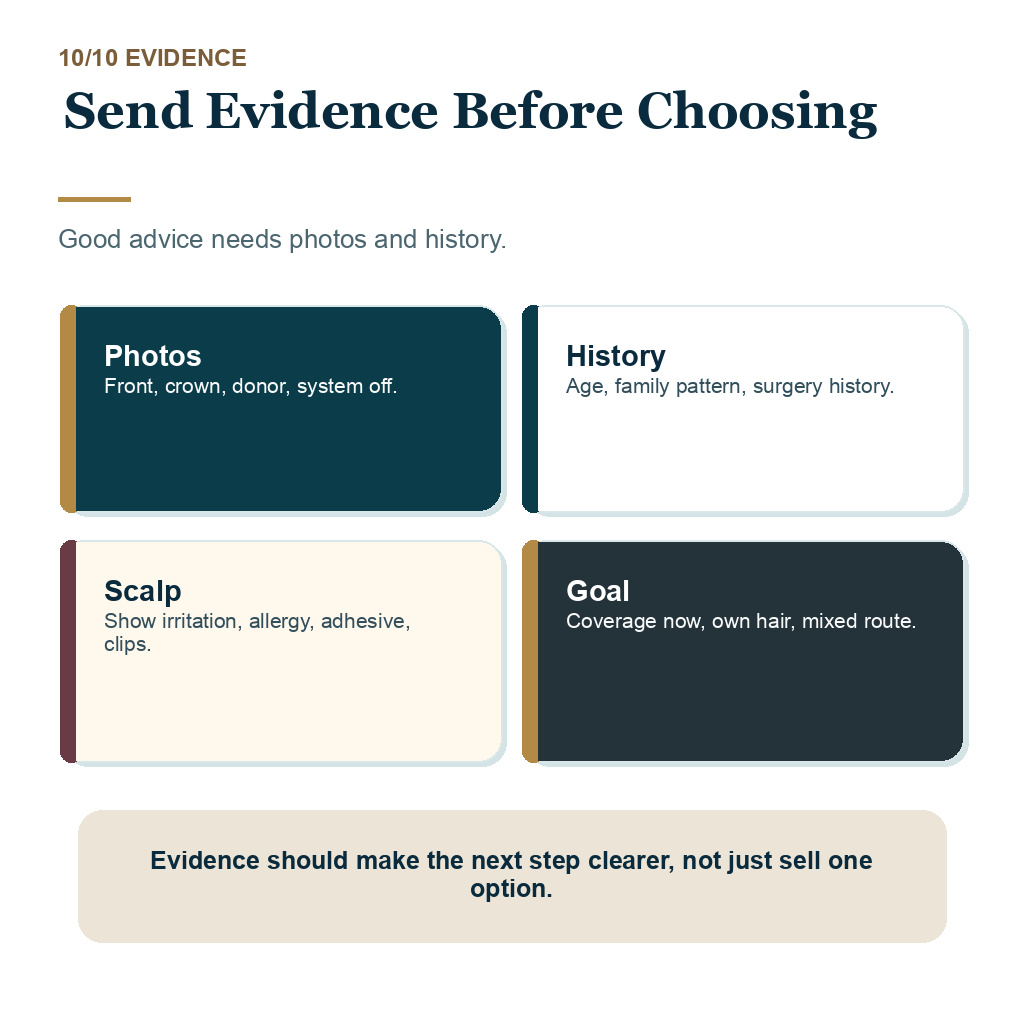
The first consultation should test whether the donor area, native hair, family pattern, age, and medication plan make surgery a responsible first step, not only whether more hair can be added. Patients who are still unsure often need a proper review of hair transplant planning from photos before trusting the first online estimate.
Donor supply changes the decision
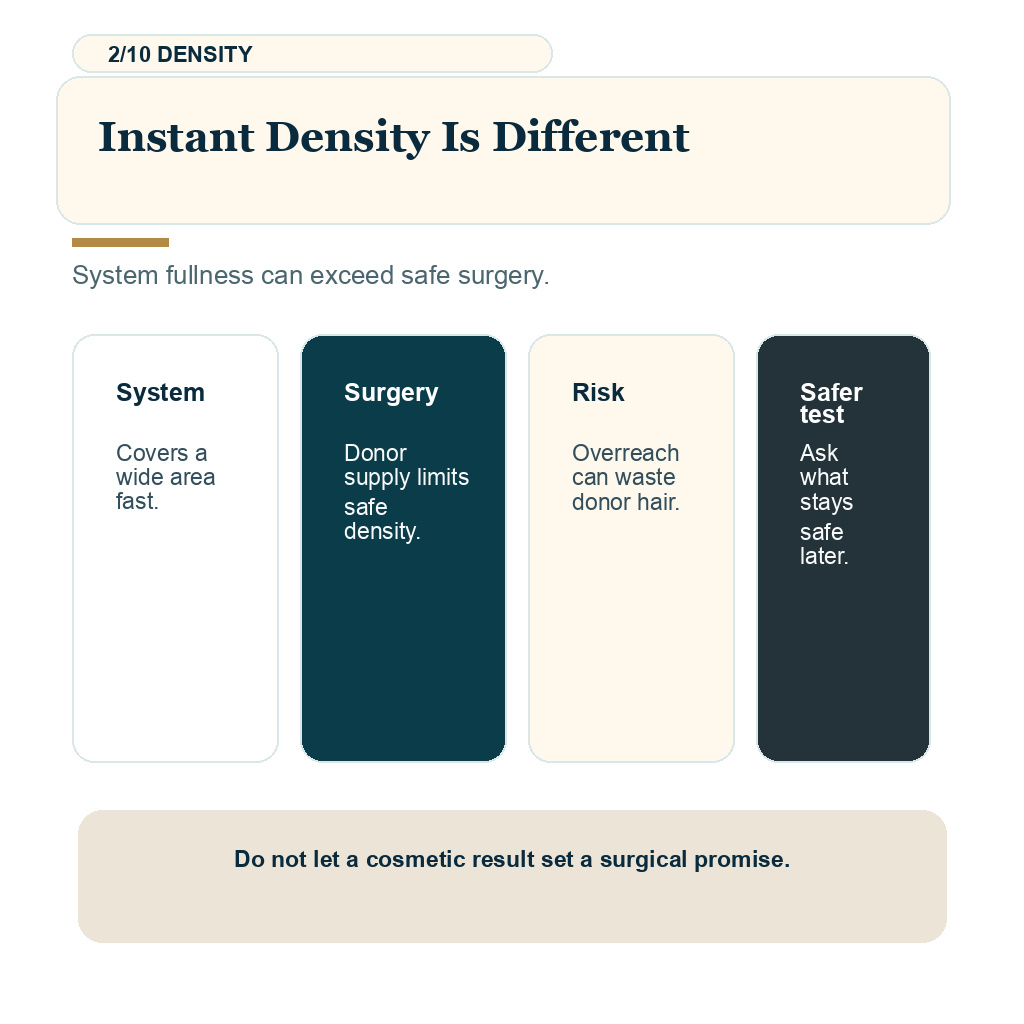
Donor reserve is the central difference between the two options. A hair system does not consume grafts. A transplant does. That one fact needs to slow down any rushed decision.
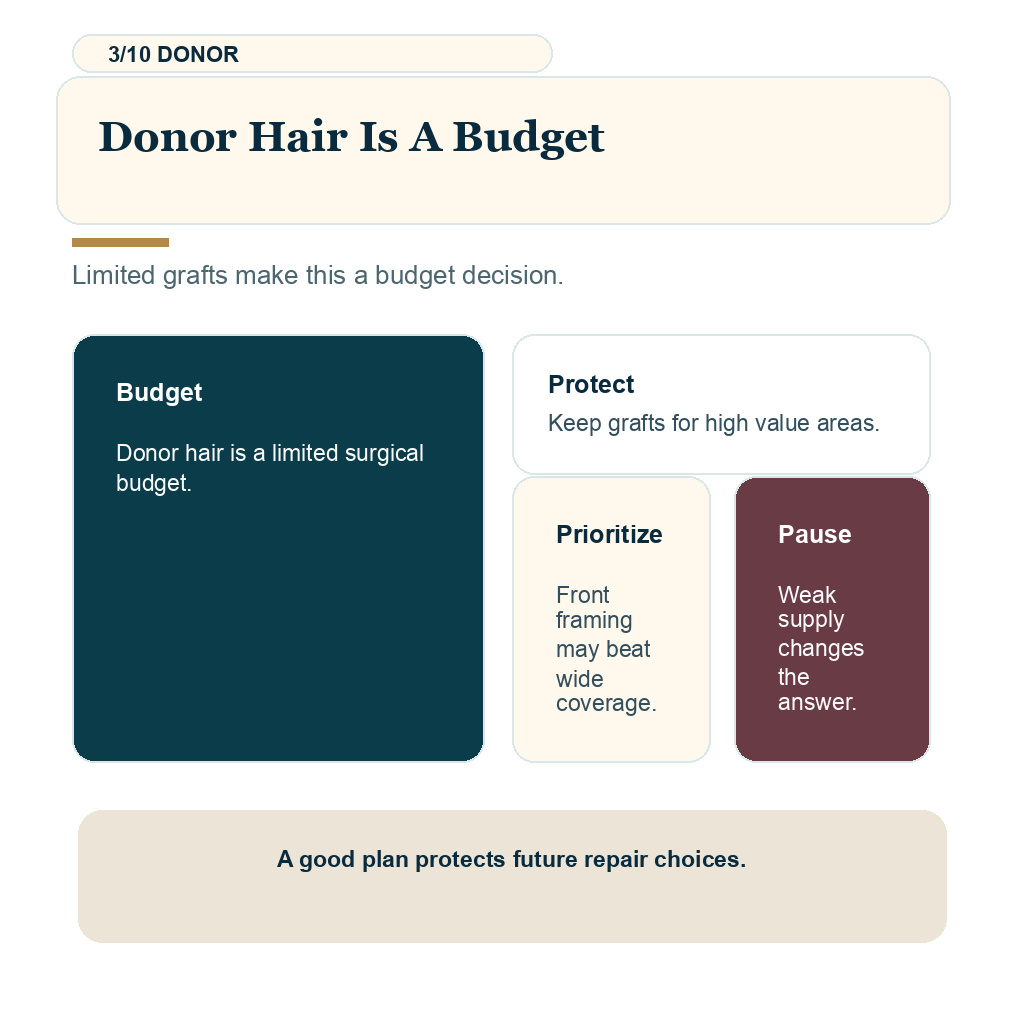
If donor reserve is strong and the recipient area is limited, surgery may be a sensible investment. If donor reserve is weak, already overharvested, scarred, or needed for future loss, a large transplant may create more problems than it solves. Donor reserve is limited. It belongs where real hair gives the most long term value, not where the patient is trying to copy the density of a removable system.
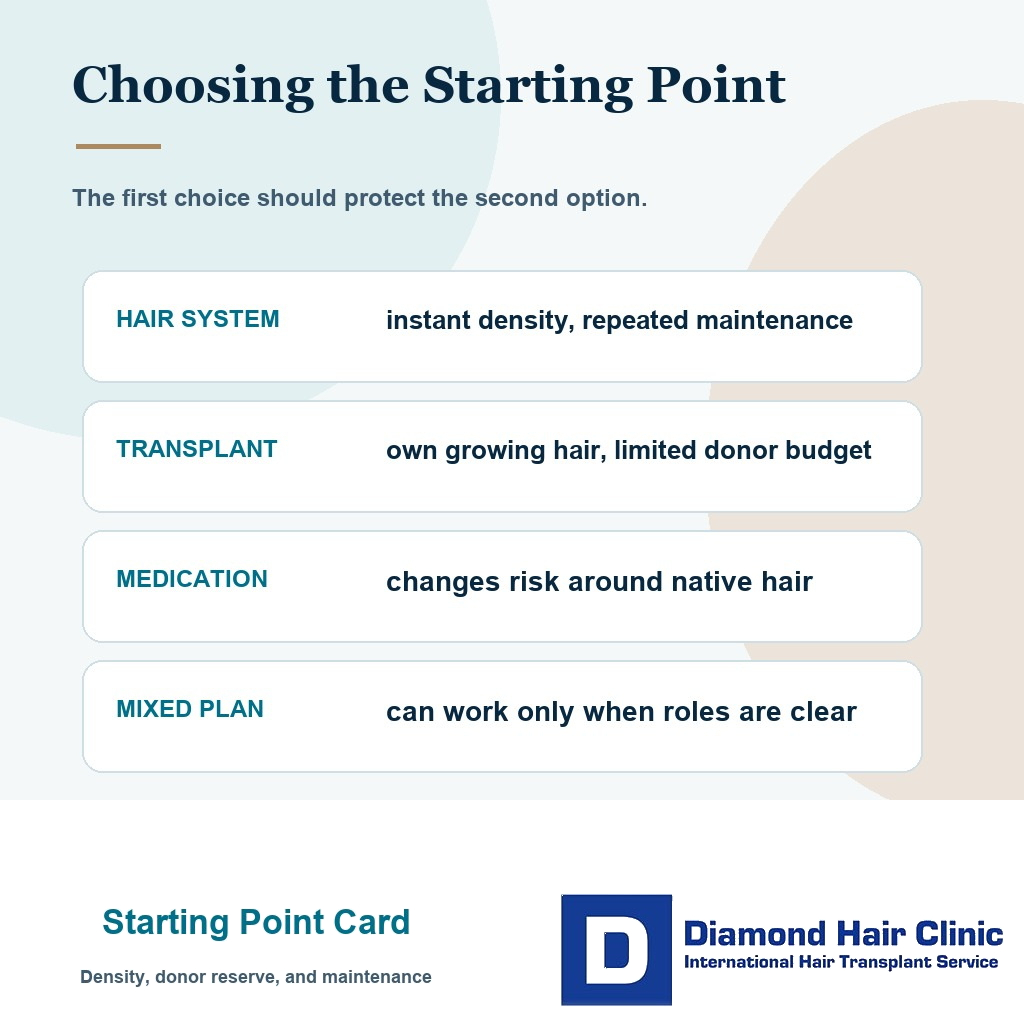
A sound starting point keeps both the cosmetic goal and the donor budget visible.
Many patients misunderstand before and after photos at this point. A system can create uniform coverage across a wide bald area. A transplant must decide where the limited grafts will matter most. That is where lifetime hair transplant graft planning becomes part of the choice, because donor hair has to be treated like a budget, not like an unlimited supply.
A patient with advanced loss may still choose surgery, but the plan should be conservative. The front may be prioritized, the crown may need lower density, and a second procedure may be discussed only after the first result matures. A system, scalp micropigmentation, or a mixed plan may sometimes serve the patient better than chasing full coverage with grafts alone.
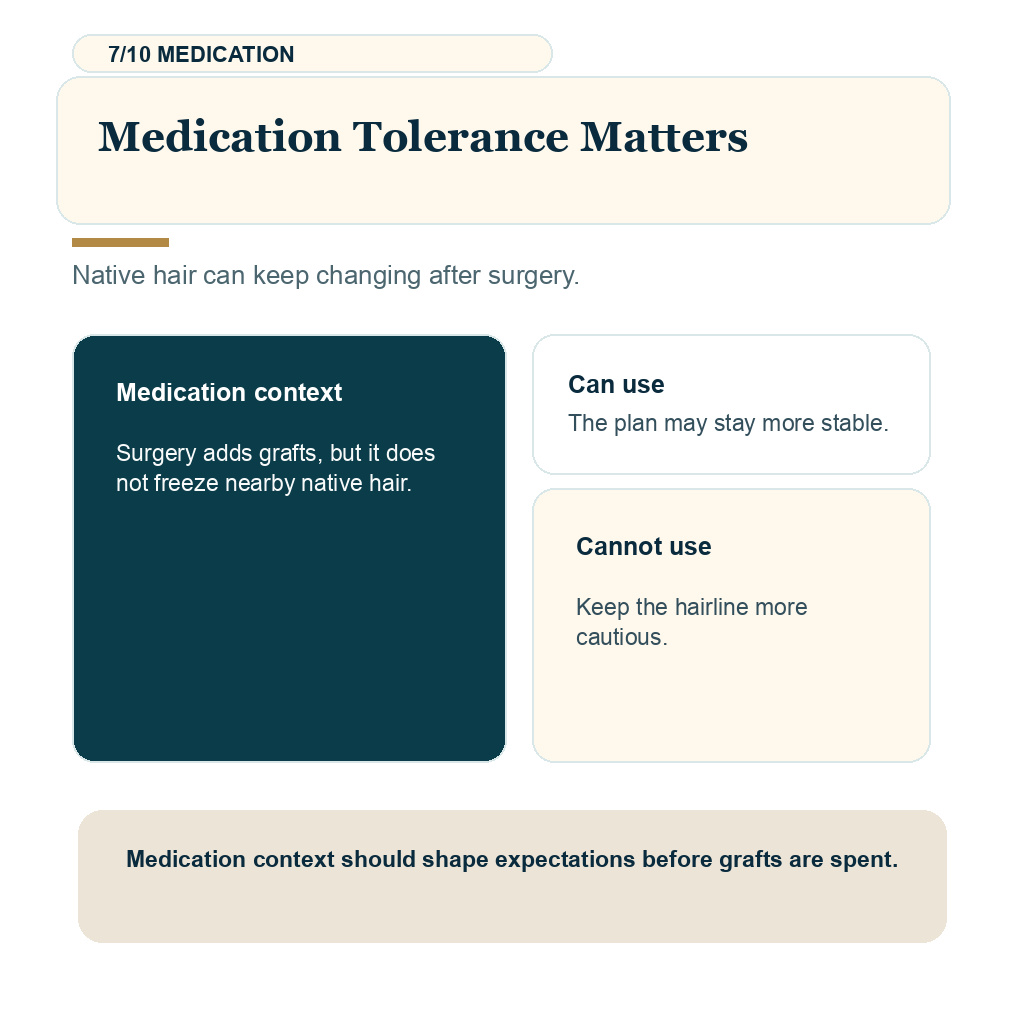
Use the 10 choice comparison slides below to review instant density, donor budget, weekly maintenance, clean scalp assessment, skin irritation, medication tolerance, mixed plans, cost over time, and the evidence to send before choosing a hair system or surgery. Swipe the carousel, use the arrows one step at a time, or choose a number below the image to jump to that point.


Medication tolerance changes the plan
Medication tolerance matters because surgery does not protect the surrounding native hair. If you can use medical therapy safely and consistently, the transplant plan may become more stable. If you cannot use finasteride, dutasteride, minoxidil, or other long term treatment for medical or personal reasons, the native hair may continue changing faster than the transplanted design.
Surgery can still be possible without medication, but the plan has to be more conservative. A low, dense, youthful hairline in a young patient who refuses or cannot tolerate medication can age badly if the hair behind it continues to thin. A hair system may give density in that phase without forcing the surgeon to spend grafts on a design that future hair loss can expose.
The decision should be medical, not emotional. Side effects, fertility plans, anxiety about medication, blood pressure, scalp irritation, and consistency all matter. If you are comparing the two paths, read the tradeoffs in hair transplant without finasteride before assuming surgery can replace long term hair loss control.
A hair system cannot safely hide early graft healing
Wearing a system to hide a fresh transplant needs careful timing. The early scalp is not ready for pressure, pulling, glue, tape, sweating under a base, or friction across grafts. Do not use a hair system adhesive on fresh grafts or healing skin. The timing depends on the treated area, the system base, the attachment method, and the surgeon’s examination.
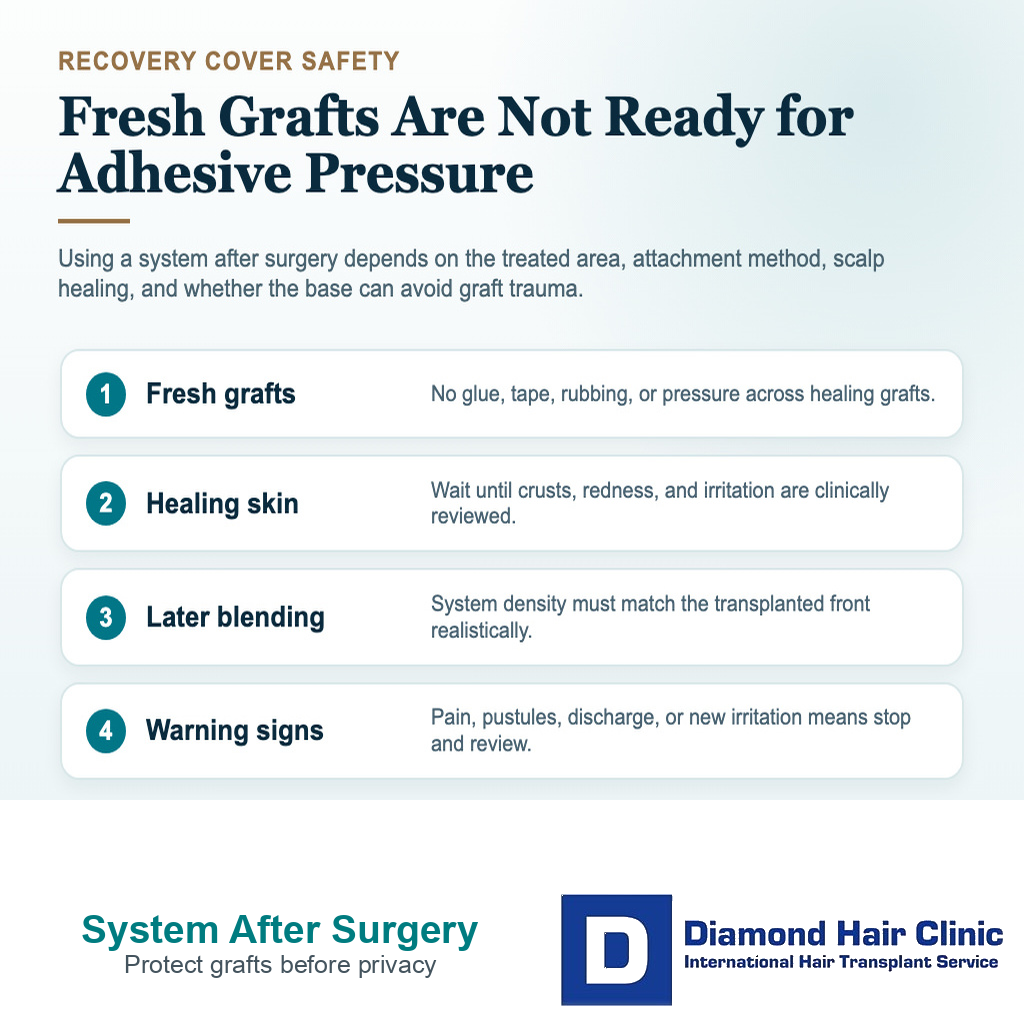
If the system sits behind a transplanted frontal hairline, it may be possible later in selected cases. Some patients use a transplanted hairline for a natural front and a system behind it for crown or mid scalp density. But the blend has to be realistic. If the system is too dense compared with the transplanted hairline, the contrast can look artificial.
The timing around hair systems after hair transplant is different from ordinary hair replacement maintenance. The system should never be used to hide a problem if it creates pressure, infection risk, or graft trauma.
Cost needs to be compared over time
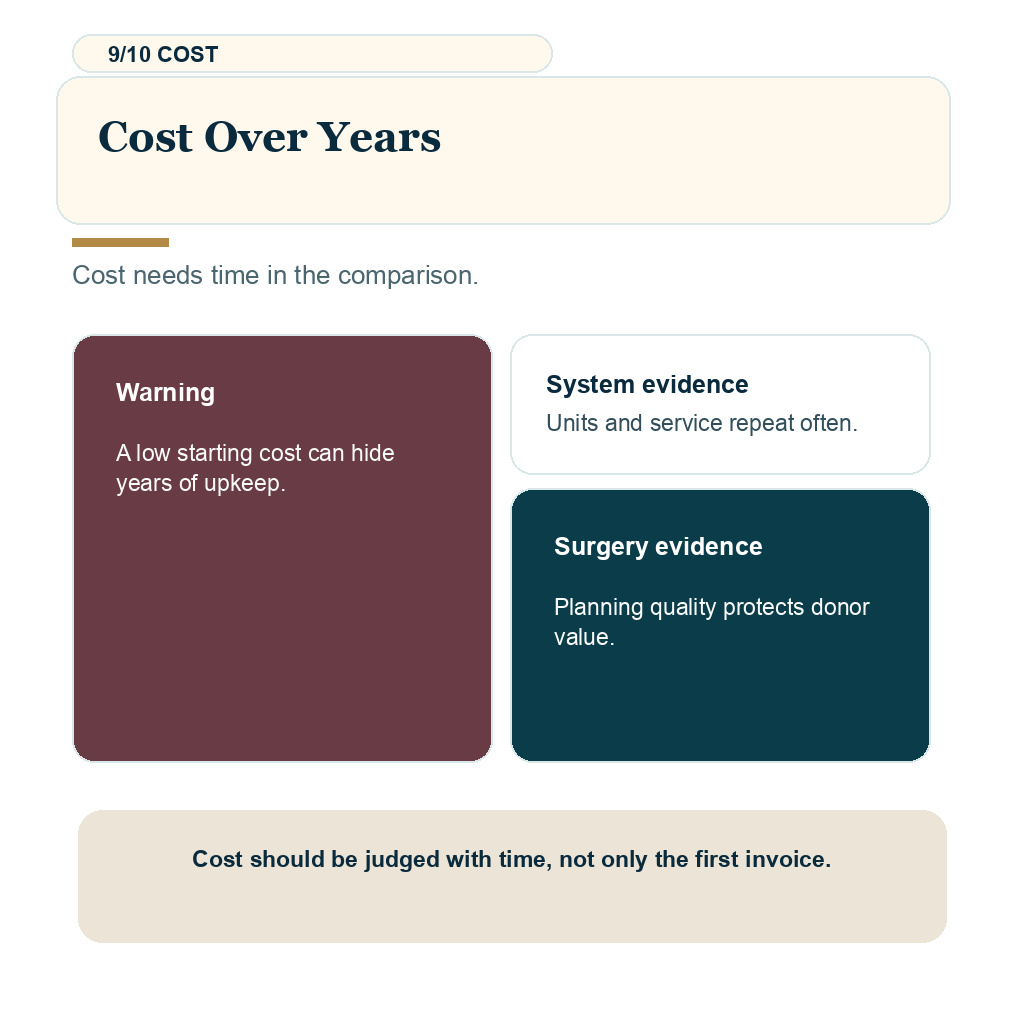
The cost comparison has to include repeated maintenance, not only the first payment. A hair system may have a lower starting cost, but it brings repeated expenses for units, service, adhesive, maintenance products, and replacement. A transplant costs more upfront, but it still may require medication, follow up, future procedures, or correction if the first plan was poor.
The financial question should include time, not only money. A system gives coverage quickly but keeps you in a maintenance cycle. Surgery has a long waiting period before the result matures. If it works well, the daily burden may be lower. If the result is thin, unnatural, or poorly planned, repair may cost more than doing less in the beginning.
Judge clinic prices against long term value. A cheap operation that spends too many grafts can become expensive later. Hair transplant cost in Turkey includes what the plan preserves or damages, not only the surgery day payment.
A combined plan can work when roles are clear
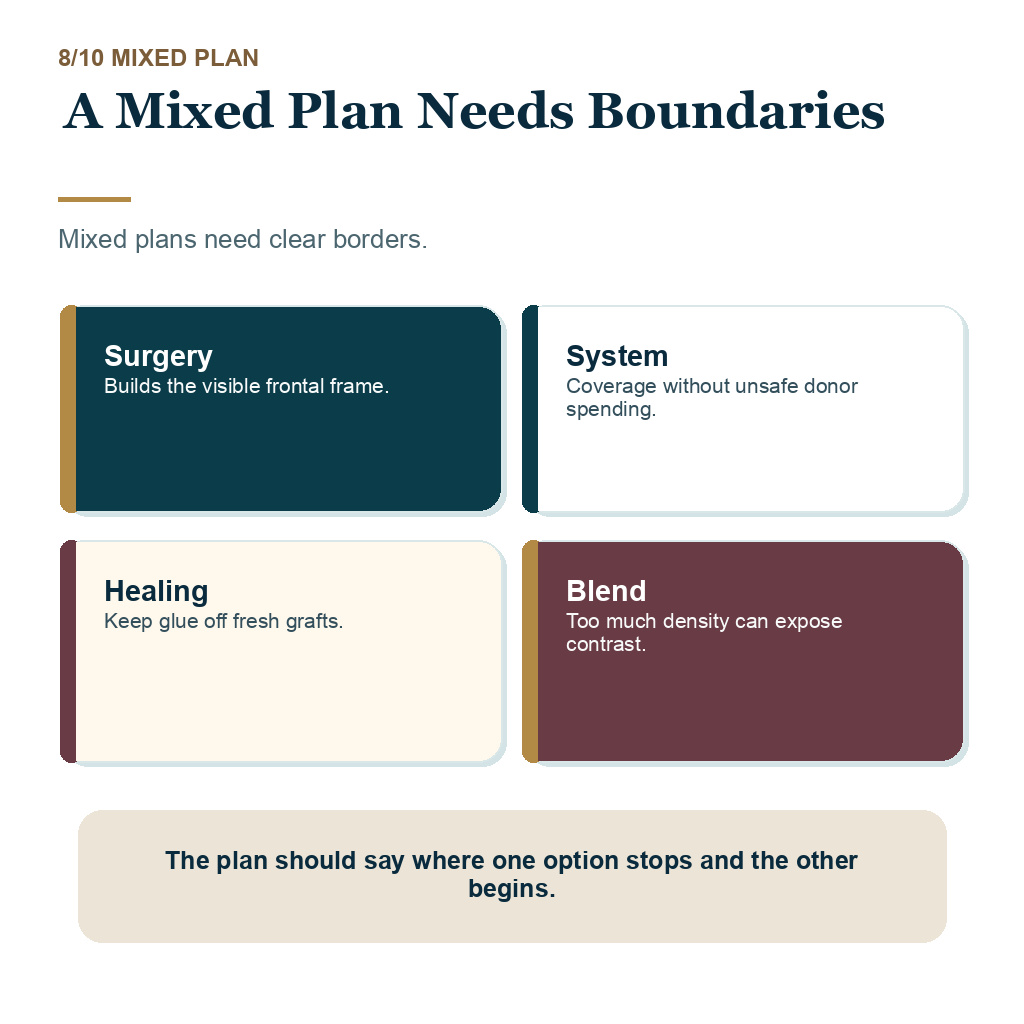
A combined path can be reasonable when the roles are clear. A transplant may create a more natural frontal frame, while a system gives coverage behind it. Or you may use a system first, then later choose a smaller transplant after understanding your preferred hairline shape and maintenance tolerance. Before combining them, define which part is the surgical hairline, which part remains system coverage, and what happens if the system density, color, or attachment style changes later.
Before surgery creates the front of a combined plan, the exit plan has to be clear. If you stop wearing the system later, the transplanted front should not leave you with a low, dense strip and very little behind it. The frontal design still needs to suit your age and donor supply, so it can make sense if the system is reduced, replaced, or removed.
The risk is simple. A hair system can set a density goal that donor grafts may not safely match. If that expectation is not corrected before surgery, you may ask the surgeon to chase system level coverage with a limited donor supply. That can damage donor planning. If the transplant hairline is too low, too dense, or too straight, the system behind it may not solve the artificial front.
A mixed plan has to respect the limits of both tools. A system can be a temporary bridge or a long term cosmetic choice. Surgery is not a way to duplicate its density. If you already wear one, you need hair transplant planning after a hair system before assuming the system density can be copied surgically. Concealers and hair fibers before a hair transplant can also make the baseline look better than the scalp really is.
Maintenance matters for active or public facing patients
If you are active or public facing, be realistic about sweat, travel, swimming, close contact, haircuts, and how much private maintenance you can accept. A system can look excellent when it is fitted, colored, and maintained well. It can also create stress if you are always checking the hairline, worrying about wind, or avoiding situations where the edge might be noticed. If sports, sweat, or swimming are routine, ask how adhesive choice, cleaning schedule, and scalp irritation are handled before you commit to the system or the operation.
Surgery creates a different type of exposure. The early healing period can be visible. Shedding can make the scalp look worse before it looks better. If the patient wants privacy, the recovery calendar matters. For patients who need privacy, keeping a hair transplant private is mainly a recovery calendar problem, not only an surgery day problem.
Some people choose scalp micropigmentation for a thin hair transplant or a hair system because they need the appearance of density more than they need every hair to be transplanted. Others accept a less dense but own hair result because they dislike ongoing maintenance. Neither choice is weak if it matches the reality of your life.
What I decide before calling either option safer?
Before I advise a patient toward a system or surgery, I first decide what the next mistake would look like. With a system, the mistake may be years of maintenance, skin irritation, or a hairline expectation that surgery can never match. With surgery, the mistake may be spending grafts on a density goal that belonged to the system, not to the patient’s biology.
I look at donor reserve, scalp health, medication tolerance, age, public exposure, and how much daily maintenance the patient can realistically accept. If the patient needs immediate high density and the donor cannot safely give it, the system may be the more protective first option. If the patient wants a permanent frontal frame and accepts slower growth with limits, surgery may be the better investment.
The written plan matters because these routes can overlap. A system can teach the patient what shape they like, but it must not force an unsafe hairline design. Surgery can reduce dependence on a system, but it must still respect donor reserve and future loss.
Choose the option your daily life can support
A hair system and a transplant solve different problems. A system can give coverage without donor surgery, but it needs upkeep, attachment, hygiene, cost, and comfort acceptance. A transplant uses real donor hair, but it cannot ignore limited graft supply or future loss.
The right choice depends on what bothers you most and what maintenance you can live with. If the donor is weak, expectations are high, or the bald area is too large, a system may be the more practical option.
That distinction should be made early, before surgery is asked to provide coverage the donor cannot give.

Read this review excerpt
Every single one of my questions was answered and they made sure I had all the details I needed to make an informed decision.