


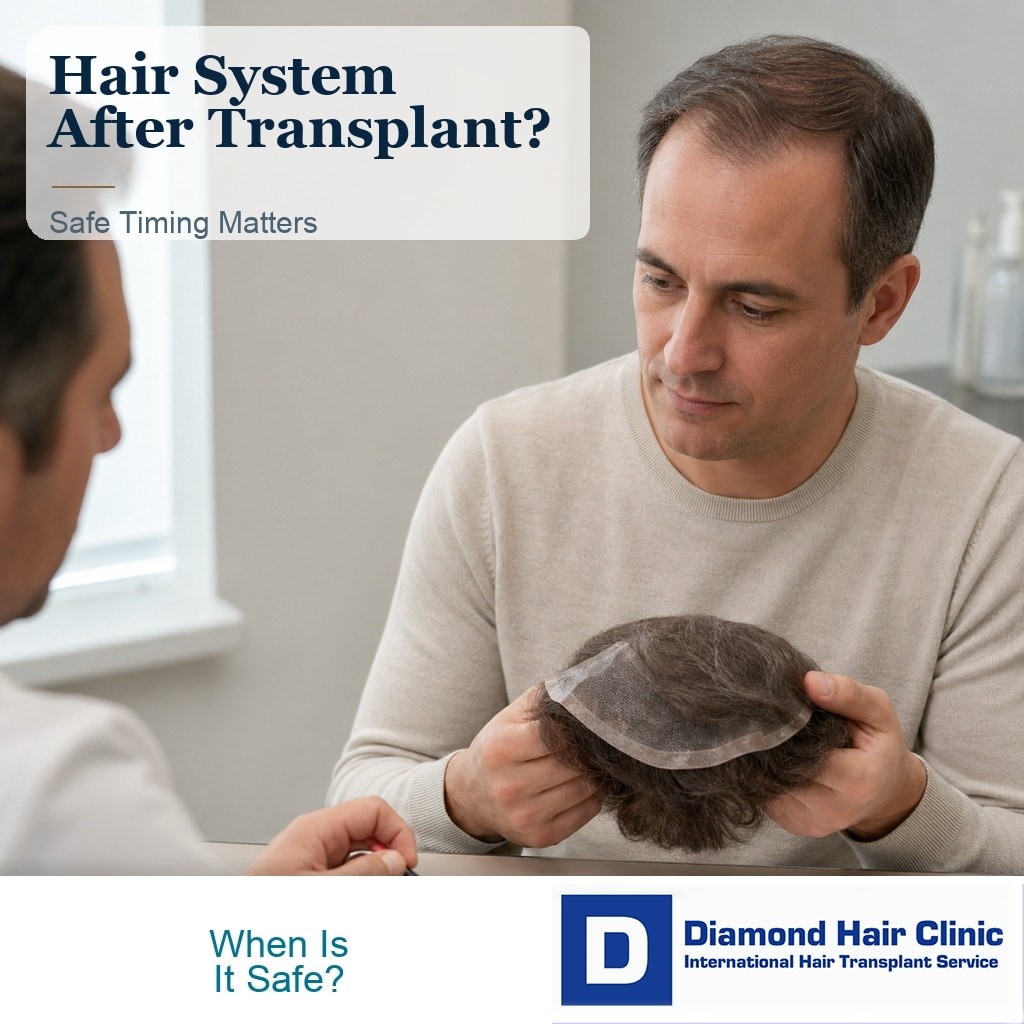


Hiding the recovery is understandable, but it cannot be the first priority. First, the grafts need protection. Then the scalp needs quiet healing. Cosmetic coverage has to wait behind the final result.
More than graft security
A quick answer such as yes, you can wear a system after a hair transplant, is too incomplete.
A patient may be able to wear a system after enough healing time, especially if the system does not touch the transplanted area, does not require glue on the recipient area, and does not create pressure or friction. The decision should come back to one practical biological concern. Will this keep the scalp settled enough for growth, or will it add pressure, sweating, irritation, or repeated trauma during recovery?
After surgery, avoiding a dramatic accident, such as pulling out grafts, is only the minimum standard. The next question is whether the scalp has the healthiest possible healing environment. That means gentle washing, good ventilation, clean skin, minimal irritation, and proper follow-up.
I separate minimum safety from ideal recovery. Minimum safety asks whether the grafts are secure enough. Ideal recovery asks whether the scalp is protected as well as possible. Those are not the same question.
Many patients are naturally focused on appearance after surgery. They want to return to work, hide redness, avoid questions, and feel normal again. I understand this very well. But a cosmetic cover should not become a biological problem. Hiding the transplant should never take precedence over protecting the result.
Different from a loose hat
A system is not just another type of head covering. A loose hat may rest lightly on the head for a short period. A system can be taped, glued, clipped, pressed, cleaned, lifted, brushed, adjusted, and removed repeatedly.
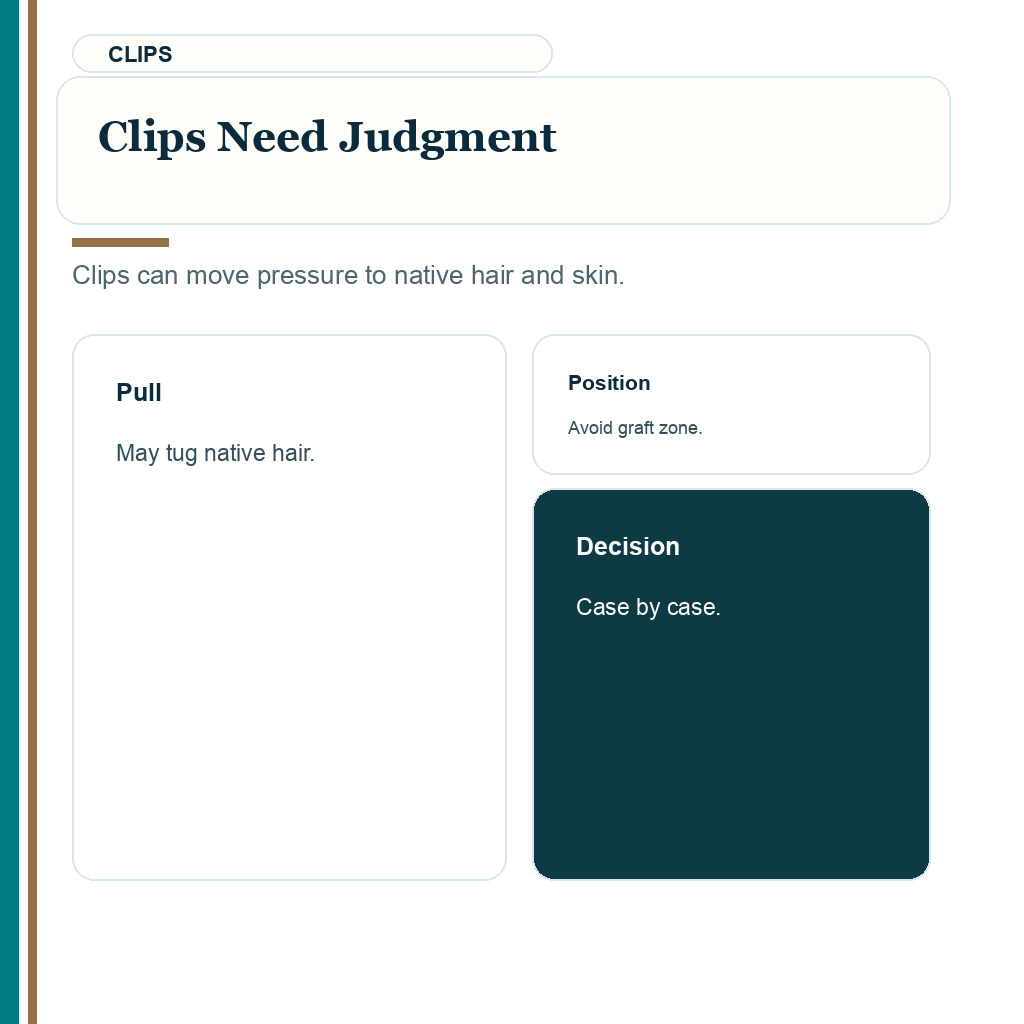
This makes a system much more aggressive for a recovering scalp than a loose hat. The guidance on wearing a hat after a hair transplant is already cautious because even a hat can create pressure, heat, friction, and sweating. A system adds more variables. Adhesive can irritate the scalp. Tape can pull during removal. Clips can create traction. The base can trap sweat and oil. Cleaning products and solvents can further irritate sensitive skin.
The recipient area after surgery is not normal skin. It has been treated through thousands of tiny openings. Even after the surface looks better, the scalp is still recovering. The donor area may also be sensitive, especially if the system, clips, or tape sit near areas that were shaved or extracted.
In the early period, the main risk is direct graft trauma. Later, the concern becomes scalp health. A system may not pull out grafts after they are secure, but it can still create redness, pimples, itching, inflammation, or irritation. These problems may not destroy the transplant, but they can make the recovery environment less than ideal.
Scalp health after grafts feel secure
Patients often think that once grafts are secure, everything is safe. That view is too narrow.
Yes, the first stage is graft security. During the earliest days, the grafts need protection from rubbing, scratching, pressure, accidental trauma, and improper washing. The early guidance on touching grafts after a hair transplant matters for the same reason.
But after the grafts are more secure, the scalp still matters. A transplanted follicle needs time to settle biologically. The surface may look better, but the skin can still be reactive. The patient may still have redness, sensitivity, pimples, dryness, itching, or inflammation. The transplanted hairs may also shed in the following weeks, which can make the patient feel anxious and more tempted to cover the area.
Aggressive covering is not helpful during this phase. A healthy scalp environment is not created by pressure, trapped sweat, adhesive residue, solvents, or repeated mechanical pulling. It is created by cleanliness, gentle handling, proper washing, and patience.
A hair transplant is not finished when the grafts are implanted. Surgery is one day. Healing continues for weeks. Growth continues for many months. If the patient wants the best possible result, the recovery environment deserves as much respect as the operation itself.
Highest risk period after surgery
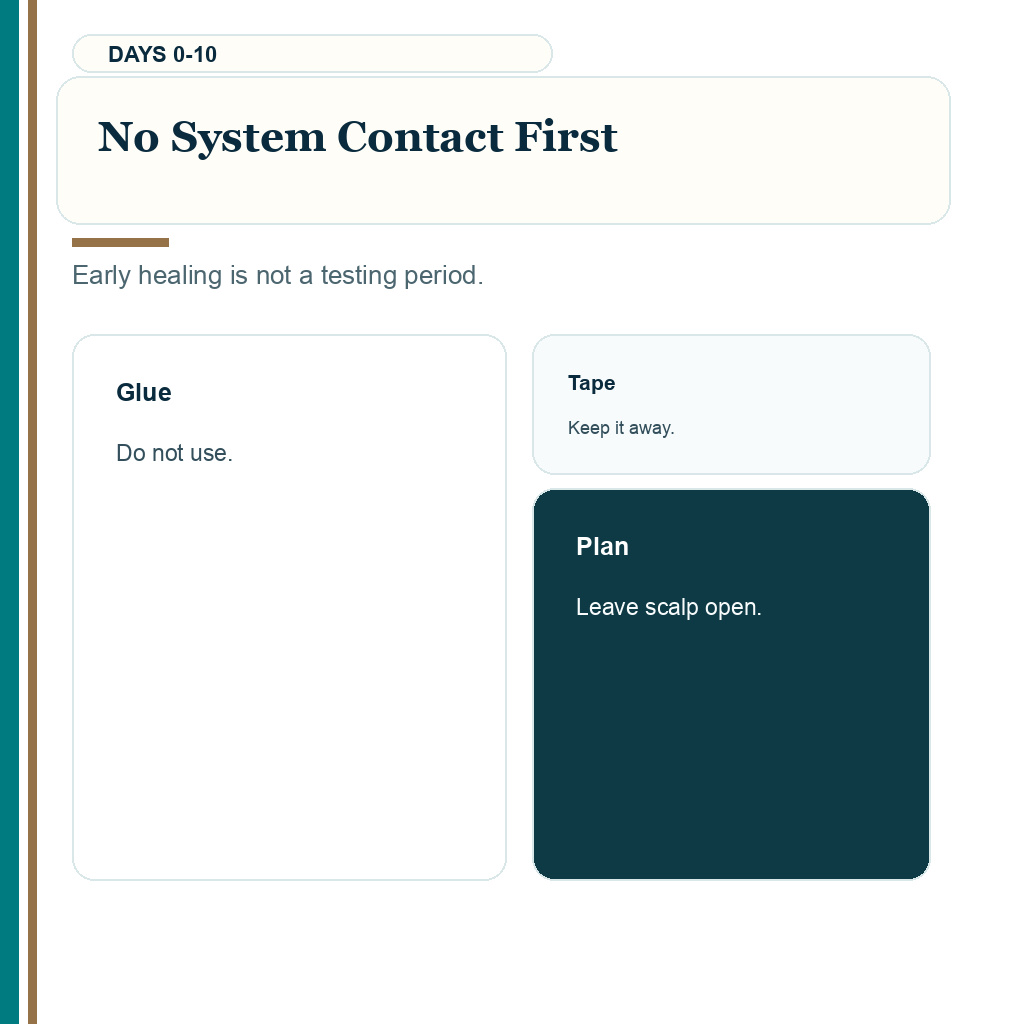
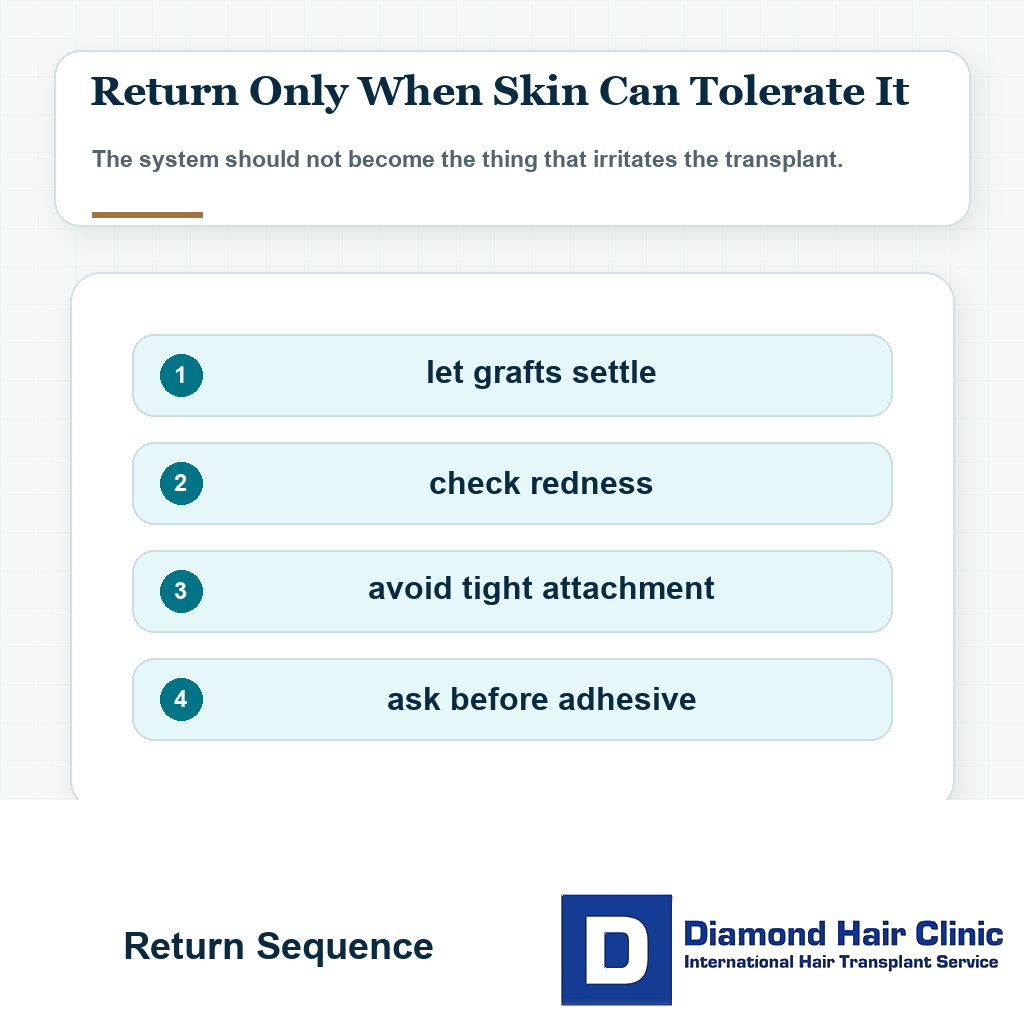
A system is at its highest risk during the first 10 to 14 days after surgery. During this period, I avoid any system touching the recipient area. No tape, no glue, no clips, no rubbing edge, no pressure, and no repeated removal.
The first days are about graft protection, scab management, swelling control, gentle washing, and avoiding unnecessary trauma. The scalp needs a clean, low irritation environment, not a cosmetic system applied over the surgical area.
Between days 10 and 14, the scalp may look much better, but better surface appearance does not make the skin ready for adhesive. It does not make sweating under a base harmless, and it does not mean a salon technician can clean and reattach a system without risk. The visible surface improves earlier than the deeper recovery.
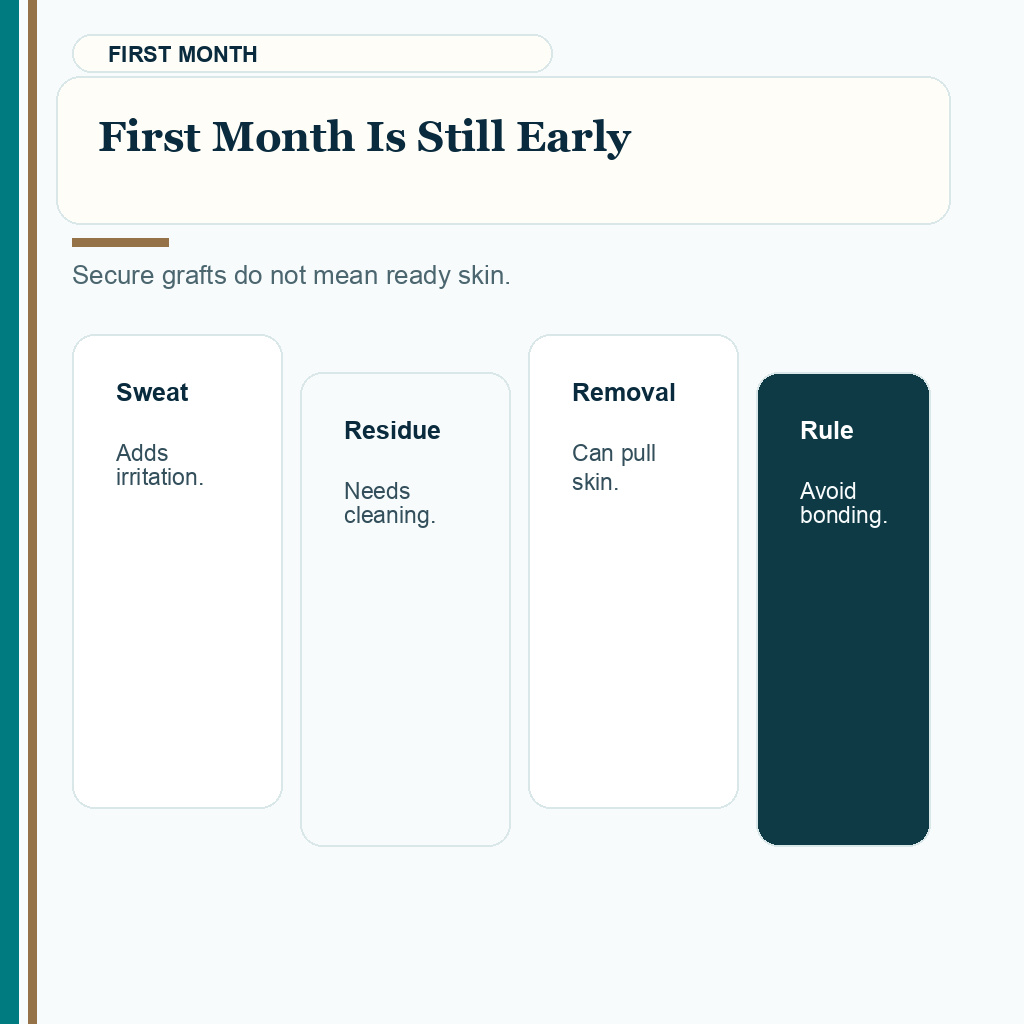
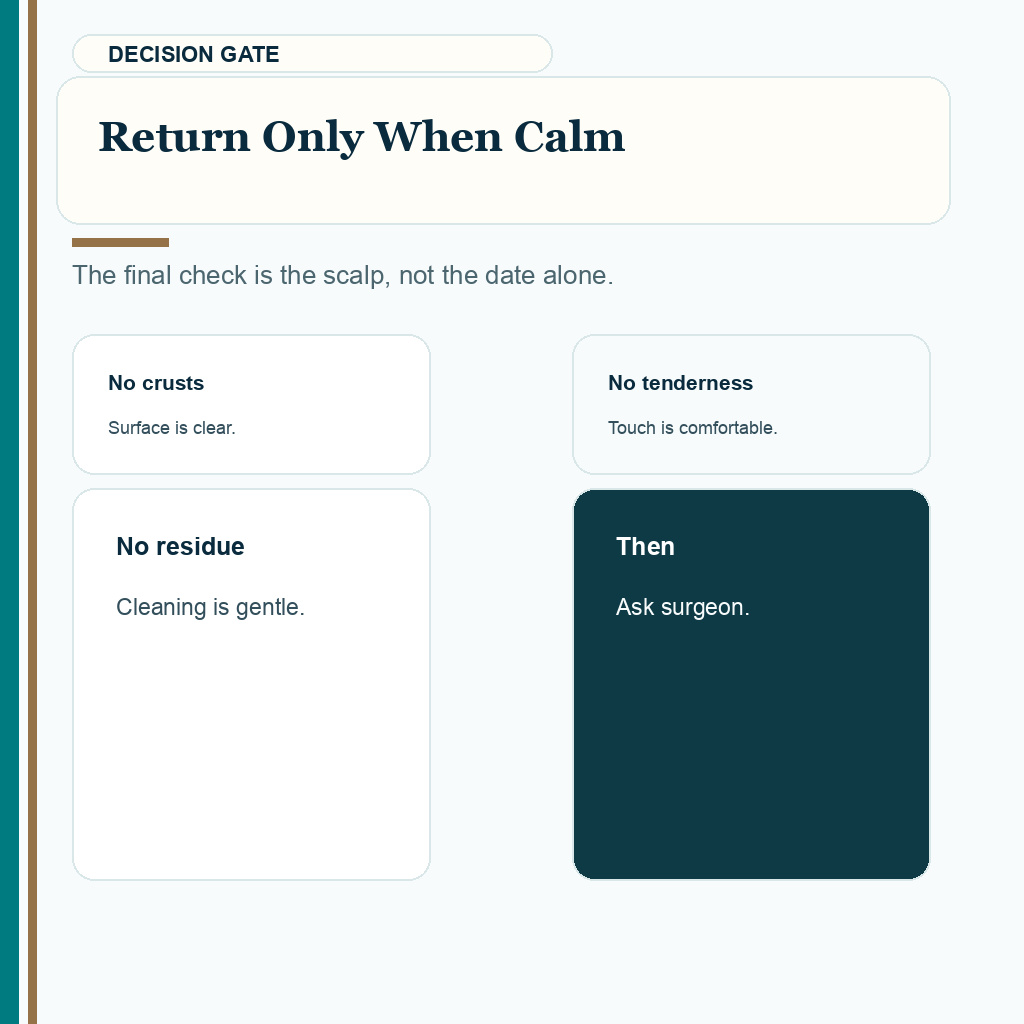
After the first month, the risk of directly dislodging grafts is much lower, but that does not make a bonded system ideal. If there is redness, itching, folliculitis, tenderness, crusting, sensitivity, or poor healing, it should be avoided. If the patient needs glue or tape directly over the transplanted area, I would be even more conservative.
The first few months are not the right time to unnecessarily challenge the scalp. The patient may be impatient to look normal, but the follicles are still moving through their recovery and growth cycle.
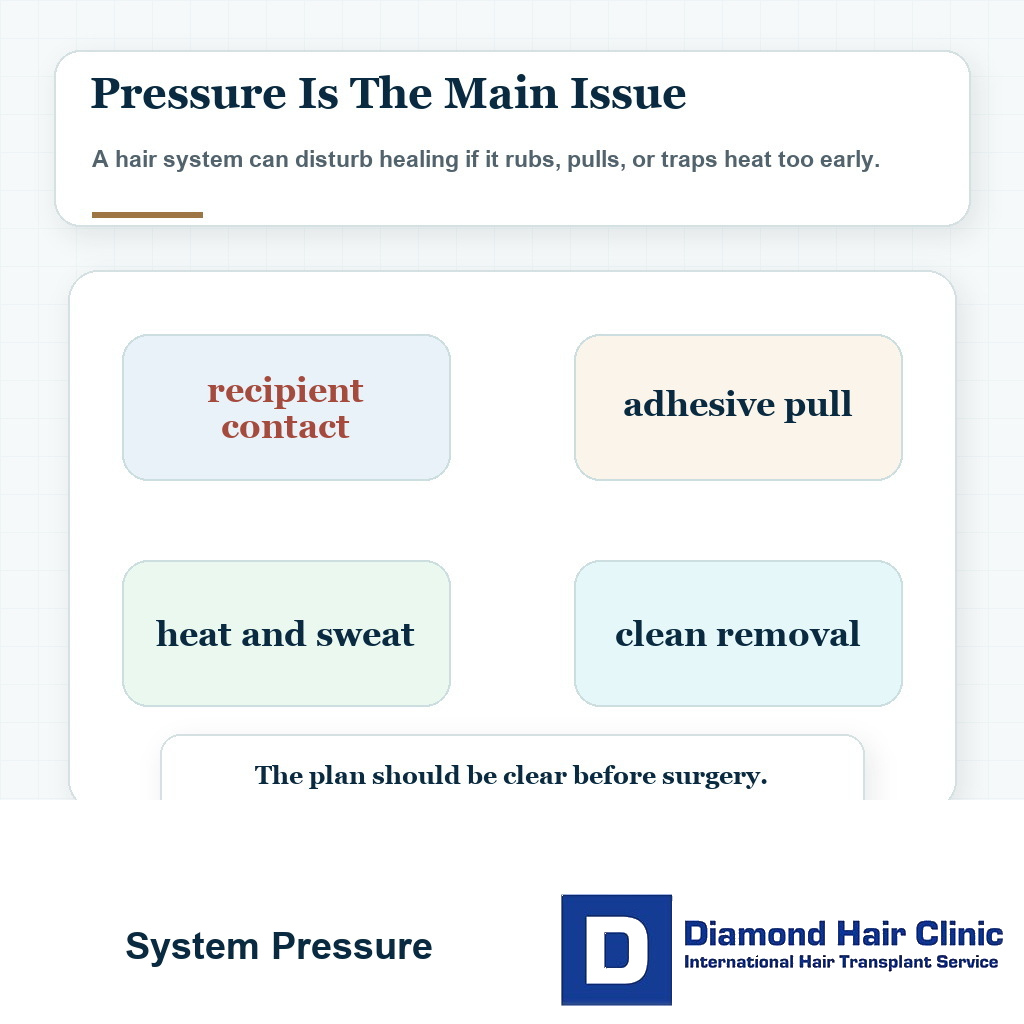
Considering a hair system again
During the first 10 days, there should be no system over the transplanted area. I avoid direct contact, adhesive, clips, pressure, or repeated removal.
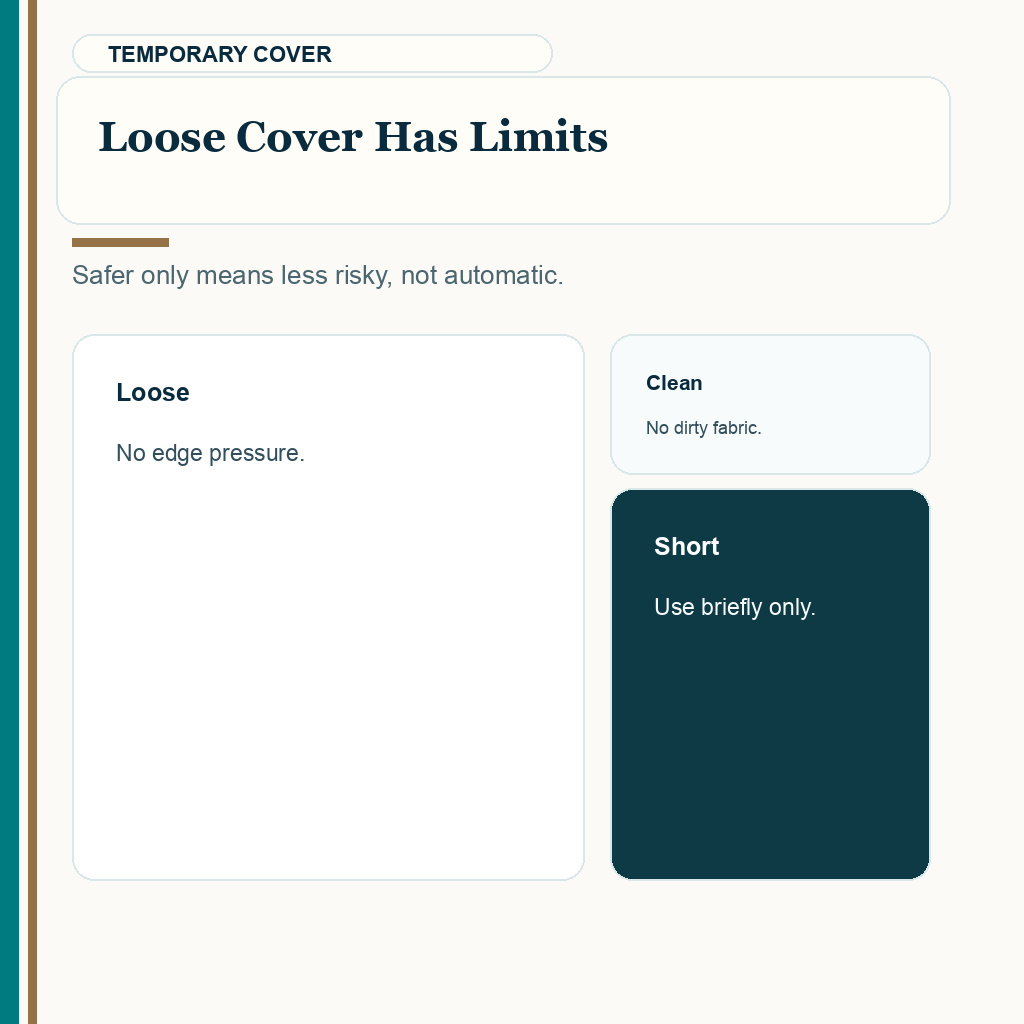
From day 10 to day 14, I still prefer no bonded system over the recipient area. A very loose, clean cover may be considered in certain situations, but a bonded system is a different matter. It can create friction, sweating, glue exposure, and removal trauma.
During the first month, I strongly prefer avoiding any system over the transplanted area. If the patient asks about a system that sits only on an untreated area, the attachment points, contact zones, removal method, and pressure near the transplanted area still need to be checked.
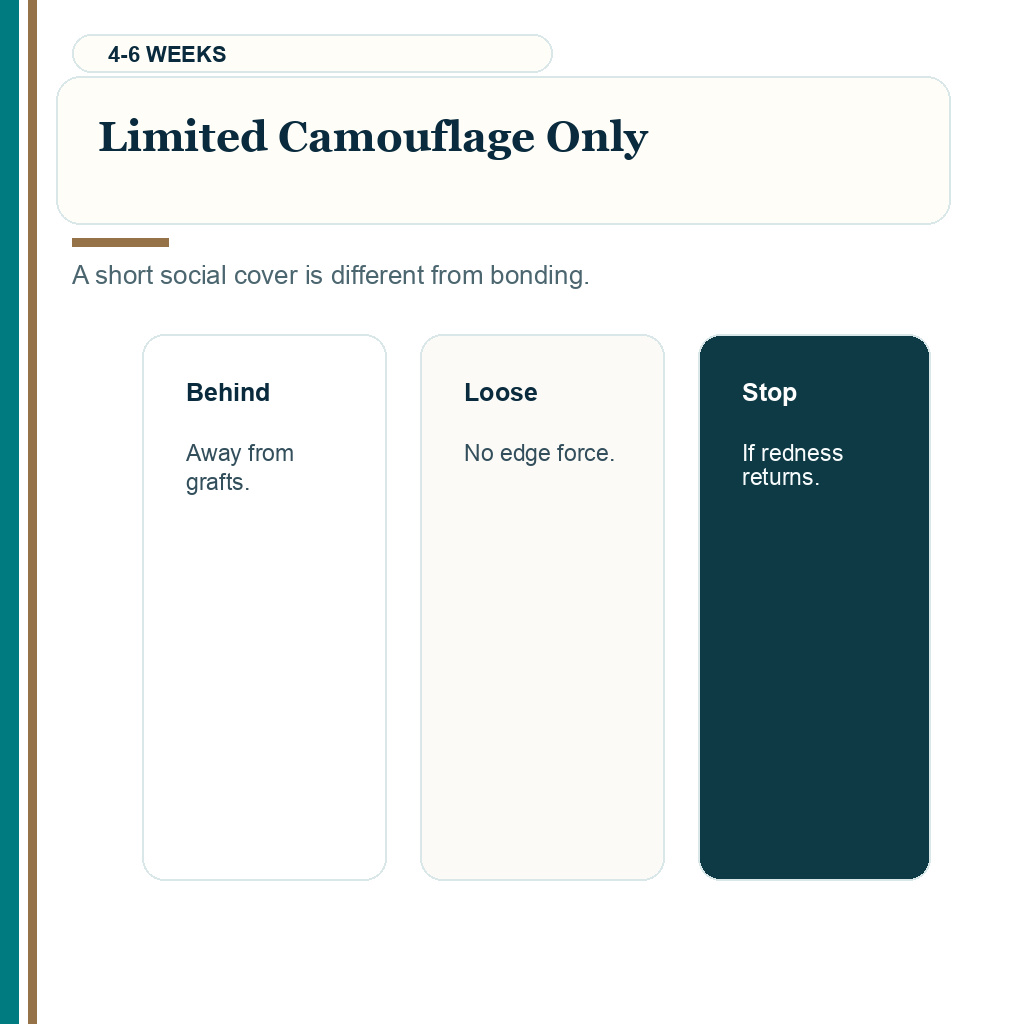
After 4 to 6 weeks, some patients may technically be able to use a system in short, careful situations if the scalp is comfortable, clean, and fully healed on examination. But I still do not like regular use over the transplanted area during the early growth period.
If glue or tape must be applied directly over the transplanted area, waiting longer is safer. I usually think in terms of 2 to 3 months or more, not because every patient will have a complication, but because unnecessary irritation during a sensitive period should be avoided.
If a patient does not truly need the system, I generally advise avoiding it during the recovery and early growth phase. If the patient does need it, it should be used as little as possible, with the least aggressive attachment method, and only after the scalp has been reviewed.
Bonded systems and the 90 day wait
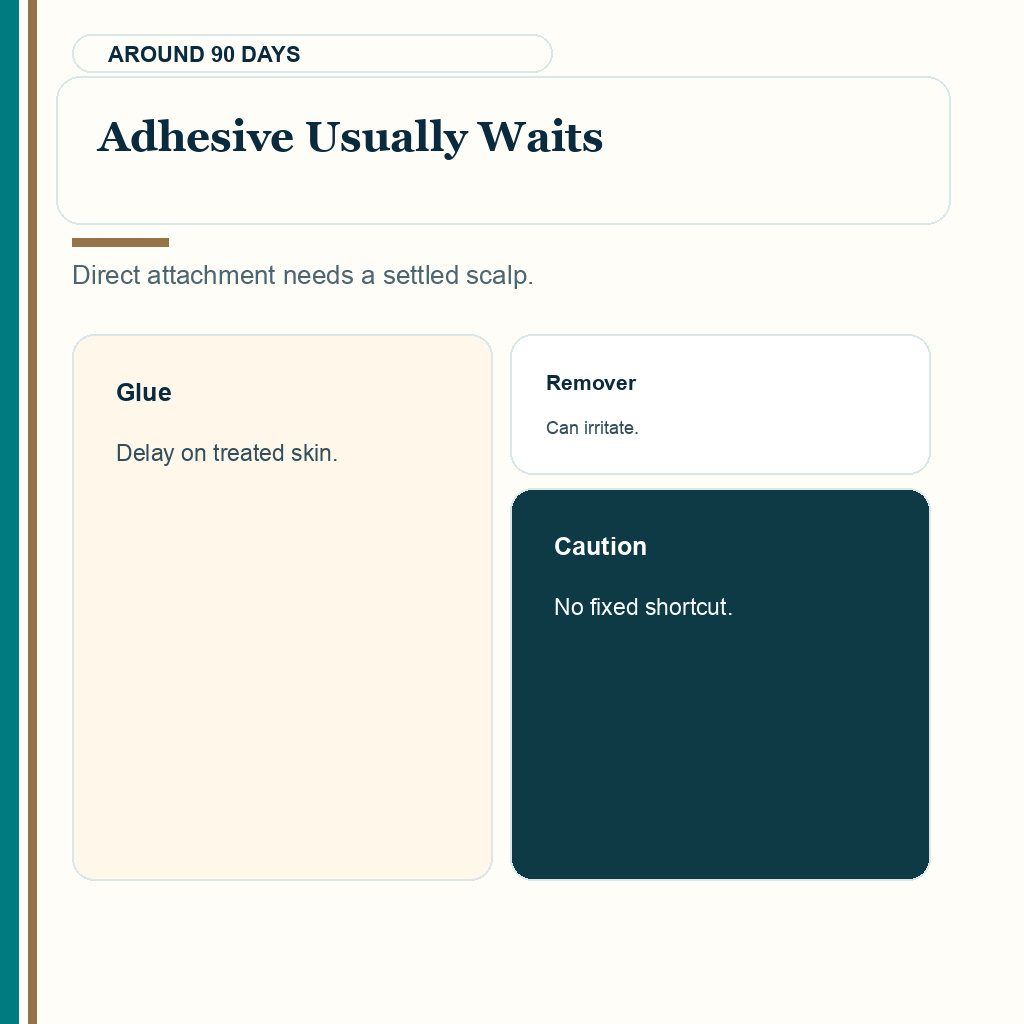
A bonded system behaves more like a cosmetic product and a mechanical device than a light cover, so I use a more conservative 90 day mindset.
In the first 90 days, I avoid turning a freshly treated scalp into a cosmetic attachment surface. Styling products, fibers, concealers, and anything that sits directly on the skin need restraint during that period. The scalp may appear quiet on the outside, but do not read that as readiness for glue, tape, solvents, friction, heat, or repeated manipulation.
A system can also conceal scalp conditions. If redness, folliculitis, irritation, or small pimples develop under the base, the patient may not notice them until later. If the scalp starts itching, the patient may scratch. If adhesive residue remains, the cleaning may become too aggressive. This is exactly the kind of cycle I avoid after surgery.
The 90 day approach is not because every patient will have a problem before 90 days. It is because the patient has only one opportunity to protect the transplant’s early biological environment. Extra caution during this period helps prevent avoidable irritation.
Sleeping with a system after surgery
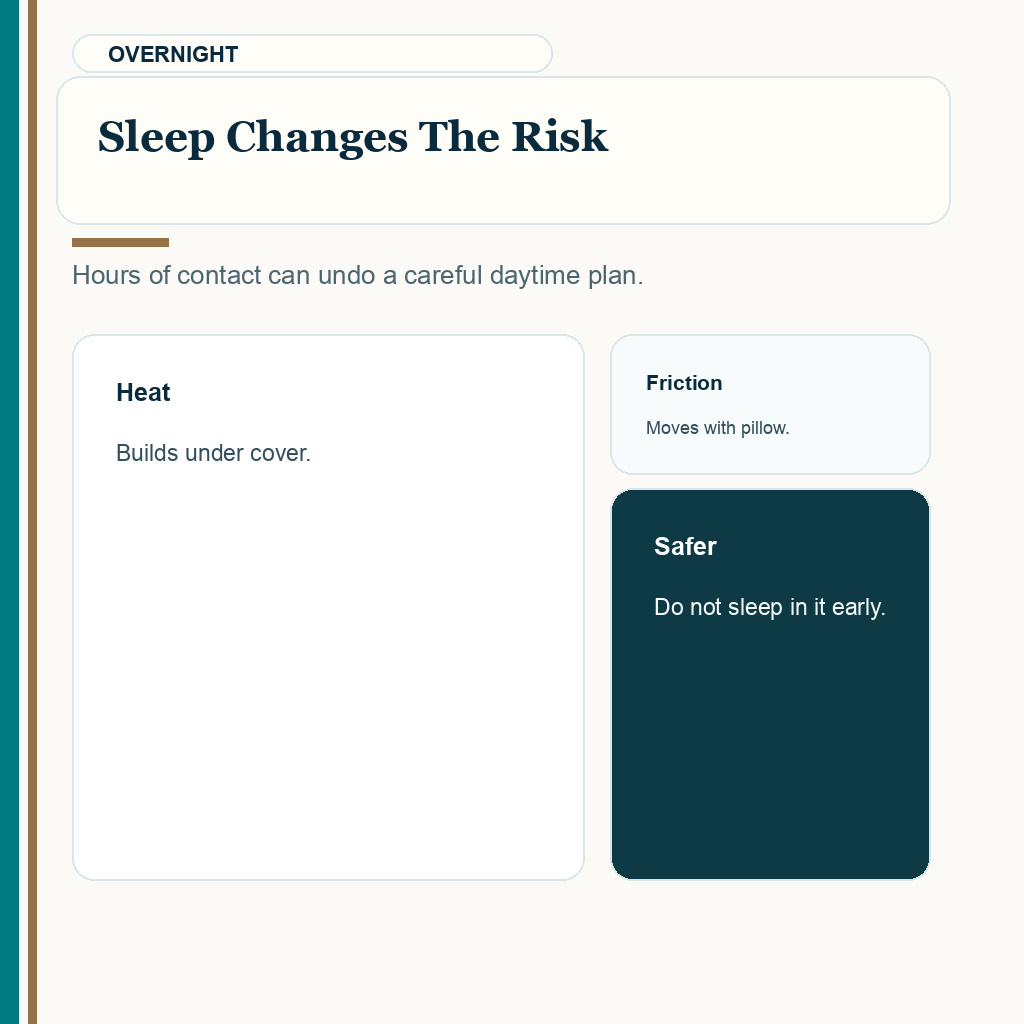
I avoid sleeping with a system during the early recovery period, especially if it touches the recipient area or needs glue, tape, clips, or pressure to stay in place. Sleep after a hair transplant already creates friction and accidental movement. A system adds another layer of risk.
Wearing it all day after surgery
Not during early recovery. The scalp needs to breathe, stay clean, and remain visible enough to monitor healing. Wearing a system continuously can hide redness, pimples, irritation, sweat, adhesive residue, and other signs that the scalp is not settled.
What if it does not touch the transplanted area?
If the system sits away from the transplanted area, the discussion is different, but the whole scalp still needs to be assessed.
Sometimes a patient has a transplanted frontal hairline and wants to wear a system behind it. Sometimes the system covers the crown while the frontal area has been transplanted. Sometimes the system is planned as a transition tool because the patient does not have enough donor capacity to restore the whole scalp surgically.
In selected cases, this type of plan can be considered, but it must be planned before surgery. The plan needs to define where the system will sit, where the tape or glue will be placed, how often the patient removes it, whether the base traps sweat, and whether the edge will rub against transplanted hair.
The safest situation is when the system does not touch the recipient area, does not pull on transplanted hair, does not press on the donor area, and can be removed without force. Even then, I assess it only while it is sitting still.
Normal use matters, not only the still position of the system. The patient may experience sweating after a hair transplant, sleep with movement, adjust the edge, remove tape, clean residue, or have the system reapplied. A system can start outside the recipient area and still disturb it during normal use. Careful, limited use during the early months is safer.
Do not improvise this alone after surgery. The decision belongs with the surgeon, not only the technician. The technician may understand cosmetic attachments very well, but the surgeon understands surgical wounds, graft placement, donor site extraction, and healing risks.
The system should adapt to the surgical plan. The surgical recovery should not be forced to adapt to the system.
Spot bonding and partial systems
Spot bonding or a partial system can sometimes reduce risk compared with bonding a full system over the treated scalp, but it is not necessarily safe. The attachment location and removal method still decide much of the risk.
If adhesive is placed only on untreated skin, the risk may be lower, but the edge can still pull, rub, trap sweat, or shift toward transplanted hair. A partial system can also create a pressure point if the base is too firm or if the patient adjusts it repeatedly during the day.
The safer version is drawn before surgery. I review the system shape, the attachment zones, the cleaning routine, and who will remove and reapply it. If those details are unclear, the word partial does not make the plan safe by itself.
Keeping a system behind a transplanted hairline
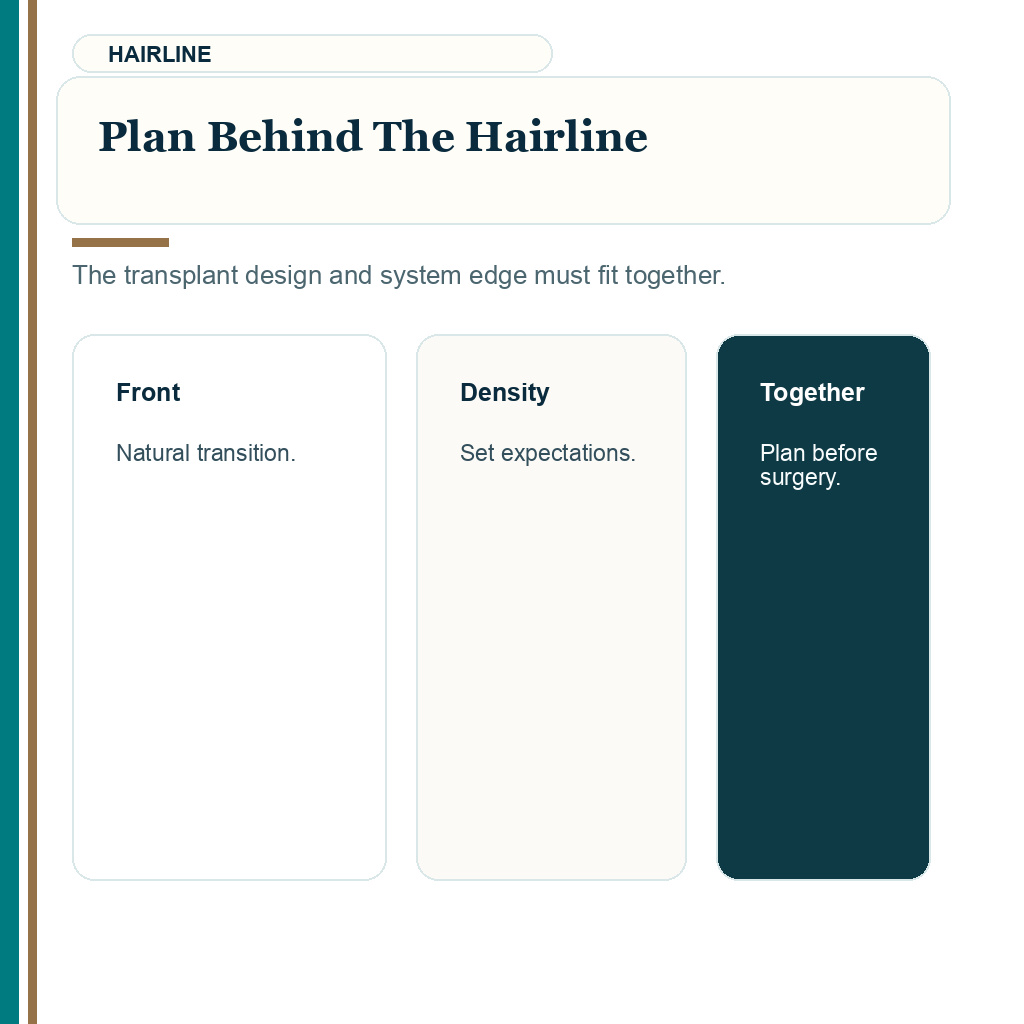
In specific cases, yes. This can work when the surgical plan is designed around it from the beginning. The transplanted hairline, density, direction, and transition into the system must be planned carefully. It should not be improvised after surgery.
Adhesive, tape, and clip risks
They can create problems, especially if used too early or in the wrong location.
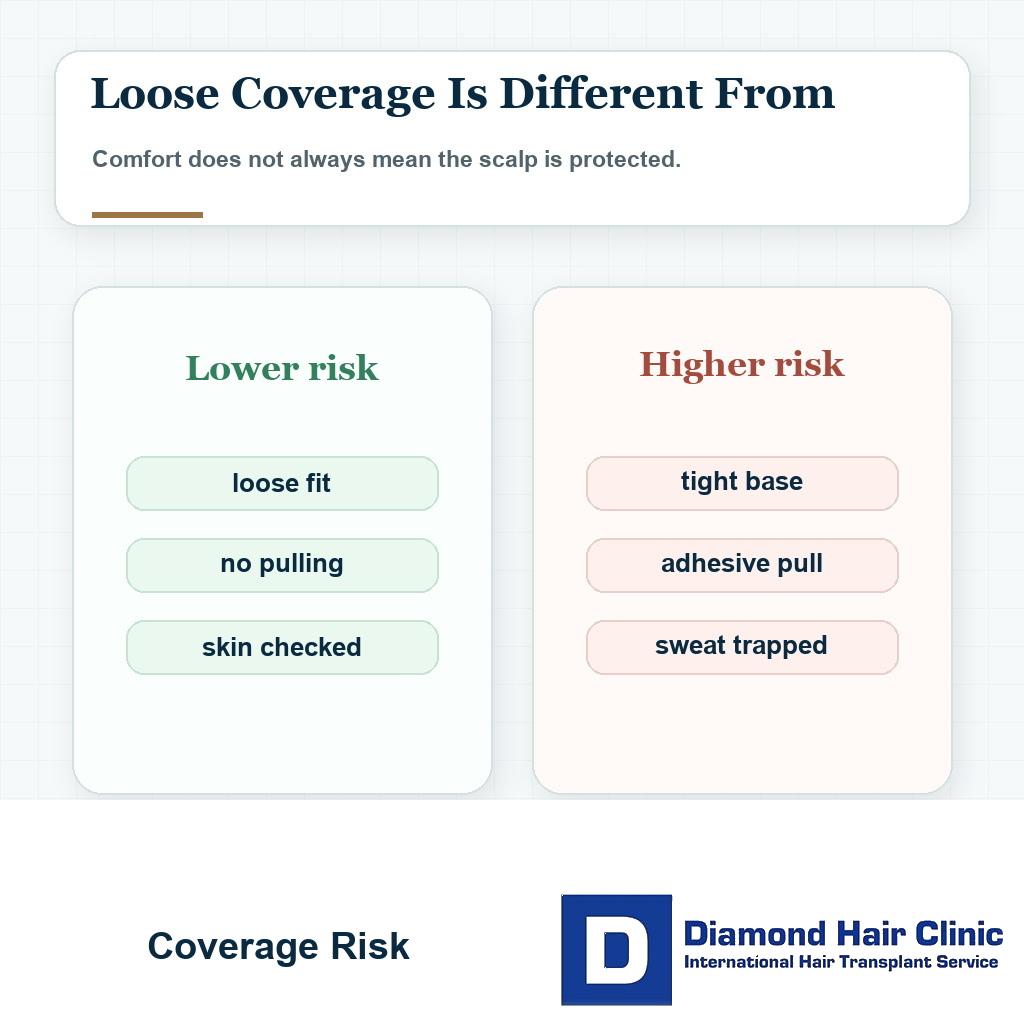
Adhesive can irritate the skin. Tape can leave residue. Removing glue may require cleaning products or solvents. Clips can pull on nearby native hair. Repeated attachment and removal can create small but repeated trauma. A tight base can trap sweat, oil, heat, and product against the scalp. Plan the removal step as carefully as placement, because a fast lift at the edge can pull nearby healing hair.
Not every case starts with one dramatic event. Sometimes the difficulty is repeated small irritations. The patient applies the system, feels itchy, adjusts it, sweats under it, removes it, cleans the scalp, reapplies adhesive, and repeats the cycle. Over time, the scalp may become red, inflamed, or covered with small pimples.
When the scalp becomes irritated, the patient often scratches or cleans too aggressively. That creates a second problem. Now the issue is no longer only the system. The issue is a cycle of irritation, anxiety, touching, and too much cleaning.
Strong adhesive over a recovering recipient area is a concern. Even if the grafts are not pulled out, the skin may become more reactive. After a hair transplant, the skin should be as settled as possible.
A system that requires force to apply or remove is too aggressive for early recovery.
Adhesive remover and solvent timing
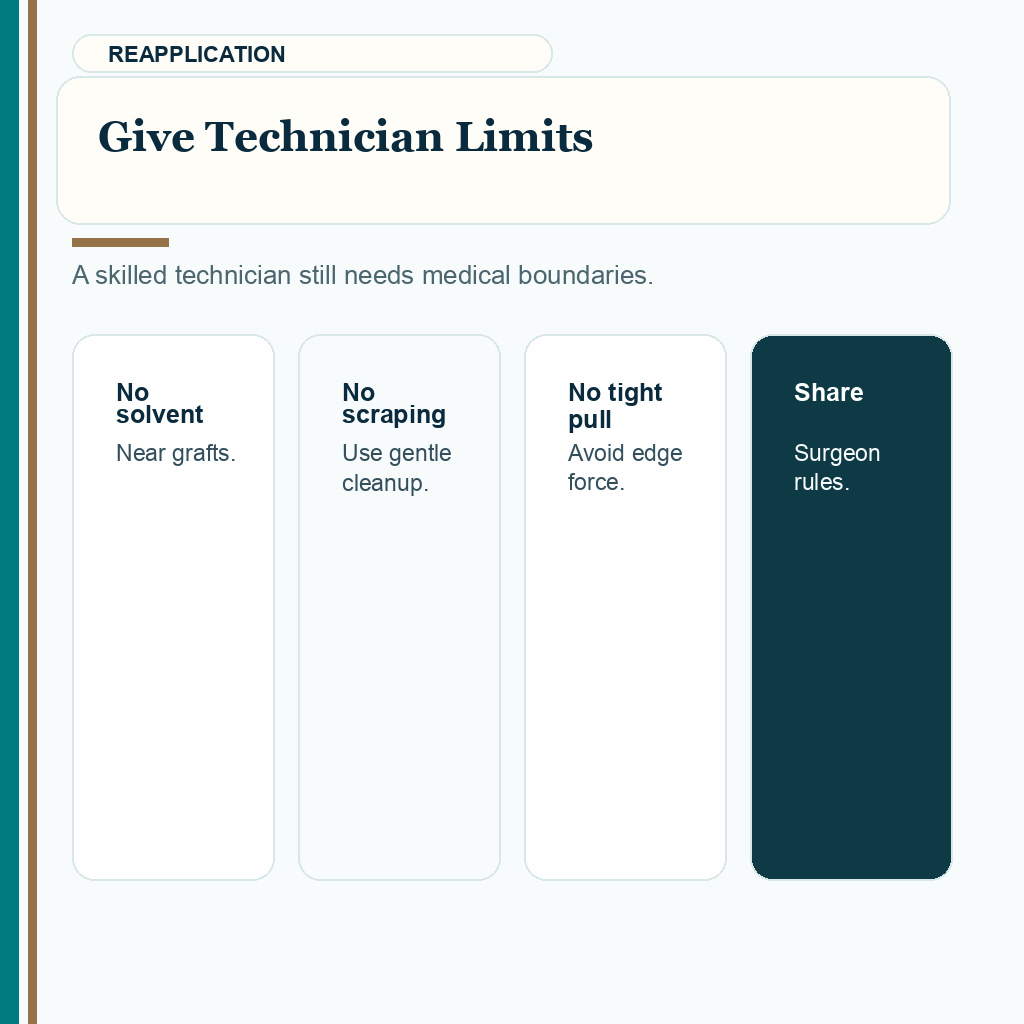
Avoid adhesive removers and solvents on or near the recipient area in the early period unless your surgeon has specifically approved them. These products can irritate healing skin, and the cleaning process itself may create rubbing or pressure.
Riskier attachment methods
The attachment method has to be judged by more than whether the patient wears a system. The important details are how it attaches, where it sits, how it is removed, and what it does to the scalp during the day.
The 8 attachment risk slides below separate bonded glue, tape on grafts, tape on untreated scalp, clips, loose temporary coverage, behind the hairline planning, technician reapplication, and scalp reaction warning signs. Swipe sideways, use the arrows one slide at a time, or choose a number below the image.
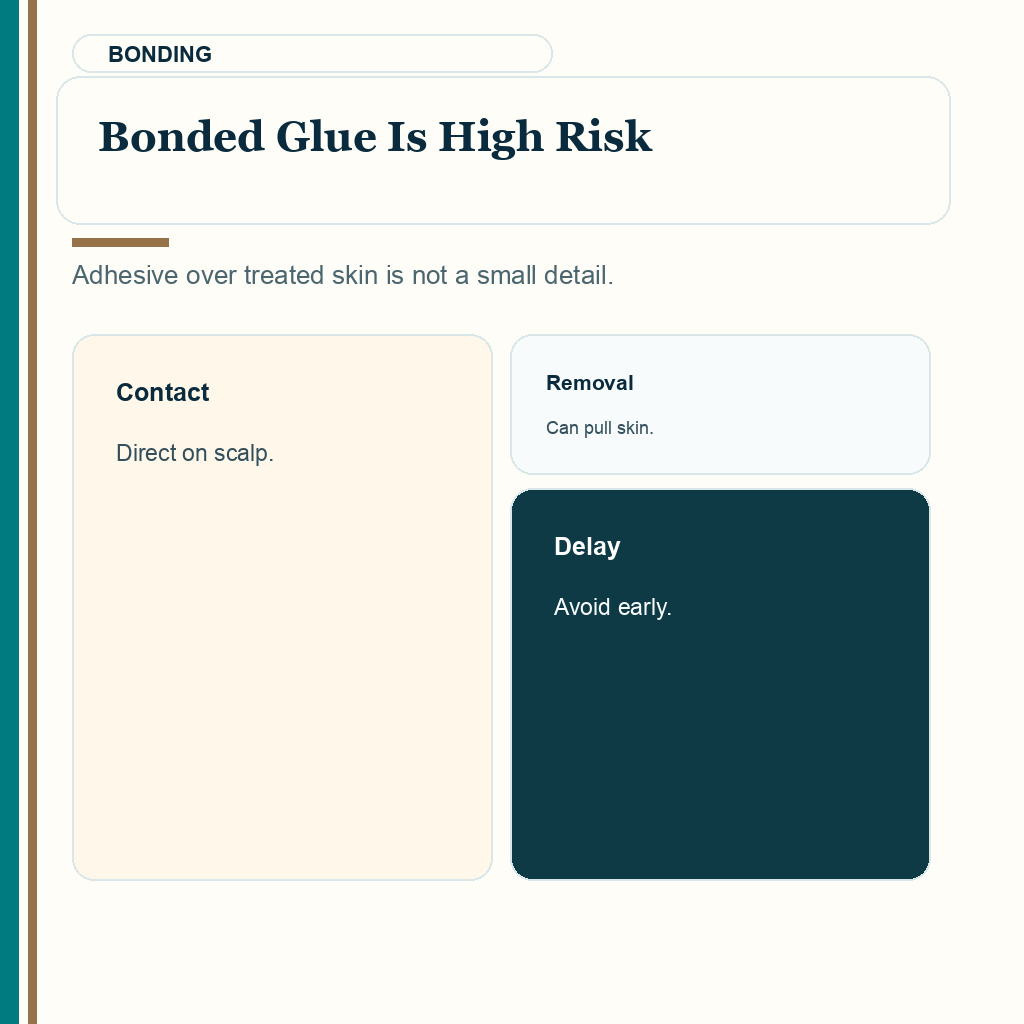
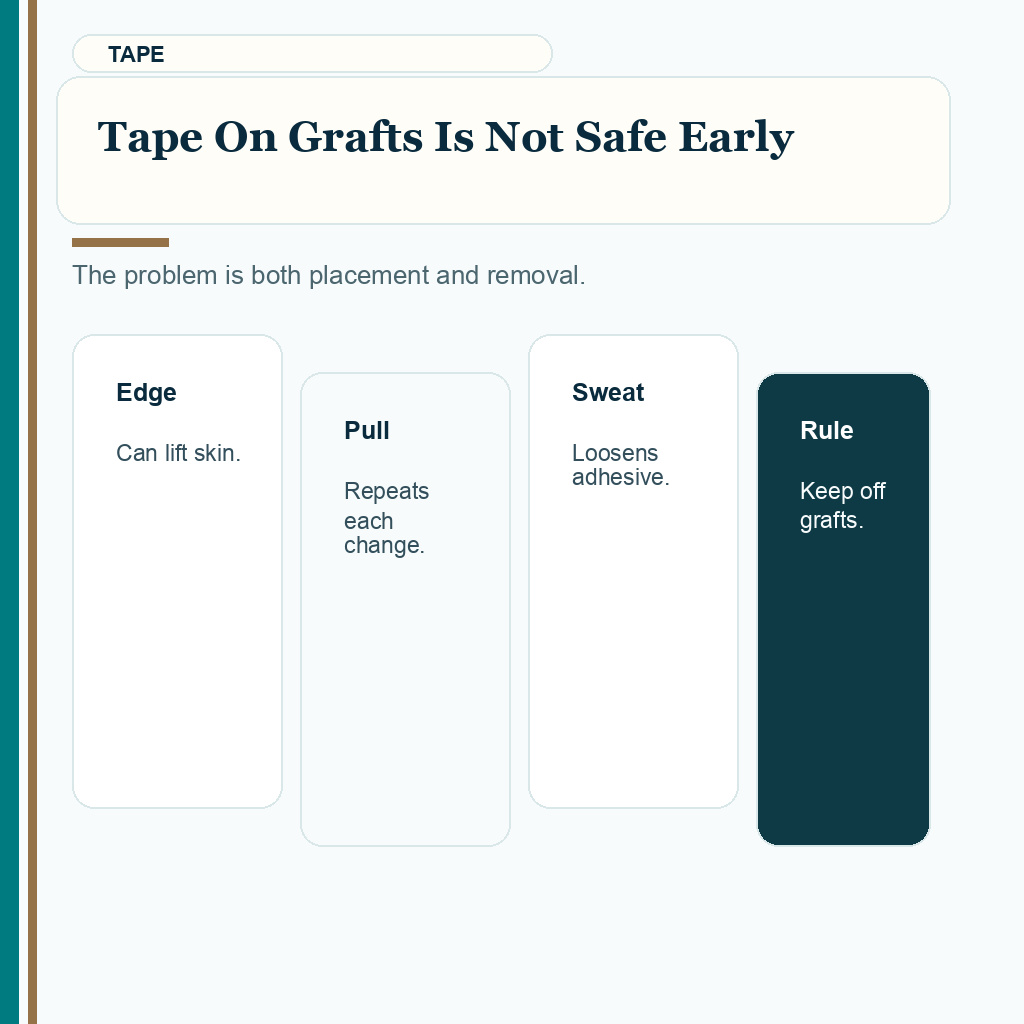

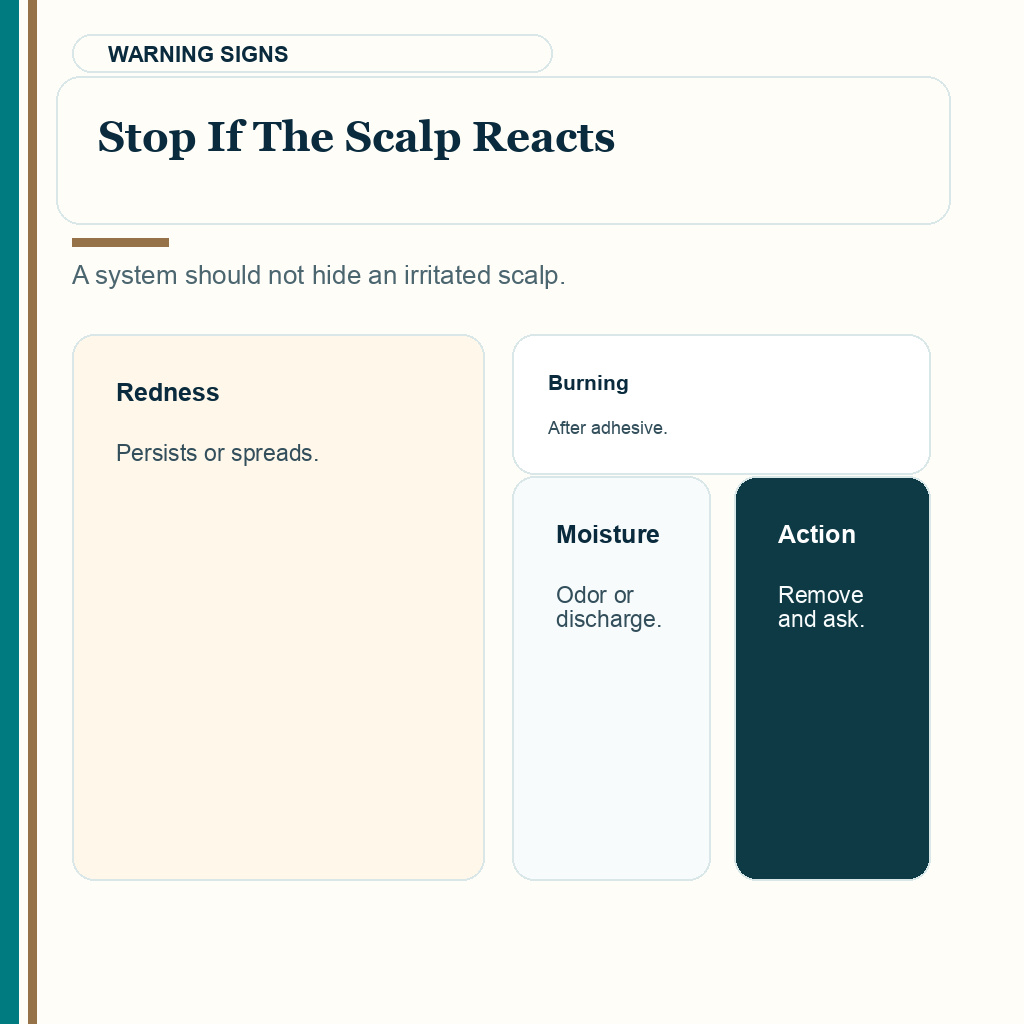
Judge the system by more than how natural it looks. Judge it by how it behaves on healing tissue. A cosmetically beautiful system can still be surgically inappropriate if it irritates the scalp.
Existing system users before surgery
If a patient already wears a system, I review this before the surgical plan is made. This is not a minor detail. It affects diagnosis, design, shaving, scalp preparation, social timing, and the patient’s expectations.
The real hair loss pattern, the native hair behind the system, the donor area, the scalp skin, and any irritation from glue, tape, clips, or covering for a long time all need to be examined. A transplant planned around a hidden scalp is not a proper plan.
The system should usually be removed early enough before surgery for the scalp to be cleaned and assessed properly. Finding adhesive residue, inflammation, traction marks, or irritated skin on the morning of surgery creates pressure and can weaken decision making.
The patient also needs to understand the emotional side. For some patients, the system is not only cosmetic. It has become a way to feel safe in public. Removing it for surgery can feel exposing. I take that seriously. But emotional discomfort needs planning, not a rushed return to the system too early after surgery.
Before surgery, we need a clear discussion about the patient’s real goal. Stopping completely, creating a natural transplanted hairline in front of the system, and reducing dependence on it are different plans. They require different surgical decisions.
Removing it before surgery
Usually yes. The real scalp, the true hair loss pattern, the donor area, and any skin reaction caused by glue, tape, clips, or covering for a long time need to be seen. A transplant should not be planned around a hidden scalp.
Preparation for existing users
If you already wear a system, send photos with the system on so I can understand the look you are used to seeing, and photos without it so I can see the real hair loss pattern. Clear donor area photos from the back and both sides are also needed, plus close photos of the attachment zones so redness, irritation, residue, or traction can be checked.
The attachment method matters. I need to know whether you use glue, tape, clips, salon bonding, or a removable base, how often you remove and reapply it, and whether the scalp becomes itchy, oily, red, or inflamed under the system. The goal also has to be realistic. Stopping the system, reducing dependence, creating a natural front edge, and keeping a system behind transplanted hair are different plans.
Please also review the instructions before a hair transplant before surgery. The operation is safer when the scalp is clean, visible, and properly assessed before the day of surgery.
If you already wear a system, do not hide it during the consultation. It is not embarrassing. It changes how I plan the surgery, protect the grafts, and guide your recovery.
Covering the ugly duckling phase safely
Sometimes it can hide the appearance, but it should not be used to fight the biology of healing.
The ugly duckling phase is difficult because the patient may see shedding, uneven density, redness, and a temporary loss of cosmetic comfort. Many patients feel that they looked better before surgery during this stage, even when healing is completely normal.
The temptation often appears at this point. The patient wants to cover the scalp until new hair grows. I understand that desire, but the timing is not ideal. During this stage, the scalp still needs to be visible enough to monitor carefully. Redness, pimples, irritation, or delayed healing should be seen early. A system can hide these signs.
If you think you may need a system for the awkward phase, decide that before surgery rather than improvising when shedding starts. The plan should state who can remove or reapply it, which zones must stay free of adhesive, and what signs mean the scalp needs to be left open for clinic review.
There is also a psychological issue. If the patient covers the scalp constantly, it can become harder to adapt calmly to the normal recovery timeline. Every temporary change may start to feel like a problem. Constant camouflage can also bring back the same dependence the patient was trying to move away from.
Looking socially acceptable after surgery is not the same as seeing the final result, which is why the timing guidance on when you look normal after a hair transplant matters for system users. The patient needs patience during this transition.
Comfort matters, but camouflage should not create unnecessary risk to the scalp.
Work and social camouflage
This concern is real. Many patients cannot take months off work and social life. They may have meetings, family responsibilities, travel, public work, or personal reasons for wanting privacy.
But the camouflage method must respect the recovery stage. In the first 10 to 14 days, I avoid anything touching the recipient area in a way that creates friction or pressure. After that, I still judge the situation by scalp condition, not by the calendar alone.
If camouflage is necessary, choose the least aggressive option. Sometimes, planning enough time away from work after a hair transplant is safer than trying to cover the transplant too early. Sometimes, a loose, clean, breathable cover used briefly is more reasonable than a bonded system. Sometimes the patient can work remotely during the most visible stage. Sometimes the best option is simply to accept a short awkward period rather than risking irritation.
Later in recovery, cosmetic products need their own scalp check. Hair fibers after a hair transplant may be useful after enough healing, but they should not be applied to an irritated or fragile scalp.
Every camouflage option has to answer more than one question. It must hide the surgery without making the scalp hotter, more irritated, or harder to monitor.
Temporary social comfort should not compromise surgical growth.
Hair fibers during recovery
Hair fibers may be less aggressive than a bonded system, but I still do not want cosmetic products applied to fragile, irritated, or freshly transplanted skin. Wait until healing is stable before using hair fibers after a hair transplant, and do not use them if the scalp is red, itchy, crusted, or inflamed.
Hairline planning when a system may stay
Some patients want a transplanted frontal hairline and a system behind it. This can be a reasonable idea in selected cases, especially when the patient has advanced hair loss, and the donor area cannot safely restore the whole scalp with enough visual density.
But this plan requires very careful design. The transplanted hairline should not be too low, too straight, too dense, or too aggressive for the patient’s age and donor capacity. If the underlying system is extremely dense and the transplanted front is softer, the transition can appear unnatural. If the transplanted hairline is too weak and the system behind it is too thick, the contrast can also look wrong.
Hairline design in a hair transplant is not just drawing a line. The plan has to consider direction, irregularity, density, temple position, facial proportions, future hair loss, and how the system will meet the transplanted hair.
The future goal also changes the plan. If the patient wants to stop wearing a system completely, the transplant plan must be different. If the patient wants to keep the system but make the front edge look more natural, that is another type of plan. If the patient wants to use the system only temporarily during growth, the timeline must be realistic.
A system and a transplant can only work together if the surgical plan is clear from the beginning. They should not be combined as a rushed solution after surgery because the patient feels uncomfortable during recovery.
Transplant density versus system density
Sometimes the improvement can be great, but a transplant cannot create unlimited density. A system can give instant fullness over a wide area. A transplant redistributes donor hair. Donor capacity, hair caliber, bald area size, future hair loss, and expectations must be judged.
In advanced hair loss, this discussion becomes stricter. If the patient has a large bald area, a weak donor supply, fine hair caliber, active progression, or high expectations for full coverage, a transplant may improve the frontal frame but still not replicate the look of a full system.
A system can hide the reality of the donor limitation from the patient. The patient may become used to seeing a dense top every day and then expect the transplant to reproduce that same density. But surgery cannot ignore donor supply. If the donor is limited, the plan must be disciplined.
The same issue helps explain why some hair transplant results look thin. Poor growth is not always the only explanation. Sometimes the original goal was unrealistic, the bald area was too large, or the graft distribution was diluted across too much scalp.
Candidacy has to be decided before surgery, not after the patient has already imagined life without the system. The decision depends on whether the patient is truly a good candidate for a hair transplant, not only whether they want to stop wearing a system.
A transplant needs planning around biological limits, not around the visual density of a system.
Crown coverage and system decisions
The crown often complicates the system discussion. Many patients use a system because the crown and middle scalp are too thin to style comfortably. They may hope that surgery can completely replace the system, but the crown can require many grafts and still have less visual impact than a frontal hairline.
Crown hair transplant planning needs the same attention. The crown has a circular growth pattern and a convex shape. It often needs many grafts to create the illusion of coverage, and even then, the visual result may not match the instant fullness of a system.
If a patient has advanced hair loss, it may be more intelligent to build a natural frontal frame and manage the crown more conservatively. In selected cases, a system behind a transplanted front may be discussed, but it has to be planned carefully and not attached too early after surgery.
The mistake comes from trying to solve everything in one emotional decision. The patient wants no visible baldness, no awkward recovery, no system, and full coverage immediately. In real surgery, this is often not realistic.
The crown should not be allowed to consume the donor area simply because the patient is trying to escape a system too quickly.
Technician reapplication after surgery
Only with surgical guidance.
A technician may be excellent at creating a natural cosmetic appearance. But after a transplant, the main question is not only how the system looks. The decision depends on whether the scalp can tolerate attachment, pressure, cleaning, adhesive application, solvent exposure, and removal.
The technician must know exactly which areas were transplanted, where adhesive must be avoided, how much pressure is unacceptable, and whether clips or tape could pull on transplanted or native hair. Without this information, a cosmetically good reapplication may still be surgically unwise.
The surgeon should guide the timing. Do not return to the salon and simply ask for the usual attachment. The usual routine may be too aggressive for a healing scalp.
If reapplication is unavoidable later in recovery, it should be gentle, of short duration when possible, easy to remove, and not bonded directly over the transplanted area. The scalp should also be checked regularly for redness, pimples, itching, pain, or crusting, or any sign that irritation is increasing.
After a transplant, the cosmetic technician should follow the surgical healing plan, not the other way around.
When a system helps and when it hides a problem?
A system can help after enough healing when it solves a practical social problem without touching the transplanted area aggressively. It becomes a concern when it hides redness, pimples, crusting, pain, poor washing, or a density promise that was never realistic.
I want the patient to separate camouflage from medical review. Camouflage can protect privacy. It should not stop the clinic from seeing the scalp, checking the hairline, reviewing donor healing, or changing aftercare when the skin is reacting.
If the system is part of the long term plan, that plan needs to be designed before surgery. The hairline, crown, attachment zone, maintenance schedule, and expected density must fit together. Otherwise the patient may get a transplanted front that fights against the system behind it.
Clinic promises that need caution
Slow down when a clinic makes the transition sound too easy. If a patient is told that they can quickly replace a dense system with one hair transplant, hide the recovery immediately, and return to normal life without difficulty, that is a reason to slow down.
A proper plan explains the first 10 days, the first month, the shedding phase, the growth timeline, donor limits, hairline design, scalp health, and the cosmetic transition. It should also explain what the patient can safely do if they need to appear in public before the transplant looks presentable.
A clinic should also be direct about whether the patient has enough donor supply to stop wearing a system. Some patients do. Some do not. Some can reduce dependence on the system but not eliminate it completely. Some may need staged surgery. Some may need to accept a softer density than the system provides.
If the consultation only focuses on graft numbers, I do not consider that enough. Graft numbers alone cannot answer how the patient will manage the first months, whether the scalp can tolerate a system, or whether the final density will satisfy someone used to artificial coverage.
The transition from a system to a transplant is not only a cosmetic issue. It is a surgical planning issue, a donor management issue, and an emotional issue.
Planning surgery while still using a system
Plan the system and the surgery together before the operation, especially if the system may remain part of the patient’s life.
Photos without the system, photos with it, the attachment method, the hairline position, the density the patient is used to, and the real hair loss pattern underneath all matter. I also have to understand whether the plan is to stop wearing it completely, create only a natural frontal hairline, keep it behind transplanted hair, or use temporary camouflage for work.
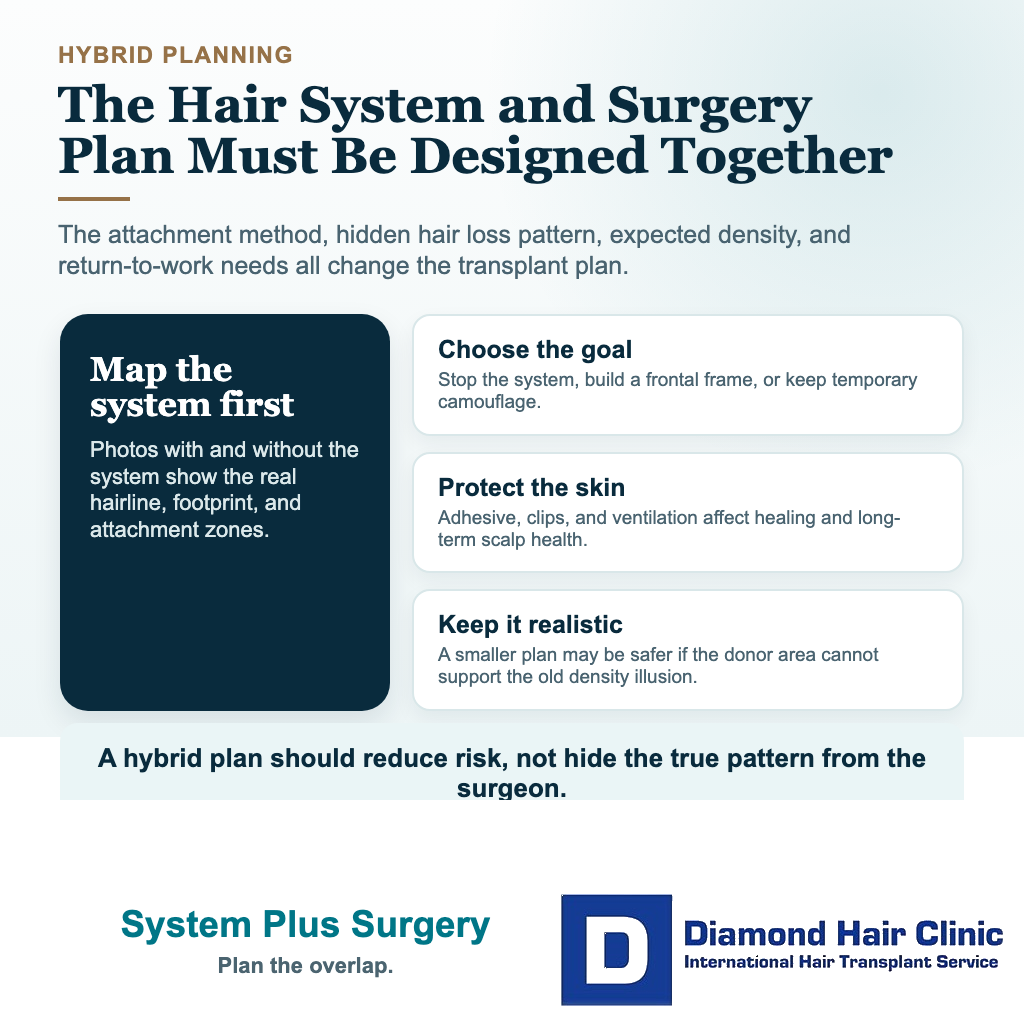
With those details clear, I can judge whether surgery is wise, whether the plan is realistic, whether the donor area can support it, and how the first months should be managed.
Sometimes the answer is a hair transplant. Sometimes the answer is a smaller and more conservative transplant than the patient expected. Sometimes, stabilizing hair loss first is wiser. Sometimes, continuing with a system is safer than spending donor grafts on an unrealistic surgical goal.
A system can be useful in some situations, but it should not pressure the patient into rushed surgery or unsafe recovery habits. The transplant should protect the grafts, protect the donor area, and protect the future appearance.
The right decision is not the one that hides the recovery fastest. It is the one that protects the final result.
Practical decision making
Avoid a system over the transplanted area during the first 10 to 14 days, avoid bonded systems during the first month, and be especially conservative with glue, tape, adhesive, solvents, or direct scalp attachment for at least 90 days. If there is redness, itching, pimples, crusting, tenderness, or irritation, wait longer.
Needing a system after surgery
After enough healing time, a system may be physically possible after a hair transplant in selected cases.
But if the patient asks whether I recommend it, my answer is different. I generally do not recommend wearing a system over the transplanted area during the recovery and early growth period unless there is a very strong personal or professional reason.
My concern is not only graft dislodgement. It is also scalp health. A system can create pressure, friction, sweating, adhesive irritation, poor ventilation, hygiene problems, and repeated mechanical stress. These factors may not always destroy grafts, but they can make the scalp less healthy than it should be after surgery.
Early healing is not only something to get through. The transplanted follicles need the best possible environment for growth. In most recoveries, avoiding systems whenever possible is safer, especially in the first months.
If a patient truly needs to use one, the scalp should be examined first, the attachment method discussed, the adhesive kept away from the transplanted area, and the system used as little as possible. Stop immediately if redness, itching, pimples, pain, discharge, crusting, or irritation appears.
In hair transplantation, patience is often safer than camouflage.
A system can hide the scalp for a while, but it cannot replace good healing, good planning, donor discipline, and a healthy scalp environment. If the patient’s real goal is the best possible hair transplant result, then the recovery period should be protected rather than aggressively covered.

Read this review excerpt
Every single one of my questions was answered and they made sure I had all the details I needed to make an informed decision.