



Androgenetic Alopecia Before FUE Is More Than a Label
If a patient asks whether androgenetic alopecia is a disease, natural aging, or a cosmetic problem, I do not treat the label as the final answer. It can be a medical diagnosis. It can be common with age. It can also feel deeply personal because the hairline frames the face. Before FUE, the useful question is whether this diagnosis can become a stable, donor safe, realistic surgical plan.
That is where many conversations become confused. Calling hair loss cosmetic can sound dismissive, especially for a young patient who is losing hair quickly. Calling it a disease can sound like surgery is automatically justified. Neither reaction is enough, because the diagnosis still has to become a stable donor safe plan. I need to understand the pattern, the speed of change, the donor area, the native hair that may still thin, and whether another diagnosis is hiding behind the same appearance.
The label should start the review, not end it
Androgenetic alopecia gives us a useful starting point. It tells me that hair follicles in certain scalp zones are miniaturizing in a patterned way under genetic and hormonal influence. It does not tell me whether the patient is ready for FUE today. The same label can describe a stable patient at 38 with a mature pattern, a patient at 20 whose corners are changing every few months, or a diffuse thinner whose donor may also be at risk.
An androgenetic alopecia diagnosis alone does not tell us whether you will reach Norwood 7, the most advanced stage on that scale.
A relative’s mild recession alone is not a reason to plan a lower hairline or use more donor hair.
I connect the diagnosis to a wider good hair transplant candidate review. The candidate question is not, “does he have AGA?” The question is whether the diagnosis, donor reserve, age, family pattern, medication history, density expectation, and hairline design fit each other.
A label also does not replace old photos. A patient may call any change androgenetic alopecia, but I still compare childhood hairline, family pattern, temple shape, crown behavior, and current miniaturization. A mature hairline or recession review can change whether I design grafts, wait, or keep the hairline higher.
One blood DHT result cannot certify that a hairline is stable. It does not reveal how the pattern is behaving on the scalp or how susceptible the follicles are. Before I agree to lower a design, I still need the history, photographs, miniaturization review, donor assessment, and evidence of change in the crown or mid scalp.
Do not send only the diagnosis word. Send when the change began, which zones changed first, and whether the donor area has also become thinner. Older photos can show whether this has been a slow pattern or a recent acceleration behind the same diagnosis.
Cosmetic concern and medical diagnosis can overlap
Hair restoration sits in an awkward space because the concern is visible. Insurance systems and the public may describe pattern hair loss as cosmetic, while dermatology still recognizes androgenetic alopecia as a diagnosable condition. Both ideas can be true without changing the surgical standard. A visible concern can still require medical diagnosis. A medical diagnosis can still require conservative cosmetic judgment.
I also do not dismiss the quality of life side. For some men, visible thinning changes confidence, self image, dating, work, and social behavior in a way that is real. That still does not make FUE an emergency treatment for anxiety or distress. If hair loss has become constant checking, panic, or a major loss of daily function, emotional readiness needs to sit beside the surgical plan rather than being handed to the operation itself.
I am careful with young patients because “natural aging” is not a useful explanation when the person is 18, 19, or in the early twenties and losing ground fast. Early androgenetic alopecia can create real distress, but urgency is not the same as readiness. In a pattern that is moving quickly, active hair loss and early transplant timing may be the bigger decision than the label itself.
The safest conversation is not to argue over one word. Disease, aging, and cosmetic impact each describe part of the picture. FUE planning needs the part that predicts the future. I want to know which native hairs are likely to miniaturize, whether the donor is reliable, and how much coverage the donor can still support years from now.
When the diagnosis question is wider than AGA
When the concern is wider than AGA itself, I separate it into hair loss diagnosis before hair transplant so diffuse thinning, biopsy decisions, active loss, donor weakness, and medication choices are not forced into one label.
There is also a skin side to the diagnosis when the crown or hairline becomes exposed. Less hair coverage can mean more sun on the scalp, so sun protection and skin checks belong in the long term conversation. That does not turn FUE, finasteride, or dutasteride into skin cancer prevention. I treat the exposed scalp as skin too, not only as an area waiting for grafts.
In the wider health conversation, I keep the surgery boundary clear. Research around androgenetic alopecia has reported links with metabolic, cardiovascular, and prostate risk signals, especially in early or vertex pattern loss. Those are observational associations, not proof that baldness causes those conditions and not a reason to use surgery as medical treatment. Blood pressure, cholesterol, weight, family history, and age related prostate questions belong with normal primary care screening while the transplant plan stays elective and donor focused.
FUE does not cure the biology behind native hair loss
FUE moves follicles from a donor area that is usually more resistant to miniaturization. It does not switch off androgenetic alopecia in the rest of the scalp. That distinction matters because a transplant can look good at one stage and still be exposed later if surrounding native hair continues to thin.
I frame surgery as part of future hair loss planning after transplant surgery, not as a one time cure. The donor hair can improve the hairline or selected zones, but the native hair around it still needs a plan. Sometimes that plan includes medication. Sometimes it includes waiting. Sometimes it means a smaller design that will age better.
I do not promise that transplanted hair makes the scalp permanently solved. The donor supply is limited. The result has to survive future contrast between transplanted and non transplanted hair. FUE can restore coverage, but it does not erase the need to plan androgenetic alopecia.
Age and speed of change can make the same label behave differently
Two patients can both have androgenetic alopecia and need opposite advice. A patient in his late thirties with slow frontal recession, strong donor density, and stable photos may be ready for a defined plan. A younger patient with recent rapid loss, diffuse miniaturization, and a strong family history may need time before surgery, even if the diagnosis is obvious.
Medication context also changes the native hair risk discussion. I do not use medication as a lazy gate where every patient must take the same route, but I do need to know what has been tried, what was tolerated, and what the patient is willing to continue. A patient considering a hair transplant without finasteride may still be planned, but the design often has to be more conservative because native hair loss risk remains part of the result.
Minoxidil response does not diagnose androgenetic alopecia for me. A patient can respond a little and still have an active patterned loss, or respond poorly because the area has too few living follicles left to support. The diagnosis still has to come from pattern, miniaturization, donor quality, and timing.
The donor area deserves careful measurement too. If there is donor miniaturization, the AGA label becomes more serious for surgery because the hair we plan to move may not be as stable as expected. I need to discover that before grafts are counted, not after the donor has been spent.
Diagnosis must be checked before grafts are counted
Pattern hair loss is common, but I do not treat every thinning scalp as routine androgenetic alopecia. Diffuse shedding after illness, diet changes, thyroid or iron problems, medication changes, scalp inflammation, patchy loss, itching, scaling, or scarring signs can change the first step. In those cases, graft numbers are not the first decision.
A diffuse thinning stability check is important because diffuse thinning can be patterned AGA, temporary shedding, donor risk, or another process mixed with AGA. If the diagnosis remains unclear after history, photos, examination, and trichoscopy, I may route the patient toward scalp biopsy when the diagnosis is unclear rather than approving surgery too quickly.
This does not mean every patient needs a biopsy or a long medical investigation. A clear patterned case with stable donor hair may not. It means I do not let the phrase androgenetic alopecia become a shortcut when the scalp is inflamed, the pattern is not typical, or the donor is thinning in a way that changes FUE safety.
Use the planning gate before accepting surgery
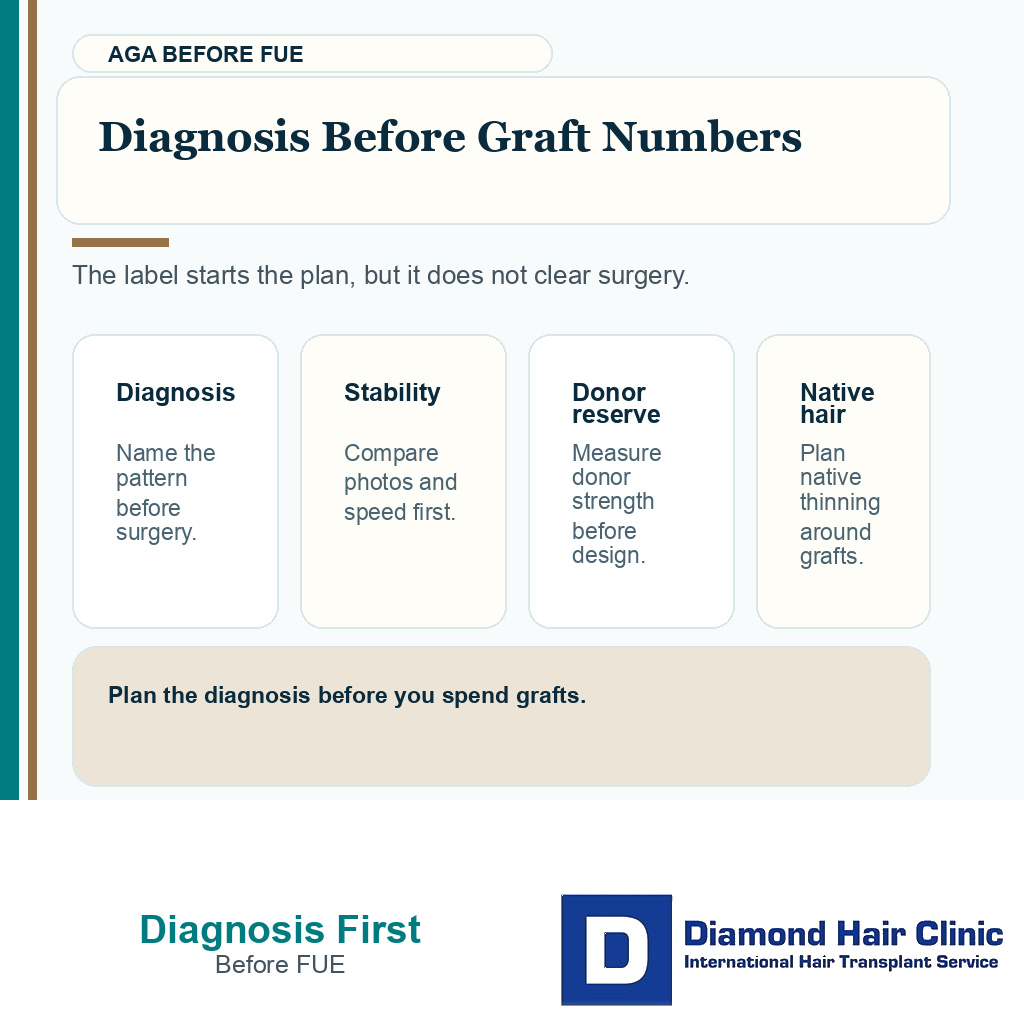
Before I accept the operation, I want the diagnosis to pass through a planning gate. First I name the most likely cause of thinning. Then I look at stability and how fast it is changing. Next I test donor reserve and how much reliable donor hair exists for this operation and possible future work. Finally I judge native hair risk and what will be left around the grafts in five or ten years.
Diagnosis planning gate
Move from the label to the FUE plan
- LabelName the pattern
- StabilityProve what is changing
- DonorTest the reserve
- DiagnosisRule out another cause
Name the pattern
The AGA label starts the review, but it does not approve surgery by itself.
Next move Confirm the pattern before any graft number becomes serious.
Prove what is changing
Old photos, speed of loss, age, family pattern, and medication history decide whether timing is safe.
Next move If the pattern is moving quickly, waiting can protect the donor plan.
Test the reserve
Donor density, caliber, safe zone reliability, and donor miniaturization decide how ambitious FUE can be.
Next move A weak donor makes even a clear AGA diagnosis more conservative.
Rule out another cause
Diffuse, patchy, inflamed, scaling, or scarring patterns need diagnosis before graft planning.
Next move When the cause is unclear, treat diagnosis as the first procedure.
This is also where future research needs perspective. Hair cloning, gene editing, and regenerative ideas may matter one day, but they should not change today’s donor discipline. I keep hair cloning and today’s donor plan separate from the decision to spend real grafts now. Future hope should not make a young patient spend too many grafts too early.
AGA is a diagnosis, not a shortcut
The label matters because it tells us why the hair is thinning, but it does not decide surgery by itself. I still need to know what is stable, what may continue to thin, what the donor can support, and what design would still look sensible if native hair changes later.
The review needs front, temple, crown, donor, side, and older photos when available, plus age, family history, speed of loss, medication history, shedding changes, scalp symptoms, and any concern about diffuse thinning or donor weakness. That gives the diagnosis a practical shape.
The AGA slides below keep the label separate from donor safety, native hair risk, and design judgment before FUE.
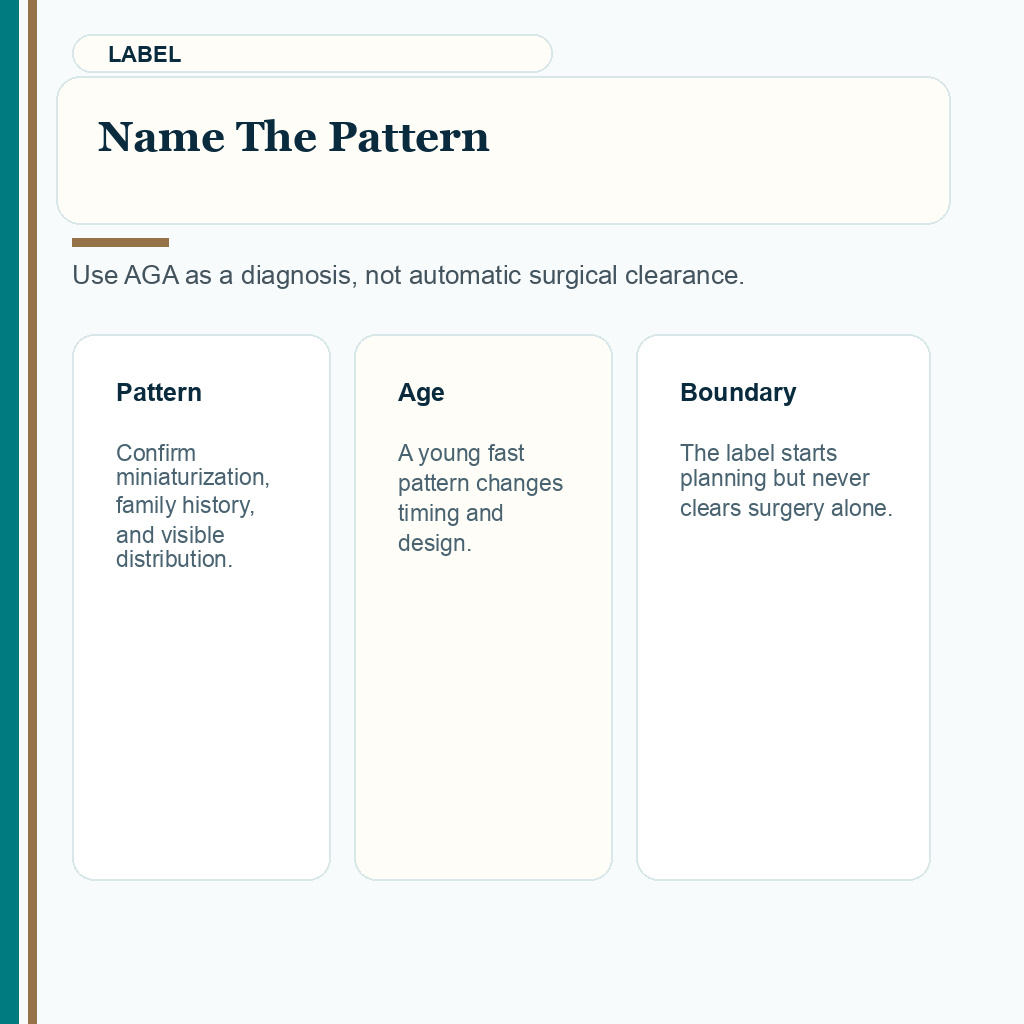


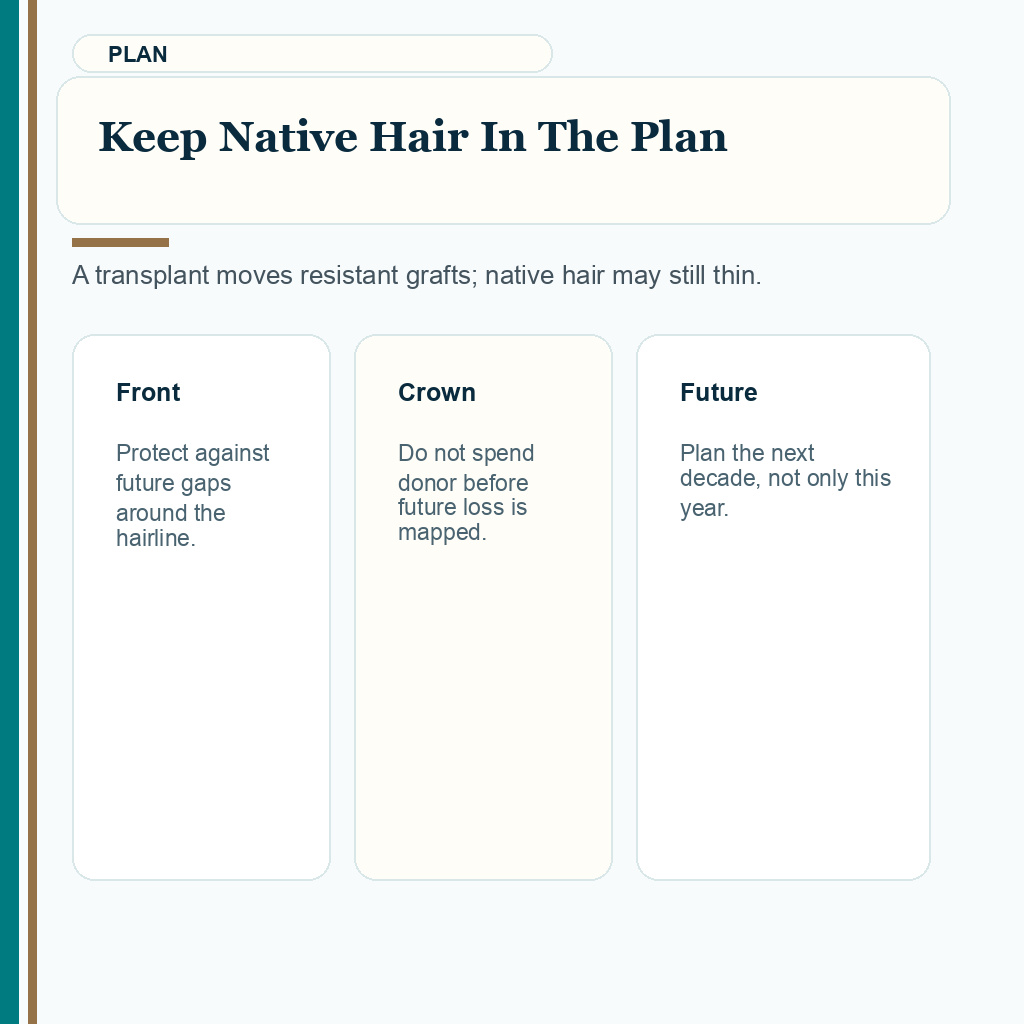
Surgery can move reliable hair, but it cannot freeze the rest of the scalp. The diagnosis has to guide donor safety, native hair risk, and a design that still makes sense later.

Read this review excerpt
Every single one of my questions was answered and they made sure I had all the details I needed to make an informed decision.