


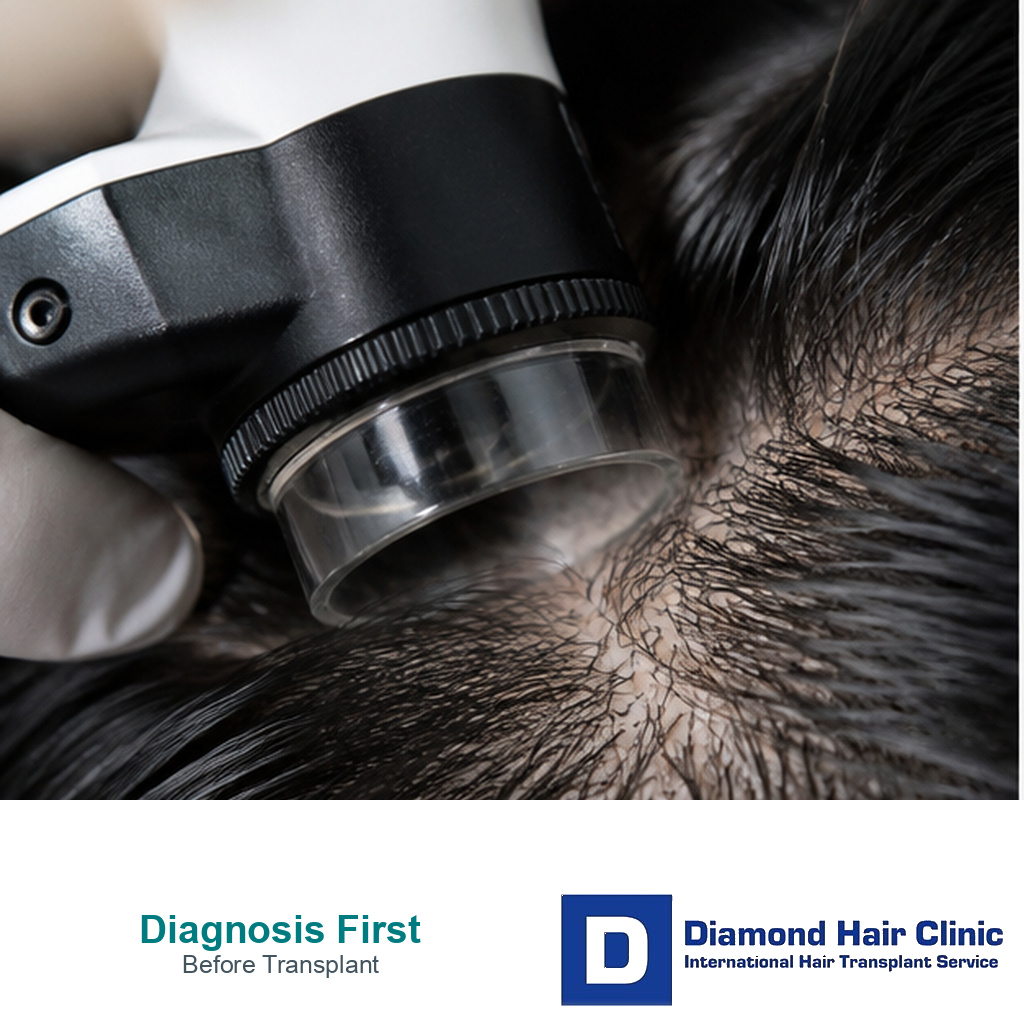
Hair Loss Diagnosis Guides Transplant Planning
A graft number should come after the reason for thinning is understood. The work is to prove the cause of loss, whether it is still active, whether the scalp is healthy enough for surgery, whether the donor area is reliable, and whether the future native hair risk has a realistic plan. Diagnosis is not surgical clearance until activity, donor quality, and scalp health are understood. It is the map that decides whether FUE planning can continue, should wait, needs treatment first, or should be redesigned.
Patients hear very different language. Some are told baldness is normal aging. Some are told it is only cosmetic. Some are told they have androgenetic alopecia and assume that means surgery is ready. I do not use any one label that way. Before graft numbers, I want the diagnosis, activity, scalp condition, donor quality, and maintenance plan to make sense together.
Diagnosis is the map, not surgical clearance
A diagnosis tells me which problem I am treating. It does not tell me, by itself, that surgery is the right clinic action. Androgenetic alopecia before FUE is a good example. AGA may explain the pattern, but I still need to know whether the loss is stable, whether the donor area is strong, whether the hairline design is age appropriate, and whether the native hair around the grafts may keep thinning.
Bring the reason for the diagnosis, not only the diagnosis name. A biopsy result, dermoscopy note, blood test pattern, or old photo can change whether surgery is the first step or a later step. Put the timeline beside the diagnosis so the review can see first thinning, fastest change, treatments tried, and any scalp symptoms together. If the explanation changes from clinic to clinic, do not average the graft numbers. Resolve the diagnosis first. New scalp symptoms, a revised diagnosis, or new donor findings need reassessment before surgery, even if the earlier plan was accepted.
I keep diagnosis connected to candidacy. A candidate review for hair transplant is not only a question of visible hair loss. The safer candidate has a readable pattern, realistic expectations, a donor area that can support the plan, and enough stability to avoid spending grafts into a moving target.
Diffuse thinning can make this decision look more surgical than it is. If medication has just started or a biopsy is being used to explain scalp inflammation, I do not reduce the case to a graft count. The diagnosis should explain what is still changing, what is treatable, and which hair can safely be used before a transplant plan is accepted.
First separate cause, activity, and donor quality
Before discussing graft numbers, I establish the likely cause of the hair loss, whether it is still changing quickly, and whether the donor can support surgery without creating a future problem. A pathology label should also agree with the biopsy site and the clinical picture. Persistent redness or itching despite a short reassuring summary needs correlation with the full report, examination, and trichoscopy before surgery is planned.
The answer can be different in each area. A patient can have a clear AGA pattern at the front and still have temporary shedding on top. Another patient can have a calm hairline but a weak donor zone. Another can have scalp symptoms that make me look for inflammation before surgery. The pattern, the scalp, and the donor all have to agree before the plan becomes surgical.
A localized patch noticed after a long operation needs a different history from gradual patterned thinning. Pressure alopecia after surgery or immobilization is one possible explanation, but the scalp still needs examination before the cause or expected recovery is assumed.
Diffuse thinning needs a stability answer before FUE
Diffuse thinning can be misleading at first glance. It may come from androgenetic alopecia, temporary shedding, stress or illness, thyroid or iron related loss, medication changes, donor risk, or more than one process at the same time. A diffuse thinning stability check matters because the donor and recipient areas may both be changing.
For a woman with diffuse thinning, hairline photos are not enough context. Low ferritin or iron concerns, thyroid history, signs of PCOS, hormone changes, and medication use may change the timing of surgery. When those details are not settled, surgery becomes a later decision, after the shedding pattern is clearer.
If the shedding started suddenly or spread across the scalp, I also think about telogen effluvium and transplant timing. A temporary shedding episode should not be treated like a permanent surgical target. If I operate while the map is changing, transplanted grafts may grow, but the surrounding hair can still make the result look thin or poorly planned.
Biopsy belongs only when the diagnosis is still unclear
A scalp biopsy is not a routine ticket before every hair transplant. Most clear patterned cases do not need it. I consider scalp biopsy before hair transplant when history, photos, examination, trichoscopy, and basic medical review do not settle the cause, or when inflammation, scarring, patchiness, pain, scaling, or unexplained failed growth changes the level of caution.
The important point is not that biopsy is good or bad. The point is sequence. If the cause is unclear, diagnosis comes before grafts. If the scalp is inflamed, the scalp should be calm before surgery is planned. If the diagnosis is already clear, biopsy may add little and can be avoided.
Check the diagnosis before graft numbers
Three short questions about the section you have just read.
Question 1 of 3
A diagnosis of patterned hair loss automatically means surgery can proceed.
A small trichoscopy sample may not represent the whole frontal region.
Every patient needs a scalp biopsy before a hair transplant.
This checks your understanding. It does not determine your suitability for surgery.
Active loss can make the timing wrong
A patient can have the correct diagnosis and still be too early for surgery. Active hair loss and early transplant timing belongs inside the diagnosis pathway. If the temples, crown, or mid scalp are changing quickly, the design I make today may be exposed by the next wave of native hair loss.
Active loss can make a correct diagnosis a wrong timing decision. Waiting is not avoidance when the pattern is still moving. It may be the part of the plan that protects the donor area. The question is not whether the patient deserves treatment. The question is whether FUE today will still look sensible when the pattern keeps changing.
The donor area needs its own diagnosis
Patients often focus on the visible thinning area and forget that the donor area has to be diagnosed too. Before FUE, I need to know whether the donor hairs are stable, thick enough, and safe enough to move. Donor miniaturization and safe zone checks can change the whole operation.
If the donor is weak, diffuse, or miniaturizing, the question changes from how many grafts can be taken to which hairs should be trusted at all. I also watch for retrograde alopecia or DUPA because those patterns can make the usual safe zone less reliable. The donor area is not just a supply area. It is part of the diagnosis.
Medication choices do not replace diagnosis
Medication history helps me understand future native hair risk, but it does not replace diagnosis. A patient who is stable on treatment still needs donor and scalp review. A patient who does not tolerate medication still deserves a careful surgical answer, not pressure or dismissal.
No response to a topical product is not enough to approve grafts. I first check whether the product was used consistently, whether the scalp reacted badly, whether the loss is really androgenetic, and whether the donor area is reliable enough for the design being requested.
When someone is planning a hair transplant without finasteride, I do not treat that choice as automatic refusal. I do make the diagnosis and design more conservative where needed, because not taking finasteride does not remove future native hair risk. The plan has to age without pretending that the biology has stopped.
Choosing surgery without long term medication still has to start with the diagnosis. I want to know whether the loss is patterned, diffuse, temporary, inflammatory, or donor related before I decide whether a conservative transplant plan can make sense.
Use the pathway before accepting graft numbers
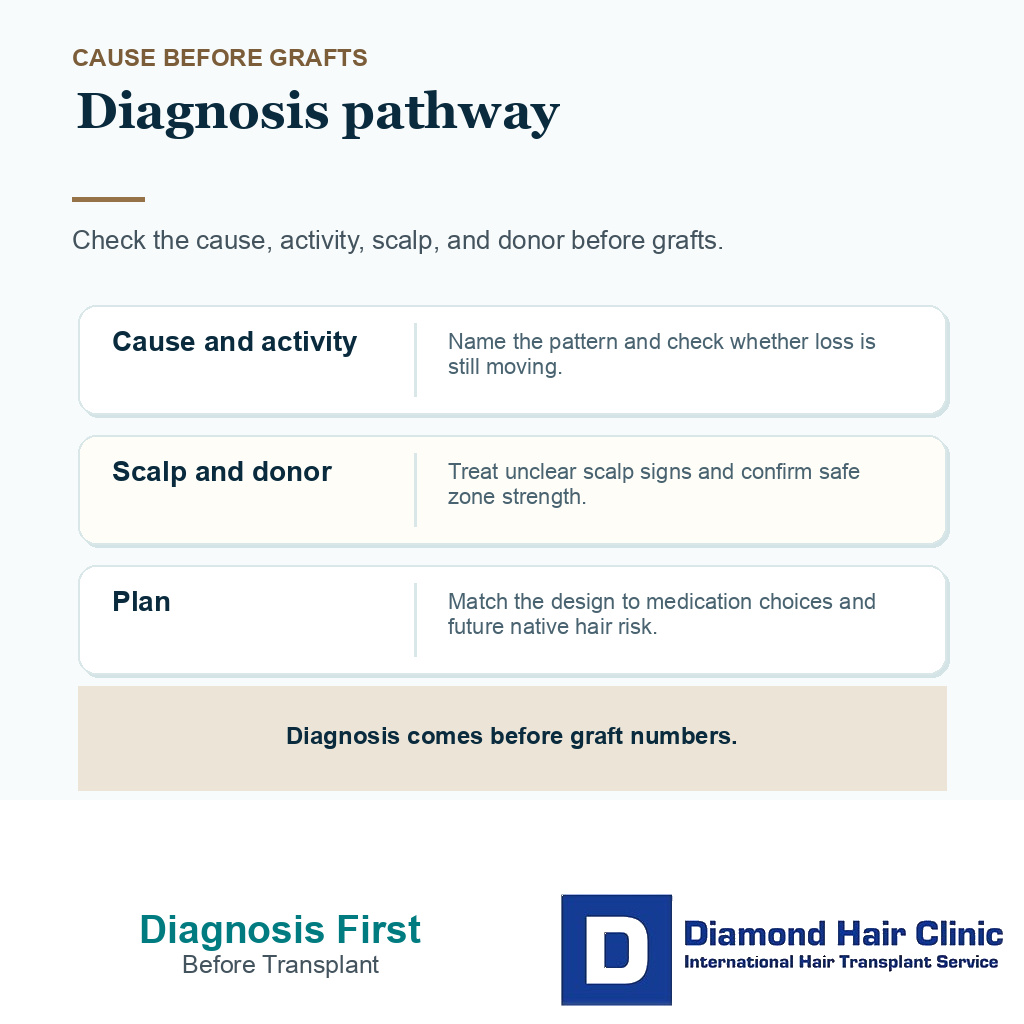
The diagnosis pathway should come before any serious graft quote. It starts with the cause, then the activity of loss, then scalp health, then donor reliability, then the maintenance plan. Only after those pieces are clear should graft count and design be discussed. Averaging several graft quotes can hide the reason those quotes disagree.
Some causes also need a different first step. Alopecia areata before surgery needs control and careful diagnosis because patchy autoimmune loss can return. Scarring alopecia or lichen planopilaris needs even more caution because inflammation can damage follicles and affect graft survival.
Diagnosis pathway
How diagnosis changes the transplant plan
- Patterned thinningmeans AGA or another patterned loss is likely.
- Loss is moving fastmeans timing is not settled, even when the diagnosis is real.
- Scalp looks inflamed or patchycan mean the cause is not routine AGA.
- Donor or medication plan is uncertaincan make the result age poorly without a safer plan.
AGA or another patterned loss is likely
Evidence I check includes distribution, miniaturization, age, old photos, and family history.
The FUE decision waits until stability, donor reserve, and native hair risk are mapped.
The diagnosis may be real, but timing is not settled
Evidence I compare includes recent photos, shedding speed, triggers, medication history, and crown or frontal change.
FUE may wait because treating first can protect the donor plan more than operating now.
The cause may not be routine AGA
Scalp clues include itching, scaling, redness, patchy gaps, scarring signs, and dermoscopy findings.
Surgery waits until the diagnosis is clearer and the scalp is quiet enough.
The result may age poorly without a safer plan
Donor evidence includes miniaturization, diffuse safe zone quality, treatment tolerance, and a preference to avoid finasteride.
The design may change toward a smaller, staged, delayed, or non surgical plan.
Check the timing and donor assessment
Three short questions about the section you have just read.
Question 1 of 3
Rapidly changing native hair loss can make surgery worth postponing.
The donor area needs assessment even when the hairline diagnosis seems clear.
Starting medication removes the need to establish the cause of thinning.
This checks your understanding. It does not determine your suitability for surgery.
Patient questions that deserve a careful answer
Is baldness a disease?
Sometimes yes, in the sense that there can be a recognized medical diagnosis such as androgenetic alopecia, alopecia areata, scarring alopecia, telogen effluvium, or another condition. Sometimes the visible concern is described as cosmetic because hair loss is not life threatening. Those two ideas do not cancel each other. A cosmetic impact can still need medical diagnosis, and a medical diagnosis still needs surgical judgment.
Why is AGA treated as normal?
AGA is common, and it often becomes more common with age, so people often call it normal. But common does not mean unimportant, especially for a younger patient or someone losing hair quickly. My priority is how the pattern behaves, whether it is stable, and whether a transplant can age well, not whether the word normal feels fair.
Does a diagnosis mean I am ready for surgery?
No. A diagnosis means we know more about the cause. Readiness needs more evidence. I still need donor quality, stability, age, family pattern, scalp health, medication context, and realistic design. The safest graft number is the one that follows the diagnosis.
What if my hair loss is not actually AGA?
Then the treatment path can change completely. Surgery may wait while shedding is tracked, blood tests are reviewed, inflammation is treated, biopsy is considered, or a non surgical plan is chosen. This is not a delay tactic. It is how we avoid moving grafts into the wrong diagnosis.
Can photos diagnose everything before I travel?
Photos are a starting point, not the whole diagnosis. They can show the pattern, hairline, crown, donor outline, and obvious warning signs. They cannot reliably confirm donor miniaturization, scalp inflammation, or diffuse shedding risk. If the photos raise doubt, I may ask for clearer photos, medical history, blood tests, trichoscopy, dermatology review, or a donor check in person before I treat a graft number as final.
Do I need blood tests or trichoscopy before a hair transplant?
Tests depend on the pattern. I start with history, photos, scalp examination, pattern review, and donor assessment. Trichoscopy helps when the diagnosis or donor safety is uncertain. Blood tests help when shedding is sudden, diffuse, medically triggered, or does not match a clear AGA pattern. A biopsy belongs later, only when the cause is still unclear or the scalp signs make surgery unsafe to plan normally.
The diagnosis has to change the graft conversation
Photos and history are not paperwork for me. They decide whether the visible pattern is ready for FUE, whether the loss needs more time, whether another diagnosis should be ruled out, or whether the design should be smaller and staged.
I ask for front, temple, crown, donor, side, and older photos when they exist, plus age, family history, speed of loss, shedding changes, scalp symptoms, and medication history. It also keeps future hair loss planning after transplant surgery in the room from the beginning.
The diagnosis slides below put cause, activity, scalp health, donor reliability, and maintenance in order before graft numbers take over.
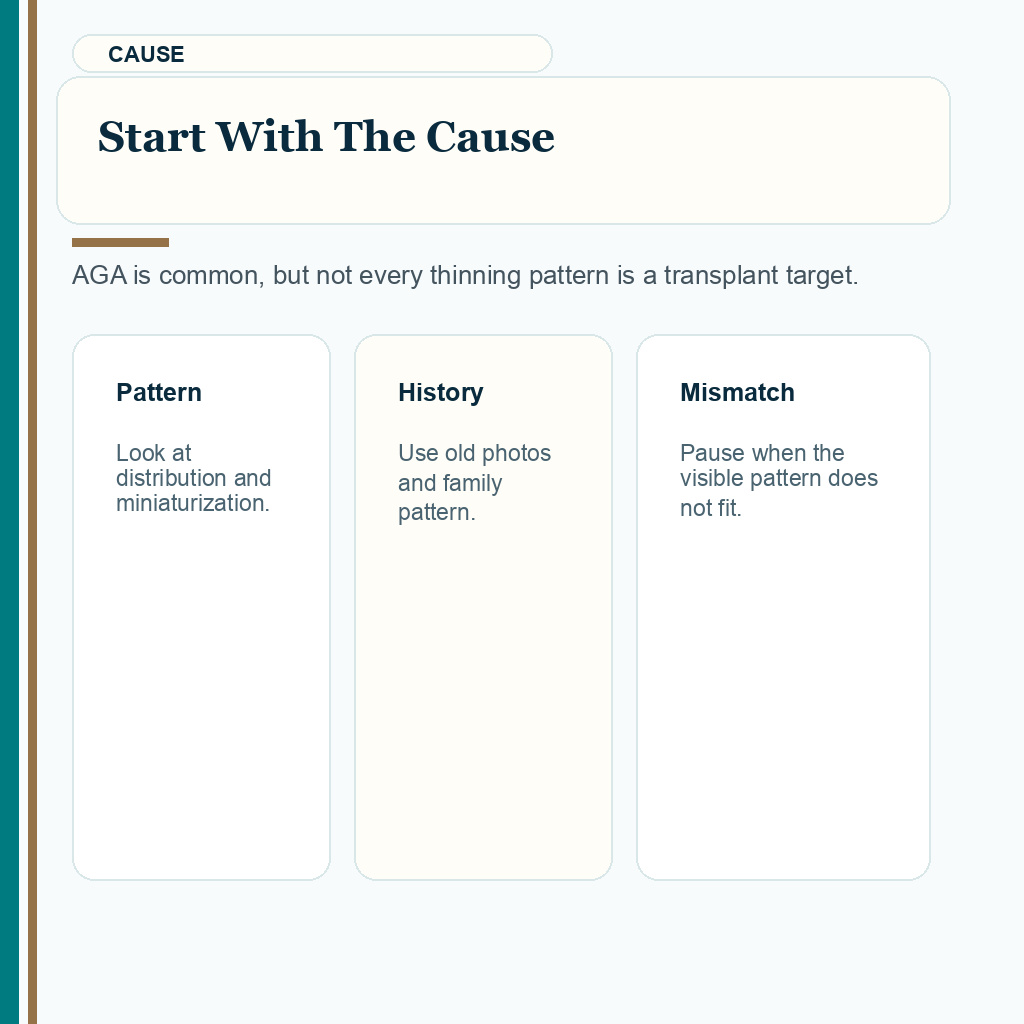
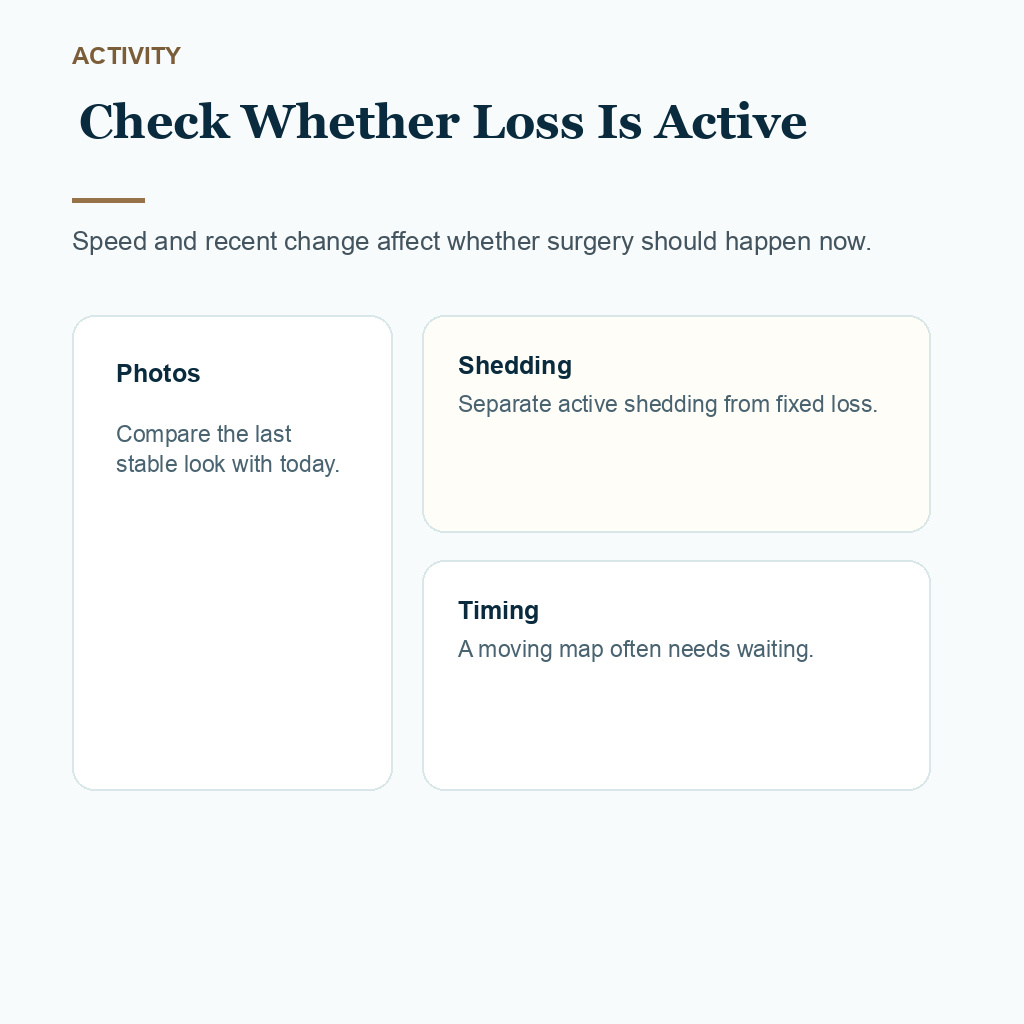

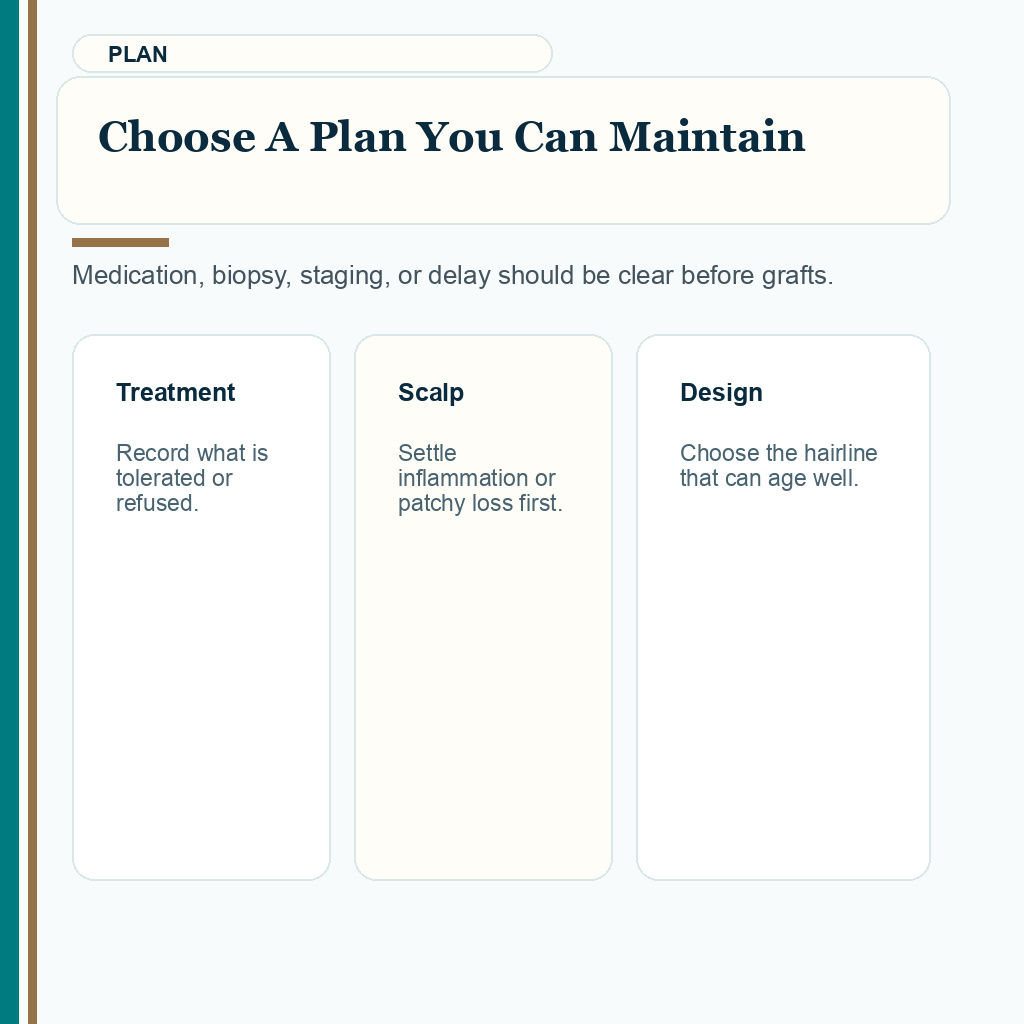
If those pieces do not support surgery yet, waiting is not wasted time. It is how we avoid moving grafts into the wrong problem.

Read this review excerpt
Every single one of my questions was answered and they made sure I had all the details I needed to make an informed decision.