


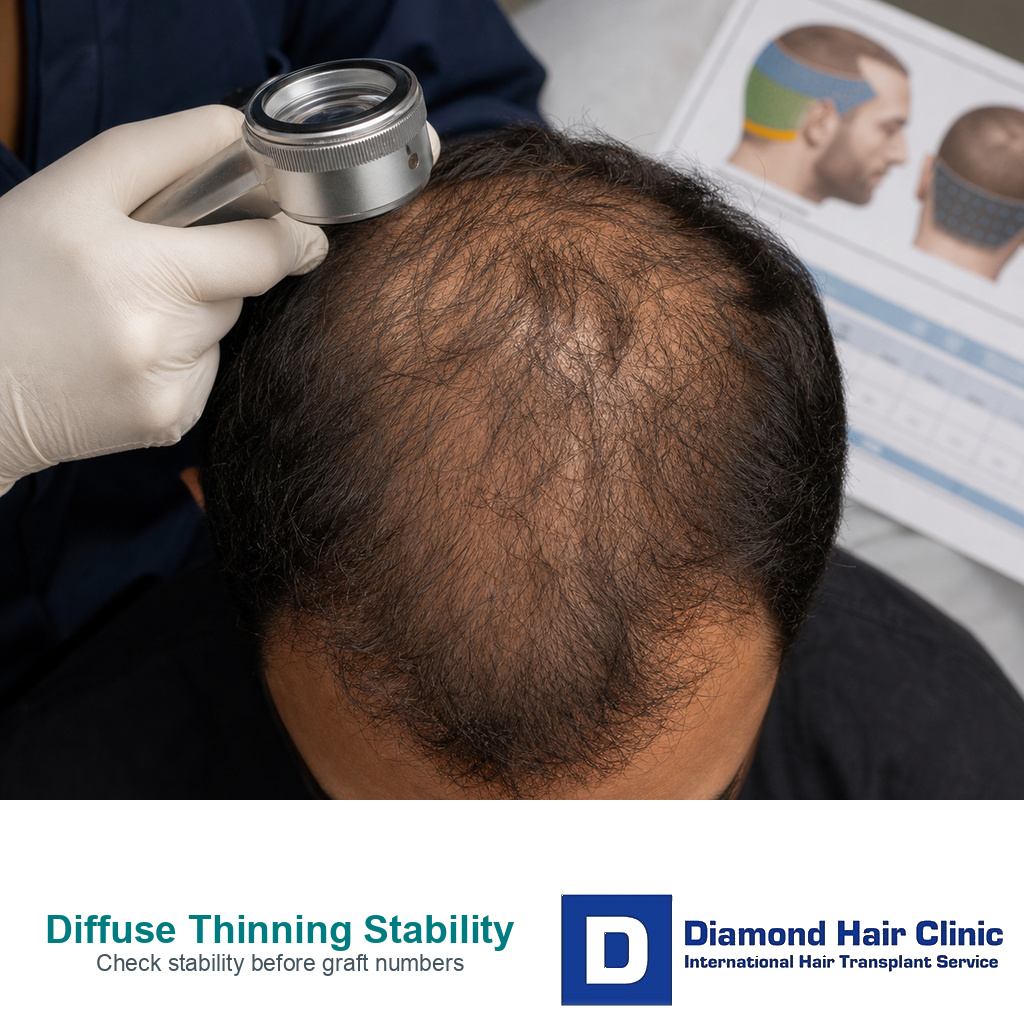
Diffuse Thinning Before FUE Needs a Stability Check
If your thinning is diffuse, FUE should not start with a graft number. It should start with a stability check. I want to see older photos, the shedding timeline, treatment history, donor area quality, and whether the first target is narrow enough to improve without spending too much donor hair. Diffuse thinning can still be suitable for FUE in selected cases, but only when the surrounding native hair and the donor area give us something reliable to plan around. A young patient who has already tried medication but still has diffuse thinning needs a combined stability, donor, and recovery plan instead of a graft number alone.
Diagnosis sits above the FUE plan
I place diffuse thinning inside a broader hair loss diagnosis before hair transplant pathway before graft numbers are discussed. The top, donor area, shedding timeline, medication history, and scalp signs need to point in the same direction before graft numbers matter.
Weak native hair that is still changing can make surgery spend donor grafts inside a pattern that is still moving. The transplanted grafts may grow, but the result can still look thinner than expected if the hairs around them continue to fade. A good plan may still include FUE, but it should be built around native hair stability, donor reserve, and a realistic first target, not around the biggest graft number someone can write on a quote.
Stability comes before the graft number
Many diffuse thinners arrive with a graft range already in their mind. One clinic may say 2,500 grafts, another may say 4,500, and the patient naturally asks which number is correct. That is the wrong starting point. I first need to know whether the existing hair has a pattern we can safely work around.
A high graft quote should not replace a miniaturization check. With diffuse thinning, the plan has to show which hairs are still reliable and which weak native hairs may disappear around the transplanted grafts. The whole operation should not be chosen by the spot that looks thinnest before the donor and native hair are checked.
In a diffuse thinning quote, I separate the graft plan from the native hairs still at risk. The design has to make sense even as those hairs continue to miniaturize, otherwise the transplant may look balanced only while fragile native density is still present. That map of weak native hairs can later explain a gap between transplanted and native hair, so graft numbers should not lead the conversation.
The number is not reliable until magnification shows the thinning map. In diffuse loss, photos can make the top look even, while miniaturized native hair changes the surgical plan.
Diffuse thinning behaves differently from a clean bald area. In a clean bald area, the target is easier to see. With diffuse thinning, there are still native hairs inside the zone we may want to improve. Some of those hairs may be strong. Some may be miniaturized. Some may be in a temporary shedding phase. If we place grafts without understanding that difference, the operation can look impressive on paper and still be poorly timed.
I separate diffuse thinning from broad active hair loss before surgery. Active loss asks whether the pattern is moving. With diffuse thinning, I also ask whether we are about to place grafts between weak native hairs that may continue to disappear.
I also separate diffuse thinning on the top from diffuse thinning that reaches the donor area, nape, or sides. A patient may have hair that looks thin on top but still have a stable donor zone. That can sometimes be planned carefully. If the donor has the same miniaturized texture, or if the pattern looks diffuse and unpatterned rather than limited to the top, FUE may need to pause because the hair we would move may not be reliable over time.
FUE is harder when native hairs are still in the target
FUE does more than fill empty space. The grafts are placed into a living scalp where native hair, blood supply, donor limits, and future loss all matter. With diffuse thinning, I have to decide whether the visual problem is a true empty area, a low-density area that can accept careful reinforcement, or a moving field where surgery may be premature.
Diffuse thinning makes repair more selective. I choose the zone where limited grafts create the most natural connection while leaving enough donor reserve for later loss, instead of filling every thin area at once.
The danger is not only future hair loss. The more specific danger is poor net cosmetic gain. The grafts may grow, but the surrounding native hairs may continue weakening, so the patient sees less improvement than expected. The transplant may not have failed in the simple sense, but the timing or target may have been wrong.
I talk about native hair shock loss after FUE before surgery, not only after it happens. Shock loss can be temporary, but weak miniaturized hairs have less reserve. If the native hair is already fragile, the plan should be conservative enough that the patient is not depending on unstable hairs to complete the final look.
The stability check before I say yes to FUE
A stability check is not a single photo. It is a pattern review. I compare the patient’s current hair to older photos, ask when shedding changed, review medication timing, examine the donor area, and decide whether the target zone is clear enough for surgery. Useful evidence includes photos taken in the same light over time, the date shedding changed, any medication start or stop, dose changes, side effects, and whether the donor looks stable under close examination. When older comparisons point to a pattern that is still changing, waiting can be safer than adding grafts too soon.
For diffuse thinning, the strongest photo set is not the most dramatic one. It is the set that shows whether the top, sides, donor, and medication timeline are moving together or separately.
Escalating or changing medication does not replace the stability check. If the top is diffusely thin, I still need diagnosis, older photos, donor quality, shedding history, and response over time before I can say whether grafts are safe. A stronger medicine may belong in a medical discussion, but it does not make an unstable surgical pattern stable by itself. Diffuse thinning needs a stability check before grafts are placed between existing hairs. Diagnosis, miniaturization, medication response, and donor safety decide whether surgery helps or simply adds risk.
Diffuse thinning is not one diagnosis. Slow patterned miniaturization is different from sudden shedding after illness, crash dieting, childbirth, thyroid or iron problems, a medication change, scalp inflammation, itching, scaling, or scarring. In those cases, the first decision may be diagnosis and stabilization, not graft planning. This is especially important in female diffuse thinning, where the diagnosis and donor reserve may be less obvious from photos. For that reason, the androgenetic alopecia before FUE label should never be used as a shortcut when the thinning pattern is diffuse or still changing.
The donor area is especially important. Diffuse thinning on the top is one issue. Diffuse or miniaturized hair inside the donor area is another. If the donor zone is not stable, the surgery can create two problems at once. There may be fewer reliable grafts for today and less reserve for tomorrow. The planning logic is close to the one I use when assessing donor miniaturization before hair transplant.
I use this kind of pattern check to keep the decision grounded before a diffuse thinner asks whether FUE should happen now.
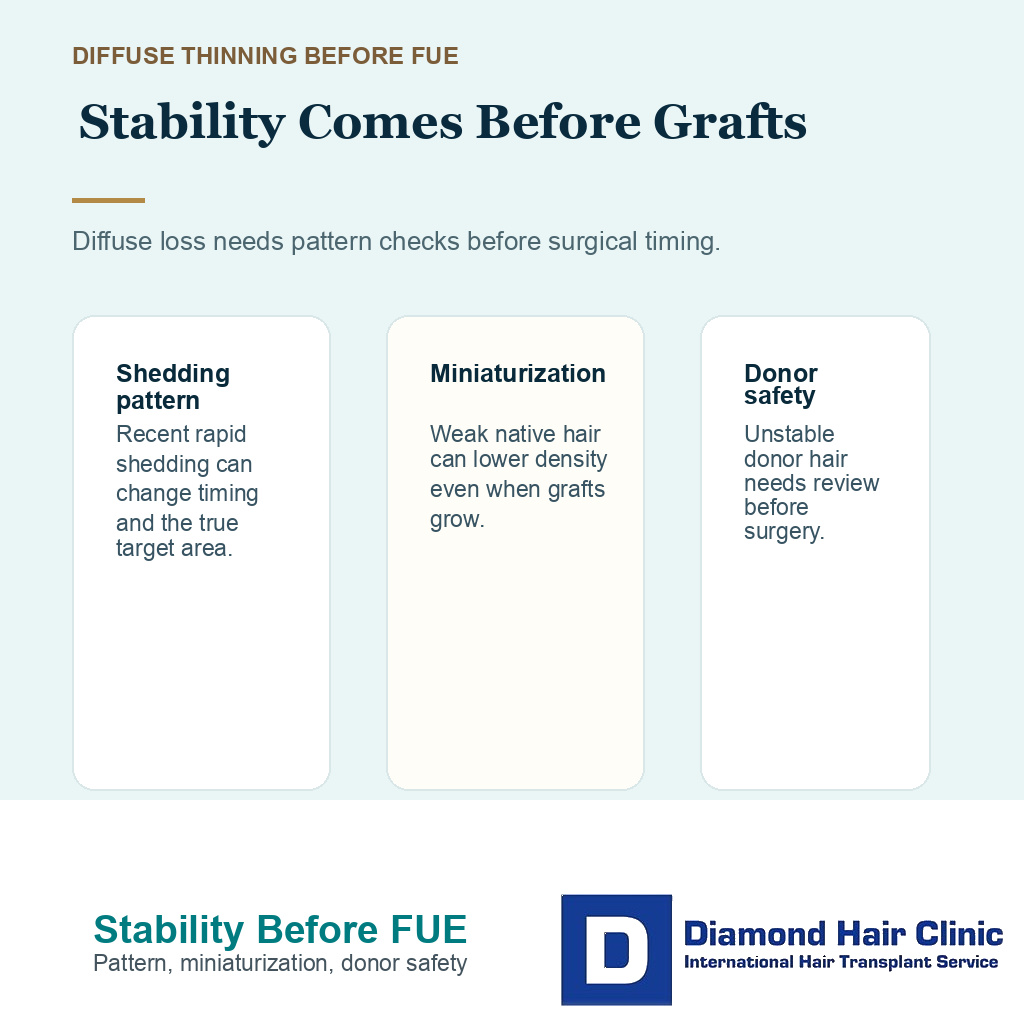
Four timing signals I look for
These signals are not a diagnosis. They are the points that decide whether I can safely plan FUE now or whether the patient needs more evidence first.
Moving loss
Recent photos or shedding still show movement.
Do not lock a surgery date yet.
New treatment
Medication was started, stopped, or changed recently.
Wait for response and tolerance.
Donor unclear
The safe donor zone needs closer review.
Protect the donor before quoting grafts.
Stable target
The donor is reliable and the first target is narrow.
Consider a conservative first plan.
Pause the date
If older photos show clear movement, I do not want surgery chasing last month’s pattern. A delay gives us a cleaner comparison and prevents a plan that is already outdated by the day of surgery.
- Compare older photos.
- Check shedding timing.
- Keep the first goal conservative.
The compass is only a first filter. It does not replace trichoscopy, donor measurement, or a close examination. Before I discuss a graft number with a diffuse thinner, I want the evidence that shows whether the pattern is stable enough to plan.
Bring evidence before asking for grafts
The strongest consultation is not the one with the best parting photo. It is the one with a clear timeline. A patient who has been stable for years on treatment should still bring the details that let me test that stability.
- Dated photos taken in the same room, same light, and similar hair length.
- A medication timeline with start dates, dose changes, stopped treatments, side effects, and shedding changes.
- A close donor review, including the back, sides, nape, and any area that looks thinner than the rest.
- Any trichoscopy notes, pull test result, blood test, or dermatology opinion if shedding was sudden or the diagnosis is not settled.
- A first priority zone for surgery, not a request to thicken every thin area at once.
If the history sounds more like telogen effluvium, alopecia areata, or retrograde alopecia or DUPA, I treat the transplant question as secondary. The diagnosis and donor stability have to become clear before grafts are counted.
Medication history changes the surgical demand
Medication is not a moral test and it is not suitable for every patient. In diffuse thinning, though, treatment history matters because the native hair is part of the visual result. If a patient has just started finasteride, dutasteride, minoxidil, or another medical plan, the hair may not have shown its real response yet. When the response is strong, it usually means weak native hairs became more useful. It does not mean new follicles appeared in a bare area.
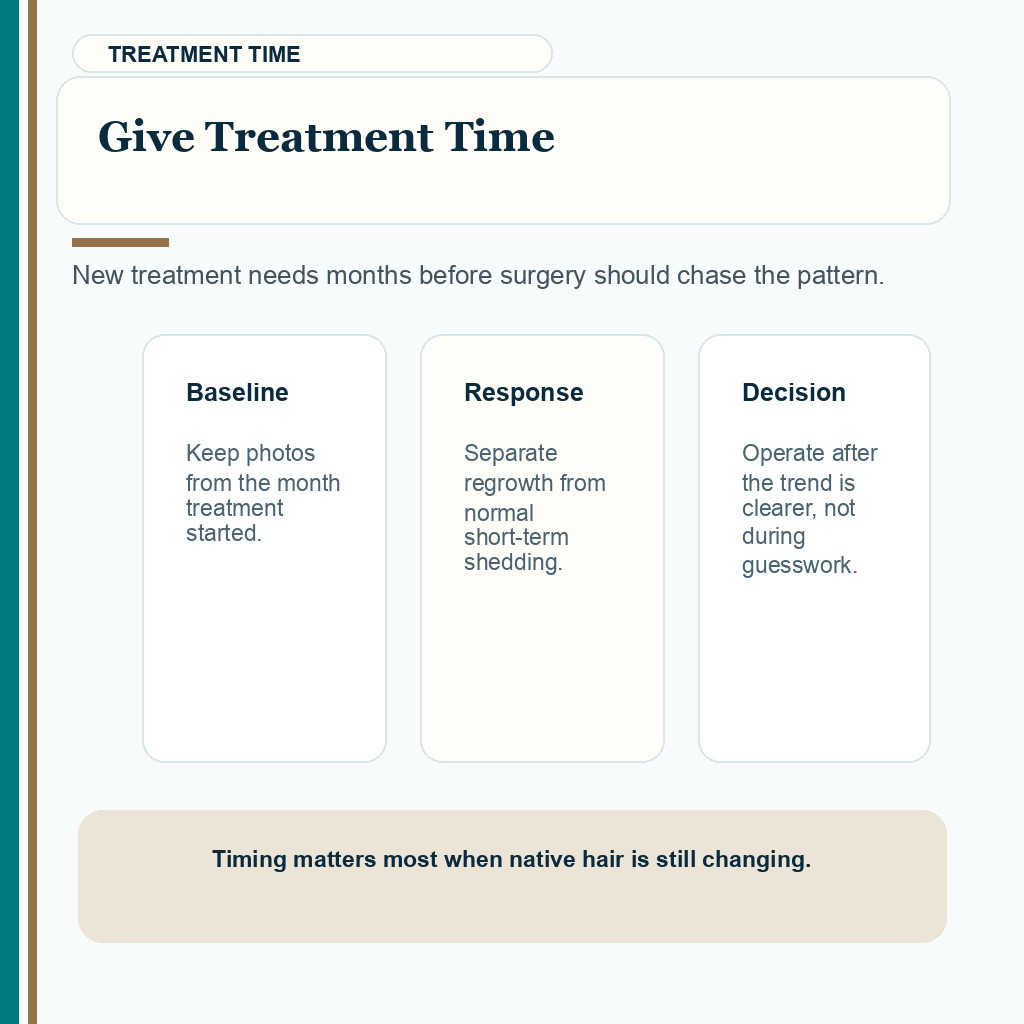
If dutasteride or oral minoxidil has only just been started, I do not treat the first few months as a stable surgical baseline. I want the medication timeline, shedding pattern, tolerance, scalp symptoms, and repeat photos to settle enough that I can see what the transplant would actually need. That review can make surgery smaller, delay it, or show that medical treatment remains the safer first plan.
I often connect the surgery decision to medication before hair transplant. I am not trying to force every patient into the same treatment. I am trying to avoid operating while the baseline is still being rewritten. If treatment improves diffuse density, the first surgery may become smaller or the target may change. That is different from asking medication to rebuild a sharply receded hairline, where the issue may be lost outline rather than low density.
Weeks are usually too early to judge a new treatment plan. Often I want several months of observation, and in unstable diffuse cases the window may be closer to 6 to 12 months before I recalculate surgical demand. The exact timing depends on the diagnosis, age, donor quality, medication tolerance, and how fast the pattern was changing before treatment.
Several years of stable hair on finasteride, dutasteride, minoxidil, or a similar plan matters, especially when dated photos under similar lighting support the timeline. But treatment stability is still not surgical clearance by itself. I still need to map donor miniaturization, including the sides and nape, and decide whether the donor hair is reliable enough to spend.
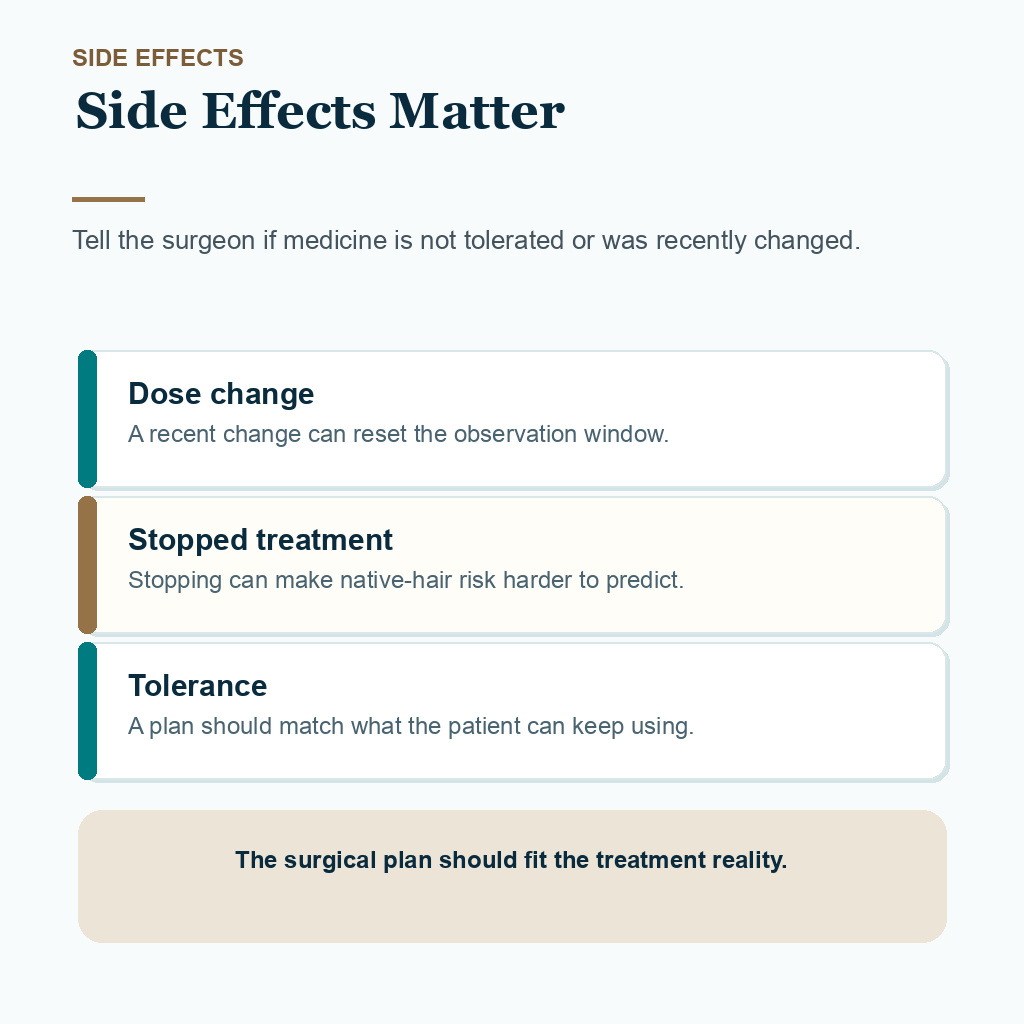
The recipient plan also has to stay realistic. If the thinning area still contains weak native hair, I plan around the risk that those hairs may not tolerate surgery well. The target should be a clear priority zone, such as a hairline or selected density area, not a promise to thicken every thin part of the scalp. A switch from finasteride to dutasteride, a lower minoxidil schedule, a stopped treatment, or symptoms after oral minoxidil can also change how I read the case. When the timeline, photos, donor exam, and patient goal do not point in the same direction, I slow the plan down before spending grafts.
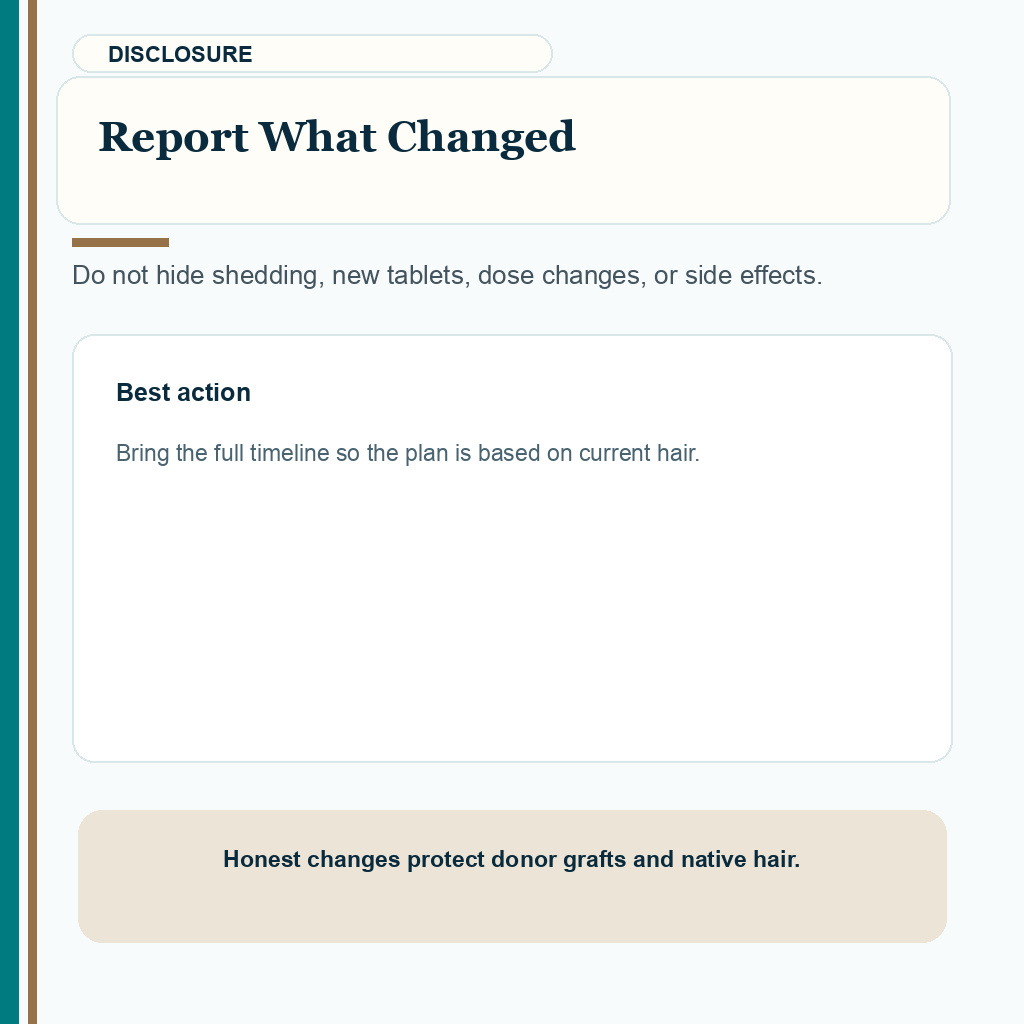
I also ask the patient to be direct about what has changed. Do not hide side effects. Do not hide that treatment was stopped. Do not say the hair has been stable for a year if the dose changed last month. I cannot protect the donor area using a timeline that is not true.
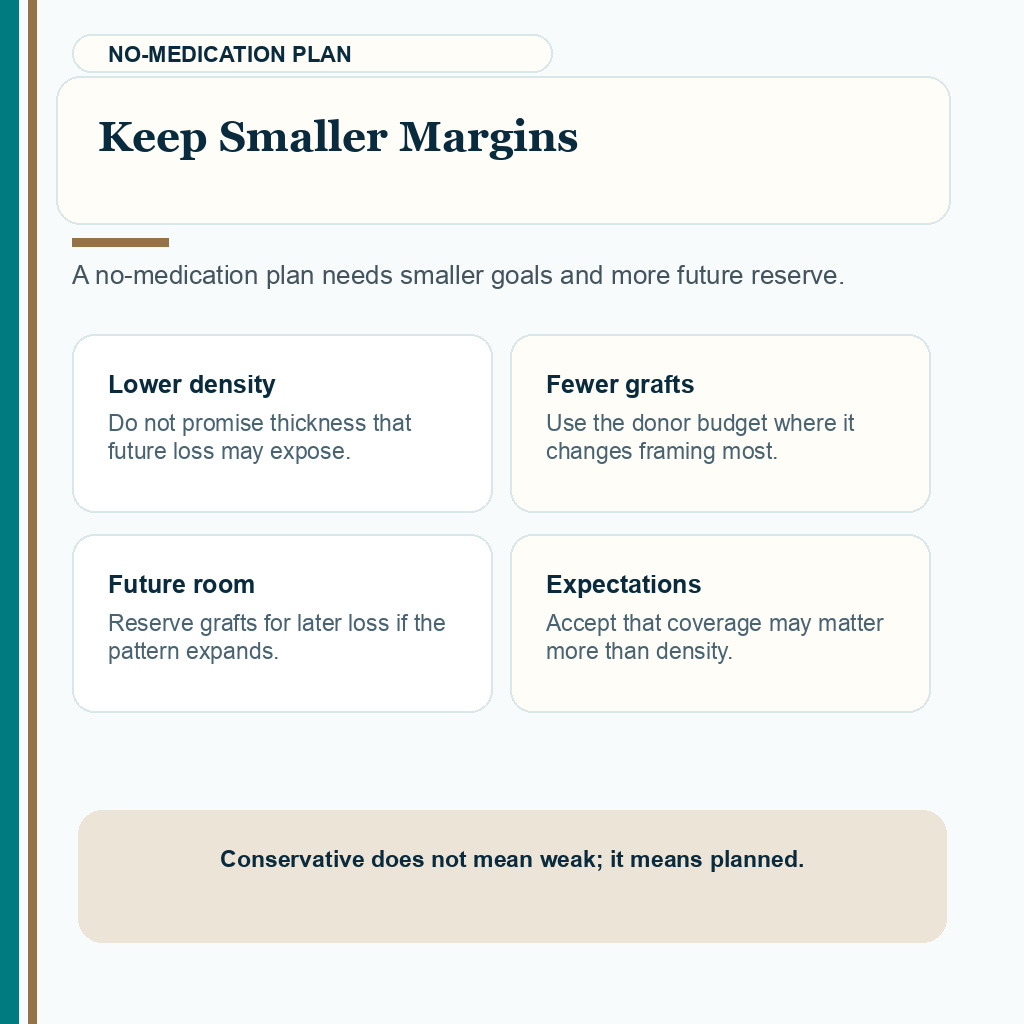
If medication is not part of a diffuse thinning plan, the target area has to be even narrower. I need enough stable native hair around the graft zone, because placing grafts into a moving field can produce less visible improvement than the graft count suggests.
What if the whole top is starting to show scalp?
Visible scalp from the hairline through the mid scalp toward the crown creates a broader stability question, not a Norwood 7 verdict from one photo. The sides may still look thick, and that is useful information, but it does not prove the donor zone is safe. I still need close donor inspection, miniaturization mapping, old photos, family pattern, hair caliber, and the speed of change before I decide whether FUE is sensible.
Fast thinning over one or two years also changes the timing. If the top is still moving quickly, the first decision may be diagnosis, treatment discussion, and observation rather than filling the front, mid scalp, and crown in one operation. FUE can improve selected zones, but it cannot stop native hairs around the grafts from continuing to miniaturize.
If a patient cannot use medication or does not want it, I do not treat that as a moral failure. I treat it as a planning limit. The design usually has to become more conservative, with a mature hairline, a narrower first target, more donor reserve, and no promise of full coverage from the hairline to the crown. For a patient who may be moving toward an advanced pattern, advanced Norwood 6 or 7 planning becomes part of the same donor conversation before grafts are spent too aggressively.
Large graft quotes do not solve a moving pattern
A high graft quote can feel reassuring because it sounds decisive. In diffuse thinning, it can also be a warning that the plan is trying to solve too much in one operation. More grafts may create more visual change, but they also spend more of the donor supply and leave less room if the pattern expands.
For diffuse thinning, the idea of lifetime hair transplant grafts becomes practical. The donor area is not an unlimited bank. It is a finite resource that must serve the patient now and later. The right number for the first surgery is not the number that fills every weak area. It is the number that improves the priority area while keeping a plan for future hair loss.
Graft numbers depend on surface area, hair caliber, donor density, existing native hair, and the visual job the grafts must perform. A number that looks reasonable for a clean empty frontal zone may be too aggressive in a diffuse case if the surrounding native hairs are weak. The same patient may need a smaller first target, more donor reserve, or no surgery until the pattern is clearer. That is the same calculation behind how surgeons calculate graft number for hair transplant.
Delay FUE when the evidence is still moving
Waiting is sometimes the responsible answer. I delay when the patient is still shedding aggressively, when medication has just started, when donor miniaturization is unclear, when another doctor has rejected the case for a specific donor reason, or when the requested hairline would consume too many grafts too early.
I also delay when the patient is treating FUE as a way to escape uncertainty immediately. Surgery can improve framing and density, but it cannot make progressive hair loss stop. If the plan ignores that, the patient may need another operation sooner than expected, or may feel that the first result never had enough support from the native hair around it.
A responsible no is not a rejection of the patient. It may mean the donor reserve is too valuable to spend before the diagnosis, medication response, or long-term pattern is clear. The better plan may be medical stabilization, monitoring, a narrower future target, or no surgery if the donor is unsafe.
Unclear details make a proper second opinion before hair transplant useful, not a delay tactic. It is a way to test whether the quote, donor assessment, hairline, and timing still make sense when the case is reviewed calmly.
A smaller first operation can protect healing
For some diffuse thinners, the best first operation is deliberately smaller than the patient expected. That is not undertreating the patient. The first operation has a precise job. It should improve the area that gives the strongest visual return while preserving donor reserve and avoiding unnecessary trauma around fragile native hairs.
A smaller first step may focus on frontal framing, a conservative mid scalp blend, or another priority zone. It may leave the crown alone. It may avoid lowering the hairline. It may use fewer grafts than a clinic that promises full coverage in one day. Those decisions can feel disappointing at first, but they often protect the long-term result.
I also discuss hair transplant without finasteride differently in diffuse thinning. If a patient cannot or does not want to use medication, the plan should not pretend the same safety margin exists. It may still be possible, but the target should be narrower, the density promise should be more conservative, and the donor reserve deserves more respect.
Decision points before choosing a surgeon
Patients often search for a surgeon who is comfortable with diffuse thinning. Experience matters, but the consultation has to make the risk visible. The useful answers protect donor hair and native hair instead of moving straight to hairline design.
- How was donor miniaturization checked at the back, sides, and nape?
- Which area is the first priority zone, and which area stays untreated for now?
- How will weak native hair and shock loss risk affect the native hair placement plan and density target?
- What donor reserve remains if the pattern widens later?
- What finding would make the surgeon wait or refuse surgery?
If the answers stay vague, I slow the decision down. A small temple or hairline touch can still be a poor decision when the donor, diagnosis, or native hair plan is not clear.
A graft quote cannot replace the stability check
Diffuse thinning before FUE is a planning problem, not a quick permission question. For diffuse top thinning, the map has to show whether grafts are being placed between stable hairs or into a pattern that is still moving. At the end of the consultation, the decision should be clear. We either proceed conservatively, wait and monitor, treat medically first, or avoid surgery because the donor or native hair stability is not safe enough.
FUE can be considered when the answers are strong and the plan is conservative. Medication history helps when it shows what improved, what stayed thin, and whether the donor also looks stable. The result should still make sense as the patient’s own hair changes. Because hair loss can continue after hair transplant, the plan has to leave room for native hair biology instead of spending every possible graft today.
Do not let a surgery date, a discount, or a large graft quote replace the stability check. If diffuse thinning is still moving, the most protective operation may be the one we do later, smaller, or not at all until the evidence is clearer.
Read this review excerpt
We also had a levelled conversation about my hairline and results I could expect based on my donor density area.