


The first session should prioritize visible framing
In most advanced baldness cases, the first priority is the frontal frame. The front affects conversation distance, photographs, and the way the face is perceived. A mature frontal improvement can change the appearance more than spreading the same grafts thinly over the whole scalp.
The first session may also support the frontal mid scalp if the donor allows. What I try to avoid is giving every zone a little hair and leaving no zone strong enough to satisfy the patient.
This is the same planning logic behind deciding whether to treat the hairline or crown first. The crown matters, but in advanced baldness it can spend many grafts quickly while still looking light under overhead light.
Different clinics quote different graft numbers for different reasons
Different quotes often mean different objectives. One clinic may be planning the front only. Another may be spreading grafts from front to crown. Another may be using a high number as sales language before defining the visual target.
A 2,500 graft plan and a 5,000 graft plan may describe different operations. Compare the priority area, expected density, crown decision, donor appearance after surgery, and reserve saved for the future before treating the larger number as stronger.
Before accepting any number, I want the graft estimate tied to area and density. A number without a map can mislead the patient, which is why how I determine required graft number starts with the treated area rather than the sales figure.
A big graft number becomes risky when donor protection is ignored
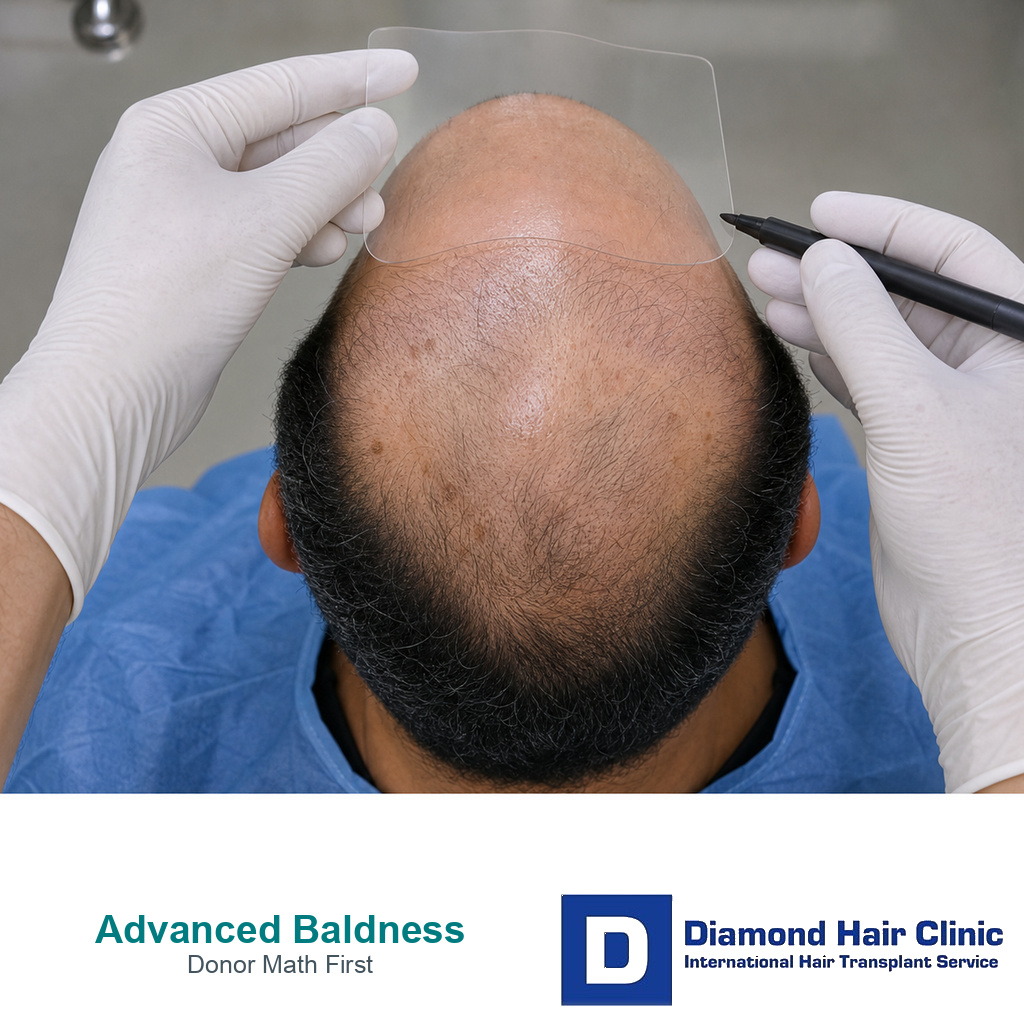
A big graft number becomes risky when it is not supported by donor measurements, recipient area size, graft survival conditions, and a future plan. The danger is not only that the top may still look thin. The deeper risk is that the donor area may be overused before the patient understands what has been spent.
Donor supply is a lifetime budget, not a bank account that refills. If extraction is too aggressive, the back and sides can look thin, patchy, or overharvested. At the same time, the top may still need more coverage.
The warning is especially important when patients are told that more grafts automatically mean a better result. In advanced baldness, too many grafts in one plan can still create weak coverage if they are spread across too much scalp or removed from a donor area that should have been protected.
Norwood 6 or 7 can still look natural with realistic goals
Yes, selected Norwood 6 or 7 patients can still achieve a natural looking improvement. The key word is improvement. It may not mean full teenage density or full crown coverage.
A natural result in advanced baldness often means a mature hairline, good direction, careful graft distribution, and a density pattern that looks intentional rather than thin everywhere. That is the standard I use when deciding whether a Norwood 6 or 7 hair transplant can look natural.
Naturalness also depends on what is not done. A very low hairline, a dense front with no donor left for the mid scalp, or an aggressive crown plan can make the first photo exciting and the long term result weaker.
Crown coverage is not always the first session priority
Sometimes, but not always. The crown can matter emotionally, especially for men who dislike overhead photos or thinning at the back. The crown is round, the hair changes direction, and overhead light exposes scalp easily. It can consume many grafts for a modest visual return.
If donor reserve is strong and the frontal plan is already protected, some crown work may be reasonable. If donor reserve is limited, trying to cover the crown too early can weaken the whole plan.
Front first is often donor discipline, not neglect of the crown. Good crown hair transplant planning explains how much donor hair the crown can safely receive and what density is realistic.
Beard or body hair may help selected advanced cases
Beard or body hair can help in selected advanced cases, especially when scalp donor alone is not enough. They are support tools, not a way to ignore scalp donor limits.
Beard hair often has a different texture and caliber from scalp hair. Chest or body hair can behave differently again. These grafts need careful placement. They may support density in selected zones, but they should not be sold as a simple replacement for a weak scalp donor.
Beard and chest hair as donor sources belong in the discussion only after the scalp donor, coverage goal, texture match, and long term plan are clear.
Good candidates for a large first session
A good candidate for a larger first session has a strong enough donor area, realistic expectations, stable or understandable hair loss, healthy scalp, and a plan that does not depend on using every possible graft immediately.
Age, family pattern, hair caliber, skin and hair contrast, crown size, medication history, and whether the patient understands staged planning all matter. If a patient expects full density everywhere from one session, the expectation may be the unsafe part of the case.
When more than one consultation says surgery is not suitable, searching only for a yes is the wrong direction. The real issue may be weak donor supply, a bald area too large for the reserve, unstable loss, unrealistic density expectations, or too little visual gain for too much donor use.
Before surgery, the question of what makes someone a good candidate for a hair transplant matters more than the largest number a clinic is willing to quote.
What I need to prove before saying yes to one large session?
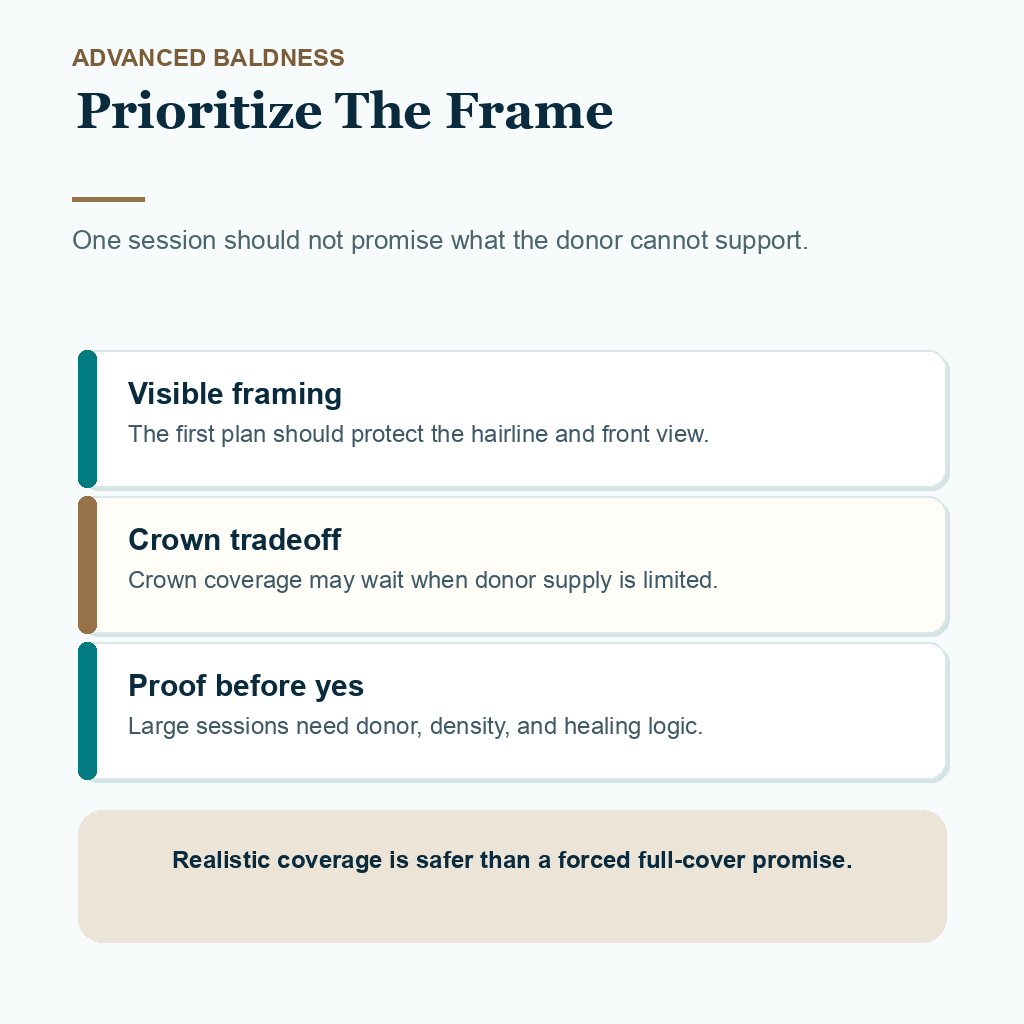
Before I accept a large advanced baldness plan, I want the case to answer specific clinical questions. Is the safe donor zone wide enough? Is hair caliber strong enough? Can the front be built without stealing from a future crown or repair need? Does the patient accept that some areas may stay lighter?
I also decide what I will not promise. I will not promise dense coverage everywhere when the bald surface is too large, count beard or chest hair as identical to scalp hair, or use a high number to hide a weak donor review. A patient comparing Norwood 6 or 7 planning or beard and chest hair as donor sources needs this boundary before travel, not after the head is shaved.
If old scars, previous strip surgery, or donor depletion are part of the history, the plan becomes even narrower. FUE after FUT and repair cases need their own donor map because one more operation can make the back of the scalp harder to live with.
Clear points before agreeing to a large session
Before agreeing to a large session, you should know the first priority zone, the planned graft number, the expected density, what will be left untreated, and how the donor will be protected. You should also know who is medically responsible for the design and the recipient area incisions.
If the answer is vague, the risk is higher. A large operation needs more surgical ownership, not less. In advanced baldness, I want the patient to know who will design the case and make the incisions because there is less room for careless planning.
Clear ownership protects the patient. A large first session only makes sense when it creates meaningful improvement without spending tomorrow’s options for today’s excitement. In advanced baldness, the responsible answer is often a mature and sustainable improvement, not a number that sounds heroic.

Read this review excerpt
Every single one of my questions was answered and they made sure I had all the details I needed to make an informed decision.