


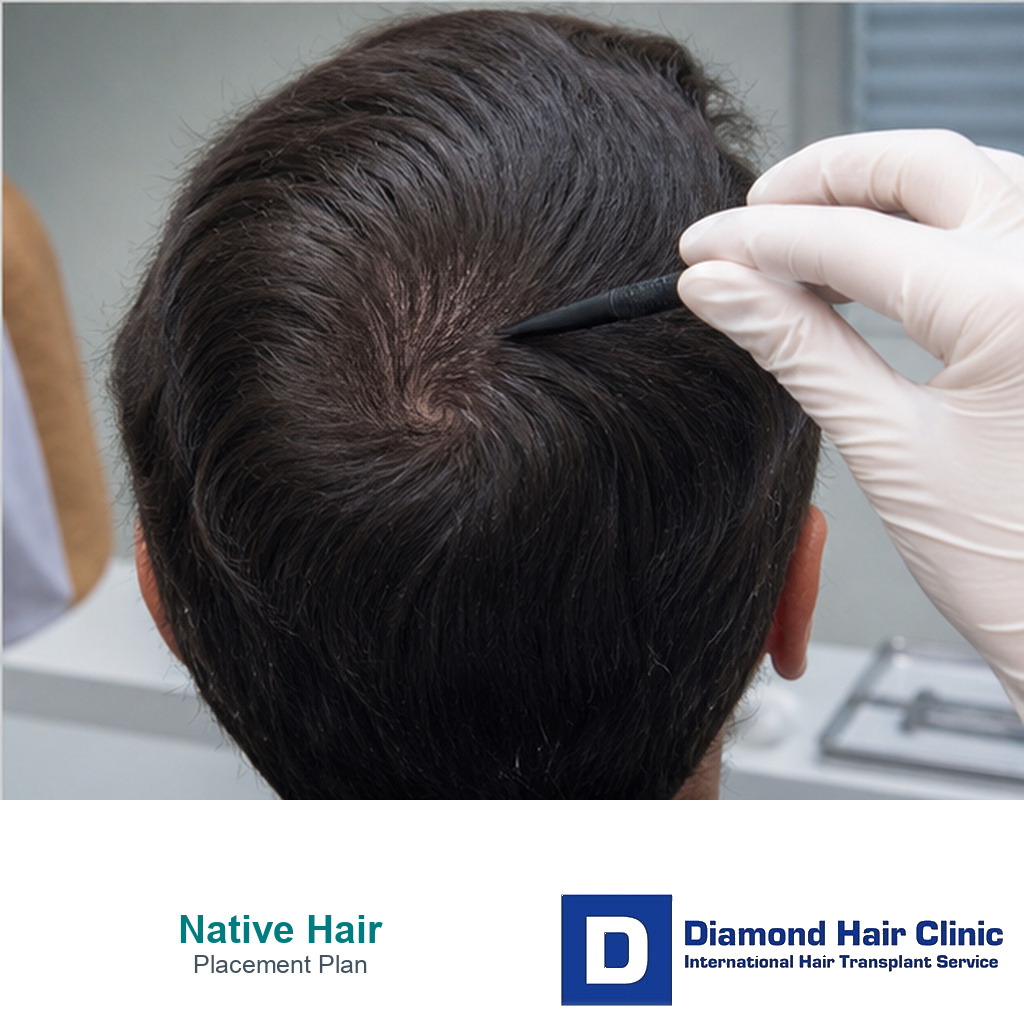
Can Hair Be Transplanted Between Existing Hairs?
Yes, hair can sometimes be transplanted between existing hairs, but only when the native hair is stable enough, spaced well enough, and visible enough to work around safely. The question is not mainly whether a clinic offers FUE, FUT, Sapphire FUE, or DHI. The first question is whether surgery can add density without injuring the native hair the patient is trying to keep.
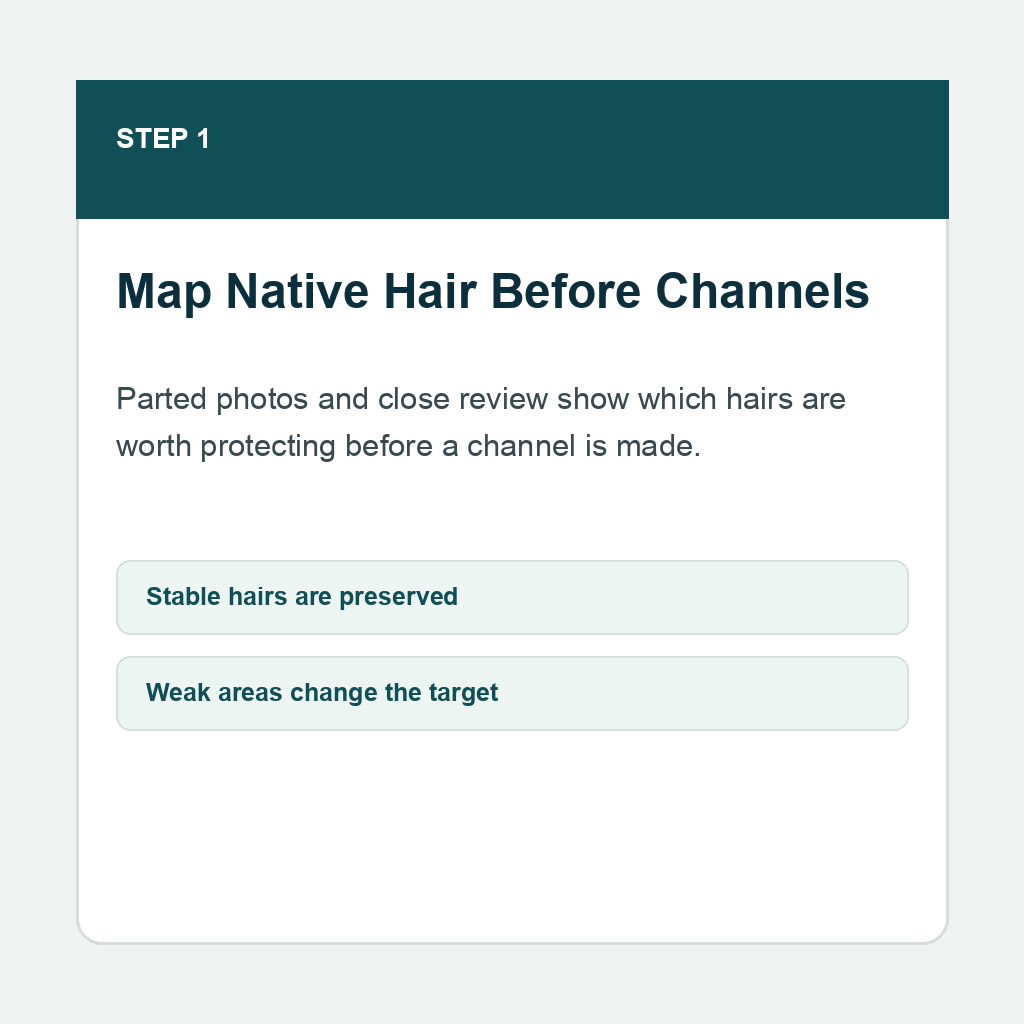
When I review this kind of case, I do not start with the tool name. I start with a native hair map. I want to know which hairs look stable, which hairs are miniaturizing, what may respond to treatment, where the donor reserve should be saved, and whether the existing hair can be parted clearly enough for safe recipient area planning.
A graft quote is still provisional if the native hair has not been mapped. I also want to know where not to place grafts, because protecting strong existing hair can matter as much as filling a visible gap. The plan should leave quiet spaces where stable native hairs need room, instead of treating every visible scalp line as empty space. If treatment has made an area fuller, I examine it again before placing grafts between the existing hairs. The original drawing may include spaces that no longer need grafts.
Ask the clinic to show the protected native hair zones as well as the graft zones. A plan that only marks where to add hair can miss the hairs that should be left undisturbed.
Before I quote this case, I want evidence that shows the pattern, not one flattering angle. Parted dry photos, wet photos or photos in harsh light when relevant, donor photos, old comparison photos, medication history, recent shedding changes, and previous clinic quotes all help me decide whether the native hair is a stable foundation or a warning sign.
First decide whether the native hair is strong enough to protect
Existing hair is not one category. Some hairs are thick, stable, and worth preserving. Some are miniaturized, weak, and already close to being lost. Some are only temporarily thin because of shedding, stress, inflammation, medication changes, or another trigger. These differences matter before a graft is placed.
If the visible hair is strong, I may be able to plan the recipient area between those hairs with careful angle, direction, spacing, and density control. If the visible hair is weak, there are three different problems to separate. Some shedding may be temporary shock loss, some risk comes from direct trauma to native follicles, and some thinning is simply the natural hair loss that may continue around transplanted grafts. For that reason, a native hair shock loss discussion should not start only after surgery. It should influence the plan before surgery. When two opinions disagree, I compare the native hair that must be protected, not only the graft count each clinic offers.
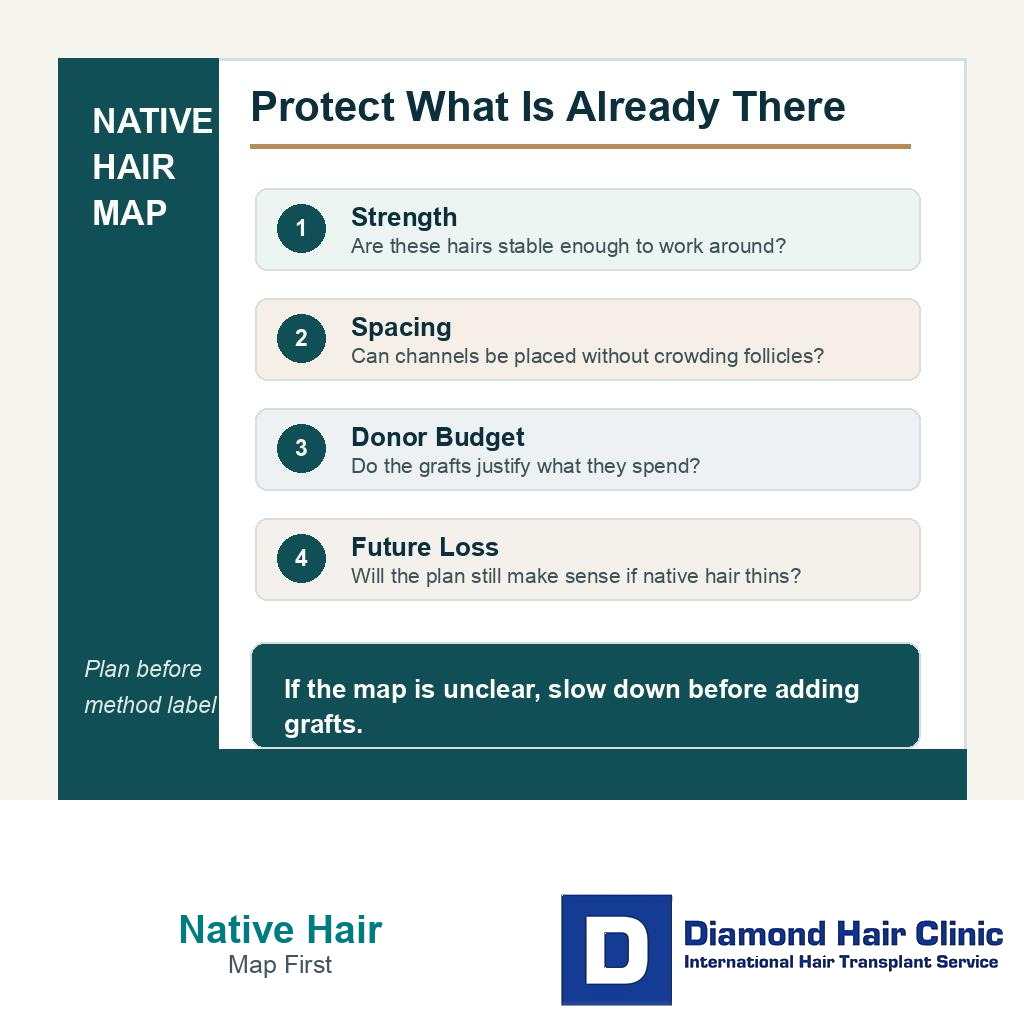
I also look at the donor area at the same time. A patient may ask for a dense pass between existing hairs, but the donor area may not justify that ambition. A careful FUE graft quote should stay provisional until donor strength and recipient conditions are measured together.
Diffuse thinning changes the placement plan
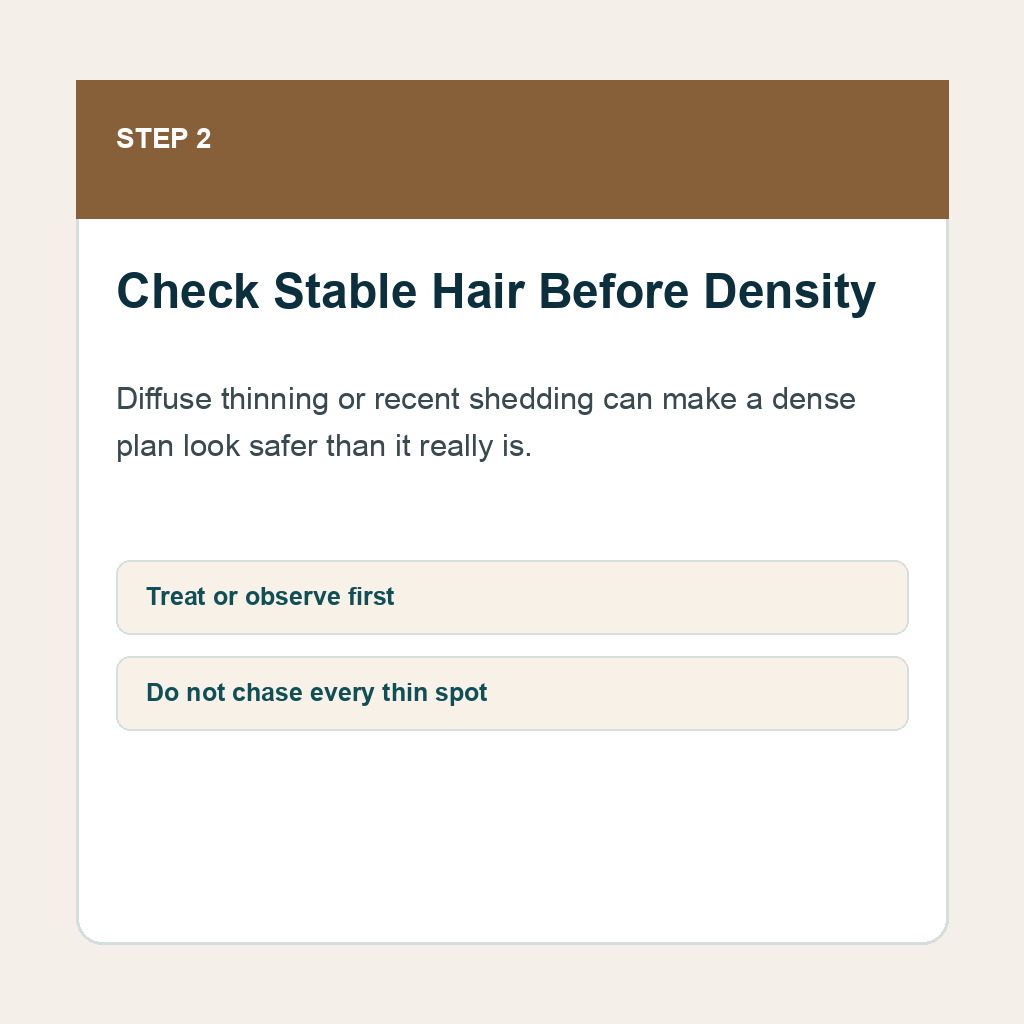
Diffuse thinning makes this decision more delicate because the recipient area is not empty. It contains hairs of different strength. The patient may see enough hair to feel hopeful, but the surgeon may see a pattern that is still moving. In that case, a transplant can add more resistant donor grafts into an unstable background and still leave a thin result later.
I separate diffuse thinning from a clean bald gap. In a clean bald gap, the target can be easier to define. In diffuse thinning, the target is mixed with native hairs that may need medical stabilization, observation, or a smaller surgical plan. A diffuse thinning stability check is often more important than the first graft number written in a quote.
A patient with diffuse thinning may still be a candidate. Another patient with a similar photo may need to wait. The difference is not decided by a forum result or a technique advertisement. It is decided by diagnosis, hair caliber, miniaturization, donor reserve, age, family pattern, medical history, and whether the goal is narrow enough to be safe. If there is sudden shedding, scalp inflammation, scarring signs, or a recent medication change, I want that checked before a graft number becomes the plan.
When medication is not part of the plan, transplanting between existing hairs needs even more restraint. The grafts may grow, but the native hairs around them can still miniaturize, so the design has to avoid creating isolated islands of density.
The tool choice does not replace the map
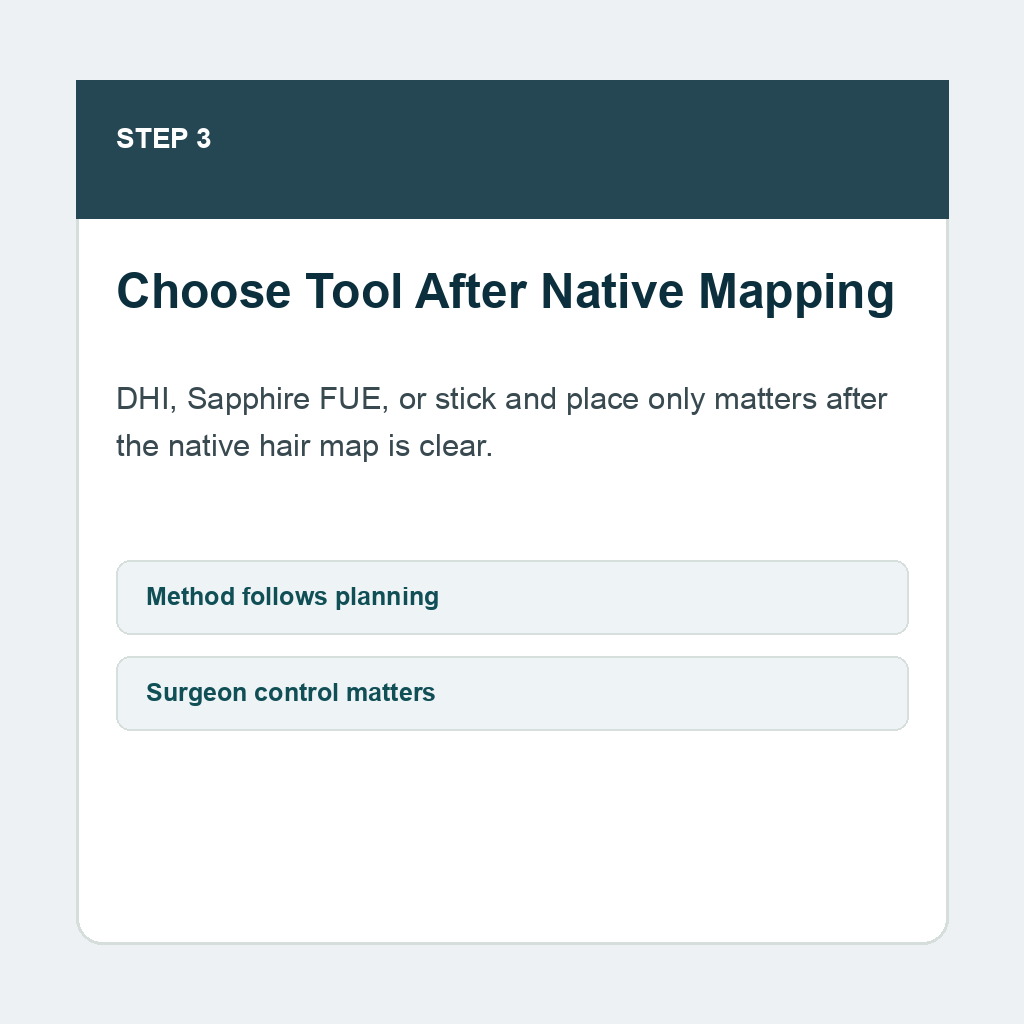
FUE and FUT describe how grafts are taken from the donor area. Sapphire FUE is still FUE, but the recipient area channels are usually made with sapphire blades instead of the steel blades used in Classic FUE channel opening. DHI usually still uses FUE extraction too, but the grafts are placed with an implanter pen in a different sequence.
Any of these routes can be useful in selected cases. The problem begins when the patient is asked to believe that one label automatically protects the existing hairs. It does not. The tool is only one part of the plan.
The broader DHI vs FUE decision still has to be tied to patient selection, donor management, graft handling, and design. In a native hair zone, I ask a narrower question. Can the recipient area be opened with enough visibility and control to reduce unnecessary trauma and still follow natural hair direction? If not, changing the label will not solve the problem.
The DHI hair transplant technique may help with certain placement goals, but it is not a promise of no shock loss or no native hair risk. The same is true for any implantation route. If existing hairs cannot be seen, parted, and followed safely, a promise to avoid shaving or a method label can become less important than visibility.
Density has to be added carefully
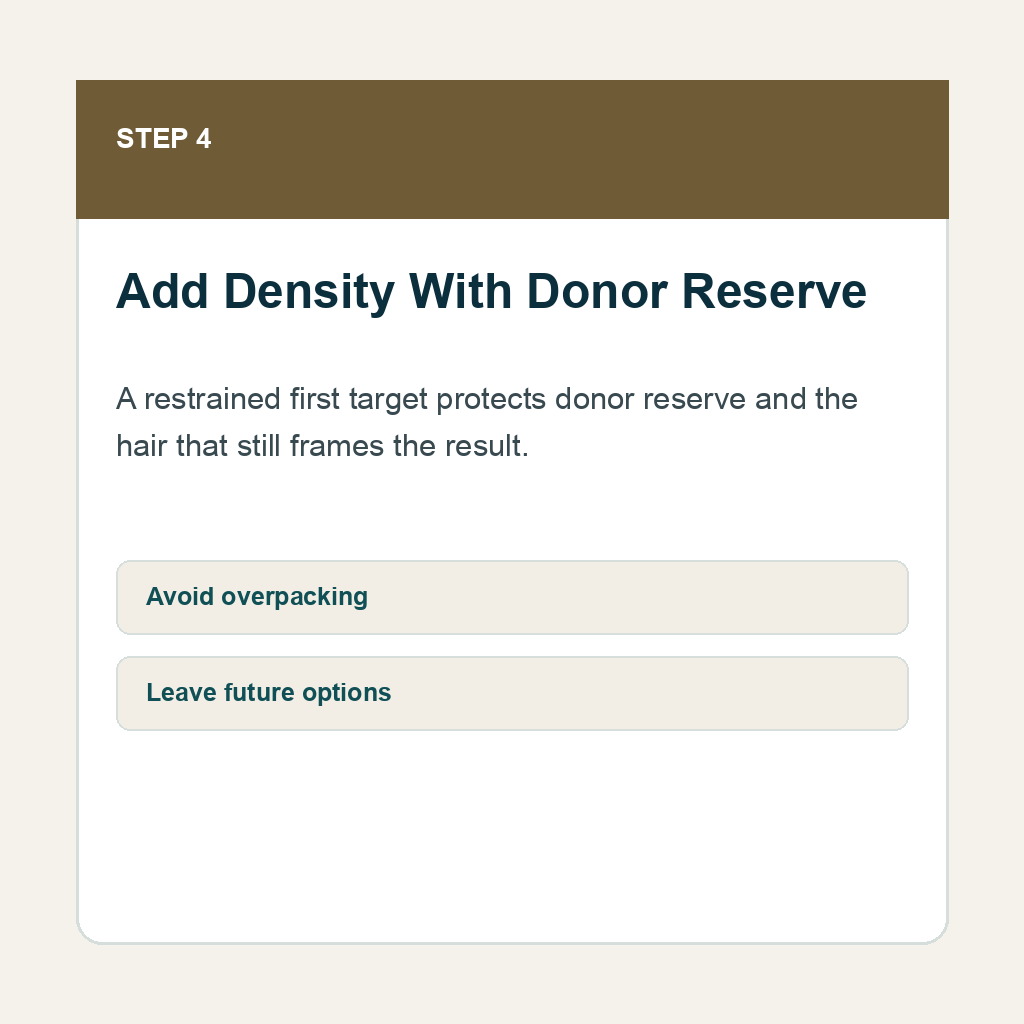
The patient usually wants density. I understand that. But density between existing hairs is not created by simply adding as many grafts as possible. Too much crowding can increase tissue trauma, make placement less precise, and spend donor hair on an area where the native hair may not last.
The target needs a reason. Sometimes that target is the frontal frame. Sometimes it is a visible part line. Sometimes it is a limited mid scalp transition. Sometimes I would not operate yet. The plan should not try to darken every thin area at once. A smaller first target can look less exciting on paper, but it often protects the result better over time.
This is especially important when a patient already has a gap between transplanted and native hair or is at risk of creating one later. If the native hair fades behind a dense transplanted zone, the result can start to look separated. That future problem is easier to prevent than to repair.
When should we slow down or wait?
I slow down when the hair loss is still moving, when recent photos are inconsistent, when the donor area looks weak, when medication has just been started or stopped, or when the patient wants a high-density quote before the diagnosis is clear. Waiting is not a punishment. It can be the step that protects the native hair and donor reserve.
I am also cautious when the plan is being sold as a method decision only. If the conversation is only about FUE, FUT, Sapphire FUE, or DHI, the missing part is the surgical map. Before choosing a method, I need to know which hairs we are protecting, which areas should be left alone, and what density is realistic without creating unnecessary injury.
The plan changes when the existing hairs are stable, moving, crowded, or weak. Choose the signal that matches the case before trusting a method label.
Native strength
Send clear parted photos and treatment history before accepting a graft count.
Strong native hair can sometimes be worked around, but spacing and direction still decide the surgical route.
The method should follow the native hair map. If the map is not clear, slow down before choosing a technique.
There is another reason to wait. Some patients with native hair still have room for medical treatment to protect what they have. That discussion is individual, and it should be handled by a doctor who understands the patient’s history. I look at options such as finasteride before and after hair transplant, and I also plan carefully when a patient is considering a hair transplant without finasteride, because native hair support cannot be treated as an afterthought.
How does the plan protect the hair you still have?
By the time I plan surgery, I want the evidence to point in the same direction. If the photos, donor view, medication history, recent shedding story, and native hair strength do not match, I slow down before turning the case into a graft number.
During planning, I look for the area where grafts create the most useful change with the least long-term cost. If native hair is strong, the surgical plan may add density around it with careful spacing. If native hair is weak, the native hair plan may be treatment first, a smaller target, staged surgery, or no surgery. In diffuse thinning, a diffuse thinning hair transplant decision is a candidacy question, not only a technique question.
Donor safety stays in the same conversation. If the donor has miniaturization or limited density, the recipient plan has to shrink. A donor miniaturization problem can make a dense native hair zone plan unsafe even when the patient still has visible hair on top.
Native hair should stay part of the map
When grafts are placed beside existing hairs, the question is not only whether the grafts can fit. I also look at whether the nearby native hairs are stable, miniaturized, crowded, or already changing. A transplant should not be blamed for every future thin patch, but it should never ignore a native hair pattern that was moving before surgery.
The method matters, but the map matters more. Spacing, direction, density goal, donor reserve, shock loss risk, and future loss all decide whether working between existing hairs is sensible.
A good consultation should leave you knowing what will be touched, what will be protected, and what would make the surgeon slow down. If the answer is only a method promise, the native hair has not been given enough respect.

Read this review excerpt
Every single one of my questions was answered and they made sure I had all the details I needed to make an informed decision.