


Finasteride and Native Hair Protection
Finasteride can be helpful before or after a hair transplant when native hair is still miniaturizing, but it is not a requirement for every patient. In transplant planning, its role is surgical. It may help stabilize the hair around the transplant, reduce future demand for grafts, and make the operation easier to design responsibly. If a patient cannot use it or does not want to use it, the transplant plan has to respect that from the beginning. If mental clarity changes make the medicine uncertain, finasteride brain fog concerns should be reviewed before the transplant plan depends on native hair protection. That medication conversation becomes especially important in a hair transplant in your 30s, when future native hair loss may still be active.
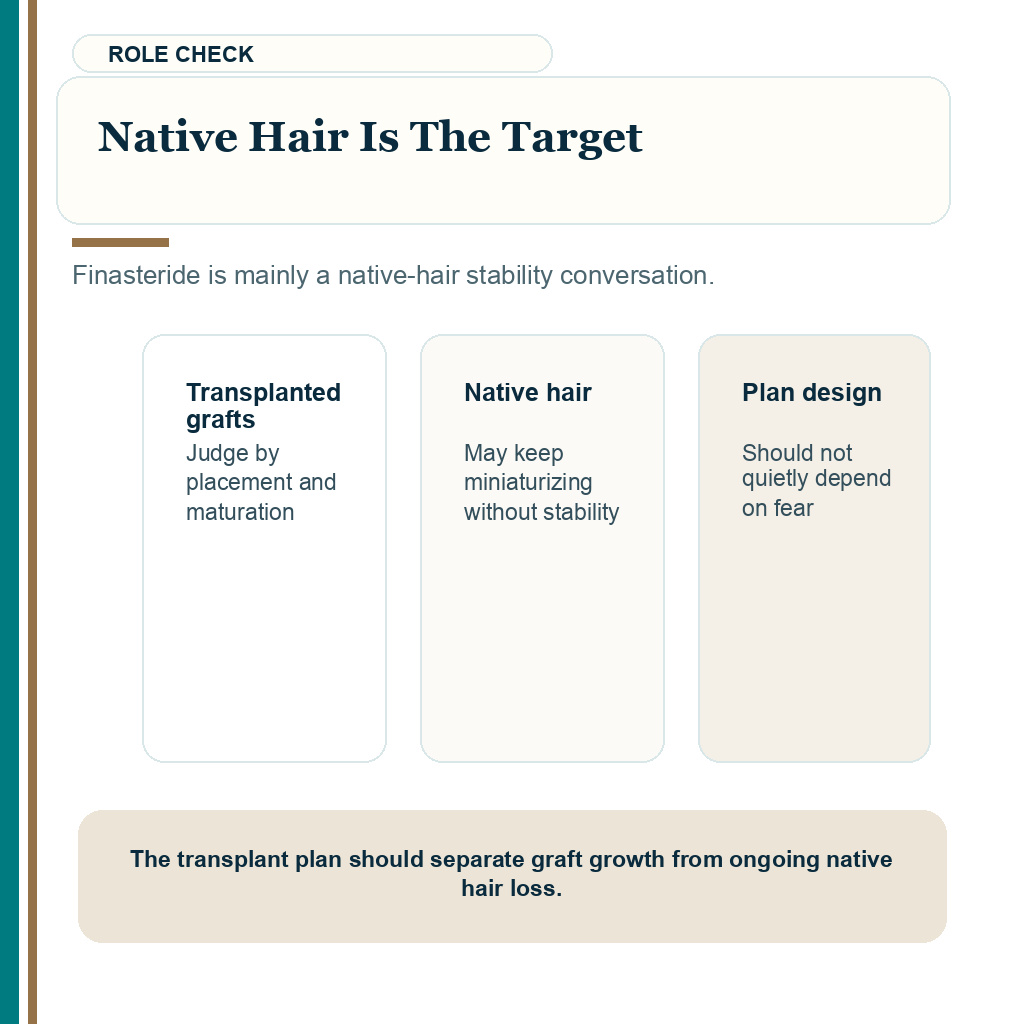
Finasteride is mainly about protecting vulnerable native hair, not making transplanted grafts survive or replacing careful graft handling. A properly handled graft should not depend on finasteride to grow, but the native hair around those grafts may keep thinning if the hair loss pattern is active. If finasteride started late, stopped, or was never tolerated, I record that as native hair context, not as an automatic excuse for a weak transplant.
Medication should never become pressure. It should help us avoid using surgery to chase hair loss that is still changing. If a patient is still losing hair on medication before a hair transplant, I separate medication response from surgical timing before graft numbers are fixed.
The native hair finasteride may help protect
In most male pattern hair loss cases, finasteride is used to slow the miniaturization of native hair that is sensitive to DHT. That usually means the hair still present on the frontal scalp, middle scalp, and crown, not the transplanted grafts taken from the safer donor zone. That question about DHT sensitive native hair also appears in testosterone therapy and hair transplant planning, especially when medication tolerance and donor reserve have to be discussed together.
An empty temple corner is a different question from active miniaturization behind it. Poor temple regrowth does not make finasteride pointless. It may simply mean the hairline shape still needs surgery while the surrounding native hair needs a separate long term plan.
If the concern is a gym supplement rather than a prescription medication, I review it separately in creatine and hair loss before FUE planning.
Not taking finasteride does not usually mean the transplant itself has failed. Usually, the issue is different. The hair that was not transplanted around the result may keep weakening. If that hair thins over the next few years, the transplant may still have grown, but the overall appearance can look less full or less connected.
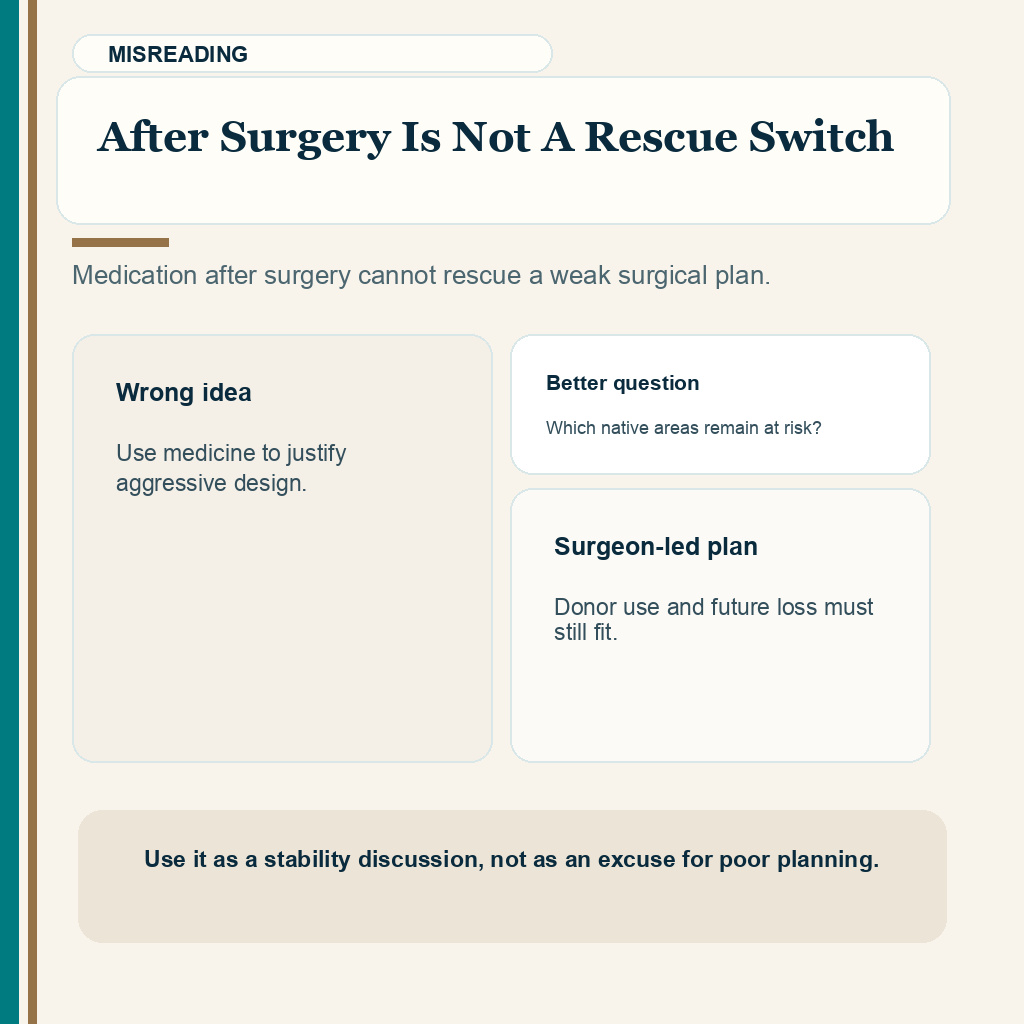
Finasteride can support a good long term plan, but it does not create extra donor hair and it does not justify an aggressive graft number. Visible regrowth is not the only useful response. Slower loss can still change how many grafts should be used. The donor supply is still limited. Medication can reduce future pressure on that supply in the right patient, but it cannot replace careful donor planning.
Finasteride need depends on native hair risk
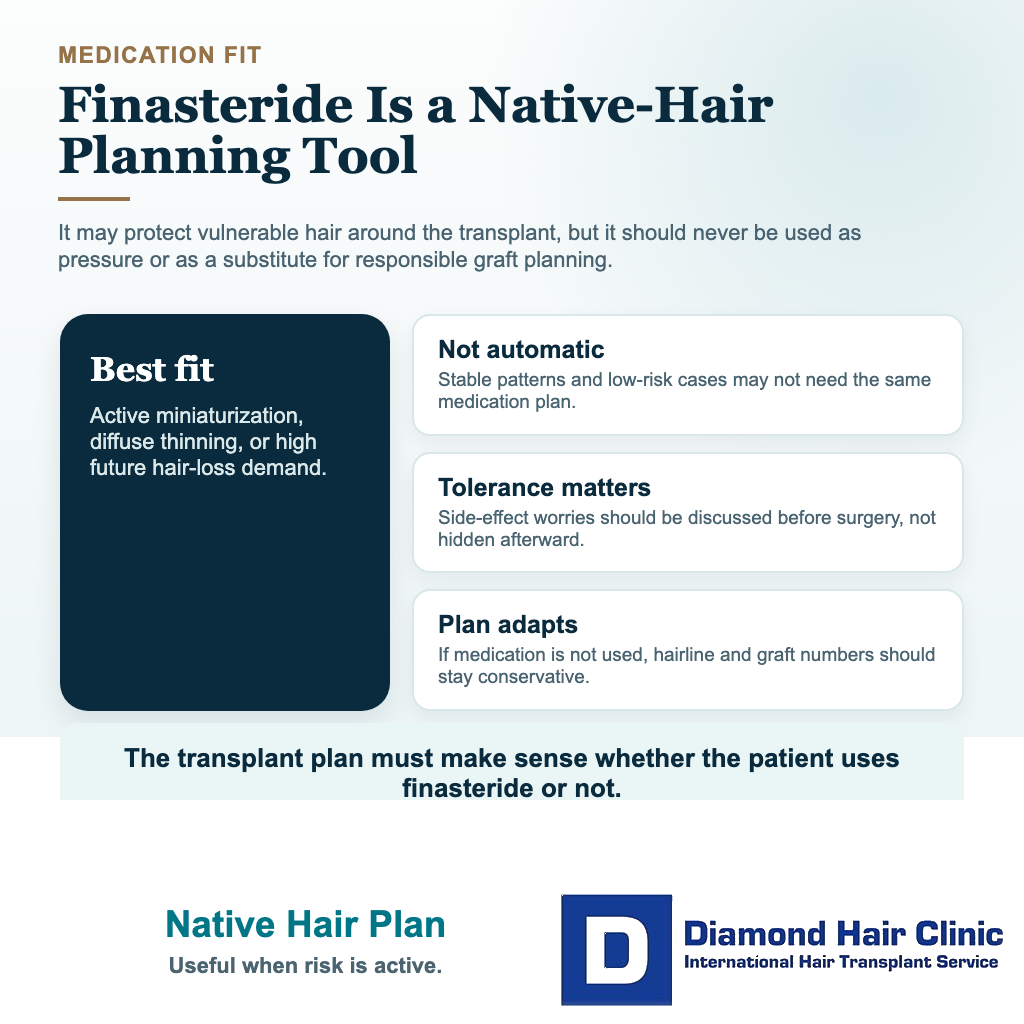
Finasteride is useful only when the native hair risk justifies it, and some patients cannot or do not want to use it. But when male pattern hair loss is active, finasteride can be part of long term planning. This is not only about whether transplanted grafts will grow. The native hair around them is the part I watch most closely. For patients considering having a hair transplant without finasteride, possible does not mean free of risk. The surgical plan must be realistic from the start.
Finasteride may be helpful before or after a hair transplant when miniaturization is active, but it should not be started blindly under pressure. If a patient is considering stopping finasteride after a hair transplant, I treat that as a planning question, not a casual change. The decision depends on age, hair loss pattern, side effect concerns, donor capacity, and how much native hair we are trying to protect. If a patient is also trying to conceive or planning a pregnancy with his partner, I separate fatherhood planning with finasteride or dutasteride before hair transplant from the general hair loss medication discussion.
Starting before surgery can change the plan
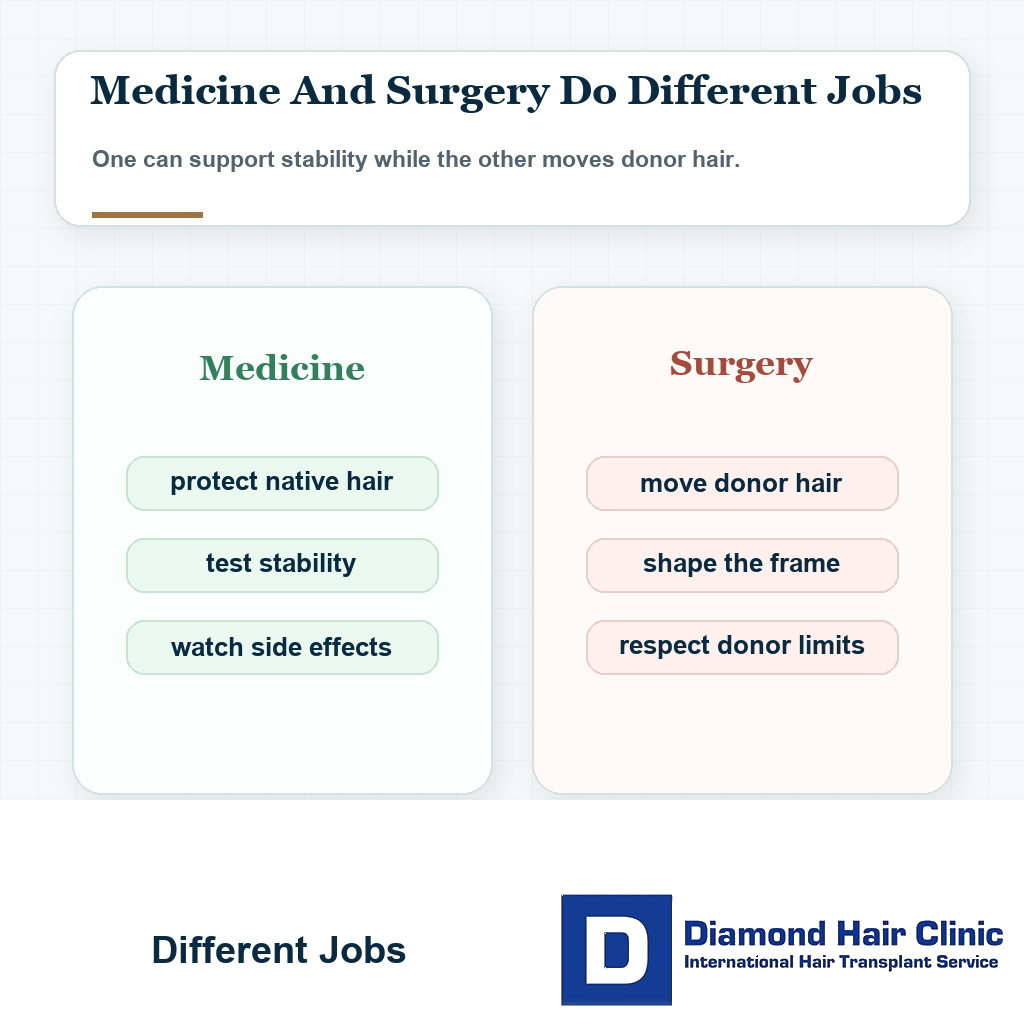
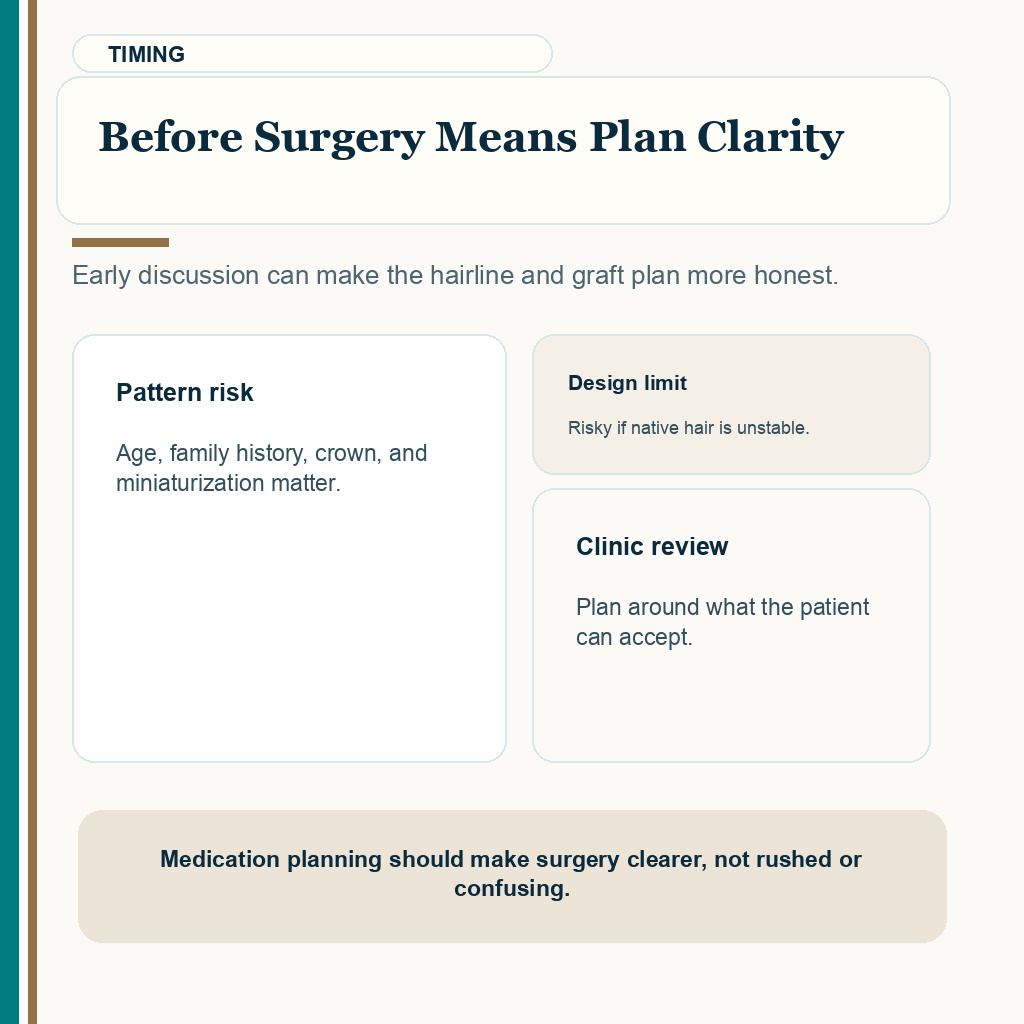
If a patient starts finasteride before surgery and responds well, the surgical target may become clearer. Some weak native hairs may stabilize or improve visually, and the patient may need a more conservative operation. Used at the right time, medication before a hair transplant may prevent surgery from being used to chase hair that medication could help preserve.
In surgical planning, stability is useful information. If the hair loss slows, I can plan around a more predictable pattern. If the loss continues quickly despite treatment, I know the case needs more conservative donor management.
Time on medication before the surgical decision
I avoid one fixed timeline for every patient, but medication needs time to show its direction. A few days or a couple of anxious weeks cannot tell us enough. Three months may tell us something about tolerance and early direction, but it is often too early to judge the full hair response.
Useful planning information often comes over several months, together with consistent photographs. In younger patients with active loss, six to twelve months of stability can be more valuable than rushing into a design that may look good briefly and then become disconnected. If the patient is young, actively thinning, and not in a rush for surgery, when medication can delay surgery may be the safer conversation.
If medication is being started close to a planned surgery date, I do not let that calendar pressure set the graft range. Finasteride may help protect native hair over time when it is suitable, but early use should not be treated as proof that a large surgery is safe before the pattern has been reviewed.
Waiting is not wasted time if it prevents an operation that is too early or too aggressive. A patient who stabilizes first may need fewer grafts, a better design, or a delayed surgery. That is a good outcome, not a failure to operate.
Does finasteride stop working after several years?
The common long term concern is that the tablet has suddenly become weak. In practice, I need to know whether the medicine is controlling enough of your pattern to make surgery predictable. Finasteride can keep lowering DHT while androgenetic hair loss still moves slowly in some men. That is not the same as tolerance. It can mean the hair loss was aggressive, the use was irregular, another shedding trigger is present, or the crown and hairline are responding differently.
After several steady years on finasteride, the result is useful evidence, not a promise. There is no fixed expiry date at five or ten years. What matters is whether the same baseline is still holding under fair comparison, and whether a new shedding period has a clear trigger before the surgical plan or medication discussion changes.
When I review a patient who has used finasteride for years, I do not judge the plan from one mirror week. I compare same light photos, age, family history, crown change, donor strength, and whether the temples were already bare before treatment. A crown may look stronger while an old temple corner does not rebuild. That can still be a useful response, but it does not give permission to spend grafts as if future native hair loss is solved.
If the stable result came from finasteride plus minoxidil, stopping minoxidil before surgery needs its own plan. If someone is stable and tolerating finasteride, changing to a stronger DHT blocker should be based on objective change and prescribing review, not fear that stronger always means safer.
Finasteride and shock loss
Finasteride may help protect miniaturizing native hair over time, but I do not describe it as a guarantee against shock loss. Native hair shock loss can still happen because surgery itself is a stress to the scalp. Stronger native hair generally gives the plan a better background.
Patients often want certainty because they are afraid of looking worse before they look better. Medicine can reduce some long term risk, but it cannot remove every surgical risk.
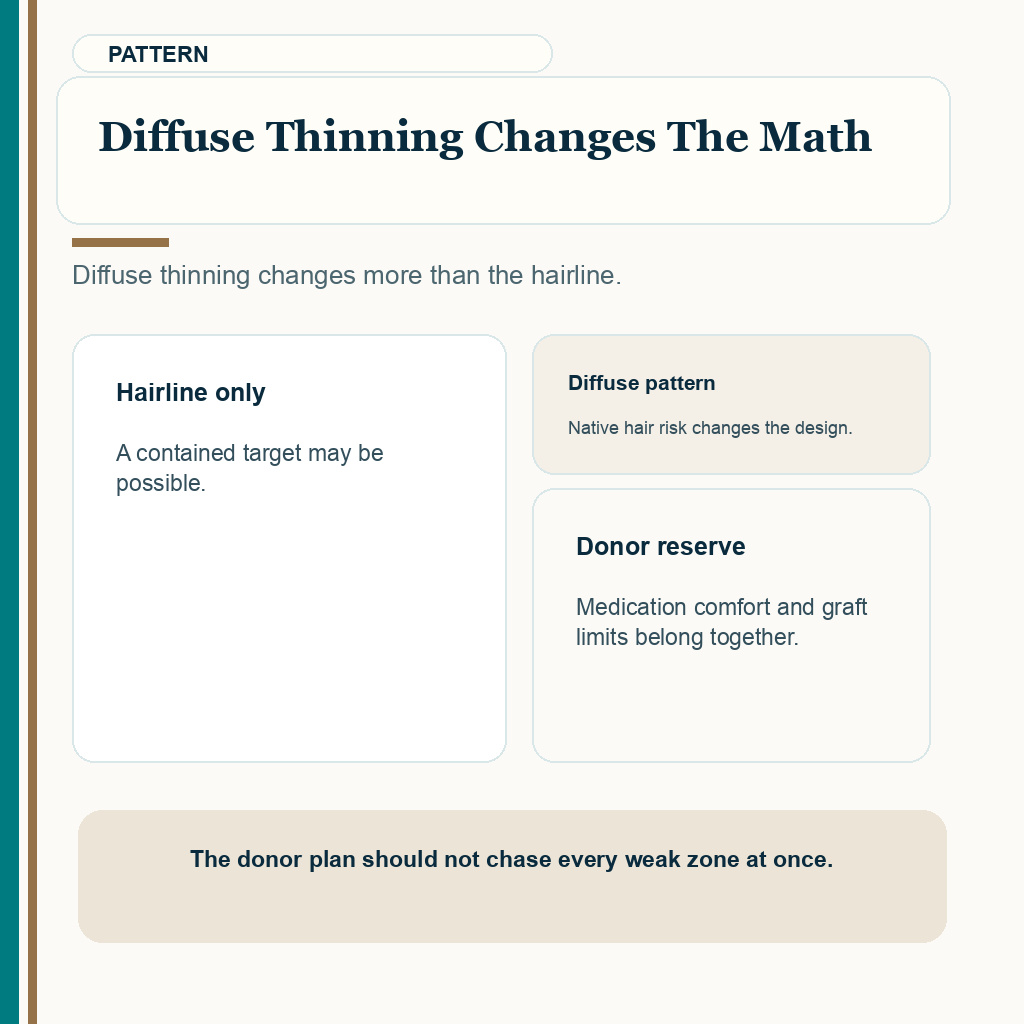
Diffuse thinning changes the decision
Diffuse thinning changes the conversation. If the top and middle scalp are miniaturizing widely, surgery alone may create a temporary improvement while the surrounding hair continues to weaken. In patients with diffuse thinning, medication may strongly influence whether surgery is wise.
In these cases, I do not simply place grafts into every thin area. The first step is to see what can be stabilized and what truly needs transplanting. This protects the donor area and the final appearance.
Starting finasteride after the transplant
Sometimes starting after surgery is reasonable, especially if the patient was not ready before or needed more time to discuss side effects with a doctor. But starting only after surgery means the operation is planned without knowing whether the native hair will stabilize. That can be acceptable in selected cases, but it is not ideal for every patient.
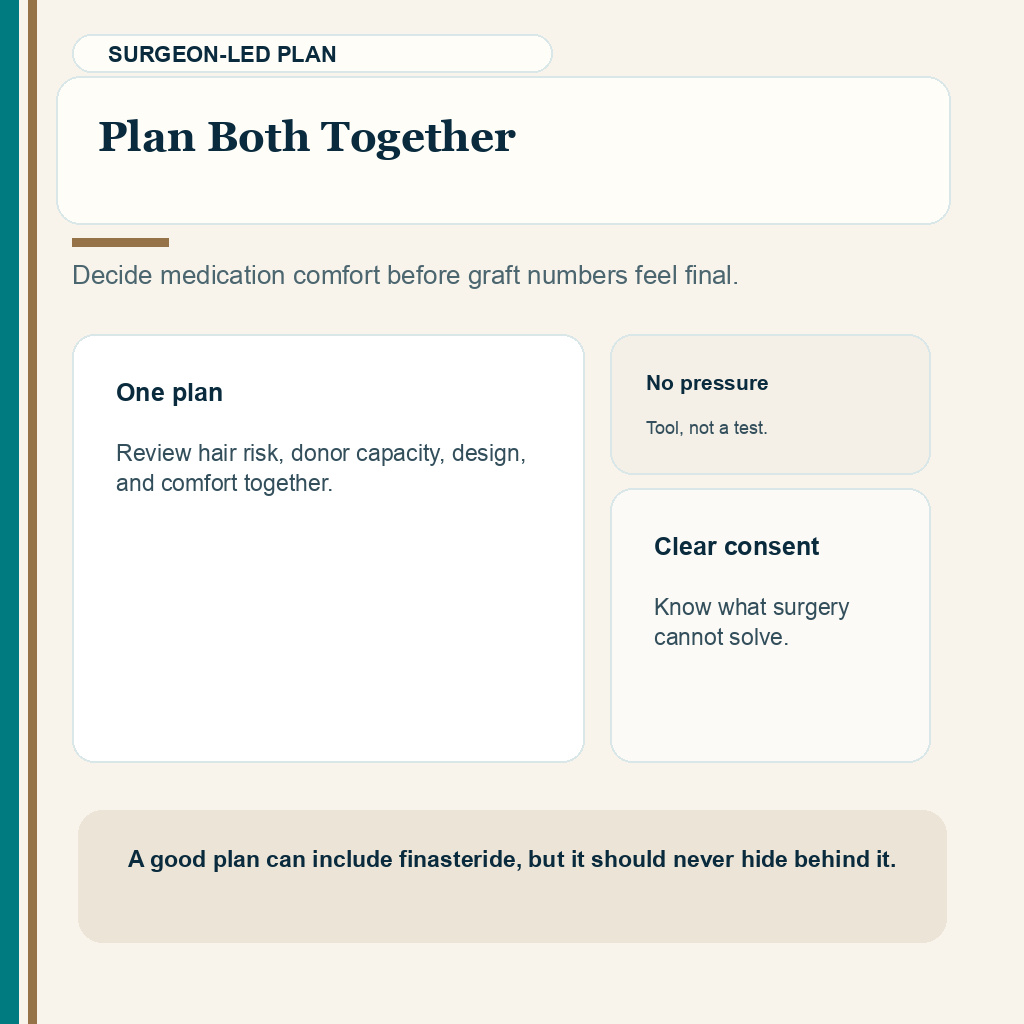
The medication discussion belongs before the surgical design is finalized. This is part of deciding whether you are truly a good candidate, not only whether the operation can technically be done.
Finasteride side effects can be a real concern
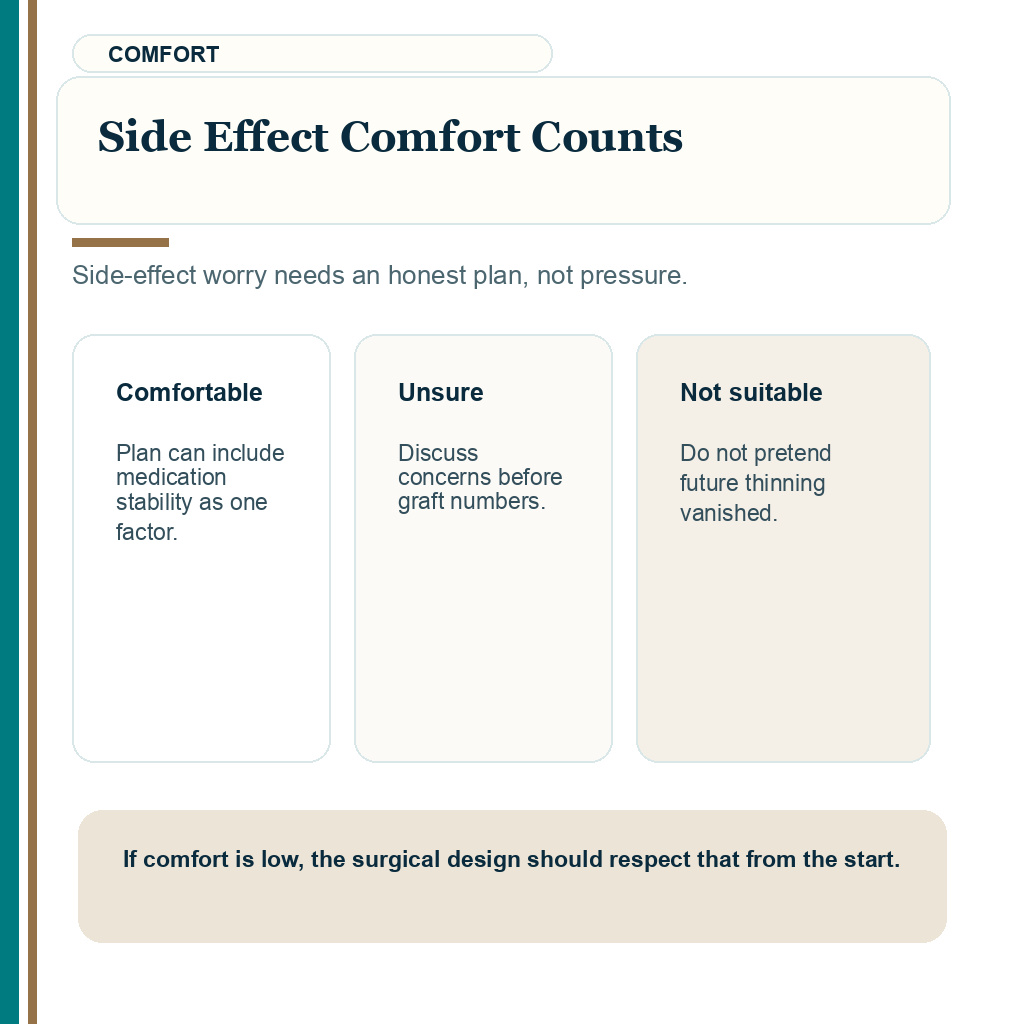
Side effect anxiety is real and should be respected. Medication pressure has no place in this decision. The decision needs medical discussion, not pressure from either side. Still, the surgical plan must reflect the decision. If someone chooses not to use finasteride, I may plan more conservatively, avoid using too much donor hair too early, and explain the risk of future thinning clearly. If the concern also involves TRT and hair transplant planning, I treat the hormone history as part of the surgical plan, not as a separate detail.
I ask about sexual function concerns, mood history, fertility plans, breast tenderness, gynecomastia, and previous hormone sensitivity. If that history is relevant, the discussion around finasteride after gynecomastia or hormone sensitivity should happen before surgery is designed.
Lower dose or topical finasteride discussions also need medical clarity. They may be considered in some situations, but they are still medication decisions. They should not be treated as shortcuts without risk or started quietly around surgery without medical guidance. The same proof standard applies when a patient arrives with subscription finasteride, dutasteride, or combination capsules, because online hair loss pills before FUE should be documented before I rely on the response history.
The choice has consequences either way. The operation should align with the patient’s medical comfort and long term hair loss risk.
Medical details to check before starting
Finasteride is a real prescription medication. If blood tests show high liver enzymes before a hair transplant, that result belongs in the medication review rather than being hidden. Before starting it, it helps to understand possible sexual side effects, breast tenderness or swelling, mood concerns, fertility concerns, and the possibility that PSA blood tests may need interpretation with finasteride use in mind.
Dose history should be literal, not estimated from memory. A 1 mg tablet prescribed for hair loss, a divided 5 mg tablet, and a tablet piece stored inside another capsule are different records when I judge stability, tolerance, and pregnancy handling risk at home.
I do not use fear to push patients away from treatment, and I do not dismiss symptoms if they happen. If a patient notices a clear change in sexual function, mood, breast tissue, testicular discomfort, or general wellbeing after starting, the answer is not to suffer in silence because a transplant date is approaching. The medication plan should be reviewed medically.
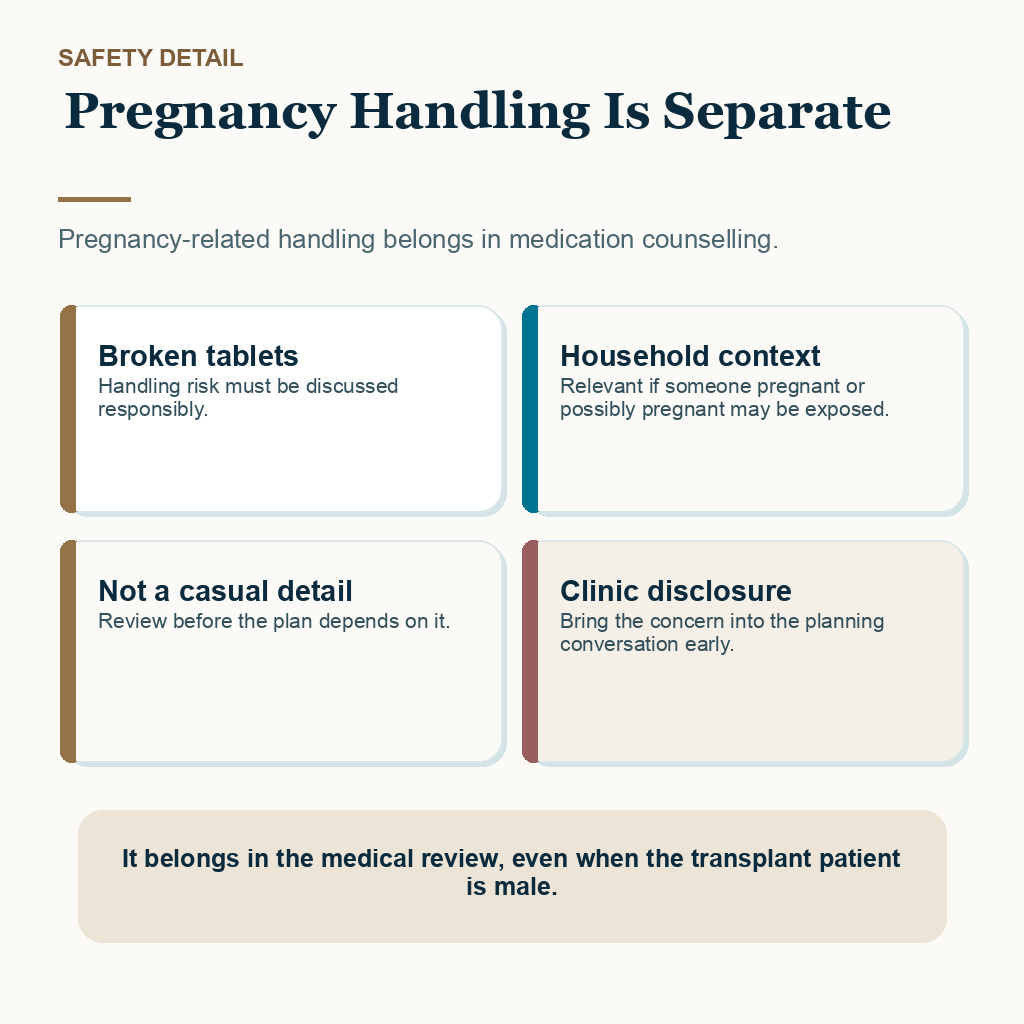
Pregnancy safety also matters around crushed or broken tablets. Finasteride is not a medication for pregnant women, and tablets should not be handled in a broken form by someone who is pregnant or may become pregnant. This may sound unrelated to a male hair transplant plan, but it is part of responsible medication counseling.
The best medication decision is one the patient can actually continue without fear, confusion, or secrecy. If the patient is not medically comfortable with finasteride, it is better to know that before surgery than design a hairline that quietly depends on a medication the patient will not use.
The hairline design has to fit the medication plan you can realistically follow. A hairline that is safe only if native hair stays protected is not the same plan as one designed for someone who may not continue treatment.
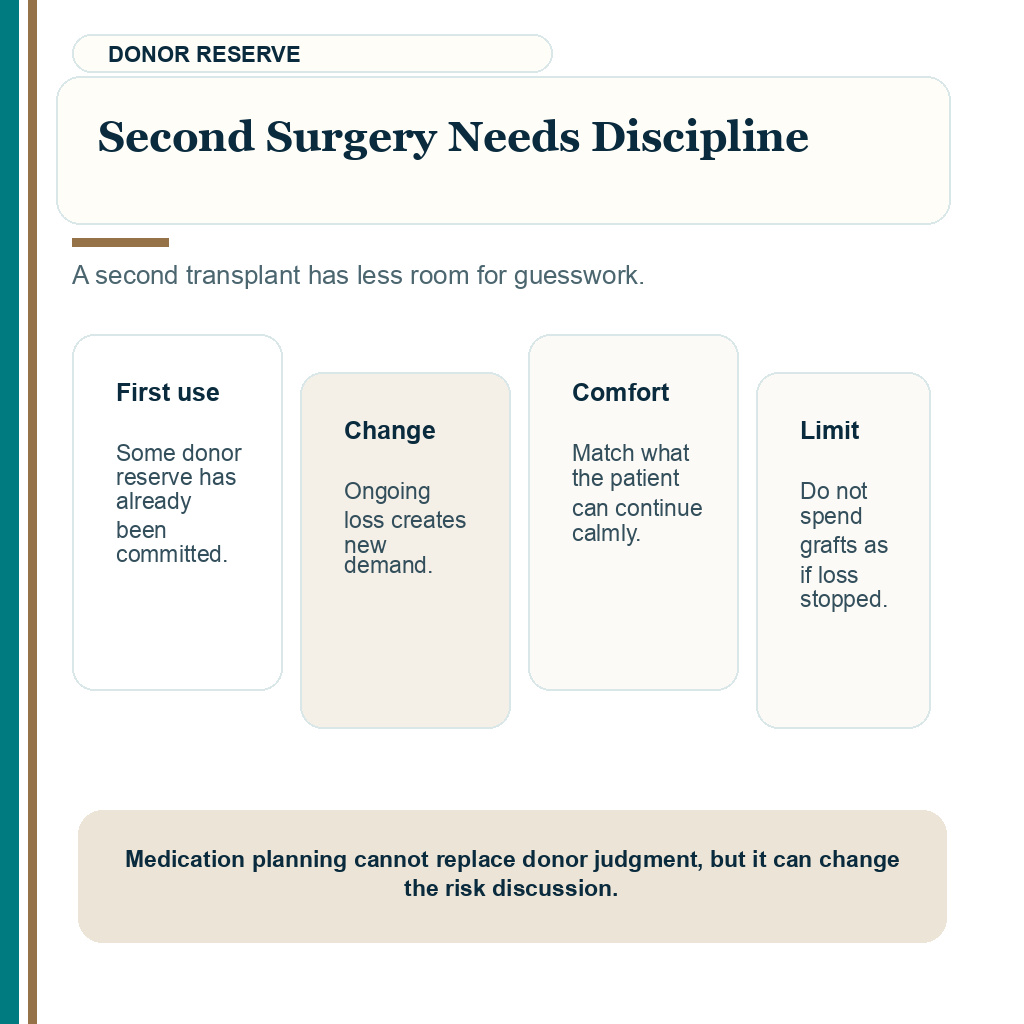
These 8 finasteride planning slides separate native hair protection, surgery timing, side effect comfort, pregnancy handling, diffuse thinning, second transplant donor reserve, and the combined medication and surgery decision. Swipe sideways, use the arrows one slide at a time, or choose a number below the image.
Minoxidil in the timing conversation
Minoxidil is a different medication with a different role. Some patients panic when shedding increases after starting it, which is why a minoxidil shed should be understood before the surgery timeline becomes crowded. Patients should also know when stopping minoxidil before surgery may be necessary, because topical irritation close to the operation is not helpful.
Finasteride alone can be a reasonable plan for some patients when the native hair risk is controlled and the patient tolerates it, but I do not use that as a rule for everyone. Minoxidil is a separate decision. It may help density or support weak native hair, but a transplant does not make it required by default. Oral minoxidil should only enter the plan after blood pressure, heart symptoms, swelling history, and prescribing doctor review are clear.
Poor visible regrowth on minoxidil does not answer the finasteride question for me. It only tells me that the growth support side of the plan was limited, so I still have to judge DHT sensitive native hair, side effect comfort, and whether surgery can be planned without assuming perfect medical control.
When a patient is already tolerating finasteride, topical minoxidil irritates the scalp or the routine will not last, and oral minoxidil would add a new systemic tablet during early recovery, I slow the decision down. Staying with finasteride while the scalp heals can be more sensible than adding another treatment from fear, as long as the hairline, density, crown, and donor plan were built around the patient’s real native hair risk.
Medication should make the plan clearer, not create chaos. If a patient is starting several treatments at once right before surgery, it becomes harder to know what is helping, what is irritating the scalp, and what is causing anxiety.
That confusion can continue after surgery when tablet changes, topical changes, shedding, and photo anxiety overlap. I keep the medication record beside the photo record, because native hair stability and graft growth are separate clinical questions.
If your pharmacy or the manufacturer changes, keep photos of the old and new labels and note the dose and dates. The switch alone does not prove that it caused more shedding or a change in your hair. Ask the pharmacist or prescribing doctor to compare the products before you change the dose or stop treatment.
Finasteride before a second transplant
Often more than before the first operation. A second hair transplant is usually planned after some donor hair has already been used. If native hair keeps thinning, every new operation has less room for error. Medication can sometimes protect the hair that remains and reduce the need to keep chasing loss surgically.
Medication does not replace surgery. When the donor area has already been used, medical stability becomes more valuable.
Medication history should shape the surgery, not follow it
Finasteride is not a box to tick after the hairline is drawn. It is part of judging native hair stability, crown risk, family pattern, side effects, and how conservative the transplant needs to be.
If you tolerate medication, the surgical design can sometimes protect more native hair while still respecting donor limits. If you cannot use it, the hairline and crown may need more restraint because future loss has less support.
The transplant should still make sense if medication is changed later for a medical reason. That is the difference between using treatment as support and using it to cover an unstable surgical promise.

Read this review excerpt
Every single one of my questions was answered and they made sure I had all the details I needed to make an informed decision.