


Fatherhood Planning While Using Finasteride or Dutasteride
Fatherhood planning rarely makes the hair transplant operation itself the fertility issue. The part that needs review is the medication plan, partner timing, and what happens to native hair if treatment pauses. If you use finasteride or dutasteride, I separate the discussion into three questions. Could your partner be directly exposed? Are sperm quality or fertility already a concern? What might happen to your native hair if the medicine is paused?
Do not make this decision in the middle of fear. Do not stop finasteride, dutasteride, TRT, or any prescribed medication just because an online discussion frightened you. Do not continue blindly either. If you are actively trying to conceive, if a semen analysis is abnormal, if your partner is already pregnant, or if you use dutasteride, bring the timing into the consultation before the transplant design is finalized. For TRT specifically, testosterone therapy and hair transplant planning keeps the prescriber, blood work review, native hair risk, and surgical design in the same conversation.
When a fertility appointment is already planned, the transplant plan should not depend on a guess. Put the appointment date, semen test status, partner timeline, and current medicine use into one decision instead of changing tablets alone. The same early coordination helps if hCG or clomiphene is part of the FUE hormone review, because fertility timing and surgical timing should not be guessed separately.
Fatherhood planning changes the medication conversation
Finasteride and dutasteride are not transplant medicines in the same way that an antibiotic or painkiller may be used after surgery. They are hair loss medicines. Their main role is to protect vulnerable native hair that can continue thinning around the transplant. I discuss finasteride before or after a hair transplant as part of long term planning, not as something that makes transplanted grafts magically survive.
Fatherhood planning changes the conversation because you may be holding two worries at once. You may worry that stopping medication will make the hair loss accelerate. You may also worry that staying on medication could affect fertility, sperm quality, or a pregnancy. Those are not cosmetic fears. They deserve a careful medical review before surgery, because surgery uses donor grafts permanently and medication decisions can change the future hair loss pattern.
You may be suitable for surgery while still needing a separate medication timeline. In another case, it may be better to postpone surgery, not because the operation is dangerous by itself, but because the fertility timeline, medication decision, anxiety level, or native hair loss is not stable enough for a responsible design.
The useful consultation question is not only whether the operation can be performed. It is whether the operation still makes sense if the medicine is paused, changed, restarted later, or avoided completely. I want the medication plan written down before I design a low hairline, crown session, or dense frontal reconstruction.
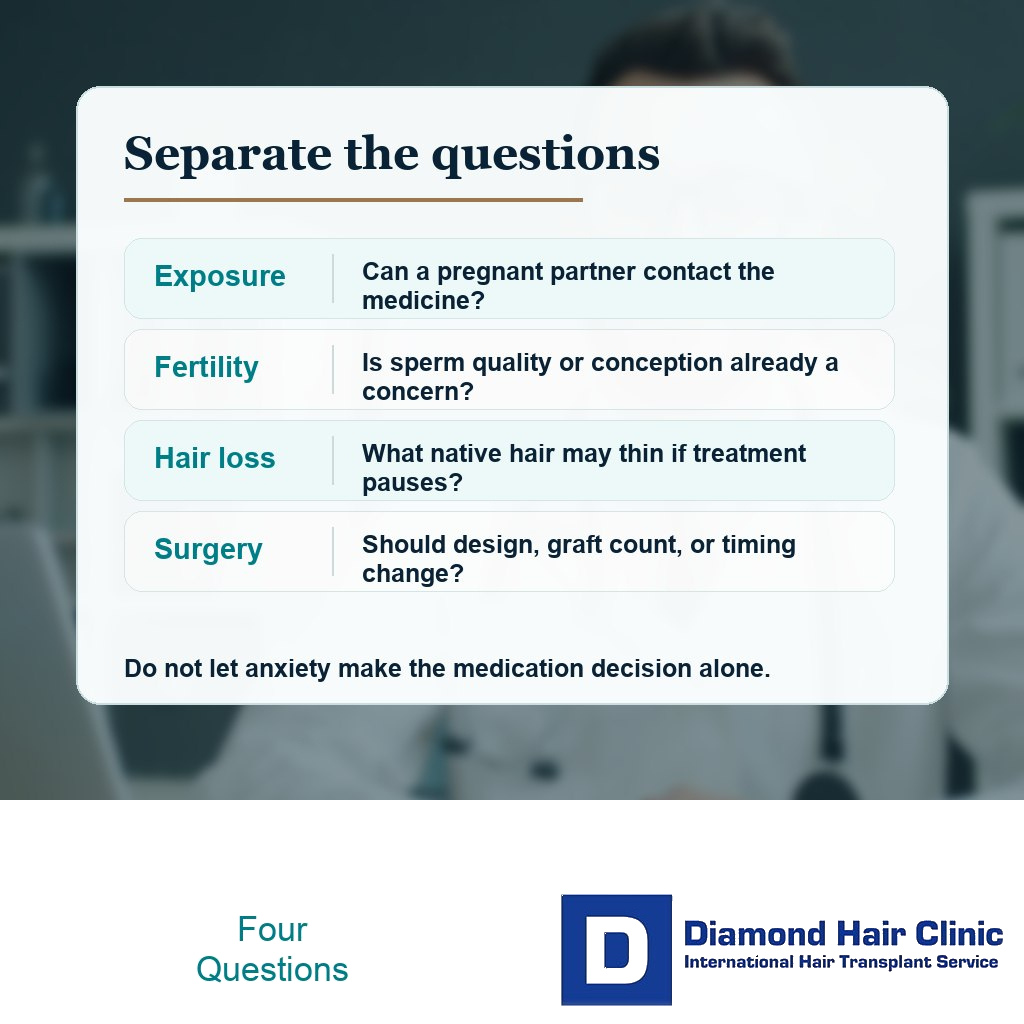
The consultation should separate partner exposure, sperm quality, native hair protection, and surgical timing.
Trying to conceive belongs in the same consultation because it can change medication comfort, even when surgery itself is not the fertility issue.
Pregnancy exposure and male fertility are different questions
These concerns often get mixed together. One question is whether a pregnant partner could be exposed to the drug. A different question is whether the medication affects the man’s fertility or semen parameters. Semen only exposure, direct tablet contact, topical scalp residue, and a leaking dutasteride capsule are not the same situation. Blood donation deferral is another exposure question, and I cover it separately in finasteride, dutasteride, and blood donation before FUE.
For finasteride, the amount found in semen is very small, and semen only exposure is not generally expected to be enough to harm a developing fetus. That should not be stretched into careless advice. A pregnant partner should not handle crushed or broken finasteride tablets, and direct use of finasteride during pregnancy is not appropriate. If there has been direct exposure, or if anxiety remains high, the prescribing doctor or obstetric team should answer the pregnancy specific question.
Male fertility is a different issue. Some men report sexual side effects, reduced ejaculate volume, or poor semen results while taking finasteride. Many men father children without difficulty, but the person sitting in front of me is not an average statistic. If you have already been trying without success, if semen analysis is abnormal, or if there is a history of fertility treatment, I do not treat the medication question lightly.
A semen analysis should not be treated like a casual home check. Results can vary, and one abnormal result needs context such as abstinence interval, recent illness, heat exposure, supplements, TRT or anabolic use, and the couple’s fertility history. If the result is abnormal, the medication decision should be made with the fertility doctor or urologist, not by guessing from a clinic package.
Sperm banking needs a timing plan led by the fertility clinic
If you are planning sperm banking, sperm freezing, or sperm cryopreservation while taking finasteride or dutasteride, do not use a timetable from a forum as the rule. Tell the fertility clinic and the doctor who prescribed the medicine before the sample is collected. In many men the semen analysis may be acceptable, but if count, motility, volume, or morphology is low, the clinic may advise a repeat semen analysis after a medically planned pause.
I do not turn that into a promise that sperm quality returns on a fixed date. Sperm results vary between samples, and the right plan depends on baseline semen results, fertility history, medication dose, dutasteride versus finasteride, and how urgently the sample is needed. The transplant design should also assume that hair loss medication may change during this period.
Abnormal semen analysis needs medical context before surgery
An abnormal semen analysis should slow the decision down. It should not become a simple reason for the transplant clinic to stop every hair loss medicine, and it should not be ignored because the surgery date is already booked. The result needs context from the doctor managing fertility or urology.
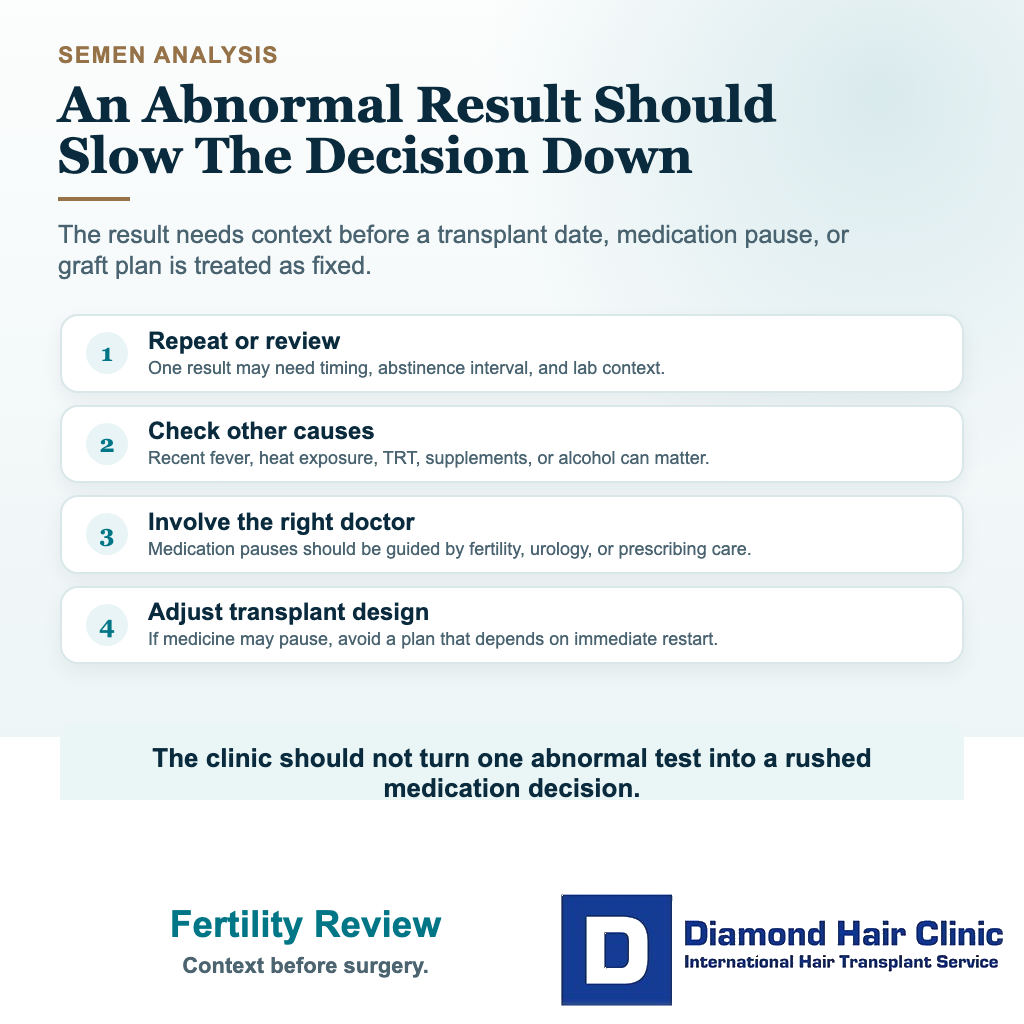
I want to know whether the test was repeated, the abstinence interval before the sample, recent fever or illness, heat exposure, TRT or anabolic use, supplements, alcohol intake, and whether the couple already has a fertility diagnosis. These details can change the meaning of the result. If finasteride or dutasteride is paused for fertility reasons, the prescribing doctor should guide the pause, and the surgical design should be conservative enough that the result is not dependent on restarting the medicine immediately.
Bring the actual semen analysis report if you have one, not only a remembered number. Motility, morphology, count, volume, collection timing, and the doctor’s interpretation can point to different decisions. A transplant clinic should not turn one abnormal line into automatic medication advice, but it should also not design surgery as if that report does not exist.
Finasteride needs a prescribing doctor discussion when trying to conceive
Finasteride is the more familiar medication in hair transplant planning. It usually has a shorter body clearance discussion than dutasteride and a longer history of use for male pattern hair loss. That does not make it right for every man trying to conceive.
With no fertility history, no sexual side effects, no abnormal semen analysis, and no direct tablet exposure for the partner, the discussion is often reassuring but still individualized. If anxiety is high, if the couple has already had a miscarriage or fertility difficulty, or if a urologist is involved, the decision may be different. A short planned pause, continued use, and stopping for many months are not the same decision. This should be coordinated with the prescribing doctor rather than decided in panic.
Stopping medication can also have a hair consequence. If native hair is actively miniaturizing, a long pause may make the transplant design look less stable later. With stopping finasteride after a hair transplant, transplanted grafts are not usually the main concern. The concern is the native hair that the medicine was helping to protect.
If a pause is chosen, it should be a written plan rather than a vague promise to stop for a while. The plan should say who advised the pause, when it starts, when it may be reviewed, what happens if shedding increases, and whether restart depends on the fertility doctor’s timing. Patients get into trouble when they stop secretly before surgery and then restart just as secretly afterward.
Dutasteride needs a longer review
Dutasteride is not simply stronger finasteride. It persists longer in the body and has a different labeling conversation. The official dutasteride labeling warns that pregnant women or women who could become pregnant should not handle leaking capsules. It also warns that men taking dutasteride should not donate blood until at least 6 months after the last dose, to avoid exposing a pregnant transfusion recipient.
That 6 month blood donation warning should not be turned into a universal rule that every couple must wait exactly 6 months before trying to conceive. It does mean dutasteride deserves more careful review than a quick answer from a clinic coordinator. The label also reports semen parameter changes in volunteers and states that the individual fertility significance is not known. For a couple already facing fertility difficulty, that uncertainty matters.
Dutasteride versus finasteride after hair transplant is a stronger medication discussion, especially when hair loss is aggressive. When fatherhood is part of the timeline, strength is not the only factor. Timing, side effects, the couple’s fertility history, and how much native hair depends on medical treatment all need to be reviewed together.
A last minute dutasteride pause does not create a clean fatherhood plan. If conception, IVF, IUI, or semen testing is already on the calendar, the medication discussion should happen early enough that the prescribing doctor can give realistic advice. Switching from dutasteride to finasteride, changing to topical treatment, or stopping everything for anxiety should not be improvised by the transplant clinic alone.

Finasteride and dutasteride should not be treated as the same fertility conversation, especially when timing is tight.
Stopping medication can hurt the transplant plan
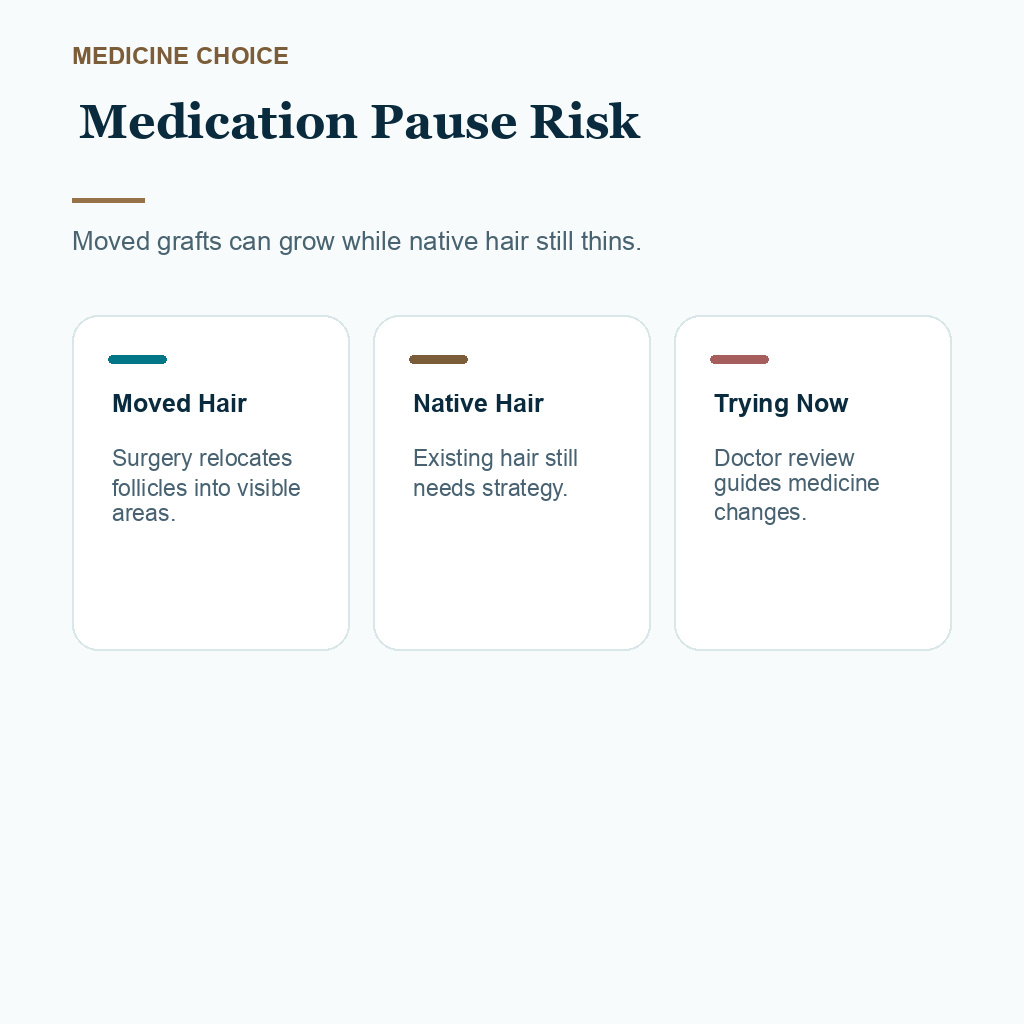
A hair transplant moves donor hair. It does not freeze male pattern hair loss. If medication is stopped for several months while a couple is trying to conceive, the transplanted area may still grow, but the native hair behind or around it may keep thinning. This can create a gap, a thinner crown, or a result that looks less connected over time.
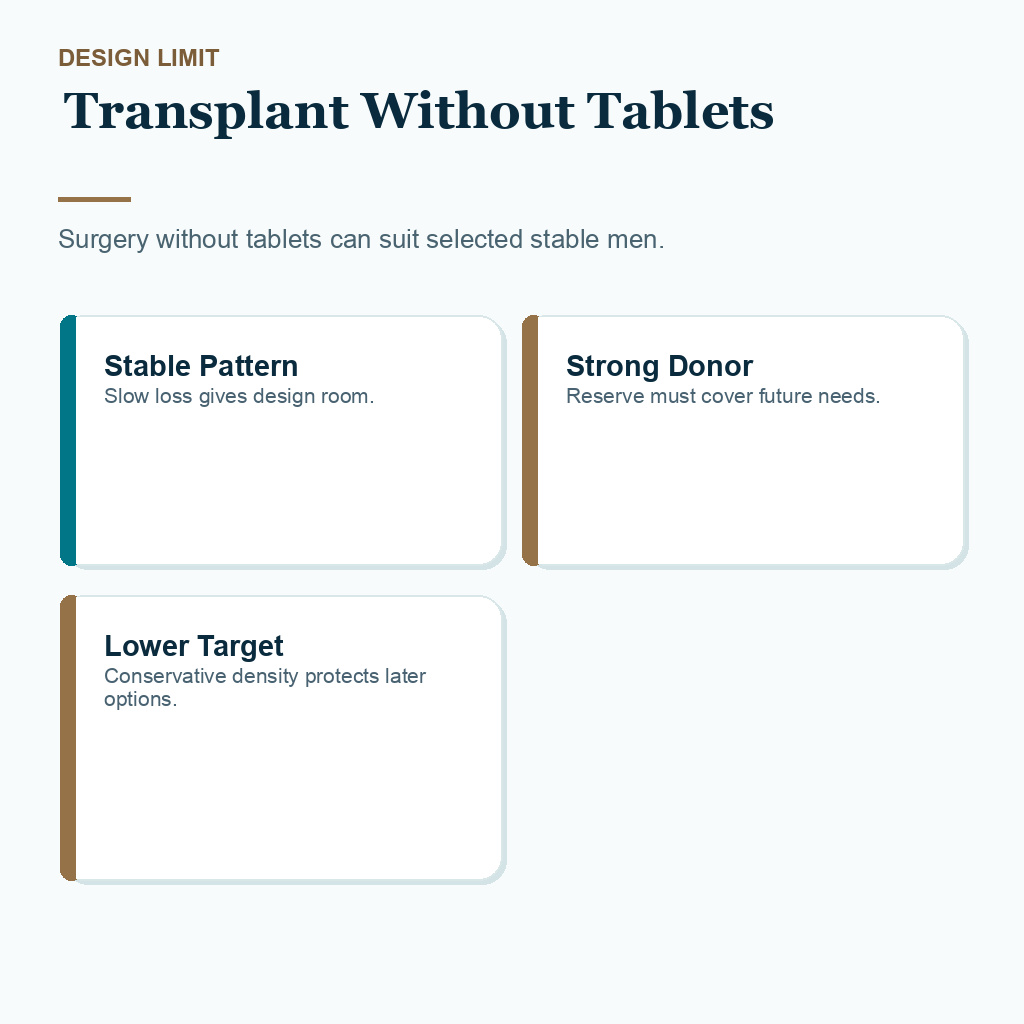
Medication is not mandatory for every transplant candidate. Some men can have a hair transplant without finasteride, especially when the hair loss pattern is stable, the donor area is strong, and expectations are realistic. The plan changes when the patient is young, has diffuse thinning, has crown loss, or has a family pattern that suggests future loss will continue.
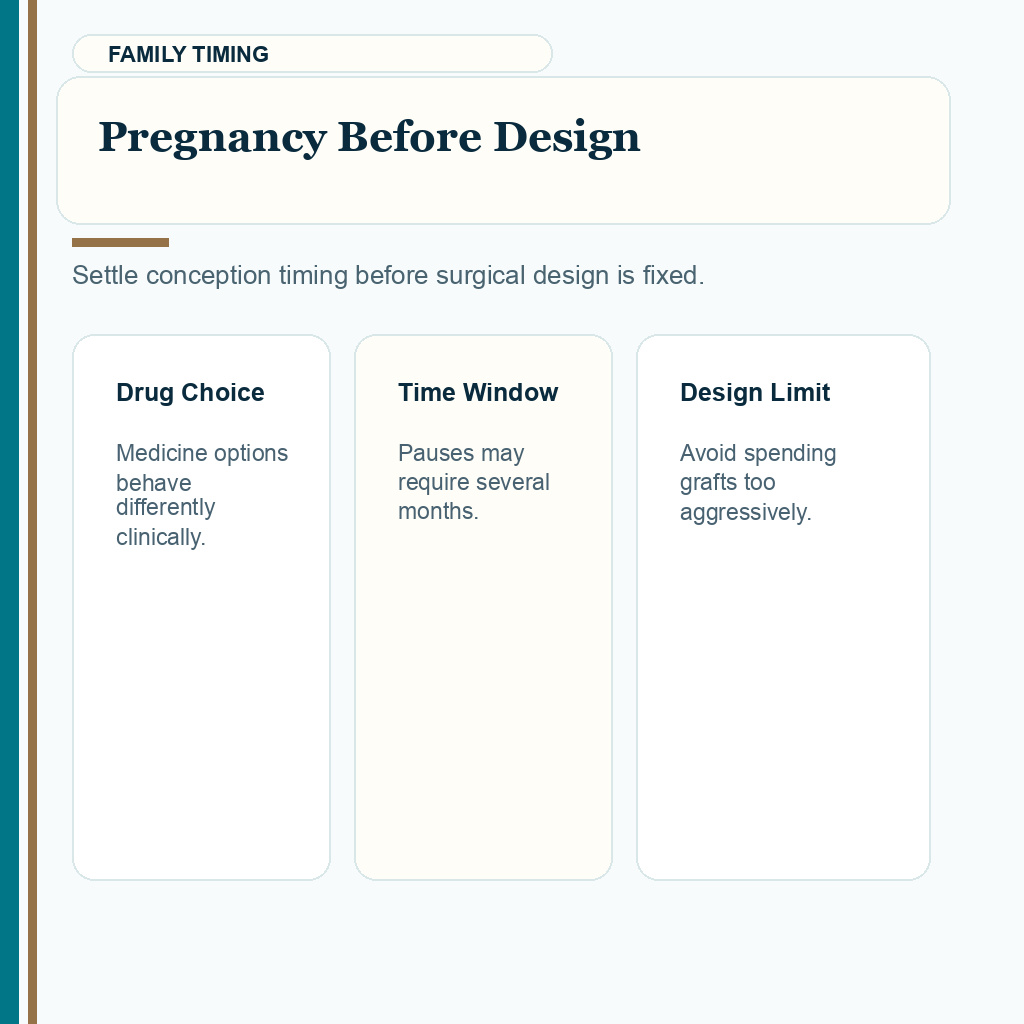
When a couple is trying for pregnancy, the medication decision should come before the surgical design, not after. A conservative hairline, a smaller first session, or delaying surgery may protect the patient better than using grafts as if medication will definitely continue for life. Candidacy is not judged from hairline photos alone. Whether you are a good candidate for a hair transplant also depends on medication stability, future loss risk, and timing.
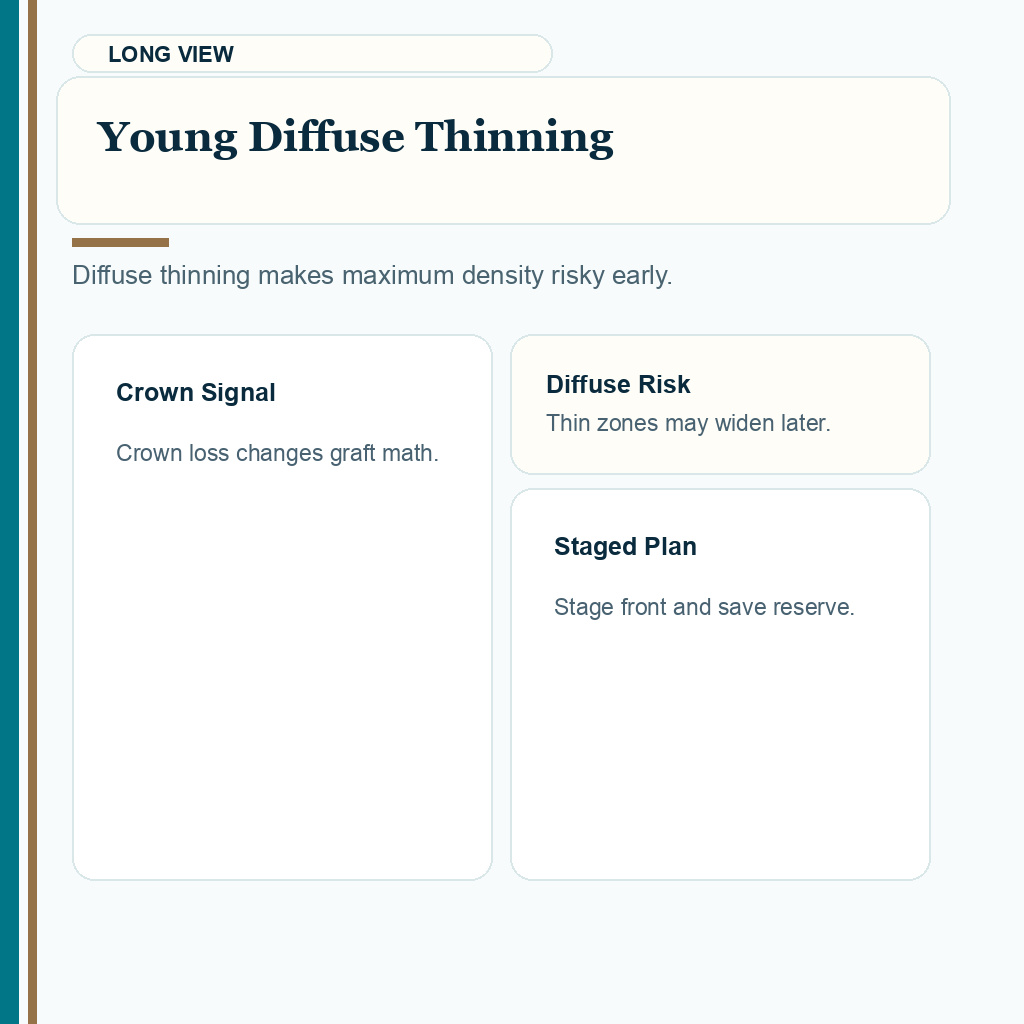
Young patients with diffuse thinning or early crown loss need this caution. If the medication plan is uncertain, I do not want the first surgery to chase maximum density in one zone while ignoring future thinning behind it. The safer design usually protects donor reserves and leaves room for the hair loss pattern to declare itself.
This recap uses 4 slides to keep medication and fatherhood planning in one place. Swipe sideways, use the arrows, or choose a number below the image.
Topical finasteride changes partner exposure
Topical finasteride adds another practical layer. The scalp product may contain finasteride alone or a combined formula with minoxidil, alcohol, propylene glycol, or other ingredients. It may leave residue on the scalp, pillow, hands, or bathroom surfaces if it is used carelessly. The safety discussion is not identical to a coated oral tablet.

Before surgery, topical products also matter because the scalp should not be irritated, greasy, or chemically inflamed on the day of the operation. After surgery, applying a topical medicine too early can mean rubbing, dripping, stinging, or irritating skin that is still healing. The scalp healing side of that decision belongs in topical finasteride before or after transplant surgery.
If a partner is pregnant or trying to conceive and topical finasteride is being used, I ask the patient to involve the prescribing doctor. Practical handling rules may be needed. These can include washing hands, avoiding partner contact with treated scalp residue, keeping bottles away from shared areas, and not using compounded high strength formulas casually. These details are not dramatic, but they are exactly the details that reduce anxiety and prevent avoidable exposure.
Tell the clinic whether the product is a spray, dropper, foam, gel, or compounded solution, and whether it is combined with minoxidil or other actives. That affects partner contact advice and surgery day scalp preparation. Do not arrive with irritated skin because you increased the topical dose or changed formulas just before the operation.
Medication and fertility review before scheduling surgery
The consultation should include the exact medication name, dose, route, how long it has been used, side effects, previous pauses, semen analysis if one exists, fertility treatment history in the couple, and whether the partner is pregnant or actively trying to conceive. If you are also using minoxidil, TRT, anabolic agents, antidepressants, ADHD medication, or supplements, those should be disclosed too. This review belongs early, not on the morning of surgery, and it is part of medication before hair transplant surgery.
TRT deserves special attention because hormones, hematocrit, fertility, and hair loss can all interact. A man using testosterone replacement may be stable and suitable for surgery, but the plan should not ignore the reason for TRT, recent blood tests, fertility goals, or DHT sensitive native hair. TRT and hair transplant planning sometimes belong in the same conversation as finasteride or dutasteride.
If different doctors give different advice, I do not want the fastest clinic to become the referee. A dermatologist, urologist, fertility doctor, or prescribing physician may need to be involved. When the answers are rushed or contradictory, a second opinion before hair transplant surgery can prevent a poor decision made under pressure.
The cleanest plan is one that everyone can understand in writing. It should include the current drug, the reason for using it, the family planning timeline, whether a pause is advised, and who is responsible for restart decisions. If fertility treatment is scheduled, the transplant date should not collide with testing, medication changes, travel stress, or the period when the couple needs medical attention elsewhere.
Pregnancy exposure concerns need the right medical team
If the partner is already pregnant, the first step is not to panic. The practical question is what kind of exposure occurred. Semen only exposure from a male partner taking finasteride is different from direct handling of crushed or broken finasteride tablets, topical residue, or contact with a leaking dutasteride capsule. Direct exposure belongs with the appropriate medical team.
Tell the transplant team about the pregnancy even if the date is booked or the package is paid. The information may change medication handling, travel timing, stress level, and aftercare support at home. Surgery may still be possible, but the plan should be reviewed calmly before the operation.
The hair transplant plan should still be reviewed. You may decide with your doctor to continue medication, pause it, change timing, or use a different hair loss strategy. A transplant clinic should not give obstetric reassurance beyond its role. My role is to make sure the hair transplant plan does not depend on a medication schedule that the couple may change for family planning reasons.
After surgery, the same calm approach applies. Early recovery medicines should be taken only as prescribed, and patients should not copy another person’s list. Allergies, bleeding risk, stomach history, blood pressure, and other medical details matter during medications after a hair transplant as well. Fertility planning belongs in that same careful attitude.
Fatherhood changes the timing conversation
I plan the case as if the medication may change, not because it definitely will, but because family planning has its own timeline. That means I do not use an aggressive low hairline just because you are currently taking finasteride. I do not spend donor grafts as if dutasteride will definitely continue for life. I also do not ignore anxiety if surgery is being chosen mainly to escape medication decisions.
The plan often needs to be more conservative and clearer. If the couple is actively trying to conceive, the medication timeline should be settled before a large graft session. If finasteride side effects are already part of the history, or if there are semen concerns or fertility treatment ahead, the surgical plan may need to wait or become smaller. If you are stable on medication and the prescribing doctor is comfortable, surgery can still be planned, but the long term native hair risk should remain visible.
The plan has to protect the family decision and the donor area at the same time. Hair restoration should not force a couple into rushed medication choices. Fatherhood planning should not push a man into a transplant design that wastes grafts either. The best plan is the one that still makes sense if the medication plan changes.

Read this review excerpt
He was very thorough in every little detail and I never felt pressure to do anything I wasn’t sure of.