


Stopping Finasteride and Native Hair Risk
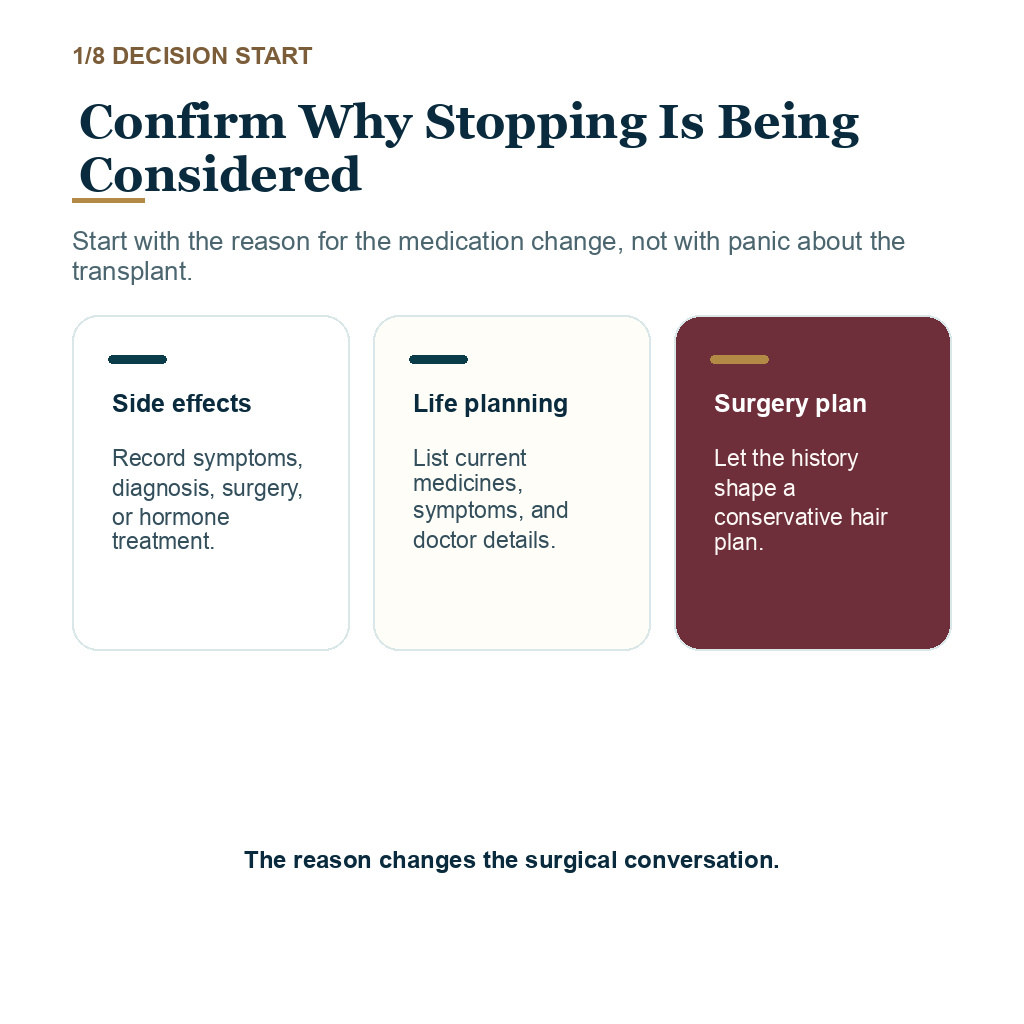
If you stop finasteride after a hair transplant, the transplanted grafts are usually not my first concern. The bigger concern is the native hair that finasteride was helping to hold. If that hair continues to miniaturize, the transplant may still grow, but the overall result can start to look thinner, separated, or older than expected.
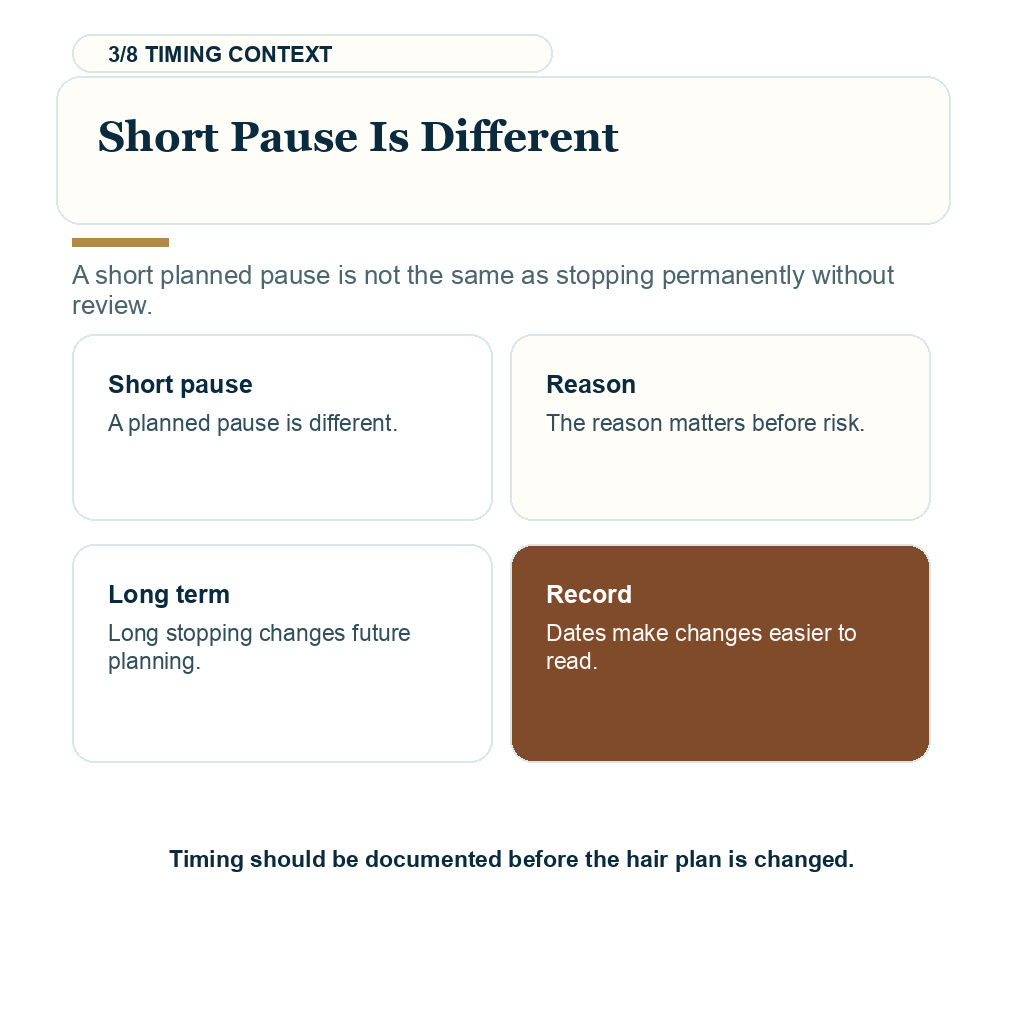
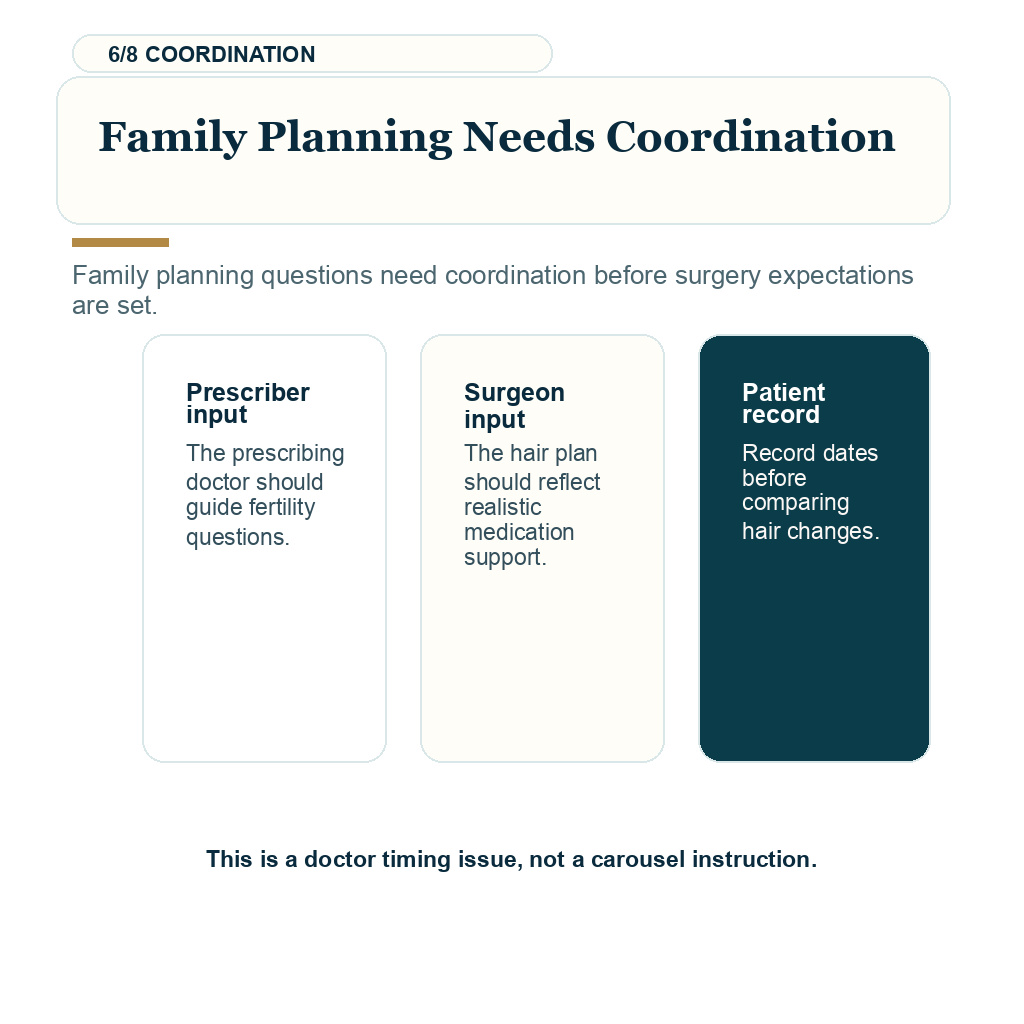
A short pause around surgery is different from stopping permanently. The answer depends on why you are stopping, how active your hair loss is, your age, how much native hair remains, and how carefully the donor area was planned. I separate when finasteride is helpful before or after a hair transplant from this question because the surgical plan can change when the medication plan changes. Family planning can be one of those reasons, and I discuss fatherhood planning with finasteride or dutasteride before hair transplant separately. If blood donation is the reason for a medication pause, I separate that too because donor center rules are not the same as the hair transplant medication plan.
Stopping permanently should include the hair you still need to protect. If the crown or mid scalp is thinning, the transplant can grow while untreated native hair keeps changing.
Before you and your doctor decide on a planned stop, take simple baseline photos in the same light and haircut. Later shedding is easier to review when the starting point is not based on memory.
Staying on medication at any cost is not the goal. The surgical plan has to stay realistic before the medication plan changes. When finasteride side effects change the transplant plan before surgery, I look at the medication benefit, the side effects, and the risk of planning surgery around hair that may not stay stable.
Switching to an herbal substitute changes the planning conversation too. Saw palmetto around FUE should not be treated as the same native hair protection.
Stopping finasteride usually does not damage transplanted grafts
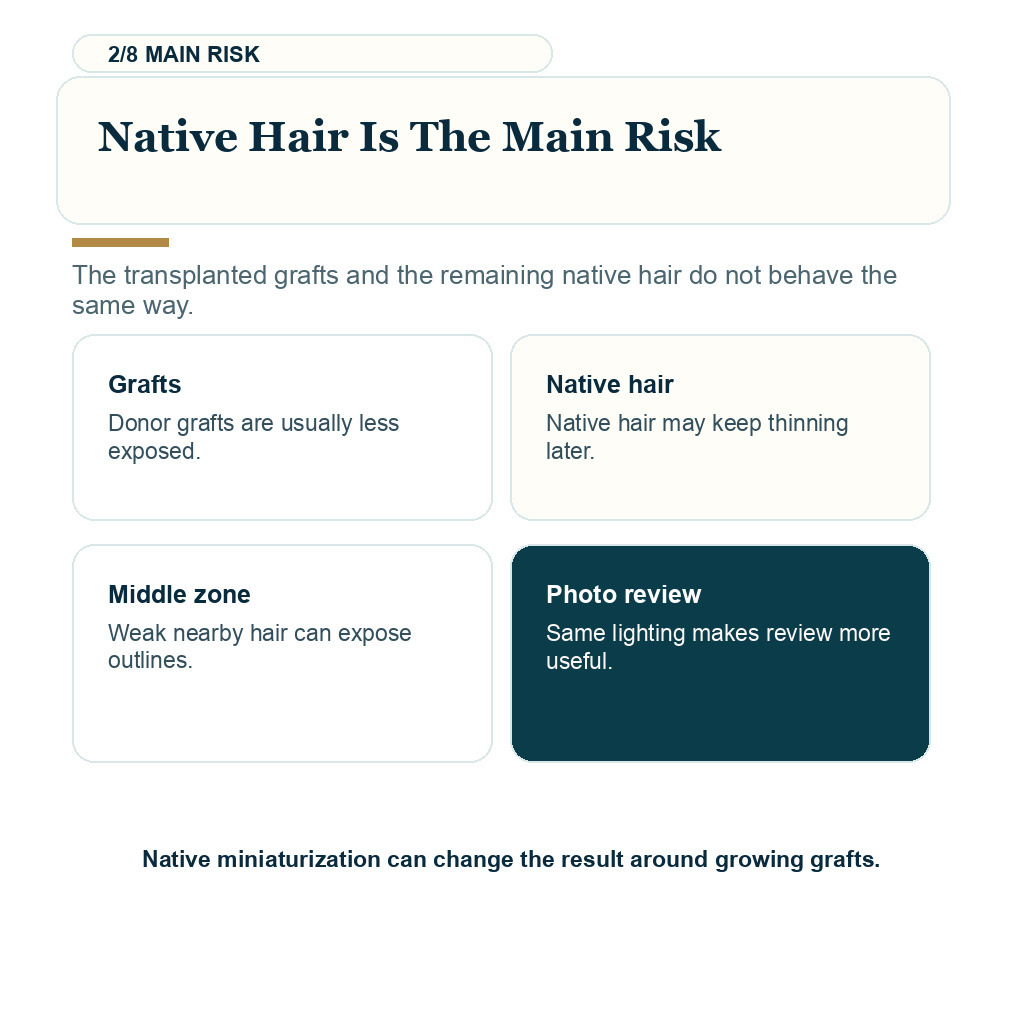
In most cases, stopping finasteride does not suddenly destroy transplanted grafts. These grafts usually come from the safer donor area, where the hair is more resistant to the pattern of male hair loss. For that reason, a hair transplant can still work even when a patient cannot use finasteride.
But do not read this as the whole result being protected. A transplant is made of two parts. One part is the transplanted hair. The other part is the native hair that remains around it. If the native hair weakens after stopping medication, the transplant can become more visible as an island of stronger hair surrounded by thinner hair. A laser cap after a hair transplant also does not replace this native hair plan.
Before deciding, separate two questions. One is whether the grafts will survive. The other is whether the result will still look natural as the surrounding hair changes. Native hair continuing to thin after surgery changes the plan for that reason, because surgery does not stop the biology of future hair loss.
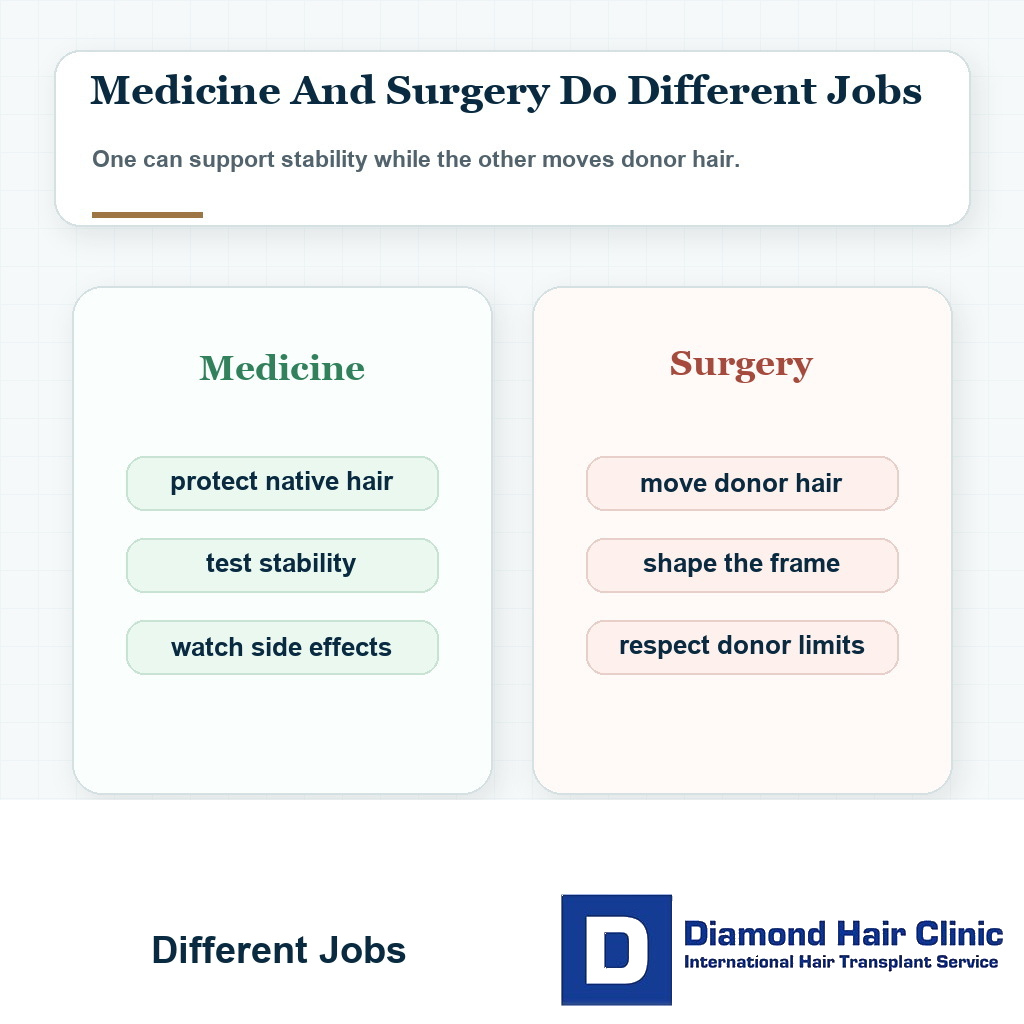
Native hair is what usually changes
Native hair is the hair that was already in the recipient area before surgery. Some of it may be thick and stable. Some of it may already be miniaturizing. Finasteride is usually used to slow that miniaturization in suitable male patients.
When finasteride stops while hair loss is still active, the native hair can gradually become finer. This may not happen in one dramatic moment. It may happen slowly enough that the patient only notices it when photos from different months no longer match.
That distinction matters surgically because a hair transplant is designed into the existing hair. I am not only placing grafts into an empty area. I am planning density, direction, and coverage around hair that may still change. If that native hair weakens, a result that looked well blended at 12 months can begin to look less connected later.
I examine plans that depend on wishful thinking. If a patient wants to stop medication, I can respect that. But I need to know it before I design the hairline, calculate density, or decide whether crown coverage belongs in the first stage. A plan for a patient who will continue medication can be different from a plan for a patient who will not.
Hair may change slowly after stopping finasteride
I do not promise the same timeline for every patient. Some men notice shedding or weaker hair within a few months. Others notice a slower change over 6 to 12 months. The useful distinction is that stopping usually does not remove the transplanted grafts, but it can allow DHT sensitive native hair to continue its previous pattern.
When stopping is due to side effects, the health decision comes first and needs discussion with the prescribing doctor. I do not try to judge the hair pattern in the first few days after stopping. Consistent photos before stopping, then again around 3 months, 6 months, and 12 months if the prescribing doctor agrees, give us a clearer picture before changing the surgical plan or adding another treatment. I use a similar measured approach when I explain how to track hair transplant growth without panicking.
If the hair becomes visibly thinner after stopping, restarting medication is not a decision I make casually for the patient. The patient and prescribing doctor should discuss safety, side effects, alternatives, and whether the goal is stabilization before further surgery.
Missing doses and stopping years later are different
Patients often ask this years after surgery, when the transplant has grown and the daily routine starts to feel tiring. I do not treat a few missed tablets, frequent missed doses, and a planned long stop as the same situation.
A missed finasteride tablet is usually not a graft emergency. Do not double up or change the dose to compensate without the prescribing doctor. If missed doses are becoming common, tell the prescribing doctor and the clinic, because the surgical plan should not assume steady native hair protection when the routine is no longer steady.
Stopping because of side effects, fertility planning, cost, fear, or medication fatigue needs a different review. I want to know which hair is transplanted, which hair is native, whether the crown or mid scalp is still changing, and whether the donor reserve can handle future loss if medication support becomes weaker.
A planned sperm banking pause is different from stopping after a frightening comment. If a fertility clinic wants a medication pause or repeat semen analysis before freezing sperm, the prescriber should define the pause and restart review before the transplant plan assumes stable medication support.
Dutasteride and minoxidil should not be bundled into the same decision. Dutasteride timing belongs with the prescribing doctor, and minoxidil after a hair transplant works through a different pathway. I use that separation so the transplant plan still matches the routine the patient can actually maintain.
Lower risk situations after stopping finasteride
Stopping finasteride is usually less risky when hair loss has been stable for a long time, when the patient is older, when there is very little native hair left in the thinning zone, or when the surgical plan was already designed without depending on medication. Even then, there is still no guarantee.
Some patients have advanced baldness and very little miniaturizing native hair in the top or crown. In that case, finasteride may have less hair to protect than in a young patient with diffuse thinning. The decision becomes more about donor management, realistic coverage, and whether the patient accepts a conservative result.
Other patients have a limited frontal hairline procedure with strong surrounding hair and a slow pattern of hair loss. If they stop medication, the risk may be lower than in a patient who is thinning across the whole mid scalp and crown. Still, the plan should leave room for change.
The question of having a hair transplant without finasteride must be discussed. It is not wrong by itself. It becomes unsafe when the plan pretends that future hair loss will not happen.
Caution signs before stopping finasteride
The risk is higher when the patient is young, losing hair quickly, has diffuse thinning, has a thinning crown, or still has a large amount of native hair that is being protected by medication. In these cases, stopping finasteride can change the long term picture more than the patient expects.
A young patient may see the front as the only visible problem, but the future pattern may not yet be fully expressed. If surgery is done too aggressively and medication is stopped later, the patient may lose hair behind the transplant. The hairline can remain, but the area behind it may thin, which creates the very problem the patient wanted to avoid.
The question of active hair loss before surgery deserves caution. A technically possible operation can still be a strategically risky operation. If the scalp is changing quickly, the first job is not to fill every visible gap. The first job is to understand the direction of the hair loss.
The crown is another area where medication decisions matter. Crown hair loss can consume many grafts and still look thin because of the natural swirl, the larger surface area, and the way light hits the scalp. If a patient stops medication while the crown is still progressing, I may choose to delay or limit crown coverage rather than spend donor grafts too early.
Side effects change the surgical plan
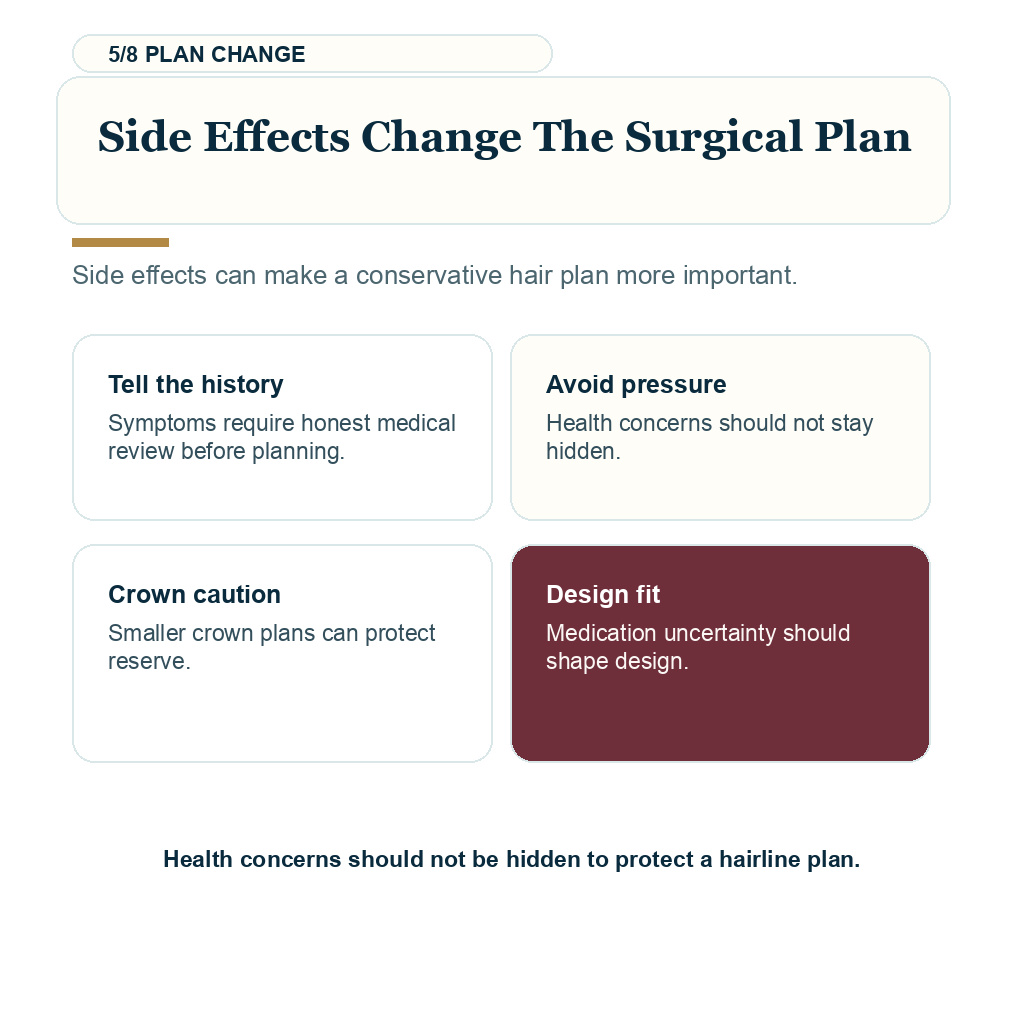
When side effects lead to stopping finasteride, I take that seriously. No patient needs to feel forced to tolerate a medication that is affecting their health, mood, sexual function, or self image. I also keep this in mind because the surgical plan must change when the medical support changes.
Stopping finasteride also should not be treated as permission to rely on another operation later. A second transplant can help selected patients, but it cannot replace the native hair protection that has been removed if the donor reserve, crown risk, or hairline design no longer support more graft use.
If the concern includes severe mood change, depression, suicidal thoughts, breast tenderness, sexual side effects, or fertility planning, I want the prescribing doctor involved promptly. Treat urgent mental health symptoms as urgent medical symptoms, not as a hair transplant planning detail.
If the reason is fertility planning, breast tenderness, mood or sexual side effects, or another medical concern, I treat that differently from a patient who stops only because the transplant looks good at 12 months. One is a health decision that needs medical review. The other is a cosmetic assumption that should be checked against future native hair loss before the plan becomes less cautious.
I separate the health decision from the cosmetic decision. The health decision belongs between the patient and the prescribing doctor. The cosmetic decision belongs in the surgical plan. If finasteride is no longer suitable, I must plan the transplant as if native hair may continue to change.
This may mean a higher hairline than the patient first wanted. It may mean lower density in one area so the donor area is protected for the future. It may mean avoiding the crown for now. It may also mean postponing surgery while the patient and prescribing doctor consider safer medical alternatives. In patients with hormone sensitivity or previous breast tenderness concerns, it is better to discuss finasteride after gynecomastia or hormone sensitivity clearly than pretend the concern is not real.
The risk is not the decision to stop when there is a valid medical reason. The risk is keeping the same aggressive transplant plan after the protective assumption has changed.
Use the carousel below to separate graft safety, native hair risk, side effects, family planning, replacement treatment limits, and conservative design. Swipe sideways, use the arrows, or choose a number below the image.


Minoxidil or PRP cannot fully replace finasteride
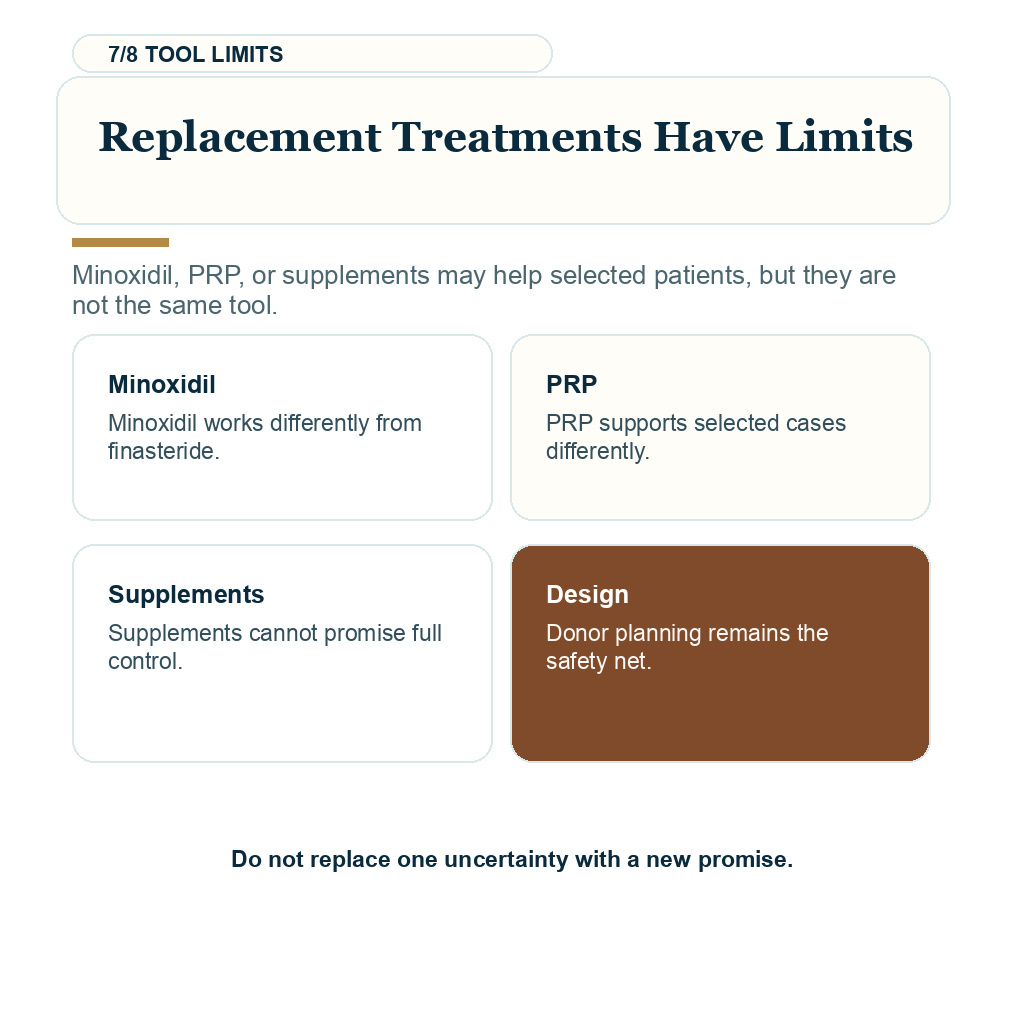
Minoxidil and PRP can be useful in specific cases, but I do not present them as a direct replacement for finasteride. I judge minoxidil after a hair transplant as its own tool because it works differently. Minoxidil can support the growth cycle. PRP may support the scalp environment in some patients. Neither should be sold as a guarantee that progressive male pattern hair loss has been controlled.
It matters because some patients stop finasteride and try to compensate by adding more treatments. They may use topical finasteride alternatives, supplements, PRP, or different routines. Some of these can be reasonable, but they do not remove the need for diagnosis and planning.
If medication can stabilize the situation well enough, surgery may sometimes be delayed or reduced. The question of whether medication can delay a hair transplant matters because a smaller operation at the right time can be safer than a large operation during active loss.
When a patient cannot use finasteride, they do not need to feel hopeless. The trade has to be clear. We can still consider surgery in some cases, but the design has to be more conservative, the donor area has to be protected, and more than one stage may be needed.
Future graft planning after stopping finasteride
Every graft used today is a graft that cannot be used again later. Lifetime graft planning becomes stricter if finasteride is stopped and future native hair loss becomes more likely, because graft distribution has to become more conservative.
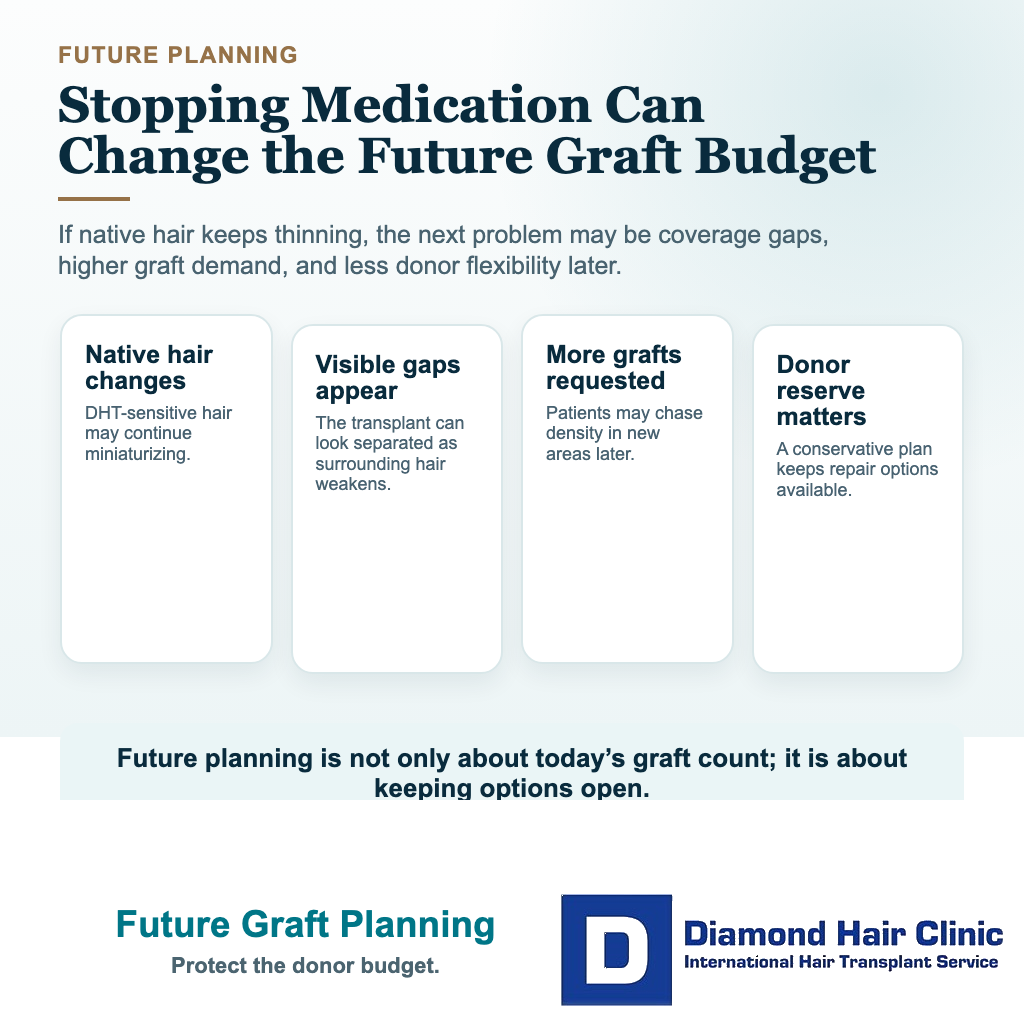
A clinic may tell the patient that more grafts will solve the problem. A high graft number can look attractive on paper, but it can weaken the future if it is not matched to donor capacity, hair caliber, recipient area size, and the likely pattern of hair loss. The process of calculating graft numbers must be done as a medical decision, not as a sales number.
After stopping finasteride following a first transplant, I factor in whether they may need a second procedure. A second operation can be very useful when the donor area was respected the first time. It becomes harder when the first operation used too many grafts too early or created a hairline that no longer fits the future pattern.
The medication conversation also changes whether a second hair transplant is worth it. The answer depends less on regret and more on what was preserved. If the donor area was protected, options remain. If it was spent carelessly, the choices become smaller.
Medication changes to discuss before stopping
Before stopping finasteride after a hair transplant, slow the decision down enough to see the whole plan. Why is the patient stopping? Is it a short pause requested around surgery, a side effect decision, a fertility discussion, anxiety about long term use, or simply fatigue from taking medication?
These are very different situations. A short pause of one or two weeks is not the same as stopping forever. A patient with side effects is not the same as a patient who is doing well but feels tired of taking tablets. A patient with stable mature hair loss is not the same as a 24 year old whose crown and mid scalp are changing quickly.
When I evaluate this decision, I look at donor quality, age, family pattern, hair caliber, crown involvement, miniaturization, medication tolerance, and how the first transplant was planned. I assess whether the patient has been promised a result that depends on medication without being told that clearly.
If a clinic makes the answer sound too neat, that is a warning sign. A useful consultation should explain the trade, not pressure the patient into one answer. It should also protect the donor area, because that is what keeps future repair or refinement possible.
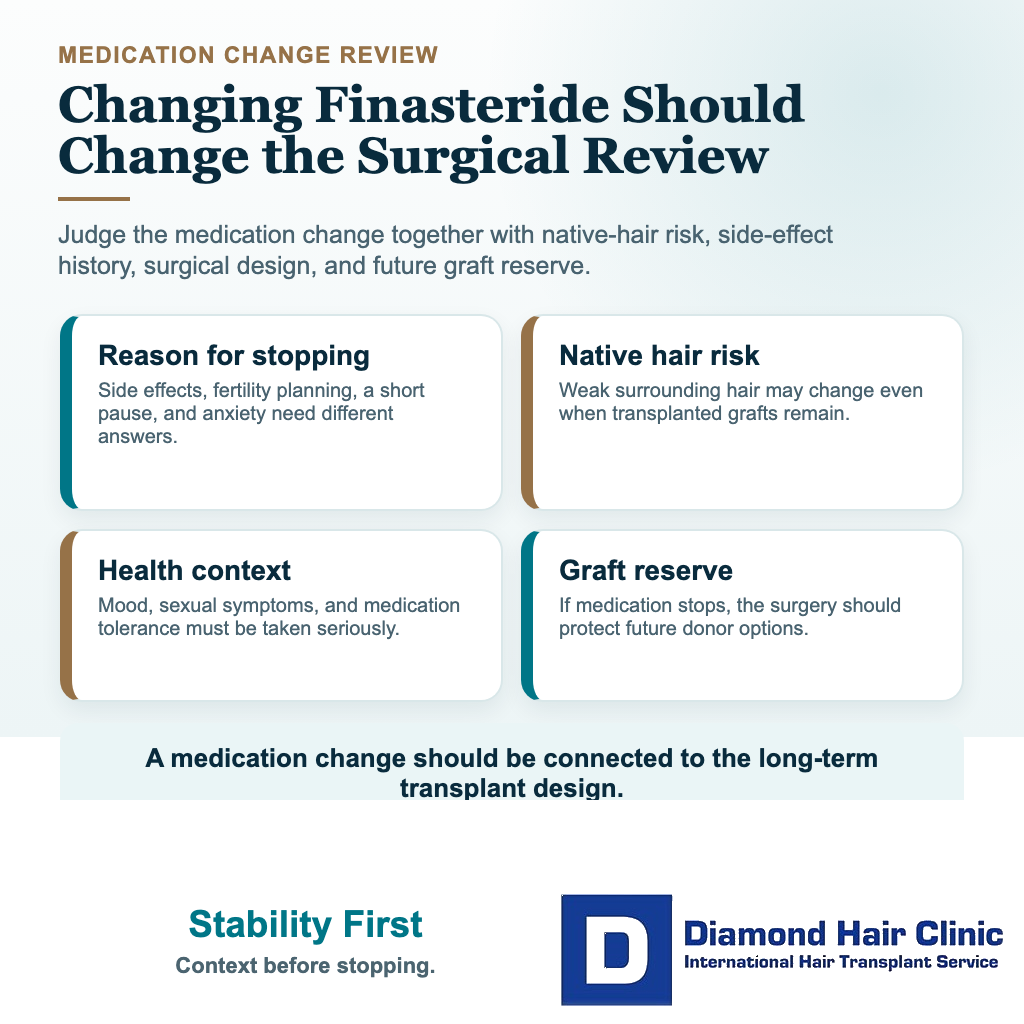
Stopping finasteride can expose native hair loss
The right decision is the one that matches your biology, your tolerance for medication, and the surgical design. If you are doing well on finasteride and your doctor agrees it is safe for you, stopping only because the transplant has grown can be a mistake. The transplant may have grown, but your native hair may still need protection.
If you cannot tolerate finasteride, you should not feel guilty. The plan should change. A conservative hairline, careful density, limited crown work, and clear long term expectations may protect you better than chasing the same dense design that would only be reasonable in a more stable patient.
Slow down if a clinic promises that you can stop medication because the transplant will solve everything. That is not how I plan surgery. A transplant can improve coverage, frame the face, and improve self image, but it cannot freeze future hair loss. Future planning means protecting the result years from now, not only creating a strong first impression.
If you are thinking about stopping finasteride after a hair transplant, do not judge the decision only by how your hair looks today. Review the native hair, the crown, the donor reserve, and the long term plan with a doctor who is willing to tell you when surgery should be more conservative. That is how the result stays natural, not just impressive for a short period.

Read this review excerpt
Diamond Hair was the only clinic asking for medications, treatments I've done before, and other type of questions that make me feel confident on the professionalism that they practice with their clients.