


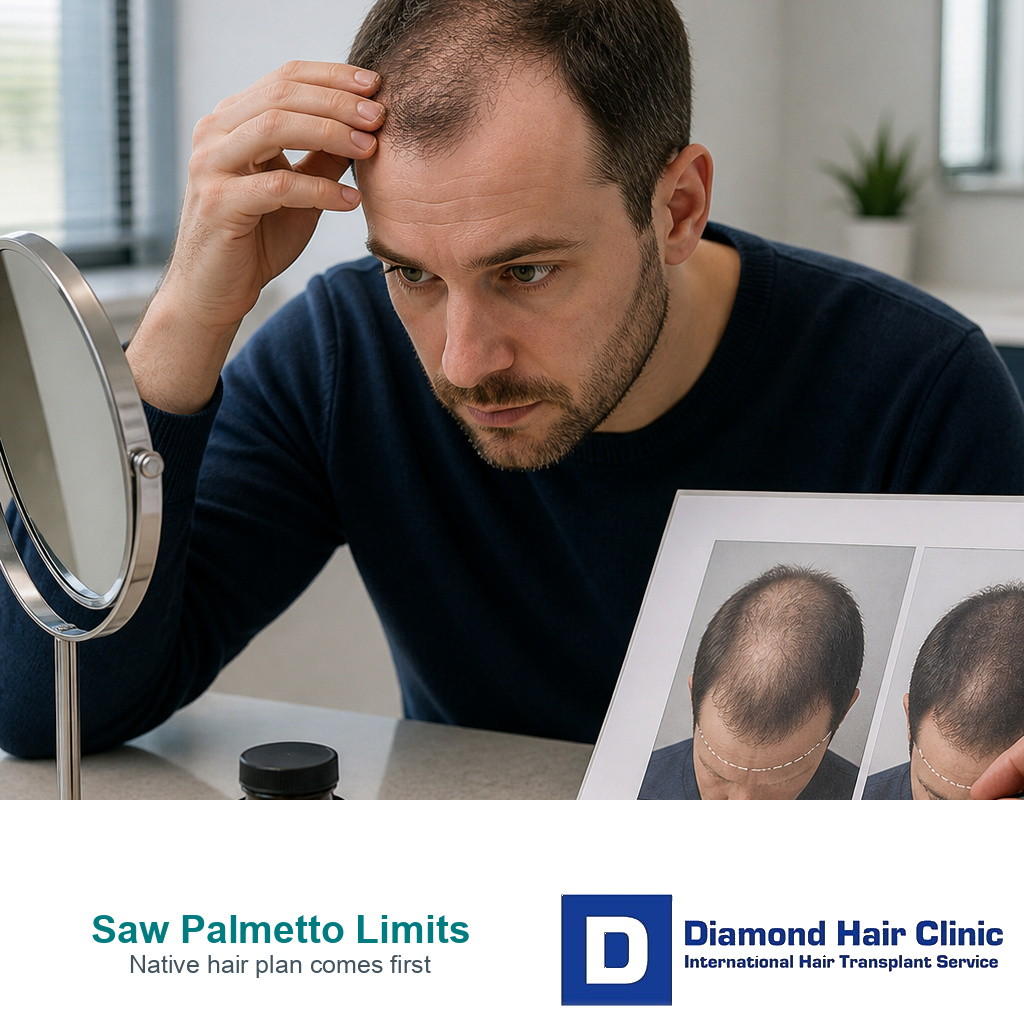
Saw Palmetto Before FUE Needs Native Hair Planning
Before FUE, I review saw palmetto as a supplement and as a clue about the native hair plan. It is not a replacement for finasteride, donor management, or long term planning. If you use it, I need the exact product, dose, ingredients, reason for use, and last use. I also need to know why you chose it.
General hair support, fear of finasteride, a previous side effect, prostate symptoms, and an attempt to hold native hair without prescription medication are different situations. A simple, disclosed capsule is not the same as a high dose blend mixed with fish oil, turmeric, pre workout stimulants, prostate medicine, or blood thinners.
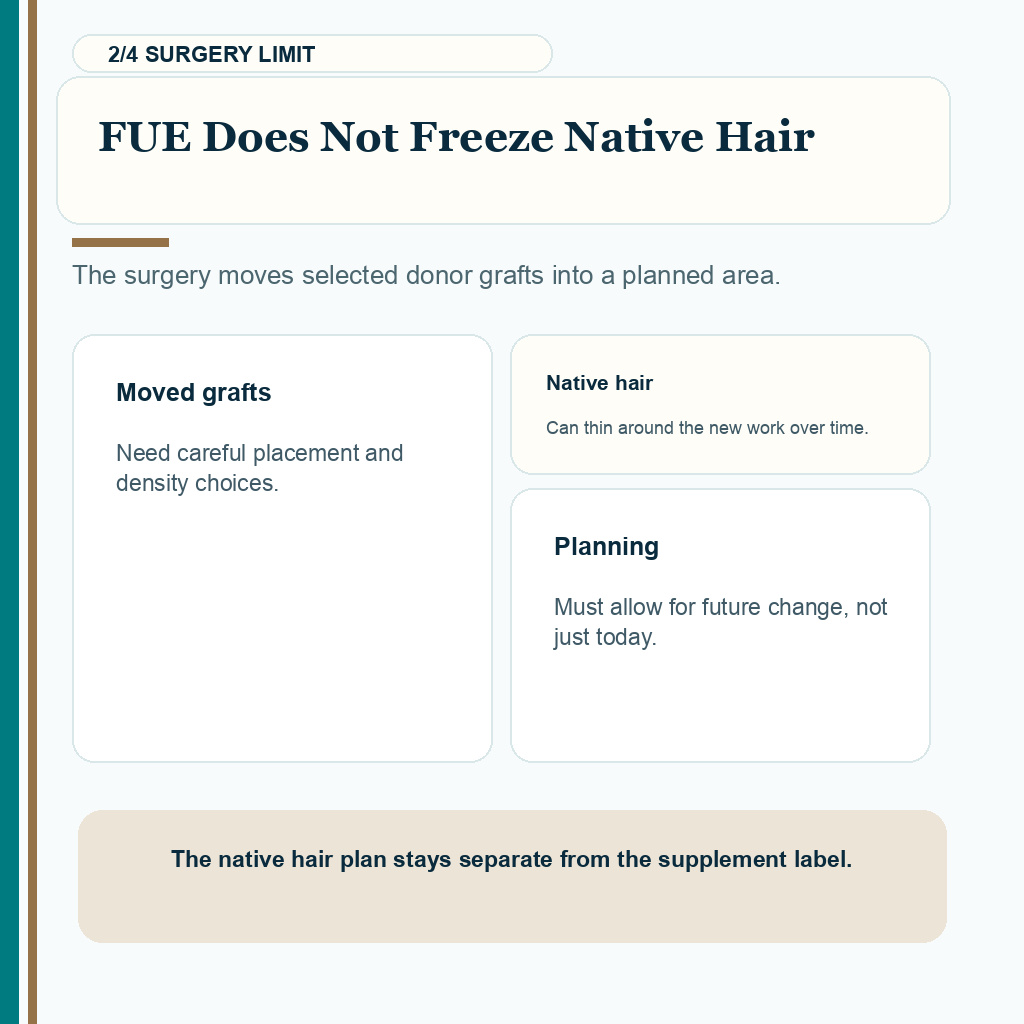
In practical terms, saw palmetto may be continued, paused, or simply noted depending on the product and your medical history. It is not a surgical treatment. Native hair still needs its own plan, because FUE moves donor hair and does not stop untreated hair around the transplant from thinning later.
Disclosure comes before confidence in the label
Do not leave saw palmetto off the list because it is sold as natural. Natural does not mean minor, predictable, or irrelevant. I do not need the list because I am against every supplement. I need it because anesthesia review, bleeding history, blood pressure, stomach irritation, liver history, prostate medication, and other tablets can change the plan.
Supplement confidence should not carry the hairline plan. If saw palmetto is your main native hair strategy, the design still has to respect the chance that loss keeps moving. If it was chosen because finasteride felt unacceptable, I treat that as a native hair planning issue, not only a supplement note.
Fish oil, turmeric, ginkgo, sleep blends, gym products, and herbal capsules also belong in the broader supplements before hair transplant surgery discussion. A label can look harmless and still contain several active ingredients. I ask for a photo of the front label and supplement facts panel because two bottles with the same front name can have different doses, extracts, additives, or mixed herbs.
If the supplement was started by another doctor or used for urinary symptoms, prostate symptoms, or another medical reason, I do not treat it like a casual hair vitamin. The route is coordination, not guessing, especially when prostate medicine, blood thinners, hormone related medicine, heart medication, or several other supplements are also involved.
Supplement planning sorter
Which saw palmetto issue changes the plan?
Use this before treating a natural supplement as a medication plan.
That is the cleanest starting point. I can review the dose and reason, but graft planning still depends on native hair risk, donor reserve, and the surgical target.
The useful split is clean disclosure, unclear product details, finasteride tolerance, recent supplement changes, women or fertility context, and whether native hair risk still dominates the graft plan.
What can saw palmetto do, and what can it not do?
Saw palmetto is marketed because it may interact with androgen pathways. That does not make it equal to finasteride or dutasteride. Only a few small studies have tested it for male pattern hair loss, and the evidence is too limited to plan surgery around. Product strength is also inconsistent. I do not design a hairline on the assumption that this supplement will hold native hair for years.
Many people arrive after reading two opposite messages. One says saw palmetto is useless. Another says it is the natural version of finasteride. Both are too simple for surgical planning. The clinical question is whether the miniaturizing native hair is stable enough for the proposed design. I look at age, family pattern, crown involvement, diffuse thinning, hair shaft quality, donor capacity, medication tolerance, and follow up photos.
When medication may change the timing of surgery, the broader medication before hair transplant decision carries more weight than the name of one supplement.
Natural does not mean irrelevant before surgery
The word natural can make people too casual. A natural product can still upset the stomach, interact with other medicines, create side effects, or confuse recovery if a symptom appears. Dietary supplements are not approved for safety and effectiveness before sale in the same way prescription medicines are, so two saw palmetto products may not represent the same extract, dose, or ingredient mix. When several products are used together, it becomes harder to know what is helping, what is causing side effects, and what should be paused around the operation.
Saw palmetto alone should not be assumed to make surgery bleed more. That would be too simple. The reason I still ask is that mixed formulas, high doses, other supplements, prescription medicines, bleeding history, and medical conditions can change surgery day review. Complete supplement disclosure is safer than a private guess.
If the product is nonessential, a planned pause may be cleaner. If it was recommended for another condition, that decision needs the doctor who knows that condition. The berry is not the main issue. The unsafe part is arriving with an incomplete medication and supplement history because the product felt too minor to mention.
Saw palmetto cannot replace a native hair plan
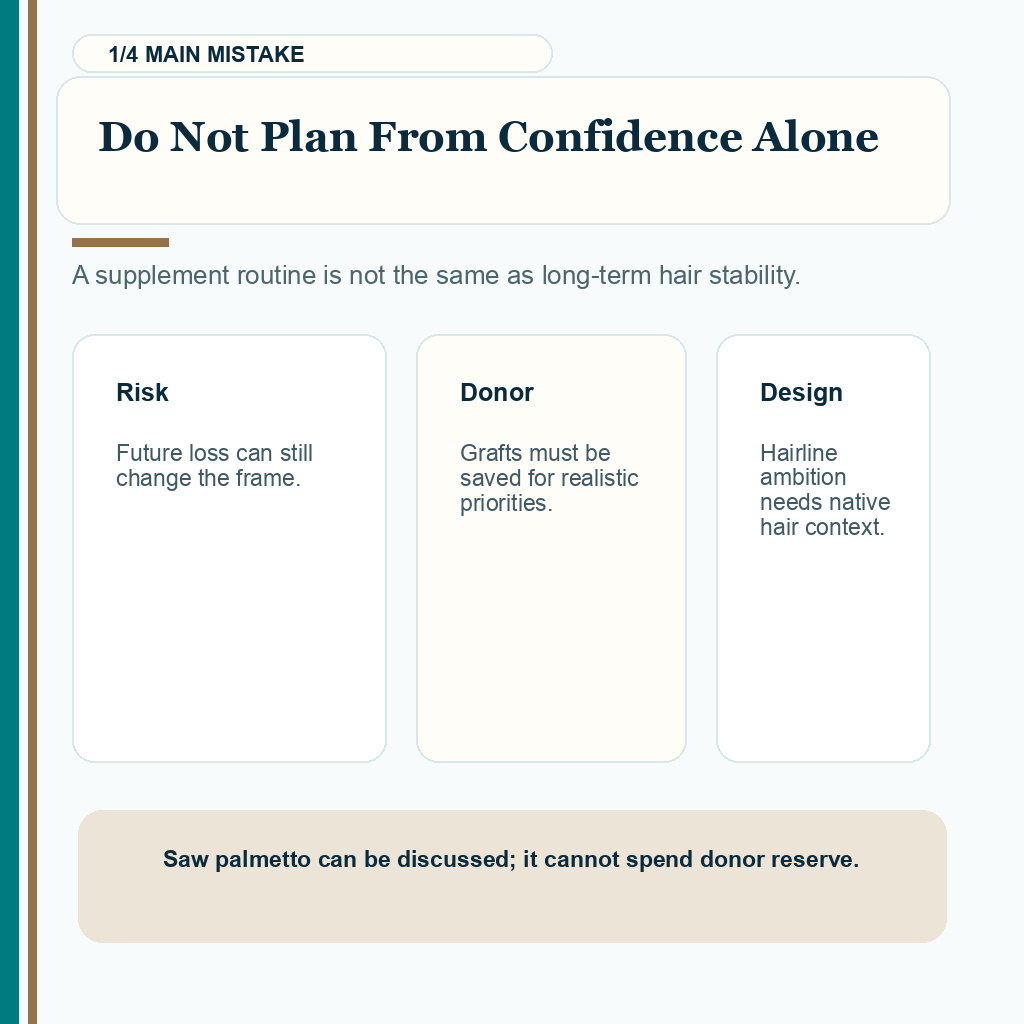
The biggest surgical mistake is using the supplement as emotional cover for an aggressive transplant. A patient may say, “I am taking something natural, so my future hair loss is covered.” That is not how I plan FUE. Transplanted grafts come from a limited donor area. Native hair around them can continue thinning, especially in young men, diffuse thinning, strong family history, and crown heavy patterns.
The hair transplant without finasteride decision has to be realistic from the start. Surgery can still be possible without finasteride in selected cases. The design may need a higher hairline, lower density target, staged approach, more cautious crown planning, or more careful temple work. Saw palmetto does not remove those design limits because the plan must still make sense if future native hair keeps changing.
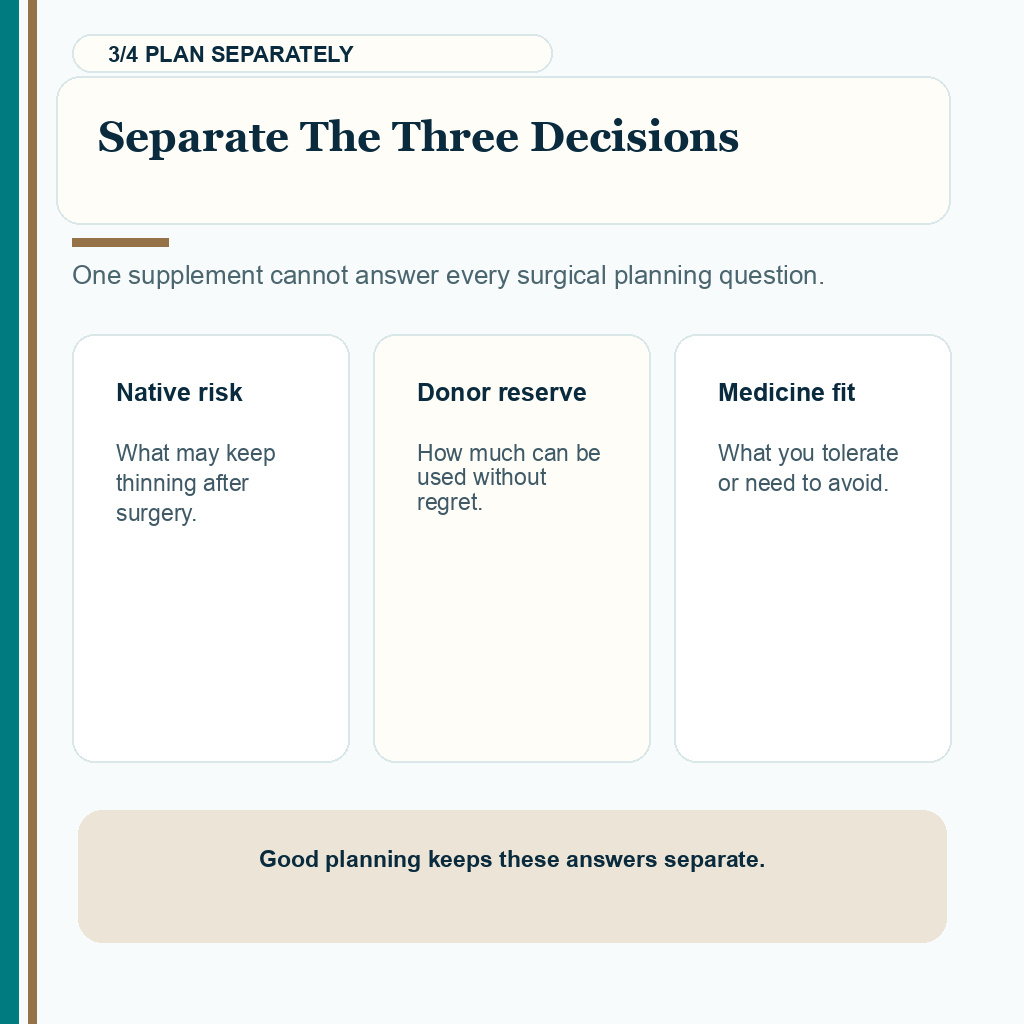
I also separate native hair risk from donor area math. FUE scars are small, but the extracted follicles are spent. The same donor math explains why donor hair does not grow back after FUE. A supplement cannot return donor grafts after they are used. The donor area is limited, so the first surgery has to make sense even if you later change or stop every hair loss product.
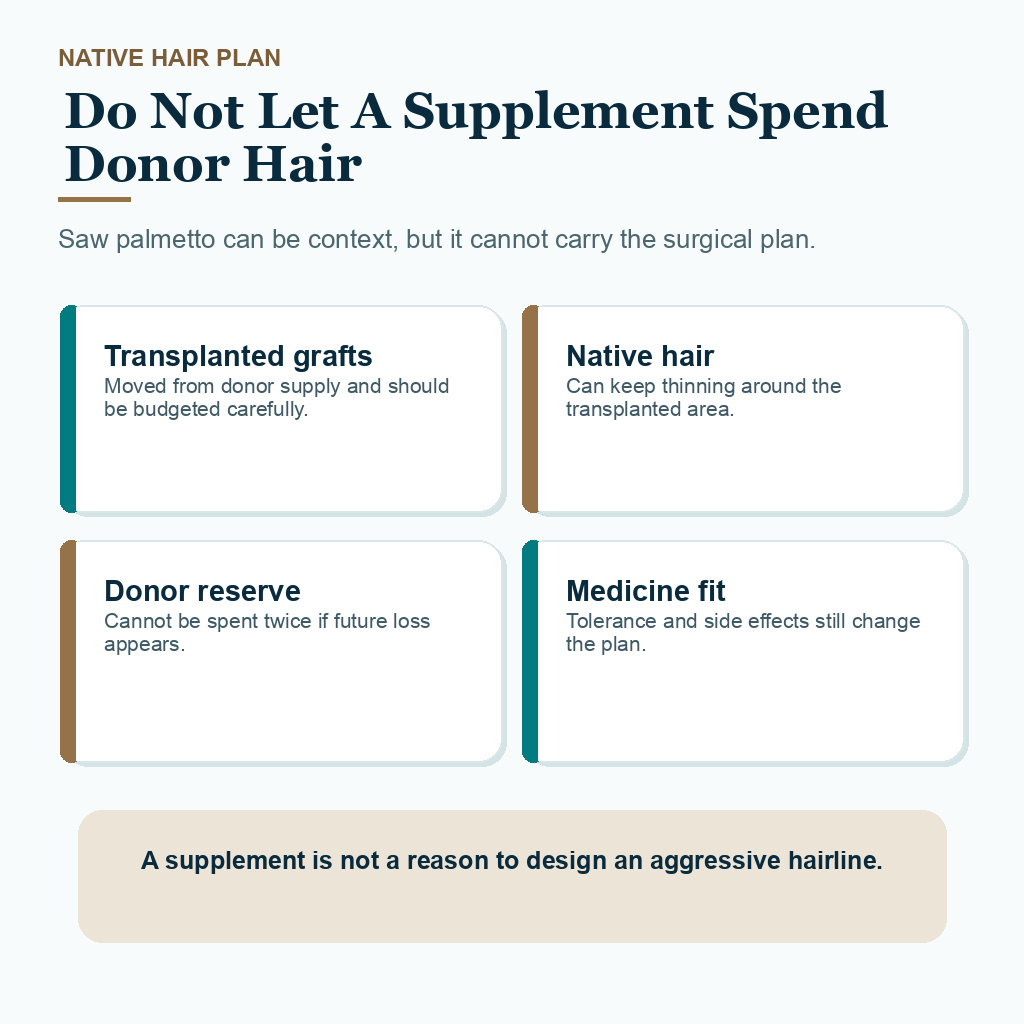
A supplement cannot make native hair planning or donor management disappear.
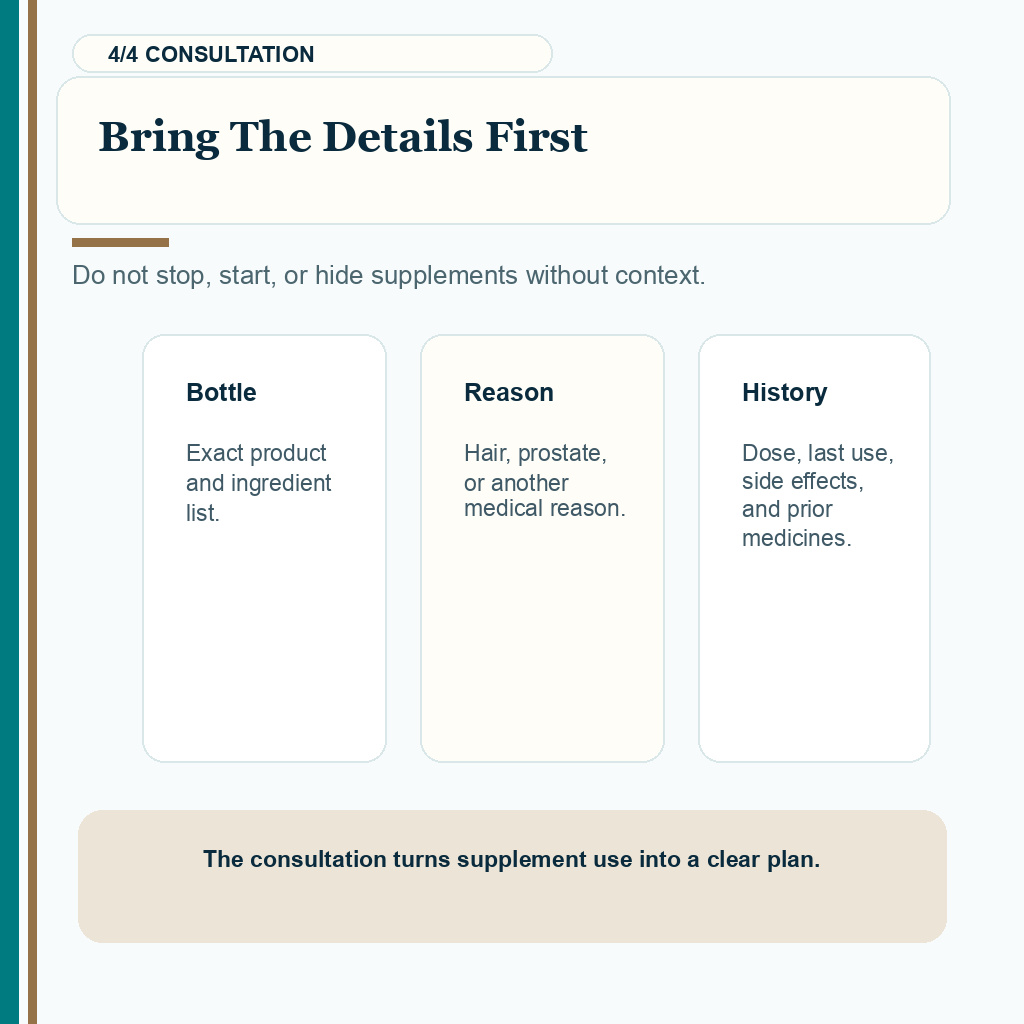
These 4 slides keep saw palmetto in the wider plan for native hair and medication choices. Swipe sideways, use the arrows, or choose a number below the image.
Finasteride side effects change the planning conversation
Saw palmetto often enters the conversation after finasteride side effects, fear of side effects, or refusal of long term prescription medication. I take that seriously. If you already reacted badly to finasteride, the transplant plan should not quietly depend on you tolerating it later.
A proven side effect, strong fear after reading online, and a simple preference for natural products are not the same planning problem. In each case, the design has to match the medication reality rather than assuming finasteride will be available later.
If saw palmetto is your compromise because prescription medication feels unacceptable, say that early. The surgical plan can then be built around that limit instead of assuming stronger medication will rescue the native hair later. That honesty is more useful than arguing whether the capsule is natural.
At the same time, replacing finasteride with saw palmetto does not make native hair risk disappear. I review the side effect history, dose, duration, recovery after stopping, mood or sexual symptoms, fertility plans, and whether a dermatologist or prescribing doctor is involved. When finasteride side effects change the transplant plan, the surgical design has to adapt to uncertain medication tolerance.
Topical finasteride can feel like a middle path. It may be worth discussing with the prescribing doctor, but it is still medication, not a cosmetic accessory. The topical finasteride before or after hair transplant question has its own timing and tolerance issues. Saw palmetto must not blur those distinctions.
How do I look at saw palmetto in women?
In women, I am even more careful about the diagnosis. Female hair loss can come from androgen sensitivity, iron deficiency, thyroid disease, PCOS, postpartum shedding, menopause, traction, scarring alopecia, medication changes, or telogen effluvium. A supplement can delay the right diagnosis if every shedding episode is treated as a simple DHT problem.
If a woman is trying to conceive, pregnant, breastfeeding, undergoing IVF, or using androgen blocking medication, the supplement list needs proper medical review. I am especially cautious with saw palmetto in pregnancy or breastfeeding because it may be unsafe in that setting, not a harmless hair vitamin. This concern also appears when finasteride, dutasteride, or pregnancy related medication limits are being compared, because pregnancy or IVF planning before hair transplant can change timing and medication decisions.
The details differ in women, but the principle is the same. Surgery should not outrun diagnosis and medical safety.
What should you bring to the consultation?
Bring the bottle, not just the name. I need the exact brand, dose, extract strength if listed, other ingredients, how often it is used, when it started, and why it was chosen. If the label says “DHT blocker,” “prostate support,” or “hair growth blend,” I still need the ingredient panel rather than the marketing phrase.
A product change after review can matter as much as starting a new supplement. If the brand, extract strength, dose, or ingredient list changes, the earlier plan should be checked against the bottle the patient is actually taking.
Also tell me whether you take finasteride, dutasteride, minoxidil, antidepressants, blood pressure medicine, blood thinners, painkillers, gym supplements, sleep products, or other hormone related tablets. If oral or topical minoxidil is part of the routine, I separate that timing question from saw palmetto. The oral minoxidil before or after hair transplant issue is different because it can involve blood pressure, heart rate, swelling, and shedding interpretation.
Good preparation is practical. Send clear scalp photos, list every product, and explain what you are afraid of losing if the product is paused. Then I can judge whether the supplement matters for surgery day, recovery, or long term hair planning.
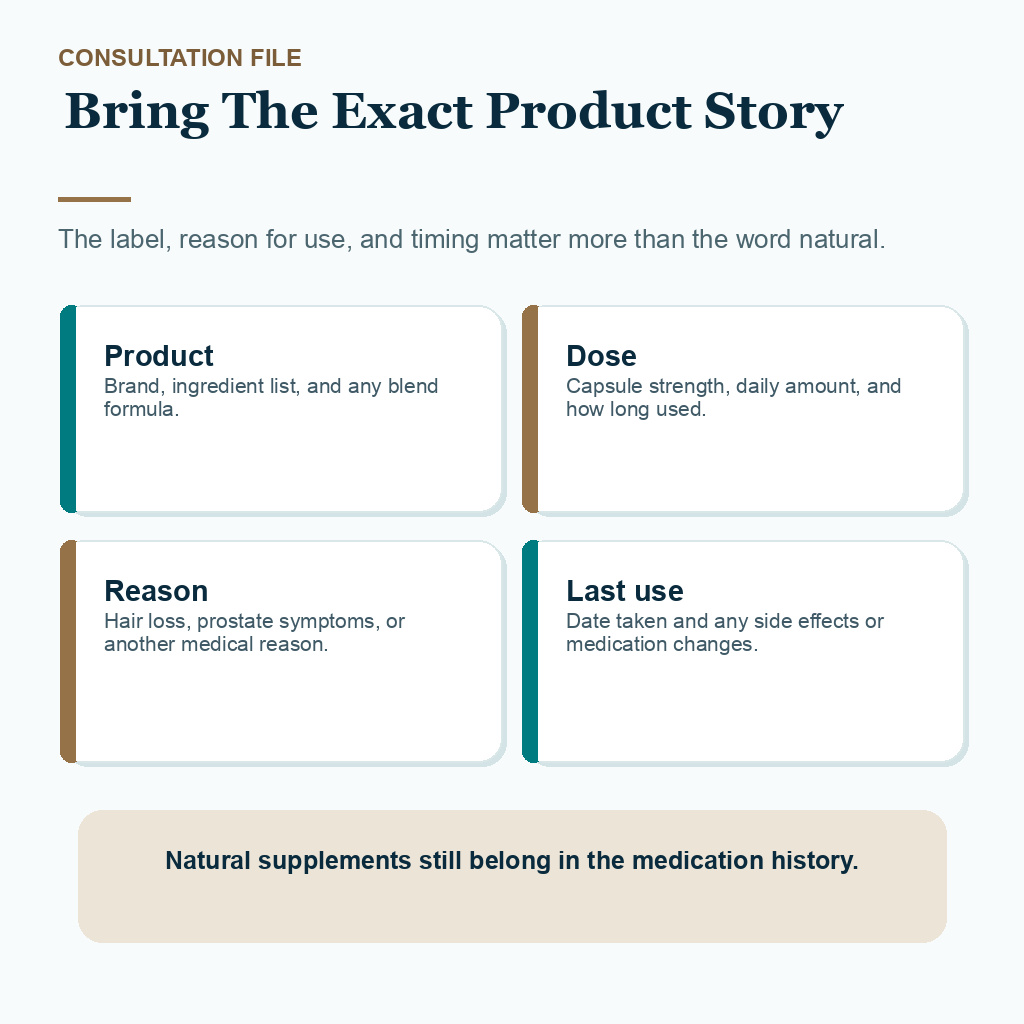
Bring the exact product details so the supplement can be reviewed before surgery day.
When might I ask you to pause or change course?
I may ask for a pause before surgery when the product is nonessential, the ingredient list is mixed, the dose is high, several supplements are being combined, or the medical history is unclear. I am also cautious when there is bleeding history, liver disease, prostate treatment, heart medication, recent symptoms, or an anesthesia plan that needs a clean medication list.
That does not mean every person must follow the same stop date, and it does not mean one forgotten capsule cancels FUE by itself. The timing depends on the product, the reason for use, the medical history, and the surgical protocol. What I do not accept is changing five products alone the night before surgery. A clean plan is made early enough that surgery day is not turned into guesswork.
If hair is still changing quickly despite tablets, sprays, or supplements, still losing hair on medication before a hair transplant becomes the more useful frame. The timing may need to wait, because one more capsule cannot rescue an unstable pattern.
How does saw palmetto change graft planning?
Saw palmetto can change the conversation even when it does not change the operation itself. If you are relying on it because stronger medication is not tolerated, I lower the risk of regret by planning less aggressively. I may avoid a very low juvenile hairline, avoid very dense temple work, delay crown promises, or stage the transplant so donor reserve is protected instead of spending it on a pattern that is still moving.
Long term planning matters more than the supplement label. A transplant can look good early and still become hard to manage if native hair continues to thin behind it. The continued hair loss after hair transplant explanation is useful because moved grafts and native hair have to be judged separately. I plan the first operation so it remains logical if you later stop saw palmetto, start prescription medication, change dose, or decide medication is not for you.
If you are already on finasteride and want to stop after surgery because saw palmetto feels easier, that is a separate discussion. Stopping finasteride after hair transplant can change the native hair background, even when transplanted grafts are growing.
The capsule stays in the background
Saw palmetto should be disclosed like any other supplement. I want to know the product, dose, timing, and reason for use, especially if it reflects fear of finasteride or concern about unstable shedding.
After that, I separate the supplement from the surgical decision. It is not a proven substitute for finasteride, not a guarantee against future thinning, and not a reason to spend donor grafts casually.
The FUE plan has to stand even if saw palmetto is stopped, changed, or found to have little effect. Donor capacity, native hair risk, hairline design, graft distribution, and follow up still carry the decision.
Read this review excerpt
He was very thorough in every little detail and I never felt pressure to do anything I wasn’t sure of.