


TRT and Hair Transplant Surgery Planning
Many patients can have a hair transplant while on TRT, but I do not treat TRT as a small detail in the plan. The transplanted grafts may grow normally, but the plan still has to account for native hair that may keep thinning under hormonal pressure.
Before I agree to surgery, the TRT history has to be clear. Why was it prescribed? Has the dose been stable? Do blood tests support the treatment? Did the hair change after TRT began? The answer affects whether the surgical design can protect your donor area for the future. TRT should not be stopped suddenly just to book an operation. The medical plan and the hair transplant plan need to fit each other before the hairline is drawn. If the plan also involves clomiphene, enclomiphene, or hCG before FUE, I want that disclosed early rather than treated as a separate detail.
Do not change TRT on your own to make surgery look simpler. I need the prescribing doctor, recent levels, dose stability, and any hair change after starting treatment before I decide how conservative the design should be. A recent dose change can make an aggressive hairline look more certain than the biology really is.
TRT changes the hair transplant conversation
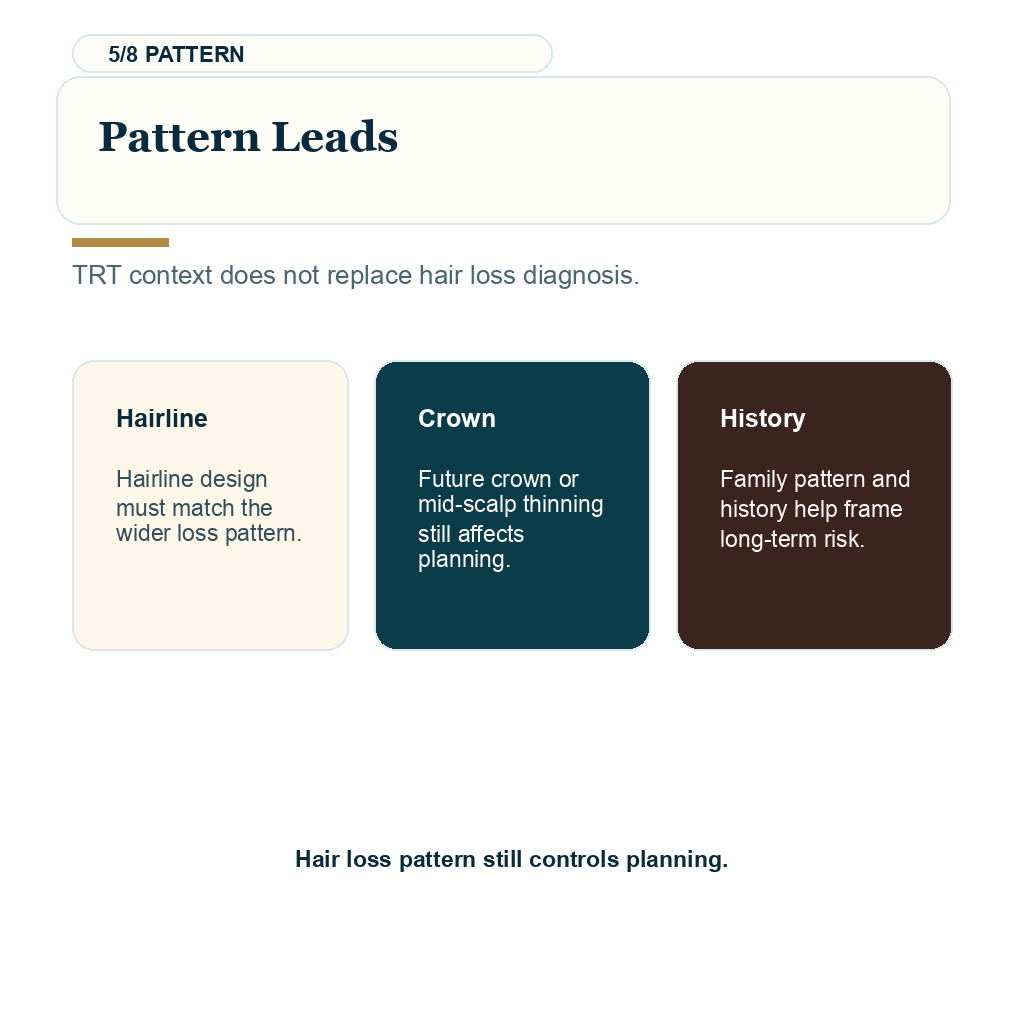
TRT changes the planning conversation because testosterone replacement therapy sits close to the biology behind many cases of male pattern hair loss. Testosterone can be converted into DHT. In genetically susceptible patients, DHT can keep miniaturizing native scalp hair. TRT can be medically appropriate and a transplant can still be reasonable, but susceptible native hair may need a more cautious design if miniaturization is already active.
In a TRT case, the bald area is only one part of the decision. The hair that still remains between the transplanted zone and the permanent donor area may decide whether the result stays connected later. If those hairs are already becoming thinner, surgery can create a nice first result but still leave the patient exposed later. The unsafe part is not always graft survival. The unsafe part is building a hairline around native hair that may keep weakening.
A stable testosterone blood level also does not prove that the hair loss pattern is stable. The hairline, middle scalp, crown, donor area, and miniaturization pattern still need to be compared over time.
That is where the discussion about finasteride before or after a hair transplant becomes relevant. Medication is not mandatory for every patient, but protection of native hair and medical suitability have to be considered before surgery. If fatherhood timing is also part of the picture, I separate hormone treatment from finasteride, dutasteride, fertility, and hair transplant planning.
Transplanted grafts and native hair are different risks
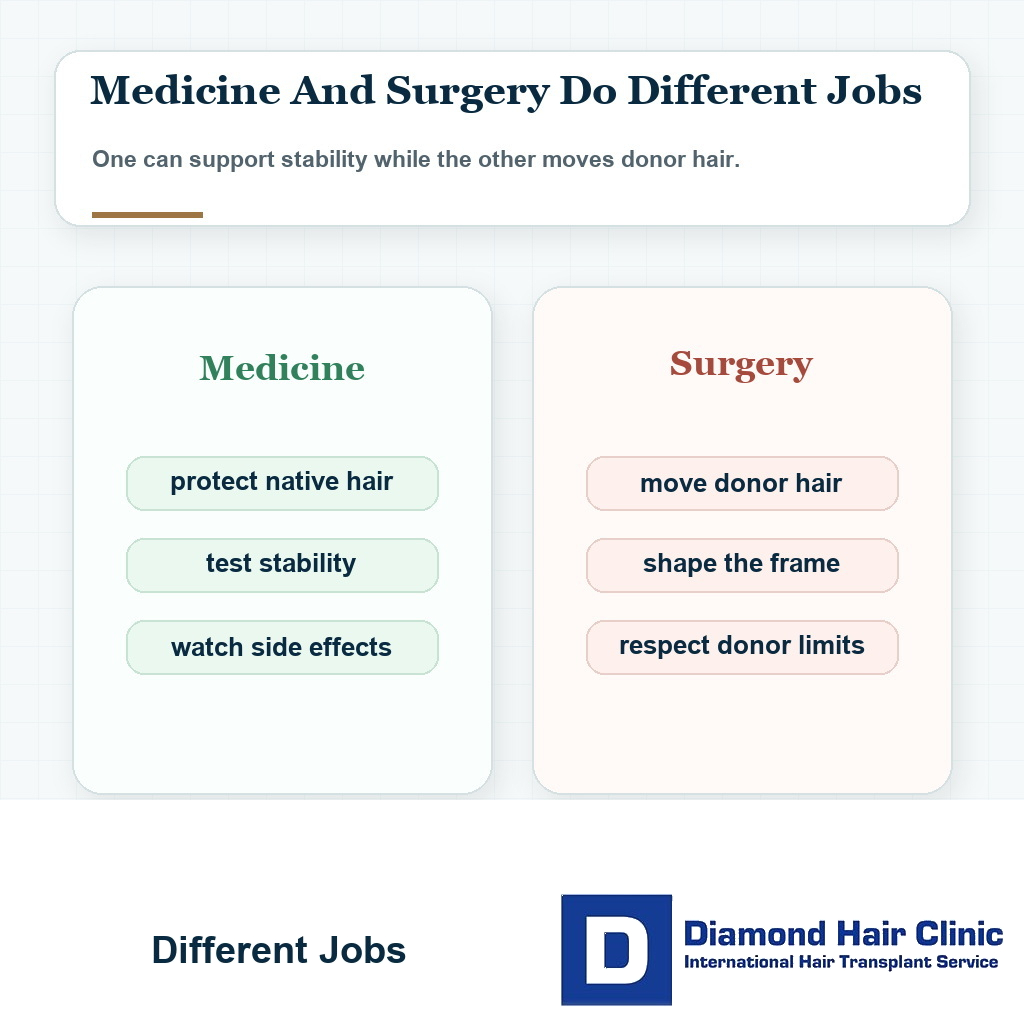
In a carefully planned hair transplant, the transplanted grafts usually come from the safer donor area. These hairs are generally more resistant to the hormonal pattern that affects the hairline, middle scalp, and crown. TRT is therefore not usually the direct reason transplanted grafts fail to grow.
But that answer can be misleading if it is given too quickly. A patient may hear that transplanted grafts are resistant and think the whole result is protected. That is not how I plan surgery. The transplanted hairs may be stronger, but the native hairs around them can still change. If the native hair keeps thinning, the transplant can start to look isolated, thin behind the hairline, or poorly connected to the rest of the scalp.
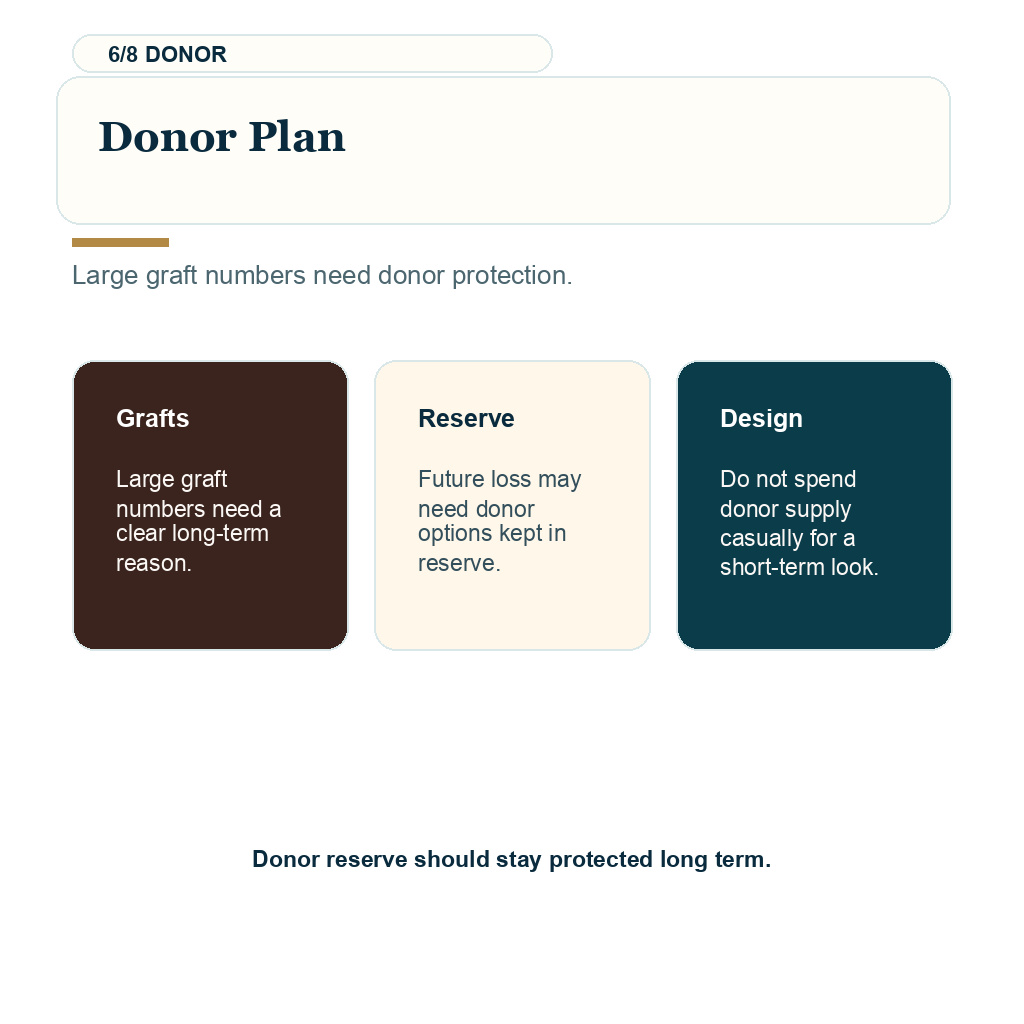
TRT is not usually the reason transplanted grafts fail, but it may make the surrounding hair loss pattern more important to the plan. A result can look good at first and still become less satisfying if the plan ignores future loss. The stronger plan protects donor capacity instead of chasing a dramatic transformation in one session.
Details that decide whether surgery is reasonable
The TRT label alone does not tell me enough. The treatment history should show whether TRT is medically prescribed for a clear reason, whether levels are monitored, whether the dose has been steady, and whether hair loss changed after starting treatment. Crown thinning, diffuse thinning, family history, rapid miniaturization, and previous surgery also change the decision.
There is a big difference between stable, medically supervised TRT and androgen exposure that changes frequently. There is also a big difference between a mature hairline with slow change and rapid loss across the top. In the second situation, surgery may still be technically possible, but the timing may be wrong.
At that point, being a good candidate for a hair transplant becomes more than a general phrase. A good candidate is not simply someone who has enough bald area to fill. A good candidate has a pattern that can be planned, a donor area that can support the goal, and medical details that do not make the plan unstable.
Prescribed TRT and higher testosterone exposure
Patients sometimes use the word TRT for very different situations. Medically supervised replacement treatment that has been stable for months is not the same as a recent start, a dose increase, higher testosterone exposure, or changing androgen cycles. I do not treat those histories as the same surgical risk.
Official drug information supports this caution. Testosterone treatment should be medically indicated, monitored, and stable, and use above the prescribed direction carries a different risk. I ask for the prescribing context instead of treating every TRT history as one category.
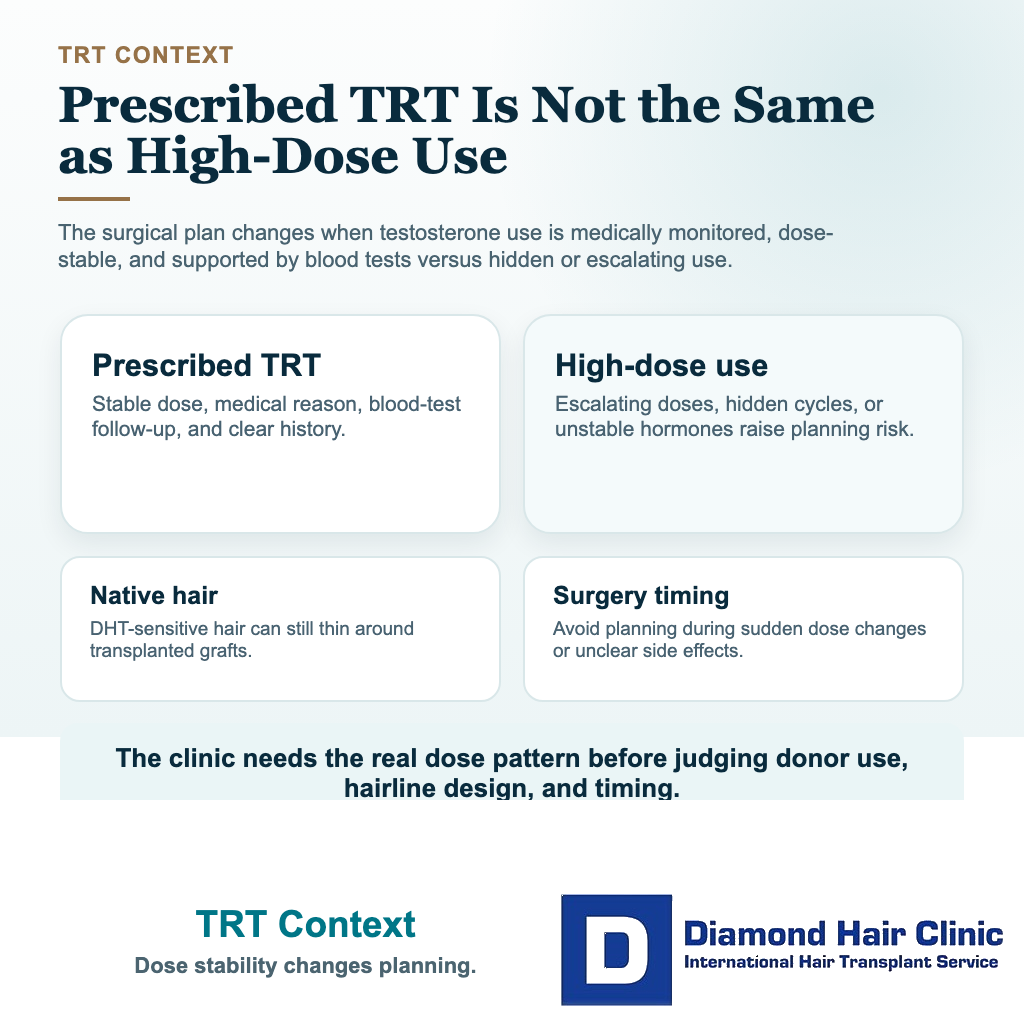
With medically supervised TRT, the relevant details are the dose, the reason it was prescribed, recent blood tests, blood pressure, sleep apnea history, and whether the prescribing doctor considers the treatment stable. If a patient is using higher doses, adding other anabolic compounds, or changing levels frequently, the hair loss pattern may be much harder to predict.
The difference matters because the transplant plan depends on future native hair. A stable medical replacement plan may be manageable. Unstable androgen exposure can make hair loss, shedding, acne, scalp oiliness, and patient anxiety much harder to interpret.
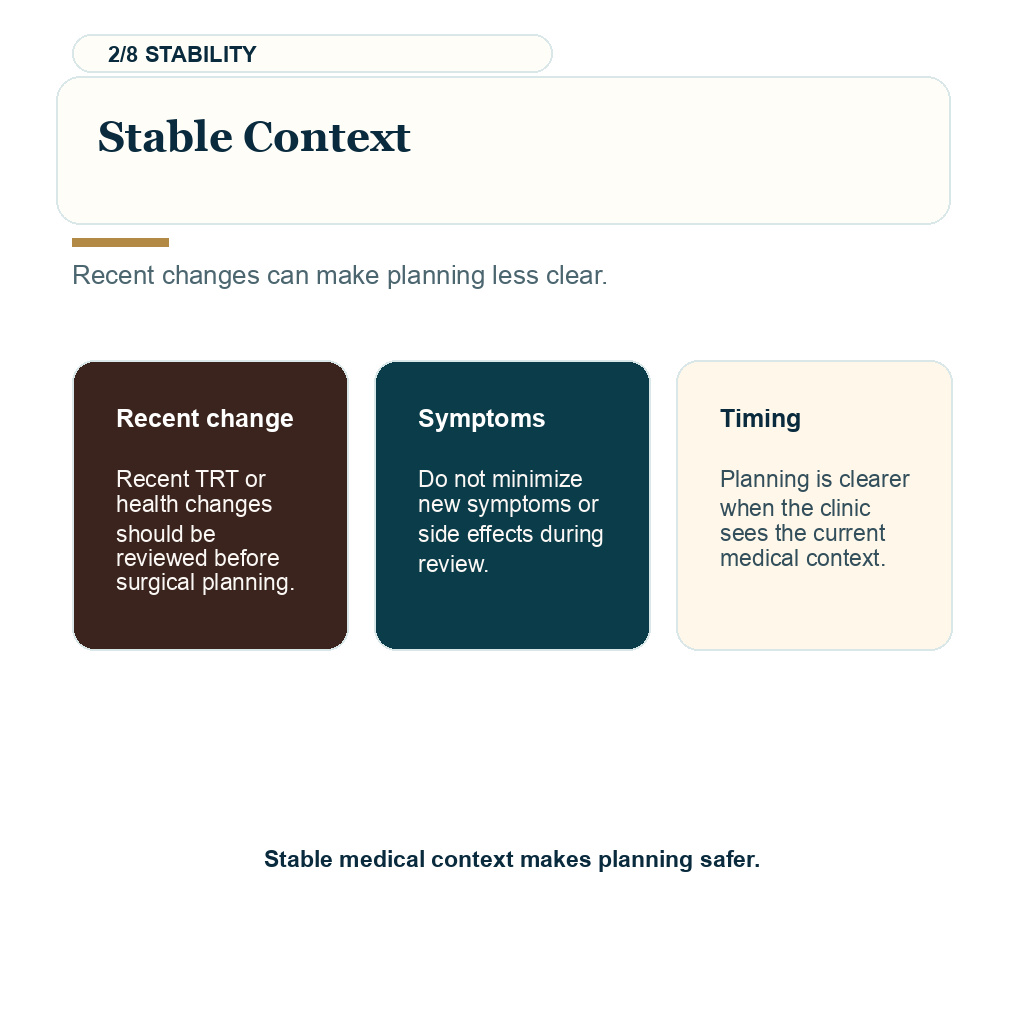
Stability is the practical line. If the dose, formulation, blood tests, and symptoms have been steady, the hair pattern can be judged more responsibly. If the patient is changing doses, adding compounds, or moving through cycles, surgery is usually better delayed until the picture is clearer.
Surgery without finasteride needs a more conservative plan
Some patients can have surgery without finasteride, but the plan usually has to become more conservative. That caution becomes stronger when TRT is part of the background. Finasteride should never be presented casually if there are real side effect concerns, previous hormone sensitivity, or anxiety about sexual or mood changes. Still, I cannot pretend the decision has no surgical consequence.
If a patient does not want finasteride, I look more carefully at age, family history, miniaturization, donor strength, crown involvement, and the speed of hair loss. I may design a higher hairline, use fewer grafts, avoid aggressive crown coverage, or recommend waiting. The aim is not a weaker result. It is a result that can age better.
For some patients, a hair transplant without finasteride can still be reasonable. For others, the same decision can make surgery fragile. If a patient also has gynecomastia or hormone sensitivity, the plan should slow down and stay medically disciplined instead of pushing the patient toward a treatment that does not feel safe.
Blood tests matter before surgery
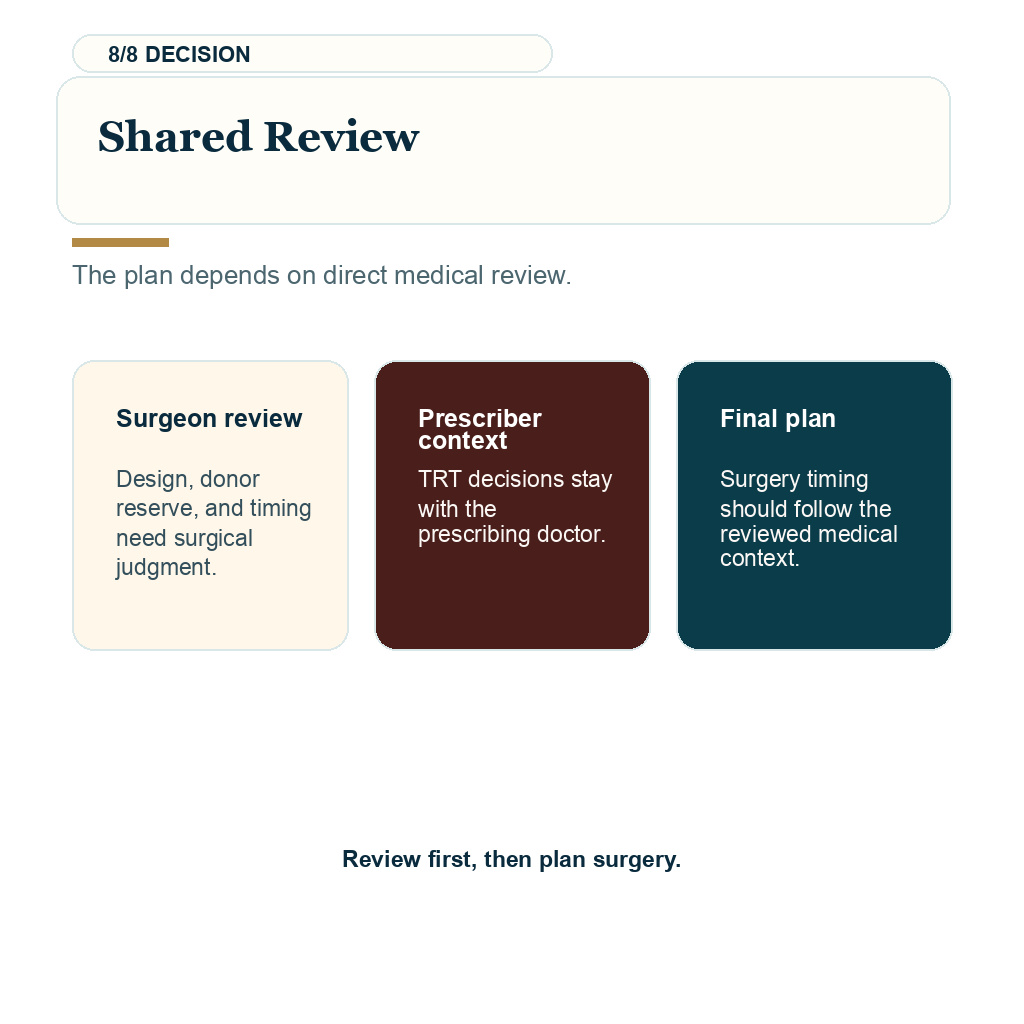
Blood tests matter because TRT is not only a hair conversation. It is a medical treatment, and surgery should not be planned while the medical side is unclear. The prescribing doctor should manage TRT, and the surgical team should know that the patient is medically stable before we operate.
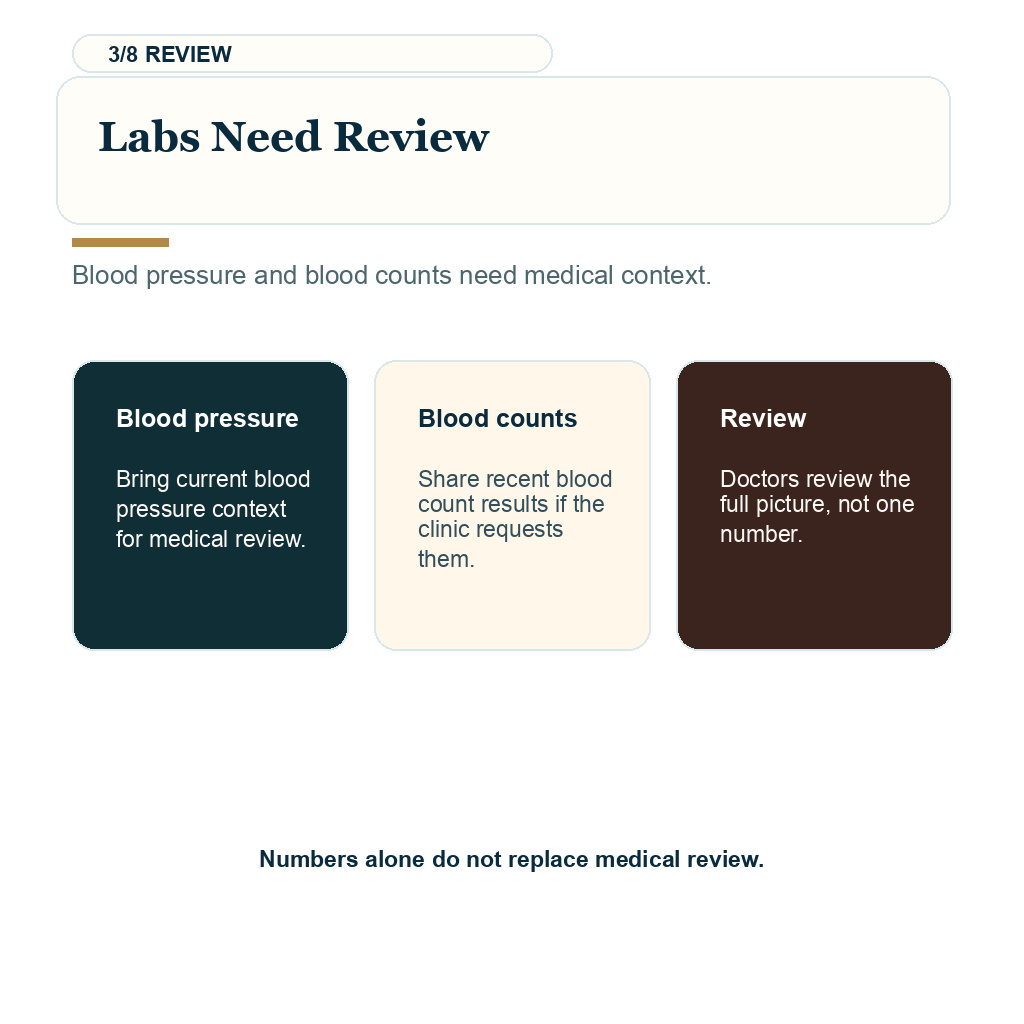
The medical review includes recent blood tests, hematocrit or red blood cell count when relevant, blood pressure, sleep apnea history, heart history, and current medication use. A hair transplant is performed under local anesthesia, but it is still a surgical procedure. If medical results are unstable, blood pressure is uncontrolled, or medication use is unclear, the right answer may be to pause the surgery plan until the medical side is clearer.
For me, blood tests before a hair transplant are part of surgical safety, not a formality. If sleep apnea is part of the history, I also connect the planning with sleep apnea and CPAP before a hair transplant. The patient may feel ready emotionally, but the scalp and the body both need a careful plan.
Handling TRT and other medications around surgery
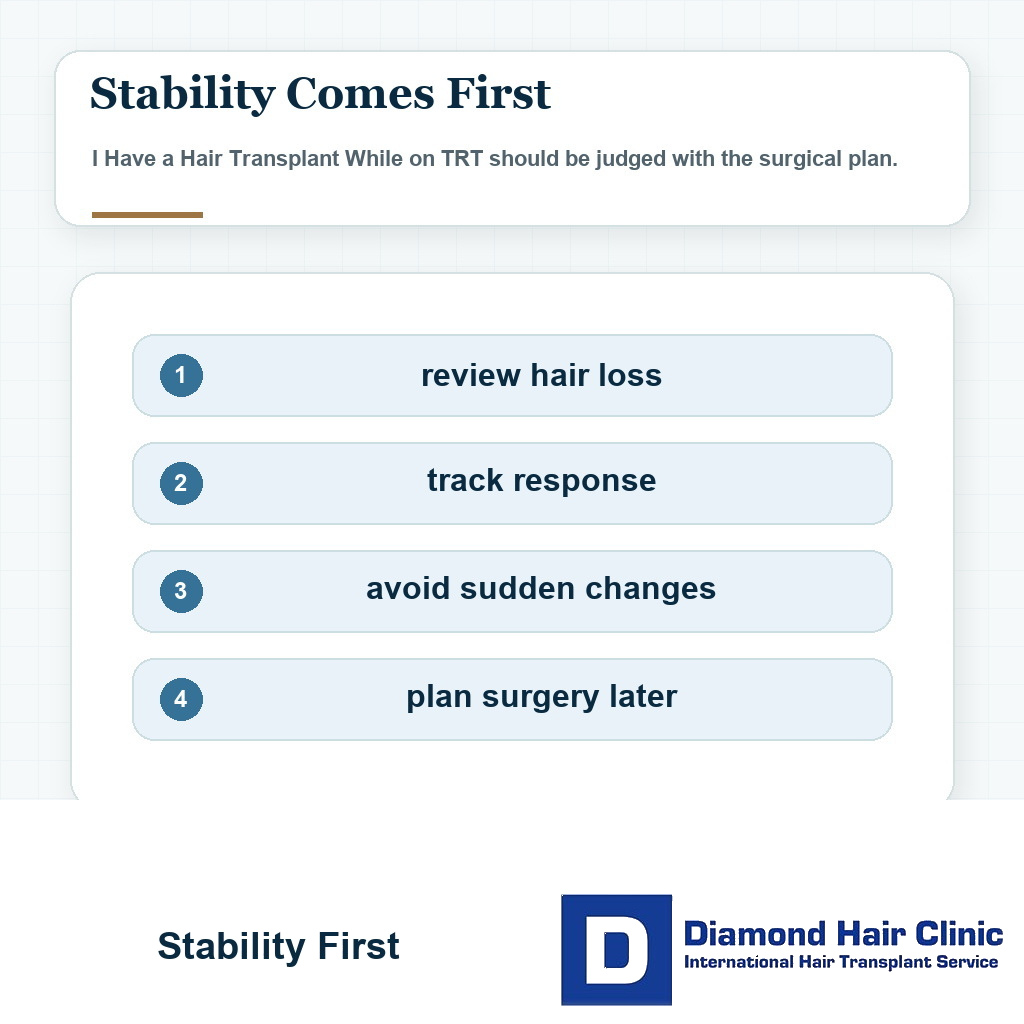
I am strict about sudden medication changes made only because a surgery date is approaching. If TRT was prescribed for a medical reason, the prescribing physician should be involved in any change. Stopping abruptly can create symptoms and anxiety that may make recovery harder, and restarting without guidance can also create confusion.
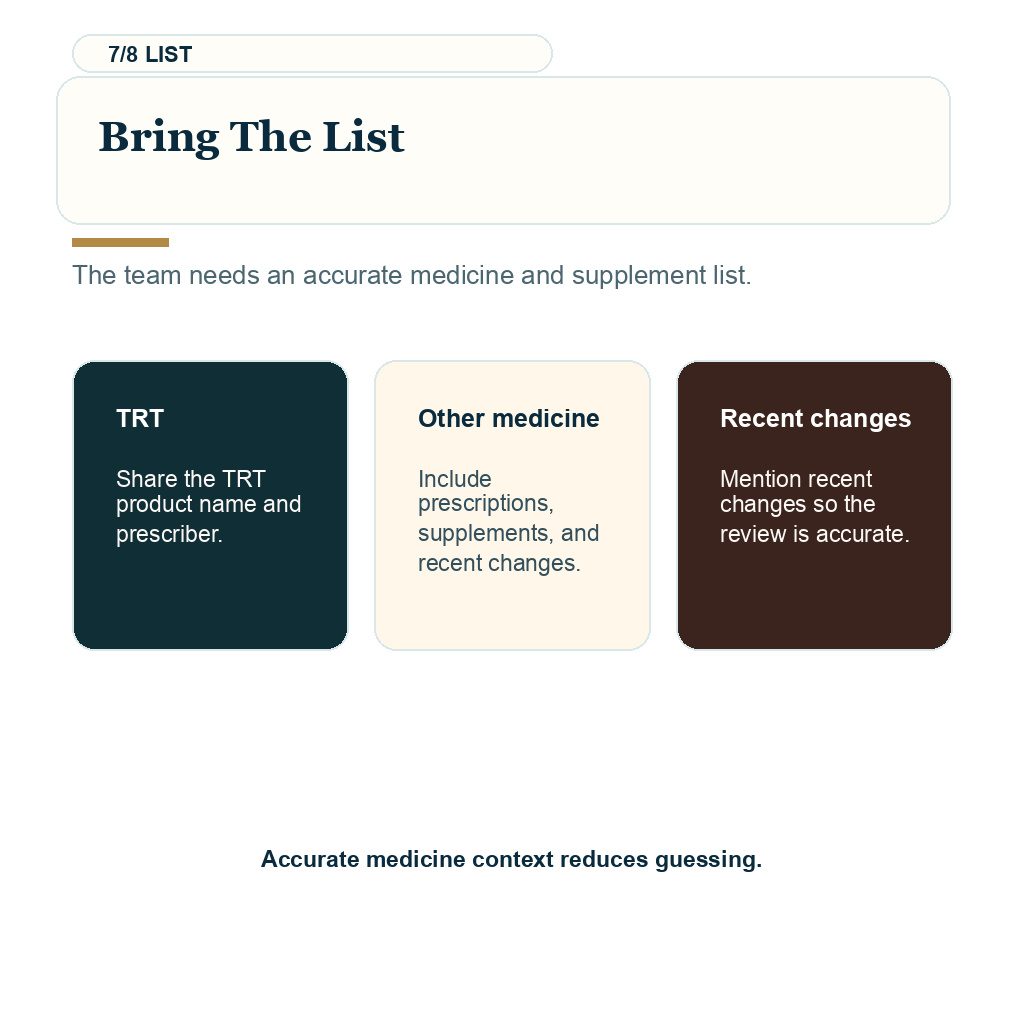
Medication and supplement planning should include minoxidil, finasteride, dutasteride, blood pressure medication, antidepressants, creatine, other supplements, and anything that may affect bleeding, healing, or the patient’s comfort. The plan should be written clearly before surgery, not improvised in the final week. A clean medication plan reduces panic after the operation.
TRT belongs in the same pre surgery medication before a hair transplant conversation as minoxidil, finasteride, supplements, and training habits. If all of them change in the same short period, we may misread shedding, inflammation, healing, anxiety, or continued loss after surgery.
Hairline and graft number planning
With TRT in the background, hairline placement and graft numbers need extra caution. If native hair may continue to thin, a very low hairline can become a burden. It uses donor grafts at the front while the middle scalp or crown may need help later. A patient may love the design at month twelve and then regret the donor use five years later.
I do not calculate grafts only by looking at the empty area. I calculate them by asking what the donor area can safely give, what the future pattern may require, and what level of density will still look natural if the native hair behind the transplant changes. The way a surgeon calculates the graft number matters more than the highest number a clinic is willing to promise.
Careful planning is part of the surgical decision itself. If a TRT patient wants aggressive frontal density but has signs of diffuse thinning, the stronger decision is to protect the donor area and create a plan that can still be defended years later.
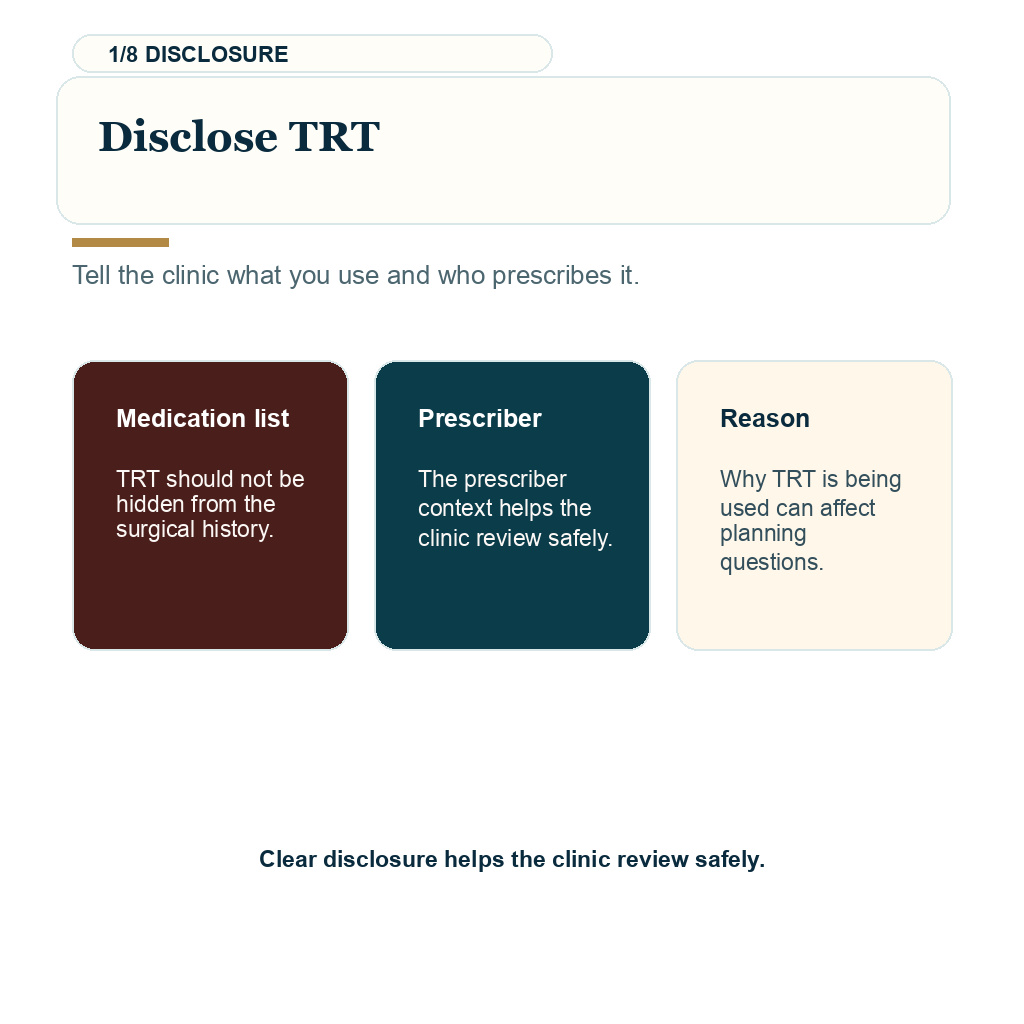
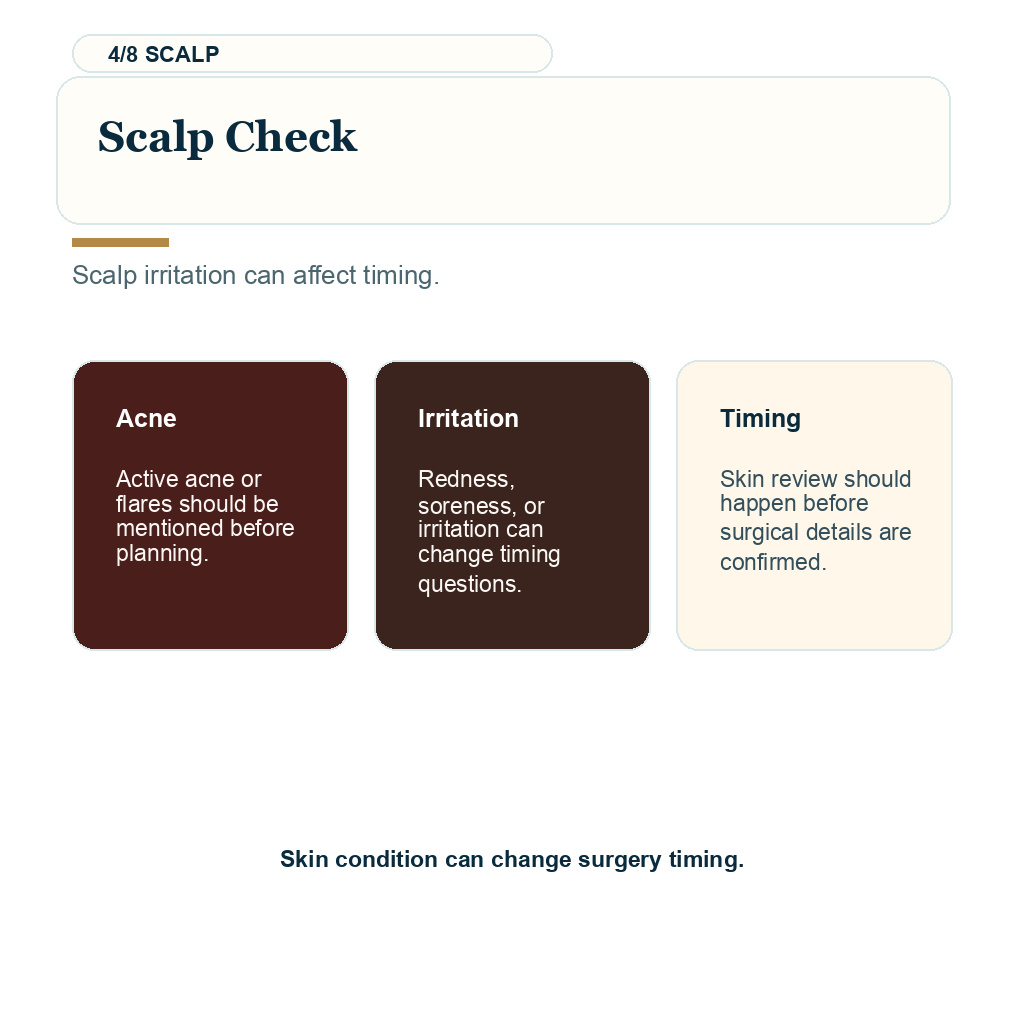
Use the 8 TRT planning slides below to separate disclosure, stability, lab and blood pressure review, scalp condition, hair loss pattern, donor planning, the current medicine list, and surgeon plus prescribing doctor review. Swipe sideways, use the arrows, or choose a number below the image.
Waiting can be wiser than operating
Waiting is wiser when the hair loss pattern is moving faster than the surgical plan can safely follow. If a patient recently started TRT and then noticed rapid thinning, surgery should not be rushed before we understand whether the shedding is temporary, ongoing, medication related, or part of male pattern progression.
Waiting may also be wiser when the patient is still deciding whether hair loss medication is tolerable, when blood tests are not stable, when the donor area is limited, or when the patient wants a low, dense hairline that does not match future risk. In these cases, the operation may be possible, but possible is not the same as wise.
A delayed surgery can be a better surgery. Waiting is not punishment. It is sometimes how we avoid a hair transplant too early while hair loss is active. Once donor grafts are used, we cannot put that donor capacity back.
Photos need context for a TRT patient
Photos are useful, but for a TRT patient they are not enough by themselves. A photo can show the visible pattern, but it cannot fully show miniaturization, medication history, hormone stability, donor density, scalp condition, or the patient’s tolerance for future uncertainty. A photo may make a case look simple when the medical background makes it more delicate.
A large graft number offered quickly deserves scrutiny. A big number can feel reassuring because it sounds decisive. The decision depends on whether the number matches the donor area, the future pattern, and the patient’s medical reality. A plan that ignores TRT history can still look confident on paper.
A hair transplant plan based only on photos is too thin for a TRT patient. The plan needs medical context, not only a drawing on the hairline.
Judging whether the plan is safe
A cautious plan should not make you feel rushed. It should explain why the proposed hairline is placed where it is, why the graft number is appropriate, what may happen if native hair continues to thin, and how the donor area will be protected. The explanation should be clear enough that you can understand it without being pressured by fear or excitement.
For a TRT patient, the plan becomes weaker if it ignores medication history, promises that TRT does not matter at all, recommends a very low hairline without discussing future loss, or treats finasteride as one fixed answer. It also concerns me when the clinic only talks about density and not donor management, blood results, or the native hair that may keep changing.
A hair transplant is not only the movement of grafts into the recipient area. It is a lifetime distribution plan. If the first plan is too aggressive, the second plan becomes harder. If the first plan respects the donor area, the patient keeps more options.
TRT should be disclosed before graft numbers are chosen
Testosterone treatment does not make every patient unsuitable for FUE, but it changes the conversation. The clinic needs the dose, prescribing doctor, blood work, stability, side effects, and whether shedding changed after treatment started.
Do not stop TRT suddenly without the prescribing doctor, and do not hide it from the hair transplant team. Native hair risk, medication choices, donor use, and recovery decisions all depend on the real medical history.
TRT cannot be treated as background noise. It has to be reviewed before hairline, crown, and graft numbers are discussed.

Read this review excerpt
Every single one of my questions was answered and they made sure I had all the details I needed to make an informed decision.