


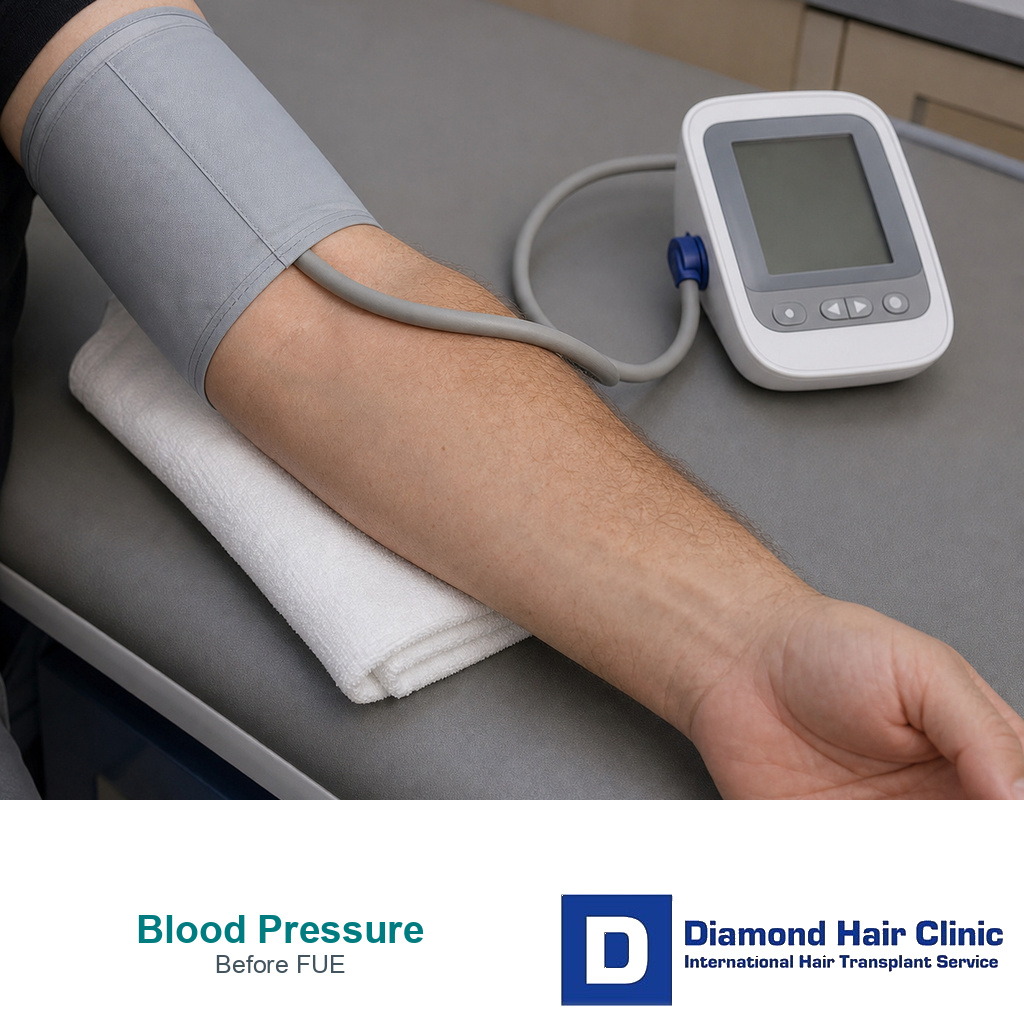
Blood Pressure Stability and FUE Surgery Safety
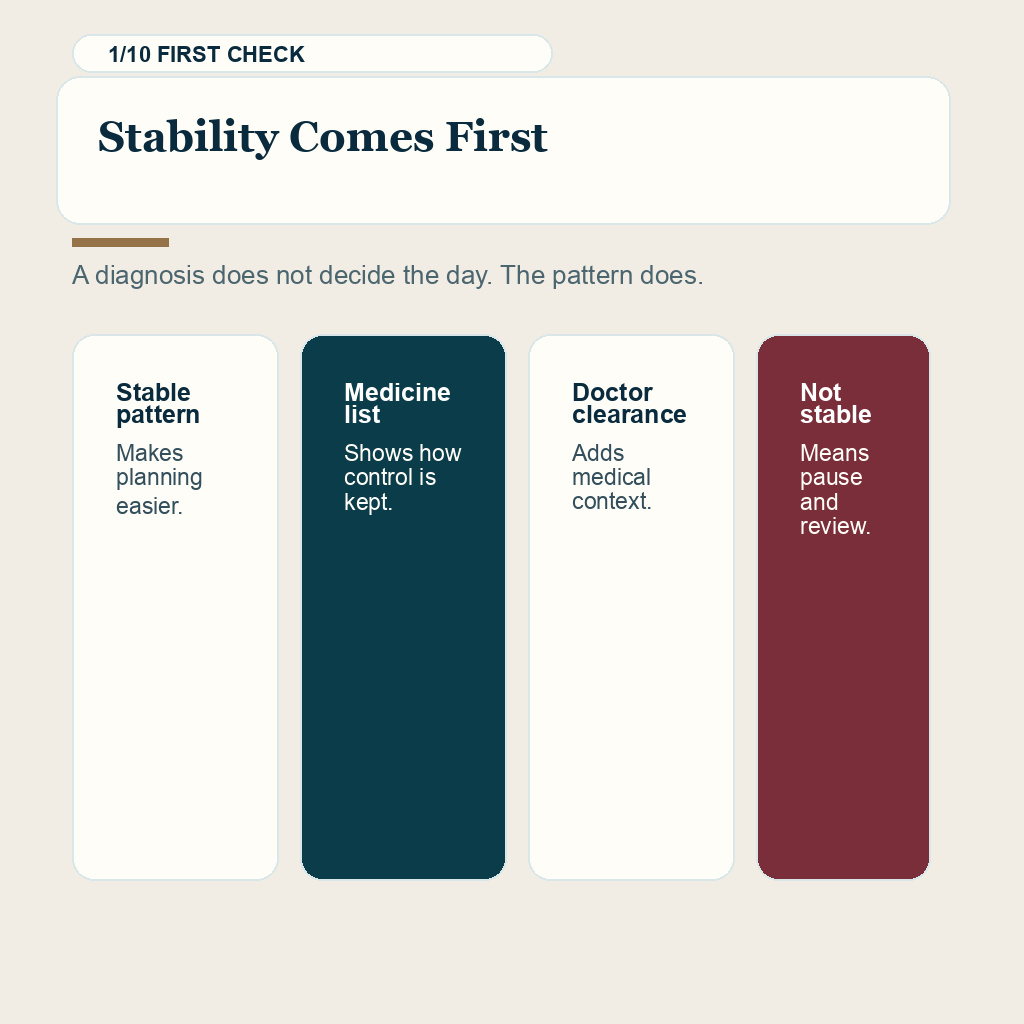
Many patients with controlled high blood pressure can have a hair transplant, but the answer is not a quick yes. The diagnosis starts the conversation, but it does not finish it. I need to know how stable your readings are, which medication you use, whether your doctor considers you fit for a procedure under local anesthesia, and whether the readings stay acceptable on the day of surgery. I check erectile dysfunction tablets after a hair transplant, because blood pressure medicine and heart symptoms can change the advice. A new episode of heart racing before a hair transplant also needs the pulse, blood pressure, symptoms, and medicine history reviewed together.
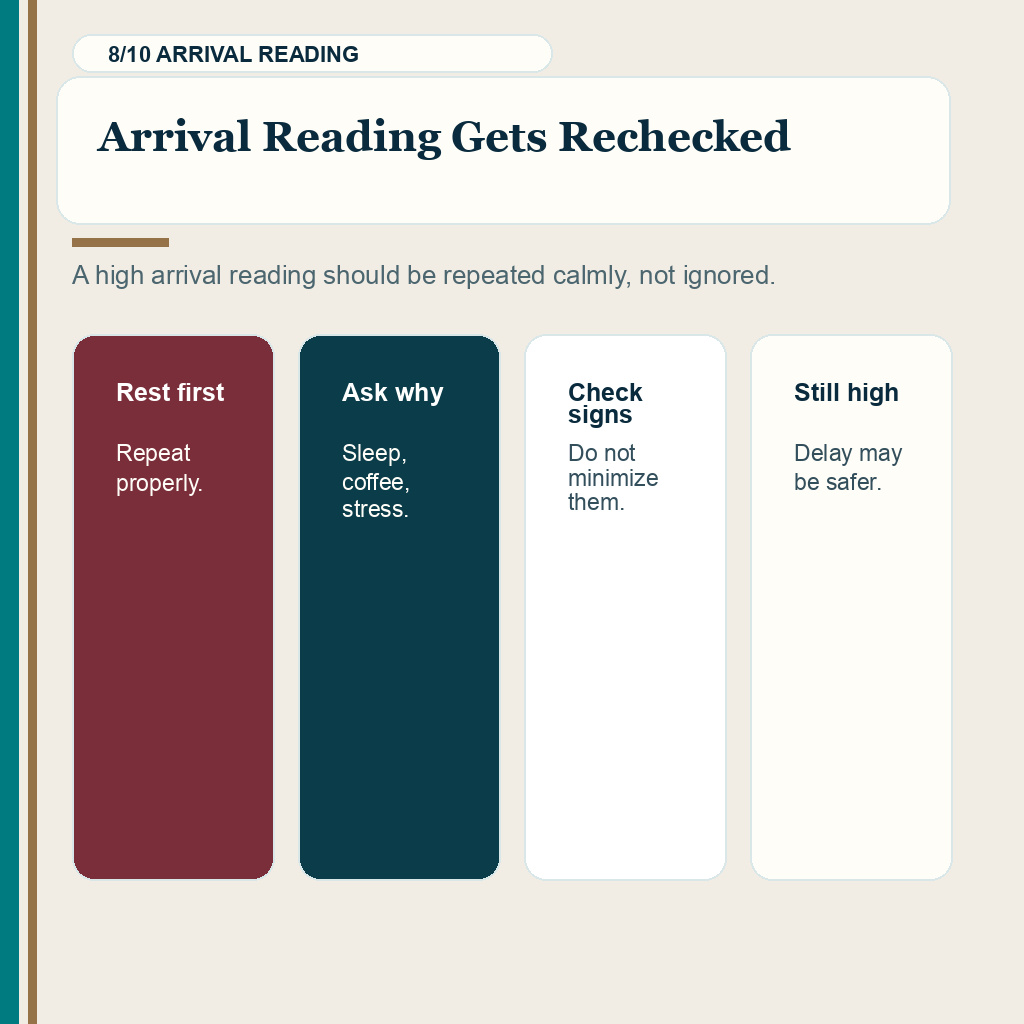
The mistake is to treat hypertension as either harmless or impossible. One nervous reading after travel is different from repeated high readings at home, chest symptoms, or medication that has recently changed. Those are also the moments when ECG and chest X ray decisions before surgery may enter the discussion. Controlled readings are usually manageable, but uncontrolled readings are a reason to pause, reassess, and sometimes delay surgery. A hair transplant is elective. If your health is not stable enough, waiting is not failure. It is surgical judgment. When a reading rises around surgery day, I recheck it calmly, let the patient rest, and judge the whole medical picture before deciding whether to continue, delay, or get medical review.
A useful blood pressure history also includes recent changes that may lower readings or create symptoms. Dieting, fasting, dehydration, hair loss medicine changes, and lightheadedness belong beside the numbers because a stable plan is different from a number that only looks acceptable on one day.
Readings that make me pause
Patients often want one exact number. In elective surgery, a reading around or above 180/110 mmHg is a serious warning sign and is usually a reason to stop, repeat the measurement after the patient has rested, check for symptoms, and consider postponement or medical review. I do not treat that number as a target. I treat it as a threshold that should not be ignored.
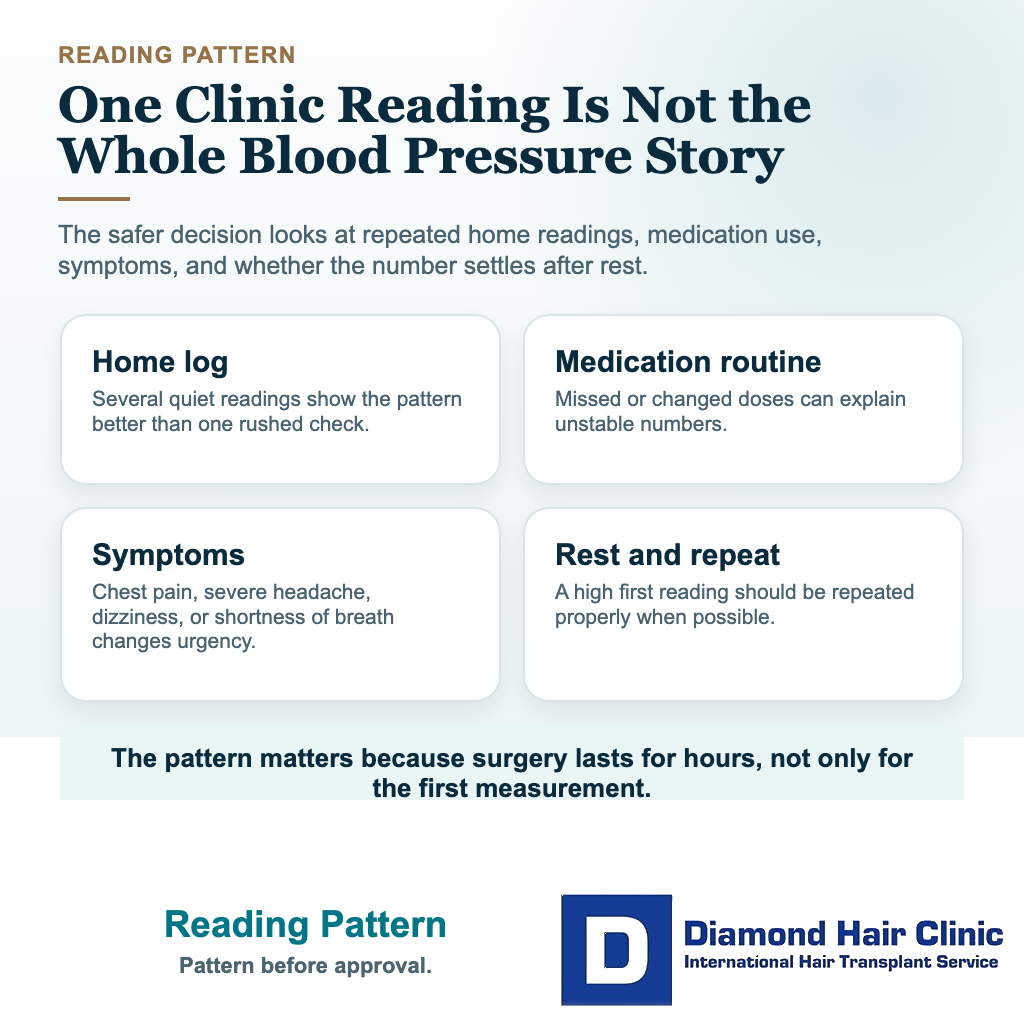
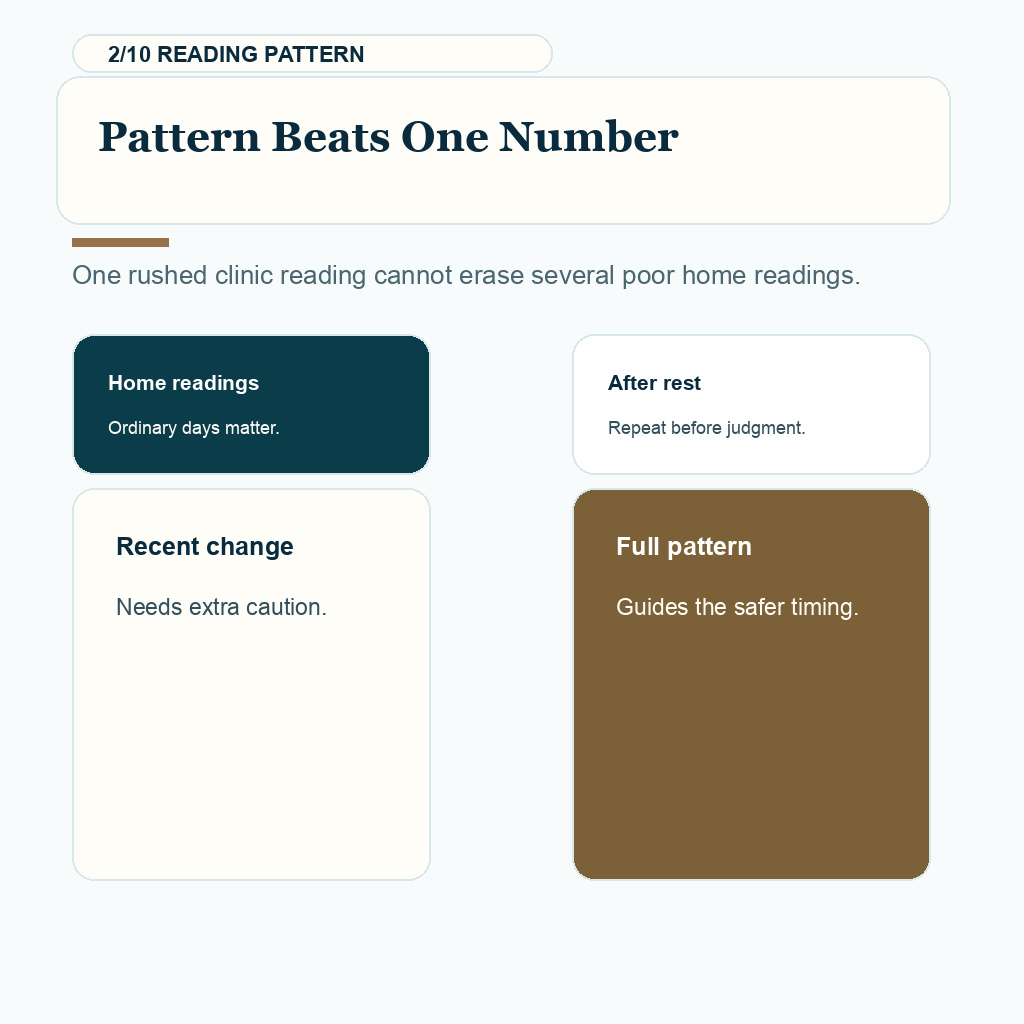
Lower readings can still matter if the patient has symptoms, heart disease, kidney disease, recent medication changes, or repeated high measurements at home. A single acceptable reading in the clinic does not erase a week of poor control. The pattern matters.
Recent home readings are useful when possible. Several measurements taken after resting on ordinary days tell me more than one nervous measurement after travel. If the home readings are already high, contact the clinic while there is still time to adjust the plan or postpone safely.
Hypertension can delay surgery when readings are unstable
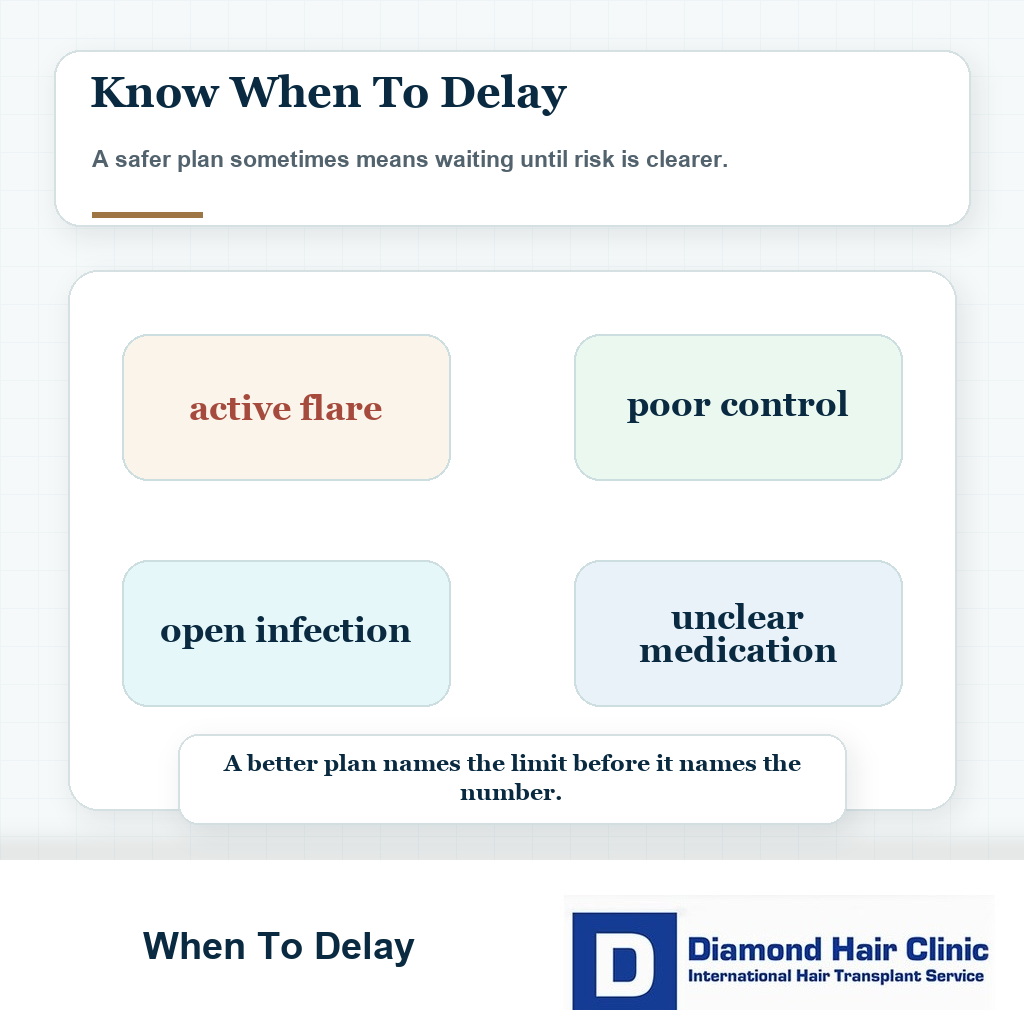
I delay surgery when the readings are not stable enough to make the procedure safe and predictable. One high measurement can happen because of stress, travel, poor sleep, caffeine, nicotine before hair transplant surgery, migraine medicine, stimulant ADHD medication, pain, fear of the operation, or party stimulant use around FUE. A strong cough near the procedure date belongs in the same safety review, so I also separate the cough before FUE surgery day plan. But repeated high readings, symptoms, poor medication control, high hematocrit that has not been explained, or a known cardiac history cannot be ignored. Cold medicine can be part of that same review, so I separate decongestants before FUE when pressure readings are already a concern.
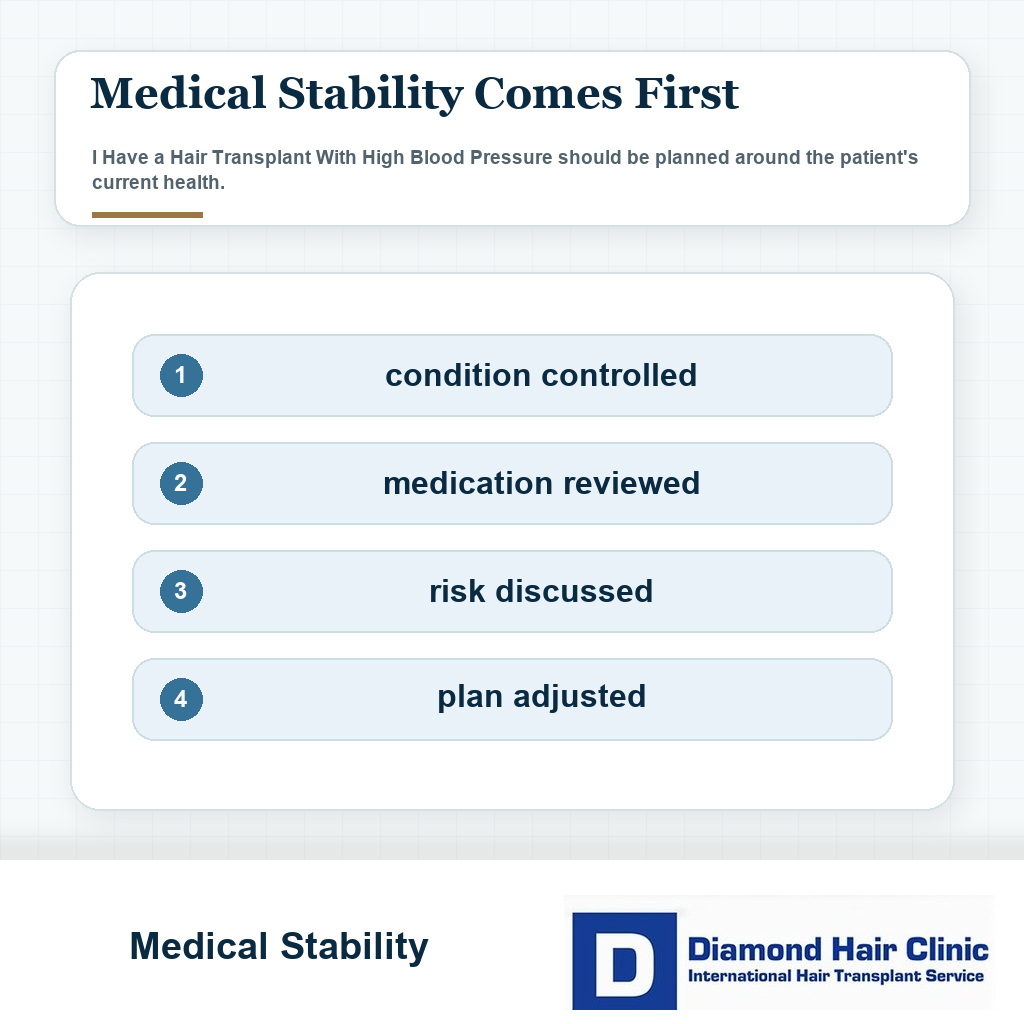
In consultation, the diagnosis alone is not enough. I review whether it is controlled, when it was diagnosed, which medication you take, whether you take it regularly, and whether your own physician has any concerns. Medical checks before a hair transplant matter. They do not exist to create anxiety. They exist to avoid a preventable problem.
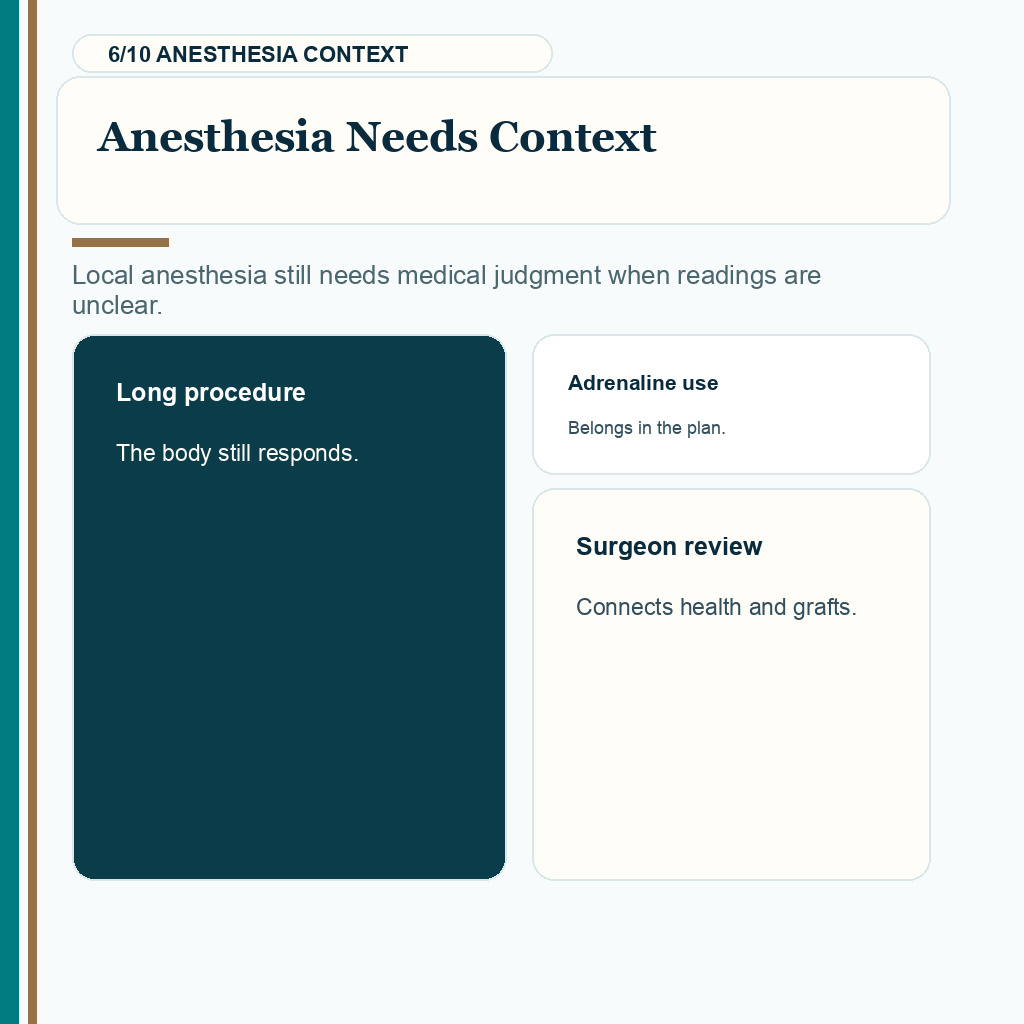
If a patient arrives with a very high reading and says, “I feel fine,” I still take it seriously. Feeling fine does not always mean the body is stable enough for surgery. The procedure may involve several hours in the chair, local anesthesia, adrenaline in the anesthetic solution, emotional stress, and small amounts of bleeding. A stable patient usually tolerates this well. I will not push an unstable patient through surgery just because the date was booked. The same careful thinking applies when planning a hair transplant with epilepsy, because procedure length, local anesthesia, and stress can all matter.
One point is easy to miss. Hypertension is not only a number on a screen. It is a sign of how the cardiovascular system is handling stress at that moment. If the body is already struggling before the first graft is taken, the surgeon cannot pretend that the scalp is separate from the rest of the patient.
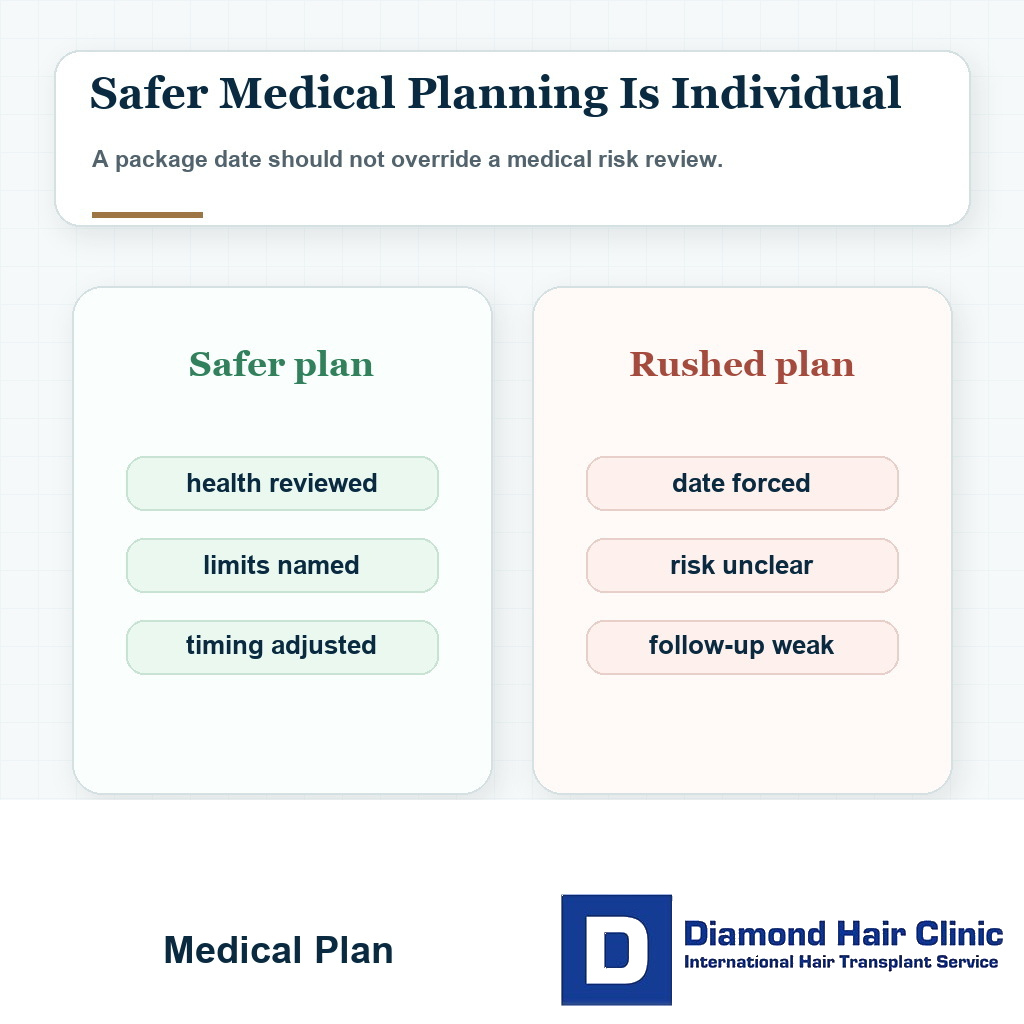
The right decision is sometimes to postpone. I know patients fear losing flights, hotel costs, or deposits. But a hair transplant can be rescheduled. A medical complication during a hair transplant should not be invited because everyone feels pressured to continue.
Readings matter during surgery
The readings matter because hair transplant surgery is not only about moving grafts. It is also about keeping the patient comfortable, stable, and safe for the full duration of the procedure. Even when the operation is performed under local anesthesia, the body is still responding to a surgical event.
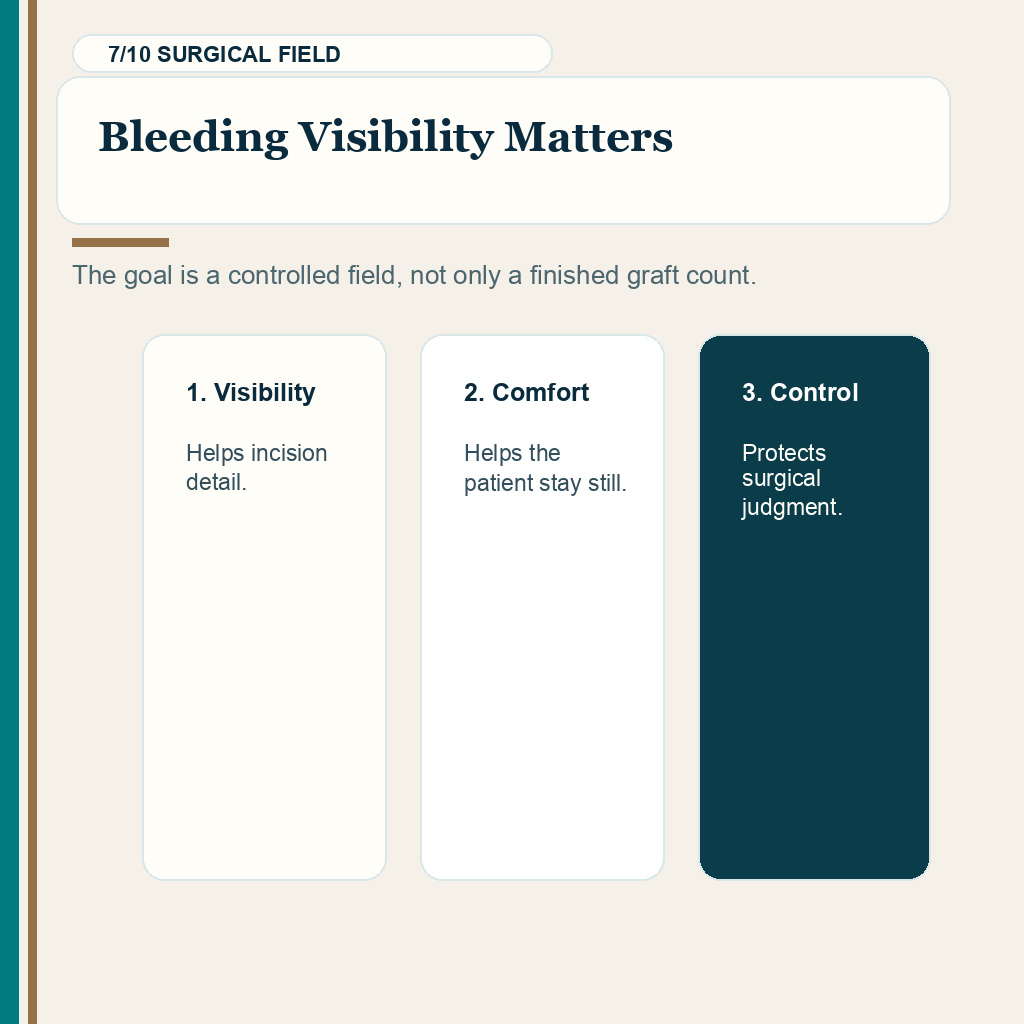
When readings are high, bleeding can become more difficult to control. That can make the recipient area less clear during incision creation and graft placement. It may also increase swelling and make the procedure more stressful for the patient. My conclusion is not that every patient with hypertension will bleed excessively. It means the surgeon must respect the risk instead of pretending it does not exist.
Patients sometimes worry that high blood pressure will simply make grafts “pop out.” I do not explain it that way. The bigger concern is that uncontrolled readings can make bleeding, swelling, comfort, visibility, and decision making less controlled during a long day. That is enough reason to take the measurement seriously.
There is also the question of anesthesia. Local anesthesia is very useful in hair restoration, but the plan still requires medical judgment. In a surgeon led setting, the person planning and performing the critical steps should understand the patient’s medical background, not only the number of grafts being sold. I ask patients to understand who performs hair transplant surgery before choosing a clinic. I do not treat sedation during a hair transplant as routine when blood pressure stability is still unclear.
The right operation is not the one that starts at any cost. This is true whether the plan is a small hairline case or a larger FUE hair transplant session. The right operation is the one that can be completed with clear visibility, stable patient comfort, careful donor management, and proper graft handling. Medical control helps protect that environment.
I factor in fatigue. A hair transplant is not a five minute intervention. The patient must remain still, comfortable, and positioned for a long time. If readings rise repeatedly during the day, the team may need to slow down, pause, reassess comfort, or reduce ambition. A careful plan leaves room for these decisions. A rushed plan does not.
During surgery, visibility matters. When bleeding is more active, tiny details become less visible. Hair angle, incision spacing, graft handling, and recipient area cleanliness all need attention. Natural surgery depends on many small accurate decisions. A medical condition that makes the field less controlled can affect the quality of those decisions.
After surgery, judge the scalp, not only the spike
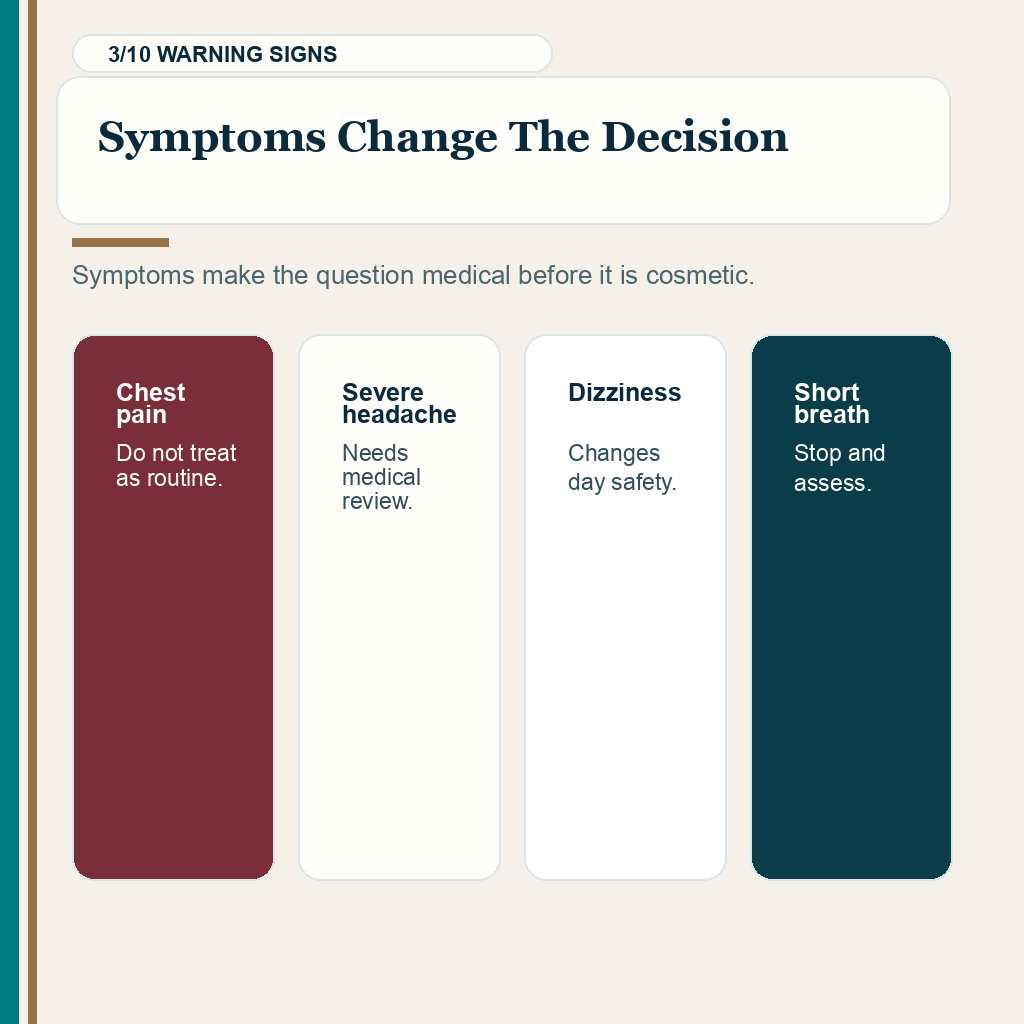
After surgery, I do not judge a brief blood pressure rise by the number alone. Timing, scalp rubbing, scratching, bumps, bleeding, pressure, and symptoms such as chest pain, fainting, severe headache, or shortness of breath change the level of concern. If the scalp was protected and there is no bleeding or visible injury, that is different from a real trauma event. The grafts still need the normal protection window, so I use the graft security timeline instead of testing the area.
The reason I still keep the early days quiet is practical. Sex, hard exercise, heat, and anxiety can raise heart rate and blood pressure, but they also bring sweat, wiping, bedding friction, bending, pressure, or accidental contact. I judge sex after a hair transplant, exercise after a hair transplant, and sweating after a hair transplant by those details, not by one number taken in isolation. A short rise without contact or bleeding is a different question from a sweaty workout, a hand brushing the grafts, or pressure from a pillow.
If the spike comes with fresh bleeding after a hair transplant, repeated oozing, worsening swelling, strong pain, or a clear hit to the grafted area, send photos and follow the clinic’s bleeding instructions. Do not press, scrub, or keep checking the grafts to prove they are safe.
Blood pressure details the clinic needs before you commit
Share your hypertension history before you book travel, not only after you arrive. If you use medication, include the name, dose, how long you have used it, and whether your doctor recently changed it. If you have heart disease, high cholesterol, chest pain, previous stroke, kidney disease, diabetes, sleep apnea or CPAP use, or blood thinner use, say this early. If you also use sildenafil or tadalafil before a hair transplant, the timing, dose, and blood pressure context need to be reviewed together.
Many patients send photos of the hairline, crown, and donor area but forget the medical part. Photos can help start a plan, but they cannot finish the assessment. I explain this carefully because planning a hair transplant from photos is useful only when it is combined with complete medical information.
Do not hide hypertension because you fear the clinic will reject you. A responsible surgeon is not looking for reasons to disappoint you. The aim is to find the most responsible path. If the condition is controlled, the plan may proceed normally. If it is not controlled, the plan may need medical clearance, medication adjustment by your physician, or a later date.
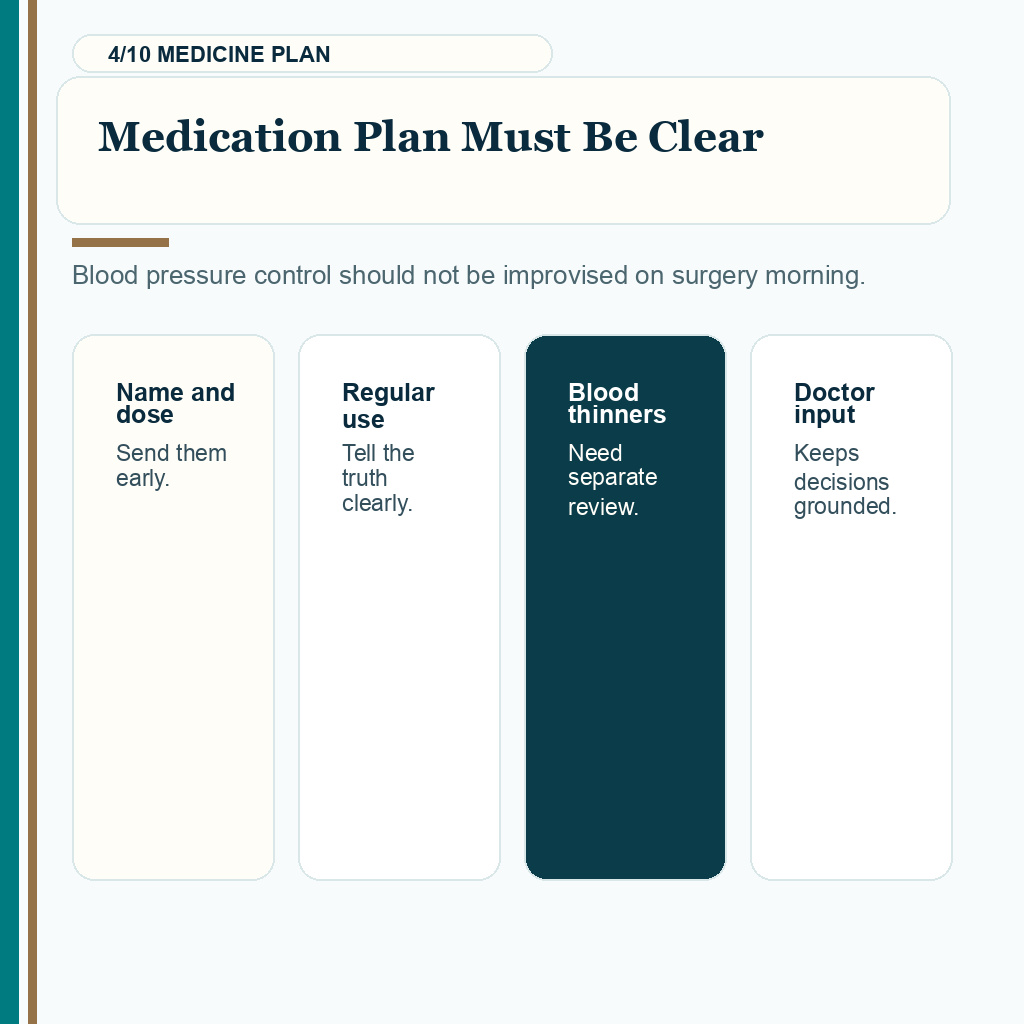
The information you give needs to be specific. “I take medicine for hypertension” is not enough. Name the medicine and say whether you took it properly. Also say clearly if you sometimes skip doses, because surgery day is not the right time to discover inconsistent treatment.
It helps when patients send this information early and plainly. There is no need to write a dramatic medical history. A clear list is enough. Diagnosis, medication, dose, recent readings, previous heart problems, blood thinner use, and the name of the doctor following you. These details allow the clinic to decide whether the case is straightforward, needs clearance, or should wait.
If a clinic does not want this information, I slow down. A clinic that is careful with your health is also more likely to be careful with your donor area. The mindset is similar. The surgeon who respects medical limits is more likely to respect aesthetic and donor limits too.
Hypertension medicine needs a clear surgery day plan
Hypertension medicine can affect the surgery day plan, but do not stop or change it by yourself. This is a common mistake. A patient becomes nervous, reads conflicting advice, and decides to skip medicine because they think it may interfere with surgery. That can make the situation more dangerous.
In general, the patient, prescribing doctor, and surgical team should decide medication timing together. Some medicines can continue. Some need special attention. Some patients also use aspirin, anticoagulants, supplements, or other treatments that can affect bleeding. Medication before a hair transplant needs clear review before surgery day.
Medication decisions cannot be improvised. If your numbers are controlled because of medication, stopping it suddenly may remove the control that made surgery possible in the first place.
This includes hair loss tablets that can affect circulation. If oral minoxidil is being considered around the transplant, it should be reviewed beside the blood pressure medicines, not treated as a separate cosmetic shortcut.
Hypertension is connected to other habits. Smoking, nicotine, poor sleep, alcohol, and heavy stress can all make the body less predictable around surgery. I explain smoking before and after a hair transplant separately because it affects healing, circulation, and surgical planning in ways many patients underestimate. I separate vaping after FUE because patients often underestimate nicotine exposure when there is no cigarette smoke.
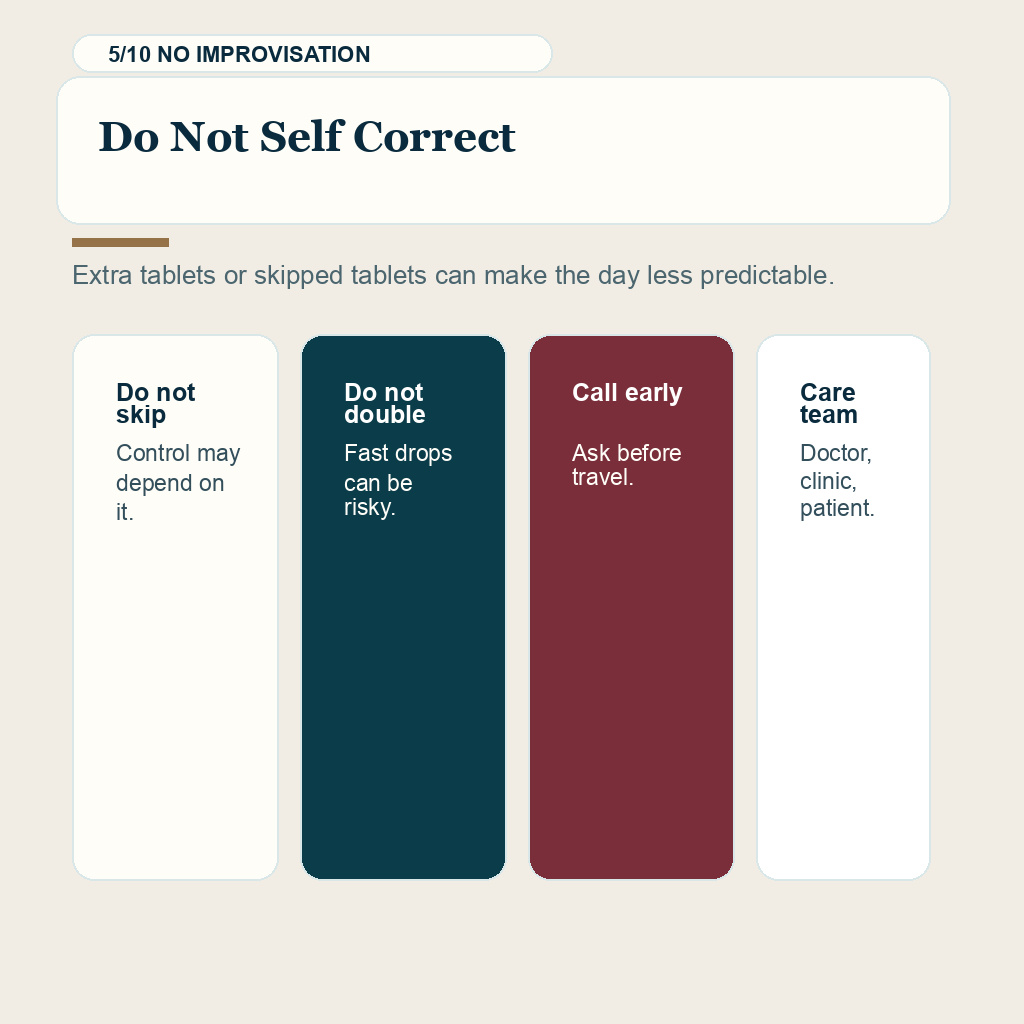
Another common problem is last minute self correction. A patient sees a high reading and takes extra beta blocker or blood pressure medication without medical advice. That can also be unsafe. The plan should not force the number down for the clinic. The goal is stable control under proper medical guidance. If the reading is not controlled without improvisation, the timing may not be right.
Patients sometimes wonder if the clinic can simply give something to lower the pressure and continue. That is not how I like to think. Treating an unexpected high reading on the day of surgery is a medical decision, not a convenience tool. If the reason is unclear, if the patient has symptoms, or if the reading remains high, delay may be the responsible medical choice.
Forgotten medicine must be discussed immediately
If you forget your hypertension medicine, share that with the clinic immediately. Do not hide it because you are afraid the operation will be cancelled. You also should not take extra tablets without medical advice just to make the number look better.
The right response depends on the medication, the reading, symptoms, timing, and the patient’s broader history. Sometimes the day can still be managed safely. Sometimes it should wait. The decision needs medical judgment, not improvisation.
Sudden self correction can be risky. A patient who forces the pressure down too quickly may create dizziness, fainting, or instability. Stable control is safer than a number pushed into range at the last minute.
Careful clinic asks medical questions early
A clinic is taking your medical history seriously when it asks about your health before treating your case as routine. It should not only ask for photos and then send a graft number. It should ask about medication, previous illness, allergies, smoking, blood thinners, and whether you have been medically stable.
Some clinics say, “No problem, everyone can do it,” because the aim is to keep the booking. That answer may feel reassuring, but it is not enough. Others create unnecessary fear to sell extra services. Careful medical judgment sits between those two extremes. It explains the risk clearly, asks for the right information, and tells the patient what must be controlled before surgery.
During clinic comparisons abroad, I advise them to look beyond price and graft count. Choosing a hair transplant clinic in Turkey should include medical communication, not only before and after photos. If nobody asks about your health until the morning of the operation, that is not an efficient system. It is a system that has left the medical question too late.
Some high volume models become risky here. If a clinic is built around moving many patients through the same day, medical details can become background noise. The concern is practical enough. Red flags of Turkish hair mills often include rushed consultation, vague doctor involvement, and a sales process that treats every patient as the same case.
An ethical clinic should be willing to say no or not today. That sentence protects the patient. If every answer is designed to keep the sale alive, the patient is not receiving medical judgment. They are receiving reassurance as a product.
A clinic that focuses only on graft numbers while avoiding your health questions is a warning sign. Graft numbers are easier to market than medical discipline. But a graft count is not valuable if the surgical day is not stable enough to support careful work.
Readings need checking during the procedure
Especially when the patient has a history of hypertension, anxiety, heart disease, or medication use that affects circulation. Checking only before surgery is not enough for every patient. A long procedure can include stress, local anesthesia, adrenaline, position changes, hunger, fatigue, and emotional tension.
Monitoring is not meant to frighten the patient. It means the team is paying attention. If the reading changes, the surgeon can slow down, pause, reassess comfort, adjust the plan, or stop if the day is no longer safe.
Purely mechanical hair transplant systems worry me here. The patient is not only a scalp with grafts. They are a whole person sitting through a medical procedure for several hours.
High arrival reading needs repeat assessment
If the reading is high when you arrive, the first step is not panic. The first step is repeat assessment after the patient has rested. Travel, lack of sleep, dehydration, caffeine, stimulant pre workout supplements, and anxiety can all raise the measurement. One rushed check should not settle the surgery decision unless the value or symptoms are clearly concerning.
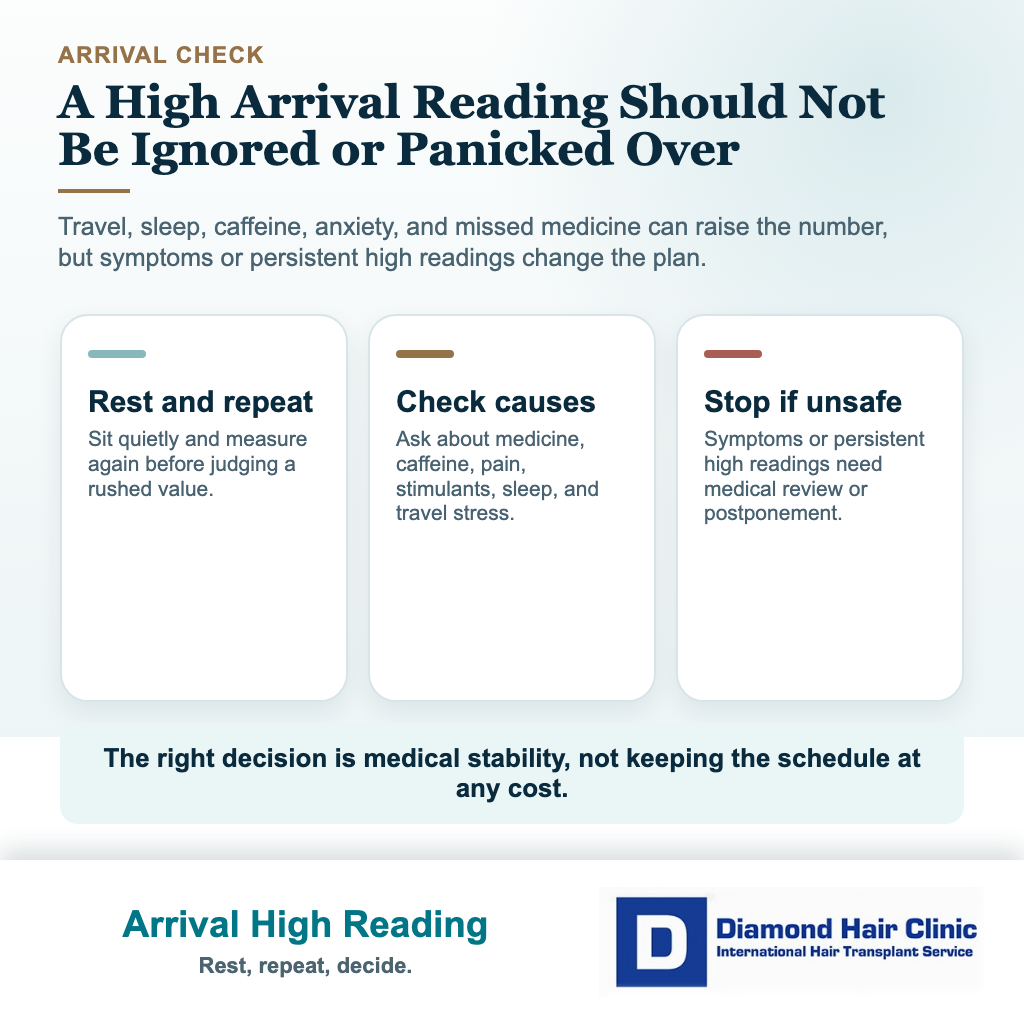
The team should ask whether you took your normal medicine, when you last ate, whether you used stimulants, and whether you have symptoms such as chest pain, severe headache, shortness of breath, dizziness, or visual changes. If symptoms are present, the question is no longer only about hair. The patient needs medical attention.
If the reading improves and the medical situation is stable, surgery may still be possible. If the reading remains too high or the history is concerning, delaying surgery is wiser. I know this can be emotionally difficult. Many patients travel a long distance and have prepared for months. But the fact that you arrived does not mean surgery must happen that day.
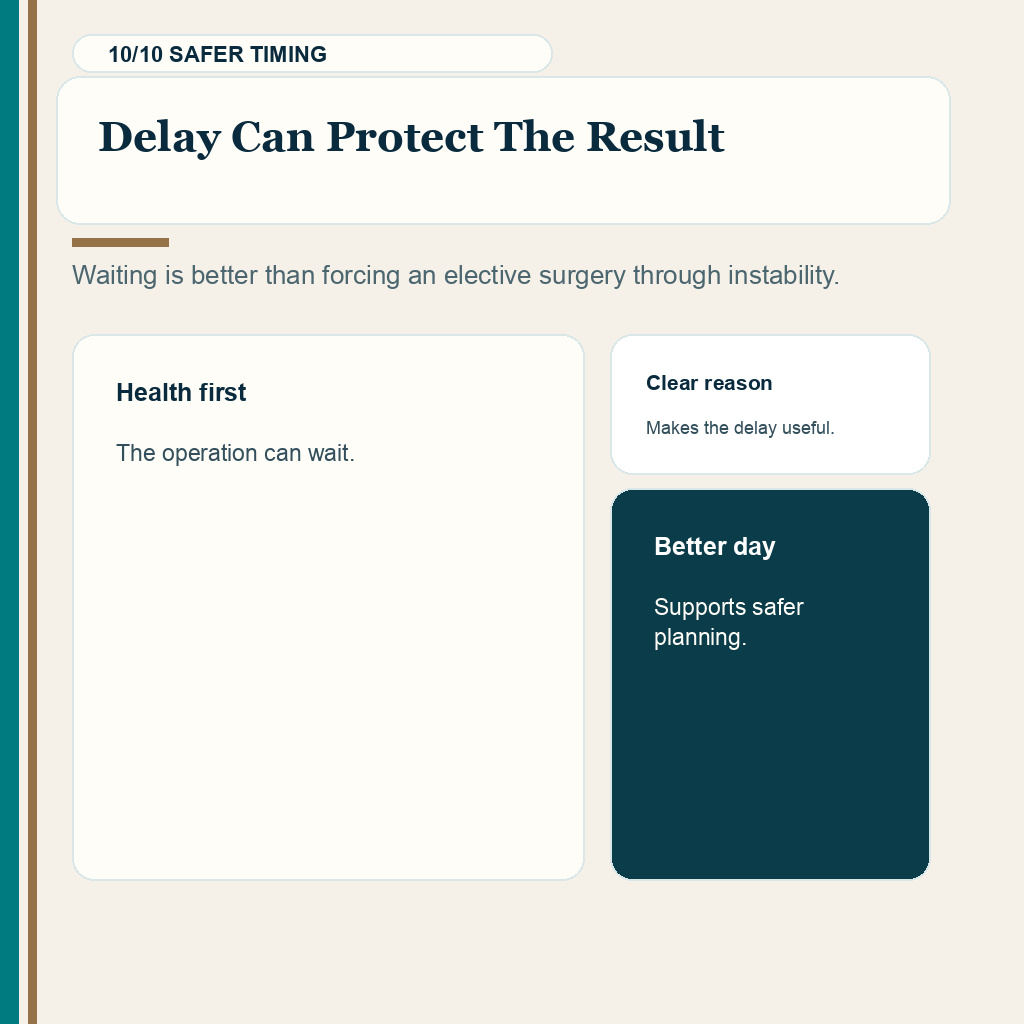
A safe delay is better than a forced operation. Hair restoration is elective. The donor area is limited. The patient’s health is not something to gamble with for convenience.
If the procedure is delayed, the clinic should explain why. The explanation needs to be clear enough for the patient to understand what happens next. Maybe you need your own doctor to review medication. Maybe you need several days of stable readings. Maybe symptoms need investigation. The answer should not be vague or dismissive.
A delay is not a punishment. Patients are often embarrassed when the reading rises. They may feel they failed the test. I see it differently. The measurement gave us useful information. We should use it wisely.
Anxiety changes the decision only when safety is affected
Anxiety can raise the reading, but it does not erase the need for medical judgment. Many patients feel nervous before surgery. Some worry about pain. Some worry about the result. Some worry because they have read too many conflicting opinions. A temporary stress response is common.
I separate mild, manageable anxiety from anxiety that is pushing the body into an unsafe state. A nervous but stable patient can usually be guided clearly. A patient whose reading remains very high, who cannot relax, or who has symptoms is not a simple cosmetic case.
Anxiety by itself is not the same as a graft displacement event. If the worry is that a high reading or panic has moved grafts, I separate that from real trauma, such as rubbing, scratching, bleeding, visible graft movement, or a direct hit to the recipient area. For graft safety, I look at what physically happened to the scalp. For blood pressure, I look at the readings, symptoms, and medical history.
It matters because some patients blame themselves. They think, “I ruined my surgery because I was anxious.” That is not how I see it. Anxiety is information. It tells the team to take time, communicate better, measure properly, and decide with discipline.
Aftercare also begins with clear communication. If a patient is already frightened before surgery, they may panic during normal swelling, redness, shedding, or uneven early growth. Medical readiness connects directly with recovery after a hair transplant. The operation is only one part of treatment. The patient must also be ready for the healing period.
An anxious patient also needs realistic expectations about control. A hair transplant has parts you can control and parts you cannot. You can control medicine disclosure, sleep, hydration, nicotine avoidance, and following instructions. You cannot control every physical reaction by willpower. The plan should include patience, not shame.
Sometimes the most helpful thing I can do is slow the patient down. If someone is rushing because they are afraid of losing more hair, looking older, or missing a clinic offer, they may not be making a medical decision. They may be reacting to pressure. The medical reading is not the only pressure I look at.
Managing anxiety without ignoring safety
I handle anxiety with patience, not shame. A nervous patient may need time to sit quietly, repeat the measurement properly, understand the plan, and speak with the surgeon. That can lower stress and make the day safer.
But anxiety should not become an excuse to ignore repeated high readings. If the number remains unsafe, or if symptoms are present, the right answer may still be to delay. One disappointing delay is safer than pretending anxiety is the only explanation when the body is telling us the situation is not ready.
For patients who know they become very anxious before medical procedures, planning should happen before travel. For feeling anxious before a hair transplant, emotional readiness and medical readiness often need to be discussed together.
Surgical plan may need to change
If the condition is controlled and you are medically fit, the surgical plan may not need dramatic changes. The surgeon still needs to plan carefully. Long surgery time, excessive graft targets, unnecessary dense packing, and poor communication can all increase stress on the body.
If a clinic offers a very large session without discussing your medical history, that is not strong planning. It may only be ambitious marketing. A responsible plan respects the donor area, the recipient area, the patient’s medical condition, and the emotional limits of the day.
For some patients, a moderate session is safer than trying to do everything in one operation. This is especially true when the patient has advanced hair loss, limited donor capacity, or other medical factors. A technically possible surgery can still be strategically unwise if it creates too much stress for too little long term benefit.
The highest graft number should not drive the plan. The goal is to create a natural improvement that the patient can heal from safely. Being a good candidate for a hair transplant includes medical readiness, realistic expectations, donor capacity, and the ability to follow aftercare instructions.
For a patient with hypertension, I factor in the emotional load of the plan. If a patient believes the operation must solve every area in one day, anxiety may rise as the day becomes longer. A focused plan can be healthier. It may treat the area that matters most visually while preserving donor capacity for the future.
My conclusion is not that every patient with hypertension needs a smaller procedure. It means the plan needs to be chosen after looking at the full patient, not only the bald area. A surgeon needs to explain why the planned session length, graft number, and coverage goal make sense for that person.
Preparing before travel for surgery
If you have hypertension and plan to travel for a hair transplant, prepare earlier than a patient with no medical history. Do not wait until the week of surgery to discover that your readings are unstable. A simple preparation plan can prevent a stressful cancellation.
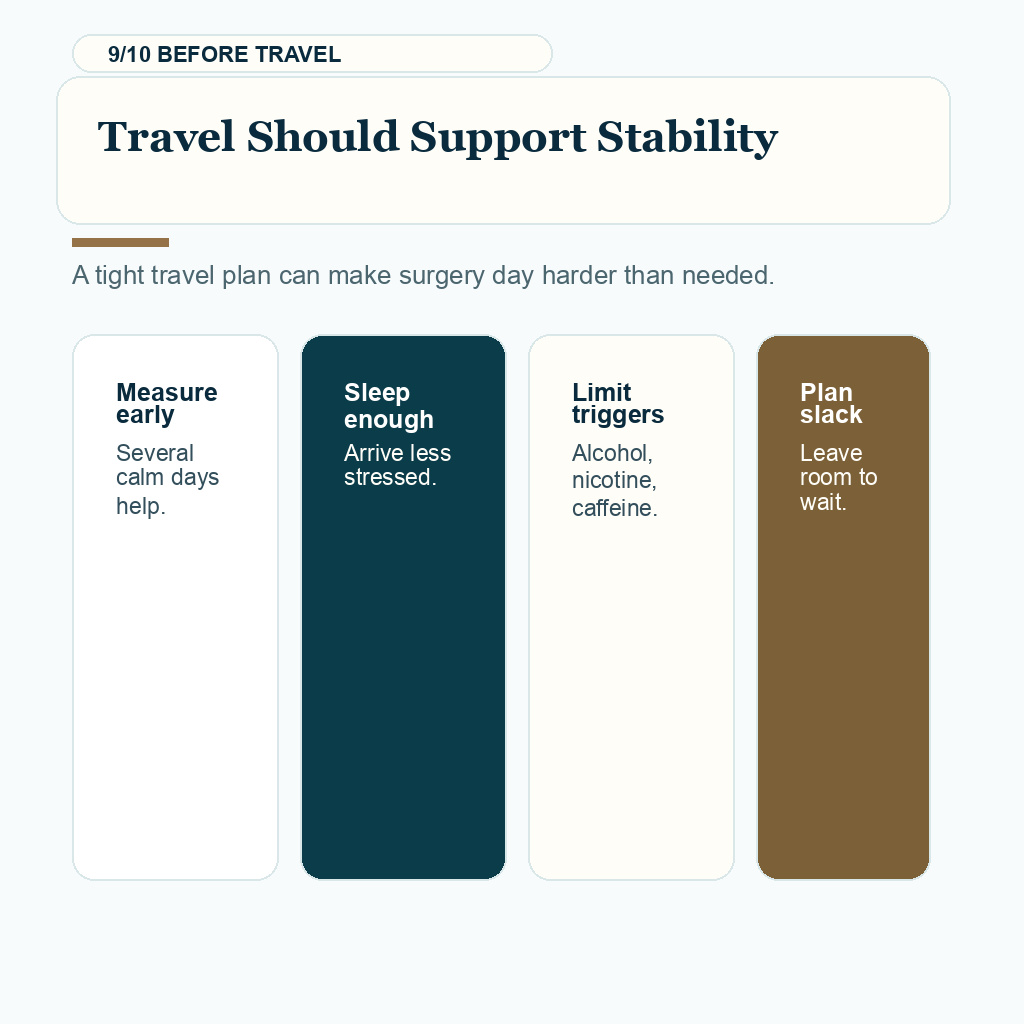
I ask the patient to measure at home for several days and write down the readings, preferably after sitting quietly rather than immediately after coffee, exercise, or an argument. I ask for the prescribing doctor to confirm whether the patient is fit for an elective procedure under local anesthesia. This is not bureaucracy. It is how we avoid guessing.
Send the clinic the medication list before flights are booked, especially if you use aspirin, blood thinners, supplements, nicotine, or stimulants. Do not stop hypertension medicine unless the prescribing doctor gives that instruction. A hair transplant date should never become the reason for unsafe medication changes.
Protect the days before travel. Heavy alcohol, poor sleep, too much coffee on surgery morning, and emotional stress can make the surgery day harder. If the readings are not stable, be emotionally prepared to delay surgery rather than force the plan.
These steps are not complicated, but they separate a serious patient from a rushed patient. They also help the clinic make a responsible decision. A clinic can only protect you from the information it knows.
You should also read the clinic’s instructions before hair transplant surgery carefully. Instructions before surgery are not decoration. They are part of safety planning. If you do not understand an instruction, ask before you travel.
One more practical habit matters. Do not compress your schedule too tightly. If you arrive exhausted, sleep badly, drink too much coffee, and go directly into surgery stress, you make the day harder than it needs to be. Travel planning needs to support medical stability, not fight against it.
This point becomes more important when the patient is flying in from another country. Flights, time zone changes, language differences, and a new city can all increase stress. A careful clinic will make the process clearer, but the patient also has a responsibility to arrive prepared and accurate.
The blood pressure slides show how stability affects anesthesia, bleeding control, travel planning, and the decision to wait. Swipe sideways, use the arrows for one slide at a time, or choose a number below the image.
Waiting can be safer than operating
Wait when readings are uncontrolled, medication has just changed, symptoms are present, or the treating doctor has not cleared the patient. Proceeding only because of lost money, a travel plan, or fear of disappointing yourself is not a medical reason to operate.
A delayed hair transplant is not a lost opportunity. It can become a better operation later. The donor area will still need careful management. The hairline will still need natural design. The recipient area will still require clean incision planning. None of these surgical decisions improve when the patient’s health is unstable.
There is another psychological benefit to waiting when the reason is clear. A patient who knows they are medically ready enters the operation with a steadier mind. They listen better. They follow instructions better. They understand that the plan was chosen with their health in mind, not only their appearance.
I have seen patients become more confident after a delay because the uncertainty is removed. They return with better readings, clearer medication guidance, and a clearer mind. The surgery then feels less like a gamble and more like a planned medical procedure. That is the correct feeling.
I keep the judgment clear. If your high blood pressure is controlled, disclosed, and medically understood, a hair transplant may be possible. If it is uncontrolled, ignored, or treated casually, surgery should wait. A natural result cannot be built on rushed medical judgment. It has to be built on safety, planning, and the discipline to operate only when the patient is truly ready.

Read this review excerpt
Diamond Hair was the only clinic asking for medications, treatments I've done before, and other type of questions that make me feel confident on the professionalism that they practice with their clients.