


Blood Thinners, Bleeding Risk, and Hair Transplant Planning
If you take blood thinners, a hair transplant may still be possible, but it needs careful planning, and you should never stop the medicine by yourself. The decision depends on why you take the medication, which drug you use, your bleeding risk, liver and clotting context, high hematocrit or clotting risk, and whether the prescribing doctor agrees that surgery can be managed safely. If that medical coordination is missing, I delay the operation. Alcohol is not a prescribed blood thinner, but alcohol use still has to be disclosed before surgery. A similar coordination approach with the prescribing doctor applies to testosterone therapy and hair transplant planning, where blood work stability and surgery timing should be reviewed before graft numbers are fixed.
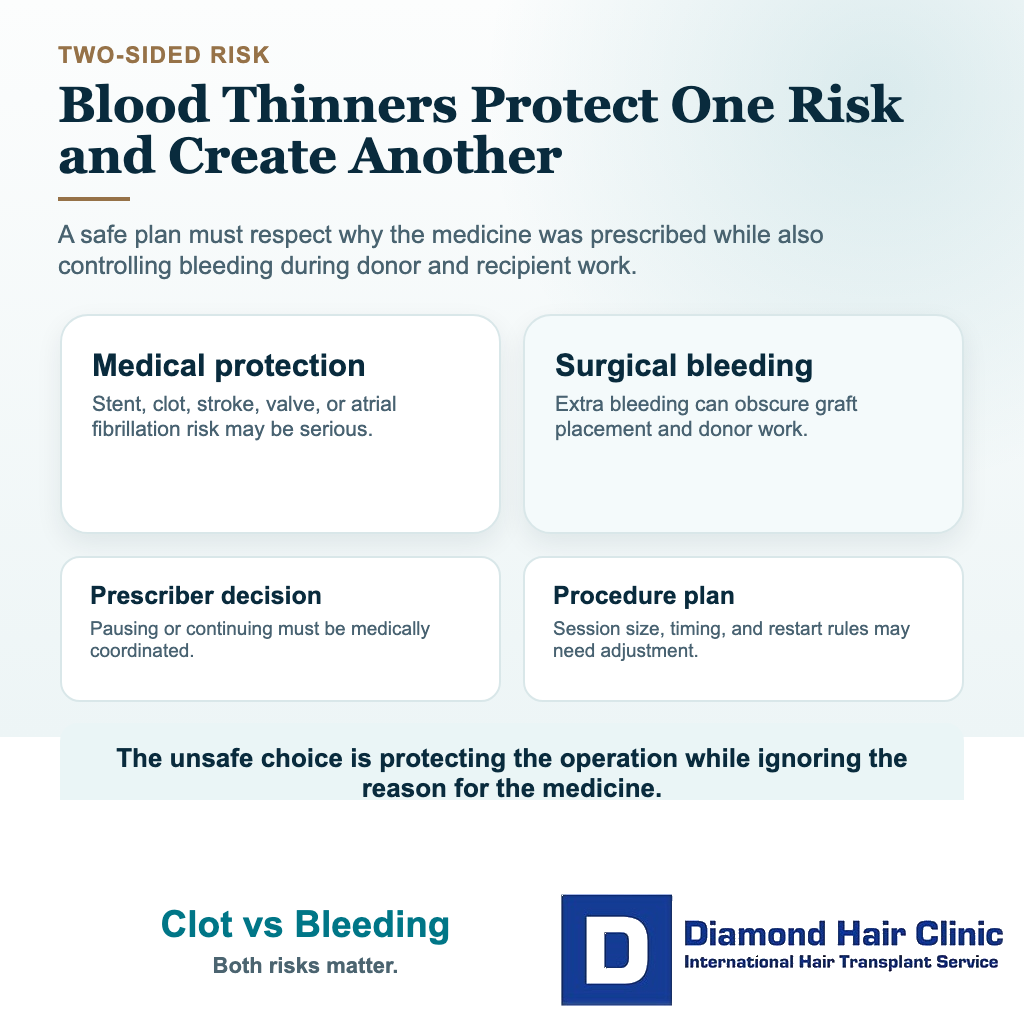
I sort these cases by medical risk very early. A prescribed anticoagulant or antiplatelet medicine for a stent, atrial fibrillation, previous clot, stroke risk, heart valve problem, or another serious reason is not the same as occasional aspirin, ibuprofen, fish oil, or a supplement. Patients who use vitamins, omega 3, or herbal products also need to disclose them before surgery. Bring the prescription label or medication app, because names, doses, and reasons for use are easy to mix up under the phrase blood thinner. One side of the decision is bleeding during surgery. The other side is the medical danger of removing protection against a clot. A safe plan may mean continuing the medicine, pausing it with the prescribing doctor’s approval, reducing the session size, delaying surgery, or refusing the operation if the medical risk is not acceptable. A diagnosed bleeding disorder is separate from a blood thinner plan, so use the hemophilia and FUE planning guide when factor levels, replacement treatment, or hematology instructions are part of the question.
In this situation, the cosmetic goal has to stay behind medical safety in a hair transplant. Hair transplantation is usually performed under local anesthesia, but it is still surgery. The donor area and recipient area both need controlled bleeding, good visibility, and predictable healing. Cosmetic injections after a hair transplant also need careful timing when bruising risk or blood thinner decisions are involved. A clinic that treats blood thinners as a small checklist item is not taking the patient seriously enough.
Many patients become anxious because they hear opposite instructions. One clinic says to stop aspirin. Another clinic gives aspirin after surgery. A cardiologist says not to stop medication. Another patient says they took it and nothing happened. My advice is direct. Do not build your plan from another patient’s medication story. Build it from your own medical reason, your own bleeding risk, and the doctor responsible for the drug. Occasional tablets, supplements, and painkillers after surgery can still matter, but changing them is not the same as changing medicine prescribed to prevent a stroke, clot, or heart problem. Dental surgery around the same period can add another bleeding and medication question, so I review dental work before or after a hair transplant separately. A blood thinner prescribed after surgery needs a stated reason and a named doctor supervising the timing.
I also have to reduce the shame some patients feel around this issue. Some people hide medication because they fear the clinic will cancel the surgery. That is the wrong instinct. If I do not know the real medication history, I cannot protect the patient. A postponed operation is much easier to accept than a medical complication that could have been avoided with realistic planning. The useful comparison is not another patient’s aspirin timing, but the exact drug name, dose, and prescribing doctor in your own plan.
Blood thinners change the hair transplant plan
Blood thinners can affect surgery because they change how easily bleeding starts, how long it continues, and how confidently the surgeon can work in the operating field. In hair transplantation, precision matters. The surgeon needs to create recipient area openings at the right angle, depth, direction, and density. Too much bleeding can make that more difficult.
The donor area also matters. During FUE extraction, each graft is removed through a small punch opening. Normal bleeding can be controlled. Excessive bleeding can slow the procedure, reduce visibility, and make tissue handling more stressful. A patient may think bleeding is only a cosmetic inconvenience, but for the surgical team it can affect the quality and rhythm of the operation.
I do not conclude that every patient on a blood thinner must be rejected. It means I have to separate the case by risk before I talk about graft numbers. I need a clear answer on whether the medicine is being taken for a serious heart rhythm problem, a stent, a previous clot, a stroke risk, a valve condition, a short temporary reason, or simply because someone was told it may improve blood flow. Those are very different situations. When that history involves DVT, pulmonary embolism, or another serious clot, I treat blood clot history and hair transplant planning as its own safety review instead of only a medication question.
The most dangerous mistake is looking only at the hair. A strong donor area and a good hairline plan do not cancel a medical risk. Before I talk about graft numbers, I assess why the patient is using the medication and who is medically responsible for it.
There is another layer that patients often miss. Bleeding is not only about the amount of blood seen on the skin. It can also affect swelling, scab formation, tissue handling, graft placement, and the comfort of the procedure. A small increase in bleeding may be manageable. A larger or unpredictable increase can change the entire surgical environment.
Aspirin and stronger blood thinners are different
Patients often use the phrase blood thinner for many different medicines, but they are not all the same. Aspirin, clopidogrel, warfarin, apixaban, rivaroxaban, dabigatran, heparin, and other drugs can have different reasons, strengths, durations, and risks. Even some supplements can affect bleeding in some patients.
Aspirin may be used for heart protection, stroke prevention, pain, or sometimes after surgery depending on a doctor’s instructions. Stronger anticoagulants are usually used for more serious clotting risks. The decision to stop or continue them must not be copied from someone else. Aspirin before a hair transplant is judged by the reason for use, because aspirin for occasional pain is not the same as anticoagulation after a pulmonary embolism or heart valve surgery.
A proper medication review is not a formality. I need the full name of the drug, the dose, the timing, the reason it was prescribed, the prescribing doctor’s contact if needed, and whether the patient has ever had abnormal bleeding. A general page about medication before a hair transplant is useful, but blood thinners deserve an even more careful conversation.
I ask about pharmacy tablets, herbal products, gym supplements, and painkillers. Some patients do not consider these medications, so they forget to mention them. That is risky. Even medication that is not a blood thinner, such as Viagra or Cialis after transplant, should still be disclosed when blood pressure or heart history is relevant. If something changes bleeding, blood pressure, heart risk related to cholesterol, or healing, I need this clear before the surgery day, not after the patient is already in the chair.
I need a clear answer on whether the patient takes the medicine every day or only sometimes. Occasional use can still matter if it happens near surgery. A patient may say they are not on medication, then mention that they take aspirin whenever they have a headache. That detail can change the instruction. Precision in consultation prevents confusion later.
Supplements and painkillers can also increase bleeding
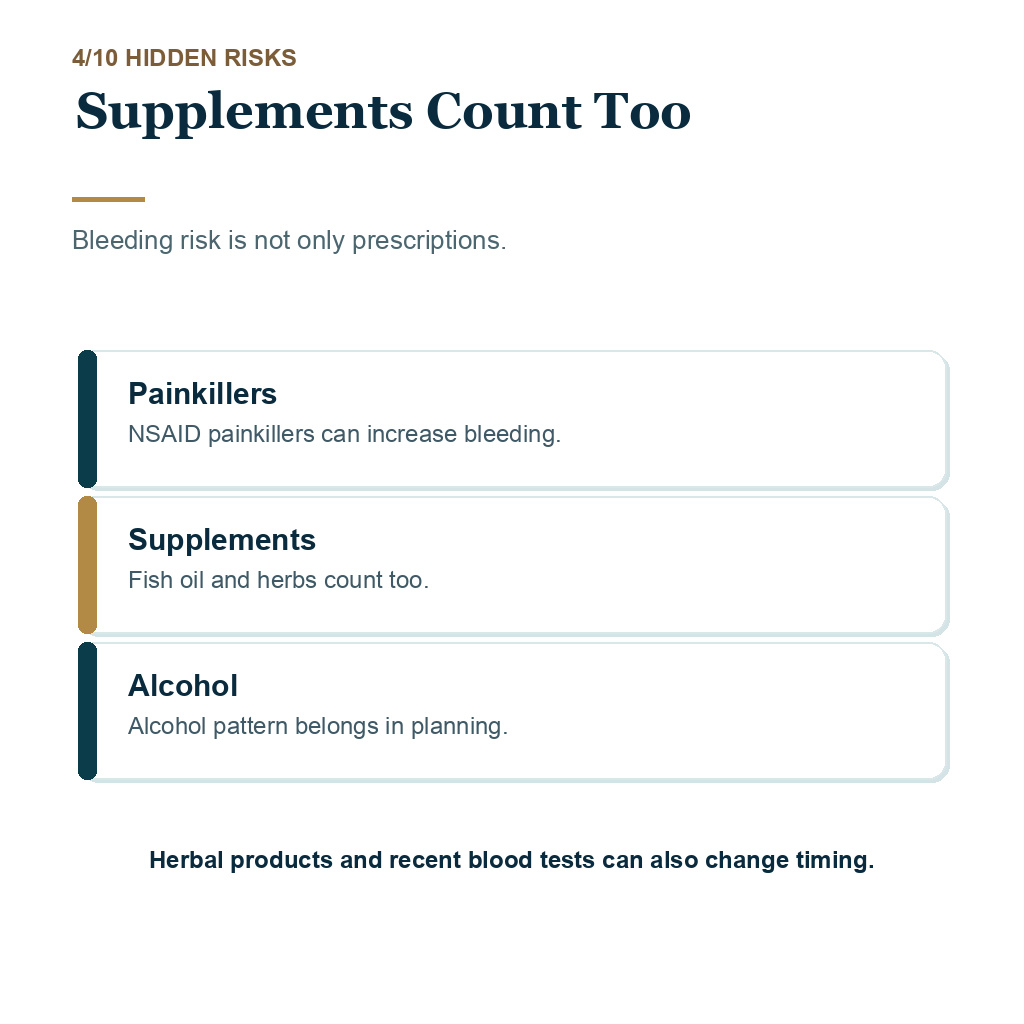
And this is a common detail patients forget to mention. A patient may carefully list aspirin or anticoagulant medication, but then forget fish oil, vitamin E, turmeric, garlic tablets, ginkgo, ibuprofen, naproxen, or other painkillers used near surgery. These products may not feel like serious medicine, but they can still matter when thousands of tiny openings are being made in the scalp. When that supplement is fish oil, the separate fish oil before hair transplant surgery review keeps it distinct from prescribed blood thinner decisions.
Patients should not panic about every supplement, but they should disclose everything early. The useful question is not whether something feels natural or medical. It is whether it can affect bleeding, blood pressure, swelling, or healing near surgery. The instruction is only reliable after the full list is visible, not after the patient remembers something on surgery morning.
Several small risks can become one larger issue. One tablet may not worry me much. But aspirin, a painkiller, alcohol, high blood pressure, anxiety, and a large planned session together can create a very different surgical day.
Stopping blood thinners before surgery
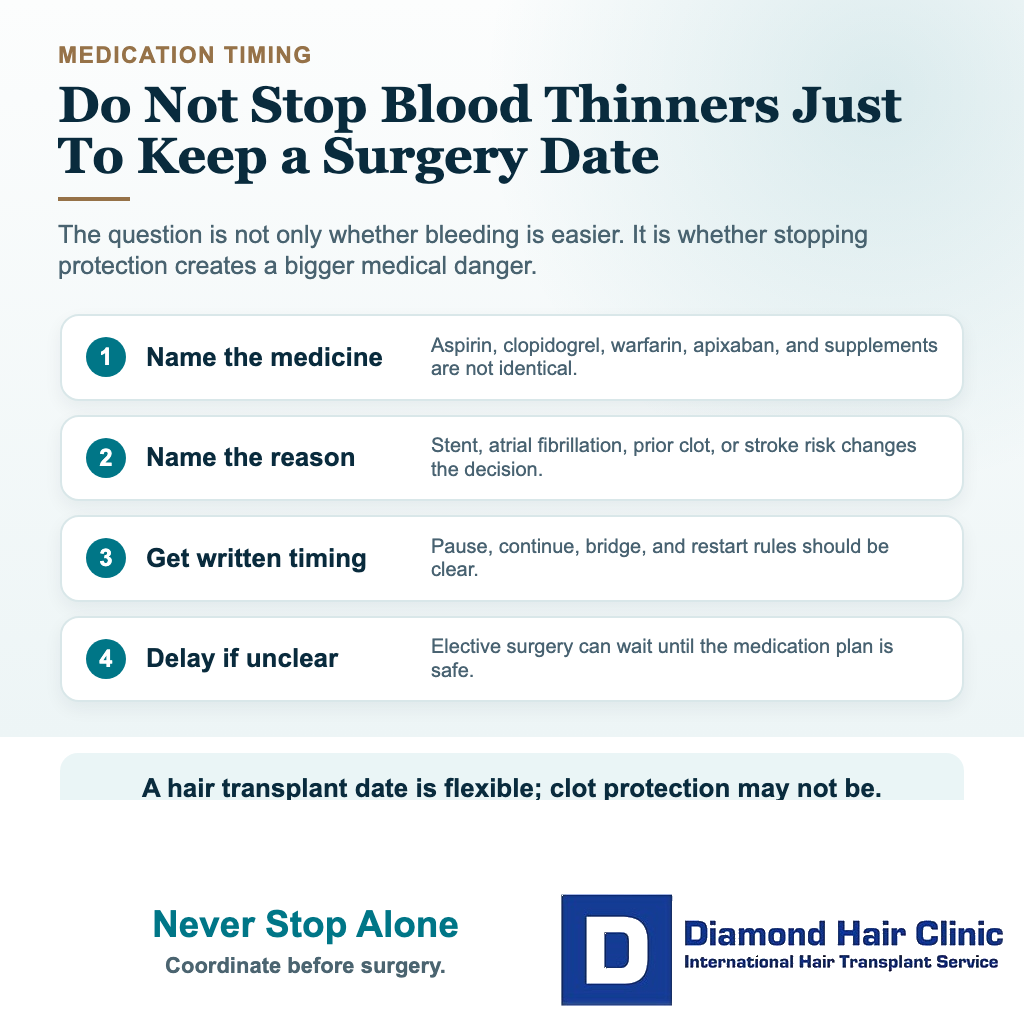
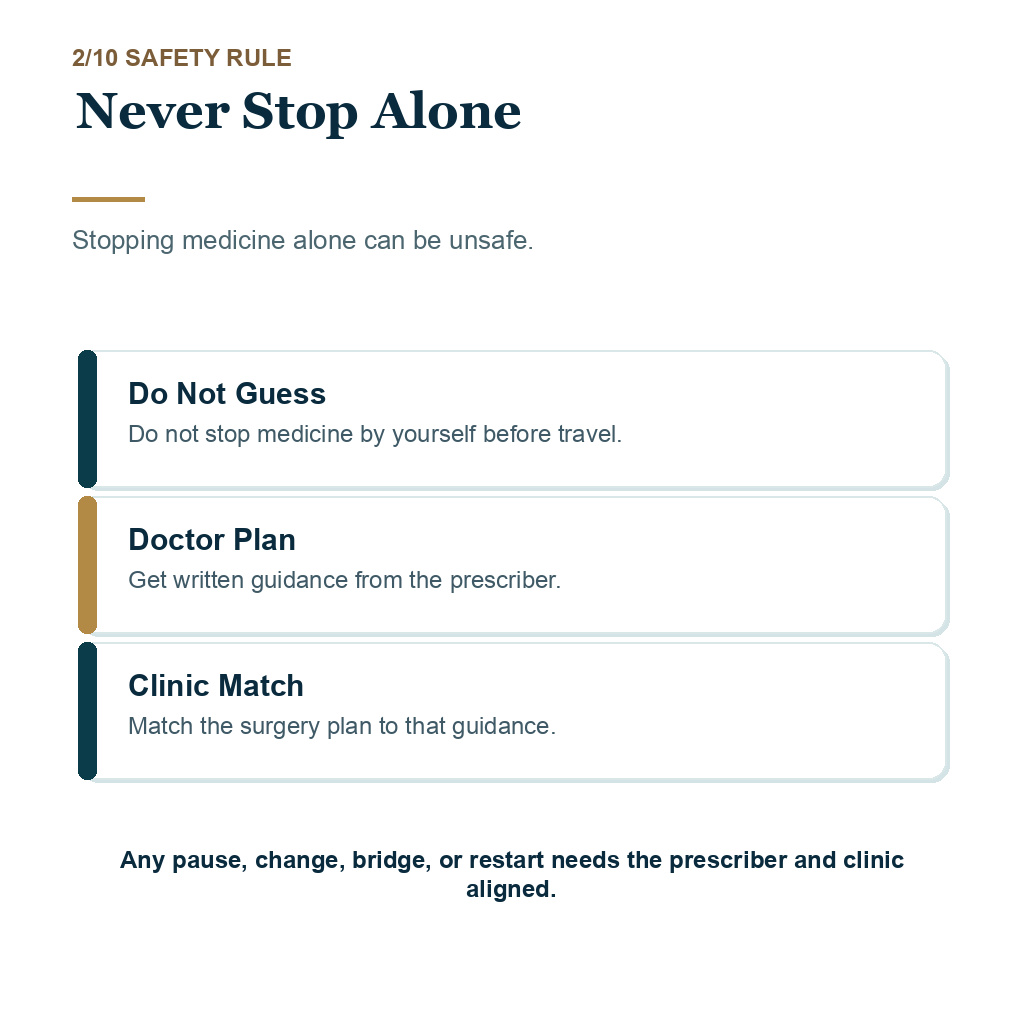
Do not stop blood thinners on your own before a hair transplant. This needs plain language because the concern is real. If a medication was prescribed to prevent a clot, stroke, heart problem, or other serious event, stopping it without medical approval can be more dangerous than the hair loss problem.
Stopping the drug is not a decision I treat as if I am the prescribing cardiologist or physician. I ask why the medicine is being used and whether the prescribing doctor has approved a surgical plan. Sometimes the medicine can be paused safely for a limited time. Sometimes it cannot. Sometimes surgery should be delayed. Sometimes the session should be smaller or the date should move.
Bring the reason for the blood thinner, not only the drug name. Aspirin after a stent, anticoagulant treatment after a clot, and medicine for rhythm problems can create different surgical questions.
Advice for a small dental or skin procedure does not simply become the right plan for a long hair transplant with thousands of small openings. It can give useful context, but the prescribing reason, the bleeding risk, and the surgical plan still decide the instruction.
I value blood tests before a hair transplant, but blood tests alone are not enough. A normal blood test does not always mean it is safe to stop or continue a blood thinner. The medical history and prescribing reason decide the level of risk.
This becomes even more important when renal function is part of the history. Kidney disease can change medication risk, blood pressure stability, anemia, and the timing of elective surgery.
Bridging is another point I do not improvise. If a patient needs temporary injections or a change from one anticoagulant plan to another, that decision belongs to the prescribing doctor, cardiologist, hematologist, or anticoagulation clinic. It is not a shortcut a hair transplant clinic should invent to protect a surgery date.
A booking message should never decide whether a blood thinner is stopped. Before I plan surgery, I want the reason for the medicine, the bleeding history, and the prescribing doctor’s limits. Stopping blindly is risky, and continuing without review can be risky too. Medication coordination has to come before booking convenience.
A patient who needs blood thinners is not necessarily a bad candidate. But candidacy must include medical readiness, not only donor density and hair loss pattern. The broader question of being a good candidate for hair transplant should include medication risk, not only photographs.
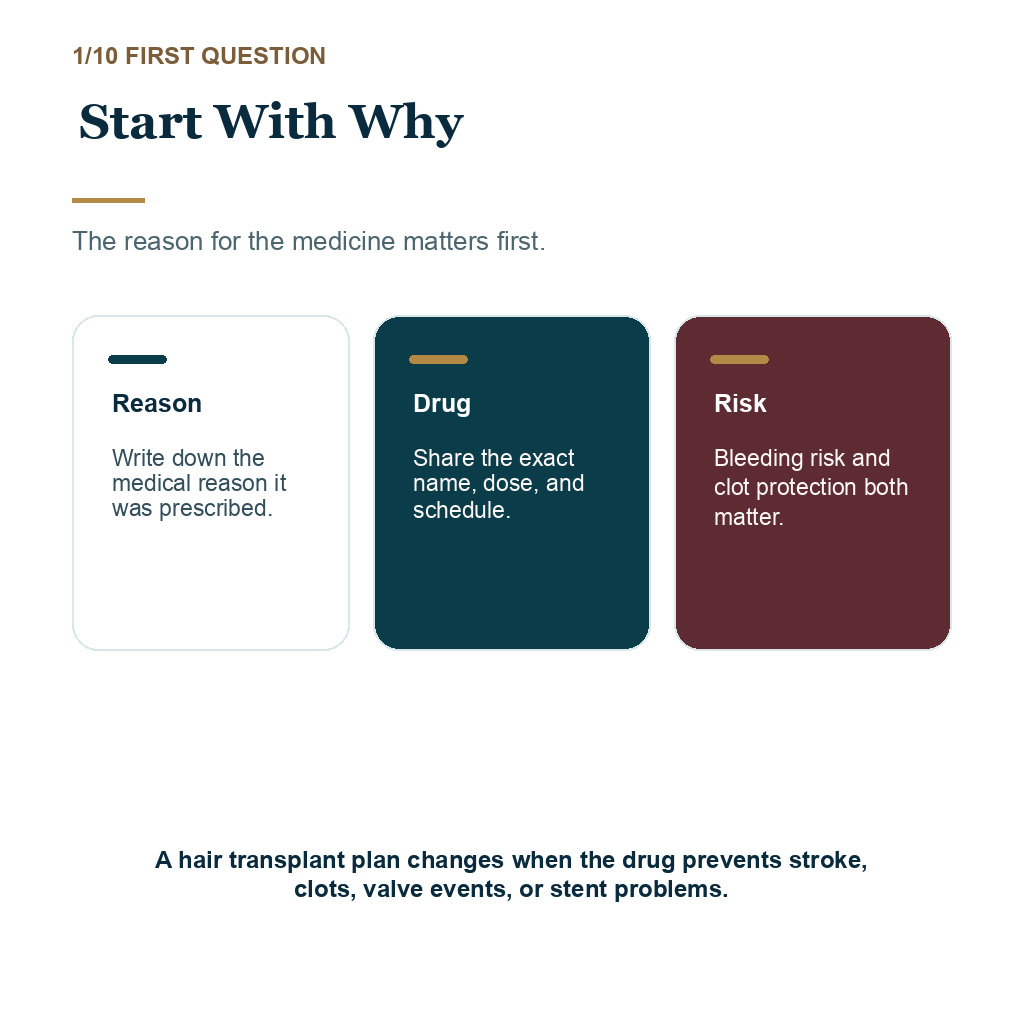
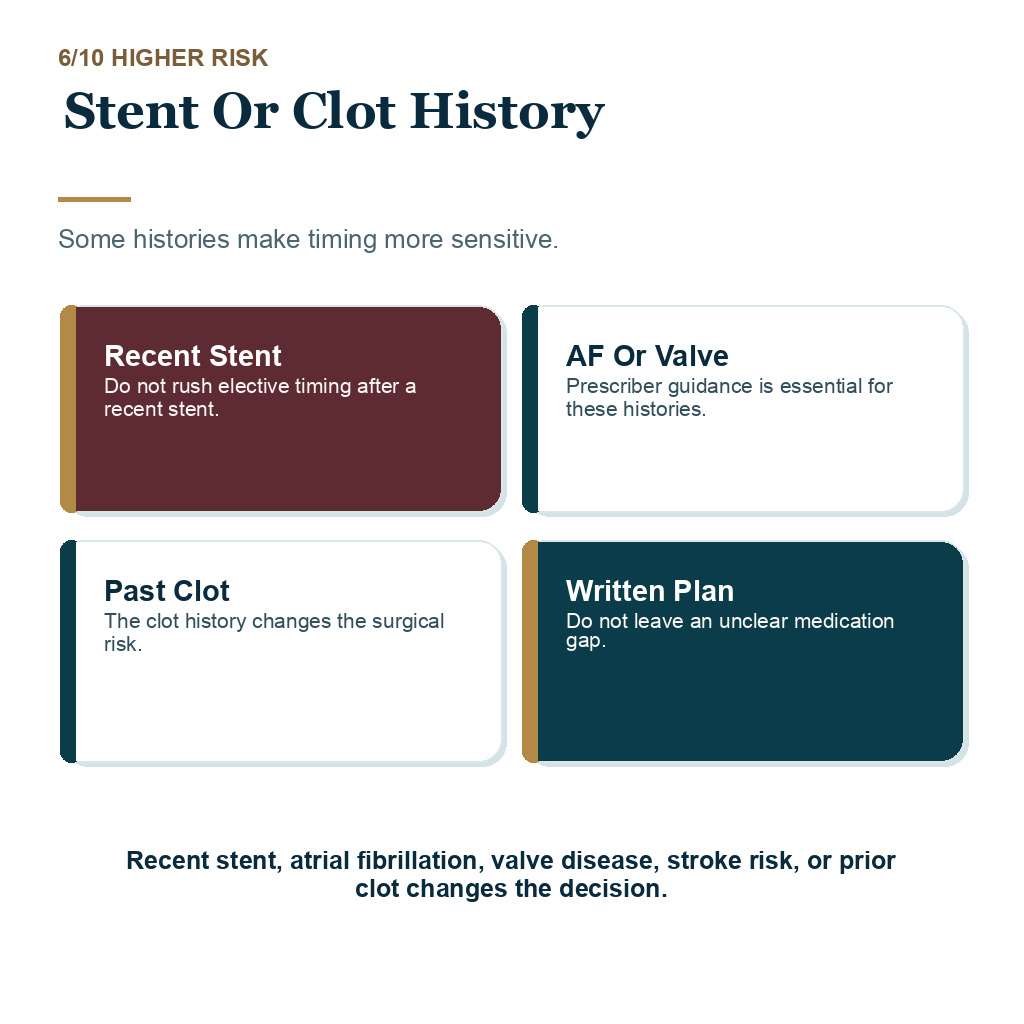
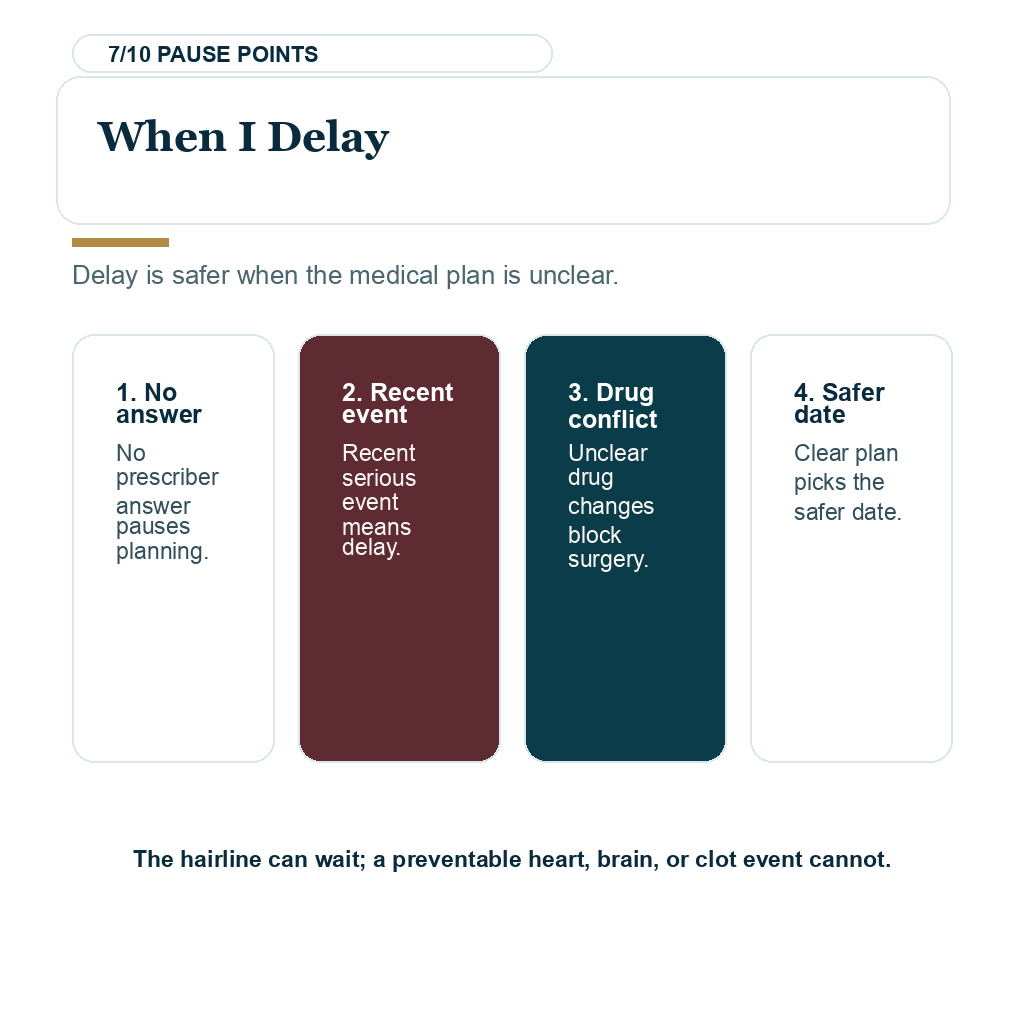
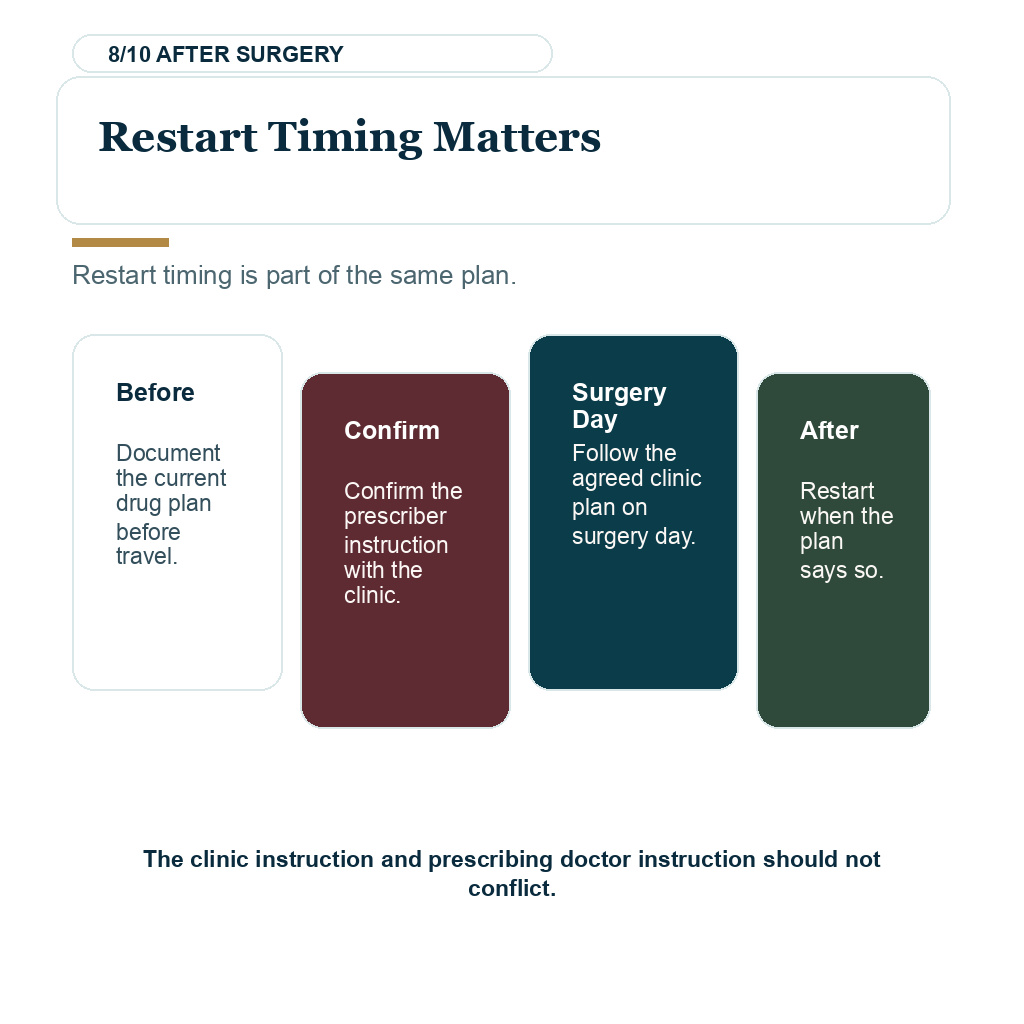
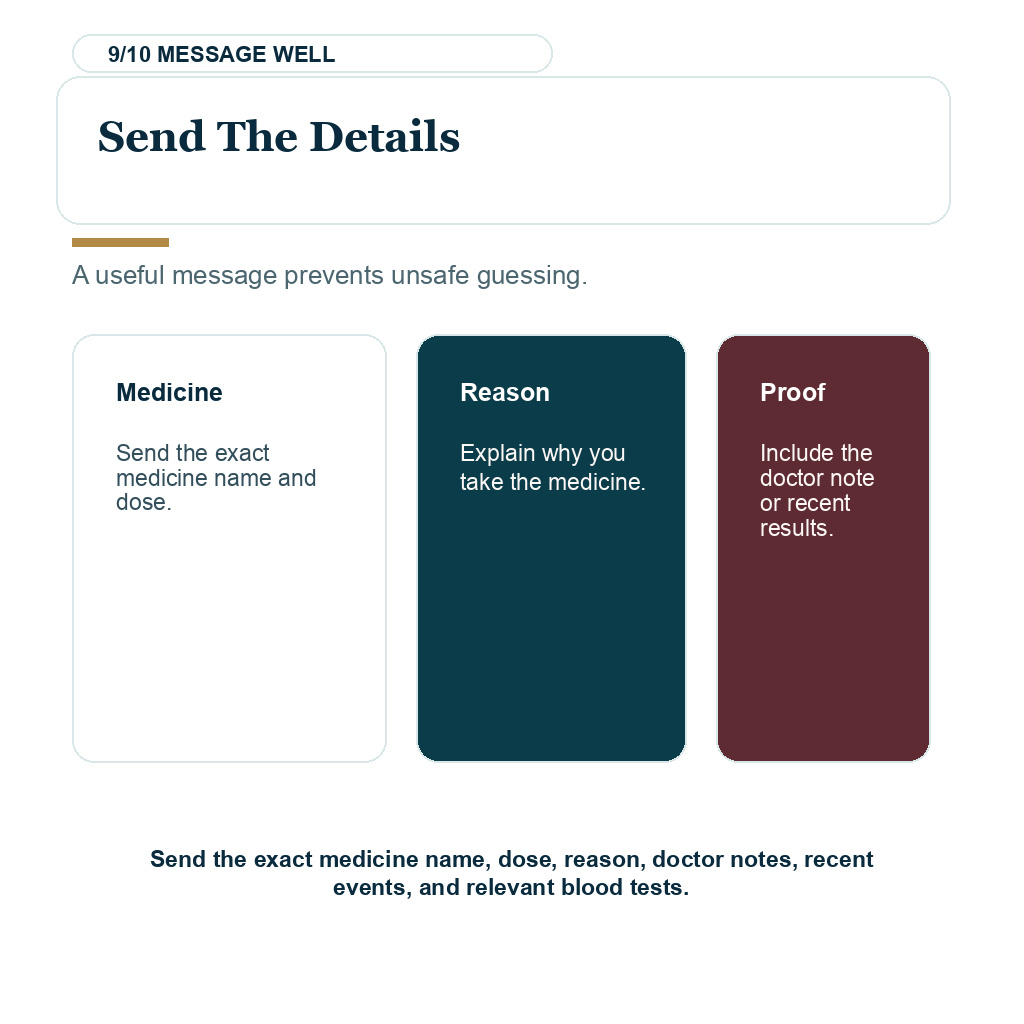
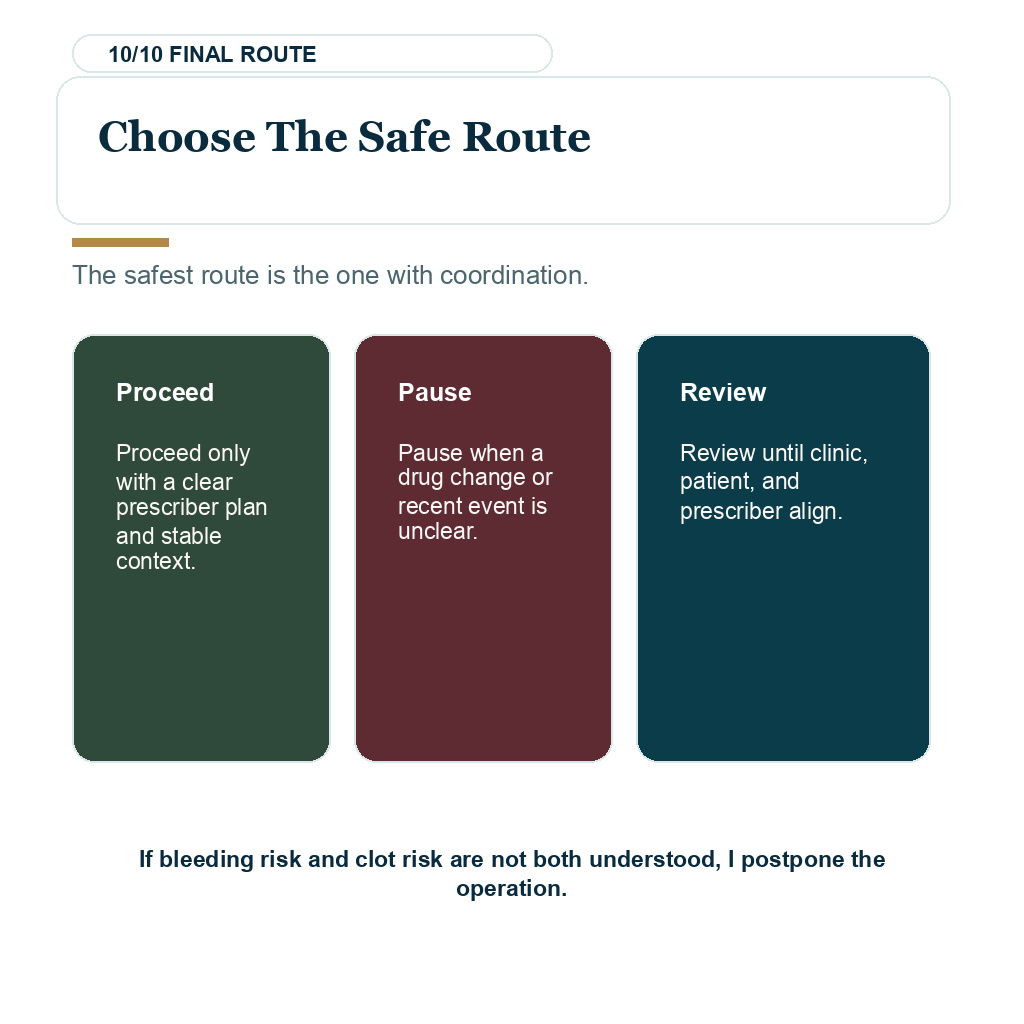
These 10 slides separate blood thinner planning into the reason for the medicine, prescriber coordination, bleeding risk, clot history, restart timing, and the route that keeps the medical plan controlled. Swipe sideways, use the arrows one slide at a time, or choose a number below the image.


Stents, atrial fibrillation, and previous clots
I become much more careful when a patient is taking blood thinning medication after a stent, atrial fibrillation, heart valve problem, pulmonary embolism, stroke risk, or previous clot. At that point, the hair transplant is no longer a separate cosmetic decision. The medication may be protecting the patient from a serious event.
If a stent is recent, if the patient is on more than one antiplatelet medicine, or if the clotting history is serious, I usually slow the process down until the prescribing doctor gives clear guidance. A hair transplant should not pressure a patient into stopping medication too early. The hairline can wait. A preventable heart, brain, or clotting complication is not an acceptable trade.
In these cases, I need the written medical plan before the surgery date is confirmed. The plan should explain whether medication can be paused, whether it must continue, when it should restart, and whether a smaller or delayed operation is safer. When the answer is unclear, I delay the operation.
When I would delay the hair transplant
I delay surgery if the patient recently had a heart attack, stroke, clot, stent placement, pulmonary embolism, major cardiac procedure, or any event where stopping medication would be unsafe. A hair transplant can wait. A preventable medical complication is not acceptable for a cosmetic procedure.
I also delay if the patient cannot explain why the drug is being taken or cannot reach the prescribing doctor. A surprising number of patients know the name of the medicine but not the reason for it. That is not enough for surgical planning. The clinic should not guess.
Uncontrolled blood pressure is another reason to slow down. Bleeding risk is not only about medication. Pressure, anxiety, vascular health, alcohol use, smoking, low platelet count, and medical conditions can all influence the surgical day. I treat high blood pressure and hair transplant planning as part of the same decision family.
Diabetes, poor wound healing, heavy smoking, active scalp inflammation, or a previous history of unusual bleeding all reduce the margin for error. These factors do not always make surgery impossible, but they change the safety conversation. Diabetes can change the healing conversation, especially when blood sugar control is not stable.
Flights, work leave, and deposits create pressure, and I understand why patients feel trapped by the calendar. Still, when the medication plan is unclear, the surgery date should move before the patient takes a medical risk. A safe clinic must be willing to rearrange the operation when the concern is not settled.
Clinic questions before accepting surgery
A safe clinic should ask for more than photographs of the hairline. I check the medication name, dose, schedule, reason for use, prescribing doctor, medical history, allergies, prior surgery history, bleeding history, and any previous instructions from a cardiologist or specialist. Without this, the consultation is incomplete.
I need a clear answer on whether the patient has ever paused the medicine before for dental work, skin surgery, or another procedure. The way the body responded, whether bleeding or clotting was a concern, and whether the prescribing doctor gave written guidance can show whether there is already a safe medical pathway for managing the medication.
Before travel, make sure the plan says whether to take or skip the medicine and who approved that instruction. Hair transplant preparation is safer when the medication plan is written before the flight, not improvised on the morning of surgery.
The patient needs to know who is making the decision. If the medication relates to the heart, blood vessels, clotting, or stroke risk, the prescribing doctor may need to be involved. The hair transplant surgeon can judge the surgical field. The prescribing doctor judges the medical risk of changing the medicine. Both judgments matter.
The surgical plan needs room for more bleeding than expected on the day. This may mean reducing the session size, slowing the pace, or stopping before the original graft number is reached. A responsible plan must leave room for surgical judgment during the procedure. It should not trap the team into chasing a number that no longer feels safe.
Bleeding affects the recipient area and donor area
In the recipient area, bleeding can make it harder to see tiny openings clearly. Hair direction, angle, and density require controlled visibility. If blood repeatedly fills the field, the surgeon has to spend more time clearing the area, and that can slow the work. It may also make dense packing less sensible in some cases.
In the donor area, bleeding can also affect the extraction rhythm. Each follicular unit needs careful handling. The surgeon must protect the graft and the surrounding donor tissue. If the field is too wet or unstable, the operation becomes less efficient and more demanding. This is not the right situation for rushed high graft numbers.
Controlled surgery matters more than proving what can be technically forced. If the patient is taking medication that may increase bleeding, I may choose a smaller session, a more conservative plan, or a delay. The donor area is a limited resource, and poor control is not how it should be spent.
Anesthesia and monitoring need clear medical ownership. Hair transplant surgery should not feel like an assembly line. The person responsible for the critical parts of the procedure matters even more when the patient has medication risk.
I consider how long the grafts stay outside the body and how steadily they are handled. A difficult bleeding field can slow the procedure and create pressure. The answer is not to hurry. The answer is to plan the case so the team can work with control, even if that means fewer grafts or a different date.
Blood thinners after surgery
This question creates a lot of confusion. Some patients are told to avoid aspirin. Others are given aspirin after surgery. Some hear that it improves blood flow. Others hear that it increases bleeding. The truth is that the answer depends on the patient, the reason for the medicine, the operation, and the doctor’s protocol.
I avoid using blood thinning medicine as a casual promise to improve growth. Transplanted grafts need careful handling, recipient area planning, oxygenation, and healing. They do not need a patient experimenting with medication because they are afraid of losing grafts. If a drug is prescribed after surgery, the reason and duration need to be clear.
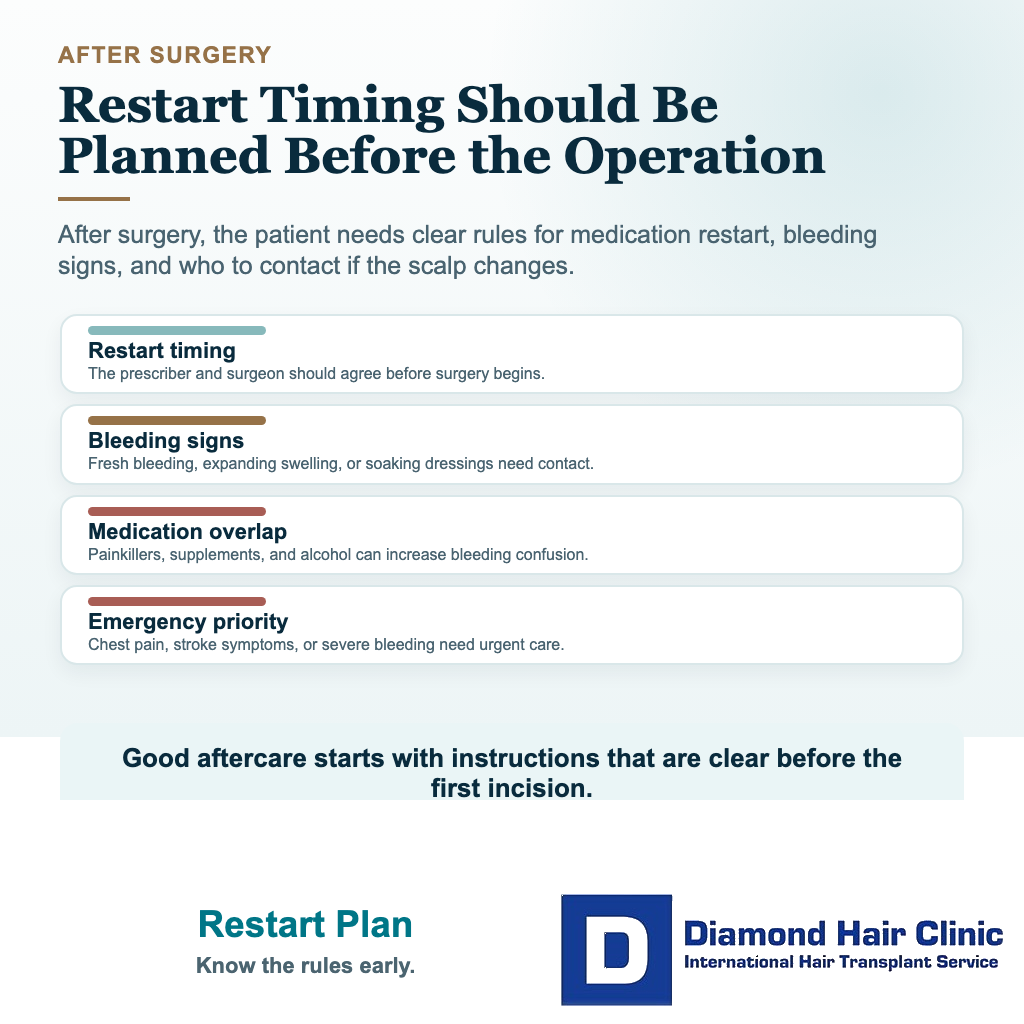
After surgery, the first priority is predictable healing. Bleeding, swelling, scab management, sleeping position, washing, and avoiding trauma all matter. A patient who is confused about medication after surgery should ask for clinic review rather than changing medication alone. The broader hair transplant aftercare routine only works when medication instructions are clear.
If the patient already takes a blood thinner for medical reasons, the restart plan should be known before surgery. I avoid a patient asking on day two whether they should restart a drug that protects them from a clot. That question should be answered before the operation is scheduled.
Prescribed medication and optional clinic medication are different categories. If a doctor gave you a blood thinner for a medical condition, that instruction carries more weight than a routine aftercare sheet. If a clinic suggests an extra medicine after surgery, it should explain why, how long, and how it fits your medical history. Your own prescribing doctor remains central when the drug protects against clotting.
Clinic instructions can become confusing
Confusion often happens when clinics use standard instruction sheets without adapting them to the patient’s real medical situation. A general sheet may say avoid aspirin. Another aftercare sheet may include aspirin. A coordinator may give one answer, a surgeon another, and the prescribing doctor another. For a patient, that becomes frightening.
The solution is not to collect random opinions until one answer feels reassuring. The solution is one clear plan. The clinic should write down what needs to be done with each medication, who approved it, and when normal use can restart. For international patients, this clarity matters even more because they cannot easily visit their local doctor after arrival.
I also warn patients about clinics that avoid responsibility by saying, ask your doctor, without explaining what information the doctor needs. The prescribing doctor may not know the hair transplant details. The hair transplant surgeon may not know the clotting risk. Good communication means both sides understand the question.
Choosing safely means looking beyond price and graft count. A patient comparing clinics should ask how the clinic handles medical risk, medications, and communication. That belongs inside the larger decision of choosing a hair transplant clinic in Turkey.
Clear instructions need plain language. They should name the exact medicine, the exact day, who approved the plan, and what to do if a dose is taken by mistake. Vague phrases such as avoid blood thinners if medically possible are not enough for someone who is about to travel for surgery.
Details that must be clear before surgery
If you take aspirin, anticoagulants, antiplatelet medication, or any medicine that affects bleeding, this conversation should happen before travel is arranged. The clinic should know the exact medicine, the dose, why you take it, and which doctor prescribed it.
Sometimes the correct decision is to continue the medicine and adjust the surgical plan. Sometimes the answer is to delay surgery until the prescribing doctor gives written guidance. Sometimes the session size should be reduced because clear visibility and bleeding control matter more than reaching a promised graft number.
Before travel, the patient needs to understand what happens if the medicine cannot be stopped, when it can safely restart, and who will monitor bleeding and blood pressure during surgery. These points should be written clearly before the patient flies, not improvised on the morning of the operation.
A smaller plan can be medically wiser. If bleeding control is not ideal, surgical discipline matters more than forcing the original number.
If a clinic answers this with a generic instruction sheet or a rushed reassurance, I slow down. The safest graft number is not the biggest number. It is the number that can be placed with control, good visibility, and respect for the patient’s health.
Blood thinner safety starts with the prescriber
Blood thinners are a medical planning issue, not a minor inconvenience in the consultation. Surgery may still be possible when the prescribing doctor approves the plan and the graft target stays conservative. When the medicine cannot be paused safely, bleeding risk is high, or the medical reason is recent and serious, waiting protects the patient better than forcing surgery.
Delaying a hair transplant is better than gambling with a patient’s health. Hair loss can feel urgent, especially when the mirror is bothering you every day. But a cosmetic surgery should never create unnecessary medical danger. This belongs among the clearest examples of why surgeon led planning matters.
The consultation should end with a written plan, not scattered guesses. The plan should explain what happens before surgery, on the surgery day, and after surgery. It should also make clear that medication changes must be approved by the right doctor.
If everything is coordinated, the patient can arrive less anxious. If the plan is vague, the patient arrives already worried, and anxiety itself can raise blood pressure and make the surgical day harder. Good planning protects the medical side and the emotional side. I keep both in mind.
Do not hide blood thinners from your clinic, and do not stop them alone to make surgery easier. Be direct about the medicine, let the prescribing doctor and clinic coordinate, and accept delay when the medical risk is not settled. Patient safety comes before the hairline plan.

Read this review excerpt
Every single one of my questions was answered and they made sure I had all the details I needed to make an informed decision.