


Can I Have a Hair Transplant With Low Platelets?
A hair transplant can sometimes still be possible with low platelets, but the count has to be understood before surgery. Thrombocytopenia simply means a low platelet count. It is a finding, not the diagnosis by itself, so I need to know why it is low and whether it is stable.
I first separate three situations. A mildly low, long standing, explained platelet count with no bleeding symptoms may still be reasonable after review. A new, falling, unexplained, or symptomatic count needs repeat testing or treating doctor input before travel, especially when there is easy bruising, nosebleeds, gum bleeding, liver disease, ITP, recent infection, or medicine that affects clotting.
A platelet count around or below 50,000 per microliter is a serious caution marker for an elective procedure that can bleed. It is not a clearance line. The cause, trend, symptoms, platelet function, medicines, procedure size, and specialist advice still decide whether FUE should go ahead, be made smaller, or wait. If the low count is connected with blood, plasma, or platelet donation before FUE, the donation type and date belong with the CBC.
The trend and bleeding history matter more than copying a platelet count that sounded acceptable for someone else. A stable mild count, a falling trend, easy bruising, nosebleeds, and medicine history are different surgical stories.
A temporary rise after treatment does not end the platelet question. What matters is why the count was low, whether it stays stable, and whether bleeding symptoms or medicines change the risk.
Low platelets can delay surgery
Low platelets can delay a hair transplant when the result suggests a higher bleeding or bruising risk. Hair transplant surgery uses many small incisions in the donor and recipient areas. The scalp is not opened like a major operation, but the day still depends on controlled bleeding, clear visibility, and clean clot formation.
A broad blood test before a hair transplant helps the clinic see platelet problems before the surgical day. The value is not paperwork. It protects you from travelling, shaving, starting local anesthesia, and then discovering that the safer decision is to wait.
A low platelet count deserves more caution when the result is new, clearly below your usual level, repeated on more than one test, or combined with other abnormal blood values. It also deserves attention when you bruise easily, bleed from the gums or nose, have red or purple pinpoint spots on the skin, have heavy bleeding after small cuts, or have a diagnosis such as ITP, liver disease, spleen enlargement, autoimmune disease, or a recent severe infection.
The operation date has to fit the medical condition. It should not force the medical decision.
Platelet numbers before an elective procedure
Most adult laboratories use a lower platelet reference range around 150,000 per microliter, though the exact range can vary by lab. A result slightly below the printed range may not carry the same meaning as a result far below it. The trend, the cause, bleeding history, medicines, and the rest of the CBC matter more than one isolated number.
Bleeding concern usually rises as platelet counts fall, but the number should not be read as a simple traffic light. Mild thrombocytopenia can be asymptomatic. Counts below 50,000 per microliter deserve particular caution before procedures that can bleed, and very low counts can become medically urgent. For elective FUE, I do not use the count alone as approval or refusal.
These numbers are context, not a simple permission table for FUE or DHI. Hair transplant is elective. A stable 135,000 with a known history can be very different from 55,000 with a falling count, nosebleeds, liver disease, aspirin use, and no hematology opinion.
A count near 50,000 is not a personal permission rule. A stable history with no bleeding symptoms and specialist review changes the discussion. Bruising, abnormal clotting tests, aspirin use, liver disease, or a falling trend at a similar number changes it in the other direction.
The platelet number also does not describe platelet function. Aspirin before a hair transplant, some anti inflammatory medicines, blood thinners, kidney disease, liver disease, alcohol use, and some medical conditions can make bleeding risk higher than the count alone suggests.
A normal INR does not cancel out a low platelet result. The tests look at different parts of clotting, so one reassuring result cannot stand in for the other. I review the platelet count and trend alongside the clotting results and bleeding history, rather than choosing whichever number makes surgery look easier to approve.
Mildly low platelet counts that may still be acceptable
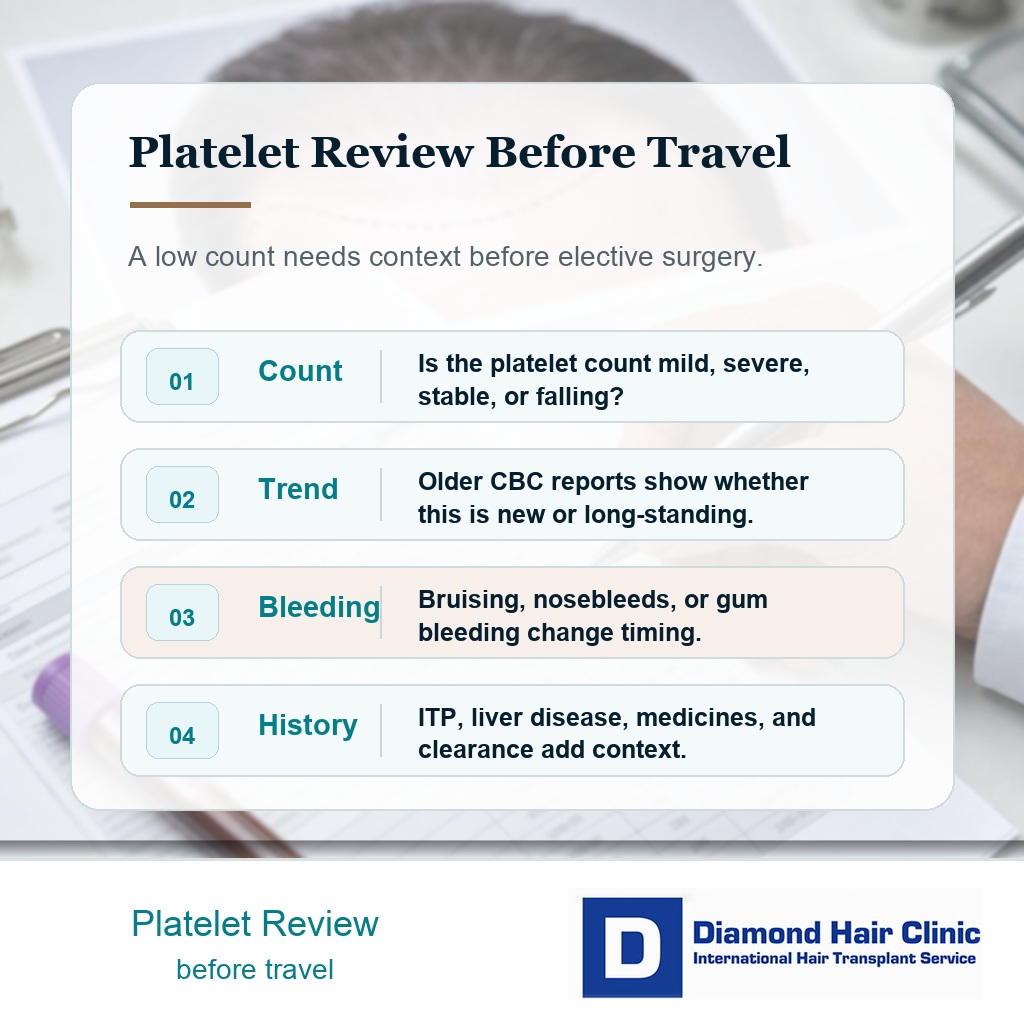
Sometimes, yes. A mildly low platelet count can be acceptable when it is stable, already investigated, not linked with bleeding symptoms, and your treating doctor has explained why elective surgery is reasonable. Some people have years of borderline or mildly low values without practical bleeding problems.
For that history, the clinic may still ask for a recent CBC, older CBC results for comparison, and a short note from the doctor who knows the platelet pattern. A number that has been stable for years is easier to interpret than a number found for the first time one week before travel.
If the low result is unexpected, I check whether the sample needs repeating or whether the laboratory mentioned platelet clumping. Occasionally, a reported low platelet count is affected by how the sample behaves in the tube. The result is not ignored. It is clarified before travel.
The decision becomes more careful when the count is dropping or when several blood lines are abnormal together. Low hemoglobin, low white cells, low neutrophils, abnormal liver tests, clotting test abnormalities, or signs of active illness can change the whole picture.
I also separate low platelets from low white blood cells before a hair transplant. Low WBC and low neutrophils mainly affect infection defense. Platelets mainly affect clotting and bleeding. They can appear in the same CBC, but they do not answer the same surgical question.
Platelet clumping and repeat testing
Sometimes a report shows a low platelet count because the platelets clumped in the tube or because the sample needs repeat checking. That possibility matters, but it is not an excuse to proceed without clarification. If the laboratory comment mentions clumping, platelet aggregates, smear review, or sample quality, I need the repeat result or smear clarification before surgery is treated as safe.
If the report mentions EDTA clumping, platelet aggregates, giant platelets, or a platelet estimate instead of a clean automated count, ask the lab or treating doctor what repeat test is needed. Often the useful clarification is a repeat CBC with smear review, or a different collection tube if the laboratory recommends it. Do not travel with only the suspicious result and assume the clinic can solve the question on surgery morning.
A corrected repeat CBC can change the decision completely. If the repeat count is normal and there are no bleeding symptoms, the concern may become much smaller. If the count remains low or the report shows other abnormal blood lines, the case needs medical explanation before an elective hair transplant.
Symptoms and history that make low platelets more serious
The history around the platelet result matters as much as the number. Easy bruising, frequent nosebleeds, gum bleeding, blood in urine or stool, purple spots on the skin, unusually heavy menstrual bleeding, or prolonged bleeding after small cuts should be taken seriously before elective surgery.
The clinic also needs to know if the low platelets are linked to ITP, liver disease, hepatitis, spleen enlargement, leukemia or blood disease, chemotherapy, recent viral illness, autoimmune disease, or medication. A stable mild platelet variation is not the same as active illness or unclear blood results.
With hepatitis or chronic liver disease in the history, platelet count becomes part of a wider medical review. The HIV or hepatitis before a hair transplant plan also depends on more than a diagnosis label. Viral control, liver function, clotting, blood count, and treating doctor advice matter.
If you have active bleeding symptoms or a doctor has already advised hematology review, the transplant should wait. A hair transplant is not urgent enough to ignore that advice.
Low platelets, anemia, and low ferritin are different issues
Low platelets, anemia, and low ferritin are all blood test findings, but they mean different things. Platelets help the blood clot. Hemoglobin carries oxygen. Ferritin reflects iron storage. You can have one problem without the others, or several at the same time.
The oxygen carrying and iron reserve side belongs to low ferritin or anemia before a hair transplant. Here, the question is different. I am looking at bleeding, clotting, bruising, and whether the count is safe enough for elective skin surgery.
The next step may be different for each blood finding. Anemia may lead to iron review, bleeding history, menstrual history, gastrointestinal review, or treatment before surgery. Low platelets may need repeat CBC, platelet trend review, medication review, liver review, hematology opinion, or treatment of ITP when relevant.
Several abnormal results together lower the threshold to wait. Low platelets, low hemoglobin, and low neutrophils together are not the same situation as one stable borderline platelet value in an otherwise well person.
Blood thinners and painkillers can change the decision
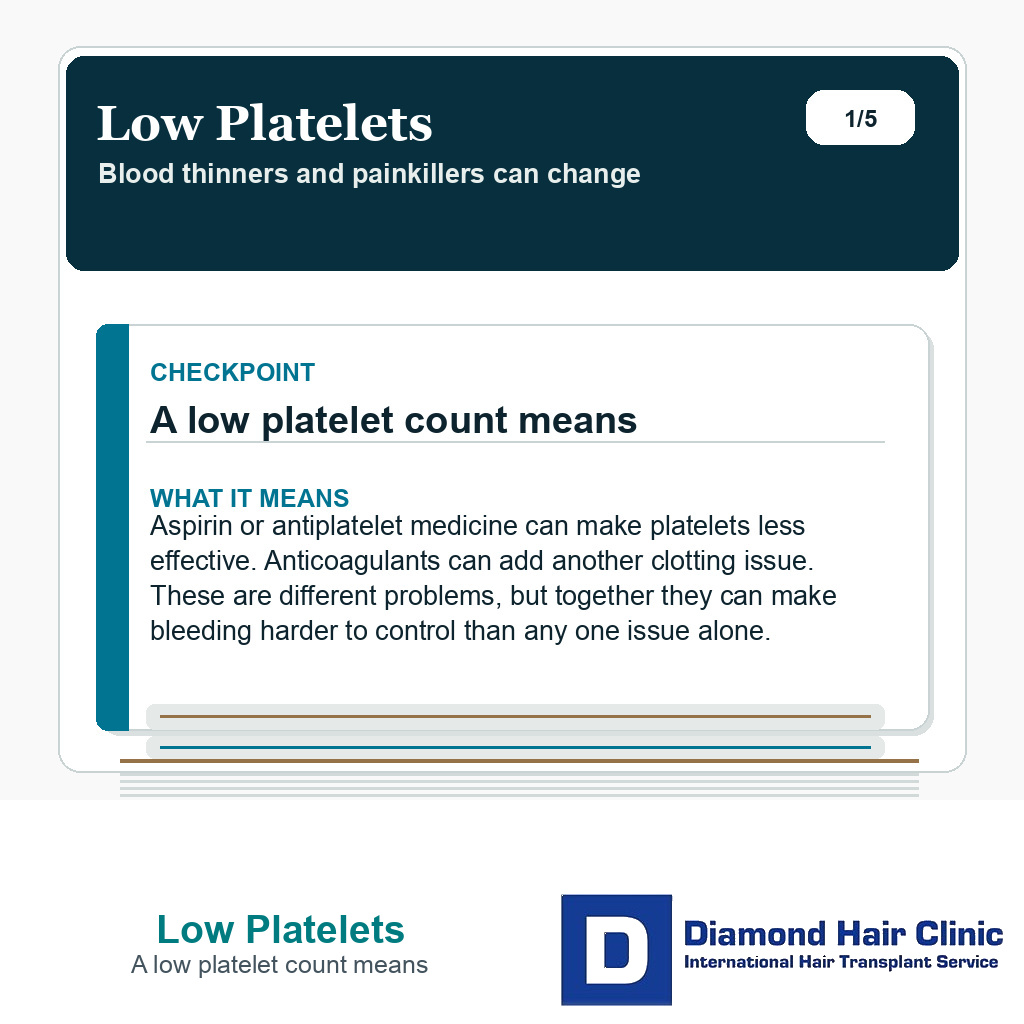
Low platelet results mean there may be fewer platelets available. Aspirin or antiplatelet medicine can make platelets less effective. Anticoagulants can add another clotting issue. These are different problems, but together they can make bleeding harder to control than any one issue alone.
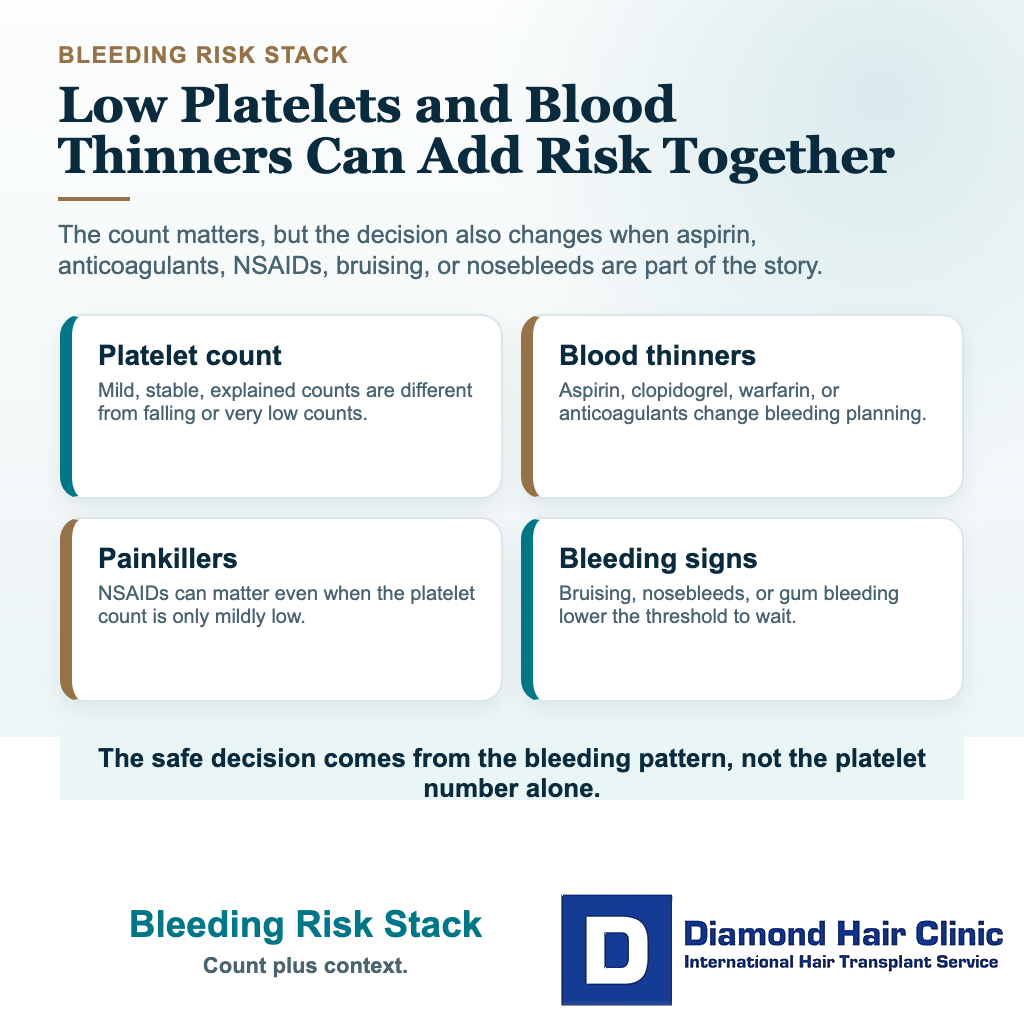
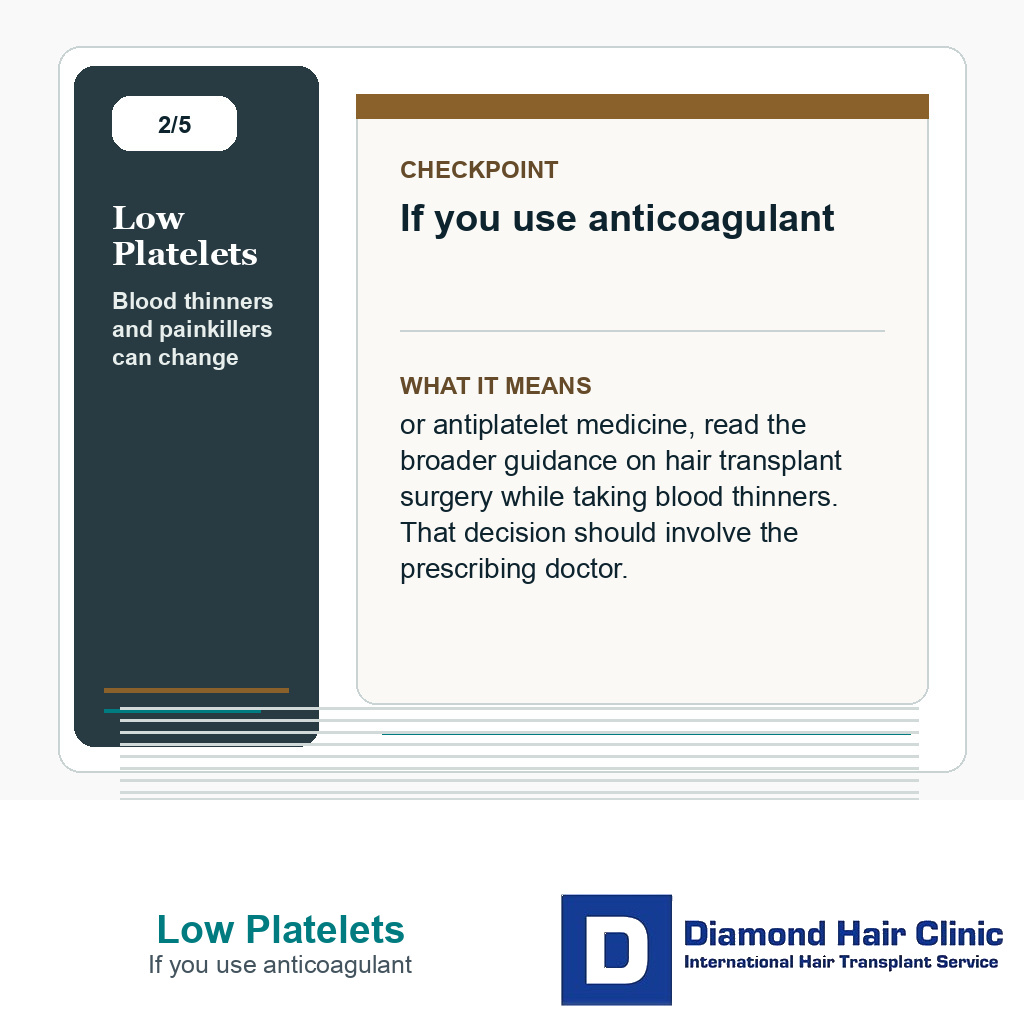
If you use anticoagulant or antiplatelet medicine, read the broader guidance on hair transplant surgery while taking blood thinners. That decision should involve the prescribing doctor. Stopping a medicine to make surgery easier can be more dangerous than postponing the transplant.
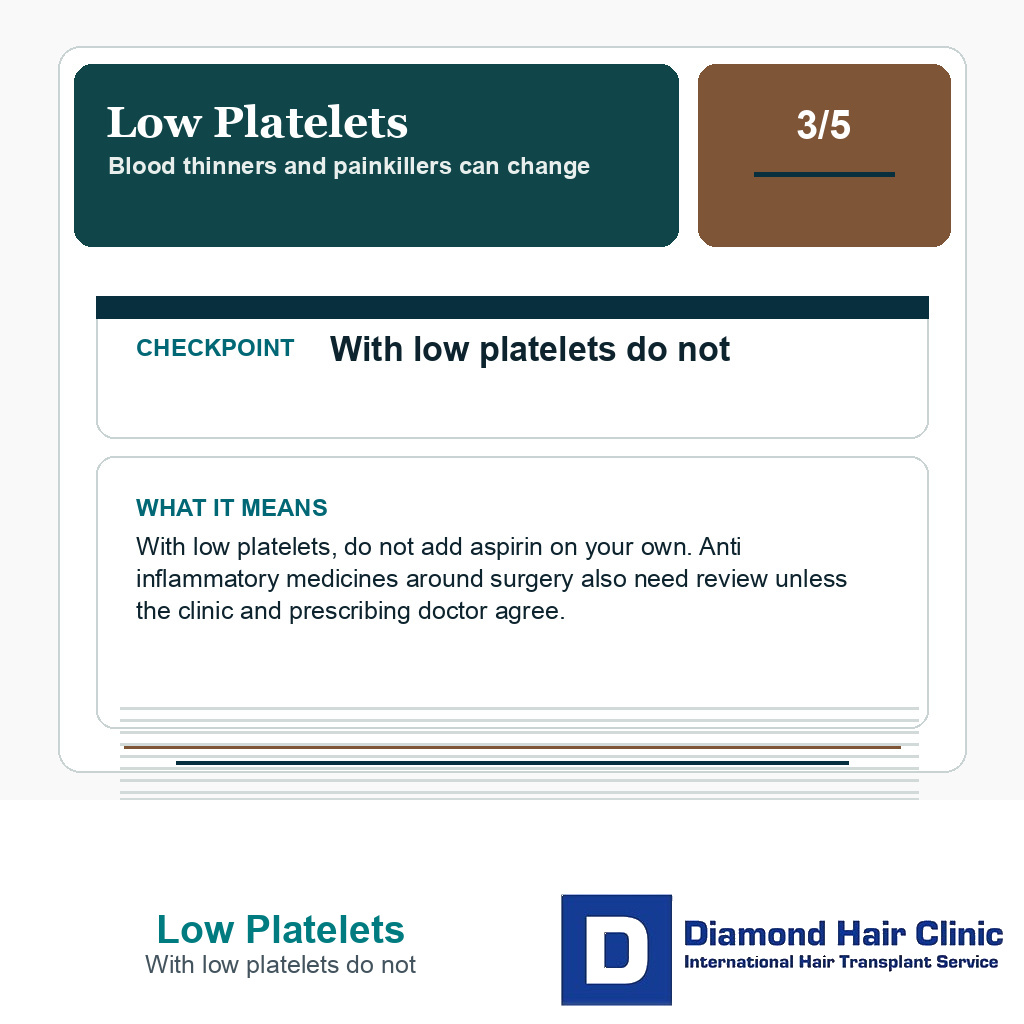
Over the counter painkillers need careful review with low platelets. Do not add aspirin on your own. Anti inflammatory medicines around surgery also need review unless the clinic and prescribing doctor agree. If pain control is needed, painkillers after a hair transplant should be chosen with clotting and bleeding history in mind.
A safe platelet plan needs the reason for each medicine and the prescribing doctor’s instruction, not only a list of what the patient stopped.
Send the exact medication names, doses, and last use dates, not only the phrase blood thinner or painkiller. This includes aspirin, clopidogrel or other antiplatelet drugs, anticoagulants, ibuprofen style anti inflammatory medicines, high dose fish oil, ginkgo, garlic capsules, bodybuilding supplements, and periods of heavy alcohol use before the test. The point is not to stop everything yourself. The point is to let the clinic and prescribing doctor understand the real bleeding picture.
Bleeding control in hair transplant surgery is not only about the blood count. It is also about truthful medication reporting, anesthesia planning, graft handling, and the surgeon’s willingness to slow down or delay when the medical picture is not clear.
These 5 slides keep platelet count, bruising history, bleeding risk, and medical clearance connected to the FUE plan. Swipe sideways or use the arrows to move through the images.


Records to send the clinic before travelling
Send the full CBC report, not only the platelet line. I need to see hemoglobin, white blood cells, neutrophils, lymphocytes, platelet count, mean platelet volume if reported, and the laboratory reference ranges. If there are flags or comments on the report, include them.
Send the exact platelet value with units, the test date, and the lab reference range. International reports may write the result as 120 x 10^9/L instead of 120,000 per microliter. A clear full report prevents conversion mistakes. A cropped screenshot of one abnormal number is not enough for surgical planning.
Send older CBC results when available. Trend is very useful. A platelet count that has been stable for five years is not interpreted in the same way as a count that fell sharply last month.
Also send your medication list, diagnosis list, bleeding history, liver or spleen history, infection history, and any hematology or internal medicine notes. If your doctor has cleared elective surgery, written clearance is much more useful than a vague verbal statement.
If the platelet issue is connected with liver disease, hepatitis, spleen enlargement, ITP, chemotherapy, or several abnormal blood values, the treating doctor note should be specific. It should say whether elective skin surgery with many small incisions and local anesthesia is acceptable, whether clotting tests such as PT/INR or aPTT need review, and whether there are limits on after surgery pain medicine or antibiotics.
Platelet review should happen before international flights are finalized whenever possible. How long you need to stay in Turkey after a hair transplant can help with logistics, but medical clearance comes before travel planning.
Prednisone, methotrexate, biologics, and platelet review
They can affect the decision, but not all in the same way. Some people with immune thrombocytopenia may have used steroids such as prednisone to raise platelets. Others take methotrexate or biologics for autoimmune or inflammatory disease, and their blood tests may be monitored because of the medicine or the illness itself.
If prednisone is part of your treatment, the dose, disease control, blood sugar, infection risk, and healing all matter. Review prednisone before a hair transplant with the prescribing doctor instead of starting or stopping it just to prepare for surgery.
If you take methotrexate before a hair transplant or Humira or another biologic before a hair transplant, the platelet count has to be judged together with disease activity, infection risk, blood tests, specialist advice, and scalp condition.
Planning should be coordinated. The transplant clinic should not make isolated decisions about immune medicines, and the treating doctor should know that the planned procedure involves many small skin openings, not only a short cosmetic appointment.
PRP and graft planning with a low platelet count
Yes, but only in a limited way. Platelet count may be relevant to PRP because PRP treatment for hair loss depends on concentrating platelets from your own blood. A low count does not by itself mean PRP has no role, but PRP is not a way to solve a platelet safety problem before surgery. It should make the clinic more careful about expectations and medical suitability.
For graft planning, the main issue is not that low platelets damage grafts directly. The concern is bleeding control, visibility during implantation, clot quality, swelling, bruising, and whether the procedure should be smaller, delayed, or avoided until the medical cause is clear.
A very large session can make medical uncertainty harder to manage. If there is a borderline medical situation, conservative planning may be safer than pushing graft numbers. Donor hair is finite, and the first operation should not be used to test whether a blood problem is harmless.
If low platelets are part of a wider autoimmune or inflammatory history, hair transplant with an autoimmune disease may also help frame the decision. Disease stability is part of surgical planning, not a separate detail.
Situations where surgery should wait
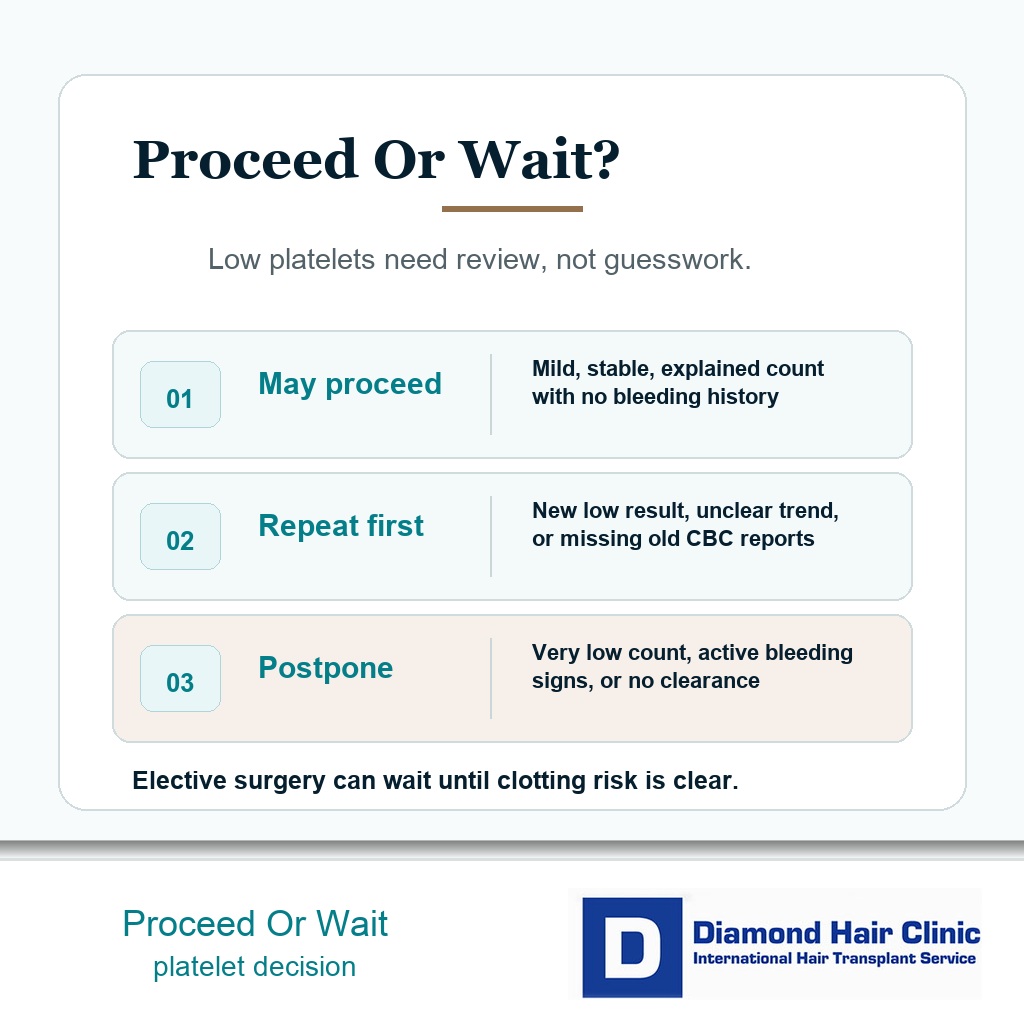
Surgery should wait when the platelet count is very low, falling, unexplained, or linked with bleeding symptoms. It should also wait when there is active illness, abnormal clotting tests, severe liver disease, unexplained bruising, several abnormal blood cell lines, or no clear plan from the doctor managing the platelet problem.
Surgery should also wait if someone is trying to manipulate the result without medical supervision. Stopping aspirin, blood thinners, prednisone, immune treatment, supplements, or prescribed medicines without guidance can create a different medical risk. That is the kind of avoidable danger I want to prevent before an elective operation. Rare serious events are usually linked to poor screening, poor judgment, unsafe medication handling, or ignored medical warning signs. A supplement or steroid that temporarily raises the number does not replace the reason for the low count.
Warning signs after any procedure include bleeding that does not settle with pressure, expanding swelling, fever, worsening pain, discharge, spreading redness, or a wound that opens. If infection concern appears, the warning signs of an infected hair transplant need quick clinic contact. Low platelets are mainly a bleeding issue, but a medically fragile patient can have more than one risk at the same time.
Waiting is not a failed booking. In elective surgery, a delay can be the decision that protects both safety and the final result.
Platelet trends matter more than screenshots
I do not clear low platelets from a single cropped screenshot. I need the full CBC, the trend, the reason for the low count, bleeding history, medication list, liver and immune history, and any treating doctor opinion. If the count is mildly low, stable, and explained, surgery may still be reasonable. If the count is very low, falling, symptomatic, or unexplained, I delay the operation until the medical picture is clear.
I also adjust the surgical plan to the medical situation, not the other way around. Sometimes that means a smaller session. Sometimes it means repeat testing. Sometimes it means hematology clearance. Sometimes it means no surgery until the platelet issue is treated or explained.
You should not feel embarrassed to report low platelets. The unsafe choice is hiding the result because the travel date is already fixed. Postponing an elective operation is better than discovering preventable bleeding risk on the surgical day.
If your platelet count is low, send the full report before travel. The answer may still be yes, but it should be a medically reviewed yes.

Read this review excerpt
Every single one of my questions was answered and they made sure I had all the details I needed to make an informed decision.