



Autoimmune Disease Requires Stable Scalp and Medical Review
A hair transplant with an autoimmune disease may be reasonable when the disease is stable, the scalp is quiet, the donor area is healthy, and the medication plan is understood. If the disease is active, affecting the scalp, causing scarring, or changing because medicines are being adjusted, I slow the decision down or refuse surgery until the medical situation is clearer.
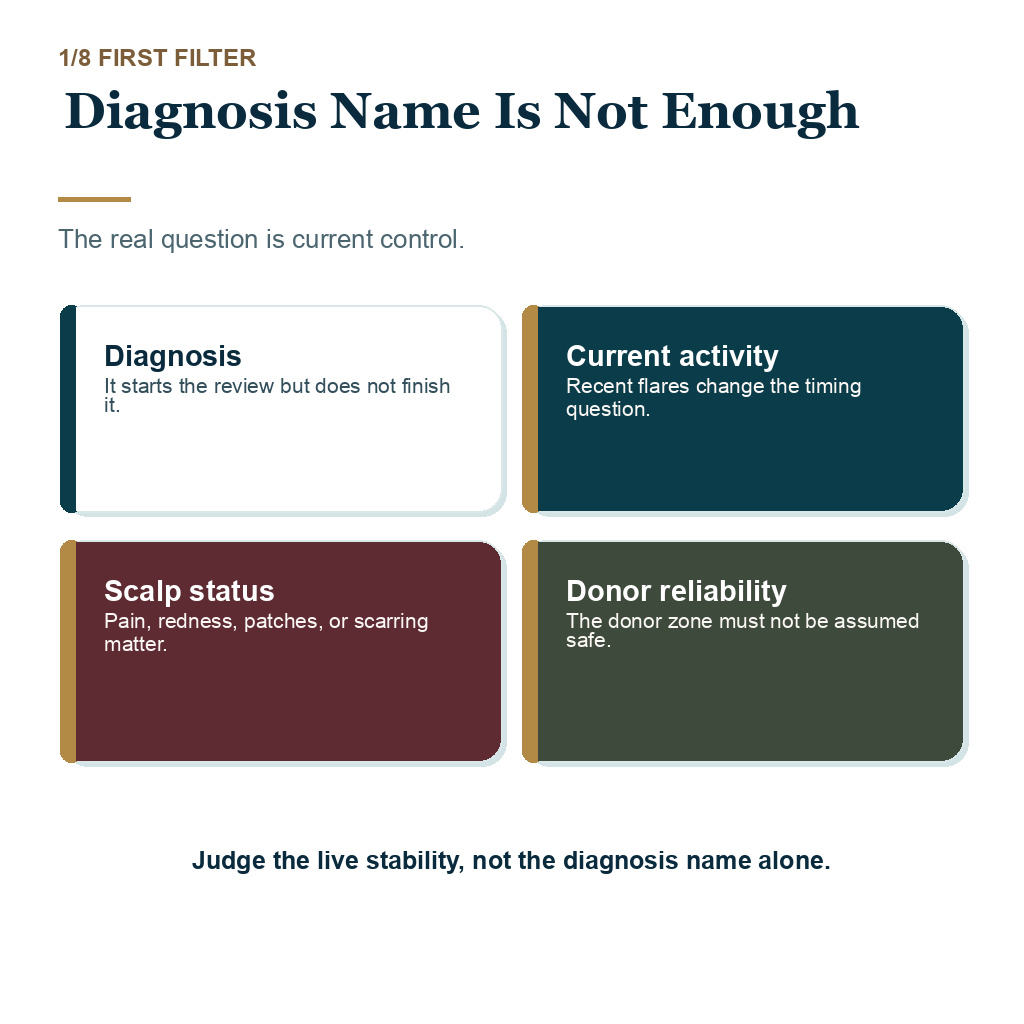
I judge this from more than the diagnosis name. I look at the scalp, the donor area, the pattern of hair loss, the history of flares, the medicines being used, including methotrexate before a hair transplant when relevant, and whether the hair loss is surgical hair loss or active disease. Crohn disease, ulcerative colitis, and hair transplant timing need disease activity review too. The mistake is treating the diagnosis name as the whole surgical answer. Some autoimmune cases should not be operated on now, and some stable cases can be considered carefully.
Clear photos help the discussion, but they are not clearance for autoimmune scalp disease. A safe decision still needs the diagnosis, activity level, medicines, wound healing history, and whether the donor or recipient skin is part of the disease.
Bring the disease timeline, not only the diagnosis label. A stable condition outside the scalp, a recent flare, and medicine changes near surgery can lead to different decisions.
Possibility alone is not enough. Donor grafts need to be placed into skin with a fair chance to heal, grow, and still look natural over time.
Autoimmune disease can stop a hair transplant in some cases
An autoimmune disease can stop or delay a hair transplant when the immune activity directly affects the scalp, hair follicles, healing, or infection risk. Then, surgery may still be technically possible, but it may be a poor use of donor grafts.
There is a big difference between a stable autoimmune condition somewhere else in the body and an active immune process destroying hair follicles in the recipient area. Controlled systemic disease may be a very different case from inflamed, painful, expanding, or scarred scalp disease.
I also check the donor area itself. In ordinary pattern hair loss, the donor area is usually the safer source of grafts. In autoimmune hair loss, I cannot simply assume that the donor zone is reliable if there are patches, inflammation, scarring, or a history of unpredictable shedding there too.
When the immune system is still actively damaging follicles, the transplant cannot solve the underlying problem. Surgery may fill an area for a short time, but if inflammation continues, the result can thin again or heal unpredictably.
Medical suitability comes before cosmetic planning. Before graft numbers matter, I look for evidence that the disease is quiet enough for surgery to be fair to the patient and fair to the donor area.
Scalp involvement changes the plan
When autoimmune activity involves the scalp, I become much more selective about surgery. Conditions such as alopecia areata, scarring alopecia and lichen planopilaris, and some lupus related scalp conditions can change the whole surgical plan.
The key question is whether the follicles are missing because of ordinary pattern hair loss, because the immune system damaged them, or because both problems are present together. If this is not diagnosed clearly, a transplant can be planned for the wrong problem.
In hair loss without scarring, the skin may still be able to accept grafts well if the surrounding condition is stable. In scarring autoimmune disease, the skin itself may have changed. Blood supply, softness, inflammation, and available follicle support may not be the same as in normal recipient area skin.
Scarred or inflamed scalp needs more caution than ordinary male or female pattern hair loss. The plan may need fewer grafts, lower density, staged surgery, medical clearance, or no surgery at that time.
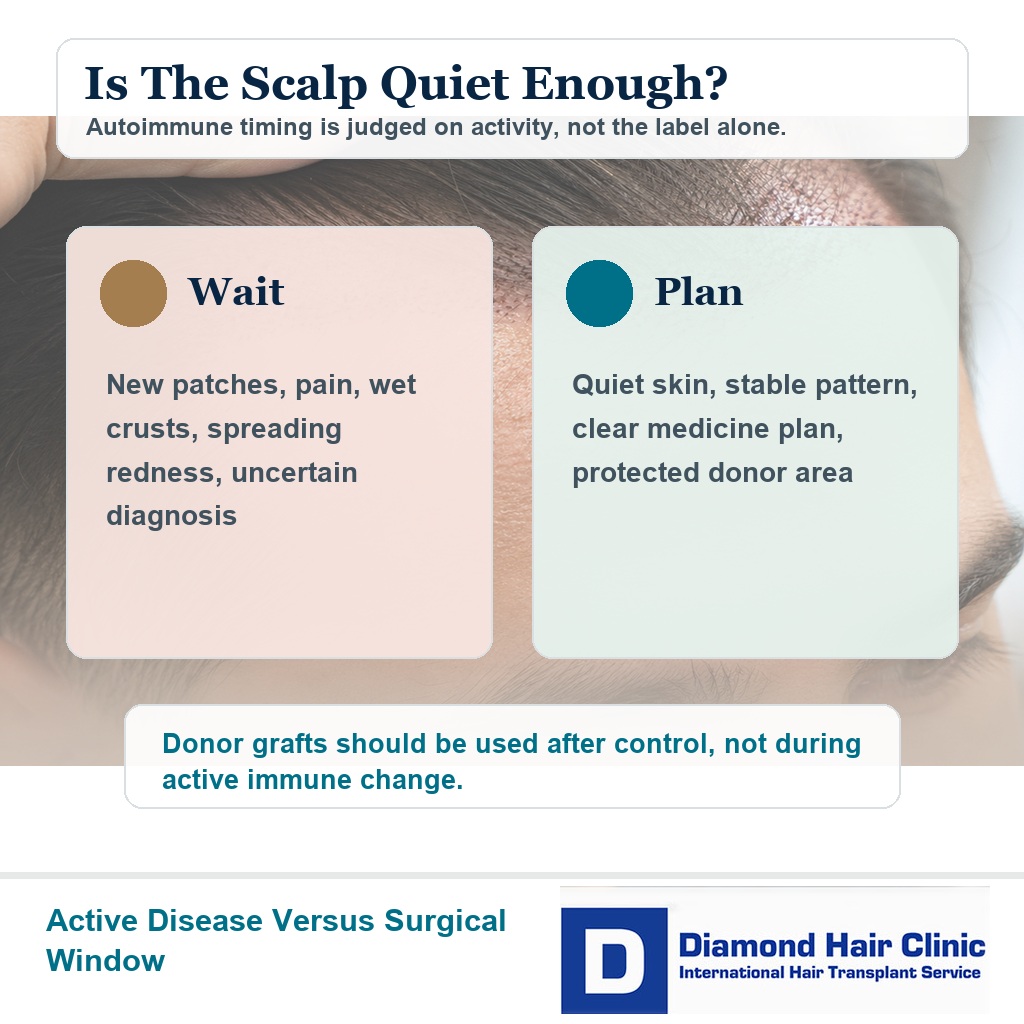
When autoimmune activity affects the scalp, timing matters more than graft number.
Disease away from the scalp still matters
When the condition does not affect the scalp, the decision may be simpler, but it is still not automatic. Controlled rheumatoid arthritis, inflammatory bowel disease, thyroid autoimmunity, or another systemic condition may be compatible with surgery if general health and the medication plan are stable.
The donor area and recipient area still need to be evaluated like any other transplant case. I need to see whether there is pattern hair loss, whether future hair loss is likely, and whether the donor area can support the plan without being overused.
A stable systemic diagnosis does not make a poor hairline plan safe. It also does not excuse aggressive graft numbers. The same principles still apply. Donor management, natural hairline design, age, future hair loss, and realistic coverage still matter.
Some autoimmune diseases have skin or healing patterns that matter even when the scalp looks quiet. For example, vitiligo and hair transplant raises different questions than active scarring alopecia. The diagnosis guides the questions, but the live examination decides the plan.
Disease stability comes before surgery
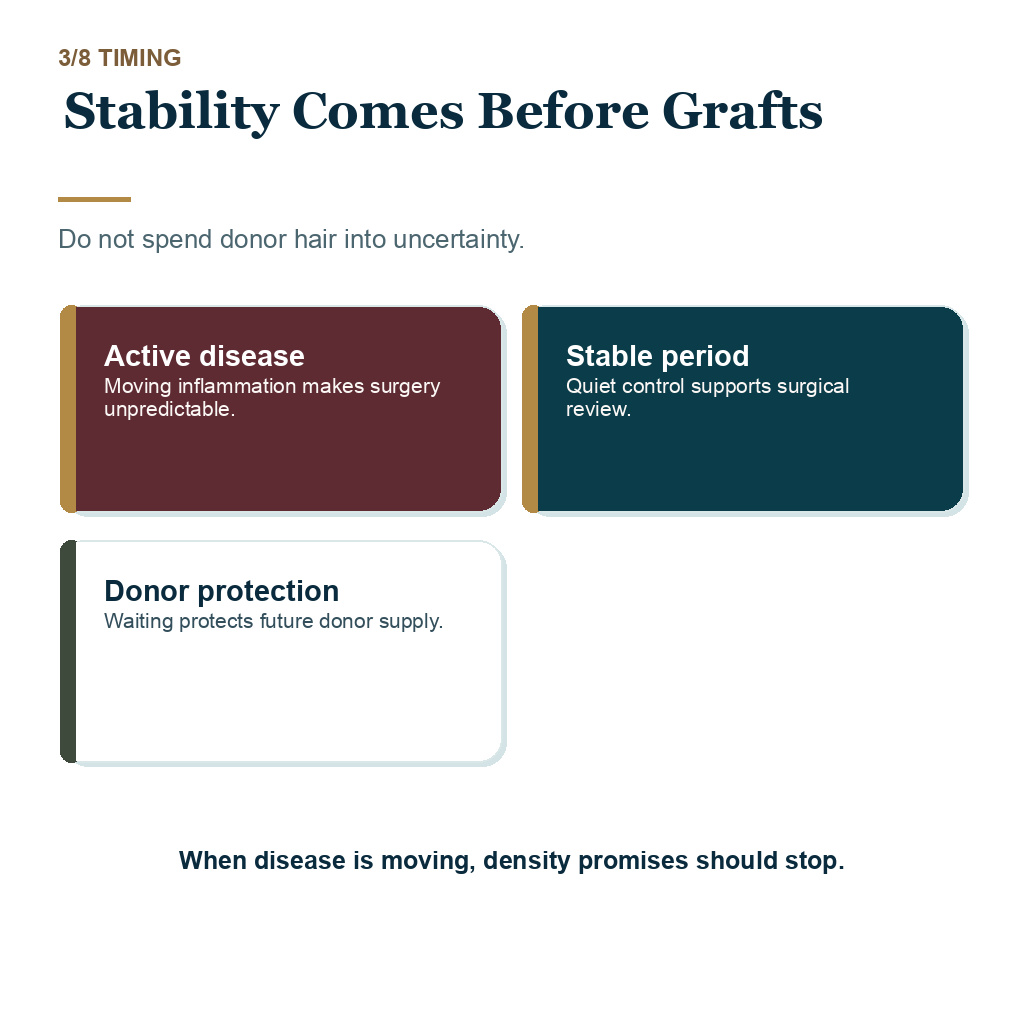
A stable period matters before using donor grafts in autoimmune disease. The exact time depends on the diagnosis, but the principle is consistent. The scalp should not be actively changing, painful, inflamed, draining, spreading, or showing new unexplained patches.
For scalp disease, the surface should be quiet and the pattern should be stable. I usually want at least 6 to 12 months without new patches, expansion, pain, intense itching, active crusting, or fresh inflammation before grafts are considered. Scarring autoimmune disease may need even longer stability and stronger specialist confirmation because donor grafts are limited and the recipient area may not behave like normal skin.
For systemic disease, medical stability comes first. A flare, infection, recent hospitalization, new immune treatment, or recent steroid dose change can make surgery less predictable. Feeling ready emotionally is not the same as being medically stable enough for an elective operation.
Waiting is not a failure when the disease is active. Waiting can protect the donor area and prevent grafts from being spent in a situation that is not ready.
Specialist clearance may be needed before surgery
Sometimes yes, especially when the scalp has been involved. Dermatology input can be more useful than a general note saying someone is fit for surgery. I review the diagnosis, current activity, treatment plan, and whether the skin is quiet enough to receive grafts.
In alopecia areata, lichen planopilaris, frontal fibrosing alopecia, discoid lupus, or other immune scalp disease, photographs alone can miss the real activity. A quiet looking area may still need dermoscopy, biopsy history, or specialist follow up before surgery is sensible.
For systemic autoimmune disease, the right doctor may be a rheumatologist, gastroenterologist, endocrinologist, dermatologist, or another specialist. The useful clearance should confirm disease stability, medication stability, infection risk, wound healing concerns, and whether any medicine should be timed around elective scalp surgery. A hair transplant clinic should not invent medication changes on surgery morning.
Immunosuppressant medicines affect the plan
Immunosuppressant medicines can change the plan. Methotrexate, biologic injections such as Humira, JAK inhibitors, corticosteroids such as prednisone, and other immune treatments may affect infection risk, wound healing, flare control, or the timing of surgery.
When the immune treatment is medicine used to prevent organ rejection after a previous transplant, hair transplant after an organ transplant needs a separate clearance discussion.
I do not ask people to stop these medicines casually. Stopping a medication can create a flare that is more dangerous for the scalp or general health than continuing it. The prescribing doctor must be part of the decision when the medication has a real immune effect.
The surgical team needs to know the medicine name, dose, timing, reason for use, and whether the disease is controlled. Some cases need a coordinated medication plan. Others only need documentation and routine monitoring. A third group should wait until the medical team confirms the timing is reasonable.
People often focus on whether a medicine is “allowed.” I focus more on whether the whole case is stable. A stable person on a medicine used consistently can be safer than someone unstable who stopped treatment just to reach a surgery date.

A safe autoimmune hair transplant decision starts with disease control, medication clarity, donor safety, and realistic expectations.
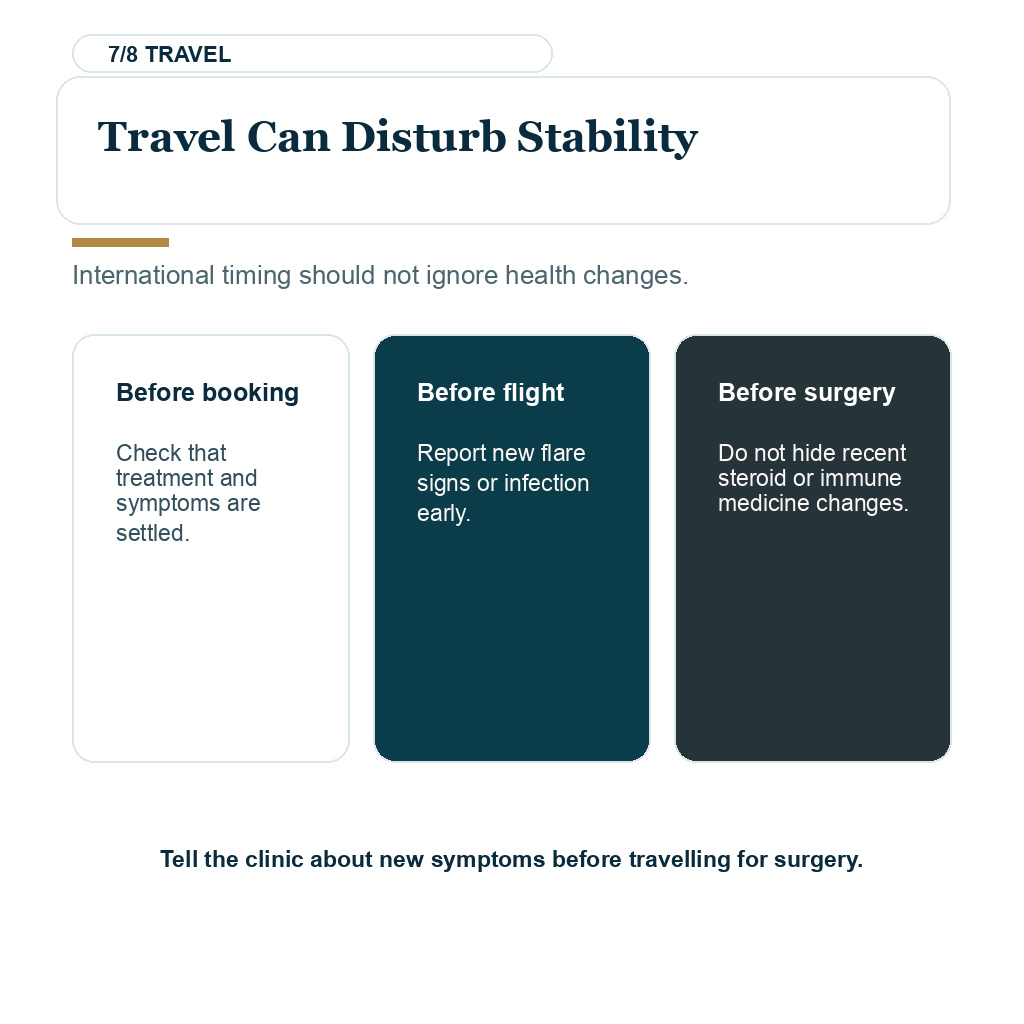
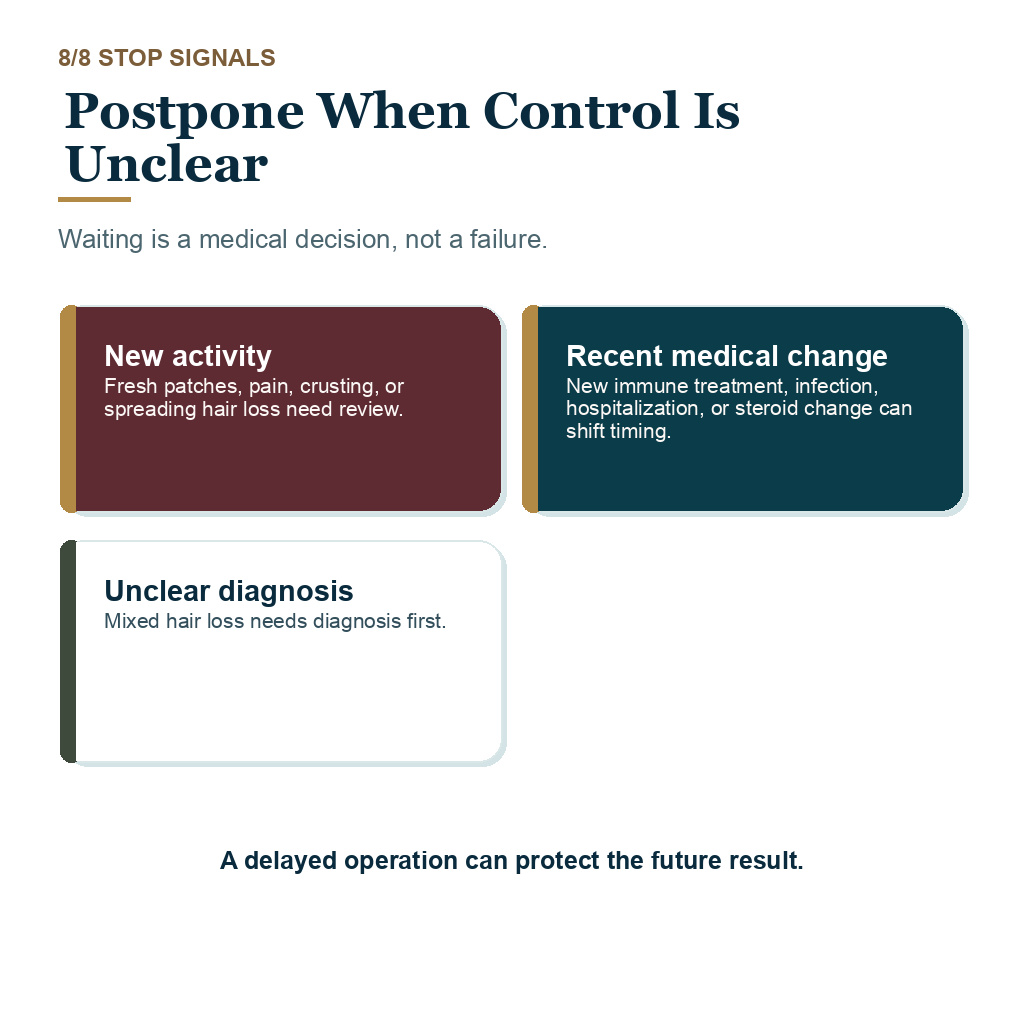
These 8 autoimmune review slides separate diagnosis name, current disease activity, scalp stability, medication timing, specialist context, donor planning, travel triggers, and postponement signals. Swipe sideways, use the arrows one slide at a time, or choose a number below the image.



Autoimmune disease can affect transplanted grafts
In ordinary pattern hair loss, transplanted donor follicles are chosen because they are more resistant to androgen related miniaturization. Autoimmune disease is different. If the immune condition targets follicles or creates scarring inflammation, donor resistance to pattern hair loss does not fully protect the grafts.
Do not read that as everyone with autoimmune disease will lose transplanted hair. It means the diagnosis matters. Stable thyroid autoimmunity with pattern hair loss is not the same as active alopecia areata, uncontrolled lupus affecting the scalp, or active scarring inflammation.
In the recipient area, I first try to understand why the hair disappeared. If scarring disease destroyed the follicles, the disease has to be quiet before grafts are discussed. If the thinning is mainly androgenetic hair loss, the transplant logic may be more straightforward.
In scarred areas, the question also includes skin quality. Stable scar tissue can sometimes accept grafts, as I discuss in transplanting into scar tissue, but active disease is a different problem.
Specific checks matter before deciding
The first check is diagnosis. Do not go into surgery with unclear patchy loss, unexplained redness, painful bumps, scaling, or sudden shedding without knowing what is causing it.
The second check is stability. If the disease is still moving, surgery should slow down. A transplant is not a treatment for active autoimmune inflammation.
The third check is donor safety. Even if the recipient area seems possible, the donor area must be protected. Autoimmune disease can still leave someone needing future grafts, and donor capacity should not be spent on an unstable plan.
The fourth check is medical coordination. Immune medication, blood thinners, long-term steroids, or complex treatment should be reviewed before surgery. This cannot be reduced to one fixed answer, especially when judging medication before a hair transplant.
I also use testing when it genuinely helps the decision. Blood tests before a hair transplant, including low white blood cell results, can provide practical information that changes timing, safety, and planning.
Some clinic promises are risky in autoimmune cases
Autoimmune cases become risky when a clinic treats the case like standard pattern hair loss without asking enough medical questions. A graft number is not meaningful if nobody has understood why the hair was lost.
A fast promise of dense coverage can sound reassuring, but it may ignore the real issue. If the scalp disease is active, more grafts do not solve the disease. If the skin is scarred, high density may not be the right first step. If the medication plan is unclear, surgery can become unnecessarily stressful.
The consultation needs to make the limits clear, not only the offer. Who examined the scalp? Is the diagnosis clear? Is the donor area safe? Is the disease quiet? Is the plan staged if needed? Is the surgeon personally involved in the decision?
When an autoimmune condition is involved, the most dangerous promise is certainty without examination. A careful answer may feel slower, but it protects donor grafts from being used before the case is ready.
Waiting can be better than operating
Waiting is better when the autoimmune disease is active, when the diagnosis is unclear, when the scalp is inflamed, when the medication plan is changing, or when expectations are too high for what surgery can directly deliver.
Waiting is also better when the transplant is being asked to hide an untreated medical problem. Surgery can move hair. It cannot switch off immune inflammation, stop progressive disease, or guarantee that a scarred recipient area will behave like normal skin.
This can be disappointing, but a delayed operation is better than a rushed operation that wastes donor grafts. Stable disease can be planned more intelligently. A flare cannot.
Candidacy is not only about tolerating the procedure. A person may technically be able to sit through surgery and still not be a good candidate for a hair transplant at that moment.
Stable disease matters more than the label
An autoimmune diagnosis does not give one shortcut answer. I need to know the exact disease, whether the scalp is involved, whether inflammation is active, which medicines are being used, and whether the donor and recipient skin behave predictably.
If the condition can scar the scalp or flare with trauma, the surgical goal becomes smaller and more cautious. Sometimes medical control comes first. Sometimes a limited session is possible. Sometimes not operating protects the patient more than trying to force density into skin that is not ready.
Lupus, psoriasis, alopecia areata, and other autoimmune conditions need separate medical routes. The specific diagnosis and its stability set the route.

Read this review excerpt
Diamond Hair was the only clinic asking for medications, treatments I've done before, and other type of questions that make me feel confident on the professionalism that they practice with their clients.