



Biologics and FUE Surgery Planning
With Humira, adalimumab, or another biologic, I first look at disease control, infection risk, dose timing, and scalp condition. Planning depends on why you take the biologic, disease stability, infection signs, dose timing from the prescribing doctor, and whether the scalp is quiet enough for elective surgery.
If you take a biologic for Crohn disease, ulcerative colitis, psoriasis, psoriatic arthritis, rheumatoid arthritis, ankylosing spondylitis, hidradenitis suppurativa, or another inflammatory condition, the medicine belongs in the surgical plan before travel is booked. Do not skip, delay, or restart a biologic injection on your own to make the hair transplant seem simpler. A coordinated plan is safer than an improvised medication change.
Stable maintenance treatment on a predictable dose interval is different from a recent start, loading dose, dose escalation, missed dose, active flare, infection, or combined immune treatment. A hair transplant should not become the event that interrupts a medicine keeping a serious disease controlled.
Bring a short note from the prescribing doctor when possible. It should list the diagnosis, dose interval, last dose, next planned dose, recent infections or flares, and whether elective scalp surgery is acceptable.
When can surgery be considered on a biologic?
Surgery can be considered when the condition being treated is stable, there is no active infection, the scalp is not inflamed, and the prescribing specialist agrees that the timing is reasonable. Then the biologic becomes a planning detail, not a reason to reject surgery by itself.
I separate the decision into hair pattern stability and medical timing. The donor hair and hairline plan may look suitable, but active inflammatory disease or an unclear biologic schedule can still make the operation poorly timed.
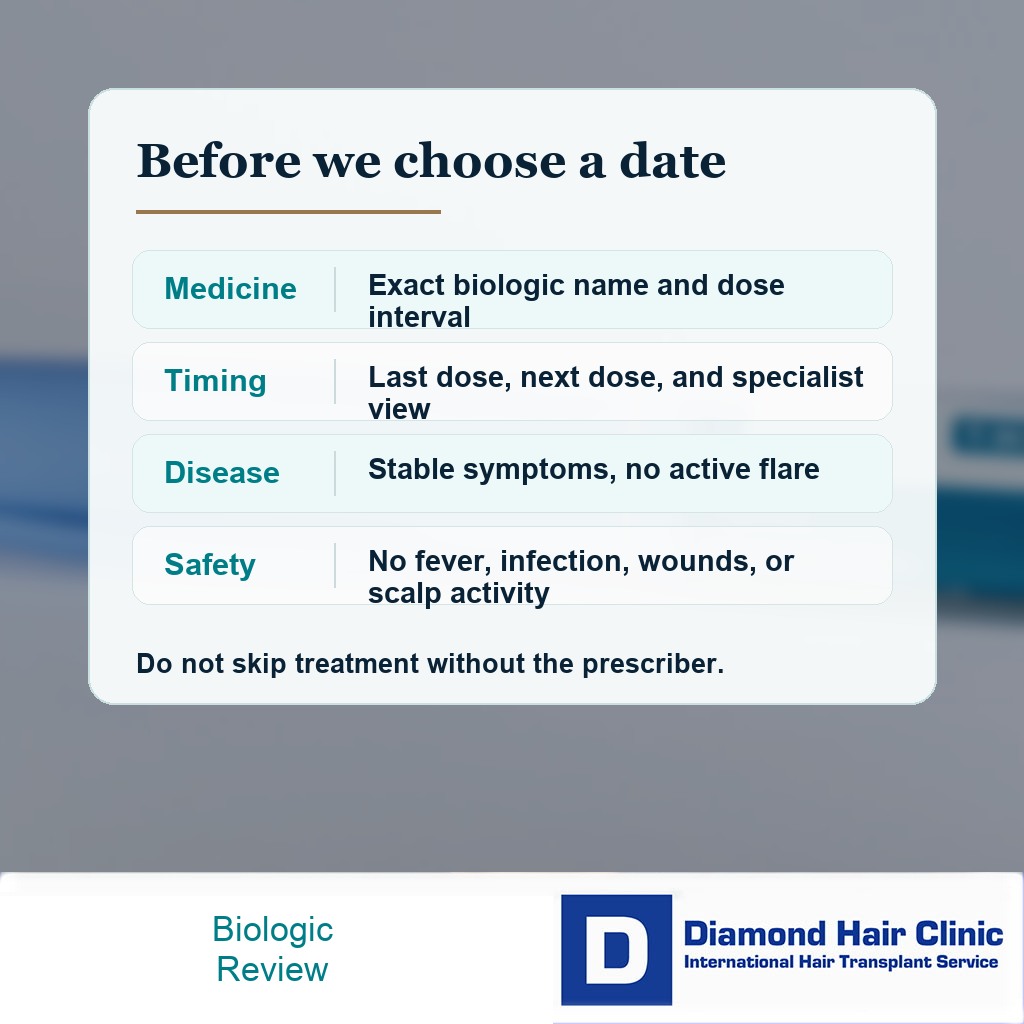
This is similar to the discipline used for medication before a hair transplant, but biologics need extra attention because they are not ordinary painkillers or supplements. They change specific immune pathways. I need the exact medicine name, dose interval, last injection or infusion date, treatment reason, disease control, recent infections, and any other immune medicine used at the same time.
Send both the brand and generic name if you know them, because biosimilars can have different names in different countries. Also send whether you are on a loading dose, maintenance dose, recent dose escalation, missed dose, or planned switch. A biologic calendar is more useful than a sentence that says I take Humira sometimes.
The prescribing specialist should be involved
The doctor who prescribed the biologic understands the disease activity, flare risk, infection history, and the consequences of delaying a dose. A hair transplant surgeon should not independently tell you to stop Humira, Remicade, Enbrel, Stelara, Cosentyx, Skyrizi, Entyvio, or another biologic.
Some specialists prefer elective surgery to be timed around a dosing interval. Some may advise holding a dose for certain procedures. Others may prefer continuing treatment if stopping creates a higher flare risk. If a biologic pause leads to a steroid rescue course or a disease flare, the plan may not become safer just because one medicine was held. The answer depends on the biologic, the disease, the dose interval, infection history, other immune medicines, and the size of the operation.
A useful specialist note should be specific. It should say whether the biologic should continue, pause, or be timed around the operation, who decides the restart date, which infection or flare symptoms should stop the plan, and whether recent blood tests, tuberculosis or hepatitis screening, or other monitoring results change the surgical timing.
A hair transplant is usually performed under local anesthesia, and it is not the same as abdominal, orthopedic, or implant surgery. It also is not a simple injection with no wound. It creates thousands of small skin openings. The decision is not only whether the medicine is allowed. Wound healing, infection control, and disease stability all need to be acceptable for an elective operation.
Injection or infusion timing needs a clear plan
There is no single timing rule that fits every biologic. Humira or an adalimumab biosimilar may be taken every other week, and some plans use a different rhythm. Other biologics may be given every four weeks, eight weeks, twelve weeks, or by infusion in a hospital or clinic. A medicine with a longer interval creates a different timing question from a medicine injected every week.
In many areas of surgery, doctors may consider planning elective procedures near the end of a dosing interval, or restarting treatment only when early wound healing is satisfactory and there is no infection. That principle can guide the discussion, but it should not be copied blindly into hair transplant planning. A 1,000 graft correction, a long maximum session transplant, and active scalp inflammation are not the same timing problem.
If the biologic is due very close to the operation date, the prescribing doctor should advise whether the date is acceptable, whether the dose should stay on schedule, or whether the hair transplant should move. After surgery, restart timing should still follow the prescriber and clinic plan. Do not restart late or early only because the scalp looks fine in a mirror. A scalp that looks quiet does not replace medical judgment when immune treatment is involved.
If the plan involves skipping or moving a dose, write the exact old date, new date, and reason in one message to both the clinic and the prescribing doctor. That reduces mistakes during travel, time zone changes, and early recovery when patients are tired and trying to follow several instructions at once.
Biologic doses during early recovery need planning
If the next injection or infusion is due during the first recovery days, the timing should be agreed before surgery, not improvised after the transplant. The scalp may look settled while thousands of small donor and recipient area openings are still healing, so a mirror check is not enough to decide whether immune treatment should restart, pause, or stay on schedule.
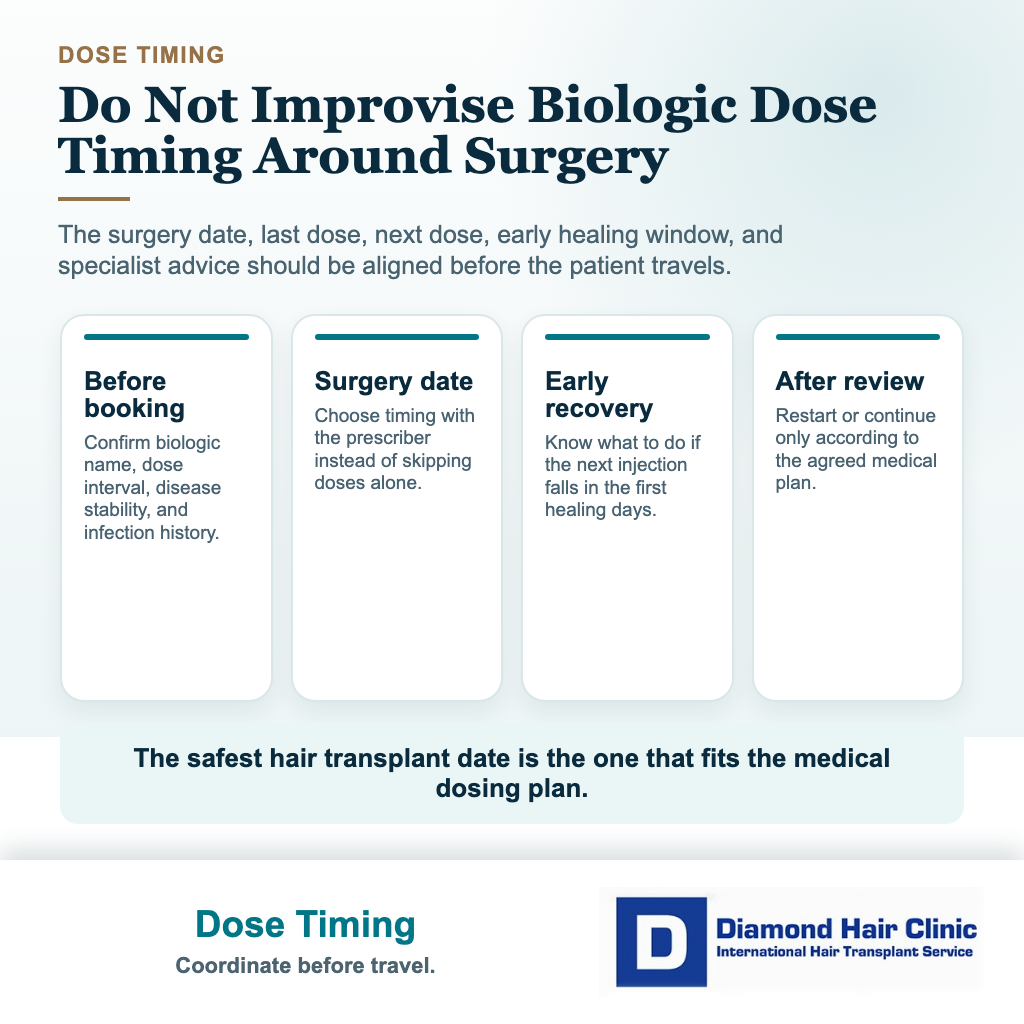
Before travel, the plan should name who decides the next dose date, which symptoms must be reported before taking it, and how fever, spreading redness, drainage, chest infection, skin infection, or antibiotic treatment after surgery should be handled. Those decisions should not be made for the first time from a hotel room or airport gate.
For many people, communication is the practical safety step. Send the planned biologic dates, follow the prescribing doctor’s instructions, and update the clinic if early healing is not clean. Do not delay a biologic dose out of fear, and do not take it early to protect travel convenience. The right timing protects disease control and wound healing together.
Details to review before choosing a date
The review should include the biologic name, last dose, next planned dose, reason for treatment, recent flares, recent fever, antibiotic use, injection site reactions, infusion reactions, skin wounds, bowel symptoms, joint symptoms, blood sugar problems, blood pressure, and the scalp condition. If corticosteroids, methotrexate, azathioprine, JAK inhibitors, or other immune treatment are also part of the case, the plan needs more caution. Anti rejection medicine after a previous transplant needs its own clearance pathway, which I explain in hair transplant after an organ transplant.
Send the most recent CBC and any liver, kidney, CRP, ESR, glucose, or disease monitoring results your specialist uses when they are available. I am not asking for every old file. I need enough current context to know whether the disease and treatment are stable enough for elective scalp surgery.
Blood tests before a hair transplant may be useful when the medical history is complex. I do not use blood tests as a cosmetic formality.
I use them to check whether there is anemia, low white blood cells, low platelet count, infection concern, liver or kidney issue, blood sugar problem, or another finding that should be handled before surgery.
Scalp examination also matters. If there are open wounds, crusting, pustules, spreading redness, active psoriasis plaques, untreated folliculitis, or painful inflammation in the donor or recipient area, the date should not be forced. A clean scalp gives grafts a better environment and makes aftercare easier to judge.
Biologics are different from prednisone or methotrexate
Biologics are targeted immune medicines, usually given by injection or infusion. Humira is the brand name of adalimumab, a TNF inhibitor biologic. Other biologics target different inflammatory pathways. They are often used when a condition needs stronger control than topical treatment or standard tablets can provide.
Prednisone before a hair transplant raises a different set of questions because corticosteroid dose, duration, blood sugar, blood pressure, skin thinning, and healing history can be important. Methotrexate before a hair transplant is also different because it is a conventional disease modifying medicine, not a biologic injection.
Treating every immune medicine as the same can lead to poor decisions. A biologic may be safer when the disease is well controlled than when treatment is stopped and the disease flares. Another case may need a delay because there is active infection, combined immune suppression, or poor healing risk. The medicine name matters, but the whole clinical picture matters more.
I also separate biologics from anabolic steroid use. A biologic prescribed for inflammatory disease is not the same thing as performance steroid use without a prescription. The words steroid, injection, and immune medicine are too broad to guide surgery. The real decision is whether the treatment, the disease, and the scalp create a stable enough situation for surgery.
When is postponing safer?
I postpone when there is fever, active infection, recent antibiotic treatment for a significant infection, draining skin lesions, uncontrolled bowel flare, severe psoriasis flare on the scalp, poorly controlled diabetes, unstable blood pressure, unexplained fatigue with abnormal blood tests, or a recent medication change that has not settled yet.
Risk rises when several factors are combined. A biologic plus a recent high dose steroid course, active scalp inflammation, and long travel immediately after surgery is not the same situation as a regular biologic schedule, clear specialist approval, and a quiet scalp.
Recent infection deserves special attention. A mild past cold that fully resolved is different from fever, chest infection, infected skin, abscess, urinary infection, infected dental problem, or any infection needing antibiotics close to the operation date. If the body is already fighting an infection, creating thousands of fresh scalp openings is poor timing for an elective cosmetic procedure.
A mild injection site reaction that settled is also different from spreading hot redness, drainage, fever, shortness of breath, or feeling generally unwell. Those symptoms should be reviewed medically before the transplant date is treated as fixed.
Early warning signs of infection after a hair transplant should be taken seriously after surgery. When biologic medicine is involved, infection prevention and follow up should be clear before the operation, not only after a problem appears.

These 5 slides keep biologic timing linked to disease control, infection risk, and the doctor managing your immune treatment. Swipe sideways, use the arrows, or choose a number below the image.



Stable disease control matters for scalp psoriasis or Crohn disease
If the biologic is controlling scalp psoriasis before a hair transplant, stopping it without a plan may make the scalp worse. Active scaling, itching, scratching, plaques, or open irritation can make the transplant day and early recovery more difficult. The cleanest plan is often made when the scalp has been quiet for a stable period.
For Crohn disease or ulcerative colitis before a hair transplant, I review recent flares, anemia, nutrition, steroid use, weight changes, bowel symptoms, and travel tolerance. Stable remission is very different from recovery after a flare while medication is still changing.
Autoimmune disease before a hair transplant often needs a more individualized decision. The hair transplant itself must not destabilize the disease plan. The operation is elective. The medical condition is not elective.
Humira or another biologic is not always the cause of shedding
Some people notice shedding while taking a biologic, but the cause is not always the medicine. Hair loss is not a common adalimumab side effect, so I do not treat every shed as drug toxicity. The underlying inflammatory disease, a flare, anemia, low ferritin, stress, weight change, infection, steroid tapering, or telogen effluvium can all contribute to shedding. A biologic may be blamed because it is the newest visible change, even when the timeline points elsewhere.
Before surgery, the diagnosis must be clear. If the diagnosis is temporary shedding, active diffuse loss, or a hair loss pattern driven by disease, surgery may be premature. Operating during unstable shedding, including telogen effluvium and hair transplant timing, can create regret. If the loss is stable androgenetic alopecia, surgery may still be reasonable after medical review.
Donor stability still matters. A biologic does not create donor capacity. If the donor area is weak, overharvested, inflamed, or affected by another diagnosis, the hair transplant plan must be conservative. The medicine question should never distract from donor management.
Recent biologic changes make timing less settled
A recent start, switch, loading dose, dose escalation, or loss of response makes the decision less settled. In the first months of a biologic plan, you and the prescribing doctor may still be learning whether the disease is controlled, whether side effects appear, and whether infection risk is changing. That is not always the best moment to add elective surgery.
If the hair loss is connected to a flare, anemia, weight loss, or medication transition, the hair may continue changing while the transplant is being planned. When that is happening, surgery can be technically possible but strategically weak. A transplant belongs on a stable diagnosis, a stable donor area, and a stable medical background.
With lupus before a hair transplant, psoriasis, IBD, or another immune condition, the hair plan should not compete with the disease plan. The right time for surgery is after the medical pattern is understandable enough to protect healing and expectations.
Travel to Turkey should follow the medication plan
Travel adds pressure. Flights, hotels, leave from work, and family support are sometimes arranged before the medical plan is complete. With biologics, that order can create avoidable risk. Send the clinic the medicine name, dose interval, last dose, next planned dose, diagnosis, specialist notes if available, recent blood tests, and clear scalp photos before final travel plans.
If you also have diabetes before a hair transplant, heart disease, active infection risk, or a history of poor wound healing, disclose it early. The anesthesia plan also belongs in the review. Anyone taking immune treatment should understand how local anesthesia and adrenaline in hair transplant surgery fit into the wider medical history.
If a biologic dose may be needed during travel, ask the prescribing doctor or pharmacist how it should be transported and stored. Many biologic injections must be protected from overheating or freezing. Keep the labelled medicine information with you, and do not inject a dose that may have been stored incorrectly just because the surgery schedule feels urgent.
For travel, keep the medication plan practical. Carry the labelled medicine information, know the storage window, avoid freezing the pen or syringe against an ice pack, and confirm what to do if the dose is delayed by flight problems. Storage mistakes should be reported, not hidden from the prescribing team.
At Diamond Hair Clinic, moving the date is safer than operating through uncertainty. A delayed operation is frustrating. A poorly timed operation can create medical risk, confusing aftercare, infection anxiety, and a result you judge under unnecessary stress.
My threshold for surgery while on biologics
Biologic treatment should make the consultation more careful, not more fearful. The answer should not be reflex approval or reflex refusal. A regular biologic schedule, specialist awareness, no infection, a stable scalp, and a realistic hair plan may make surgery reasonable. A flare, treatment change, active infection, or several immune medicines together may mean waiting is safer.
I also consider the reason for surgery. A small, conservative hairline refinement with strong donor reserves is a different surgical burden from a large session with unstable health and diffuse loss. Medical suitability and hair suitability must agree before I accept the case.
If you take Humira, adalimumab, infliximab, etanercept, ustekinumab, secukinumab, risankizumab, vedolizumab, or another biologic, tell the clinic before arranging travel or surgery. Involve the prescribing doctor before choosing a surgery date. Do not stop the medicine on your own. The right plan protects disease control first, then builds the hair transplant around that reality.

Read this review excerpt
Every single one of my questions was answered and they made sure I had all the details I needed to make an informed decision.