


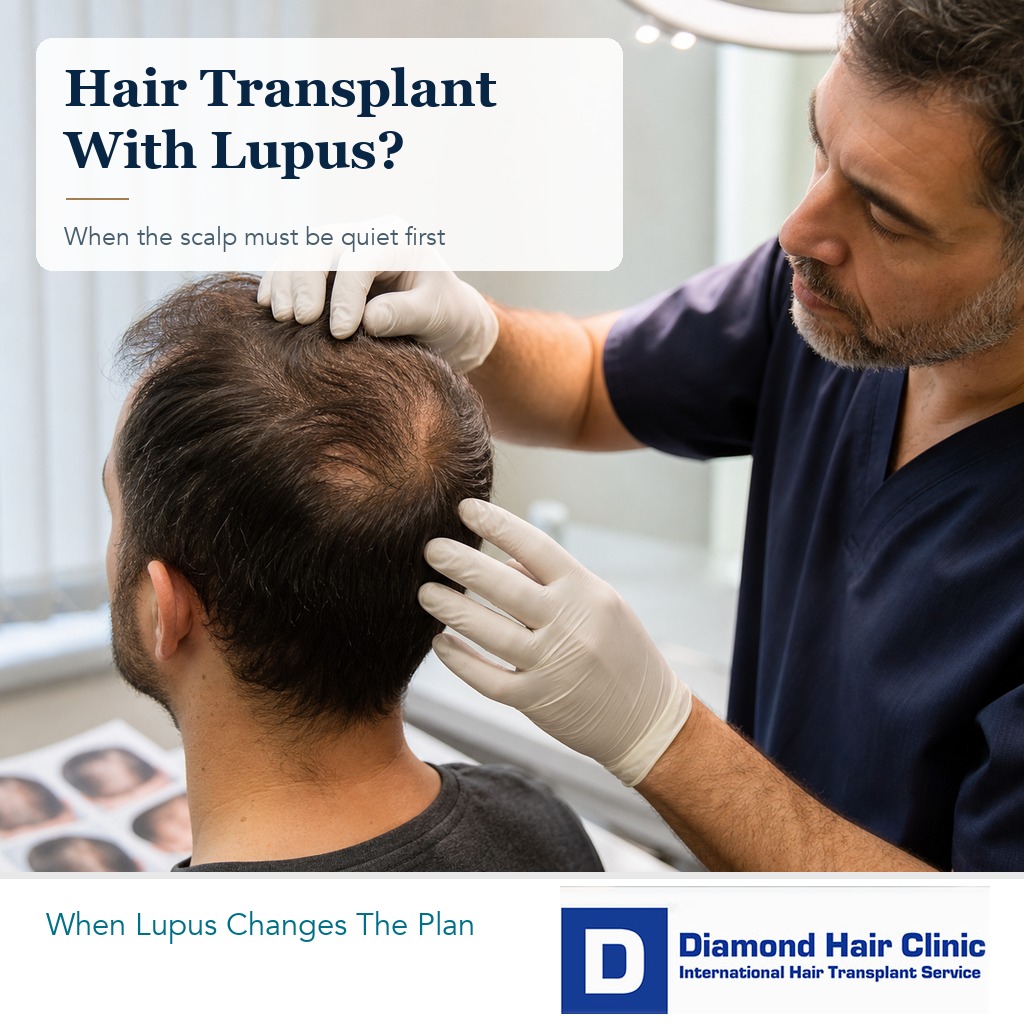
Hair Transplant With Lupus Needs Medical Stability
Some people with lupus can have a hair transplant, but only when the disease is medically stable, the scalp is quiet, the donor area is safe, and the hair loss is the kind surgery can actually improve. If lupus is active on the scalp, or if there is redness, scaling, burning, pain, open sores, new patches, or scarring that is still spreading, surgery should wait.
A transplant can move healthy follicles, but it cannot control lupus inflammation. Before I discuss technique, graft numbers, or travel dates, I need to understand why the hair was lost.
Hair loss from lupus can come from several different mechanisms. It may be temporary shedding during a flare, scarring from discoid lupus, shedding related to medicine, anemia or thyroid problems, stress, or a separate male or female pattern hair loss at the same time. These are not the same surgical problem for graft planning.
Lupus readiness gate
Is this a quiet enough surgical window?
Use this before a graft quote or travel date. Lupus changes the answer when the disease, scalp, medicines, or donor area are still unstable.
Start with disease stability, then check whether any warning line should slow the plan.
Surgery can be discussed when the lupus doctor is comfortable, the scalp is quiet, and the hair loss target is a problem surgery can realistically improve.
If one warning line applies, the priority is medical clarity before another surgery promise.
Lupus changes the transplant decision
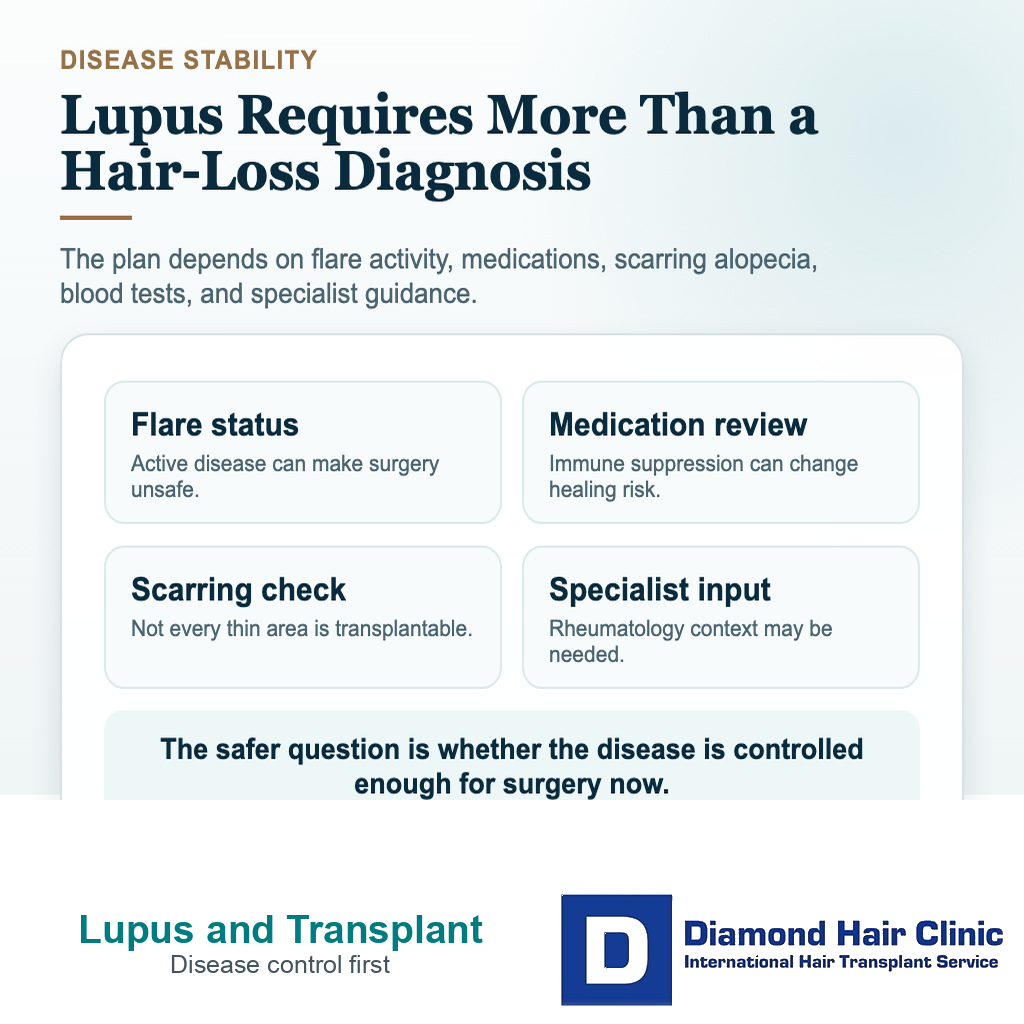
Lupus changes the decision because the scalp may not be a normal surgical field. In routine pattern hair loss, I judge donor capacity, hairline design, recipient area coverage, hair caliber, and future hair loss. With lupus, I also ask whether the skin itself is inflamed, whether follicles are being damaged, and whether the body is stable enough for elective surgery.
Lupus is not one surgical category. Someone with well controlled systemic lupus and stable male pattern hair loss is different from someone with active discoid lupus plaques on the scalp. The diagnosis name matters, but the current behavior of the scalp matters more. This point also applies to the broader autoimmune disease hair transplant question.
If the scalp is quiet and the hair loss pattern is suitable, surgery may be discussed carefully. If the scalp is active, unstable, or still being diagnosed, waiting is often the more responsible decision.
When lupus has quiet months and active months, label the photos by flare status instead of showing only the best day. A quiet scalp in one picture can hide a pattern that still needs the rheumatologist and dermatologist to settle first. One calm scalp photo should not carry the whole plan. Include flare dates, medicine changes, and whether the hair loss area is scarring or still capable of recovery.
The type of hair loss must be identified first
The first practical distinction is scarring versus hair loss without scarring. When shedding is not scarring, the follicles may still be present. Hair can improve when the lupus flare, medication issue, thyroid problem, iron deficiency, stress, or another trigger is treated.
Using donor grafts too early can waste a limited resource on an area that still has medical recovery potential. A methotrexate or another medication issue can change that judgment before the surgery plan becomes the focus.
Scarring alopecia is different. When lupus permanently damages the follicle, the skin may lose visible follicular openings and the hair may not return on its own. This is when people start asking whether grafts can cover the patch.
Even then, surgery is not automatic. The disease must be quiet enough that new grafts are not placed into an active inflammatory process. That overlaps with the principle behind hair transplant surgery with scarring alopecia or lichen planopilaris.
There is also a third possibility. You may have lupus and ordinary pattern hair loss at the same time. If the thinning follows a clear male or female pattern and lupus is controlled, the surgical question becomes more realistic. The useful step is not to blame every thin area on lupus without checking carefully.
Surgery should wait during active disease or unstable healing
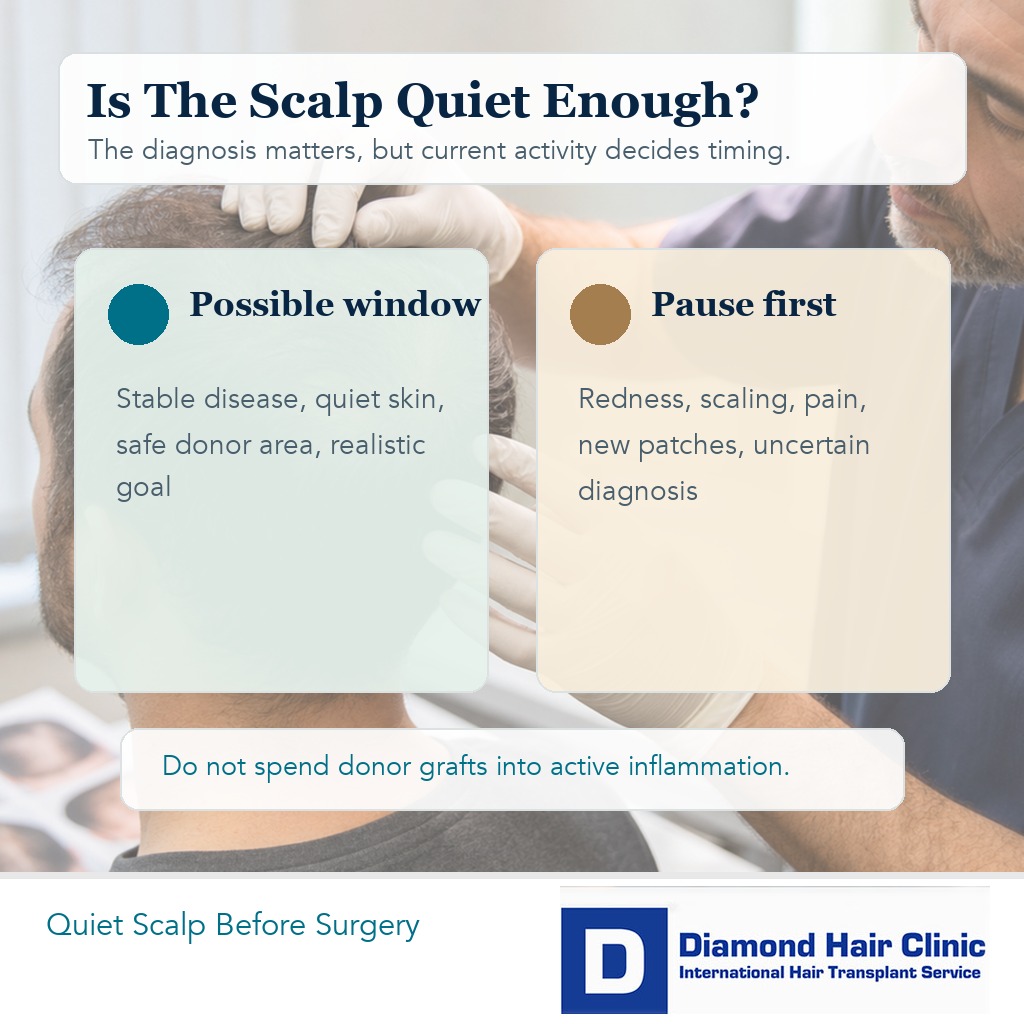
Surgery should wait when the scalp has active redness, scaling, crusting, tenderness, burning, itching, open sores, new patches, or signs that hair loss is still expanding. I also delay if the lupus diagnosis is uncertain, if dermatology or rheumatology review has not happened, or if medication has recently changed and shedding is still moving.
A transplant during an unstable phase can create two problems. Graft survival may be less predictable, and you may think the transplant failed when the real problem was ongoing disease activity.
That is unfair to you and unsafe for the donor area.
This same timing logic applies to other inflammatory scalp conditions. Controlled skin matters before operating in someone with scalp psoriasis before a hair transplant or seborrheic dermatitis before a hair transplant.
The diagnosis is different, but the surgical principle is similar. Treating and waiting first often gives grafts a better environment than operating through active scalp inflammation.
Surgery can be considered after stable disease control
Surgery can be considered when lupus is medically controlled, the scalp has stayed quiet, the donor area is not affected, and the area to be treated has a stable reason for hair loss. The goal may need to be measured.
When lupus is part of the history, I am not trying to create the most dramatic density possible. I am trying to improve appearance without creating an unreliable surgical situation.
If you have a scarred patch from old discoid lupus that has been quiet for a long time, a limited transplant may sometimes be discussed. If you have stable pattern hair loss and lupus is not active on the scalp, surgery may be planned more like a standard case, but with more medical caution.
The decision still depends on donor strength, hair caliber, skin quality, medication status, and expectations. The broader question of hair transplant candidacy becomes even more important when lupus is part of the history.
A quiet scalp is needed before graft placement
Scalp activity matters because grafts need a quiet place to heal. If the recipient area is inflamed, scratched, scaling, or still changing, the operation is being performed into uncertainty. A quiet scalp does not guarantee success, but an active scalp makes the plan less reliable before surgery begins.
A quiet patch and an active patch are different surgical fields. In an active patch, the question is not only whether grafts can be placed. It is whether inflamed skin is being asked to heal thousands of small wounds at the wrong time.
Stability has practical signs. New patches, clumps of shedding, burning, pain, active plaques, crusting, or repeated short flares all make me cautious.
I need to know whether a dermatologist has confirmed the diagnosis and whether treatment has truly controlled the disease. A scalp that looks better for a few days and then flares again is not the same as a stable surgical field.
Photos alone miss too much. A photo can show a bald area, but it may not show follicular openings, tenderness, scale, miniaturization, scarring texture, or whether the donor area is involved. A page about whether a hair transplant plan can be trusted from photos alone is especially relevant when a medical scalp condition is involved.
Preoperative checks come before using donor grafts
Before using donor grafts, the medical picture needs to be clear. That may include a dermatologist’s diagnosis, rheumatology clearance when systemic lupus is involved, medication review, blood tests when appropriate, direct scalp examination, and sometimes a scalp biopsy before a hair transplant when the diagnosis or activity is uncertain.
The purpose is not to make the process difficult. It is to avoid using permanent donor grafts before you are medically ready.
For some people, blood work matters because lupus can be associated with anemia, clotting issues, immune treatment, kidney involvement, or medication effects. A hair transplant is usually done under local anesthesia, but it is still surgery. Medical screening can be protective rather than unnecessary, especially when judging blood tests before a hair transplant.
I review the donor area with extra caution. If the donor area is thin, inflamed, scarred, or affected by the same disease process, surgery becomes much more limited. A large graft number should not be offered before the donor area and scalp disease are judged properly.

Lupus doctor confirmation may be needed before surgery
For systemic lupus, I usually want the doctor managing the lupus to confirm that elective surgery is reasonable at that time. The question is not only whether you want a hair transplant. It is whether the disease, medicines, blood count, kidney status, clotting history, and general health make a minor surgical procedure sensible now.
Recent lupus activity or medication changes shift the timing discussion. A recent flare, kidney involvement, anemia, clotting problems, high dose steroid use, immune suppressing medicines, anticoagulants, or medication changes do not simply rule out surgery, but they change timing and planning. Any medication before a hair transplant belongs in that review.
Do not stop hydroxychloroquine, steroids such as prednisone before a hair transplant, immune treatment, or any lupus medicine on your own to make surgery seem easier. If a medicine matters for surgery, coordinate it medically. A hair transplant is elective. Lupus should not be destabilized for it.
Lupus medicines can change the surgical plan
Lupus medicines can change the surgical plan because they may affect infection risk, healing, bleeding risk, sun sensitivity, or general medical stability. Not every medicine prevents surgery. The medication list still needs review before the plan is confirmed.
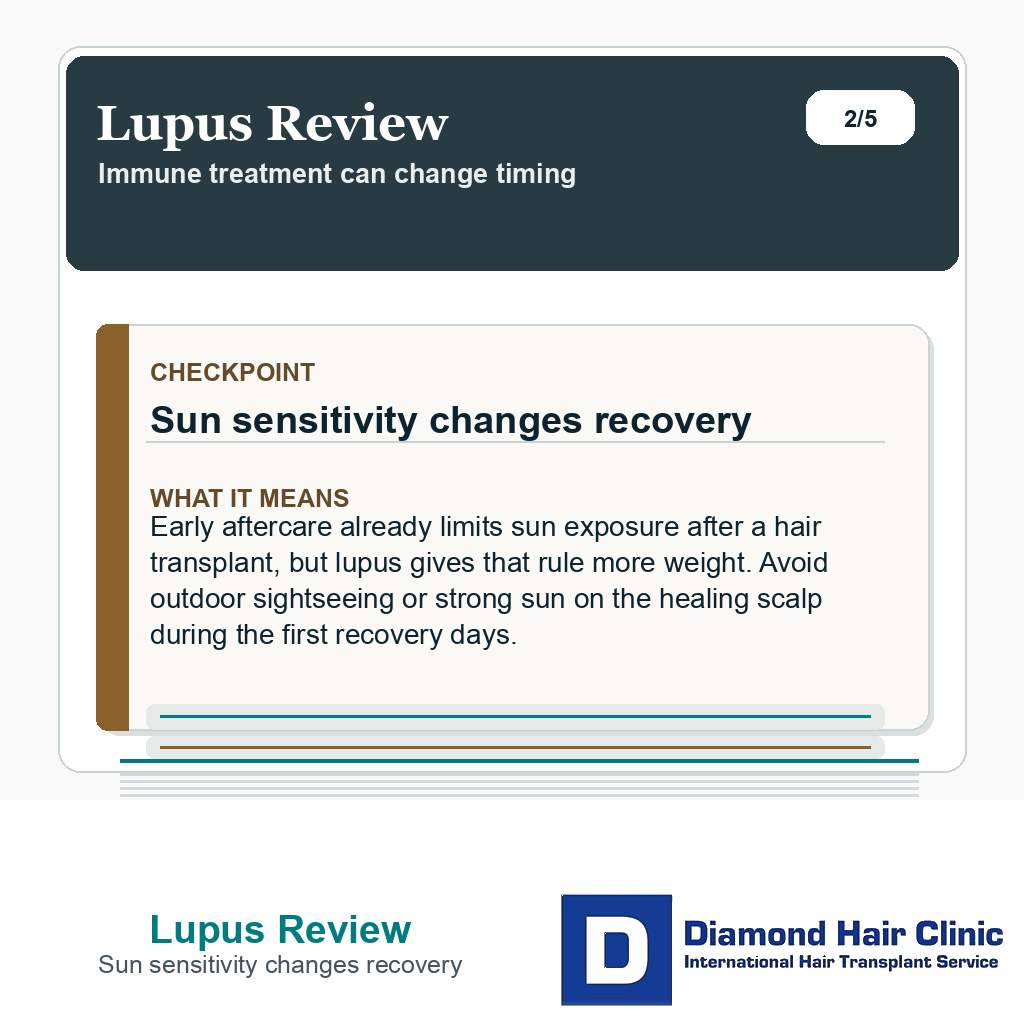
Sun sensitivity also changes recovery. Early aftercare already limits sun exposure after a hair transplant, but lupus gives that rule more weight. I do not want strong sun, outdoor sightseeing, or unnecessary heat on the healing scalp during the first recovery days.
Do not stop lupus medicine by yourself to qualify for surgery. That can be dangerous.
If a medicine raises a surgical concern, the safer path is coordination with the doctor managing lupus. The transplant should adapt to medical safety, not the other way around.
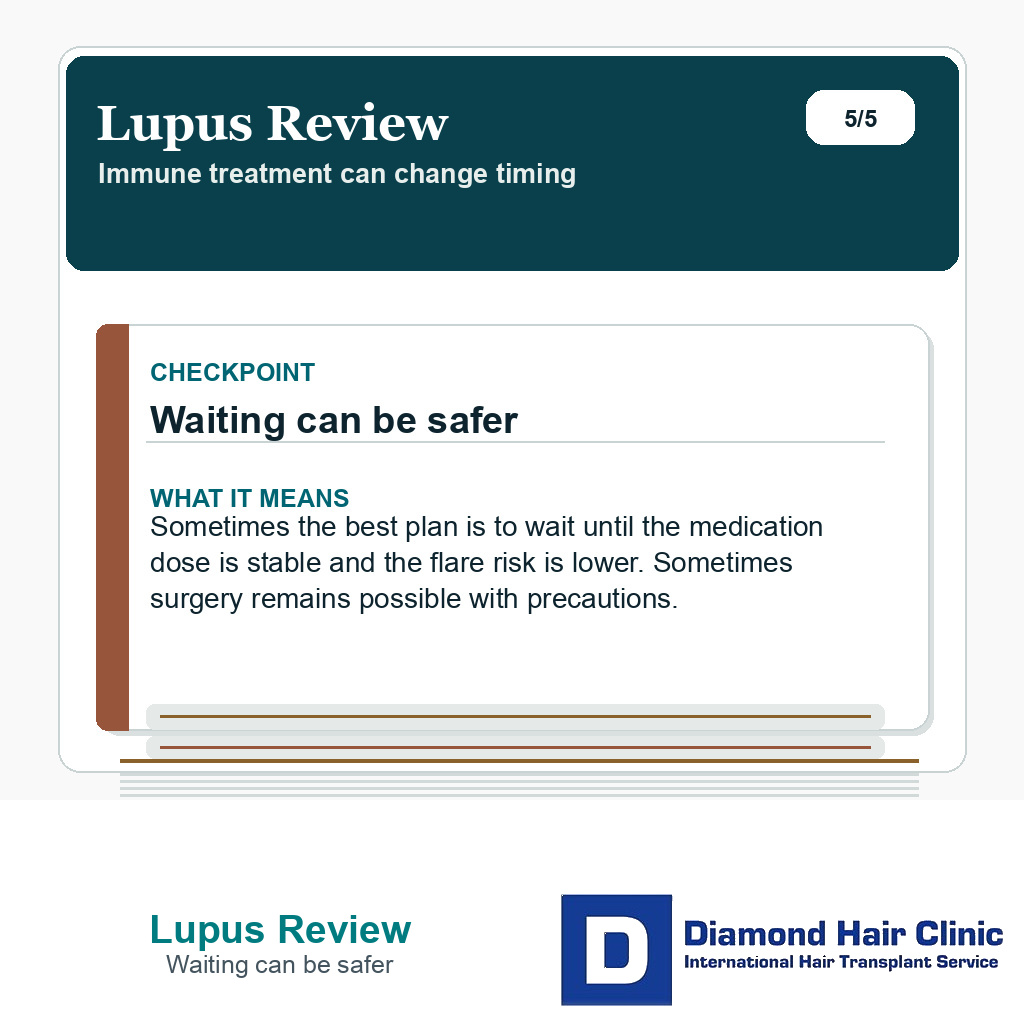
A stable supervised medicine plan is different from a dose that is changing because the disease is still active. Those two situations should not be treated as the same surgical risk. Sometimes waiting until the dose is stable is safer. Sometimes surgery remains possible with precautions.



Scarred lupus patches may not grow transplanted hair predictably
Transplanted hair can sometimes grow in scarred tissue, but scarred lupus patches are not the same as normal scalp. Blood supply, skin thickness, inflammation history, and surface texture can all change the result. I plan more carefully in scarred areas than in ordinary pattern hair loss.
Surgery can improve coverage, but it cannot make scarred skin behave like untouched scalp. Density may need to be lower. More than one stage may be needed. If the disease becomes active again, the result can be affected later.
I avoid dramatic promises when lupus is part of the history. Placement is only one part of the decision. I check whether the area is quiet enough, vascular enough, and realistic enough for you to accept the limits of surgery.
Pattern hair loss can exist alongside lupus
If lupus is controlled and you also have male or female pattern hair loss, surgery may become more straightforward, but not automatic. Pattern hair loss still needs donor management, natural hairline design, long-term planning, and realistic density. Lupus adds a medical layer, but it does not remove the normal surgical rules.
In women, I am especially careful because diffuse shedding can come from thyroid disease, iron deficiency, stress, medication changes, lupus activity, or pattern hair loss. These causes can overlap. Low ferritin, anemia, and hair transplant timing show why some hair loss should be corrected medically before donor grafts are used.
Autoimmune hair loss can also mimic other conditions. Someone with lupus may also have alopecia areata, or another diagnosis may be mistaken for shedding related to lupus. That distinction matters because hair transplant planning with alopecia areata carries a different risk profile from stable pattern hair loss.
Risky clinic promises should slow the decision
If a clinic treats lupus as a small detail and moves quickly to a graft number, slow down. A useful consultation should ask what type of lupus you have, whether the scalp is active, whether a dermatologist has confirmed the diagnosis, what medicines you take, and whether the donor and recipient areas are safe.
A fast promise may sound attractive because it removes uncertainty. It may say FUE is safe for everyone, scars can always be filled, lupus does not matter, or enough grafts will solve the problem.
I do not agree with that way of thinking. In lupus, the responsible answer may be surgery, treatment first, waiting, or no surgery at that time.
Before committing, the medical plan needs to be clear, not only the price and date. What should be clear before committing to a hair transplant matters for everyone, but it matters more when an autoimmune condition is in the background.
Consultation records should include lupus history and treatment details
Bring your lupus diagnosis details, the name of the doctor managing it, current medicines, recent medication changes, blood test results if available, biopsy results if a scalp biopsy was done, and clear photos showing how the hair loss has changed over time. If you have flare triggers, scalp pain, itching, burning, crusting, sun sensitivity, or kidney or clotting history, say that directly.
The consultation also needs a clear goal. Are you trying to fill a stable scarred patch, rebuild a frontal hairline, treat diffuse thinning, or cover an area that is still changing? Each goal has a different level of risk.
If another pigment condition such as vitiligo, or another autoimmune skin issue is present, it needs review too. With hair transplant surgery with vitiligo, skin stability and surgical trauma can change timing even when the hair loss itself has another cause.
Operating now or waiting depends on disease stability
If lupus is active, unclear, or still causing unstable scalp changes, waiting is the better decision. That is not lost time. It protects the donor area until the medical problem is better understood.
A delayed operation can still be planned later. Donor grafts spent into the wrong environment cannot be put back.
If the disease is controlled, the scalp is quiet, the donor area is strong, and the hair loss pattern is surgically suitable, then a hair transplant can be considered with careful expectations. The plan should be medically coordinated and explained clearly before surgery.
By the end of the consultation, the answer should be clear. It should show whether surgery is appropriate now, whether treatment should come first, and what result is realistic. In lupus, that clarity matters more than speed.

Read this review excerpt
Every single one of my questions was answered and they made sure I had all the details I needed to make an informed decision.