


Anabolic Steroids Around FUE Surgery
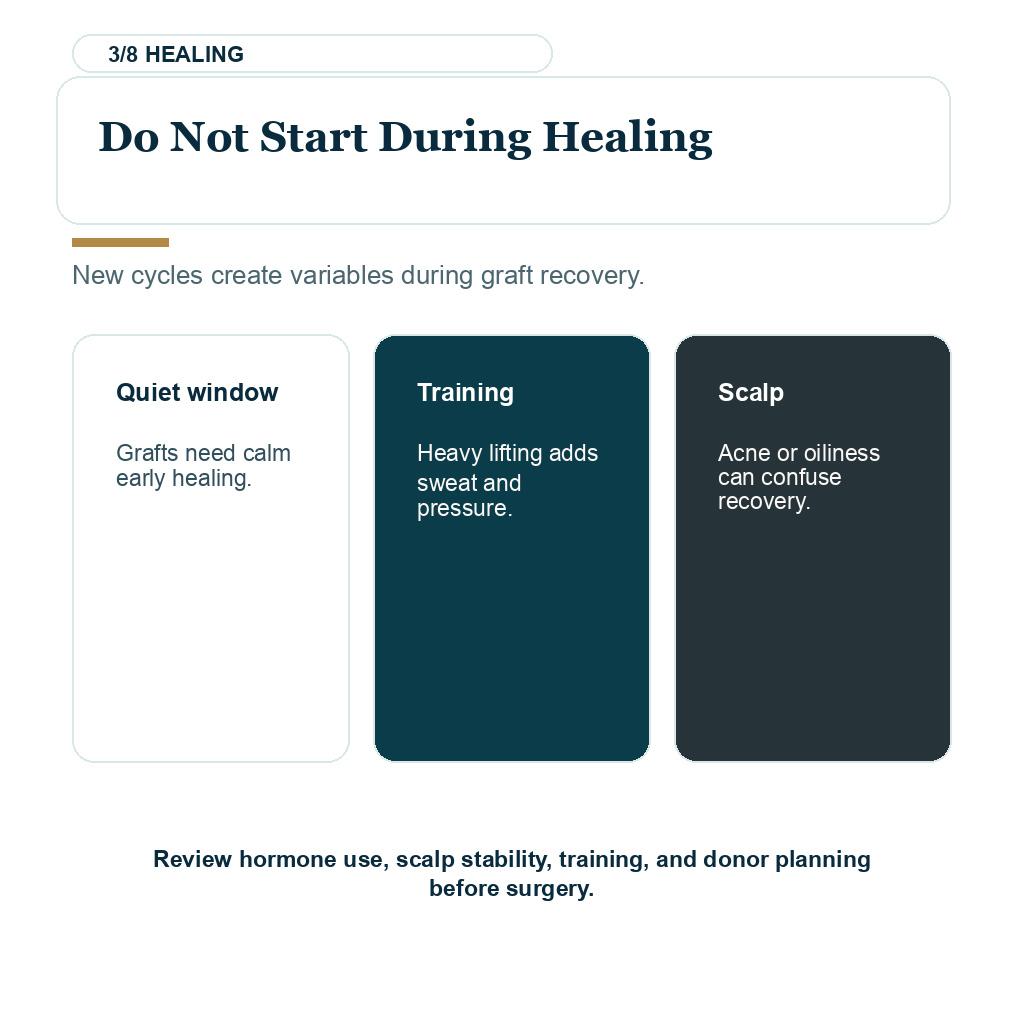
Do not start or restart an anabolic steroid cycle that is not medically prescribed in the early healing period after a hair transplant. The grafts need a quiet recovery window, and a new cycle can bring heavy training, sweating, acne, blood pressure changes, poor sleep, and scalp inflammation at exactly the wrong time.
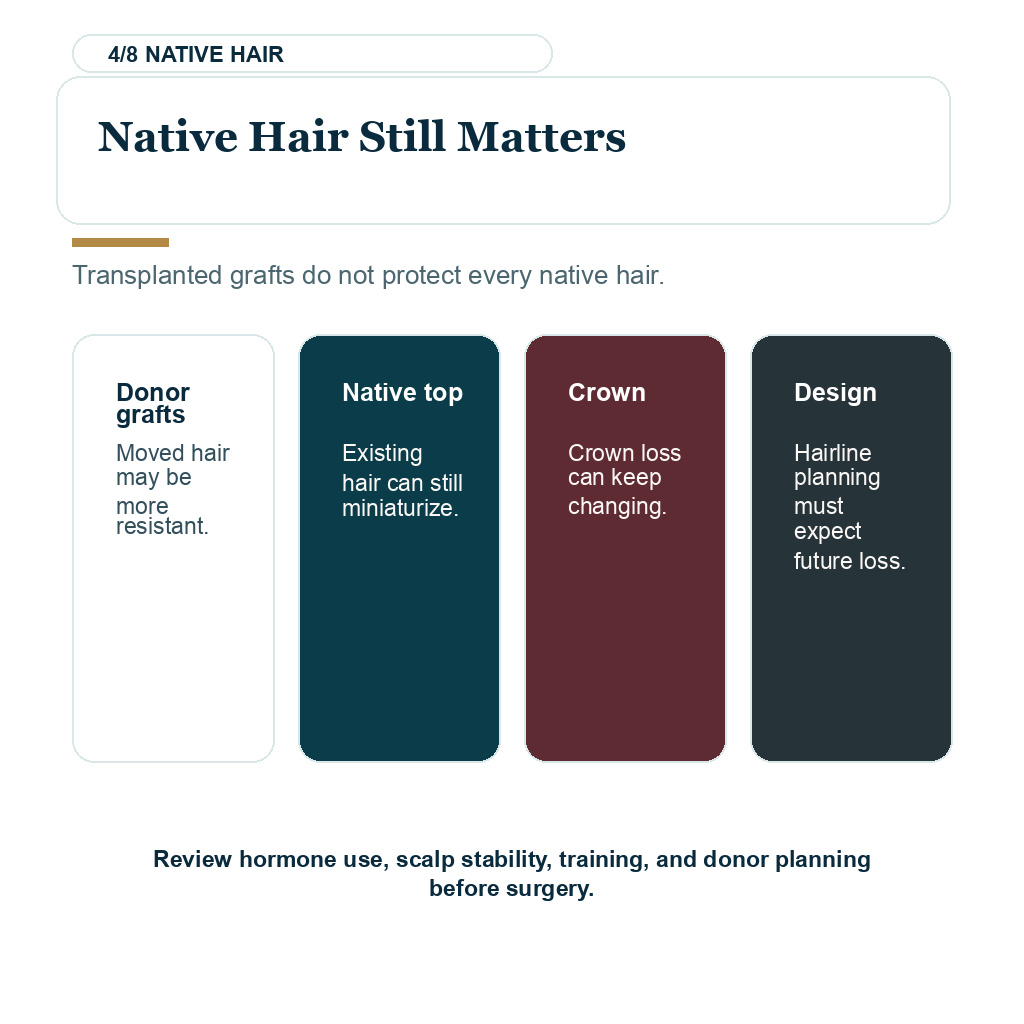
The issue over time is different. The transplanted grafts are usually more resistant to androgen pressure than the native hair on top of the scalp, but that does not make a steroid cycle harmless. High androgen exposure can accelerate loss of the native hair around the transplant and blur the cause of later thinning.
If testosterone is prescribed medically as TRT, I treat it differently from a bodybuilding cycle, but the dose, blood tests, and medical follow up still have to be stable before surgery. A hair transplant should not be planned around hidden steroid use, unstable hormones, or a promise that transplanted hair is completely protected no matter what you do. For the prescribed therapy side, testosterone therapy and hair transplant planning explains how stable dosing, blood work, native hair risk, and donor reserve are reviewed before FUE.
If testosterone is prescribed medically as TRT, I treat it differently from a bodybuilding cycle, but the dose, blood tests, and medical follow up still have to be stable before surgery. A hair transplant should not be planned around hidden steroid use, unstable hormones, or a promise that transplanted hair is completely protected no matter what you do. For the prescribed therapy side, testosterone therapy and hair transplant planning explains how stable dosing, blood work, native hair risk, and donor reserve are reviewed before FUE.
Do not let hair loss medicine become a reason to hide a steroid cycle. Dutasteride, finasteride, minoxidil, or TRT history may change the conversation, but they do not make high androgen exposure irrelevant to native hair or recovery.
Also list HCG, clomiphene, DHT blockers, and support medicines used around a cycle, because the hair strategy and hormone treatment can affect different risks.
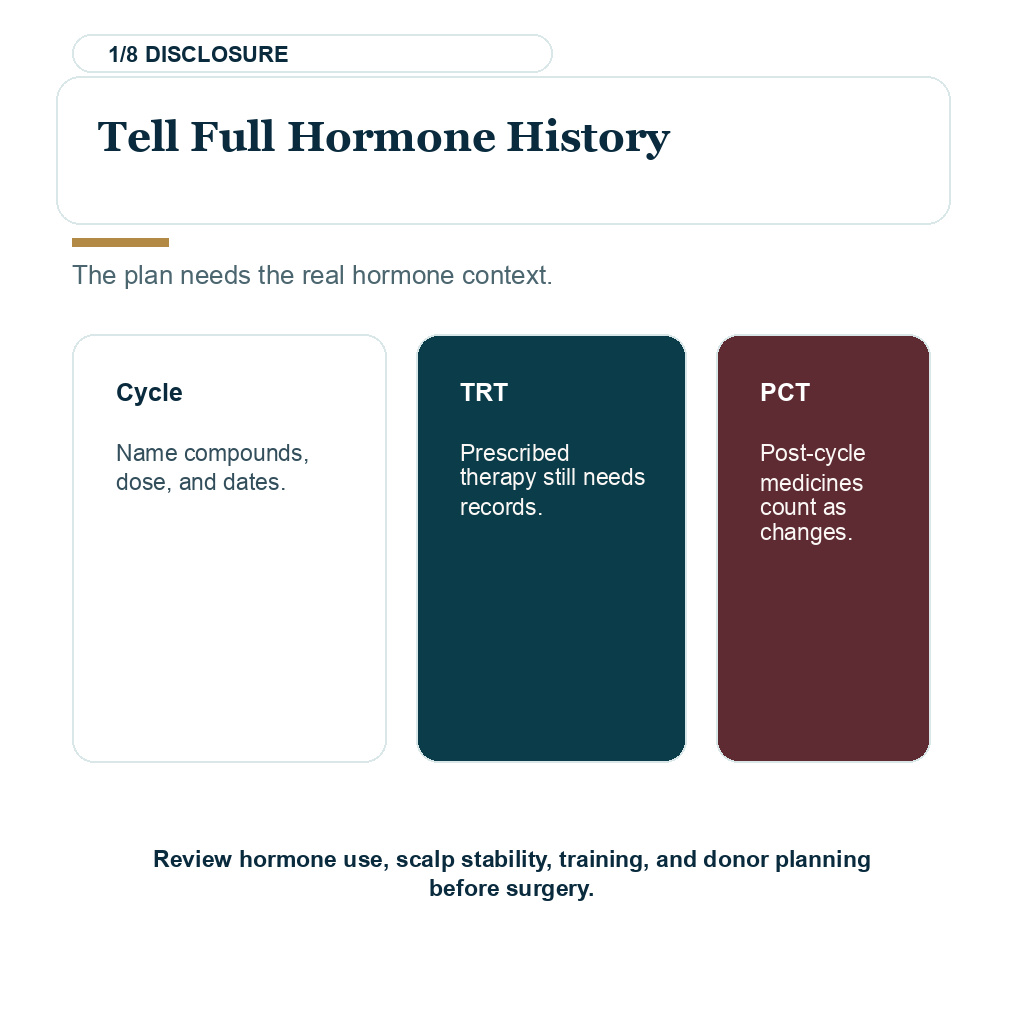
Do not describe a cycle as only a gym supplement. Testosterone, SARMs, medicines used after a cycle, acne treatment, and blood pressure tablets all belong in the same disclosure before surgery. That disclosure also covers clomiphene or hCG before FUE after a steroid cycle, where the safe step is review rather than hiding the protocol.
One more distinction matters. Here I am talking about anabolic androgenic steroids used to raise androgen exposure for physique or performance. That is not the same as prednisone or another medically prescribed corticosteroid for asthma, allergy, autoimmune disease, or inflammation. If a doctor has prescribed any steroid medicine, do not stop it suddenly before surgery. Tell the clinic so the surgical and medical plan can be coordinated safely.
Anabolic steroids do not only affect grafts
In most male pattern hair loss cases, grafts are taken from the donor area because that hair is more resistant to DHT than the hairline, mid scalp, and crown. That is the reason transplanted hair can keep growing for many years after surgery. It is also why many patients hear the quick answer that steroids will not affect transplanted hair.
That answer is too simple for real surgical planning. The transplanted hair may be more resistant, but the scalp still has to heal, the skin can still react to inflammation, and the native hair around the transplant may remain vulnerable. A transplant is not a shield against all future androgen pressure.
When I plan the donor area, I am not only thinking about today’s operation. I am thinking about whether the hair we move will still look natural if you continue to lose native hair behind it. A steroid cycle can make that question more serious.
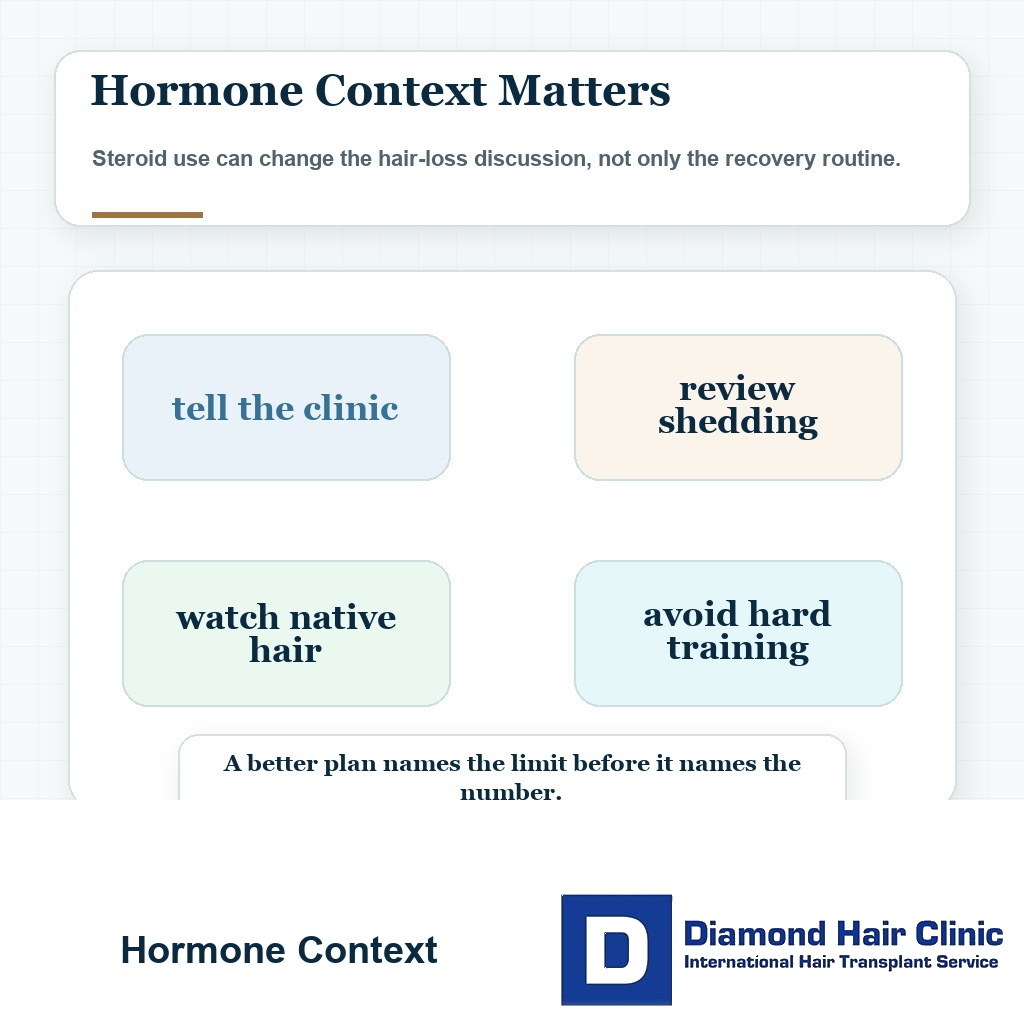
Steroids can increase risk for native hair
Anabolic steroids can increase androgen exposure far beyond normal physiology. In a man who is genetically sensitive to androgenetic alopecia, that can speed up miniaturization of the native hair. The transplant may grow, but the hair behind it can keep thinning, and you may feel that the surgery failed when the real problem is continuing loss around the result.
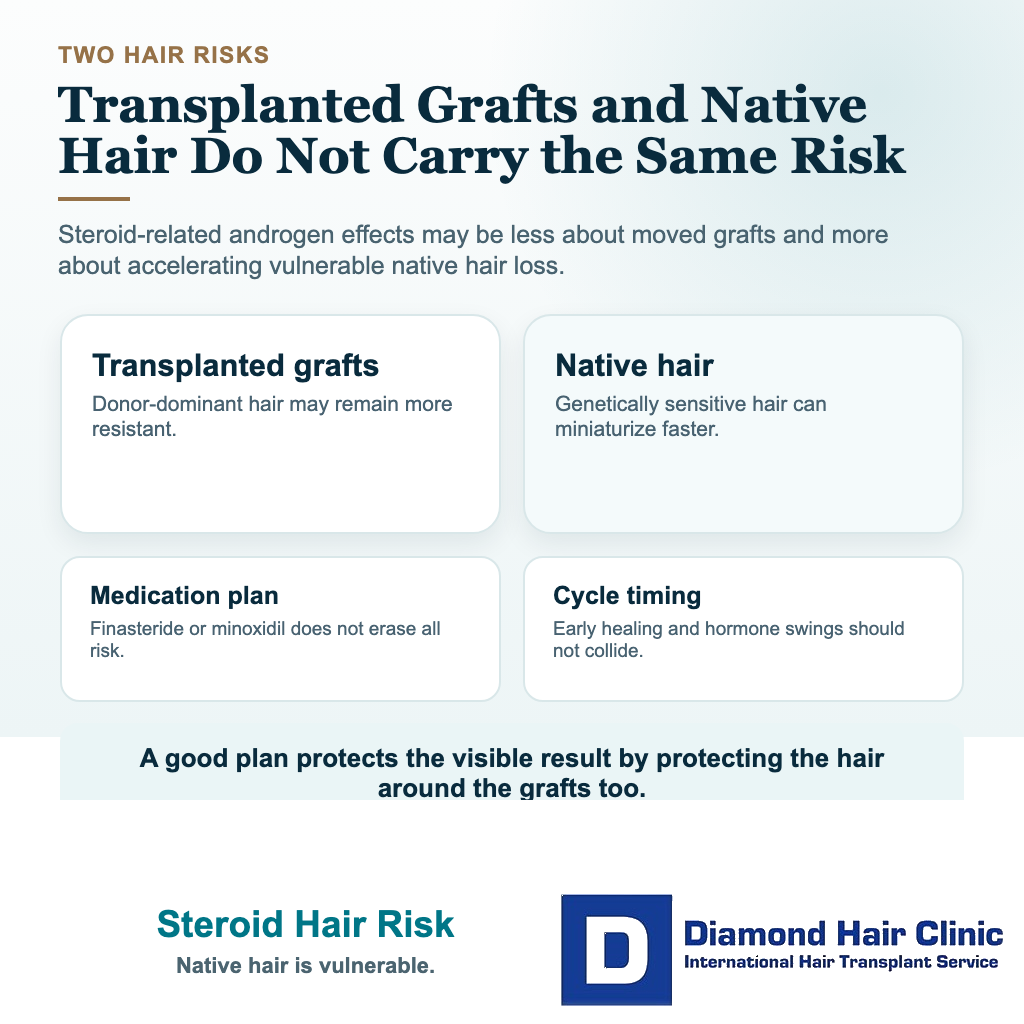
This matters most in younger patients, diffuse thinners, crown cases, and men who already needed surgery because their hair loss was active. A low, dense hairline may look attractive in early photos, but if the surrounding native hair weakens quickly, the result can become isolated or unnatural.
The direction of the planned hairline matters as well. If the design spends many grafts to create a very low front while the mid scalp and crown are still unstable, later acceleration from steroids can expose the weakness of that plan. You may then need more grafts, but the donor supply may already have been used too aggressively.
A similar planning problem appears in having surgery while hair loss is still active. The new grafts may grow, but the whole head of hair still has to make sense as native hair changes over the years.
Early healing period is the wrong time for a new cycle
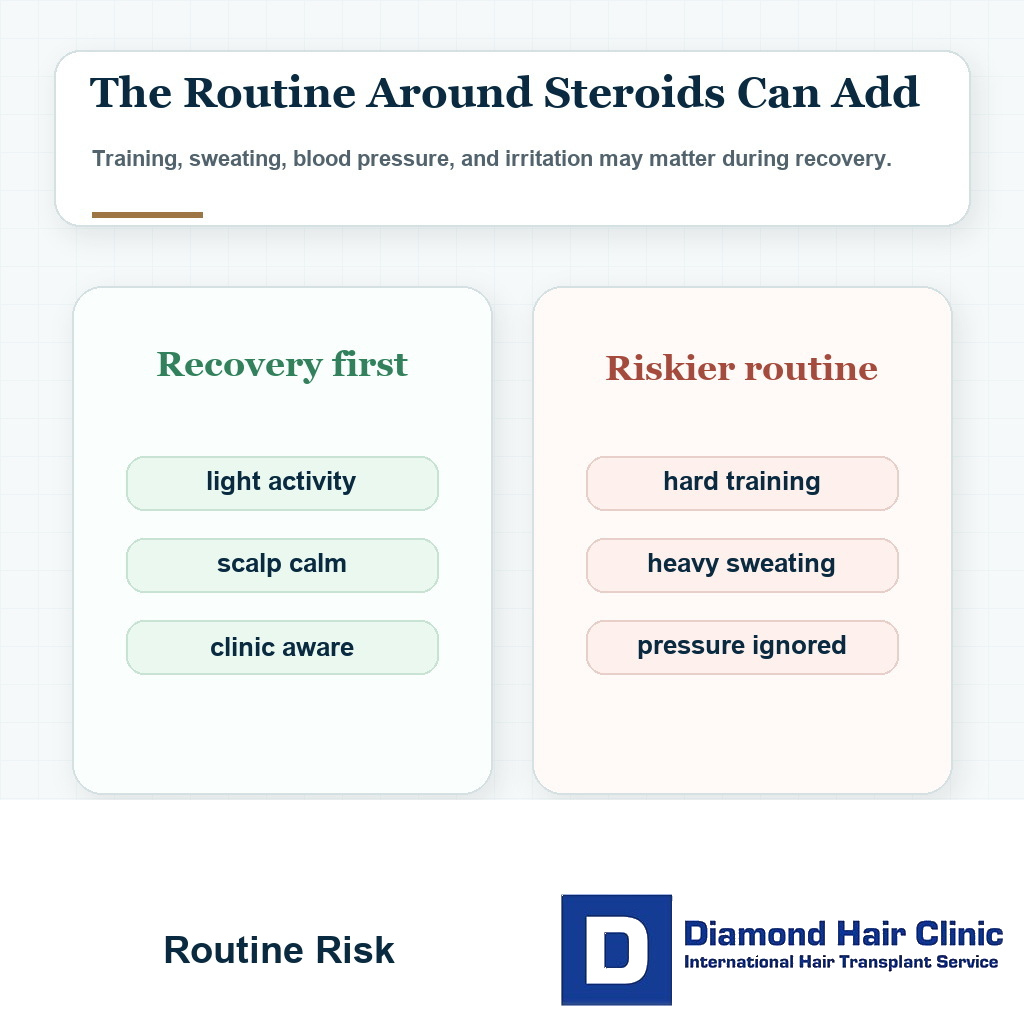
During the first 10 to 14 days, the grafts need protection from rubbing, pressure, scratching, heavy sweating, infection risk, and unnecessary irritation. This is also the time when you are dealing with washing, scabs, redness, swelling, sleep position, and limits on training.
Starting a new steroid cycle that is not prescribed during this early period creates too many moving parts. If acne, scalp oiliness, redness, high blood pressure, mood changes, poor sleep, or inflammation appears, it becomes harder to know whether the concern is normal healing, medication, training, infection, or the steroid cycle.
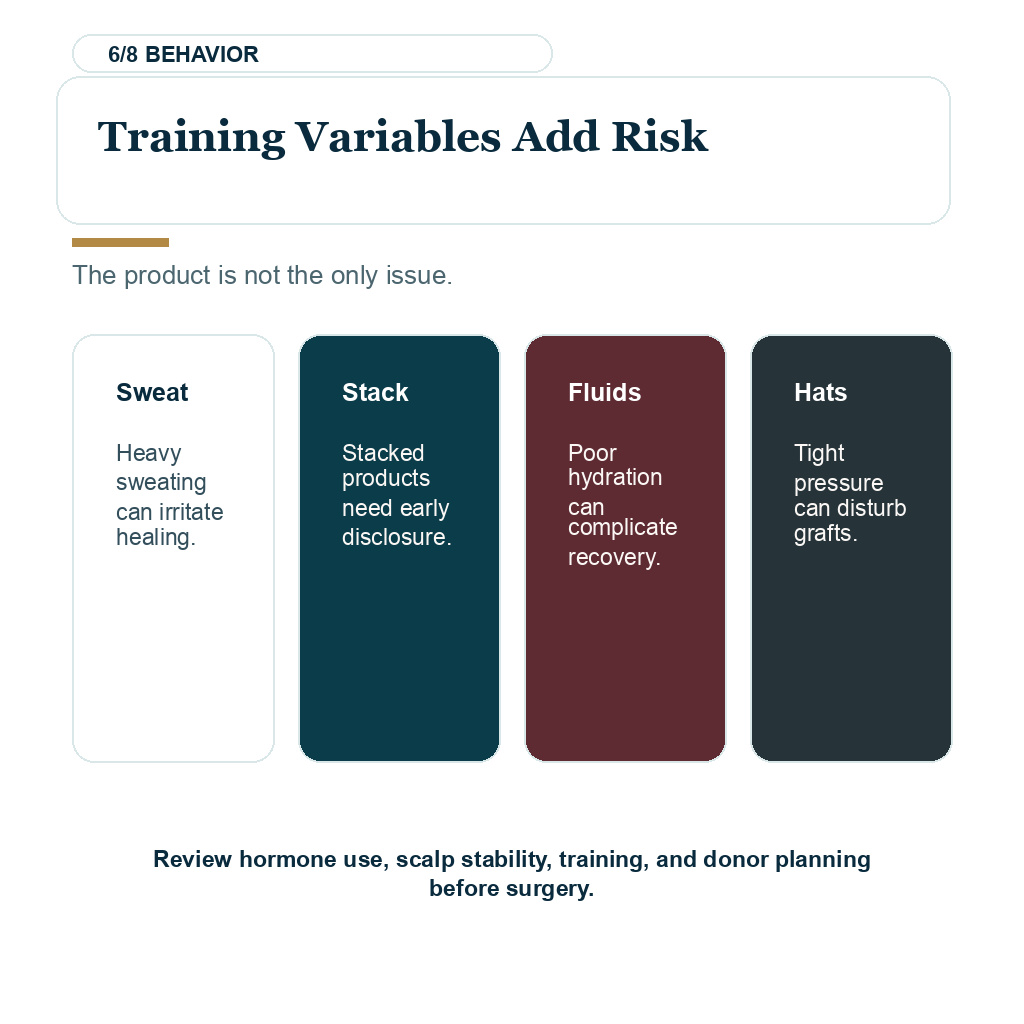
Exercise after a hair transplant needs the whole recovery picture. Someone thinking about a cycle is often also thinking about heavy lifting, supplements, recovery peptides, dehydration, tight hats, and sweating. The discussion about creatine after a hair transplant and pre workout after a hair transplant belongs in that recovery discussion. The product is not always the main issue. The timing, training behavior, and healing environment often matter more.
Waiting depends on healing and hormone stability
I do not give a universal clearance day for anabolic steroids that are not prescribed. Do not start in the first 10 to 14 days, and avoid a new cycle while scabs, redness, folliculitis, swelling, strong itching, or poor sleep are still active. In practical terms, many patients need at least 3 months before the scalp and early shedding pattern are easier to judge, and some should wait longer.
The reason is not only graft anchoring. A new cycle often changes training intensity, sweating, blood pressure, acne, sleep, mood, supplements, and scalp oiliness. If shedding begins, the clinic then has to separate expected transplant shedding, native shock loss, medication changes, and androgen acceleration. That is much harder when several variables changed at once.
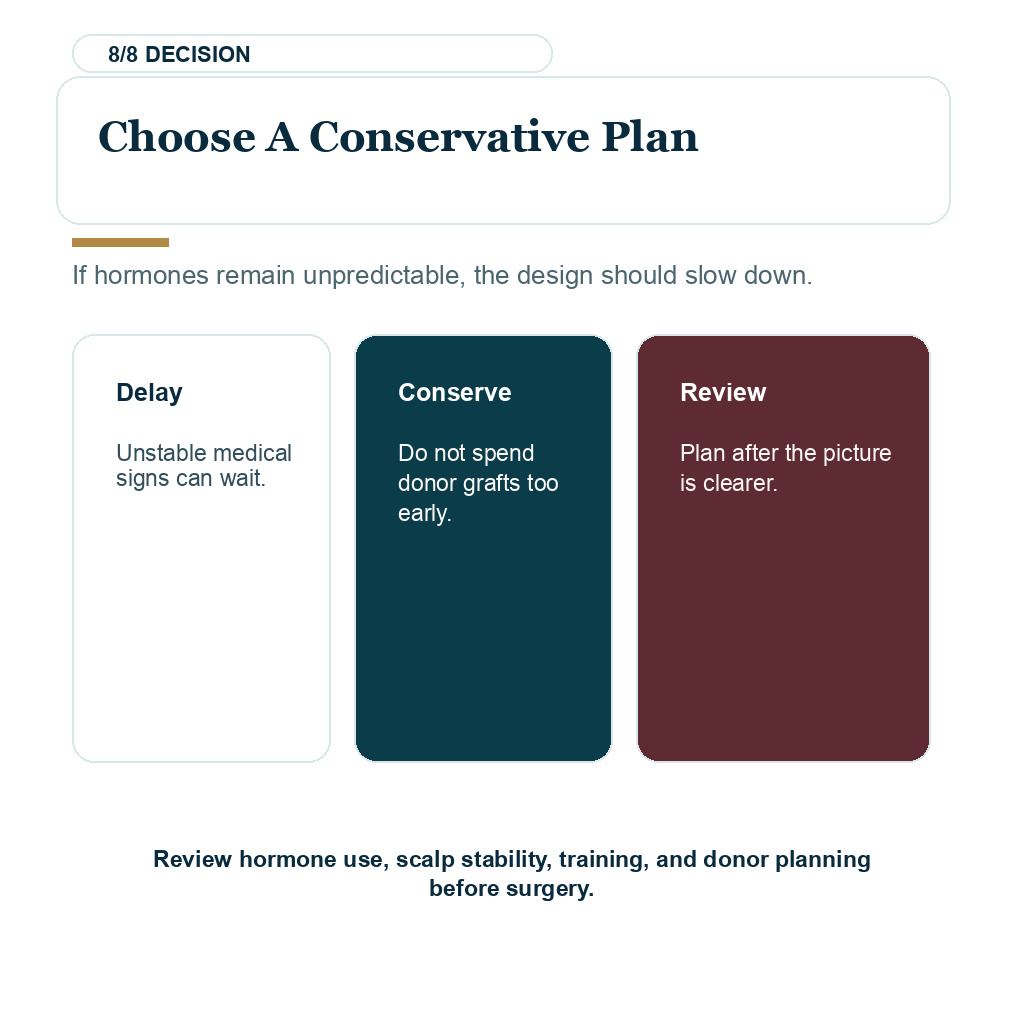
If you are unwilling to delay a cycle, the surgical plan should become more conservative, not more aggressive. The conservative plan is to protect the donor area and design a hairline that can tolerate future native hair loss instead of spending too many grafts before the hormone pattern is predictable.
Prescribed TRT is different from a bodybuilding cycle
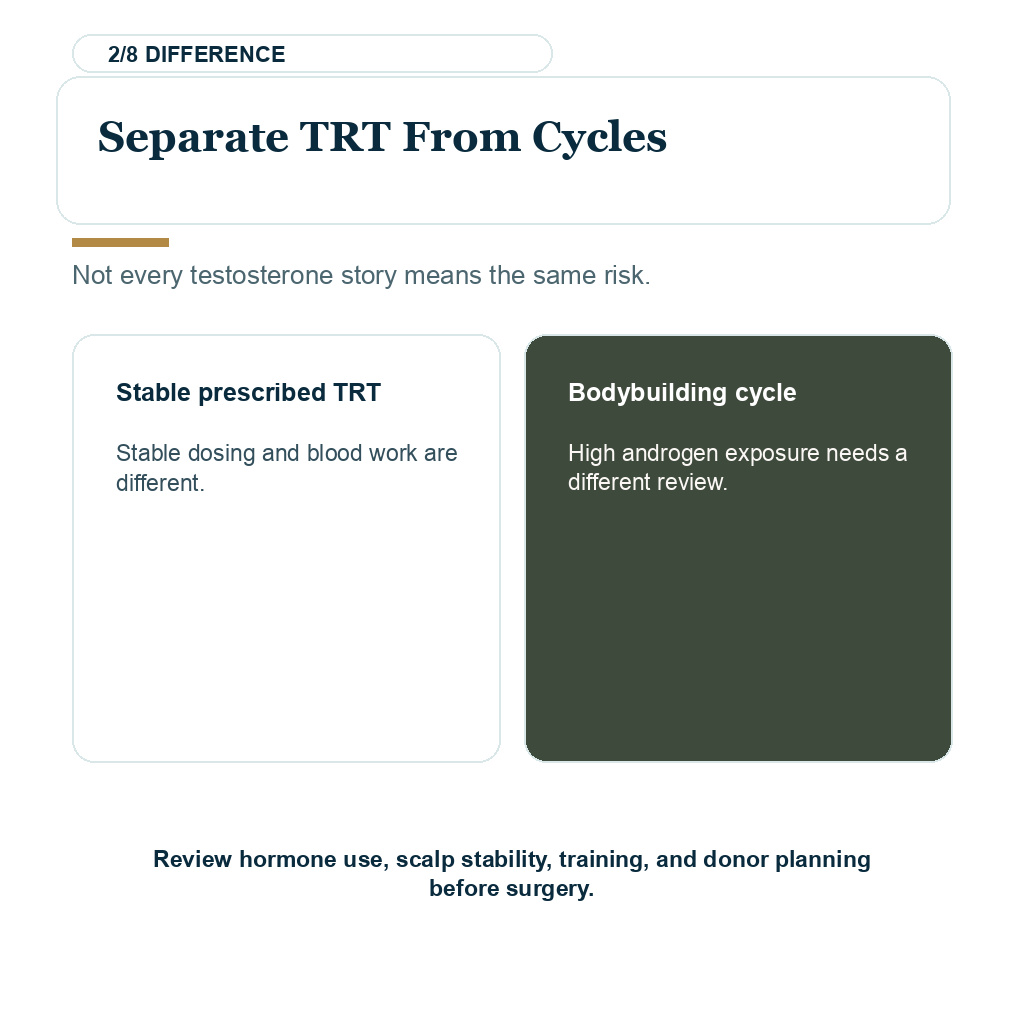
Prescribed TRT and a bodybuilding cycle should not be treated as the same situation. TRT is meant to restore testosterone to a medically supervised range for a diagnosed problem. A bodybuilding cycle usually uses higher doses or additional compounds for physique goals, often without consistent medical monitoring.
Prescribed testosterone may still fit a surgical plan when the dose is stable, the blood work is followed, and the hair loss pattern is understood. Keep that in mind with having a hair transplant while on TRT. Even then, the hormone history still matters. If TRT is medically prescribed, do not stop or change it on your own just to fit a surgery date. The prescribing doctor and transplant surgeon should both understand the plan.
A steroid cycle that is not prescribed needs a different conversation. The consultation has to cover what was used, when it was stopped, whether hair loss accelerated, whether acne or scalp inflammation appeared, whether blood pressure changed, and whether you are willing to keep the surgical plan conservative. A hidden cycle can make a technically good transplant look poorly planned later.
There is another practical difference. With stable prescribed TRT, you may be able to show months of consistent laboratory values and medical follow up. If you change compounds, dose, training intensity, supplements, and medication after a cycle every few months, the surgeon is working with a moving target. That makes it harder to predict the hair loss pattern and harder to protect the donor reserve.
Current cycles and medication after a cycle need disclosure
If you are already on a cycle, recently stopped one, or are using medication after a cycle, do not hide it and do not improvise around the surgery date. The safer question is whether your blood pressure, blood markers, scalp condition, acne, sleep, shedding, and medication plan are stable enough for elective surgery.
Current side effects belong in the hormone history. Share blood pressure readings if you have them, active acne or skin infection, poor sleep, recent dose changes, and medicines used after a cycle so the review reflects your real condition.
Stopping suddenly may also create medical and hormonal problems, so this should not be handled by silence or guesswork. The prescribing doctor, when there is one, and the hair transplant surgeon should both understand the timing. If there is no prescribing doctor because the use is non prescribed, the need for clear communication with the clinic becomes even stronger.
Other medicines and supplements around surgery need review too. Medication before a hair transplant should be reviewed because the operation is easier to plan when the clinic knows what is actually in your system, what recently changed, and what may change again during recovery.
The clinic needs the full hormone history before surgery
Tell the clinic about prescribed hormones, anabolic steroids that are not prescribed, recent cycles, medication after a cycle, blood pressure medicines, acne treatment, anticoagulants, supplements, and any past side effects related to hormones. Do not leave this out because it feels embarrassing. A surgeon cannot plan safely around information that is hidden.
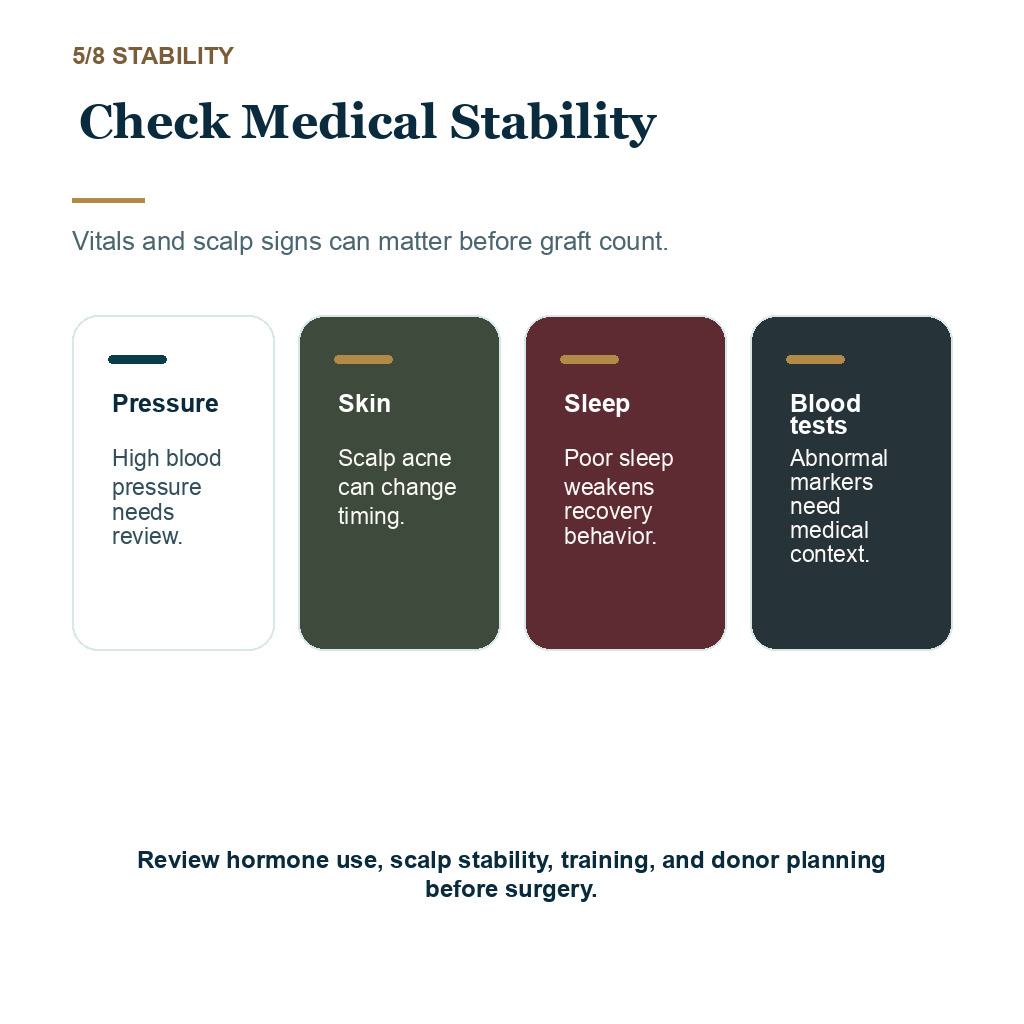
Blood tests before a hair transplant matter here. They do not decide everything, but they can reveal safety issues that should be reviewed before an elective operation. If blood pressure is unstable, blood counts are abnormal, liver markers are concerning, or medication use is unclear, a delay may be wiser than forcing the date.
Sudden shedding during or after a cycle matters too. That can change how I judge the donor area, the crown, and the native hair that might be at risk after surgery.
Medication cannot make every steroid risk safe
Hair loss medication can help some patients protect native hair, but it should not be treated as permission to run any steroid cycle without consequence. Finasteride and dutasteride can reduce DHT exposure in suitable patients, but they do not make every steroid compound safe for hair. Some anabolic drugs act through androgen pathways that are not solved by DHT reduction alone, and medication does not remove the general health risks of anabolic steroid use.
The section on finasteride before or after a hair transplant explains why medication can be useful for stabilizing native hair. It can be part of planning over time, but it is not a guarantee that aggressive hormone use will leave the hair untouched.
Minoxidil also needs medical judgment. Oral minoxidil around a hair transplant may be appropriate for the right patient, but it is still a systemic medication. Adding or changing several medications around surgery can create confusion if shedding, dizziness, swelling, irritation, or scalp symptoms appear.
I never design a hair transplant by assuming medication will rescue an aggressive plan later. Medication can support the native hair, but the surgical design still has to make sense without pretending the risk has disappeared. A conservative hairline, realistic density, and staged crown planning may protect you more than adding another medication after a risky plan has already been done.
Steroid side effects can affect the operation
Anabolic steroids can be associated with acne, oily skin, mood changes, blood pressure problems, abnormal blood markers, liver strain, cardiovascular risk, and hormone suppression. You may not have every problem, but these risks matter because a hair transplant is elective surgery.
For example, scalp acne or folliculitis can disturb the recipient area and donor area. Uncontrolled blood pressure can make the operation less safe. Mood instability and poor sleep can make the recovery period harder. If you already have hypertension, I handle that with the same seriousness I describe in hair transplant planning with high blood pressure.
The hair issue is only one part of the decision. You may be focused on graft survival, but the operation also has to be safe from the medical side. Bleeding risk, healing, inflammation, medication interactions, and surgery day suitability all matter.
Surgery can still be reasonable when the plan is stable
Surgery may still be reasonable when you are medically stable, the hormone history is disclosed, the hair loss pattern is not rapidly changing, and the plan does not depend on using too many grafts too early. The design has to respect the possibility that native hair may keep thinning faster than expected.
The risk rises when you are young, actively shedding, planning a very low hairline, refusing medication despite aggressive hair loss, or asking for a large graft number while continuing high androgen exposure. In that case, being a good candidate for a hair transplant is not only about having enough donor hair today. The plan also has to look sensible later.
Sometimes the better plan is a smaller hairline, a delayed crown, a period of medical stabilization, or postponing surgery until the pattern is clearer. Waiting can feel frustrating, but it may protect the donor reserve and prevent a result that looks incomplete after the next wave of native hair loss.
Reject promises that ignore hormone risk
Reject any clinic answer that treats steroid use as irrelevant, describes every graft as permanently safe in every situation, or says one large session can solve future loss driven by androgen exposure. Those answers are too convenient. They avoid the harder question of what will happen to the native hair around the transplant.
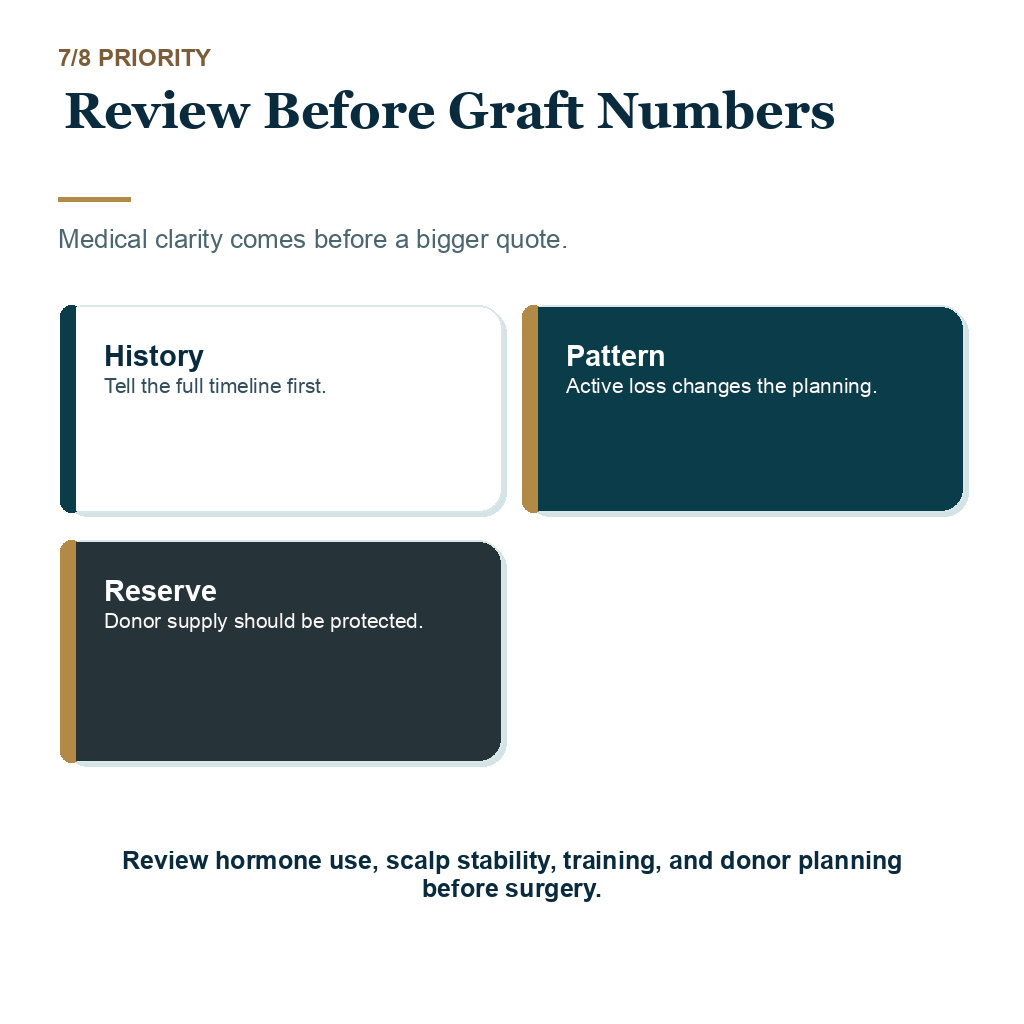
A weak consultation may focus only on graft numbers, discounts, and quick booking. A stronger consultation should ask about hormone use, medication tolerance, donor capacity, family history, crown risk, and the future pattern of hair loss. It should also explain why a high graft number can be a poor plan if your hormones and native hair are unstable.
That standard matters when choosing a hair transplant clinic in Turkey. A clinic that avoids difficult medical questions may still produce attractive marketing photos, but you need planning, not only a package.
Reject any promise that tries to separate the transplant from the rest of your biology. Hair restoration is not only a design drawn on the front of the scalp. Hormones, native hair strength, donor supply, scalp health, age, family history, and future medication decisions all meet inside the same result.
If a clinic says none of that matters, you are not being given a serious surgical assessment. The answer may still be surgery, but it should be surgery with the limits clearly explained.
These 8 anabolic steroid review slides separate hormone disclosure, TRT versus cycles, early healing, native hair risk, medical stability, training variables, graft number priorities, and conservative planning. Swipe sideways, use the arrows one slide at a time, or choose a number below the image.
Steroid use needs the medical picture first
If anabolic steroid use is part of your life, the responsible step is not to hide it and hope the transplant will solve everything. Bring the full history into the consultation. Let the surgeon judge your donor area, native hair, crown, medication options, blood pressure, scalp condition, and timing before making the decision whether surgery is sensible.
The decision has three parts. First, are you medically safe for elective surgery? Second, is your native hair stable enough for a transplant plan? Third, will the hairline, graft number, and crown strategy still make sense if future androgen exposure continues?
If those answers are unclear, surgery should wait until the medical picture and the hair loss pattern are easier to judge. A good transplant is not only the one that grows in the first year. It is the one that still looks natural after your future hair loss, donor limits, and real lifestyle have been considered.
Read this review excerpt
He was very thorough in every little detail and I never felt pressure to do anything I wasn’t sure of.