


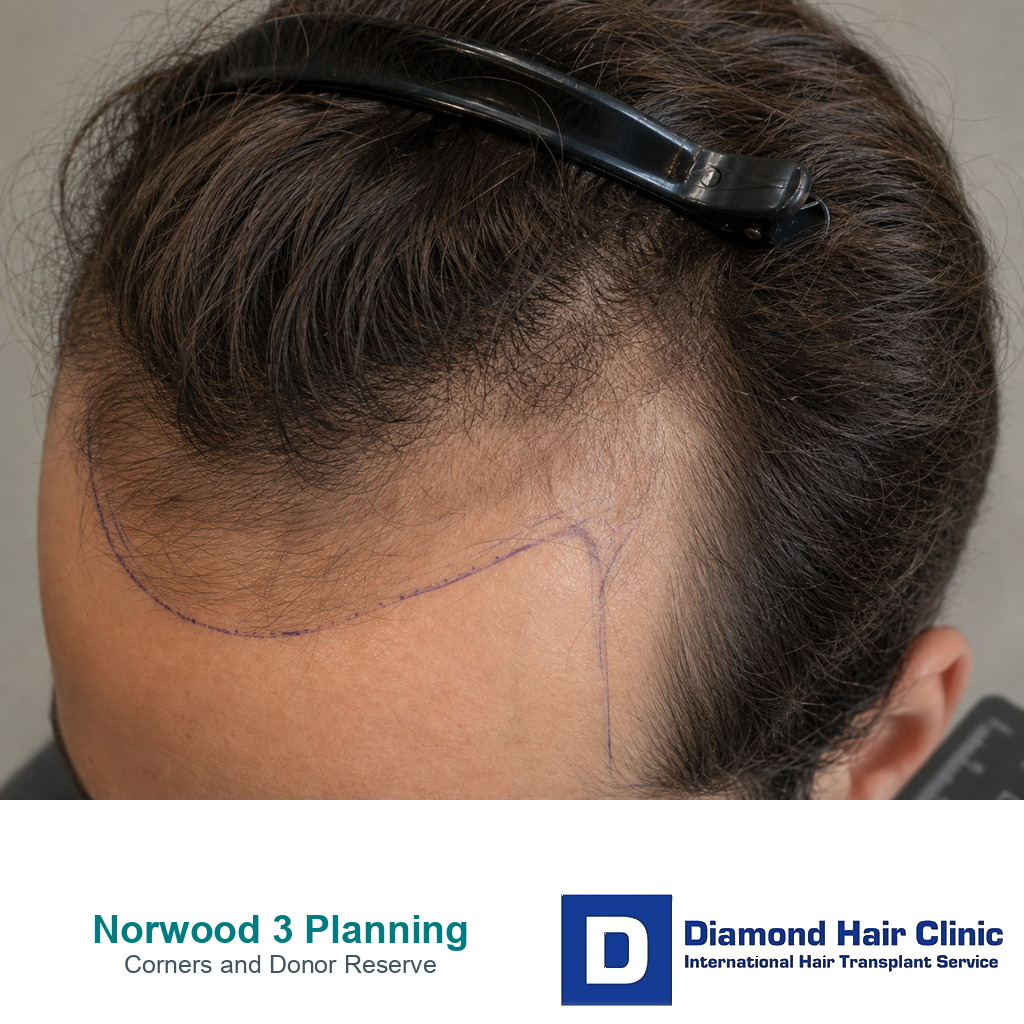
Norwood 3 Hairline and Donor Planning
If you are around Norwood 3, a hair transplant can be reasonable, but the Norwood label is not enough to approve surgery. I first need to know whether the recession is stable enough, where the hairline can safely sit, how much of the front actually needs grafts, and how much donor reserve must remain if the mid scalp or crown changes later. If the pattern has moved beyond corner planning, Norwood 4 or 5 hair transplant planning explains how the graft budget changes.
I treat Norwood 3 as a future planning problem, not only a corner problem. If the corners are rebuilt too low or too densely, the result can look attractive at first and become difficult to manage when native hair behind it can continue to thin.
The corners should be planned with the hair behind them, not in isolation. Wet photos, family pattern, crown inspection, medication history, and donor reserve help decide whether the goal is a modest corner fill or a larger lifetime plan.
Norwood 3 is only a starting point for planning
Norwood 3 usually means visible recession at the temples or frontal corners. The central forelock may still look strong, the crown may still look quiet, and you may still style the hair well from the front. The decision can feel confusing because you may not look bald, but the corner loss may be real enough for a surgical discussion.
Norwood 3 is not one identical shape. Some men mainly have corner recession. Some have a more frontal type A pattern. Some have early crown involvement, often described as Norwood 3 vertex. That difference changes whether the plan focuses on the corners, the frontal band, crown risk, or a broader future loss strategy. The label describes the pattern. It does not decide by itself that surgery should happen now.
The Norwood stage gives me a starting point, not a full surgical plan. I still need to examine hair caliber, miniaturization behind the hairline, family pattern, age, medication history, donor density, and the way you want to wear your hair. The same Norwood number can need different treatment in a young patient with fast loss and an older patient with a stable pattern.
Serial photos matter here. A single dry, styled photo may hide thinning behind the forelock, while wet hair, harsh light, or a comb through video can reveal miniaturization that changes the design. If the hair behind the planned front line is weakening, the corner design needs more caution than it would in a stable isolated recession.
This is also why I separate a Norwood 3 plan from a Norwood 2 hair transplant decision. Norwood 2 can sometimes be watched longer because the recession may still be a mature hairline. Norwood 3 usually needs a more serious discussion about whether surgery is being used to restore a natural frame or to chase an old teenage hairline.
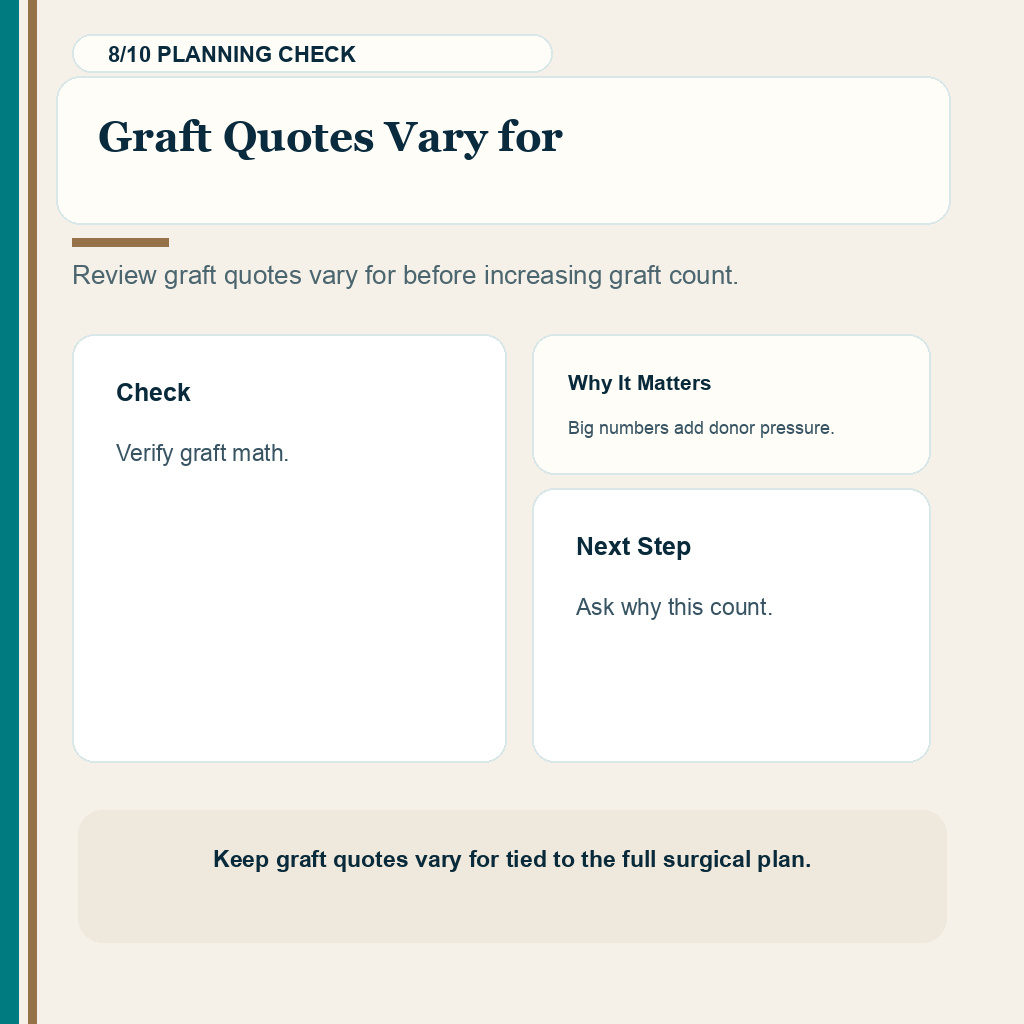
Graft quotes vary for Norwood 3
It is common to receive different graft estimates from different clinics for Norwood 3. One clinic may quote around 1,800 to 2,200 grafts. Another may quote 3,000 or more. The difference is not always proof that one estimate is wrong, but it is a signal that you need to understand what each clinic is trying to build.
Use one marked photo before comparing graft quotes. Two clinics may sound far apart because one is quoting only the corners while another is including the frontal band behind them.
Fine hair, a wide forehead, deep corners, or a plan that blends into the forelock may increase the graft number. A lower hairline or stronger temple corner closure also increases the number. A more conservative design may use fewer grafts because it respects the existing central forelock and avoids creating a dense wall at the front.
The number is unsafe when it is separated from the design. A graft count without a hairline drawing, donor assessment, density target, single hair front row plan, and future loss plan is only a sales number. Ask whether the quote covers only the corners or also the frontal band behind them. A slightly slower plan can protect you better than spending too much donor hair in the first procedure. Before you compare price per graft, make sure the Norwood 3 map is medically believable, with the treated corners, density target, and protected donor reserve explained.
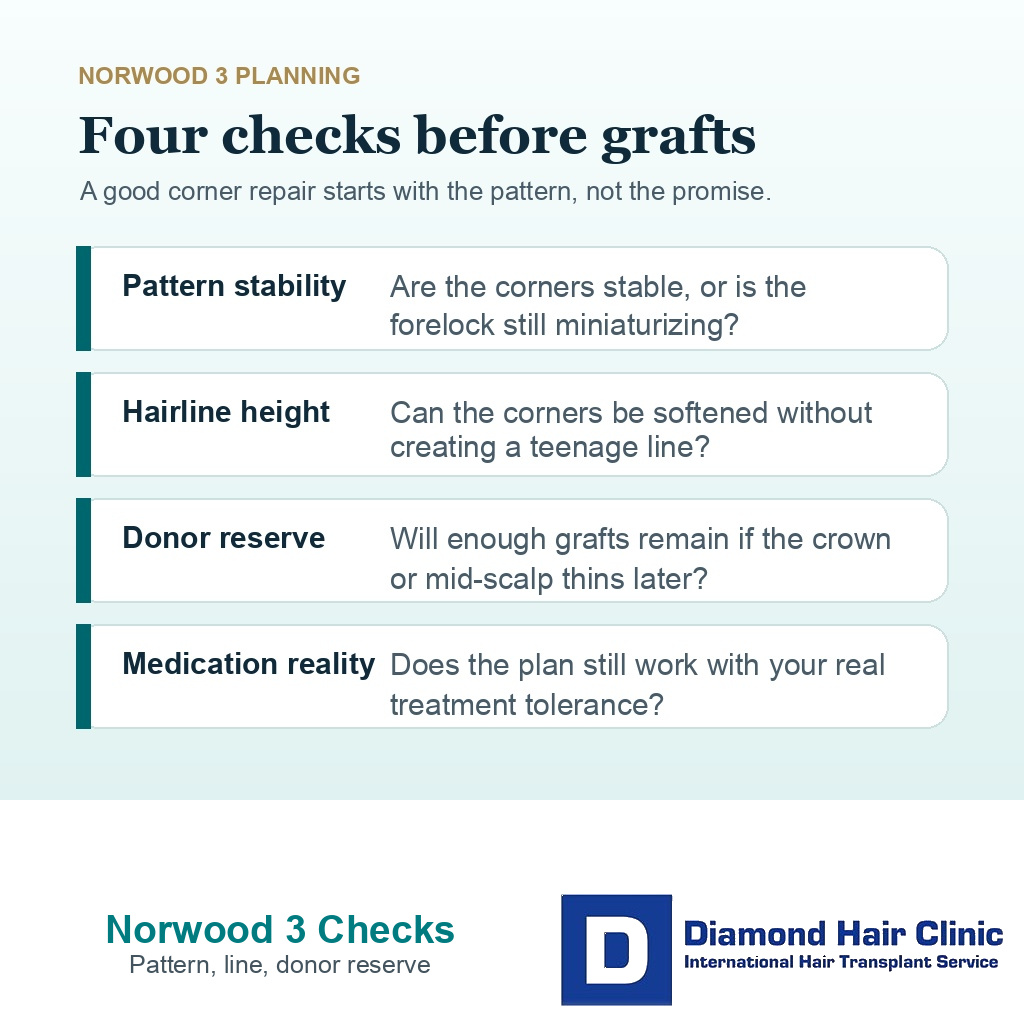
Norwood 3 planning starts with stability, hairline height, donor reserve, and the treatment plan you can realistically maintain.
Norwood 3 can still be too early for surgery
Norwood 3 can be too early for surgery when the pattern is still moving quickly, you are very young, the family history points toward advanced loss, or the treatment plan has not been tested long enough. In that setting, surgery can create a strong front while the native hair behind it continues to retreat.
Age matters because donor hair is limited and male pattern hair loss often progresses over years. A man in his early twenties with Norwood 3 recession may feel desperate because the corners affect the face, dating confidence, and photographs. I understand that pressure. Still, the design has to survive the possibility of Norwood 5 or 6 progression, not only look good at today’s hair length and styling angle.
In a younger patient, too young for hair transplant is not decided by birthday alone. Pattern stability, donor area, medical treatment, and emotional expectations decide whether surgery is mature enough.
Should I plan Norwood 3 surgery in my early twenties if medication is recent?
I would slow that decision down. A recent medication change and one set of photos should not become a fixed Norwood 1 or Norwood 2 target. I first want to see whether the native hair is stabilizing, how much miniaturization remains behind the hairline, and whether the donor reserve can still support the design later.
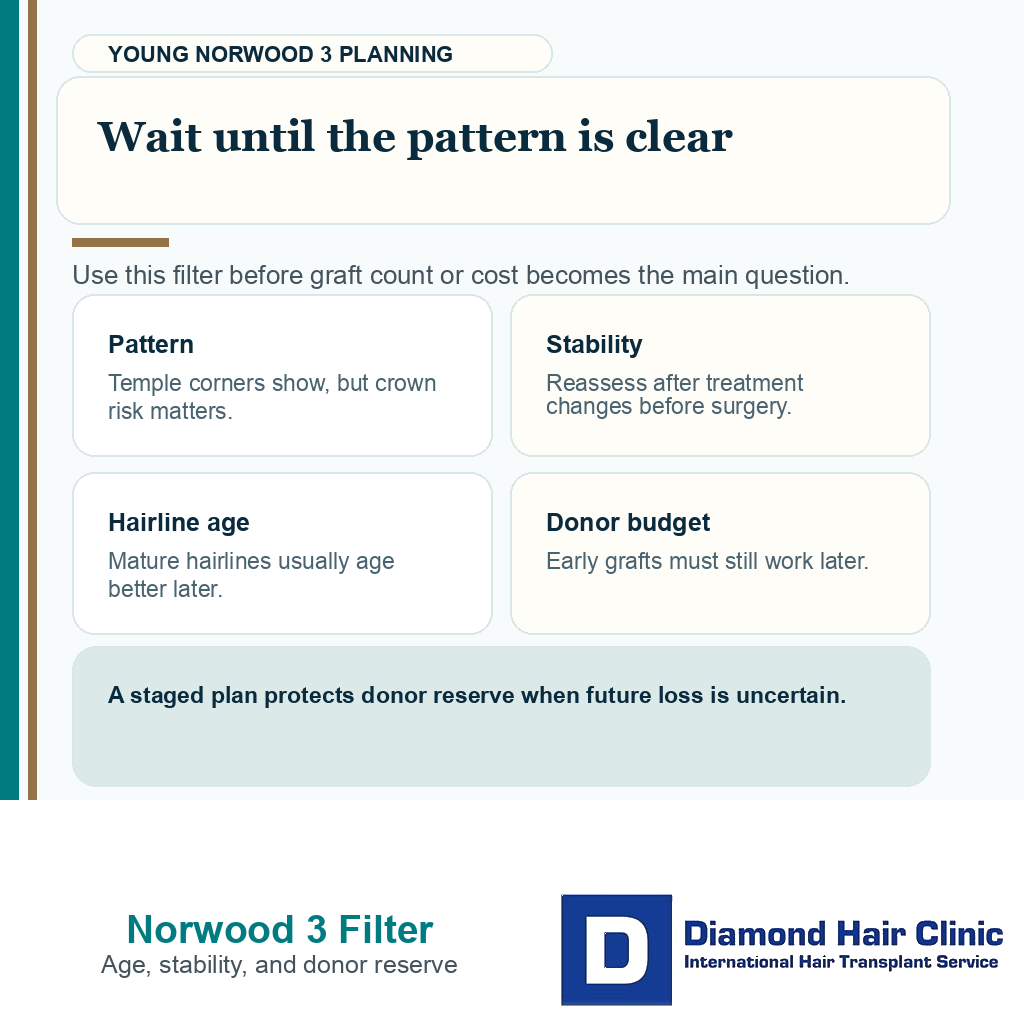
Young Norwood 3 planning should test pattern, stability, hairline age, and donor reserve before graft count or price becomes the main decision.
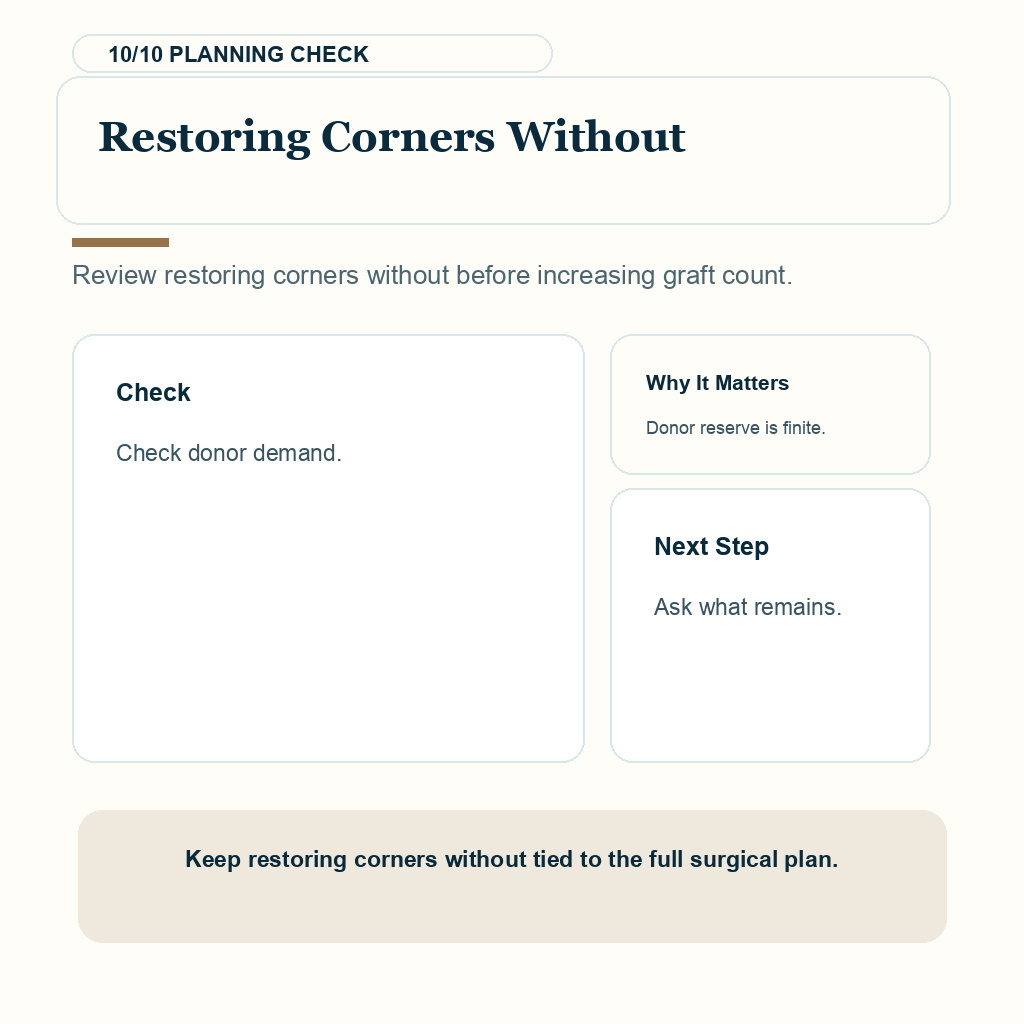
Restoring corners without an artificial look
The corners need to be restored to a mature frame, not to the lowest line you can imagine. A Norwood 3 hairline often needs softness at the front edge, slight irregularity, correct direction, and enough recession left to suit the face as it ages. A perfectly straight, low, dense hairline can look impressive in one photo and artificial in real life.
Temple corner work is especially unforgiving. The hair direction changes, the skin angle changes, and the first rows need finer single hair grafts. If the corners are closed too aggressively, the face can look boxed in. If the corners are ignored completely, you may feel the transplant did not solve the visible problem. The balance is surgical, not cosmetic drawing.
I also separate frontal corner recession from temple point reconstruction. Closing the frontal corners can frame the face. Rebuilding weak temple points is a different decision with different angles, finer hairs, and higher risk of looking unnatural if the donor hair is not suitable. A Norwood 3 plan needs to say which one is being treated.
Hairline design in hair transplant surgery and temple graft count planning both sit inside this decision. The front that ages best is not the lowest front. It is the line that fits your current face, your donor capacity, and the likely future pattern.

Norwood 3 corner design needs to improve the frame without spending future donor reserve too aggressively.
Front corners do not show the whole risk
At Norwood 3, it is easy to look in the mirror and see only the temples. I look at the whole scalp. I check the forelock, mid scalp, crown, donor area, beard option if it may matter later, hair shaft thickness, and signs of diffuse miniaturization. The front corners may be the visible complaint, but they are not always the only area at risk.
If the crown is likely to open later, a very aggressive frontal plan can steal grafts from a future crown or mid scalp strategy. If the forelock is miniaturizing, the transplant must blend into hair that may become weaker. If the donor area is already fine or limited, a dense corner repair can create donor thinning that only becomes obvious after the first short haircut.
The same donor budget issue can return later if the hairline is repaired first and the top then needs a second transplant review for thin coverage.
In a Norwood 3 case, lifetime graft planning matters from the first design. Donor hair is not an unlimited budget. Once grafts are moved, the decision cannot be undone without another repair problem.
Medication tolerance and family history can change the plan
Medication does not replace surgery when the corners are already empty, but it can change the timing and the design. If finasteride, dutasteride, or minoxidil helps stabilize native hair, the transplant can often focus more confidently on the missing corners. If you cannot tolerate medication or do not want it, the surgical plan must assume more future native thinning.
I do not design a Norwood 3 hairline as if treatment will freeze hair loss forever. I ask what you have actually used, what side effects occurred, whether the response has been stable, and whether the plan still works if medication is reduced or stopped. Active shedding or weak response changes the surgical threshold, which is why still losing hair on medication before a transplant deserves a separate look. When shedding is active after a medication change, I wait for a clearer pattern before locking the surgical map.
If you are stable on finasteride but not using minoxidil, I would not make surgery depend on starting minoxidil first. I first ask whether the corners are already empty, whether the native hair behind them is stable, and whether the design still works if minoxidil is never added or later has to stop. That is the difference between a useful medication delay before hair transplant and simply postponing a stable Norwood 3 corner repair.
Family history also matters. If your father, uncles, or brothers moved from early temple recession to Norwood 5, 6, or 7, I treat your front corners with more caution. A careful review of family hair loss history matters here because a nice Norwood 3 result should not trap you into an unnatural island if your pattern later becomes stronger.
Realistic graft range for Norwood 3
There is no universal graft number for Norwood 3. A small corner softening may sit around 1,500 grafts in the right case. A broader frontal reconstruction that blends into the forelock may move closer to 3,000 grafts. Many plans sit between those examples. Fine hair often needs more grafts for the same visual coverage than coarse hair, and a lower design needs more grafts than a mature design.
I treat those numbers as examples, not promises. The real estimate depends on measured surface area, hair caliber, desired density, existing native hair, and donor safety. I avoid promising a fixed number before seeing the scalp in detail because false precision can lead to poor planning.
A serious estimate needs to connect the drawn area to the density target. The front edge may need finer single hair grafts, while the area behind it may need different follicular units and a different density. Existing native hair can reduce the empty surface area, but it can also make placement more delicate if those hairs are miniaturizing.
The proposed number has to match the surgical goal. If a clinic quotes a high number, ask where those grafts will go, how many will be reserved for the first rows, how density changes behind the first rows, and how donor reserve will be protected. If a clinic quotes a low number, ask whether the result will look unfinished. A mature Norwood 3 plan explains both the visible frame and the donor cost you cannot see in the mirror.

Different graft quotes can all sound plausible until the design, hair caliber, donor reserve, and staged plan are reviewed together.



Staged plan can sometimes make more sense
A staged plan can be better when you are young, the pattern is still uncertain, the donor area is not generous, or you want a subtle change first. The first surgery can restore the frame without spending the entire donor budget. Later, if the pattern stays stable and you want more density, a second smaller session may be safer than one very aggressive first surgery.
This does not mean every Norwood 3 case needs two surgeries. It means the first surgery cannot be designed as if no second decision will ever be needed. Hair loss is a moving condition. A good first transplant gives you a better frame and still leaves options.
For some patients, smaller hair transplant sessions protect naturalness when the future pattern is not fully visible yet. A staged approach can feel slower, but it keeps the first operation from spending grafts too aggressively.
Donor area details that come first
Before I agree with any Norwood 3 graft number, I check the donor area carefully. I look at density, hair caliber, miniaturization, safe zone boundaries, previous extraction if any, skin quality, and whether short haircuts would reveal thinning after FUE. A donor that looks full in one photo can still be narrow, fine, or miniaturized under examination. The safe donor area is not every hair on the back and sides. Low nape hair, retrograde thinning, and miniaturized zones should not be treated as permanent donor reserve.
I also check whether the graft plan is using the correct hair types. The first rows of the hairline need fine single hair grafts. The area behind can use larger follicular units where they blend naturally. 45 grafts per cm2 density planning cannot be copied across the whole front as one fixed target.
Dense packing has a biological limit. Blood supply, graft handling, skin quality, and donor availability all matter. If a clinic speaks only about maximum density and not about donor preservation, I slow the conversation down.
Warning signs that make me slow the plan down
I slow a Norwood 3 plan down when you want a very low hairline, the donor area is weak, the crown is already miniaturizing, hair is still being lost quickly, or the clinic estimate is built around a large number without a clear design. I also slow down when the plan is based only on dry styled photos, without wet photos, donor inspection, family history, medication tolerance, or a realistic discussion of future loss.
Watch for a plan that ignores how the result will look under real conditions. A dense front in controlled lighting can still look thin in harsh light, wind, wet hair, or a comb through video. Natural results in harsh light and wet hair belong in the expectation before choosing an aggressive density target.
A third warning sign is a front only plan that forgets the crown. Some cases need the hairline first because it frames the face. Others need a broader plan that balances the hairline and crown. When donor reserve is limited, the hairline or crown first decision becomes part of the original plan, not a later afterthought.
My approach to a Norwood 3 consultation
In my consultation, I do not start by asking how many grafts can be sold. I start by asking what the front should look like in five, ten, and twenty years. I check your age, family history, medication tolerance, current styling, donor strength, and whether the central forelock is stable.
Then I draw the hairline with conservative judgment. I use the design to create a natural frame that still belongs to your face as you age, not to erase every sign of maturity. In Norwood 3, that often means careful corner work, soft first rows, correct direction, and enough density behind the line to avoid a sharp border.
The consultation also has to be direct about limits. If the donor area is weak, if the crown is already moving, or if the expectation is teenage density, delaying or declining surgery is safer than creating a front that becomes a repair case later. If the request is to lower the central hairline, close both corners, rebuild temple points, and protect a future crown at the same time, the answer may need to be staged or reduced rather than forced into one operation.
Protect the donor reserve behind the new corners
A Norwood 3 hairline should improve the face without spending grafts as if the rest of the pattern is finished. I still check age, family history, crown activity, miniaturization behind the corners, medication tolerance, and donor strength before agreeing with the design.
A conservative corner repair can look strong when the first rows are soft and the density behind them is believable. The mistake is chasing a low youthful outline that leaves no room for future hair loss or crown change.
If the donor reserve, medication story, or future pattern is unclear, slowing down is often the stronger decision. The best result is not the largest quote. It is a hairline that still belongs on the patient when the hair story continues.
Read this review excerpt
We also had a levelled conversation about my hairline and results I could expect based on my donor density area.