


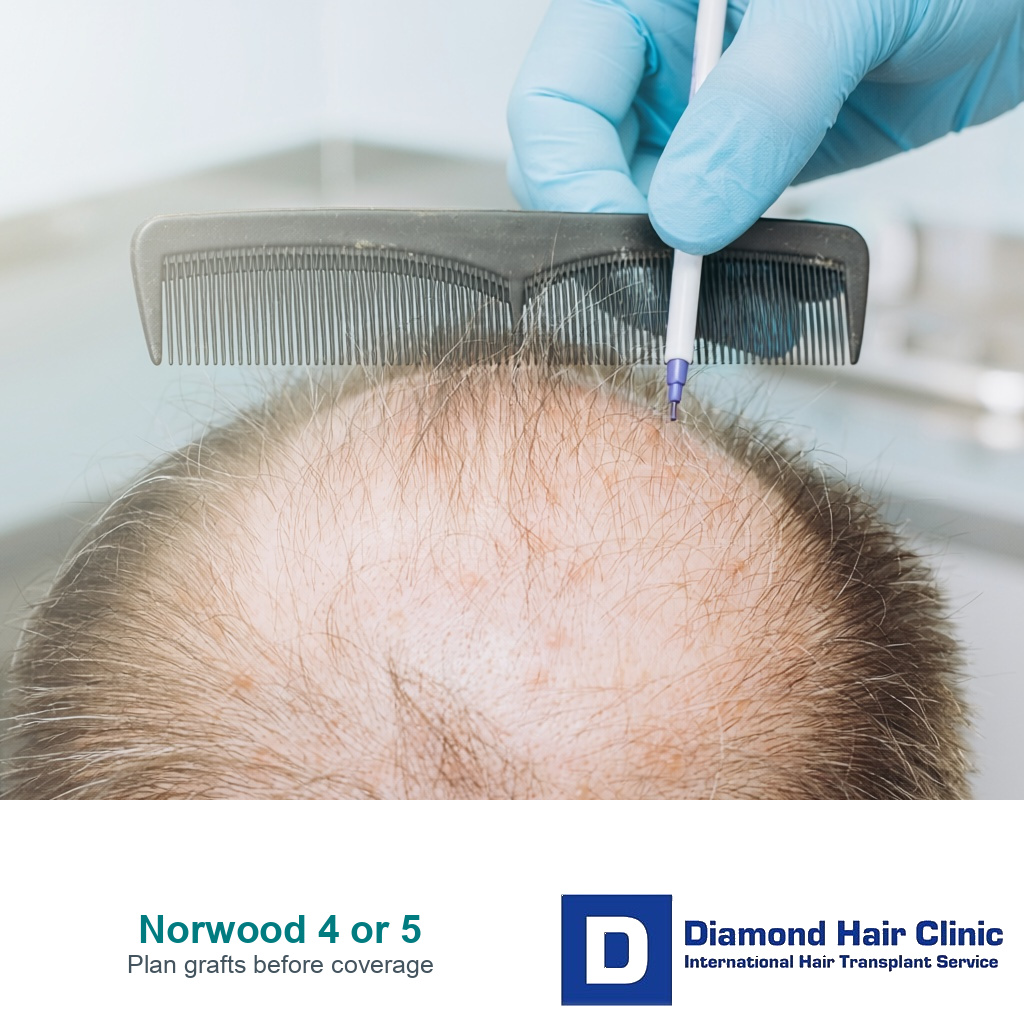
Norwood 4 or 5 Hair Transplant Planning Needs a Graft Budget
At Norwood 4 or 5, I do not begin by asking how many grafts can be packed into one operation. I first decide how the front, midscalp, crown, and future hair loss can safely share the same donor reserve. This stage is already beyond a small hairline change, but it is still different from an advanced Norwood 6 or 7 case. The plan has to use limited donor capacity carefully.
The hard part is that every attractive promise draws from the same graft bank. A lower hairline uses grafts. A dense front uses grafts. A bridge through the midscalp uses grafts. Crown coverage uses many grafts and often gives a softer visual return. In many Norwood 4 or 5 plans, the front usually gets priority, the midscalp has to connect the result, and the crown is treated cautiously or staged if it would spend too much reserve. I judge the plan by whether it still makes sense if the pattern progresses. The biggest advertised number is not enough.
The first decision is not the graft number

A patient may arrive with three clinic estimates. One says 3,500 grafts, one says 4,500 grafts, and one says 5,500 grafts. That range looks like a technical disagreement, but often it is really a design disagreement. One clinic is spending more on a low, dense hairline. Another is trying to reach the crown. Another is spreading grafts thin across a large area. The number alone does not tell you whether the plan is wise.
For Norwood 4 or 5, graft placement matters most when enough donor reserve remains protected for later. How much is reserved for the frontal frame? How much is needed to connect the midscalp so the top does not look divided? Is the crown being treated now, reduced, or saved for later? What donor area remains if native hair continues to miniaturize? A graft budget should name both what is being treated and what is being protected. It should also say what finding would make us stage the operation instead of forcing the front, midscalp, and crown into one day.
When two quotes are far apart, ask each clinic to mark the same zones on the same photos. Only then can you see whether the difference is a real plan, a wider treated area, or a number that spends donor reserve too quickly.
Lifetime graft planning matters here because a hair transplant is not a single day purchase. It is the planned use of a limited donor resource over many years. A Norwood 4 or 5 patient needs that idea before the first recipient area incision is made.
Norwood 4 and Norwood 5 are not the same surgical problem
Norwood 4 usually means the frontal recession and top thinning have become more established, often with crown involvement beginning or already visible. Norwood 5 means the balding bridge between the front and crown is weaker, and the total area needing coverage is larger. Two patients may both say they are “around Norwood 5,” but one still has useful midscalp hair and another has almost no bridge left. A styled photo can also understate the difference. Wet hair, comb through views, and donor examination can move the plan closer to Norwood 4 or closer to Norwood 5.
The difference changes planning. If the midscalp bridge is still present, the operation may be able to reinforce the front and protect the visual connection to the crown. If the bridge is weak, the plan has to decide whether to rebuild that connection or accept a more staged approach. If the crown is large and expanding, chasing it too early can dilute the front and still leave the back looking thin.
Here the practical distinction matters. A Norwood 4 pattern with a usable bridge can often prioritize the frontal frame and connection behind it. A Norwood 5 pattern with a weak bridge or expanding crown usually needs a more conservative hairline, staged midscalp work, and a crown plan that does not empty the donor reserve.
For earlier recession, Norwood 3 hair transplant planning shows why early planning still needs discipline. For advanced loss, Norwood 6 or 7 hair transplant planning shows why limits become stronger. Norwood 4 or 5 sits between those two situations, which is why the decision is often misunderstood.
A low hairline can steal from the crown later
Many patients judge a plan by the proposed hairline. I understand why. The frontal frame is what you see in the mirror, in photos, and in conversation. But at Norwood 4 or 5, a low adolescent hairline can take grafts away from the midscalp and crown before we know how the rest of the pattern will behave.
A natural hairline should match age, face shape, donor reserve, hair caliber, and likely future loss. Recreating a teenage front edge can make the top look patchy later. A slightly more mature hairline with stronger density behind it can look more natural and age better than a low line that consumes too much donor capacity.
Hairline or crown first becomes a real planning question at Norwood 4 or 5. The front usually gives the strongest visual change, but that does not justify ignoring the crown completely. It means the crown decision has to fit the donor math instead of competing with it blindly.
How should crown coverage be discussed?
The crown is a wide spiral area. It can swallow grafts quickly because the hair changes direction and the surface area may be larger than it appears in a single photo. Patients often ask for the crown to be “filled in” at the same time as the front, but a crown can demand more grafts than the result will visually repay.
That does not mean the crown should never be transplanted at Norwood 4 or 5. It means I need to know the size of the crown, the strength of the donor area, the patient’s age, medication history, hair caliber, styling goal, and whether the frontal half can still be made stable. A small, stable crown is a different problem from a broad or expanding crown. A small crown may be reasonable. A broad or expanding crown may need lighter coverage, a delayed plan, or a second stage decision after the front and midscalp are secure.
The crown hair transplant discussion is useful here because the crown behaves differently from the hairline. For Norwood 4 or 5, the crown is often the difference between a strong lifetime plan and an overextended first surgery.
One session should not pretend the crown is free. If the crown is included early, the plan has to show what front density, midscalp connection, or future reserve is being traded for it.
Use these 10 graft budget slides to see how a Norwood 4 or 5 plan spends, saves, or stages grafts across the hairline, midscalp, crown, donor reserve, and future loss. Swipe sideways, use the arrows one slide at a time, or choose a number below the image.
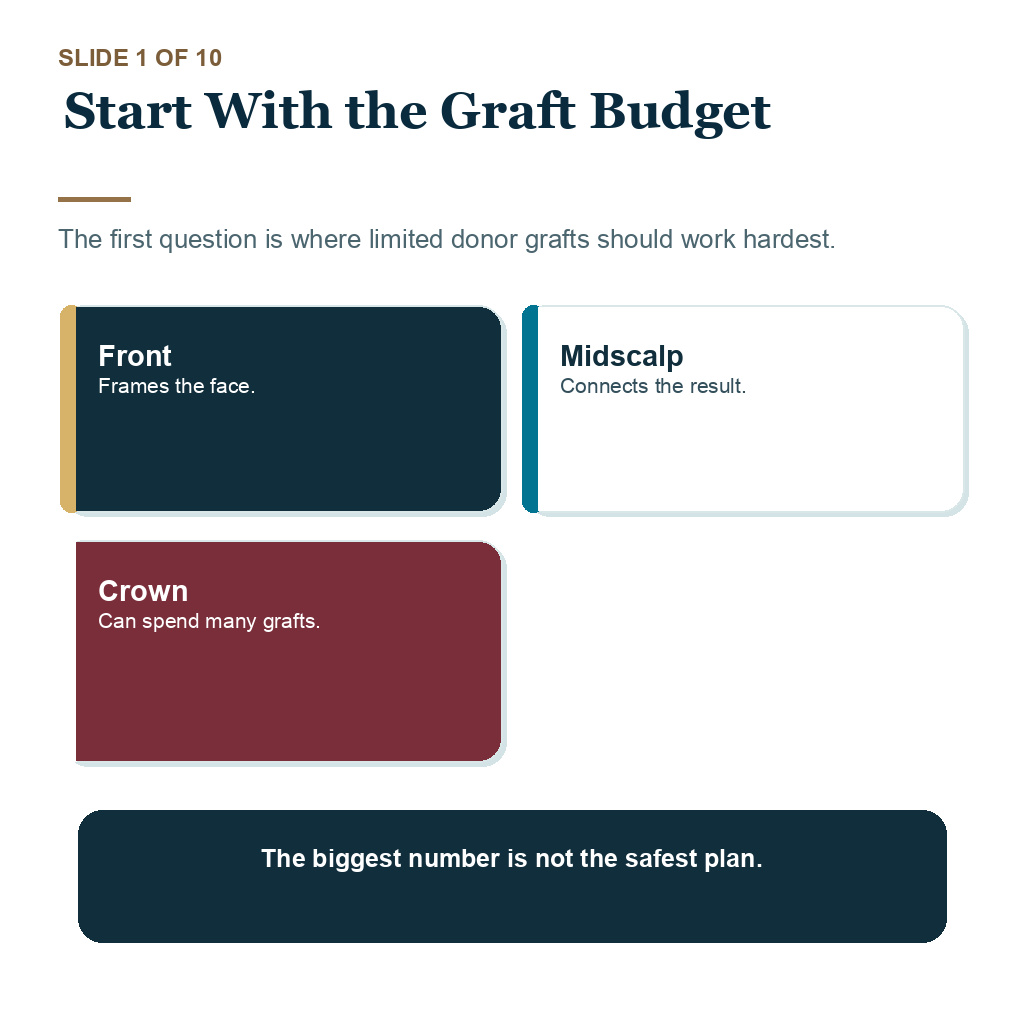
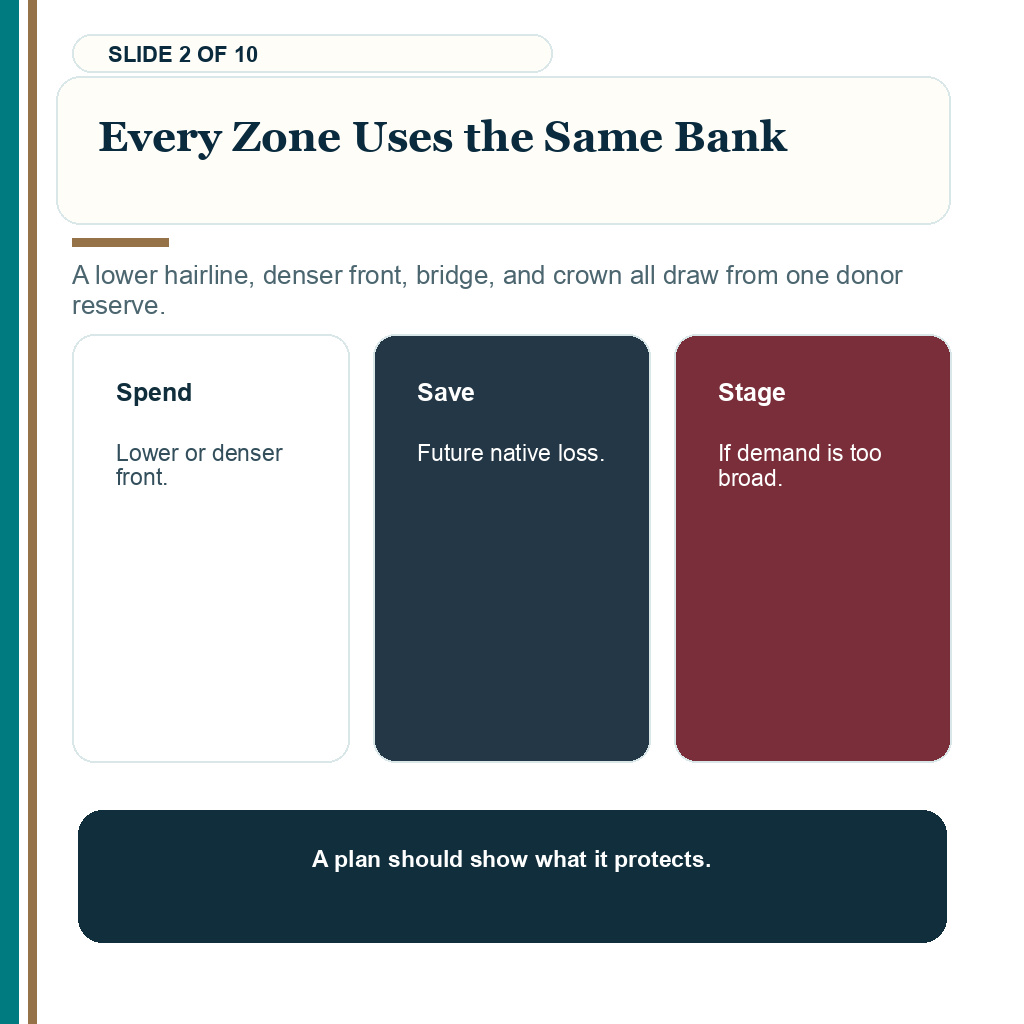
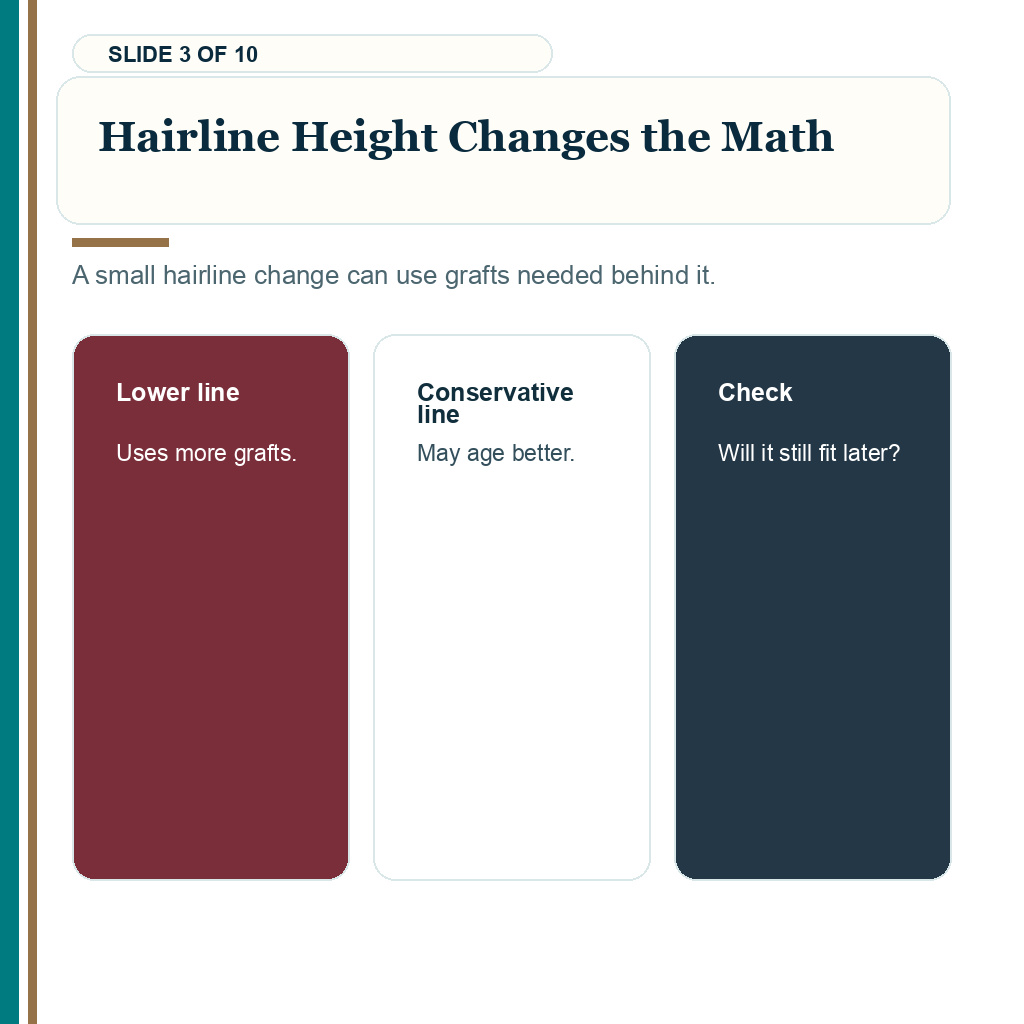
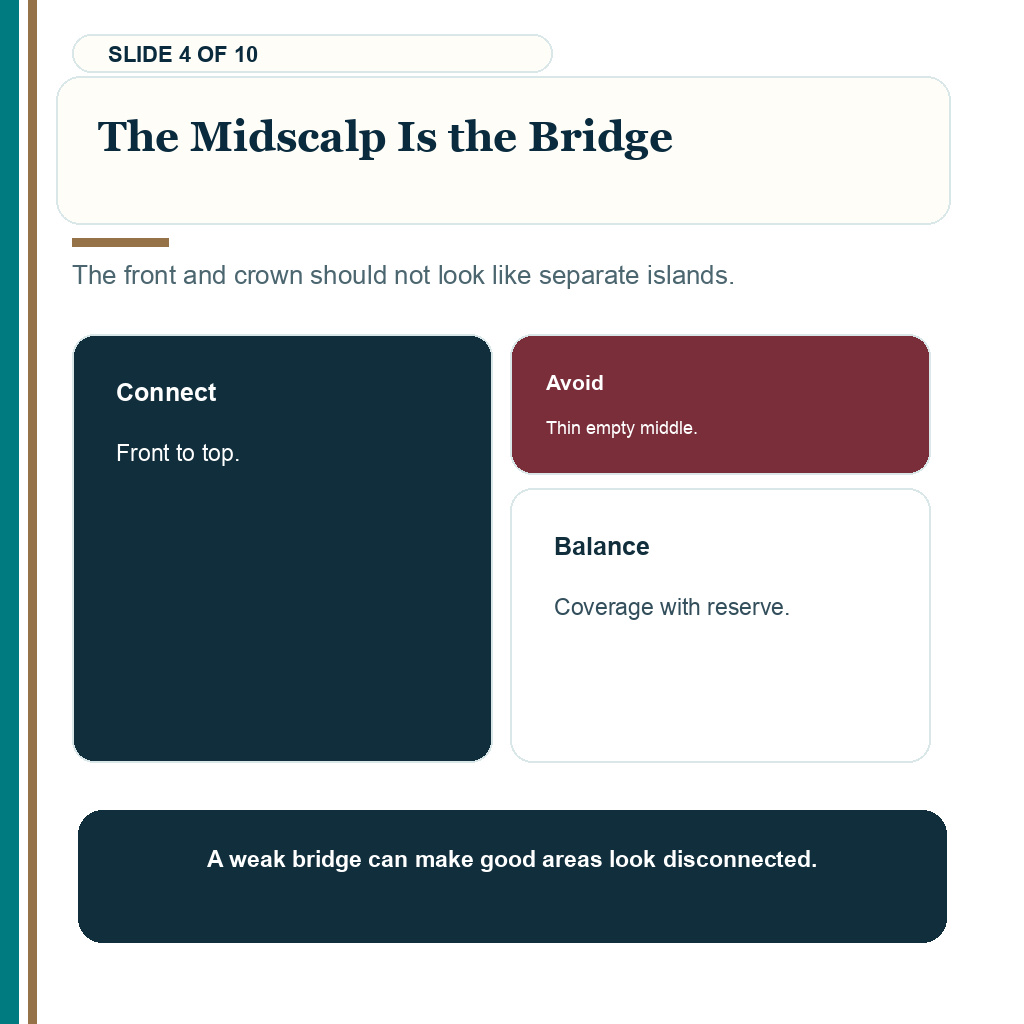
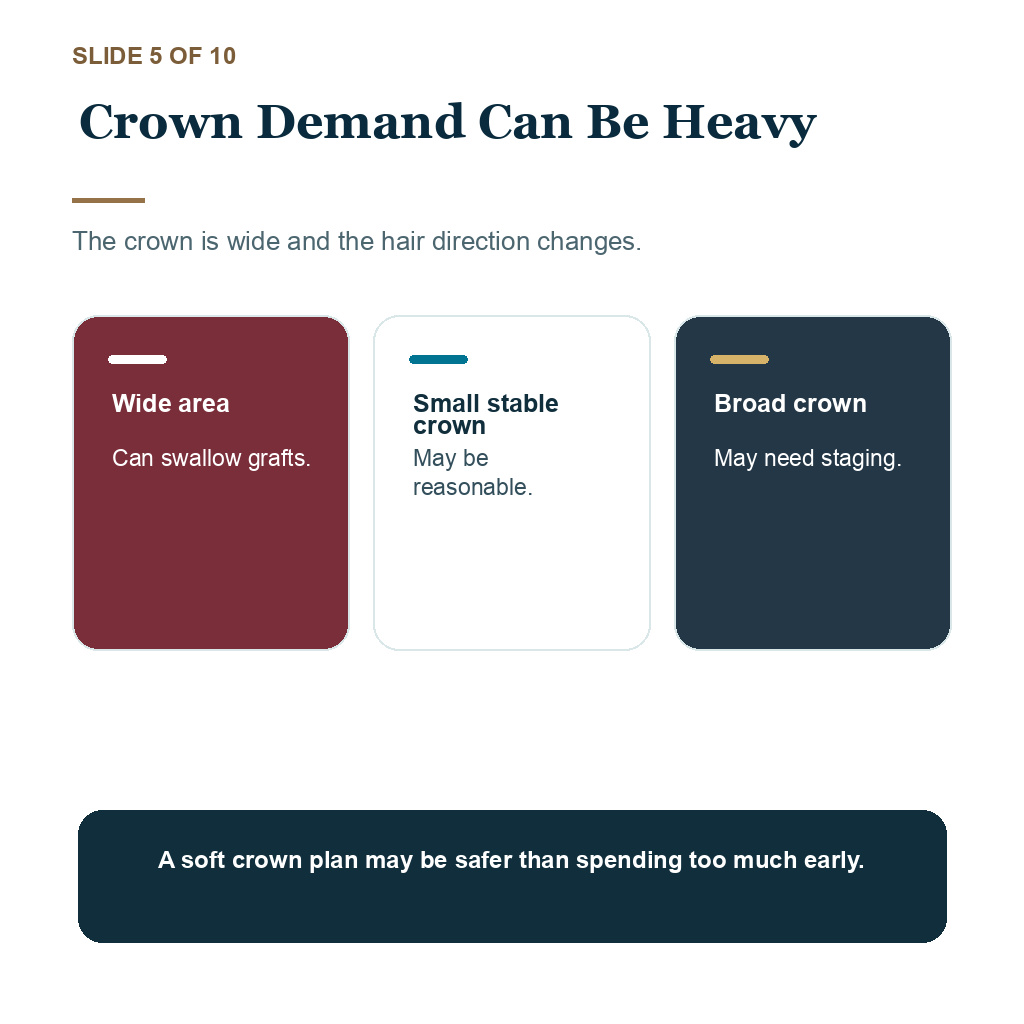
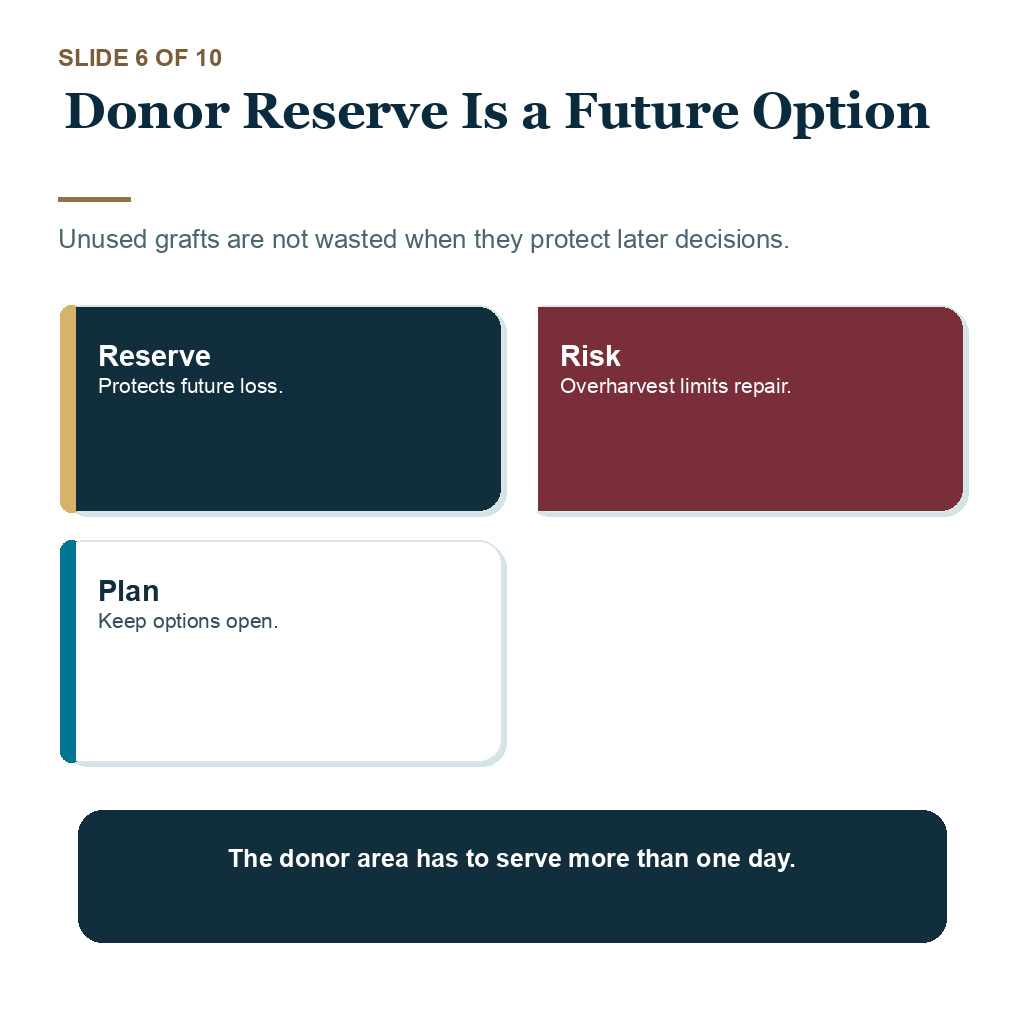
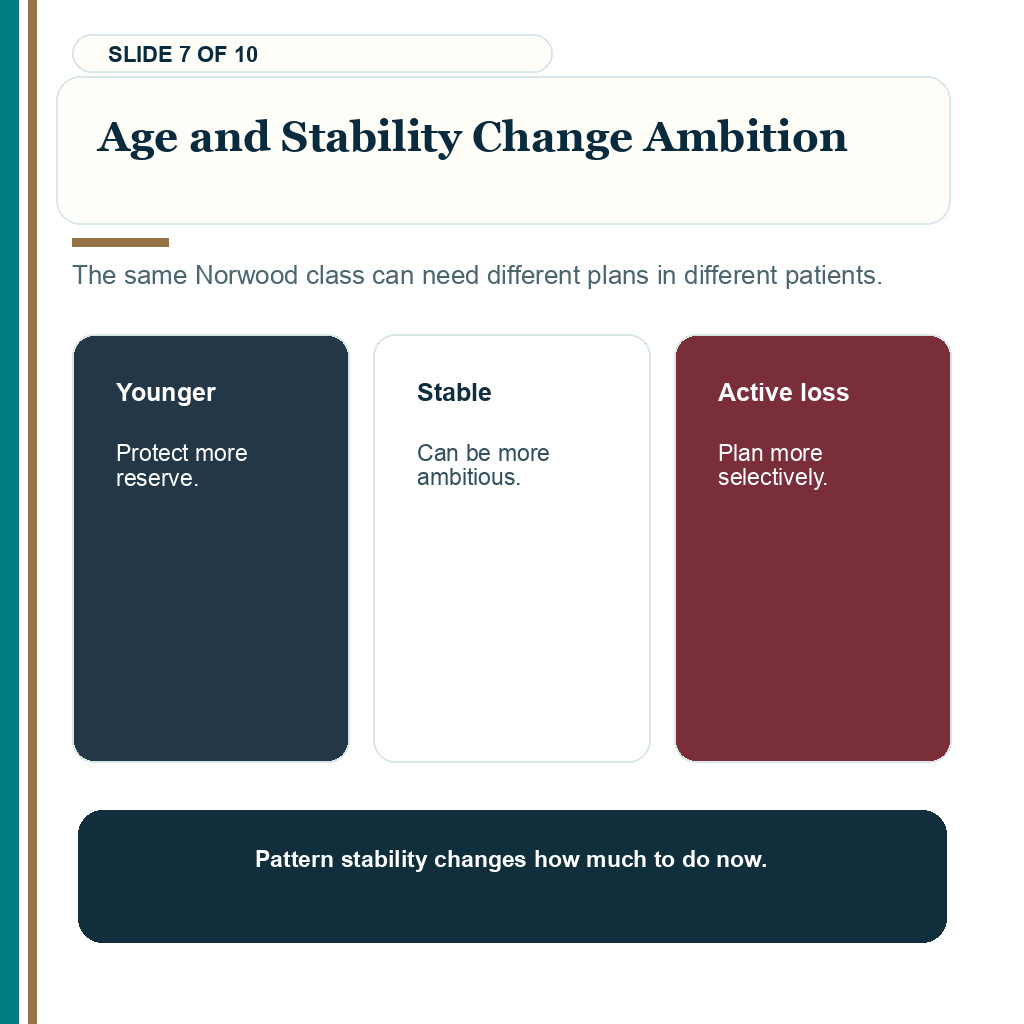
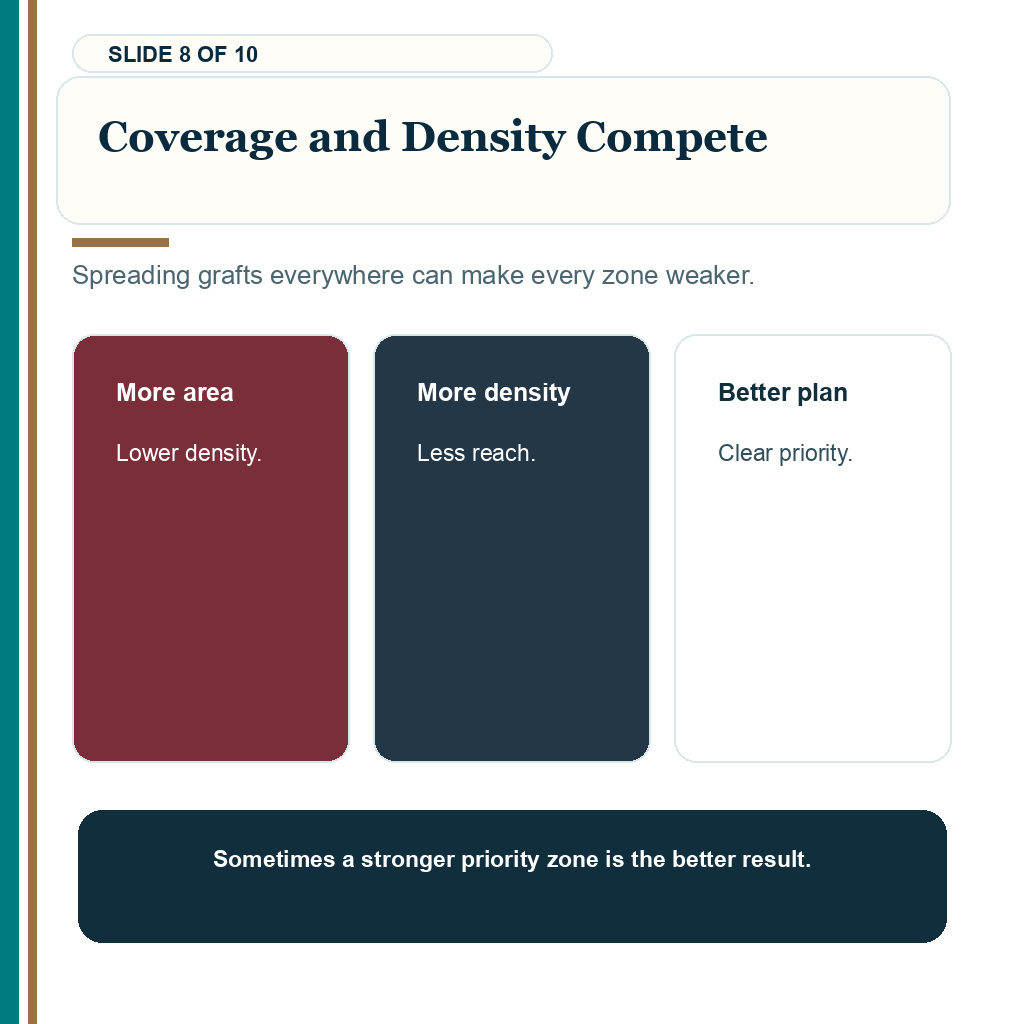
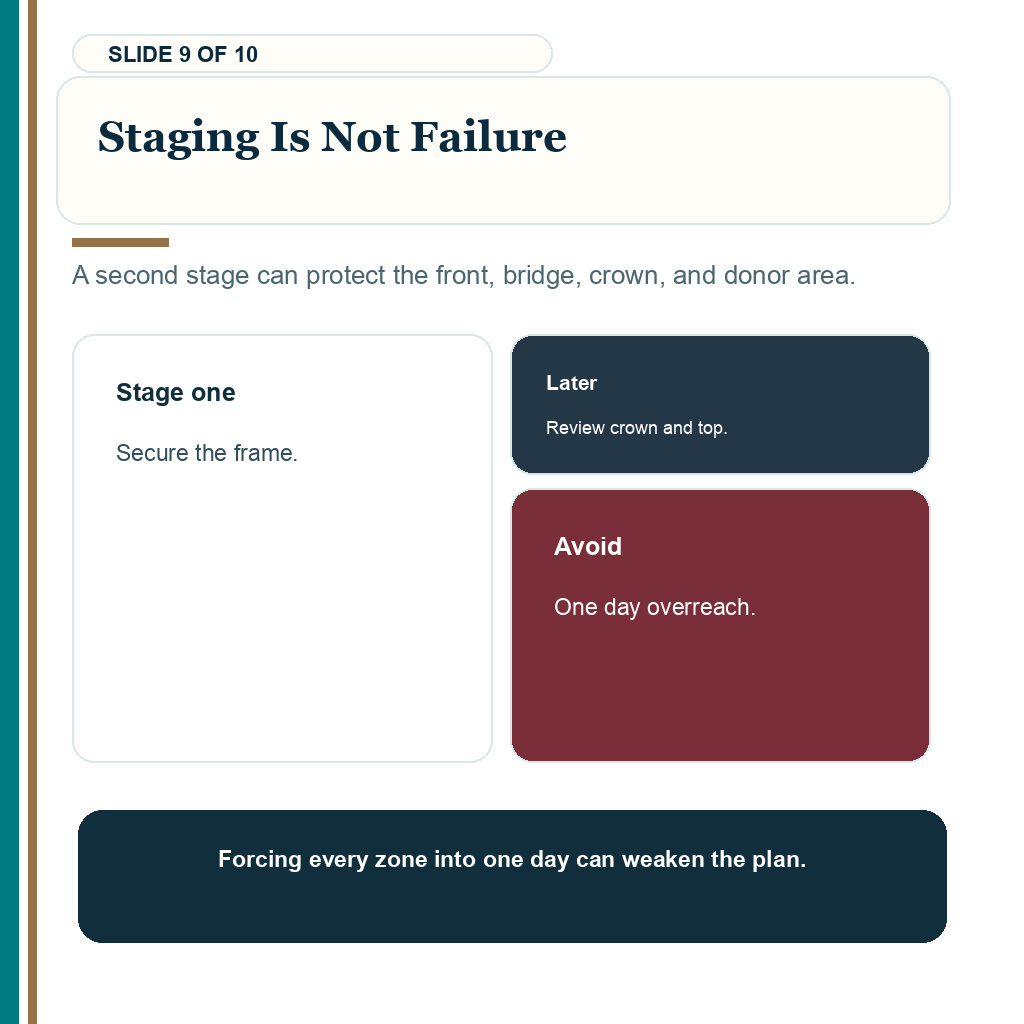
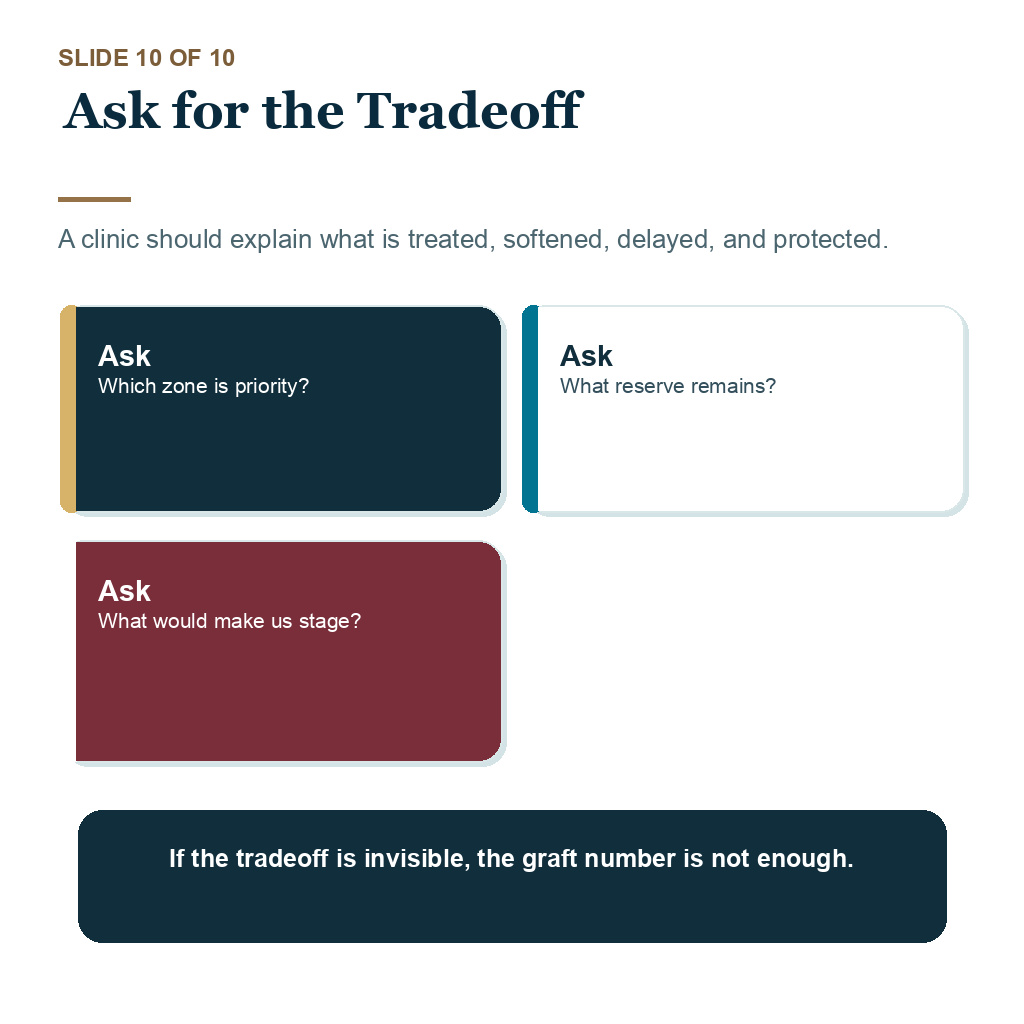
The slides are not a graft calculator. They show the tradeoff. If more grafts are spent in one zone, fewer are available for the other zones or for future loss. Every zone competes with the same donor bank.
Norwood 4 or 5 graft budget planner
Where should grafts go first?
The plan has to decide what matters now, what can wait, and what donor reserve must stay untouched.
Front frame
The front changes the face first, but it should not take grafts as if the crown and future loss do not exist. A mature, soft hairline with enough density behind it often protects the result better than a low line that spends the budget too early.
Before accepting the plan, ask how many grafts are assigned to the front and what reserve remains. Slow the decision down if the design uses a low dense hairline and leaves no clear donor reserve for later.
Midscalp bridge
The midscalp is the bridge between a strong frontal frame and a crown that may need restraint. If this zone is ignored, the result can look divided even when the hairline itself grows well.
The useful question is not only the total graft number. It is how the front, midscalp, and crown are divided. A large quote without zone distribution can hide thin spreading across too much scalp.
Crown
The crown can consume grafts quickly because the surface area and swirl pattern demand more than many patients expect. Delaying or softening crown coverage is sometimes how the total plan stays realistic.
For crown work, ask whether it belongs in the first surgery or should wait for a second stage. Be careful with any promise of full front and crown density in one surgery if the donor math is not explained.
Donor reserve
Donor reserve is the budget for the first plan, future hair loss, and any later correction. A high graft number is only acceptable when the donor area can support it without visible thinning or unsafe overharvesting.
The number to protect is not only the number removed. Ask what stays untouched after the first extraction. A weak, previously harvested, or miniaturizing donor area should reduce ambition, not be pushed into a bigger promise.
Second stage
A second stage is not a weak plan when the first operation already has to balance front, midscalp, crown, and future reserve. Staging can be the responsible way to protect donor safety while the first result and the remaining pattern become clearer.
Before surgery, the plan should name what is first, what waits, and what result is realistic after one session. If staging cannot be explained in plain language, the graft number is not enough evidence.
Medication history changes the plan
Medication does not create donor hair, but it can change the planning confidence. If a patient has been stable on finasteride, dutasteride, minoxidil, or another medical plan under proper guidance, I may have more confidence about how fast the native hair is changing. If the patient is young, losing hair quickly, and has never tried medical stabilization, a very aggressive transplant plan becomes more risky.
Medication is not a blanket rule before surgery. Some patients cannot use certain medicines, do not tolerate them, or choose not to. The point is that the surgical plan should not pretend future loss is frozen when it is not. A Norwood 4 or 5 patient with active progression may need a higher hairline, lower density target, staged crown plan, or a more selective first surgery.
If the donor itself shows miniaturization, the caution becomes stronger. The donor miniaturization and safe zone discussion is important here because transplanted hair is only as reliable as the donor area we choose to use.
When a Norwood 4 or 5 patient does not want medication, I become stricter about where the grafts go first. The plan should not promise the front, midscalp, and crown equally unless the donor reserve can support that choice later.
Donor reserve sets the ambition of the plan
Two patients with the same Norwood number can have very different donor capacity. Hair caliber, density, color contrast, scalp laxity, curl, safe zone strength, prior extractions, and donor miniaturization all change what can be done. A patient with thick hair and strong donor density can sometimes tolerate a broader plan. A patient with fine hair and weak donor density may need a narrower design even if the balding pattern looks similar.
A front view alone is not enough for Norwood 4 or 5 surgery planning. Donor reserve must be examined carefully. It is also important to decide how much can be harvested without creating visible thinning, patchiness, or overharvesting. A plan that looks impressive on the recipient side can still be a bad plan if the donor has been sacrificed.
Donor area strength and a weak donor area are not small details. At this stage, donor protection is not cautious wording. It is the foundation of the result.
When does a one session promise need a second look?
Some Norwood 4 or 5 patients can have a strong first surgery. Still, full front, midscalp, and crown restoration in one operation is not a responsible promise for every patient. When the recipient area is large, density has to be distributed carefully. If the clinic promises complete coverage with a very high graft number, ask where those grafts are coming from, what will be left for later, and what donor evidence supports the claim. Confidence language is not enough here. I need donor measurements, zone distribution, safe zone logic, and a clear explanation of what remains unused.
Large sessions can be useful in selected patients, but they can also become a way to hide poor planning behind a big number. A 5,000 graft conversation should include donor safety, surgical time, graft handling, density distribution, and what remains for the future. It should not be only a sales sentence.
A 5,000 graft FUE hair transplant can be reasonable in selected patients, but the number has to earn its place in the plan. For Norwood 4 or 5, the question is not only whether the number is possible. The question is whether it is the right use of the donor bank.
Photos alone can miss the real risk
Remote photos can show the general pattern, but they can also mislead. Wet hair, flash, styling, crown angle, and lens distance can make the same scalp look very different. Photos also do not show donor miniaturization reliably, scalp characteristics, hair shaft diameter, or how the hair behaves under direct examination.
Photo planning can be a useful first filter. It can help decide whether a case deserves a consultation, which areas look most important, and whether the request is realistic. For a Norwood 4 or 5 case, useful photos include the front, both temples, top, crown, donor back and sides, wet or unstyled views, and a short video with the hair moved aside when possible. Even then, a final plan still needs donor examination and long range judgment.
Planning a hair transplant from photos has limits at this stage. A clinic can estimate, but the responsible plan must stay flexible until the surgeon can confirm the donor and recipient area conditions.
Where do I draw the line in Norwood 4 or 5 planning?
A Norwood 4 or 5 patient can still have enough donor reserve for a strong plan, but I do not spend that reserve just because a larger quote sounds impressive. The plan should slow down when the proposed hairline is too low, the crown request would empty the budget, or the patient is already close to a Norwood 6 or 7 pattern.
The plan should also name what is intentionally not being treated. Leaving a crown lighter, keeping the hairline mature, or staging the midscalp may feel cautious, but it protects the result from looking unnatural when native hair keeps changing.
The written explanation matters because this is the stage where patients can still avoid an advanced baldness repair problem. A plan that fits the donor today should also leave a realistic route for advanced baldness planning if the pattern progresses later.
When should a Norwood 4 or 5 operation be delayed?
Delay or reduce a Norwood 4 or 5 plan when the hair loss is still moving quickly, the donor reserve is already thin, the requested hairline is too low, or the crown demand would use grafts that the front may need later.
The patient may still be a candidate, but not for every version of the plan. Sometimes the responsible order is medication stability first, a mature hairline, a smaller first session, or waiting until the pattern is easier to read.
How do I plan for a Norwood 4 or 5 patient?
I start by defining the pattern, not just naming it. Is the patient closer to Norwood 4 with a useful bridge, or closer to Norwood 5 with a larger bald zone? Is the crown small, large, expanding, or stable? Is the front still worth rebuilding strongly, or would a lower hairline create a donor problem later? These are clinical questions, not cosmetic preferences alone.
Then I separate the plan into zones. The frontal hairline and forelock need a natural frame. The midscalp needs enough connection that the result does not look split. The crown must be judged by size, expectation, and donor cost. Finally, some grafts must remain outside the first surgery in case native hair continues to thin. Unused grafts are not wasted grafts if they protect the next decision.
When the donor is strong and the pattern is stable, the plan can be more ambitious. When the donor is weak, the patient is young, the crown is large, or the hair loss is active, the plan should become more selective. A good Norwood 4 or 5 plan leaves a future plan possible. That is the difference between spending grafts and investing them.
Make the graft budget visible
At Norwood 4 or 5, the consultation should make the graft budget visible. Which area gets strength first? Which area is kept lighter? What happens if the crown expands? What donor reserve remains after the first session?
A responsible plan may choose a stronger front, a softer crown, or a staged route instead of trying to fill every visible space at once. That is not a smaller ambition. It is how the surgeon keeps the donor area from being spent before the long-term pattern is clear.
Do not judge the offer by the biggest graft number or the lowest hairline drawing. Judge whether the hairline, midscalp bridge, crown demand, donor reserve, and future loss have been put on the table in plain language. If the tradeoff is invisible, the plan is not ready.
Read this review excerpt
We also had a levelled conversation about my hairline and results I could expect based on my donor density area.