



Verteporfin Hair Transplant Claims Need Evidence
Patients usually ask about verteporfin because they want to know whether it can reduce FUE dot scarring, help donor hair regrow, or make a safer second surgery possible. I understand that hope. I still do not plan a hair transplant as if verteporfin can replace donor management. The evidence is not strong enough to count donor regrowth in the graft budget or use the same donor area twice.
I read each verteporfin claim through practical proof questions. What was actually tested? Was there a control area? Did the result stay stable? Does the surgical design still work if there is no donor regrowth at all? If the plan fails without verteporfin, it is too dependent on an unproven promise.
Separate the promise from the surgical plan before it changes the decision. Less visible scarring, smoother healing, and extra usable grafts are different claims, so the donor plan should not borrow from the strongest claim when only the weaker one is being discussed.
In my planning, verteporfin does not change the first principles of FUE. The donor area is finite. Extraction pattern matters. Punch size, spacing, hair characteristics, future hair loss, and repair options still matter. If this new use eventually proves useful, it should make a careful plan better. It should not be used to justify a careless plan.
Why are patients asking about verteporfin now?
Most patients are not asking about verteporfin because they enjoy laboratory details. They are asking because donor supply is the hard limit in hair transplant surgery. A young man with advanced loss may be told that his donor area cannot safely cover every bald zone. A repair patient may already have visible FUE dots or overharvesting. Someone planning a first surgery may wonder whether waiting for donor regeneration would give a better long-term option.
The discussion often moves too quickly from early test photos to large conclusions. A small treated zone can look encouraging, but a full surgical plan needs more than an encouraging image. It needs repeatable results, proper controls, known dosing, safety follow-up, and a clear answer about whether the hair that appears is cosmetically useful over time.
I keep this topic next to donor planning, not hype. If you are comparing clinics, a verteporfin promise should not distract you from the basics. The real danger is still donor area overharvesting risk, because removing too much hair from the wrong places can leave a permanent cosmetic problem.
Verteporfin limits in hair transplant planning
Verteporfin is a photosensitizing medicine known from eye treatment, where it is used with controlled light activation. In wound healing research, it has been studied because it can affect pathways involved in scarring. The part that interests hair transplant patients is the possibility that a treated wound may heal with less scar tissue and possibly with skin structures that normal scar tissue lacks.
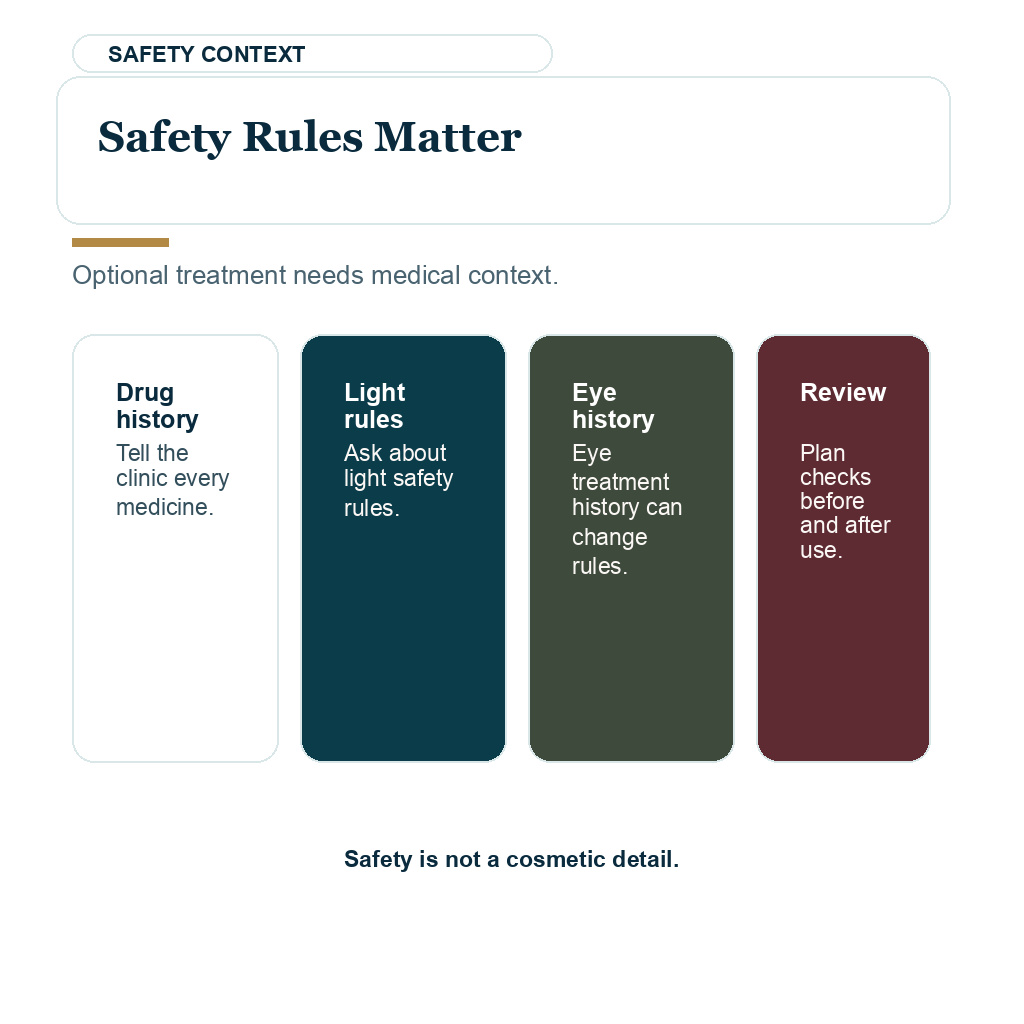
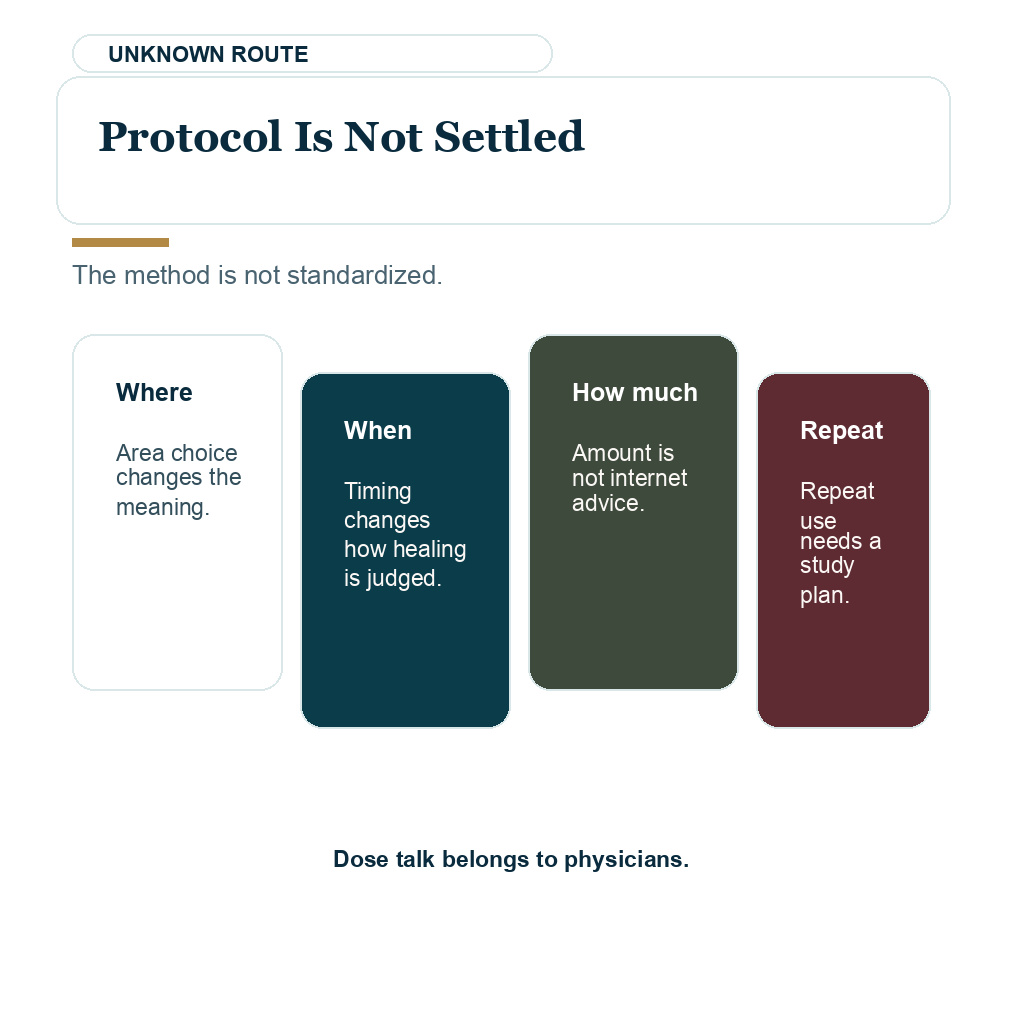
That does not make verteporfin a routine hair transplant treatment. In its approved use, it is an eye medicine activated by light. Using it around FUE extraction wounds is a separate question outside its approved use. A hair transplant protocol would need its own dose, timing, safety rules, consent language, light precautions, and follow-up evidence. A laboratory result or early clinical observation is not the same as a standardized FUE protocol across different donor densities, skin types, ages, medications, and surgeon techniques.
I separate the claims before I let them influence planning. Smoother healing is one claim. Less visible FUE dot scarring is another. Meaningful donor hair regeneration is much larger. The first two may still matter, but they do not give the patient a new donor bank for future surgery.
I review topical metformin after FUE donor scar claims with similar restraint. Scar quality research may become useful, but it should not be turned into a donor regrowth budget before controlled FUE evidence exists.
The donor area should not be budgeted twice
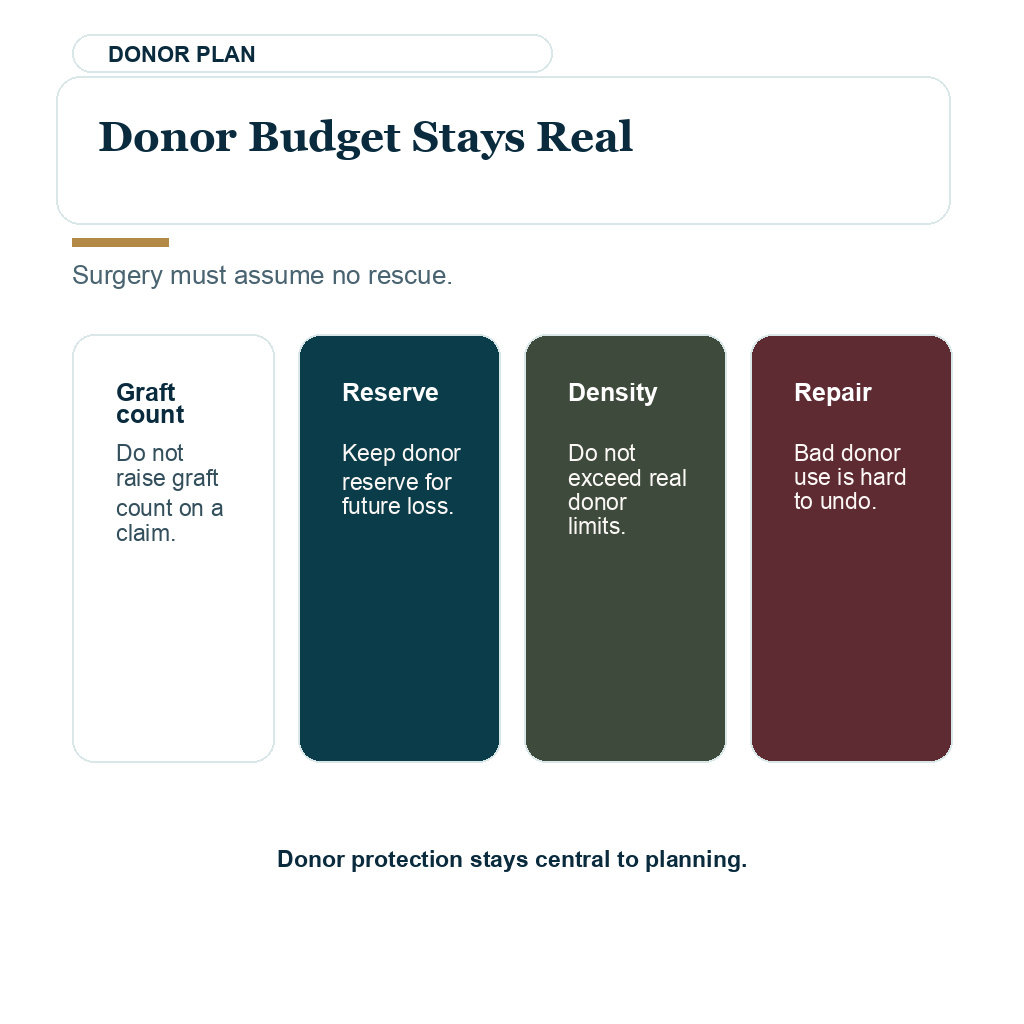
The most important planning rule is to treat the donor area as limited until strong proof says otherwise. In standard FUE, donor hair removed from one spot does not grow back there. I am careful with aggressive graft quotes for the same reason. A plan that depends on future donor regeneration may look attractive on paper, but it can leave a patient with poor coverage, visible donor thinning, and fewer repair options.
An interesting donor photo should not become a donor budget. Plan the extraction pattern as if no usable regrowth will happen, then treat any proven benefit as extra safety.
When we plan FUE, the question is not only how many grafts can be removed today. It is how the donor will look after healing, how it will look with short hair, and whether enough reserve remains if the crown progresses later. If a clinic tells you verteporfin means you can safely take far more grafts, ask them to show long-term controlled evidence, not enthusiasm.
This matters even more in repair cases. If the donor area is already weak, I do not treat verteporfin as a rescue shortcut. The better starting point is a realistic review of overharvested donor area repair, scar visibility, hair length, SMP options, and whether another surgery is truly worth it.
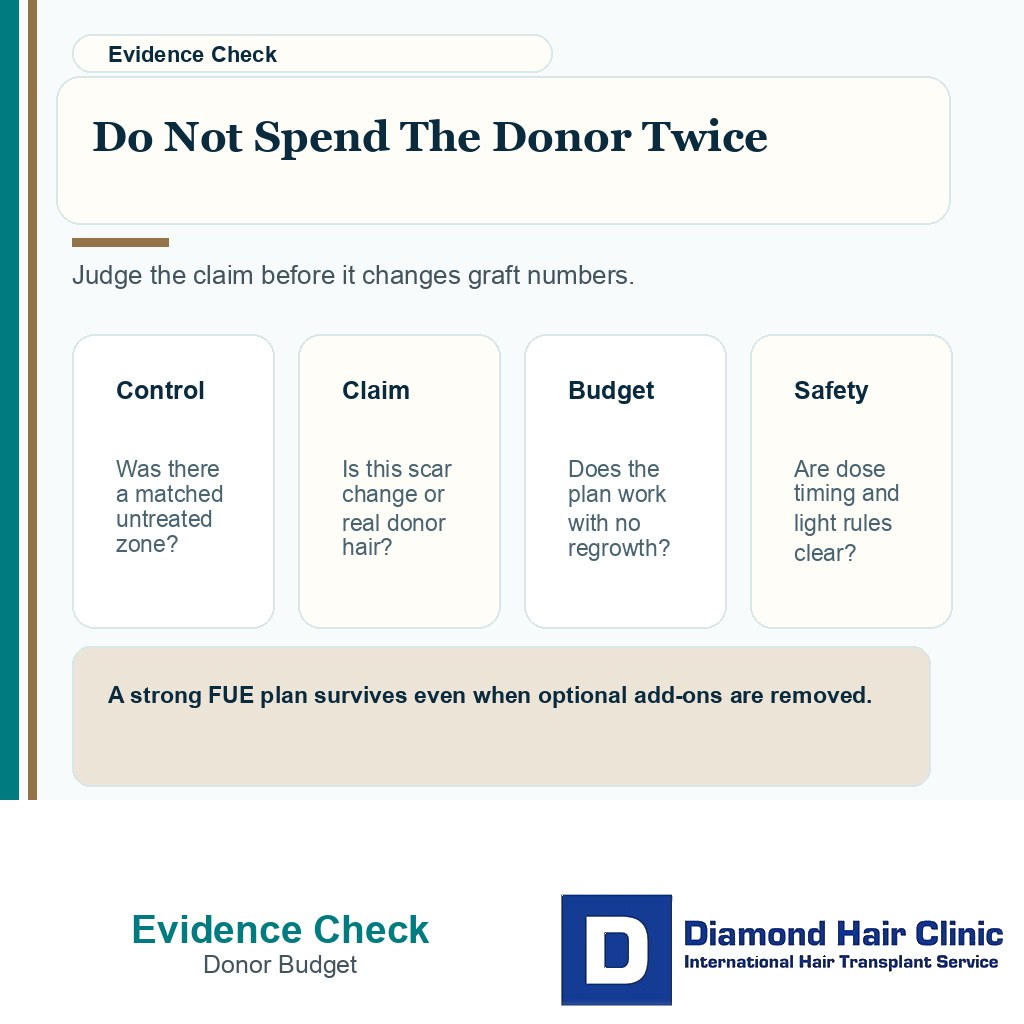
A careful way to read early donor regrowth photos
Early donor photos can be useful, but they can also be misleading when they are read without context. The first question is whether the treated area has a matched control area. The second is whether both areas were photographed with the same lighting, angle, hair length, wetness, magnification, and timing. Small differences in these factors can make skin texture and hair count look better or worse.
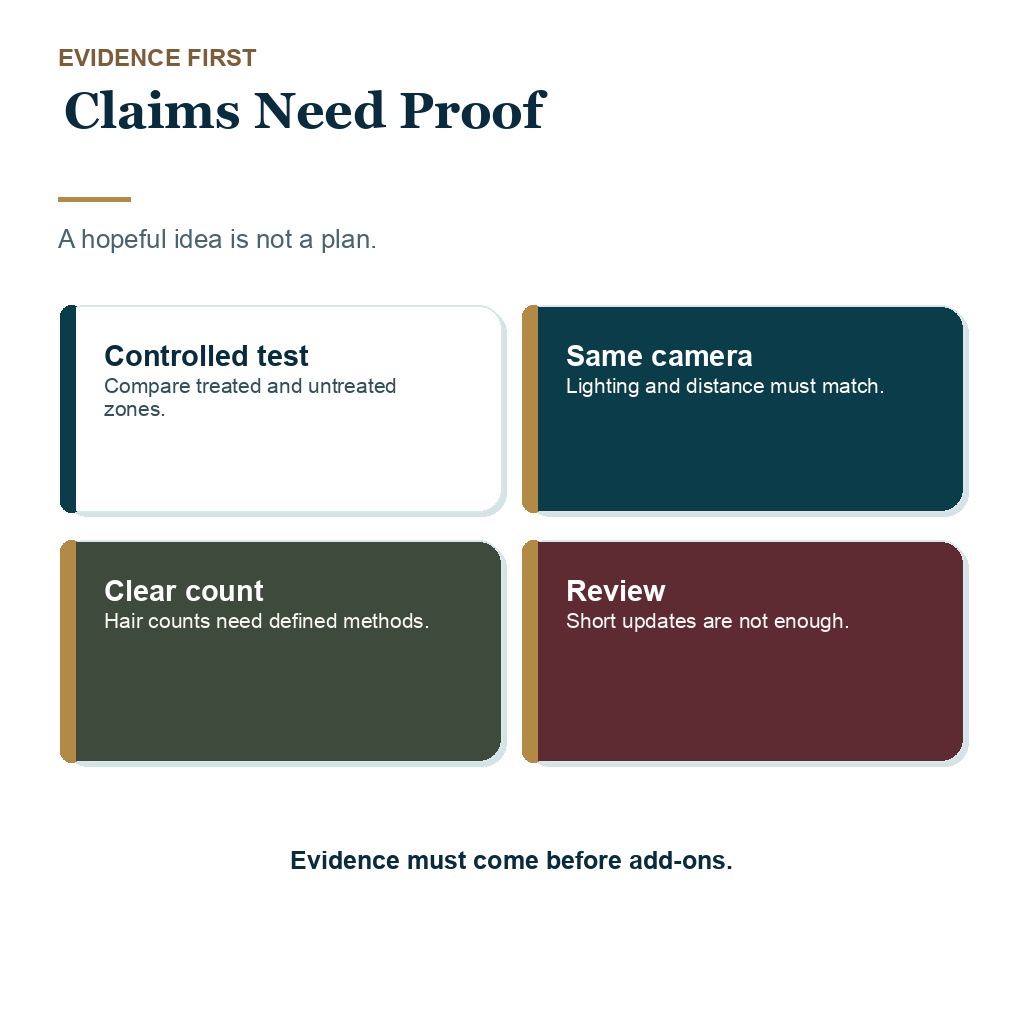
The third question is whether the outcome is measured or only visually described. A close image can be persuasive, but it is not the same as density measurement, repeated follow-up, and clear documentation of the starting point. For that reason, I keep the language cautious until the evidence is stronger.
Interest is reasonable. The standard still has to be strict. If a result is real, careful measurement should support it. If the result is not yet proven, the donor plan should still follow standard donor safety rules, including spacing, safe zone mapping, and realistic expectations about FUE punch size and donor scarring.
Donor Regrowth Evidence Filter
Proof a verteporfin claim should show
Use this when a clinic, video, or discussion makes verteporfin sound like a solved donor regrowth method. The question is not whether the idea is interesting. It is whether the evidence is strong enough to change a surgical donor plan.
A claim needs a fair comparison
A strong claim needs a treated zone and an untreated control zone planned before surgery, not selected afterward because one photo looked better. Lighting, angle, hair length, wetness, magnification, punch spacing, and follow-up timing should be close enough that the comparison is not just a camera effect.
Scar improvement is not donor regrowth
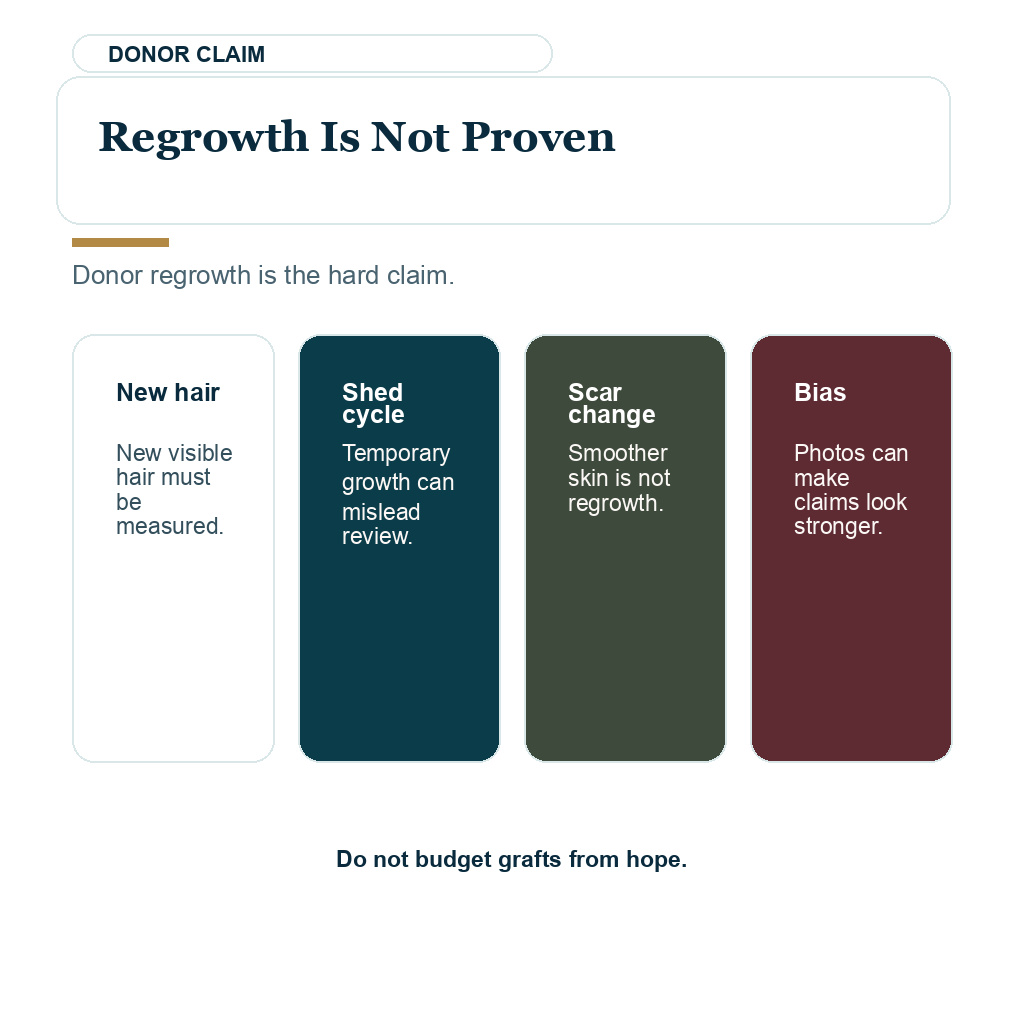
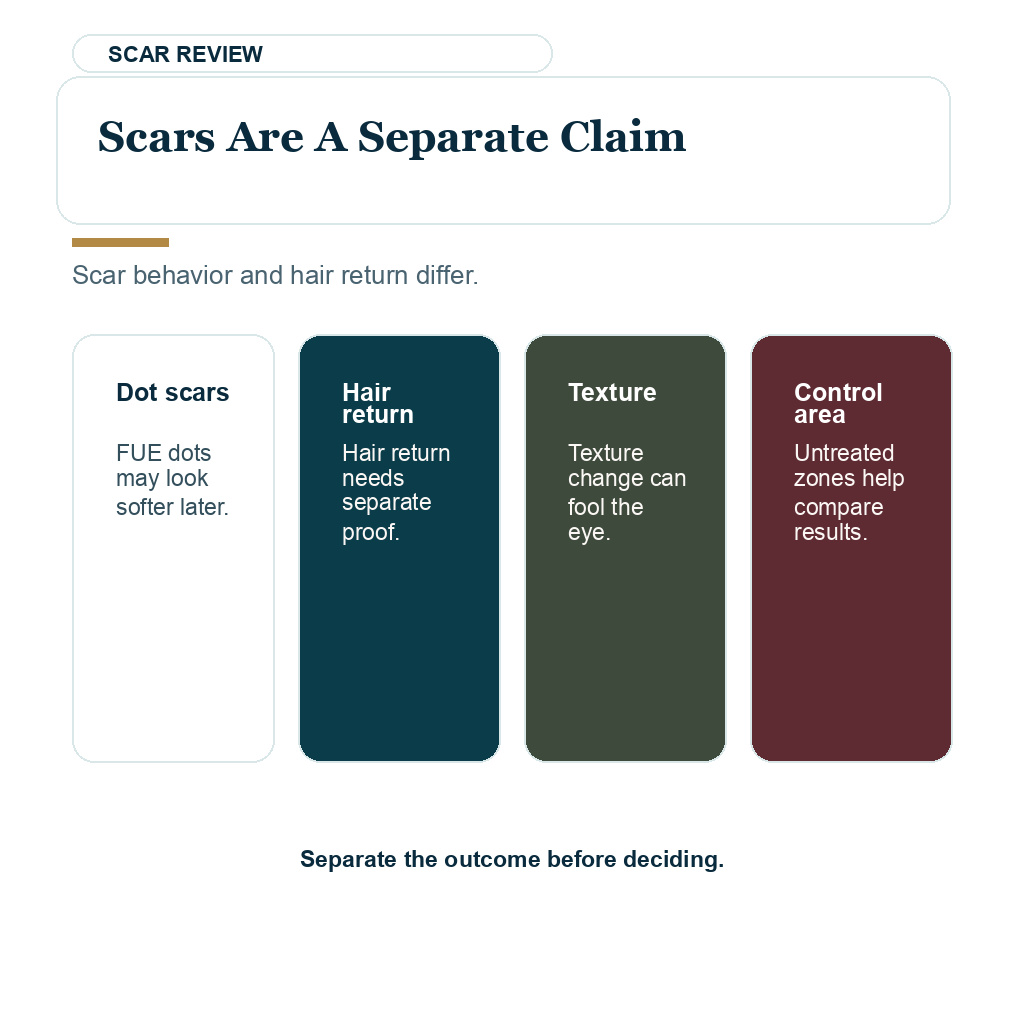
Smoother skin, less visible dot scarring, or better texture may still matter, but those are not the same as cosmetically useful donor hair returning. Ask whether the result measured hair count, caliber, density, and stability over time, not only whether the donor skin looked improved.
The donor budget must work without verteporfin
If a low hairline, high graft count, or crown plan only makes sense when verteporfin works perfectly, the design is too dependent on an unproven assumption. The donor plan should still protect reserve, future hair loss, and repair options if no usable donor regrowth appears.
Research interest still needs medical boundaries
Verteporfin is a real medicine with safety, timing, consent, aftercare, and precautions around light exposure. It should not be sold like a simple scarless extra. Before building a hair transplant around it, confirm who is monitoring the protocol, what is being measured, and what happens if healing, photos, or donor density do not improve.
If one of these proof points is missing, do not spend the donor area twice. Treat verteporfin as a research question, not as a replacement for conservative donor management.
Unsafe scarless FUE claims
The phrase scarless FUE is already easy to misuse. Standard FUE does not create a long strip scar, but it still creates thousands of small extraction wounds. With good planning, those dots are usually well hidden by surrounding hair. With poor planning, they can become visible, especially when too many grafts are removed or the patient keeps very short hair.
Adding verteporfin language to a weak plan can make the message more dangerous. If a clinic says there will be no scars, no donor loss, or unlimited future grafts, that is not a careful medical explanation. It is a sales claim. You need a clear answer on how many grafts are safe without verteporfin, how the donor will be protected, and what the repair options would be if the result is thinner than expected.
A claim tied to a very high graft count, a low aggressive hairline, or pressure to book quickly should make you slow down. A new optional extra cannot replace the clinical checks that matter before booking a hair transplant.
Checks before building a plan around it
If you are offered verteporfin as part of FUE, confirm what role it plays. Is it part of a registered study, a protocol run by a physician, an extra outside its approved use, a small test zone, or a clinic plan for the whole donor area? Those are different situations. The consent process should explain what is known, what is unknown, what light precautions or other aftercare rules apply, and what the clinic will measure afterward.
This should not be improvised on surgery day, brought by the patient, or added because another case sounded promising. The medical team should own the protocol, storage, dose, consent, and follow-up, or it should not be part of the operation.
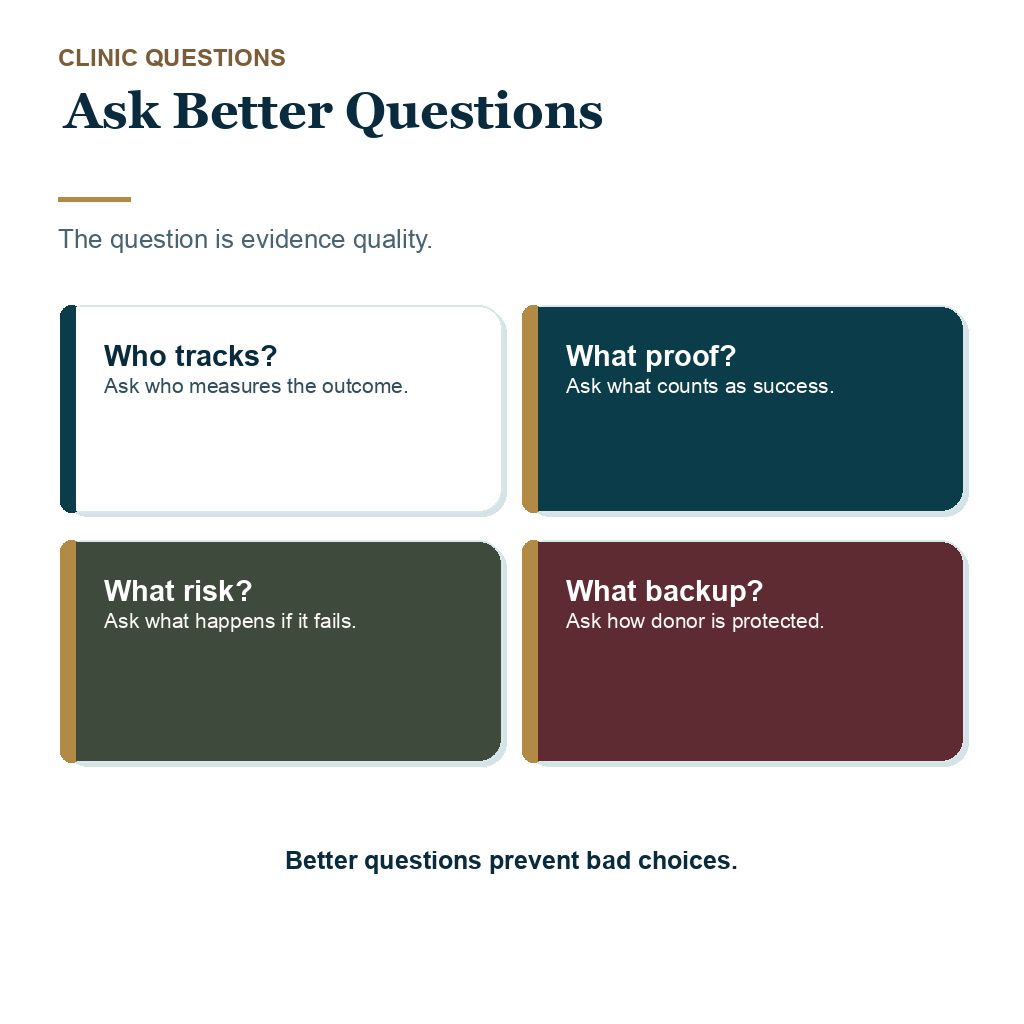
Ask whether the clinic will show test and control areas, whether they will measure density, and whether the follow-up will continue long enough to judge the result. Confirm how photos will be standardized. Confirm what happens if there is no useful regrowth. Ask whether the clinic will still keep graft numbers disciplined.
Most importantly, ask whether the main surgical plan stands on its own. If the answer is yes, verteporfin becomes an experimental support question. If the answer is no, the surgical risk is being taken to chase a claim that has not yet become reliable.
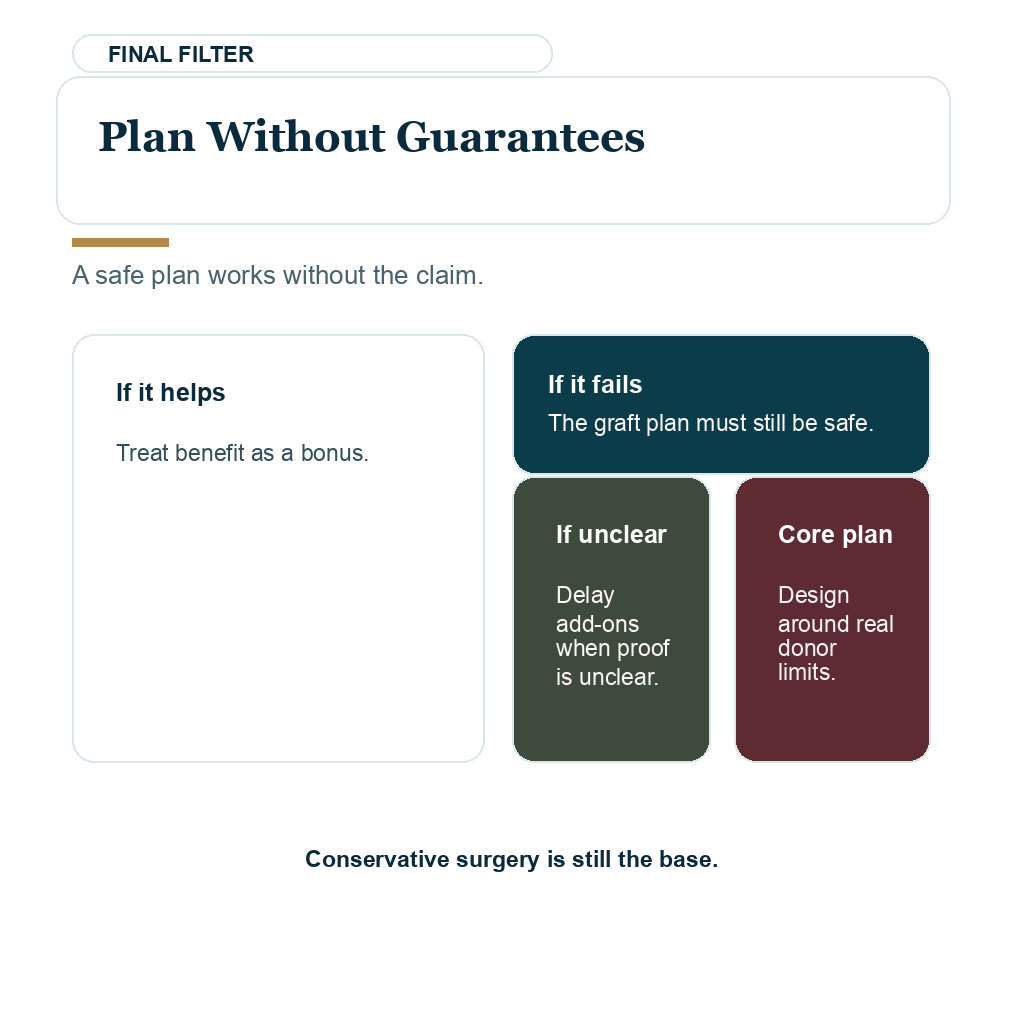
The eight slides below are an evidence filter, not proof of donor regrowth. They separate research claims, donor regrowth proof, scar effects, donor budgeting, safety context, unsettled protocols, measurement quality, and planning without guarantees, so the plan is judged by current evidence rather than excitement around a possible future use.
How do I keep the plan independent from verteporfin?
If a patient asks me about verteporfin, I do not dismiss the question. I explain where the idea comes from, why the topic is attractive, and why the plan still has to work as surgery. The hairline should be designed for the patient in front of us, not for a future technology that may or may not become standard.
That means the donor estimate stays cautious. The crown is not overfilled if the donor cannot support it. The hairline is not pushed too low because an optional extra might reduce donor damage. If the patient has a weak donor area, weak donor area hair transplant planning should be part of the decision before any optional drug is discussed.
I also keep the medication discussion separate from the surgical promise. Verteporfin is not a hair loss stabilizer like finasteride or minoxidil. It does not answer whether native hair will continue thinning. It does not replace diagnosis, donor mapping, or long-term planning. It may become important, but it should earn that place through evidence.
Before booking, keep the plan grounded
Before booking, treat verteporfin as a claim to evaluate, not as a guaranteed advantage. A clinic that is serious about it should be able to discuss uncertainty without making the patient feel foolish for asking. It should also be able to explain the plan if the drug adds no benefit.
With a strong surgical plan already in place, new research can be followed without changing the graft budget. If the plan only sounds good because verteporfin is expected to create donor hair or erase scars, I slow down. Hair transplant planning should protect you even when every optional extra is removed from the conversation.
The final question is not whether verteporfin is exciting. It is whether your current plan respects your donor area today. That is the standard I use before trusting any promise about donor regrowth, scarless FUE, or future repair capacity.
When does waiting for stronger evidence make sense?
Waiting can be reasonable if your current plan is borderline and you would only feel comfortable if donor regeneration becomes proven. If your donor is strong and the design is conservative, the decision should still be based on current surgical planning rather than a future optional extra.
I do not count verteporfin donor regrowth in the graft budget today. A few encouraging observations are not the same as repeatable controlled evidence, and smoother donor healing is not the same as cosmetically useful hair returning.
A high range or split session quote should still stand without verteporfin. Even when a patient follows the research with interest, the safe graft range has to be chosen as if the donor supply is finite.
Verteporfin is also not the same as broad stem cell marketing. It is a specific medicine being discussed through wound healing and donor area research, but the evidence standard is similar. Patients need proof before trusting any optional extra, and I ask for comparable proof with stem cell claims in hair transplant.
A hair transplant plan is not ready if it only feels safe because verteporfin might create new donor hair. The donor area should be protected using what is proven now.

Read this review excerpt
told me the quality of my donor hair and what he could take out and advised me what will the be best outcome with what donor hair I had.