


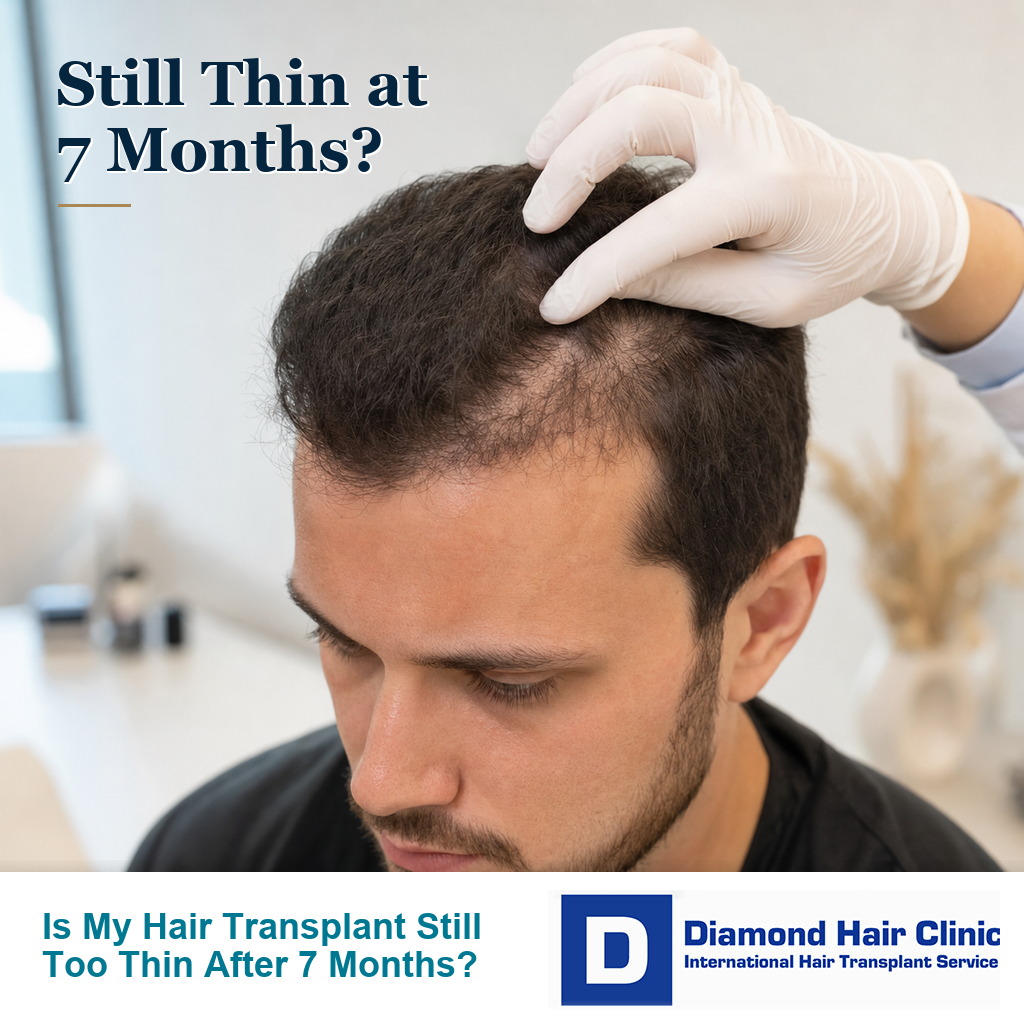
Thin Growth at 7 Months Needs Careful Review
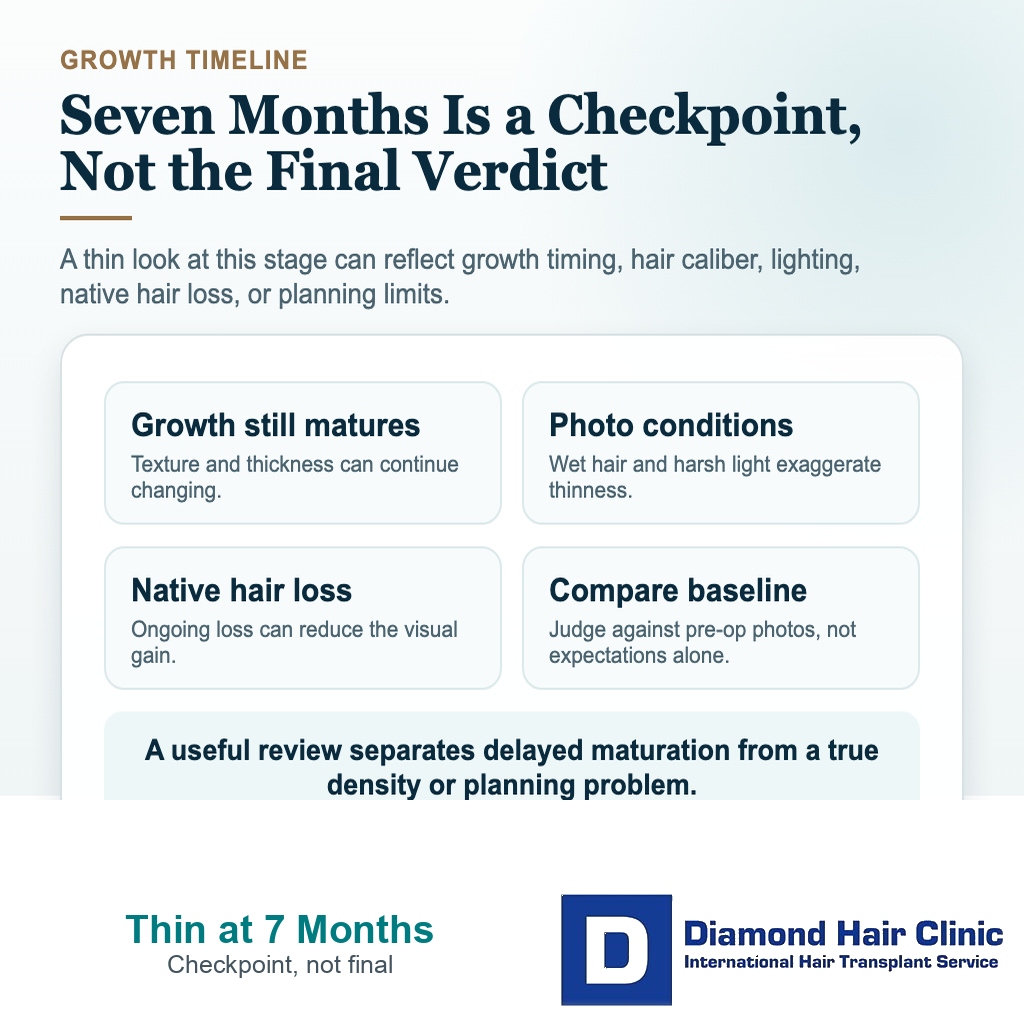
Around seven months after a hair transplant, a thin result does not mean the transplant has failed. It can still improve, especially when the crown was treated, the hair is fine, or the new hairs are present but still short and soft. But this is also late enough to look at the pattern more carefully.
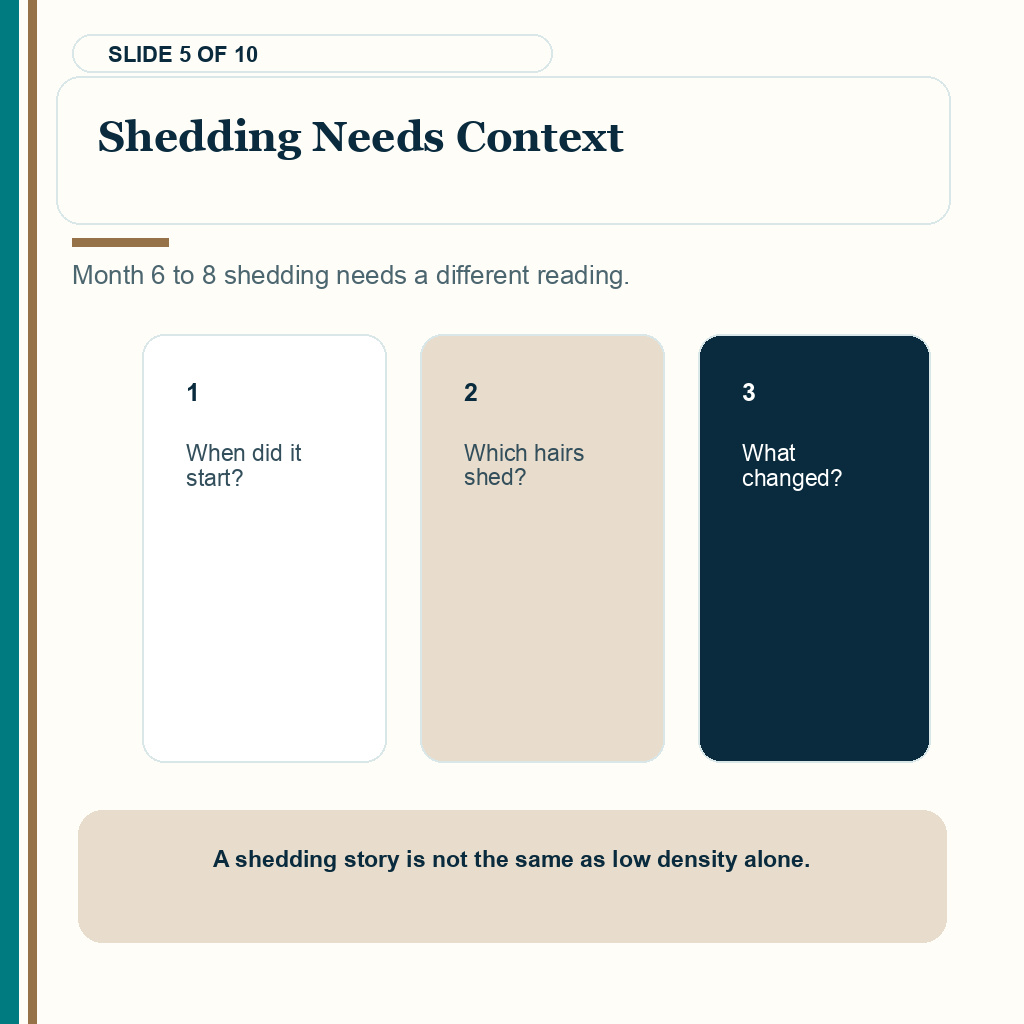
If the concern is new hair fall rather than thin coverage alone, I read it as a month 6 to 8 shedding pattern before judging density. The practical distinction is simple. Thin but improving hair needs patience and documentation. No visible progress, unhealthy scalp signs, or a pattern that does not match the surgical plan needs a structured review.
An apparent setback after visible growth needs the same sorting. I want to know whether hairs are actually falling, whether short fine hairs are simply not giving coverage yet, and whether the surrounding native hair is weakening behind the grafted zone.
For a setback that feels sudden, compare the best recent week with the current week under the same styling routine.
By the time a patient is around seven months, I want more than one close photo. I check steady change, scalp health, whether the transplanted zone matches the original plan, and whether native hair loss is making the result look thinner than expected.
One harsh light photo can make a developing result look worse than it is. The opposite mistake is accepting vague reassurance when the area has shown no real movement for months. A careful comb through video can help, but only when it is compared with earlier photos in similar lighting. When photos disagree, match the hair length and parting first, because exposure can change before true density changes. Compare the hair dry, at the same length, and under the same light before judging density.
If the anxiety began before the six month review, I do not let the first frightening photo set the whole story. A later review should look for whether the same zone is shrinking, staying static, or widening under matched conditions.
Patchy areas deserve the same comparison rules as the rest of the result. Mark whether the gap is shrinking, staying identical, or widening before turning a seven month photo into a revision decision.
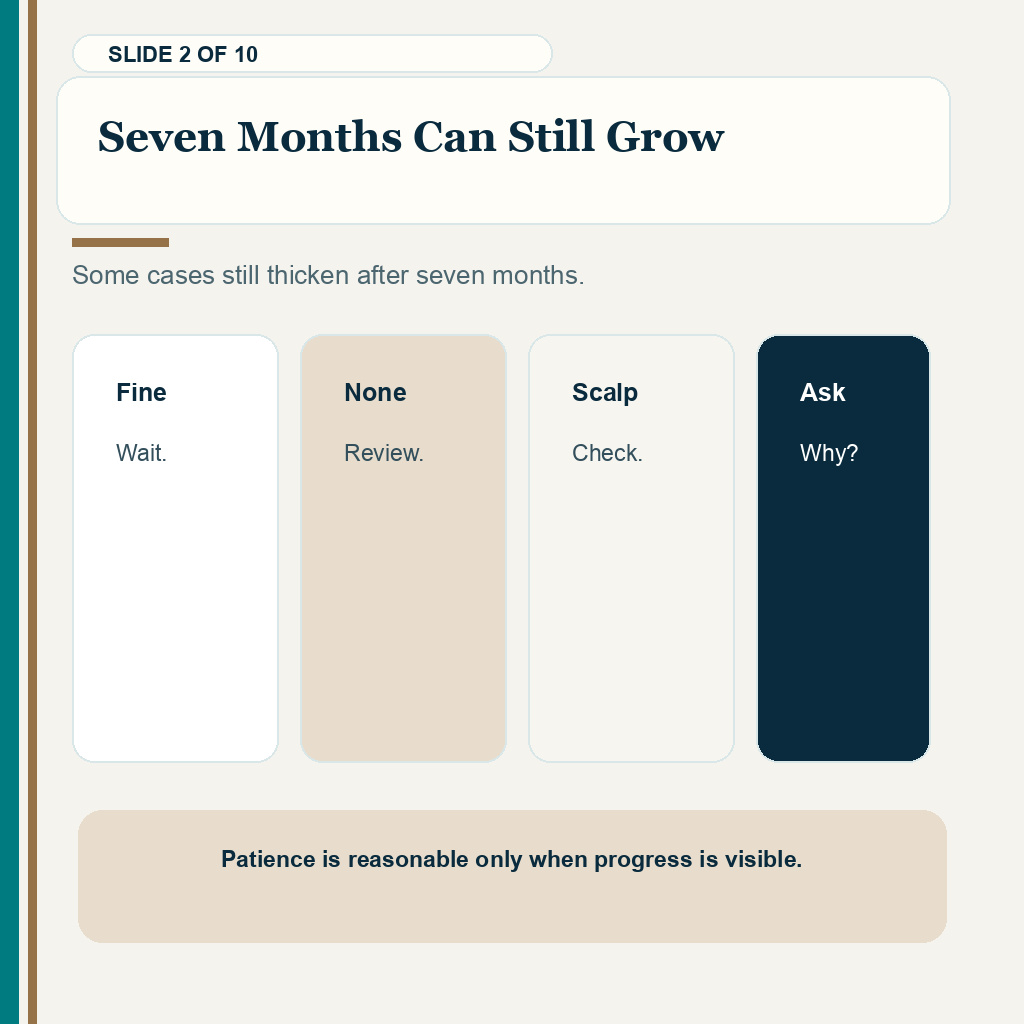
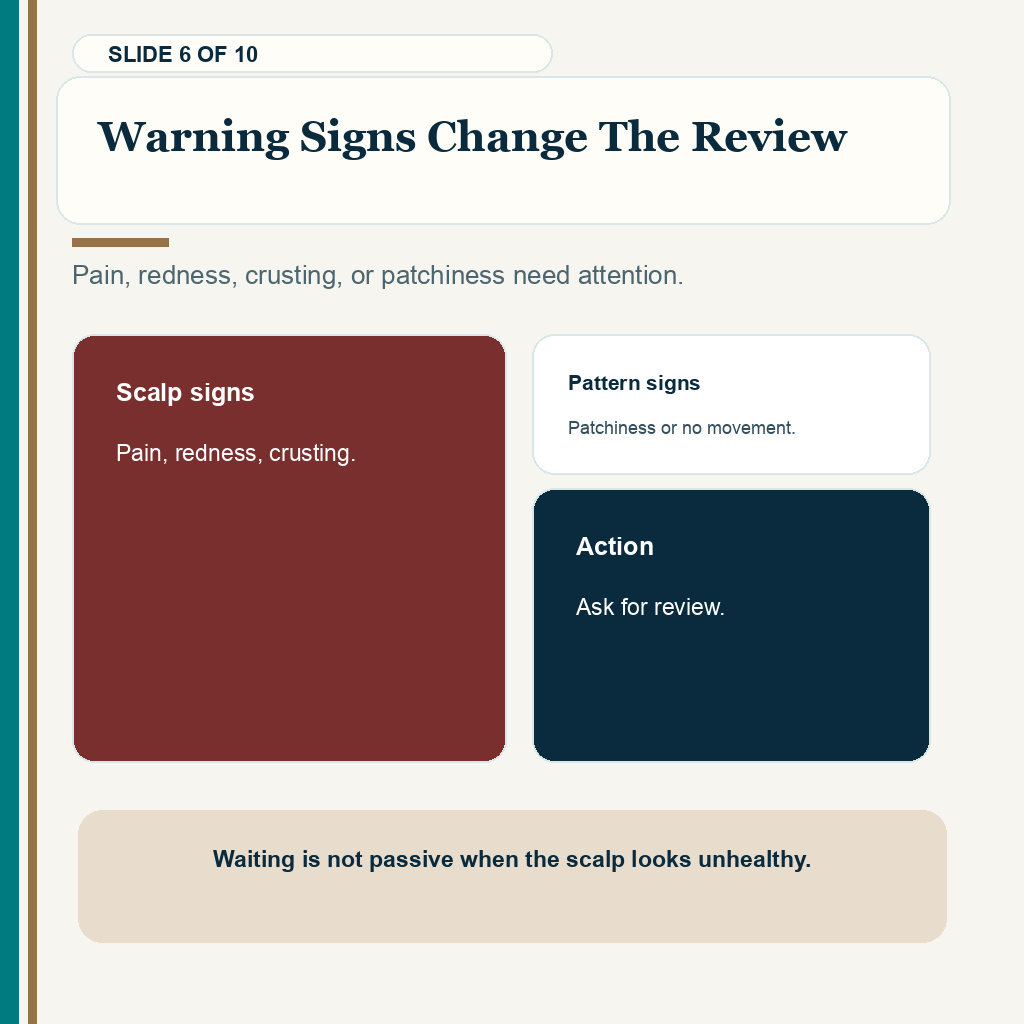
If there is visible progress, fine new hairs, and a settled scalp, waiting is often reasonable. If there is no visible progress, increasing patchiness, pain, redness, crusting, or a pattern that looks wrong compared with the surgical plan, I do not treat waiting as the whole answer.
A thin result around seven months does not always mean failure
A thin result at this stage often means the transplant is still maturing. It can also reveal an underpowered plan, slow growth, crown delay, ongoing native hair loss, or poor graft survival. The month number alone does not diagnose the case. When the first operation used about 3,000 to 3,500 grafts over a broad bald area, I also compare the result with the zones those grafts were actually meant to cover, not with an imagined full density result over the whole top.
I separate three questions. Are transplanted hairs actually growing but still fine and see through? Is the area improving compared with months four, five, and six? Is the thin look coming from the transplanted zone, the surrounding native hair, or the crown where growth can be slower? The month 6 density check is the record that makes that comparison cleaner. A useful earlier step is learning how to read fine new hairs after FUE before the review becomes a full density judgment.
A month five hair growth check can make that comparison cleaner before this point, especially when the worry is slow but visible movement rather than a completely silent area.
A result around seven months should not be judged only by density. I compare it with the original graft placement, hairline design, crown plan, donor capacity, hair caliber, and your photos over time. A result that looks thin but is steadily improving is different from a result that has shown almost no change for several months. If the worry is no longer only thinness but whether the front looks natural, a month eight hairline check gives the review a clearer structure.
For someone checking too often, a monthly photo set is more useful than daily mirror checks.
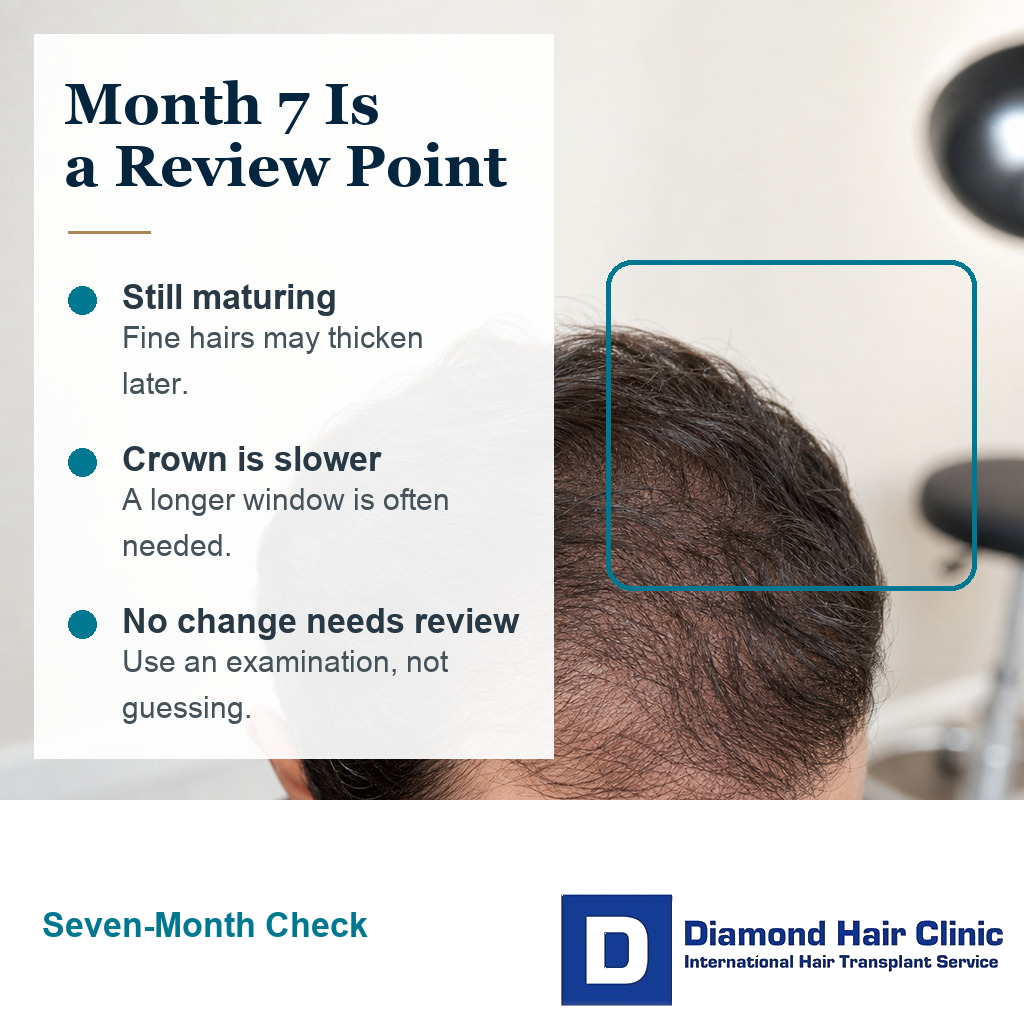
A result around seven months can still be unfinished
Around seven months, the result is still not final because transplanted hair does not only appear. It changes caliber, length, texture, and visual coverage over time. You may see growth, but the hairs can still be fine, wiry, uneven, or too short to create the final illusion of density. A later one year FUE result review should then separate normal maturation from a real density or design problem.
The front is often easier to judge earlier than the crown. Even then, I usually need to see how the hair behaves closer to 9 to 12 months before making a strong judgment about density. In slower cases, especially in the crown, the more mature picture may take closer to 15 to 18 months.
Some poor results will not become good simply because time passes. This stage should be interpreted with evidence. Direction of change matters. More small hairs, better coverage in similar lighting, and improving texture are good signs. No change at all, worsening scalp symptoms, or a clear mismatch between the implanted area and the plan needs review.
The wider density issue is why some hair transplant results look thin. This rounded stage is one checkpoint inside that bigger judgment.
Some signs are reassuring around seven months
The most reassuring sign is not perfect density. It is clear movement in the right direction. Useful signs include new hairs breaking through, older new hairs getting darker or thicker, and the treated area looking better in the same lighting than it did a few months earlier.
Fine, soft hairs in the same thin area are different from a smooth looking gap where I cannot see new shafts at all. Both can worry you, but they do not mean the same thing clinically.
A settled scalp is also reassuring. Mild sensitivity can still happen, but the recipient area should not look angry, crusted, infected, or persistently inflamed. A healthy scalp with slow improvement is a different situation from a thin result with redness, pain, repeated pimples, or crusting.
Hair length matters more than many people realize. A new hair that is only a few centimeters long cannot cover the scalp the same way a mature, longer hair can. If the hair is short, soft, and still changing, I avoid making a final density judgment too early.
Months 6 to 8 are different from early growth
Four months is often too early for density judgment. Some people are only beginning to see growth then. Around months 6 to 8, I still allow room for maturation, but I expect the case to give me more information than it did at month four.
If the area was very thin at month four but now has many new fine hairs, the direction is encouraging. If months four, five, six, and seven all look almost identical, that is not proof of failure, but the details deserve a more careful review.
Location matters as well. A frontal hairline with almost no visible growth around seven months is a different concern from a crown that is slowly thickening but still see through. Hair characteristics matter too. Fine straight hair can look weaker under light than thicker, wavier hair with the same graft count.
A low density month four picture carries a different meaning than a picture taken around seven months. The earlier stage is often still about early growth. This stage deserves a firmer review, but still not a rushed verdict.
The crown often looks thin for longer
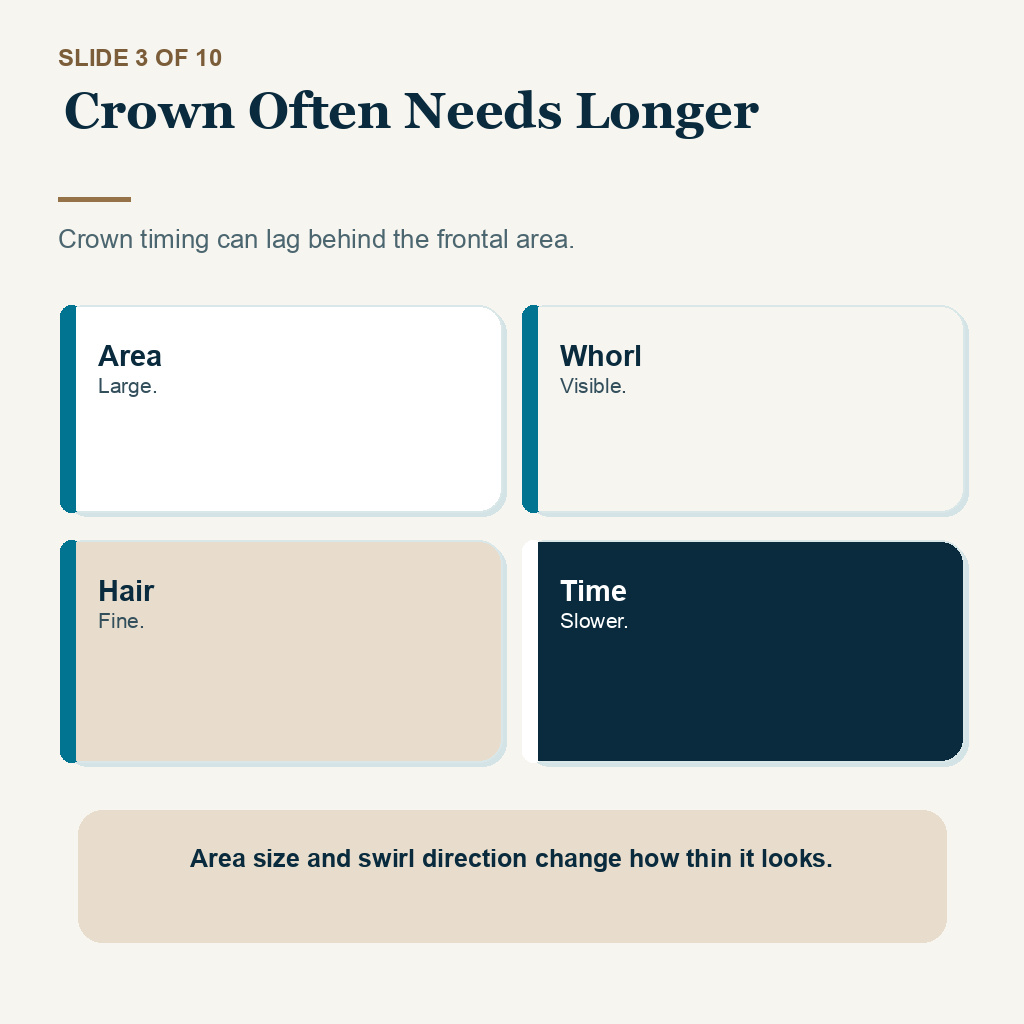
The crown can look thin for longer because it is a difficult area to cover. Hair direction rotates, the scalp is viewed from above, and light reflects directly onto the area. Even a technically good crown transplant can look less dense than expected around this stage.
The crown also consumes many grafts if complete coverage is expected. I have to think about the future, not only the photograph at one stage of recovery. If hair loss is still progressing, filling the crown aggressively too early can spend donor grafts that may be needed later for more visible areas.
Around month seven, a crown review has to consider the whorl direction, graft distribution, hair caliber, the untreated surrounding crown, and whether the patient had enough grafts for the area treated. Sometimes the transplant is still maturing. Sometimes the original crown plan was too ambitious for the donor budget.
If the crown is the main worry, the limits of crown hair transplant planning matter because clinics can easily oversimplify this area.
Native hair loss can make the transplant look worse
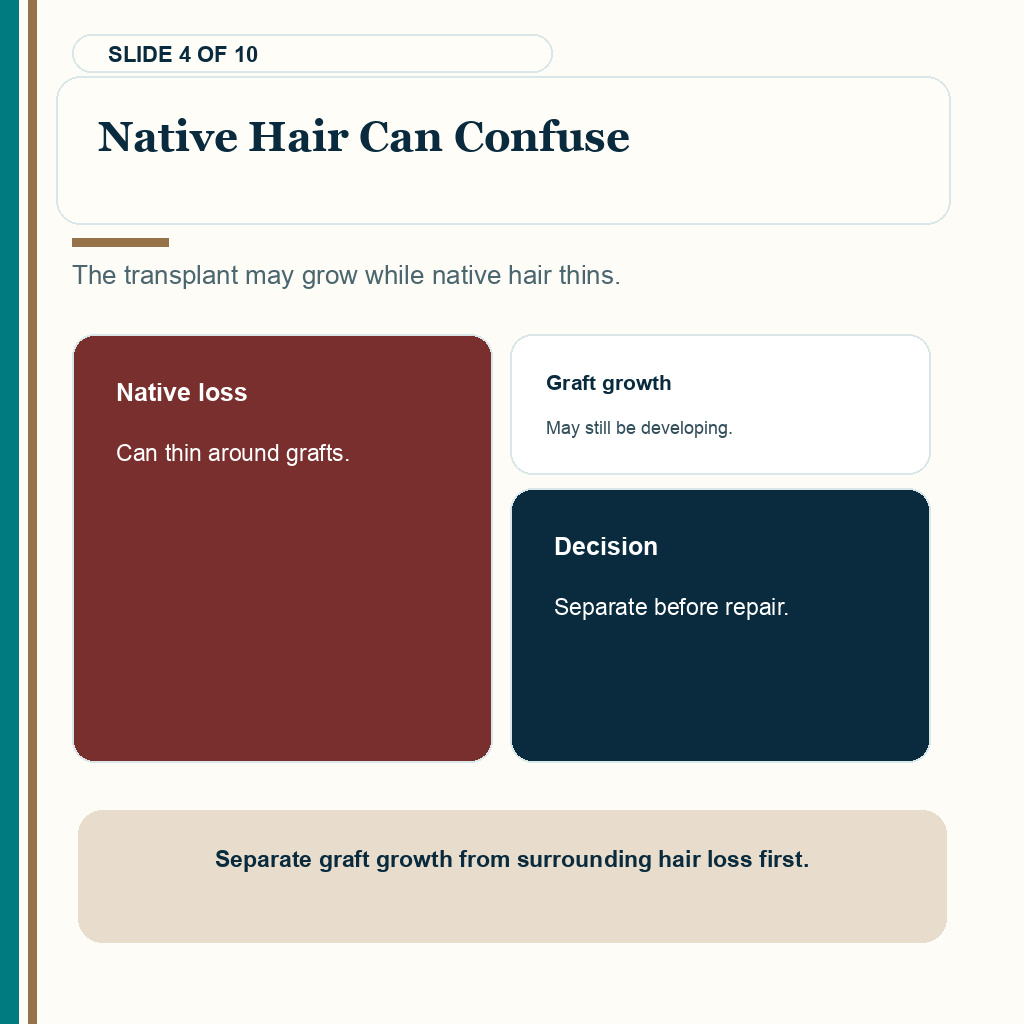
A transplant can be growing while the surrounding native hair is thinning. When that happens, it can feel as if the transplant failed, but the real issue is a mixed picture. Some implanted hairs are maturing while native hair around them is losing density.
This is common when surgery was done while hair loss was still active. It can also happen if medication was stopped, changed, or never used in someone with ongoing androgenetic hair loss. The transplanted area and the native hair do not always behave the same way.
Shock loss can also confuse the picture earlier in recovery. Temporary native hair shedding usually appears earlier than month 7, but if native hair has not recovered as expected, the result may still look thin. The separate discussion on native hair shock loss after a hair transplant is useful when the thinning seems to involve existing hair, not only grafts.
The long term issue is that hair loss can continue after a hair transplant. That distinction can protect you from blaming the wrong cause.
No shedding changes how I read the result
No shedding by itself does not tell me that the result will be better or worse. Some people shed most transplanted hairs in the early weeks. Some shed gradually. Some appear to keep many short hairs and still go through a quiet growth phase afterward.
Around seven months, I focus less on whether there was a classic shedding phase and more on what the scalp is doing now. Are new hairs visible? Is the density improving? Are the hairs gaining length and caliber? Is the scalp healthy? These questions matter more than the exact shedding story.
Many people panic because their recovery did not match the timeline they saw online. Recovery can vary, so medically plausible progress matters more than one exact timeline.
If shedding was unusual or barely happened, no shedding after a hair transplant still does not decide graft survival by itself.
Thinness around seven months sometimes needs review
Thinness around seven months deserves a review when there is almost no visible progress from earlier months, when the transplanted zone has clear empty areas, when one side behaves very differently without a good reason, or when scalp symptoms continue.
I also review the case if there is pain, persistent redness, pimples, crusting, infection concern, or irritation that does not fit the normal healing stage. A settled scalp with slow improvement is one situation. An unhealthy scalp with no progress is another.
The review should include the original plan, graft count by area, implantation pattern, before surgery photos, day one photos if available, month by month photos, donor assessment, medical treatment history, and current scalp condition. Without those details, reassurance has little value.
At this stage, I am more cautious with crown judgment than with the frontal line. A crown that is slowly improving, showing short new hairs, and looking acceptable dry is different from a crown that has shown no movement in matched photos. Wet hair or overhead light should be recorded, but it should not be the only evidence used for the decision.
Medication changes, stopping minoxidil or finasteride, a new shedding trigger, scalp inflammation, illness, or strong stress during recovery all matter. These details do not excuse a weak surgical result, but they can explain why the visual picture is confusing.
A proper review around this stage is not only a request to wait longer. It decides whether the pattern is still within a normal maturation window.
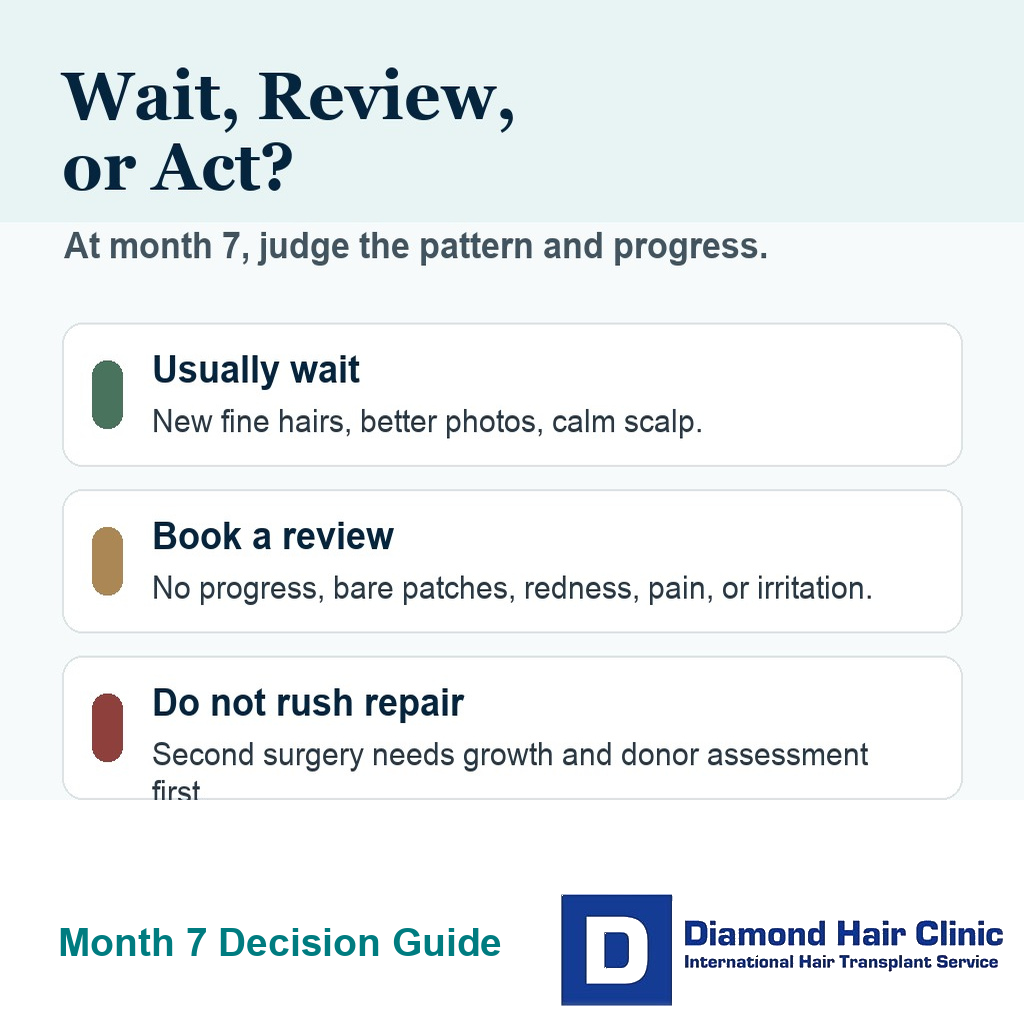
Use the slides to compare timing, photos, warning signs, treatment changes, repair offers, and next steps.
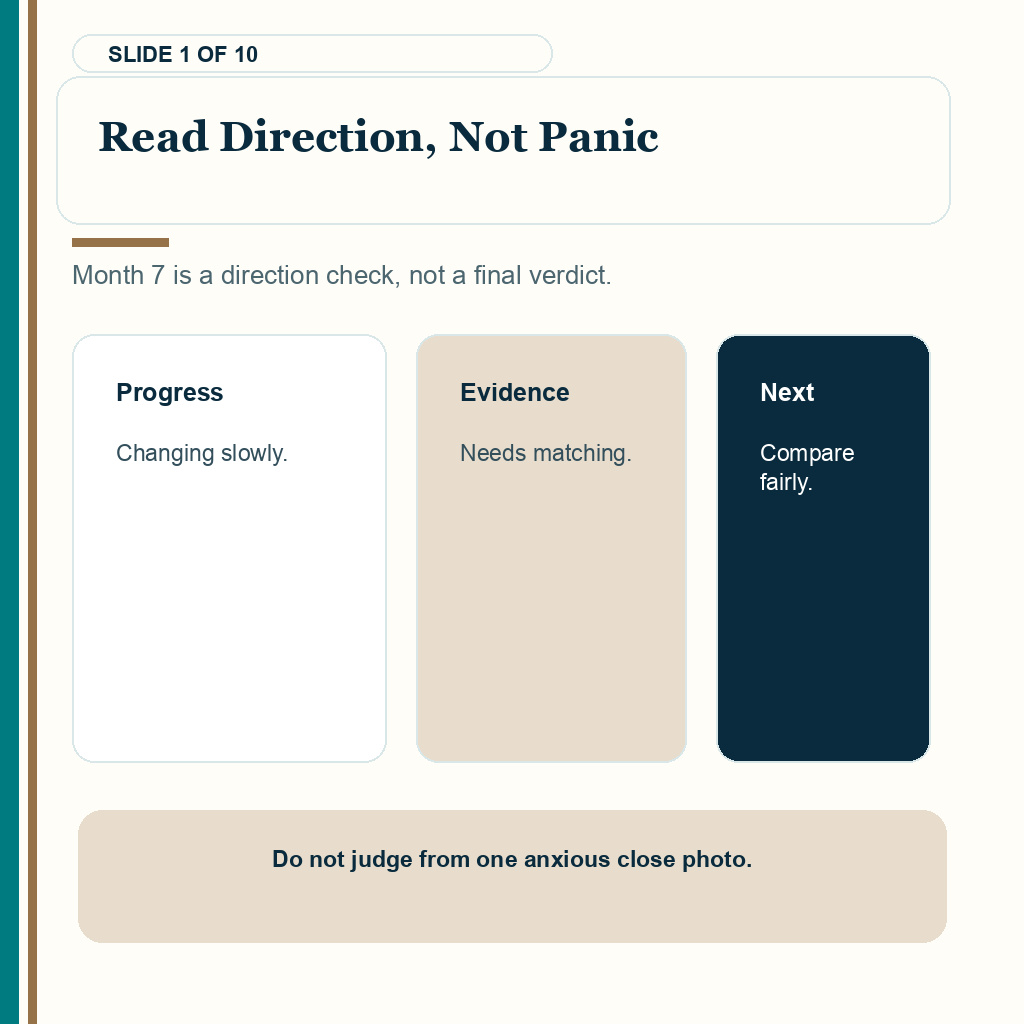

Some treatment changes should wait
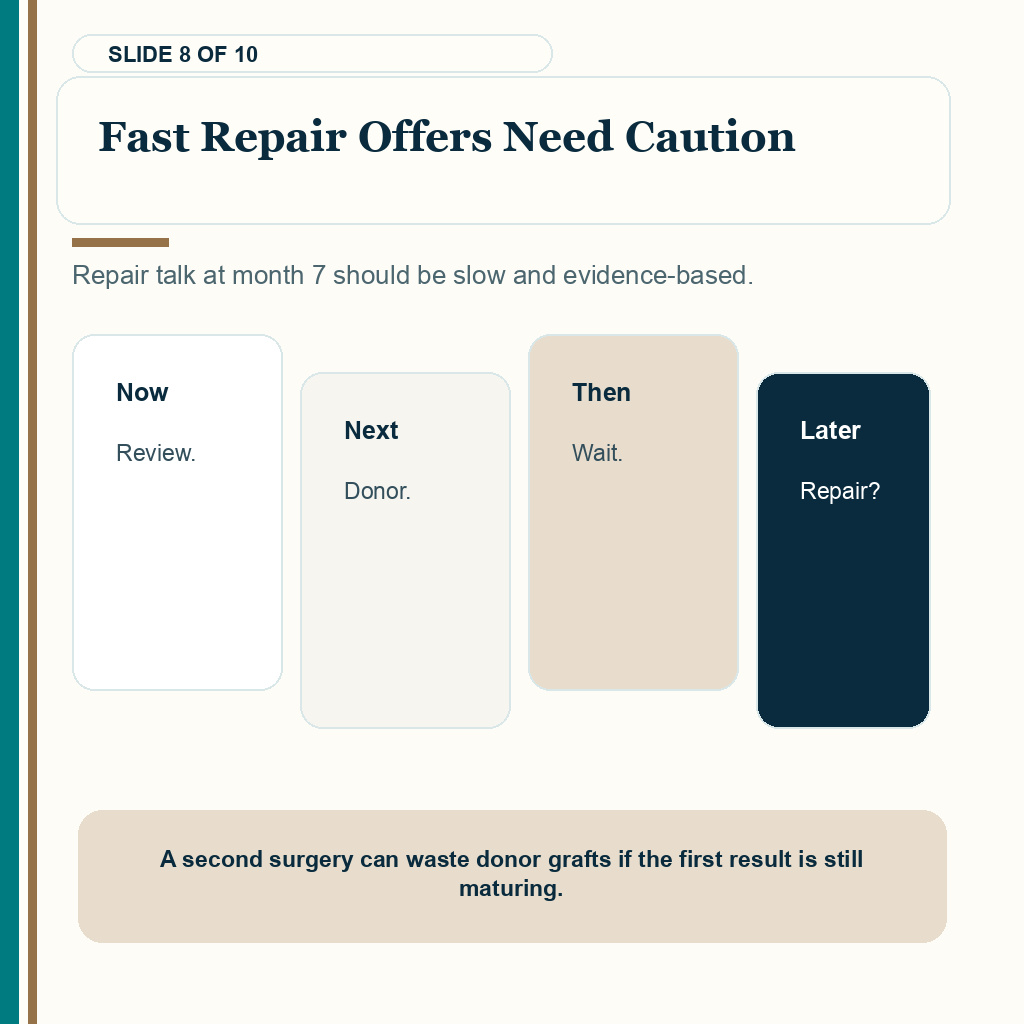
The first thing to avoid is planning repair surgery too early. A second procedure before the first result has matured can waste donor grafts, disturb a developing result, and create a plan based on anxiety rather than evidence.
Avoid changing several treatments at once without medical guidance. If you start, stop, or change minoxidil, finasteride, dutasteride, supplements, PRP, or other treatments all at the same time, it becomes harder to understand what helped, what irritated the scalp, and what caused shedding.
Gentle handling, consistent photos, and clear communication with the surgical team are more useful than panic decisions. If medication is part of the long term plan, the timing and consistency around minoxidil after a hair transplant need a planned discussion instead of panic changes.
If a second operation is being discussed, first ask whether a second hair transplant is worth it from donor safety, timing, and the original plan. A repair or second session should not be planned from frustration alone.
Some clinic promises should be questioned
Around month seven, be careful with any promise that sounds too certain before the case has been examined. A clinic cannot responsibly diagnose a thin result from one photo, one message, or one phrase such as “normal, wait.” It also cannot responsibly promise that repair will fix everything without checking donor capacity and the original plan.
Be especially careful with clinics that use anxiety around seven months to sell a second surgery quickly. When you are worried, pressure can feel like an answer. A better review is slower. It should explain what is still maturing, what may be underperforming, what can be improved later, and what should not be touched yet.
The graft number from the first surgery also needs context. A 4,000 graft operation spread across a large area may look thinner than the same number used in a smaller frontal zone. A crown focused plan may need more patience. A case with ongoing native loss may need medical stabilization before any new surgery is considered.
When I judge whether the original operation made sense, I return to candidacy. Grafts alone never define a safe plan. Keep that in mind with good candidate for a hair transplant.
Only matched photo comparisons are useful
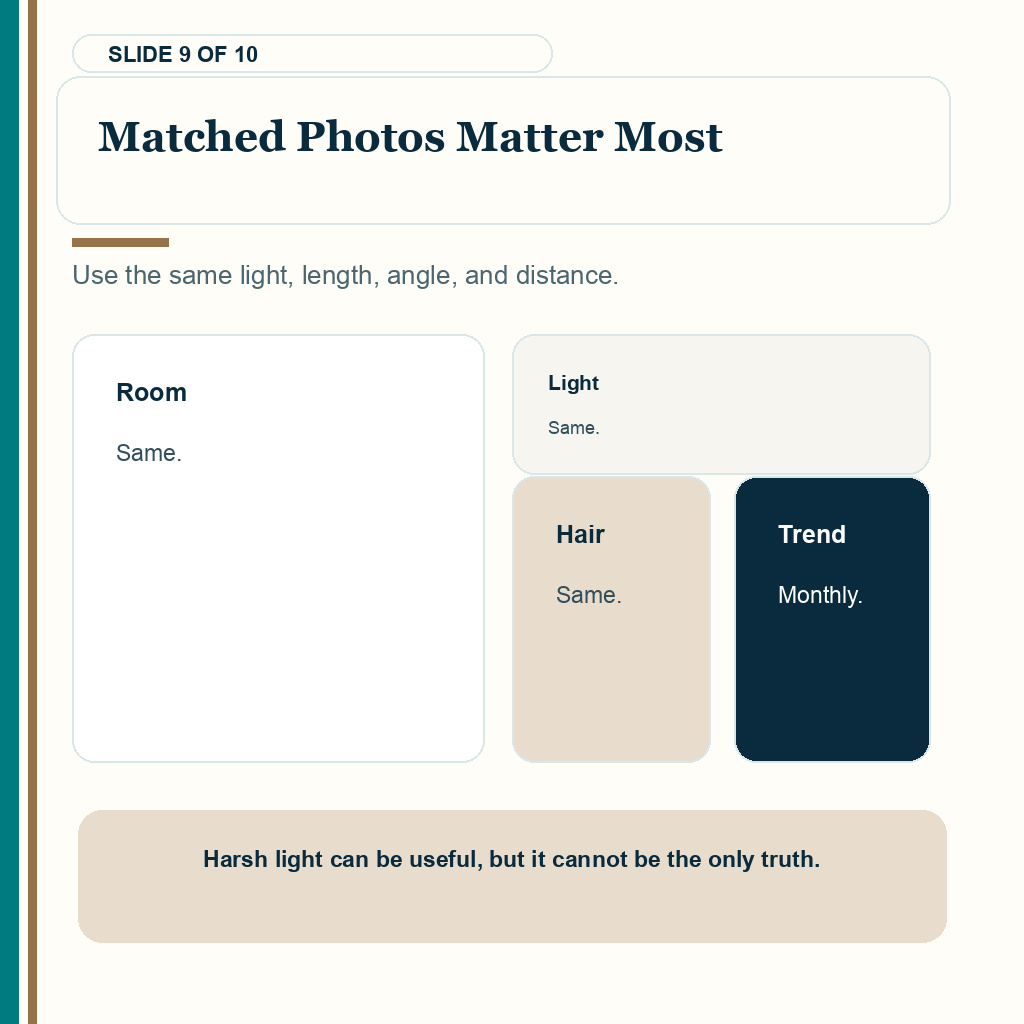
Use the same room, same light, same hair length, same camera distance, and the same angles once a month. Wet hair, harsh bathroom light, overhead flash, and different styling can make the scalp look much thinner than it looks in normal life.
The most useful comparison sets show the front, both temples, mid scalp, crown, donor area, and normal social distance. Close detail photos are useful for detail, but they can exaggerate scalp visibility. You also need to know how the result looks to another person, not only under a phone camera five centimeters from the scalp.
Do not compare your result around seven months with another person’s final result, different graft count, different hair caliber, different hair loss class, or different lighting. That comparison creates anxiety but not medical judgment.
When another patient’s recovery photo starts the anxiety, first test whether the comparison is fair. Online hair transplant photos can help separate timing, lighting, graft plan, hair type, and symptoms before that image influences the decision.
Wet hair, hair pushed apart with fingers, fibers, concealers, and direct overhead light can all make a developing transplant look different from normal life. Clear photos still matter, but the harshest possible photo should not become the only truth. For that reason, I separate normal daily appearance from harsh light and wet hair testing.
Your own case matters more than another patient’s timeline. Month by month progress in the same conditions gives a better answer than scrolling through other people’s best photos.
Around seven months is still a moving picture
Around seven months, density can still be behind the final result. The useful comparison is the same angle, same light, same hair length, and the same treated area, not the most frustrating mirror moment.
Some cases are clearly moving and need more time. Others show poor growth, unhealthy skin, or a pattern that does not fit the original graft plan. Those cases deserve investigation rather than generic reassurance.
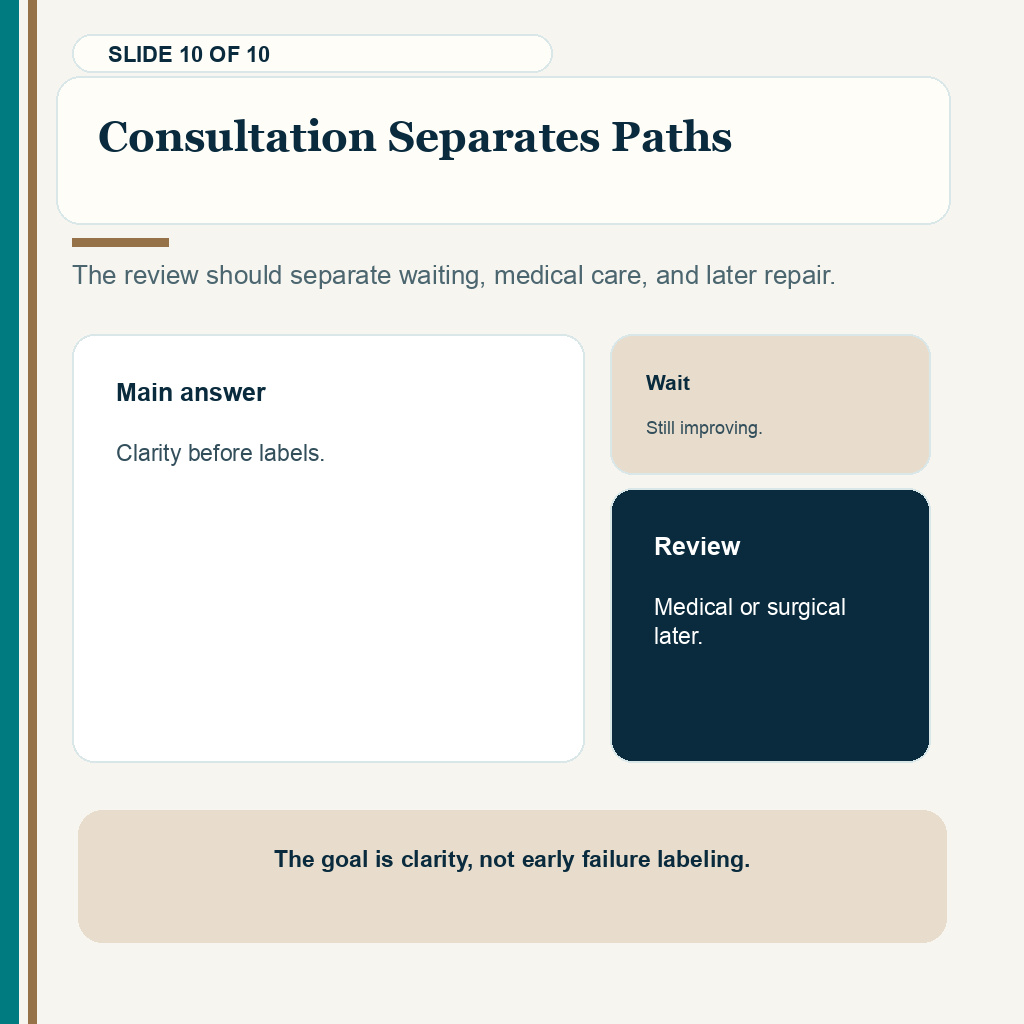
Do not declare failure too early, but do not ignore a silent area. A good review should leave you knowing whether to wait, treat a scalp or medical issue, or keep repair as a later discussion.

Read this review excerpt
Upon arriving home, I sent 4 photos (of each side of head) after every washing process to doctor for checking where I was given personal advice for how to take care of my healing head.