


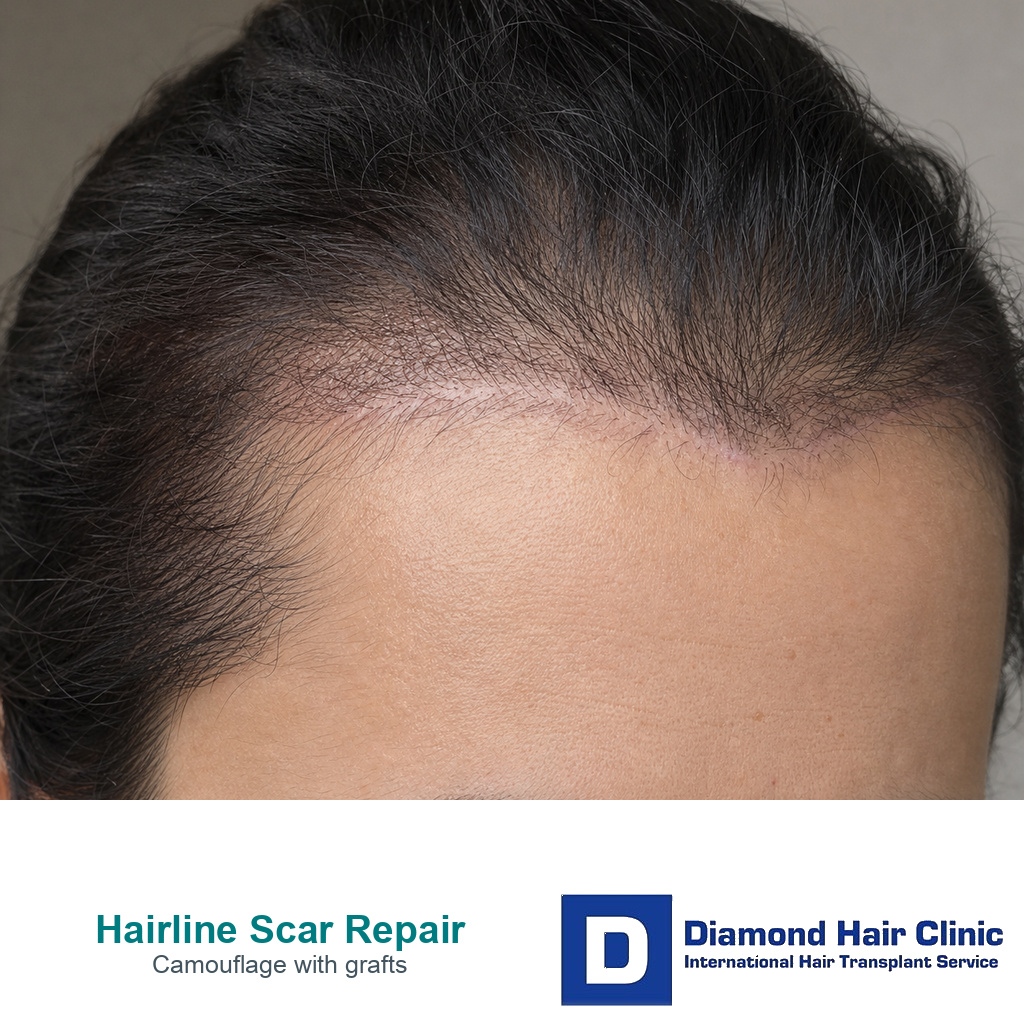
Repairing Hairline Advancement Scars With Transplant Surgery
A hair transplant can sometimes soften or camouflage a scar from surgical hairline advancement, forehead reduction, or a previous forehead shortening procedure. It should not be treated like ordinary hairline lowering. The scar has to be mature, soft enough, well supplied with blood, and positioned in a way that grafts can grow in a natural direction. I usually want the scar to be reviewed after at least 9 to 12 months of healing, and sometimes longer if the tissue is still red, firm, raised, painful, or changing. Scar tissue is less predictable than normal scalp, so the plan often needs fewer grafts at first, lower density expectations, and a staged approach. This is different from a side hairline or sideburn scar after a facelift, where the design sits beside the face and the goal may be side frame repair rather than frontal lowering.
Transplanted hair can sometimes soften a visible forehead reduction scar, but I do not judge it as a simple coverage problem. Scar height, texture, movement, surrounding hair direction, skin tension, hair caliber, donor reserve, and the role of scar revision all shape the plan. Rushing this decision can spend valuable donor hair on tissue that was not ready to receive it.
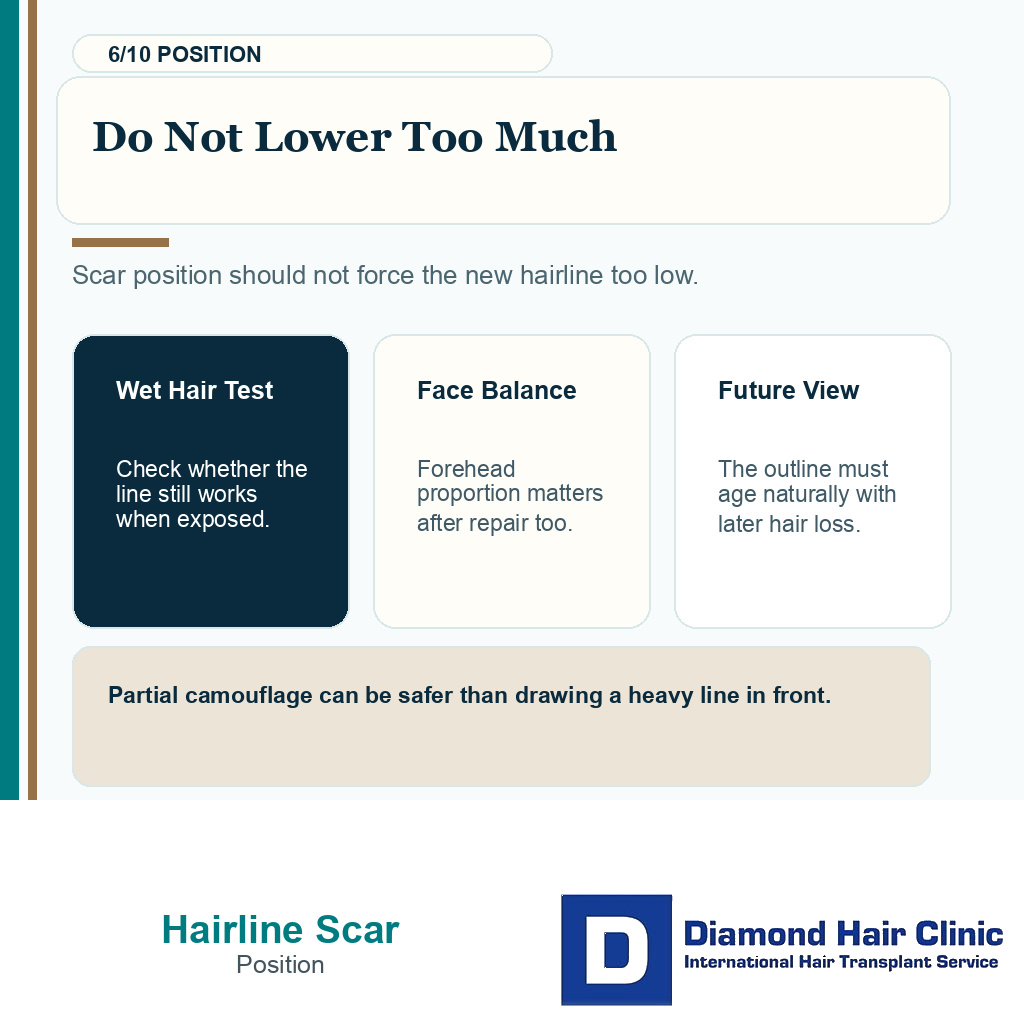
Scar coverage should not pull the whole design lower than the face can carry. I review photos with the forehead relaxed and the hair lifted away from the scar so the first row is judged as a hairline, not only as camouflage.
Scar repair differs from lowering a naturally high forehead
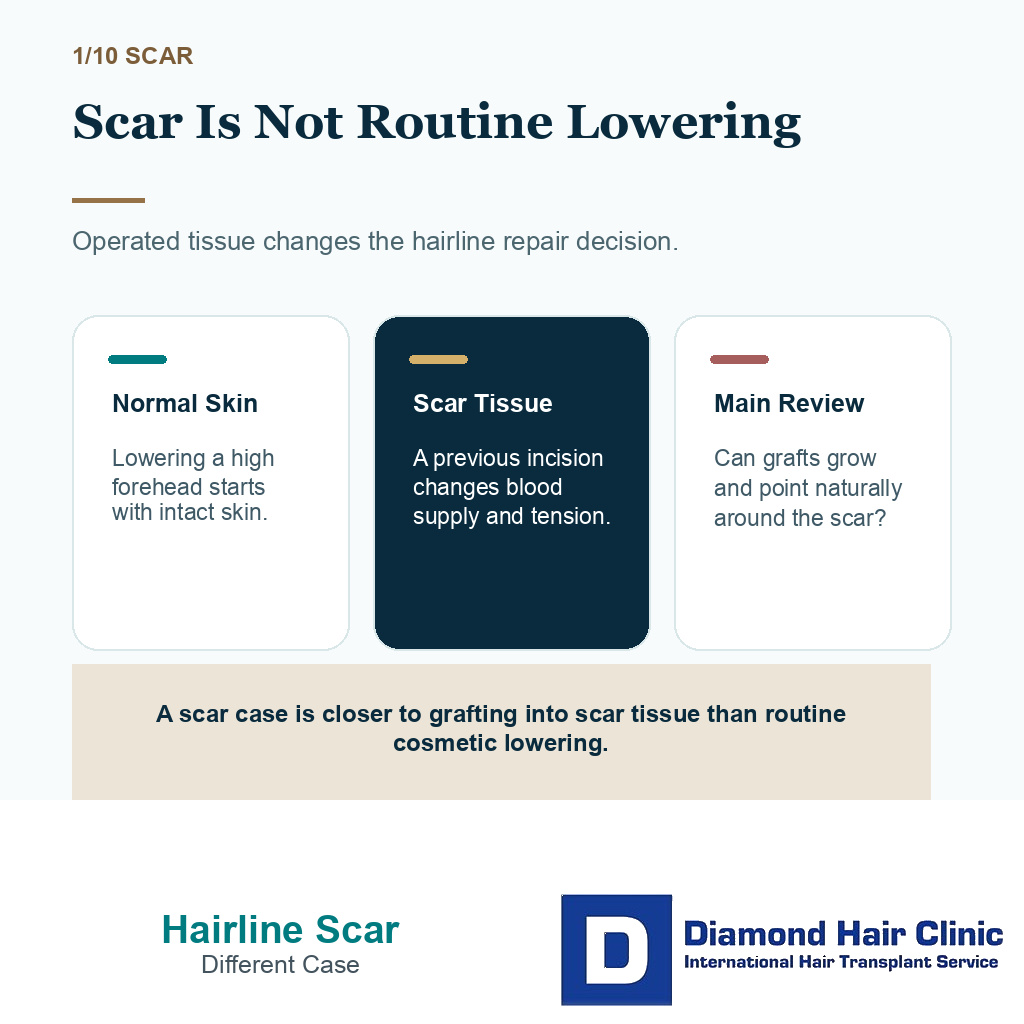
With a naturally high forehead, the skin at the future hairline is usually intact. When lowering a naturally high forehead with hair transplant, the main questions are facial proportion, age appropriate placement, future hair loss, density, and donor management.
A hairline advancement scar is different because the front border already contains operated tissue. The surgeon is not only designing a lower hairline. The surgeon is deciding whether grafts can survive in scarred skin, whether the scar should be crossed or softened, whether the hairline should sit just in front of it, and whether the old operation changed the natural movement of the forehead skin. That makes the case closer to hair transplant into scar tissue than to a routine cosmetic lowering case.
If you also have male or female pattern hair loss, the decision becomes more complex. A forehead reduction scar may be the visible problem today, but future thinning can expose a low or dense front line later. The repair should not solve one scar while creating an unnatural hairline that ages badly.
Scar maturity matters before review
The scar should look and feel stable before grafting is planned. A mature scar is usually flatter, paler, less tender, less itchy, and less reactive than it was in the early months. Redness, firmness, pain, thickening, or widening means the tissue is still active or under tension. I also check how the scar behaves when the brows lift and the forehead moves, because tension can become more obvious with expression. A red, raised, painful, or widening scar should not be rushed into grafting just because you are embarrassed by it.
Nine to 12 months is a common review window, but it is not a magic permission date. Some scars settle earlier. Some need longer. If you have thick scarring, keloid tendency, repeated surgery, inflammation, or ongoing tightness, dermatology or scar revision input may be needed before any transplant plan is discussed. The decision should be based on the tissue, not only on the calendar.
If you have a history of raised scars, chest or shoulder keloids, hypertrophic scars, or unusual wound healing, that history must be reviewed before new surgical sites are created. Scar behavior changes the surgical threshold. That also matters for keloid scars and hair transplant risk.
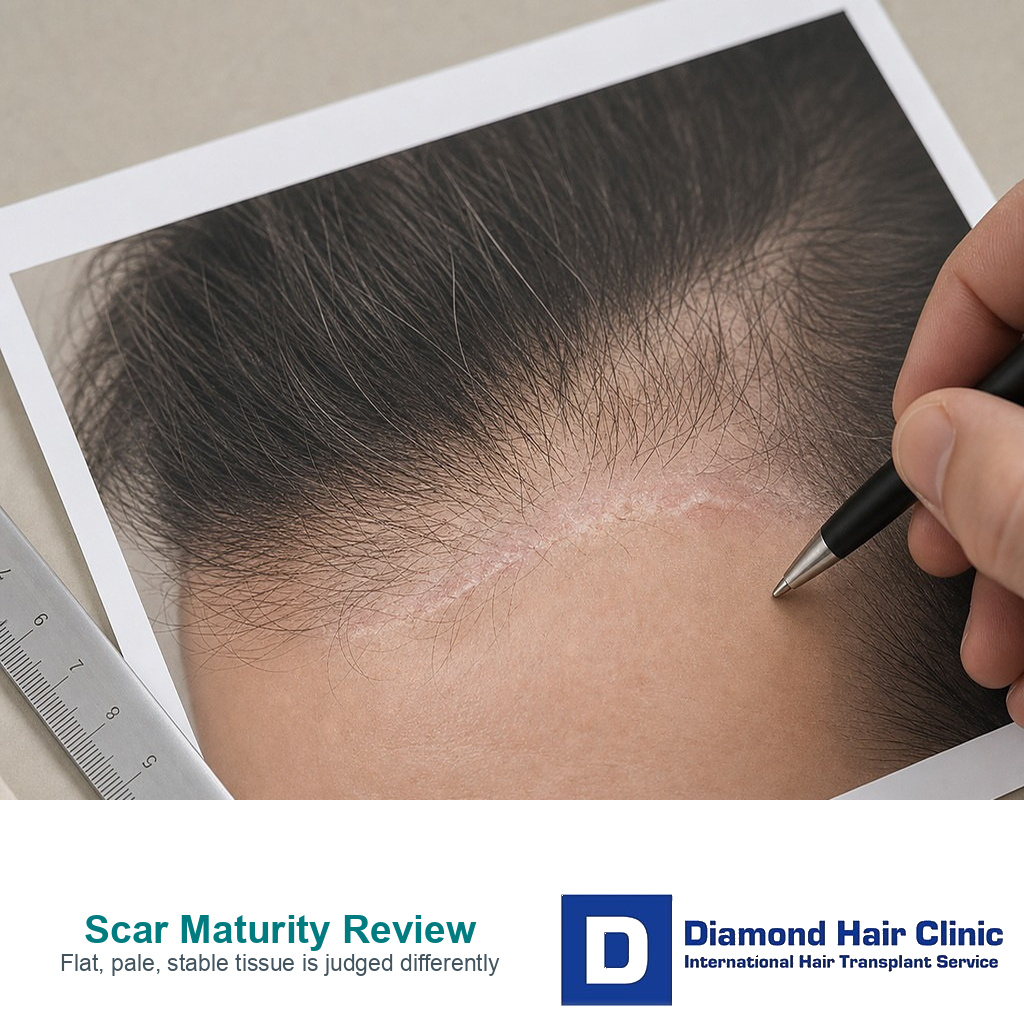
Before grafts are placed into a scar, the review has to look at maturity, softness, color, and surrounding hair direction.
Scar tissue makes grafting less predictable
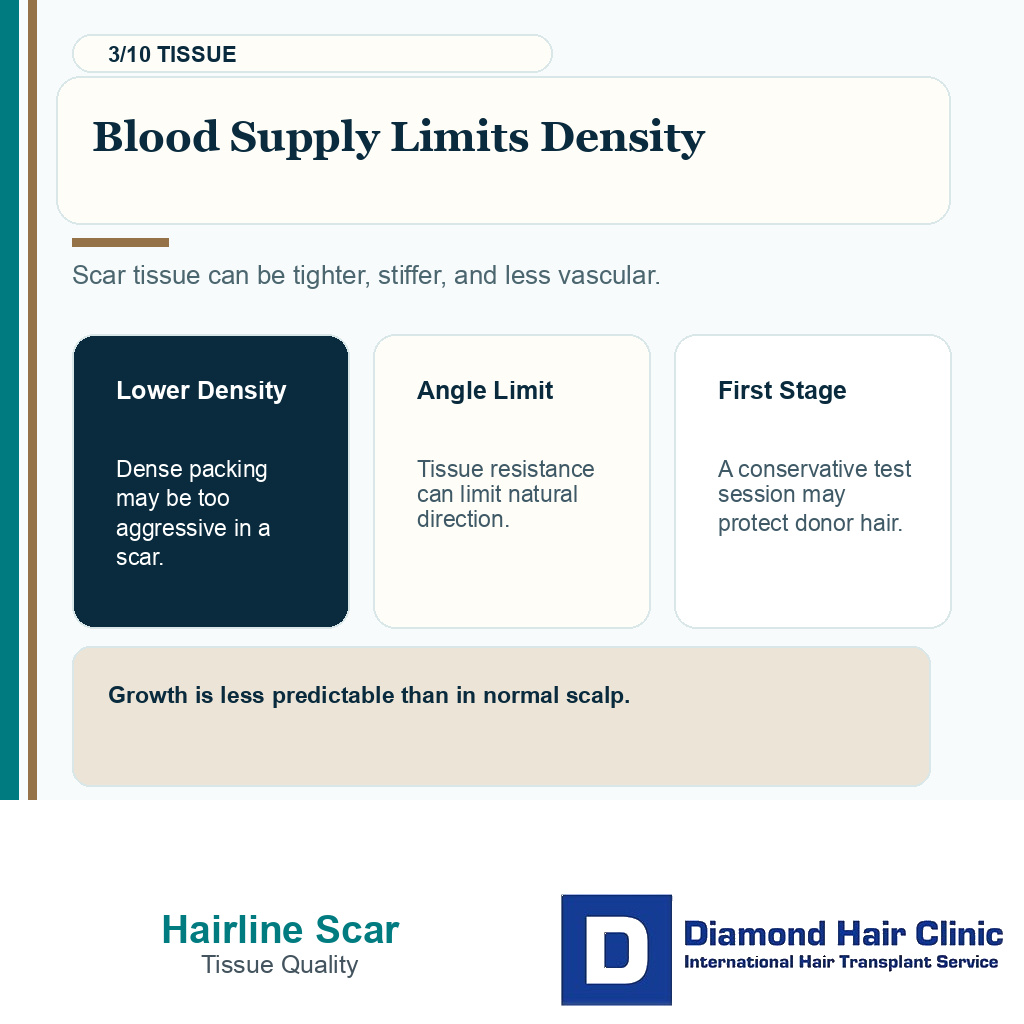
Normal scalp has better blood supply, softer tissue, and more predictable healing. Scar tissue can be tighter, stiffer, and less vascular. Prior steroid injections, laser treatments, scar revision, infection, or repeated irritation can also change how the tissue behaves. Every transplanted follicle needs a good environment in the first days and weeks after placement. Dense packing that might be reasonable in normal skin may be too aggressive for a scar.
The angle is also less forgiving. Hair along the front hairline should not grow straight forward like a brush. It has to follow a soft, irregular direction that matches the surrounding hairs. When grafts are placed through or around a scar, the surgeon may have less flexibility because the tissue resists the incision angle. Hair direction matters as much as coverage in a visible front hairline scar.
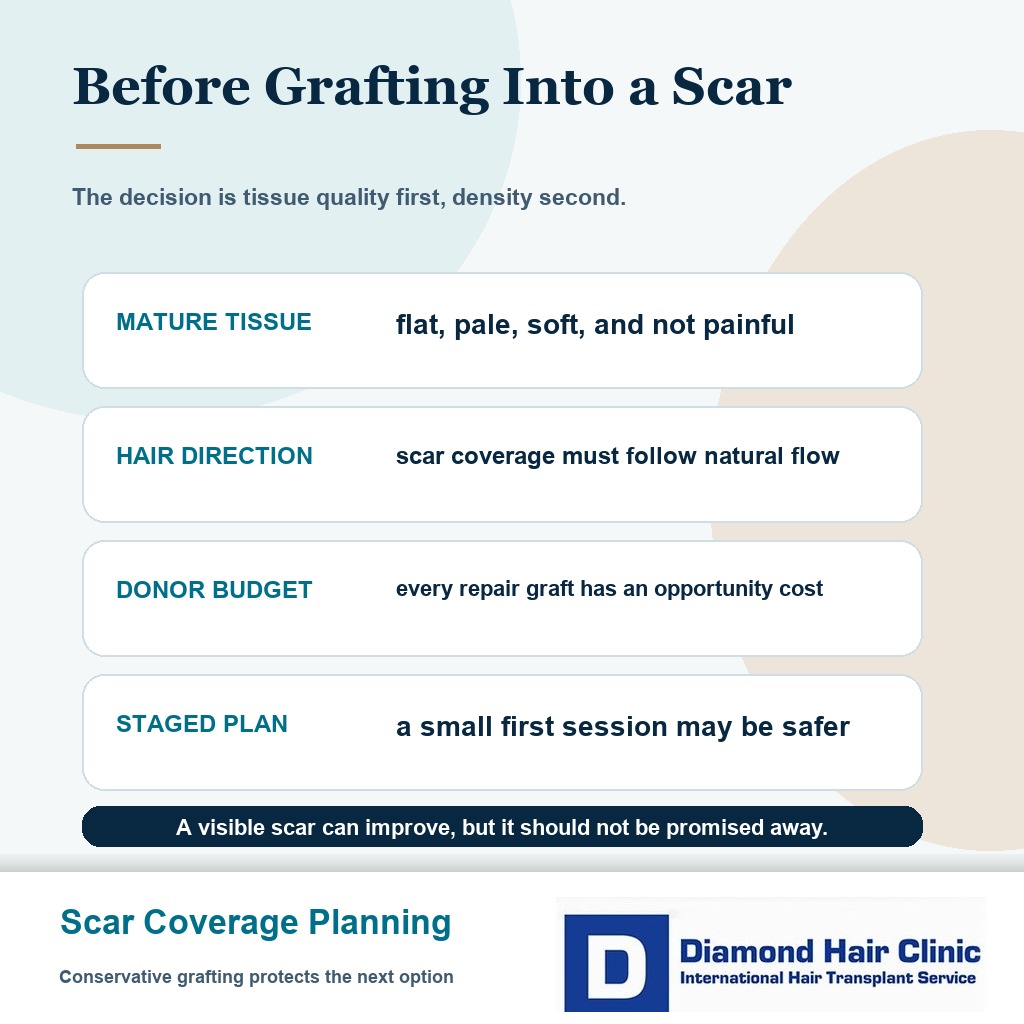
Scar coverage is planned around tissue quality, hair direction, donor cost, and whether a staged first session is safer.
A scar case can fail even if hair grows. The scar may be partly hidden, but if the direction is wrong, the repair can look artificial. If this worries you, it helps to understand wrong hair direction after hair transplant, because direction errors are difficult to disguise at the hairline.
Scar patterns that are poor candidates
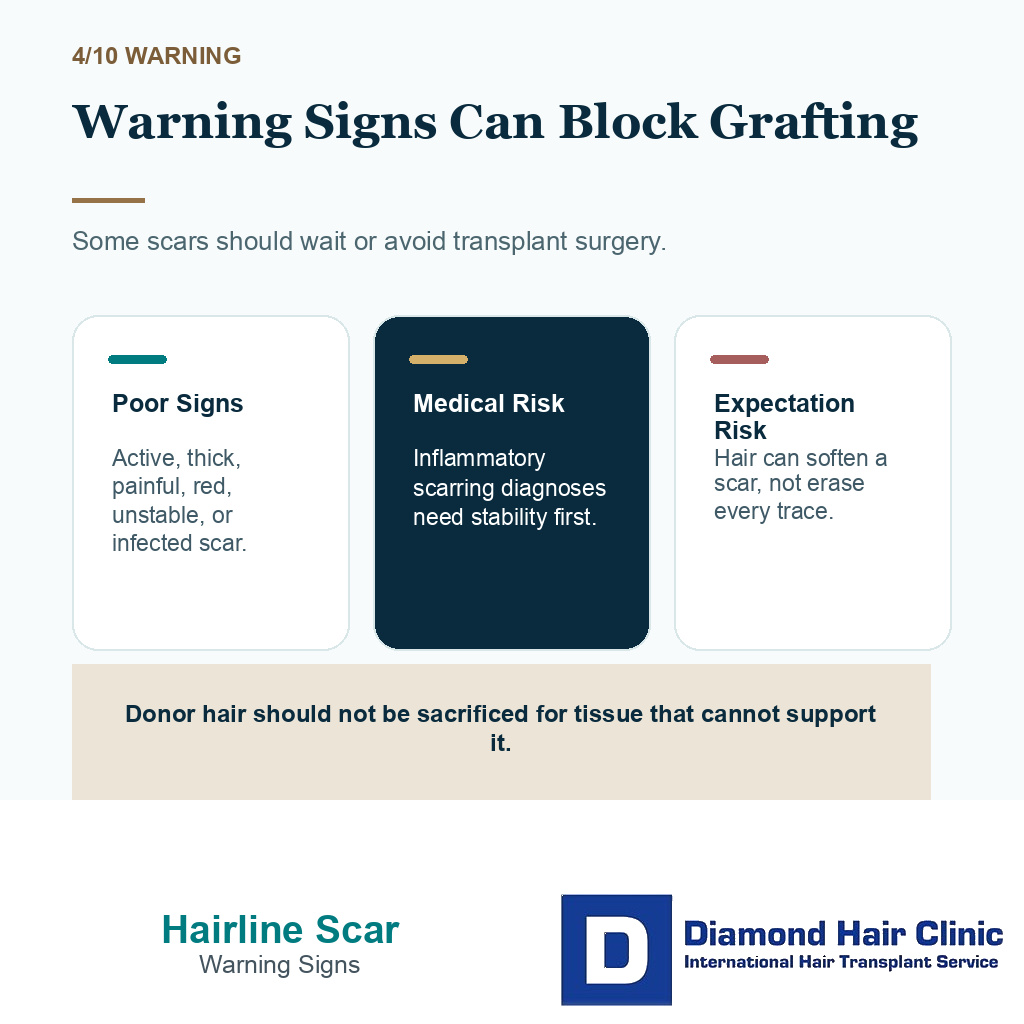
A scar is a poor candidate when it is still active, thick, painful, red, unstable, very wide, infected, or under strong tension. It is also a poor candidate when you expect transplanted hair to erase the scar completely. Hair can soften a line and reduce contrast, but a scar may still be visible under harsh light, wet hair, short styling, or close inspection.
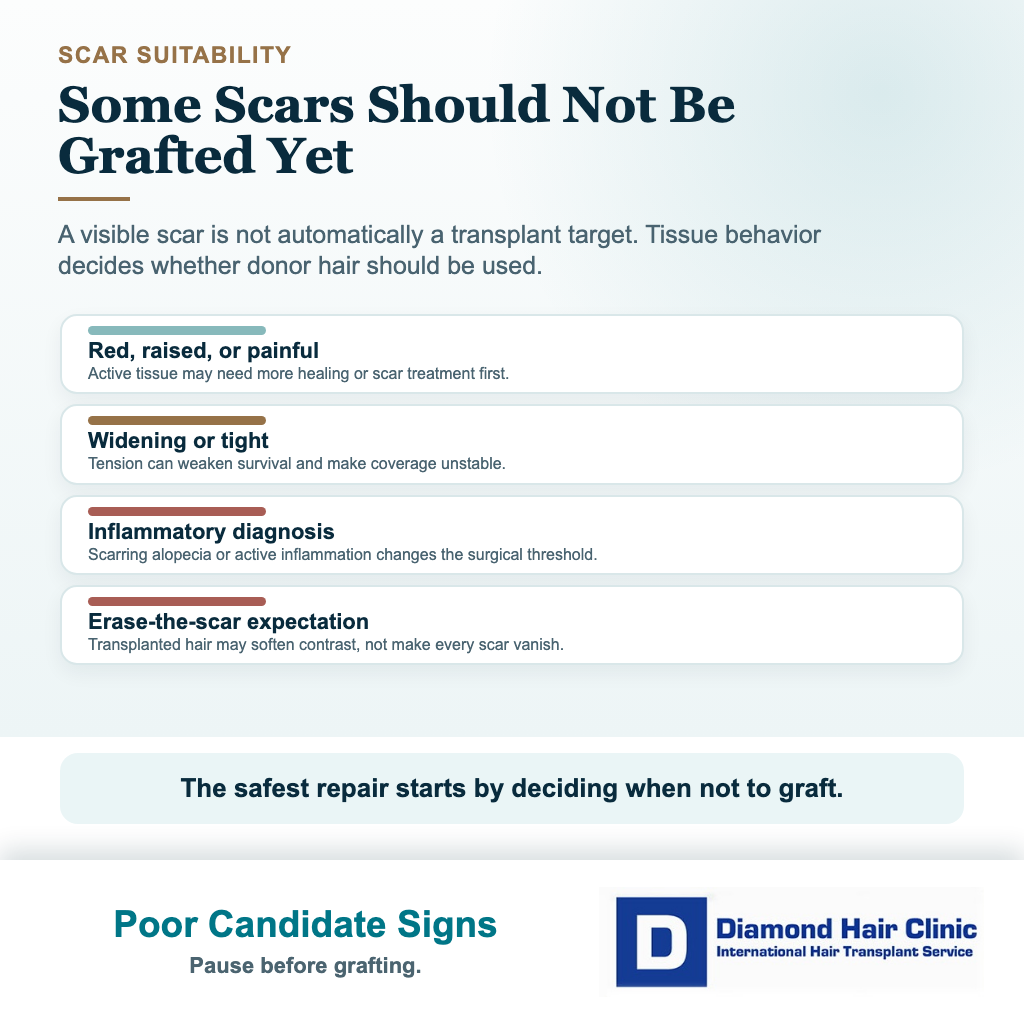
Some people have more than a surgical scar. They may have scarring alopecia, frontal fibrosing alopecia, lichen planopilaris, traction alopecia, or another inflammatory diagnosis near the hairline. If the medical diagnosis is active, transplant surgery may be unsafe or disappointing. For scarring alopecia and transplant candidacy, stability has to be proven before grafts are moved.
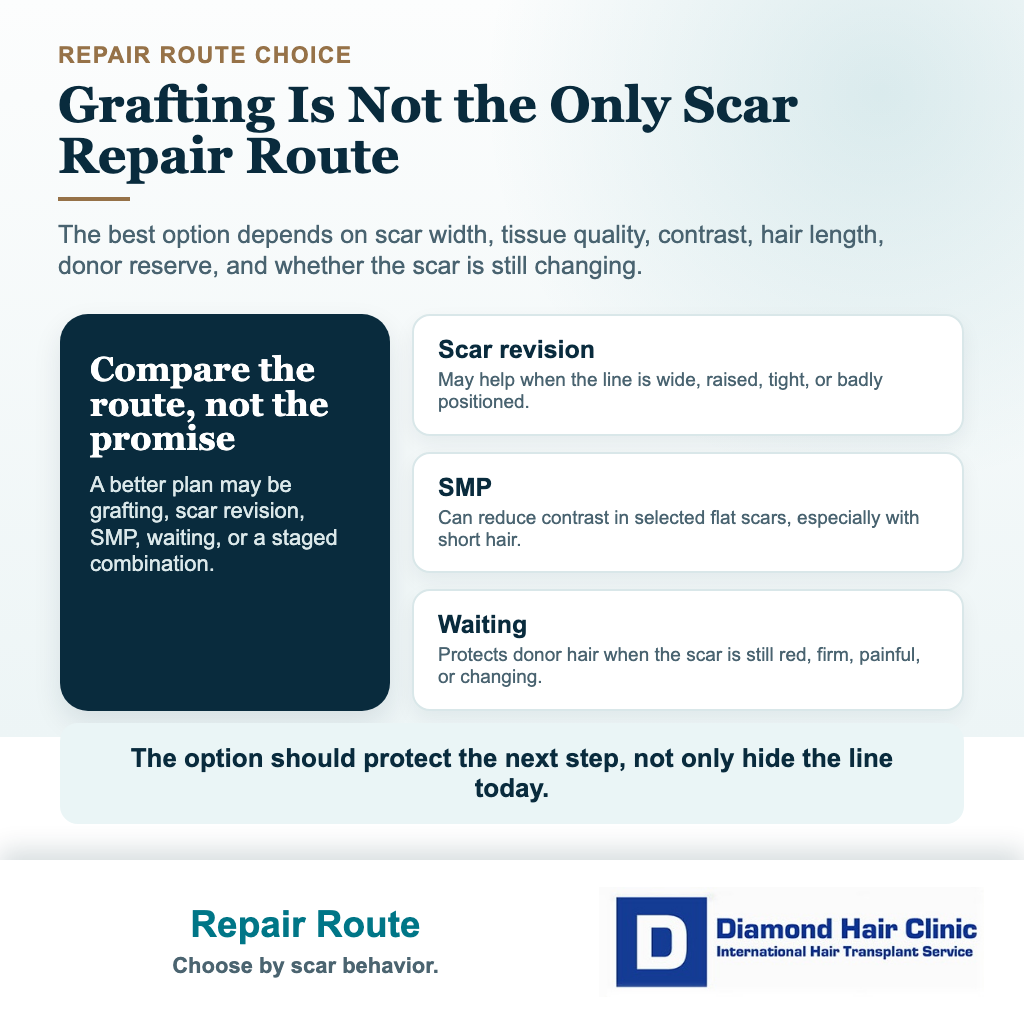
A poor candidate can sometimes become a better candidate later after scar treatment, waiting, scar revision, or medical control. But some scars should not be grafted. If graft survival is unlikely, donor hair should not be sacrificed for a result that cannot be responsibly promised.
Hairline design around an old scar
The new hairline design must be built around the face, the scar, and the future. It should not simply be drawn low enough to cover every millimeter of the old line. If the new hairline is too low, too straight, or too dense, you may trade a scar problem for an unnatural hairline problem.
The repair often works better when the hairline is built with irregularity, softer density at the edge, and careful direction that lets the hair fall naturally over the scar. Fine single hair grafts are usually more useful at the visible edge than thick multi hair grafts, because a scar repair should not create a hard transplanted border. The scar may be grafted directly in selected areas, partly crossed, or partly camouflaged by hair placed just in front of it. The plan depends on scar position and tissue quality.
Temple points also need careful planning. A forehead reduction scar can tempt the surgeon to close the temples too aggressively, especially when you want a smaller forehead. Temple work is one of the places where small design mistakes are very visible. With temple point restoration, direction, density, and age appropriate shape matter.
Use these 10 hairline scar repair slides to separate scar maturity, grafting limits, design choices, staged repair, and safer alternatives before accepting a plan. Swipe sideways, use the arrows to move one slide at a time, or choose a number below the image to jump to a specific slide.



Lowering the hairline again is not always needed
In a hairline advancement scar repair, the design decision is whether coverage will still look natural when the hair is wet, pulled back, or viewed years later. I want to see the line with your normal styling and with the hair pulled back, because those are different tests. If the scar is just behind or inside the natural front edge, a small number of grafts may be used through the scar and around it without meaningfully lowering the whole hairline. If the scar sits lower or wider, trying to cover every part of it by drawing a new line in front can make the forehead too short or the hairline too rounded.
Scar coverage is not only a close photograph question. I also look at facial proportion, temple shape, hair direction, future hair loss risk, and whether the new outline will still look natural years later. In some cases, the better plan is partial camouflage, scar revision first, or a staged transplant rather than a lower, denser hairline that creates a new cosmetic problem.
Afro textured or very curly hair changes the plan
Curly hair can give helpful visual coverage, but extraction and placement are technically more demanding because the follicle may curve under the skin. Around a hairline scar, the surgeon also has to respect curl direction, hair exit angle, and the way the hair will sit when it grows long enough to cover the line.
A hairline advancement scar with Afro textured or very curly hair should not be treated as a fast high density case. The donor extraction must be conservative, the punch angle must respect the hidden curl, and the hairline should not be packed so tightly that graft survival or natural flow is weakened. A smaller, controlled first session can be more protective than an aggressive repair that spends too much donor hair before the scar response is known.
If this is your hair type, it helps to understand Afro textured and very curly hair transplant challenges. The same technical caution becomes even more important when the recipient area is scarred.
Scar coverage may need more than one session
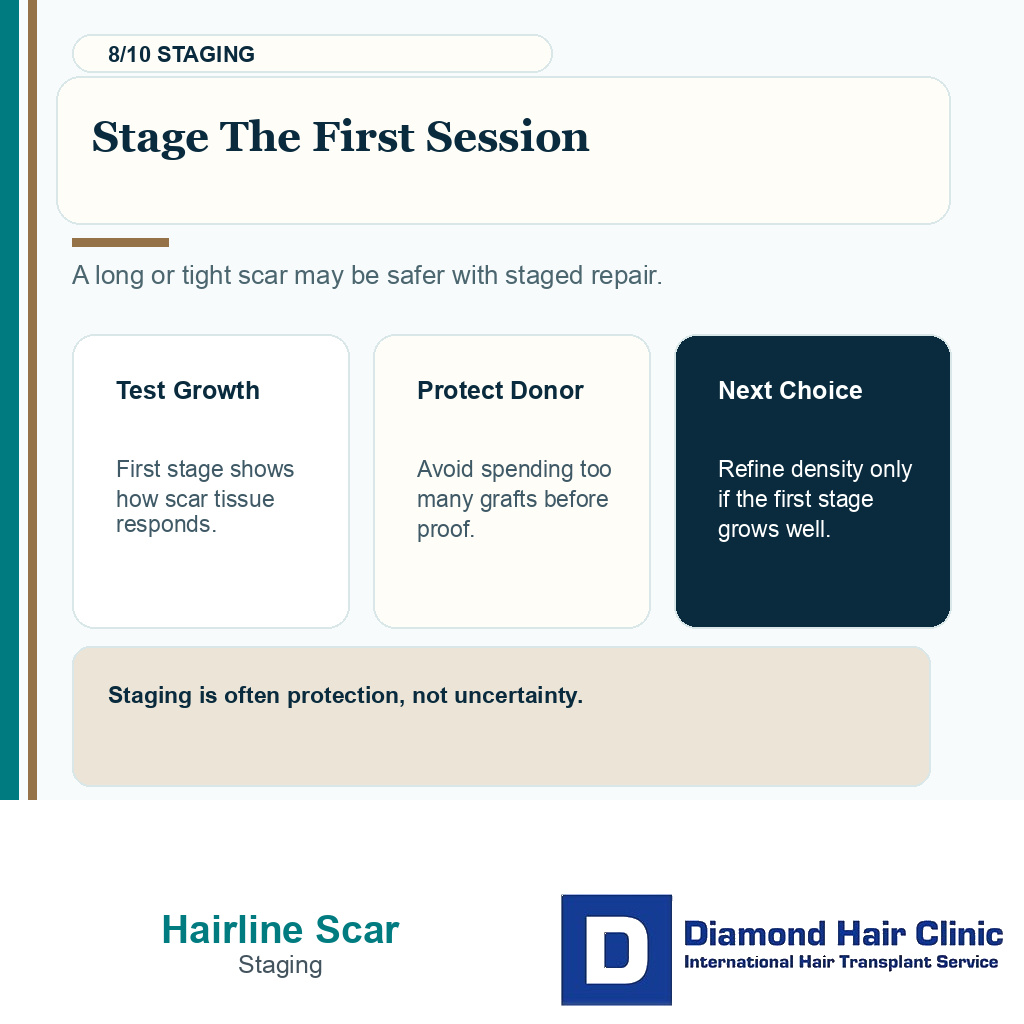
Sometimes a small scar can be treated in one careful session. A longer, wider, tight, or less vascular scar may be safer as a staged plan. The first session can test the tissue response, establish a soft front edge, and show how the grafts grow before more donor hair is committed. If the first growth is patchy, the next decision may be lower density camouflage, scar revision, SMP, or waiting instead of simply adding more grafts.
A staged first session can protect the donor area. This is especially true when you have already had another operation, have limited donor reserve, or want a dense cosmetic change at the front. If the first stage grows well, a second stage may refine the density. If the first stage grows poorly, the surgeon has learned something important without spending too much donor hair.
This differs from a routine hair transplant touch up. A touch up usually adjusts a small weak area after an otherwise reasonable transplant. Scar coverage has a tissue quality problem built into the case, so the density target must be more conservative.
Records and photos to prepare
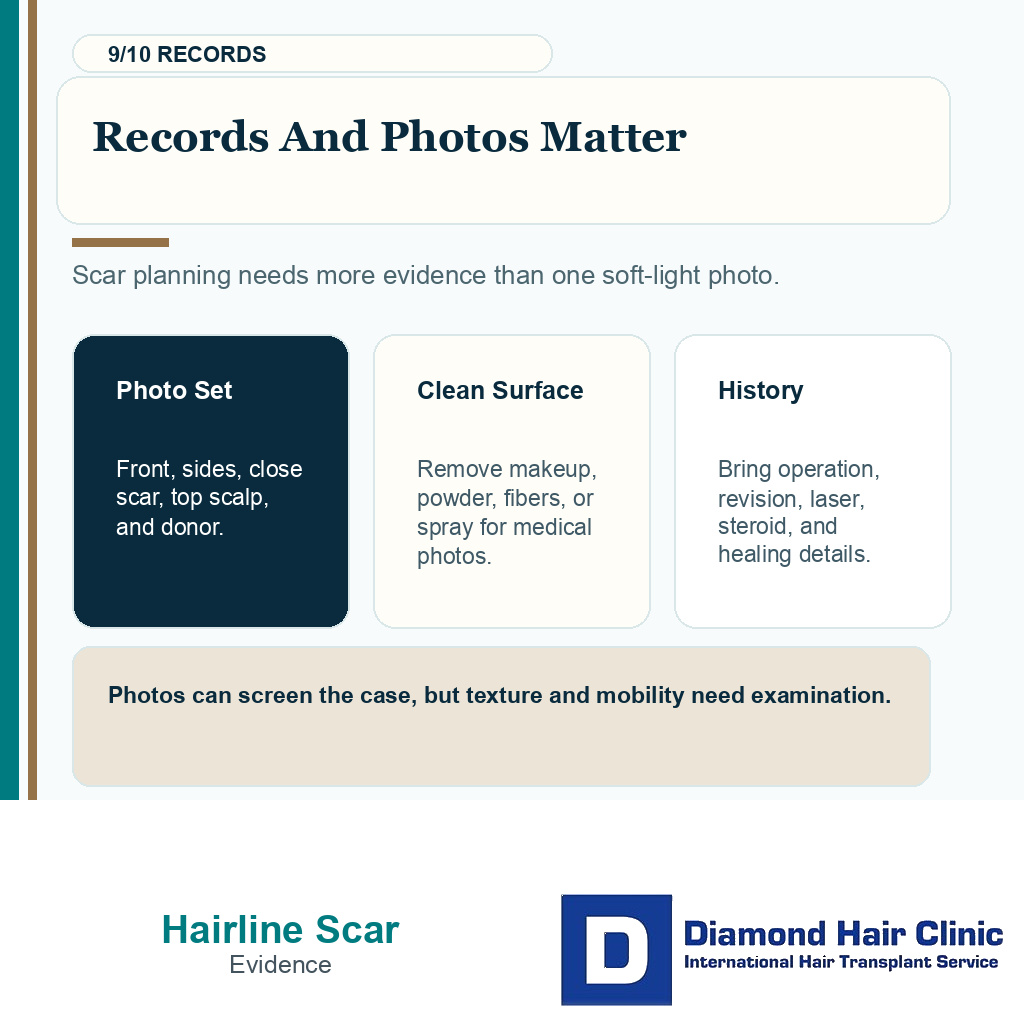
Before consultation, prepare clear photos from the front, both oblique angles, both sides, close hairline views, top scalp, and donor area. Use dry hair, similar lighting, and no hair fibers or heavy styling product. Remove makeup, tinted powder, concealer, or spray from the scar area before the medical photos, then add separate cosmetic styling photos if you want to show how you normally hide it. If the old scar is hard to see in soft lighting, include one plain photo in harsh light too. A surgeon needs to see both the cosmetic concern and the real tissue surface. Do not send only the angle where the scar almost disappears. Scar repair planning also needs the view that explains why it bothers you in normal light.
If you have the operative report from the hairline advancement or forehead reduction, bring it. The incision position, scar history, healing problems, revision attempts, steroid injections, laser treatments, and timing all matter. If the case involves a prior hair transplant as well, graft counts, photos, and donor records become even more important.
Photo only planning has limits in scar cases. It can help decide whether a case is worth examining, but it cannot fully judge scar texture, mobility, thickness, or blood supply. With hair transplant planning from photos, some decisions need in person assessment.
For a forehead reduction scar, ordinary hairline lowering photos are an incomplete comparison. The useful examples show a healed scar repair with the hair lifted away from the line, alongside the finished hairstyle.
Scar revision, SMP, or waiting may be better
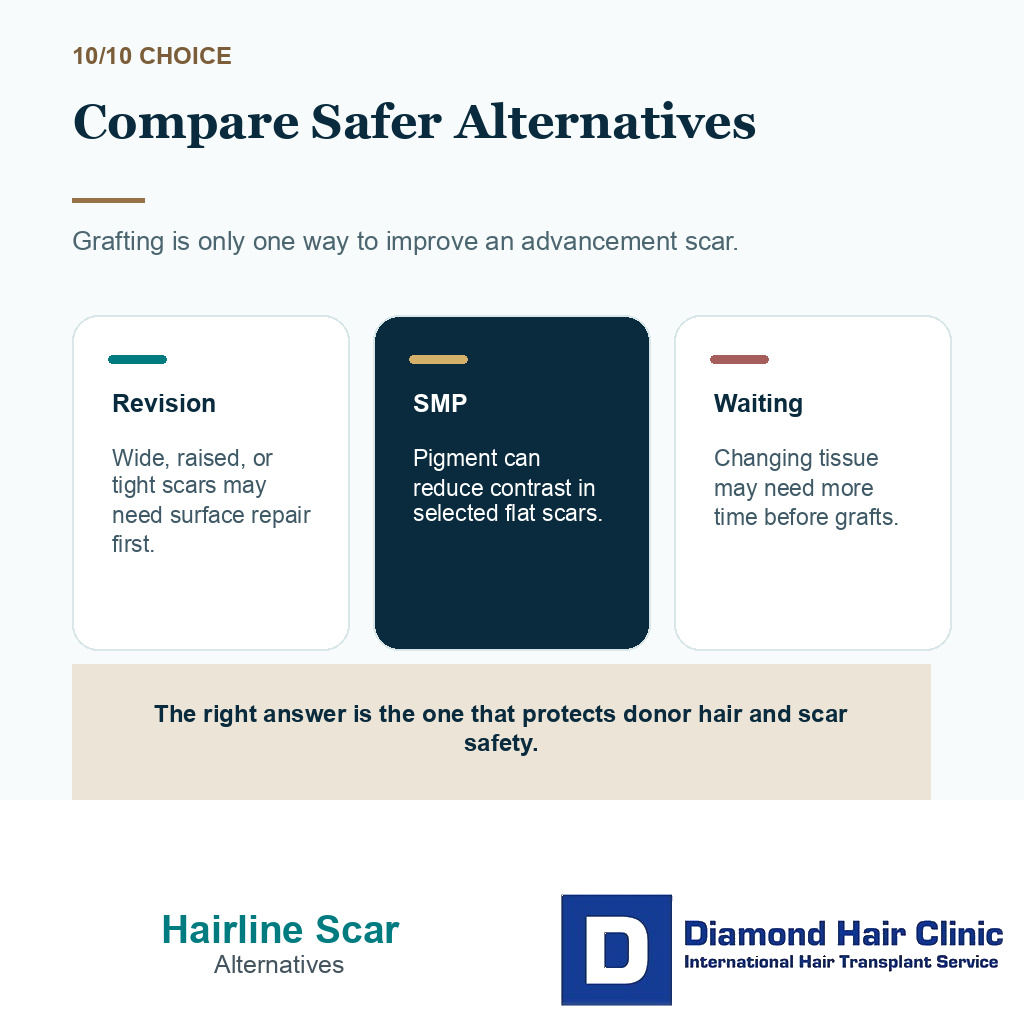
Grafting is not the only option. If the scar is wide, raised, very tight, or badly positioned, scar revision may be considered before or instead of transplantation. Scar revision and grafting are not the same decision. Revision tries to improve the surface or position of the scar. Grafting tries to camouflage the line with hair. If the scar is flat but contrast is the main problem, scalp micropigmentation may help selected cases, especially when the surrounding hair is kept short enough to blend with pigment. SMP can reduce contrast, but it does not add hair direction, hair volume, or scar softness. If the scar is still changing, waiting may be the more protective medical decision.
There are also cases where another repair creates more risk than benefit. If you have a low artificial hairline, weak donor area, active inflammation, or unrealistic density expectations, a different plan may be safer. If the old procedure produced an unnatural result, the broader repair logic overlaps with bad hair transplant repair, but scar coverage still has its own tissue problem.
The decision should compare the cosmetic gain against the donor cost. If a few hundred grafts can soften a mature scar and improve styling freedom, the plan may be reasonable. If thousands of grafts are needed to hide a scar and rebuild a low hairline, you need to understand what that means for future hair loss and later repair options.
Scar repair has to respect the tissue
A hairline advancement scar is not the same as untouched skin. Width, color, softness, blood supply, surrounding hair direction, and donor reserve all shape how much coverage is realistic.
The graft plan may need to work inside the scar, just in front of it, behind it, or in stages. A modest first stage can be wiser than forcing density into tissue that may grow unevenly.
The scar should be mature enough to judge before another operation, and the hairline should still fit the face. A good repair softens visibility without spending donor hair as if this were routine hairline lowering.

Read this review excerpt
told me the quality of my donor hair and what he could take out and advised me what will the be best outcome with what donor hair I had.