


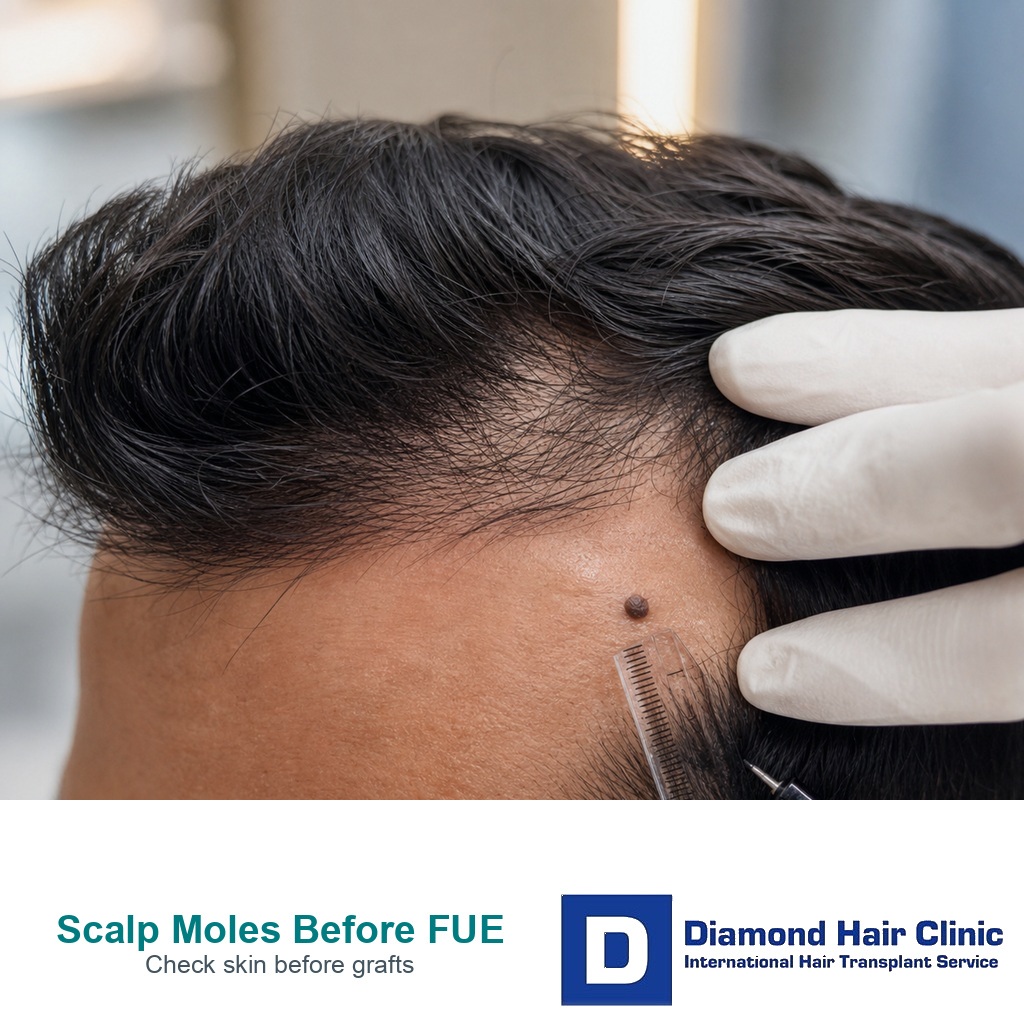
Scalp Mole Review Before FUE Surgery
A hair transplant can still be possible with a scalp mole, raised bump, birthmark, or dark spot. The key distinction is whether the spot is known, stable, and medically clear, or whether it is new, changing, painful, bleeding, crusting, irregular, or uncertain.
A changing or unexplained scalp lesion needs review before hair transplant incisions are made. If the spot is stable and cleared, graft placement can often be planned around it or, in selected cases, near it. The wrong moment to discover a suspicious scalp spot is surgery day, after travel, shaving, and the surgical plan are already moving.
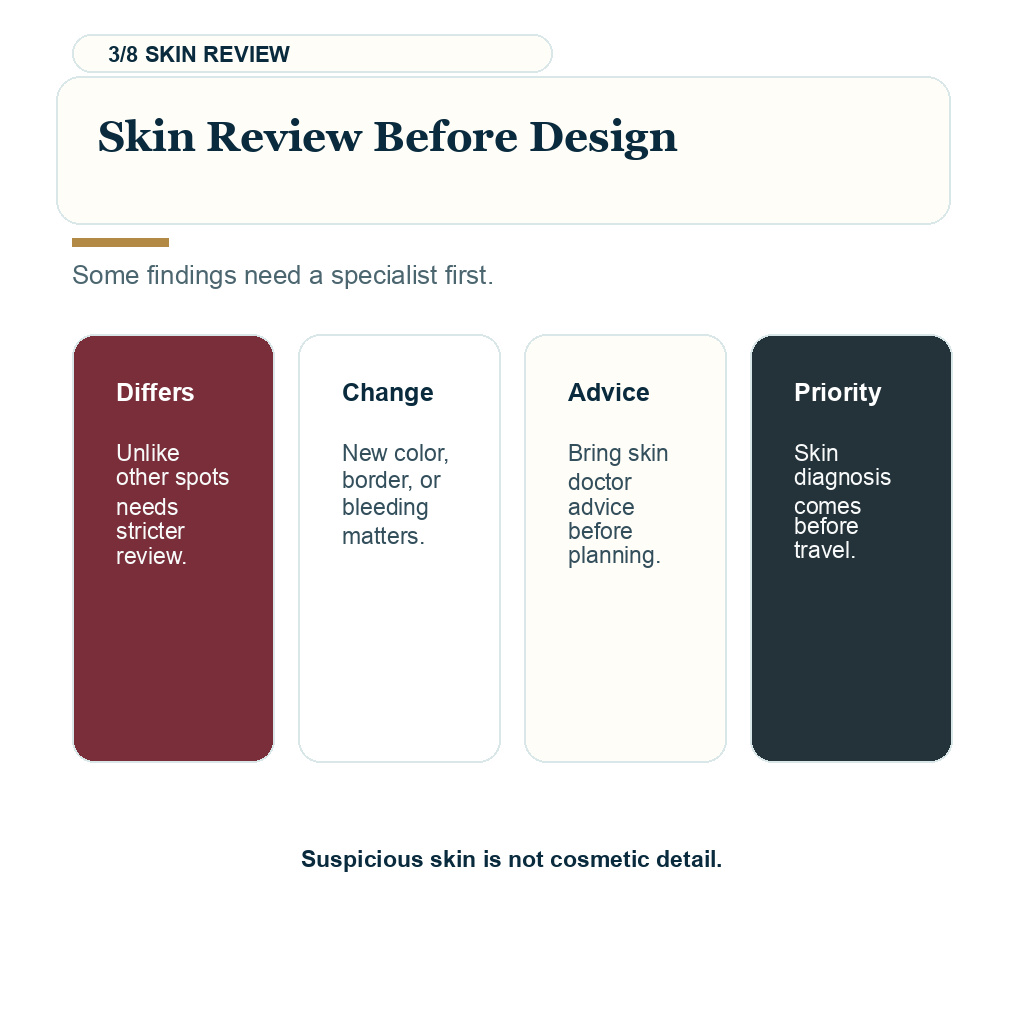
A hair transplant is elective surgery through living skin. Skin diagnosis comes first, stable healing comes second, and only then do hairline design, graft number, density, and cosmetic detail belong in the plan.
Scalp moles matter in surgical planning
Moles matter because the surgeon is working through skin, not on a blank drawing surface. In FUE, I need to choose donor extraction points and recipient area incision sites. If a mole sits inside the planned hairline, temple, crown, or donor zone, I must decide whether it is a harmless landmark, a spot to avoid, a lesion that needs a dermatologist, or a scar or birthmark that may change blood supply and graft survival. Marking its position before shaving helps keep lesion review separate from ordinary graft planning.
Most stable moles are not emergencies. Some have hair growing through them naturally. Some are flat, unchanged for years, and only become visible when the hair is shaved. The unsafe mistake is treating every dark or raised spot as harmless just because the appointment is for cosmetic surgery.
A mole with hair growing through it can still need review. I judge the spot by its history, shape, border, color, surface, symptoms, and whether it behaves differently from the other moles on the same scalp.
Before I plan incisions, I need the history clear. Has the spot been there for years? Has it changed in color, size, border, elevation, bleeding, crusting, itching, or pain? Has a dermatologist examined it with a dermatoscope or removed a sample when needed? Once the head is shaved and marked, a small scalp spot can become harder to notice, so it should be pointed out again before incision planning starts. Shaving can reveal spots that were hidden in booking photos, so point them out again before the final design is marked.
Leave a raised scalp spot as it is before consultation. If it needs review, I need its original surface or dermatology records, not a fresh wound that hides the lesion border.
If the answer is unclear, I pause the hair transplant plan. Unexplained inflammatory scalp disease also deserves diagnosis before grafts are placed, and scalp biopsy before hair transplant can be part of getting that diagnosis right before surgery.
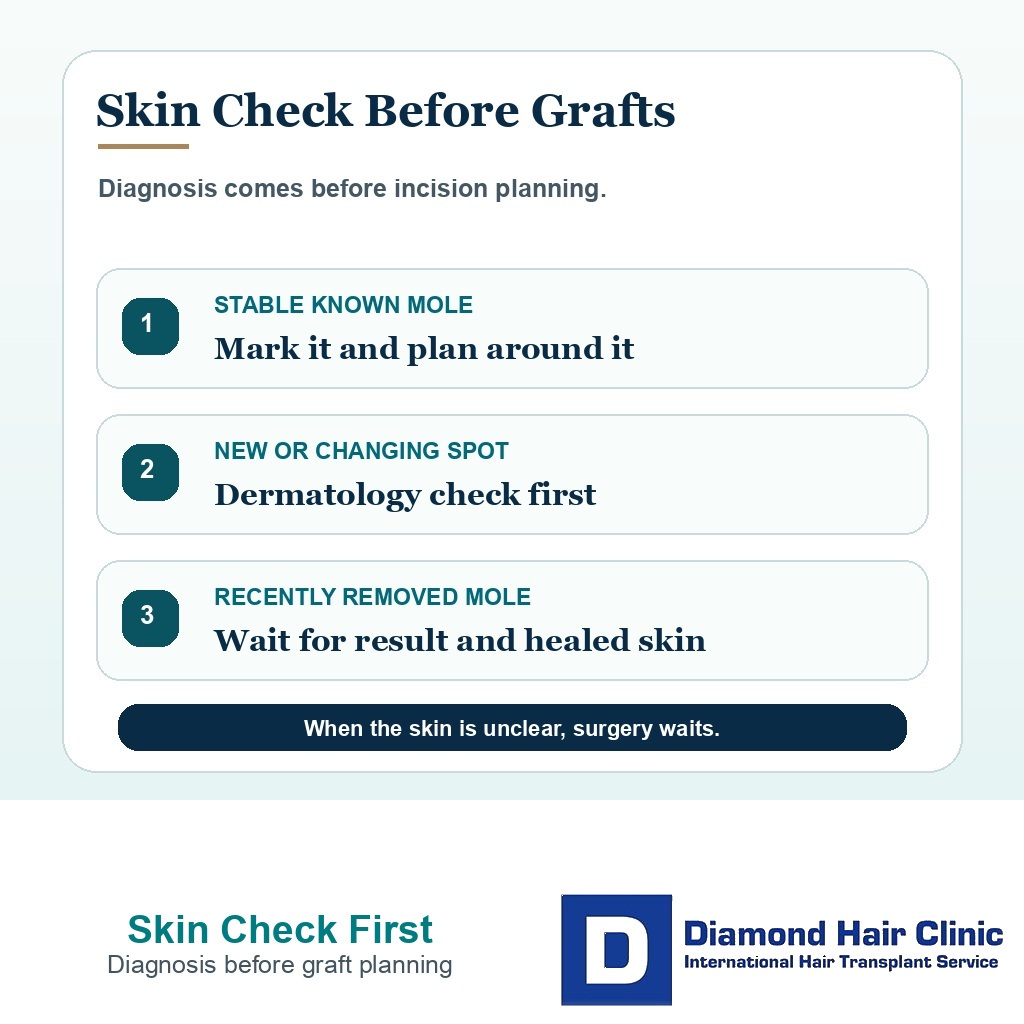
Grafts can sometimes be placed near a mole
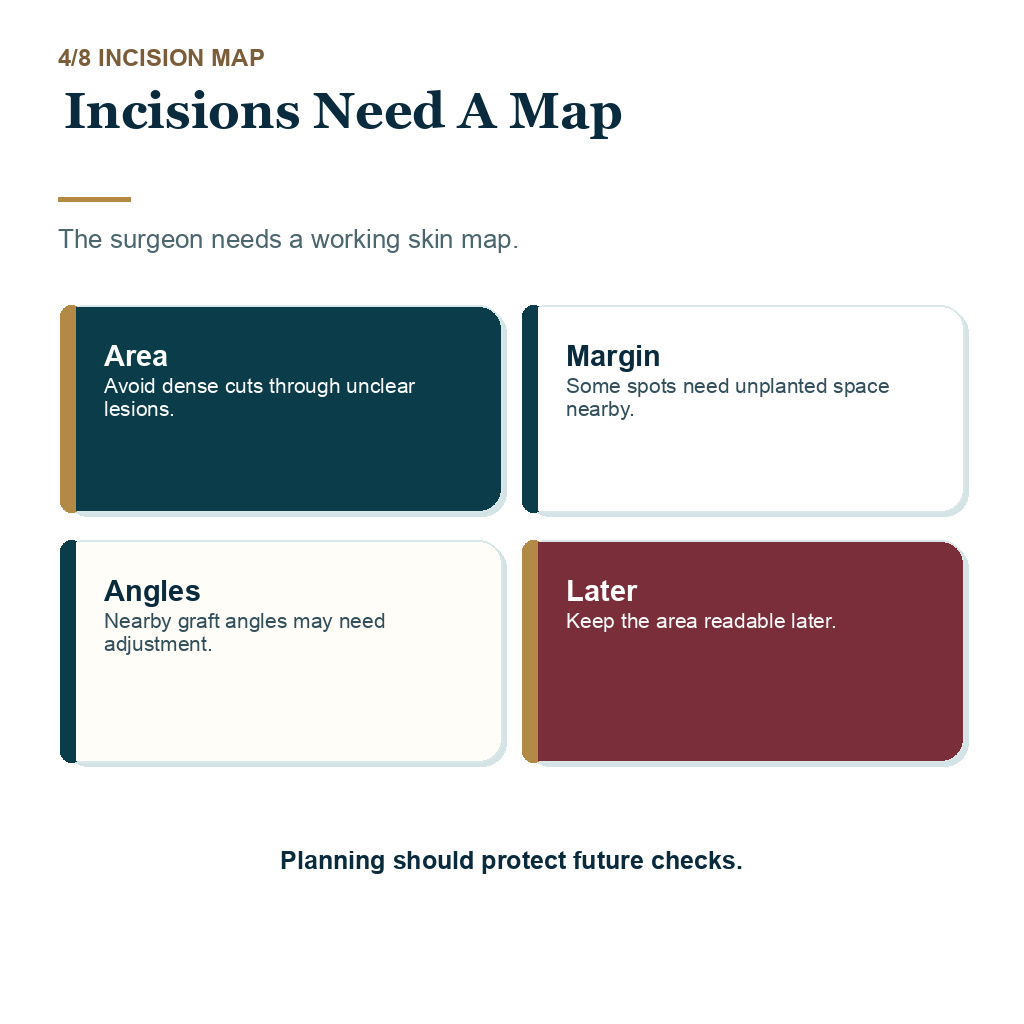
Some stable moles can have grafts placed nearby. Others need a small safety gap or a design that works around them. I do not decide this from the word mole alone. A flat mole that has been stable for many years and medically cleared is different from a raised, irritated, irregular, or newly changing lesion.
There is also a practical surgical point. Recipient area incisions create small wounds. If a mole needs future dermatology monitoring, repeated trauma, scabbing, pigment change, or graft hair growing through the lesion can make the area harder to interpret later. That does not mean every mole must be removed. It means the transplant plan must not make future skin monitoring harder.
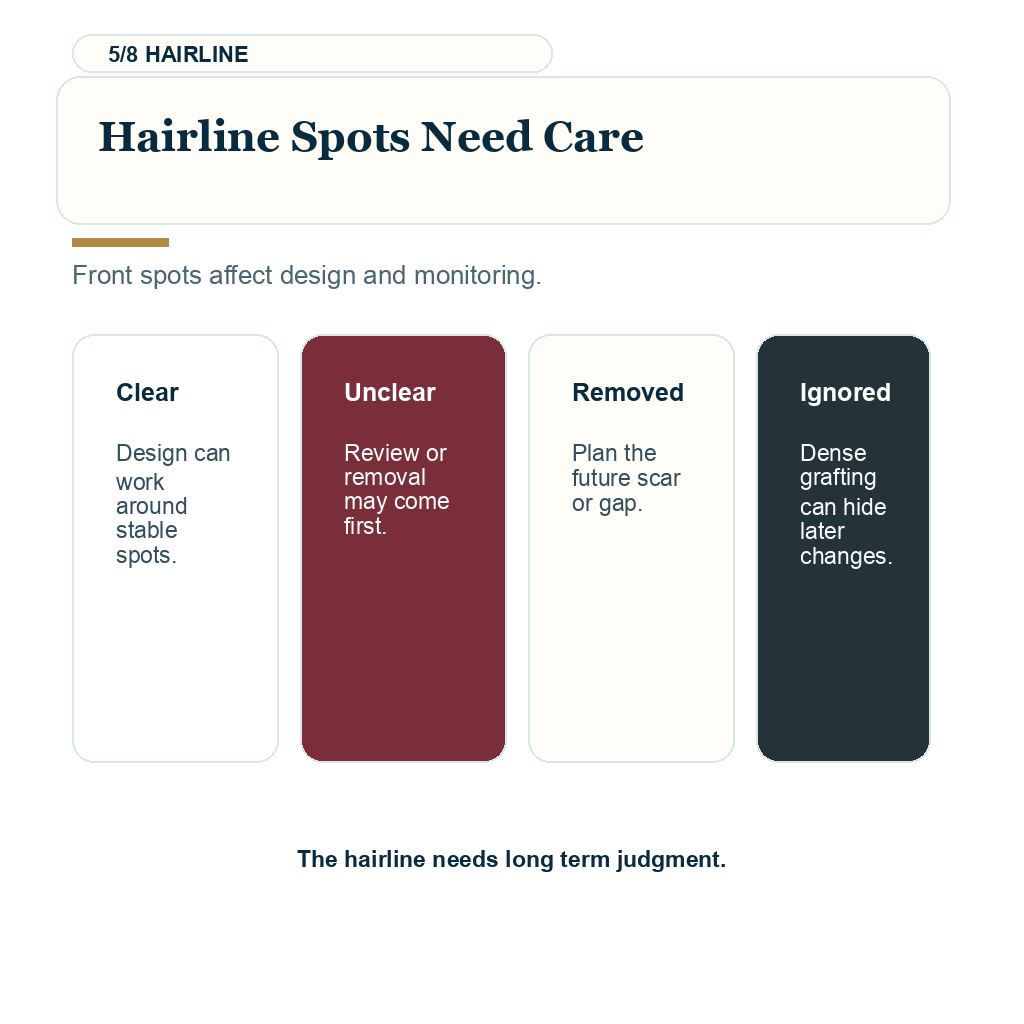
A slight hairline adjustment is safer than dense graft placement through a lesion that has not been identified. This is especially true at the frontal hairline, where every millimeter is visible and where future mole removal could leave a small scar, gap, or direction problem if the spot was ignored during planning.
Dermatology review before surgery
Dermatology review comes before surgery when a mole is new, changing, irregular, more than one color, bleeding, crusting, painful, itchy, growing, or simply different from the other moles on the same person. I pay attention to practical warning signs such as asymmetry, an irregular border, color variation, enlargement, and change over time. Size alone is not a clearance test.
When the spot is unclear, do not assume it is harmless from a quick look. It may be a mole, wart, scalp cyst before hair transplant, scar, folliculitis, scab, pigmentation, or another skin lesion. Scalp lesions are easy to miss because hair covers them. A close haircut, shaving, or transplant preparation may reveal something that was hidden for years.
A photo sent to the clinic can show location, size, and whether the spot interferes with the proposed design. It cannot replace proper skin examination when the lesion looks suspicious or behaves differently from the rest.
If the lesion needs biopsy or removal, that decision belongs before the hair transplant, not inside a rushed surgery day conversation. I do not treat cosmetic flattening, laser, or a quick shave as medical clearance for a suspicious pigmented lesion. If tissue is sampled, the diagnosis and pathology result matter more than making the scalp easier to operate on.
When the spot is inflamed, red, draining, or tender, I treat it closer to folliculitis and hair transplant surgery than to a stable mole. Active inflammation needs to settle before incisions are planned around it.
Mole removal may need to come first
Removal is not always needed. It depends on the diagnosis, size, depth, location, cosmetic concern, and expected scar. A small raised mole in the planned hairline may be removed for medical or cosmetic reasons, but removal itself creates a wound. That wound needs time to heal before recipient area incisions are made around it.
The removal method matters. Shave removal, excision, laser, or another dermatology technique can leave different textures and scars. Hair transplant into scar tissue is less predictable than routine work on normal scalp, so the final scar has to be judged before grafts are placed around it.
If a mole is removed, I plan the transplant after the pathology result and after the skin has healed enough to judge the scar. Planning thousands of grafts around a wound whose final shape, color, or firmness is still unknown is poor surgical timing.
For someone with a history of raised or abnormal scars, the threshold for caution is higher. A small mole removal scar may matter more in a person prone to keloid scars and hair transplant surgery, because the scar response can change both timing and design.
Moles inside the donor area can change extraction
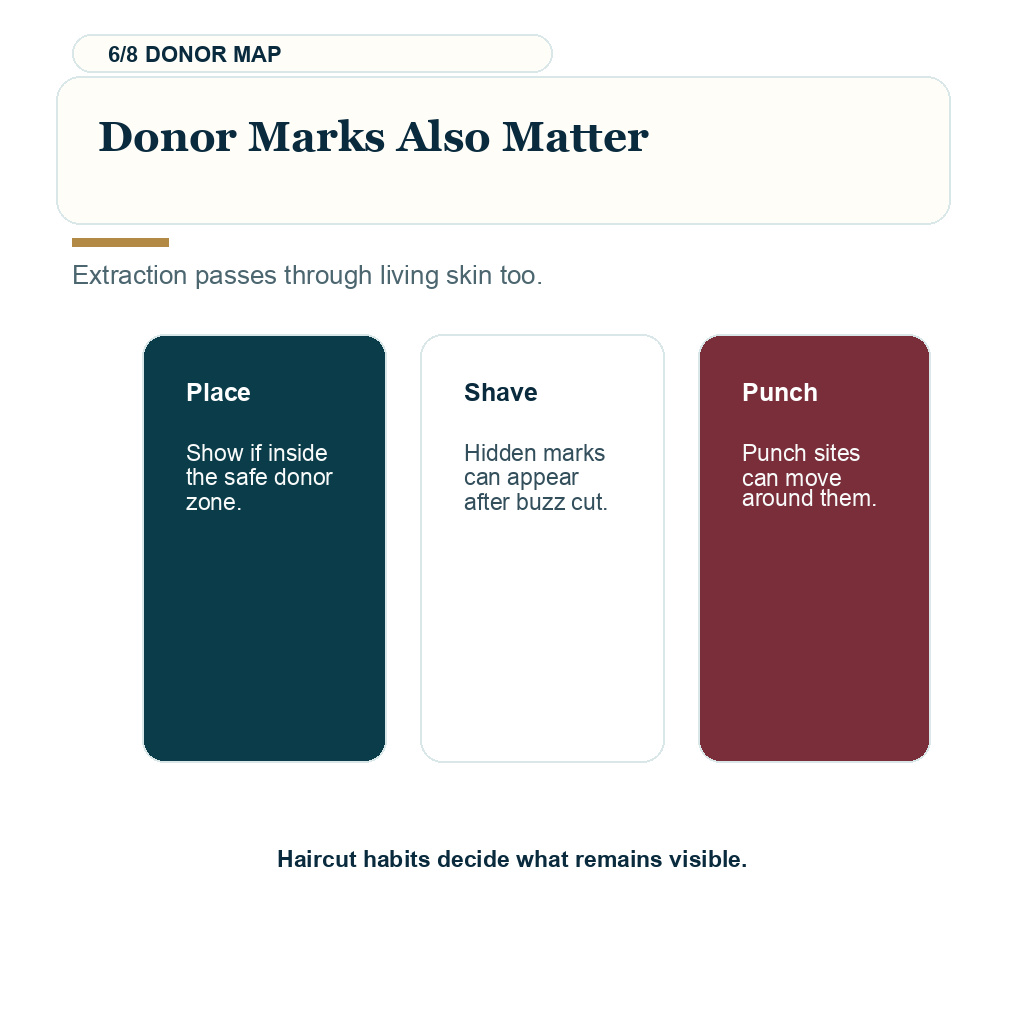
A donor area mole changes extraction planning. If it is stable and medically cleared, I can usually avoid extracting directly through it and distribute FUE punches around it. If it is large, raised, irregular, or sits inside a zone that would otherwise be heavily harvested, I mark it before extraction and keep the pattern conservative.
The donor area is already a limited resource. I do not want to create unnecessary wound trauma over a lesion, distort a mole that should be monitored, or leave a visible patch because the extraction pattern ignored the skin. This becomes more relevant if you wear short hair after FUE donor scars, because there is less camouflage for donor changes.
If you have many scalp moles, a history of atypical moles, or past skin cancer, I involve dermatology input before surgery. The hair transplant team needs to know which areas are safe to touch, which areas need photographs, and which areas must be avoided.
Advanced thinning can make this review more important, because a scalp that has been uncovered for years may also show sun damage. I do not treat a rough patch, a sore spot, or a changing mark as a transplant detail. If it sits where I plan to make incisions or extractions, I want dermatology clearance before donor hair is spent.
The same exposed scalp also needs a sun plan after surgery. I separate that from mole clearance, because shade, hats, and product timing answer a different question from whether a mark is safe to operate through.
When the scalp will be shaved, map and photograph important spots before shaving so the lesion does not get lost among fresh extraction dots or healing scabs. I keep that mole map separate from the extraction and recipient area map, because fresh FUE dots, scabs, and redness can make a known lesion harder to find during early healing.
New spots after surgery need review
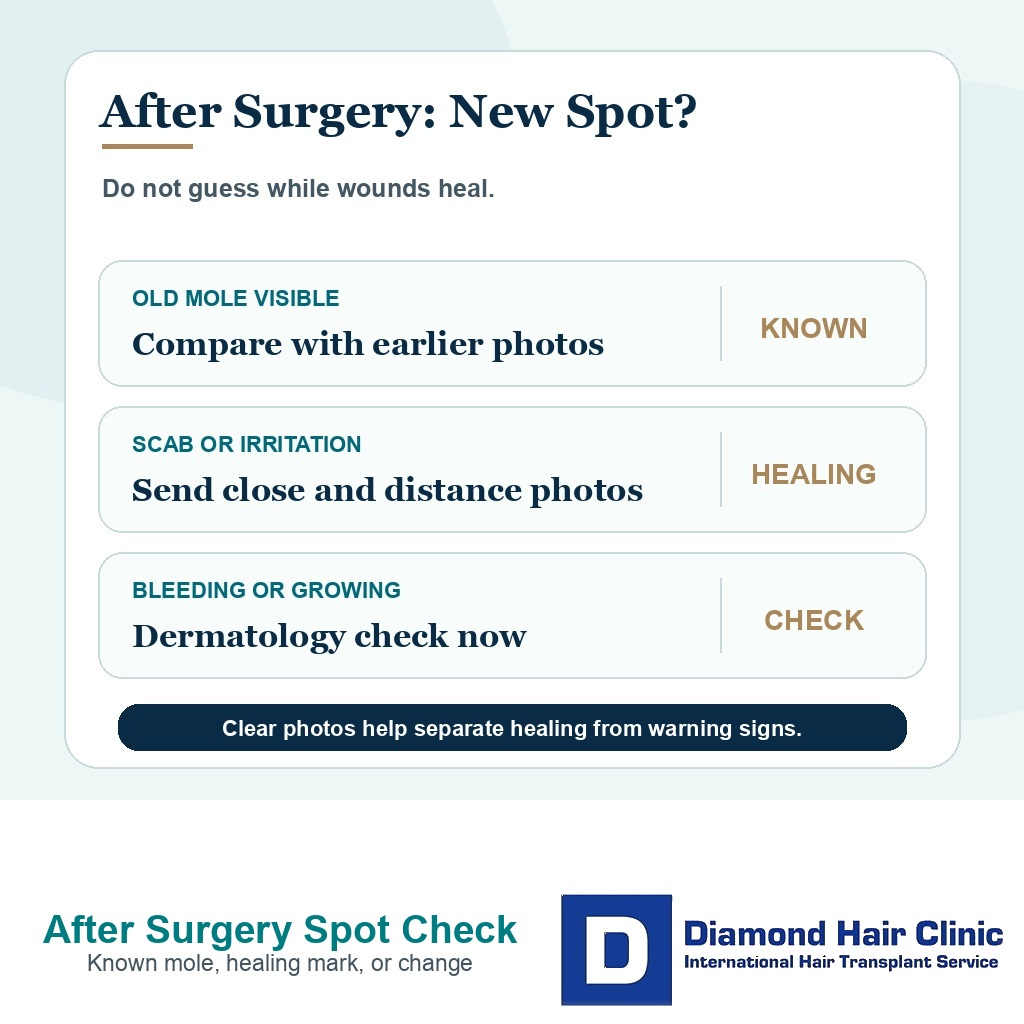
A spot noticed after surgery may be a mole that was hidden under hair before shaving. It may also be a scab, dried blood, irritation, folliculitis, pigment change, bruising, or a skin lesion that deserves examination. Compare it with old photos if available, then send clear current photos to the clinic.
A healing explanation is reasonable only when the spot follows the expected healing pattern. A lesion that is new, changing, painful, bleeding, crusting, enlarging, uncertain, or different from the surrounding healing dots needs review instead of reassurance from a phone photo alone.
Early after surgery, color changes can confuse patients. Dark scalp color after FUE, redness, scabs, and healing dots can all look alarming in a close photo, but redness, scabs, or pimples after hair transplant need attention when the skin is becoming more irritated instead of calmer.
Do not scratch, pick, laser, shave off, or apply strong creams to a new spot after surgery without medical review. The grafted area and donor area are healing wounds. The wrong home treatment can create irritation, infection risk, or a scar that becomes harder to correct than the original concern.
Birthmarks, scars, and graft survival need a different plan
Sometimes a hair transplant can improve coverage over a scar, birthmark area, or previous surgical reconstruction. It is not the same as routine density work on healthy scalp. Scarred or previously operated skin may have different blood supply, stiffness, thickness, and healing behavior. The graft number may need to be lower, the session may need to be staged, and the cosmetic goal may be camouflage rather than full density.
Promises become risky here. A large congenital birthmark, tissue expansion history, burn scar, or old surgical scar is not routine hairline lowering work. I have to judge the skin, donor supply, age, ability to protect grafts after surgery, and whether a non surgical option is safer first.
For scarred areas, I usually prefer conservative test planning rather than a large first session. If the skin accepts grafts well, the plan can sometimes continue. If survival is weak, pushing more grafts into the same tissue only wastes donor hair.
Photos to send before booking
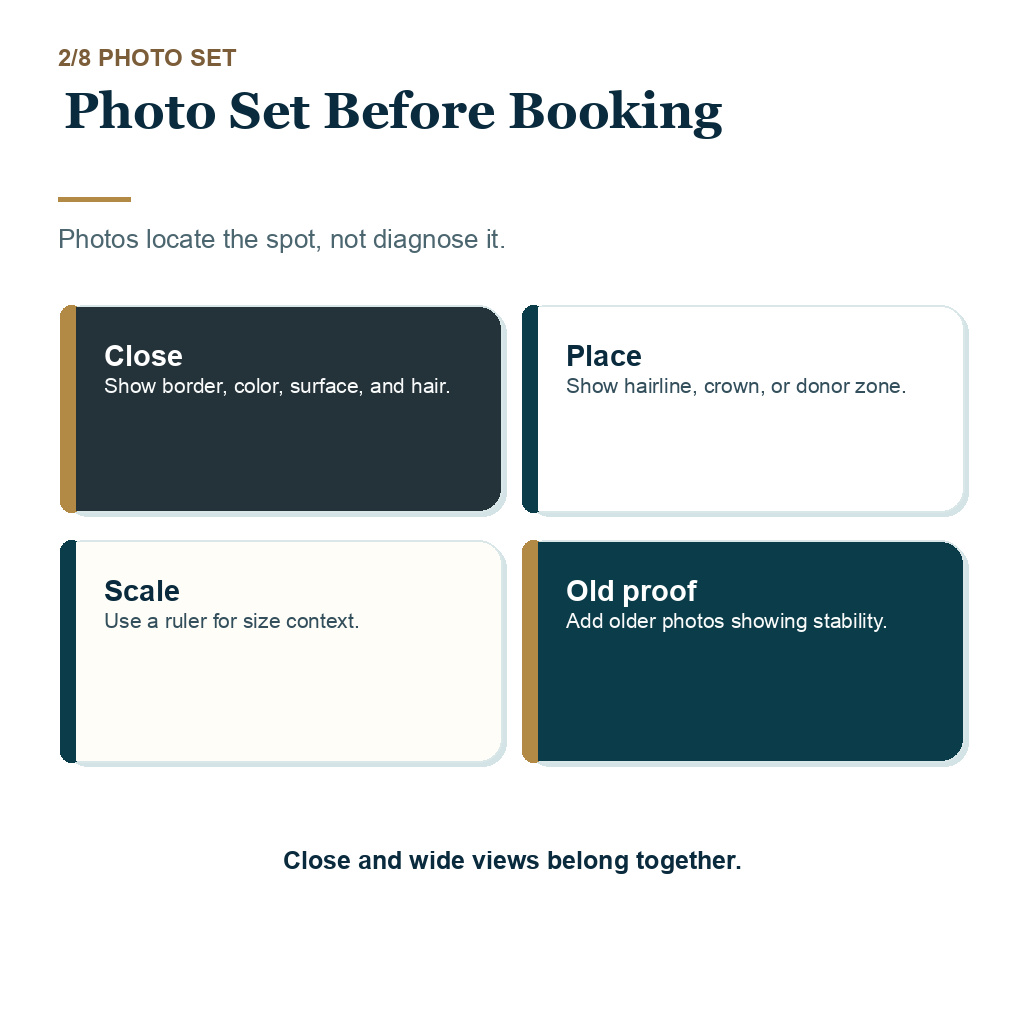
Send close, clear photos of the spot and wider photos that show where it sits in the hairline, crown, donor area, or scar. Part the hair around it, include a ruler or another simple scale if possible, and avoid filters or heavy flash that changes the color. Include old photos if the spot was visible before. If the mole was removed, send the dermatology note, pathology result if there was one, date of removal, and a current photo of the healed area.
Photo review helps planning, but it has limits. A picture can show size, position, color contrast, and whether the lesion interferes with the proposed design, but hair transplant planning from photos alone cannot reliably diagnose every skin lesion. Suspicious or unclear skin findings need a different standard, such as dermatoscope examination, biopsy, removal, or monitoring by the right clinician when indicated.
Share your normal haircut with the clinic. A mole hidden under longer hair may become visible with a buzz cut. A donor area birthmark may matter more for someone who wears a low fade. A small scar at the frontal hairline may matter more for someone who styles the hair backward.
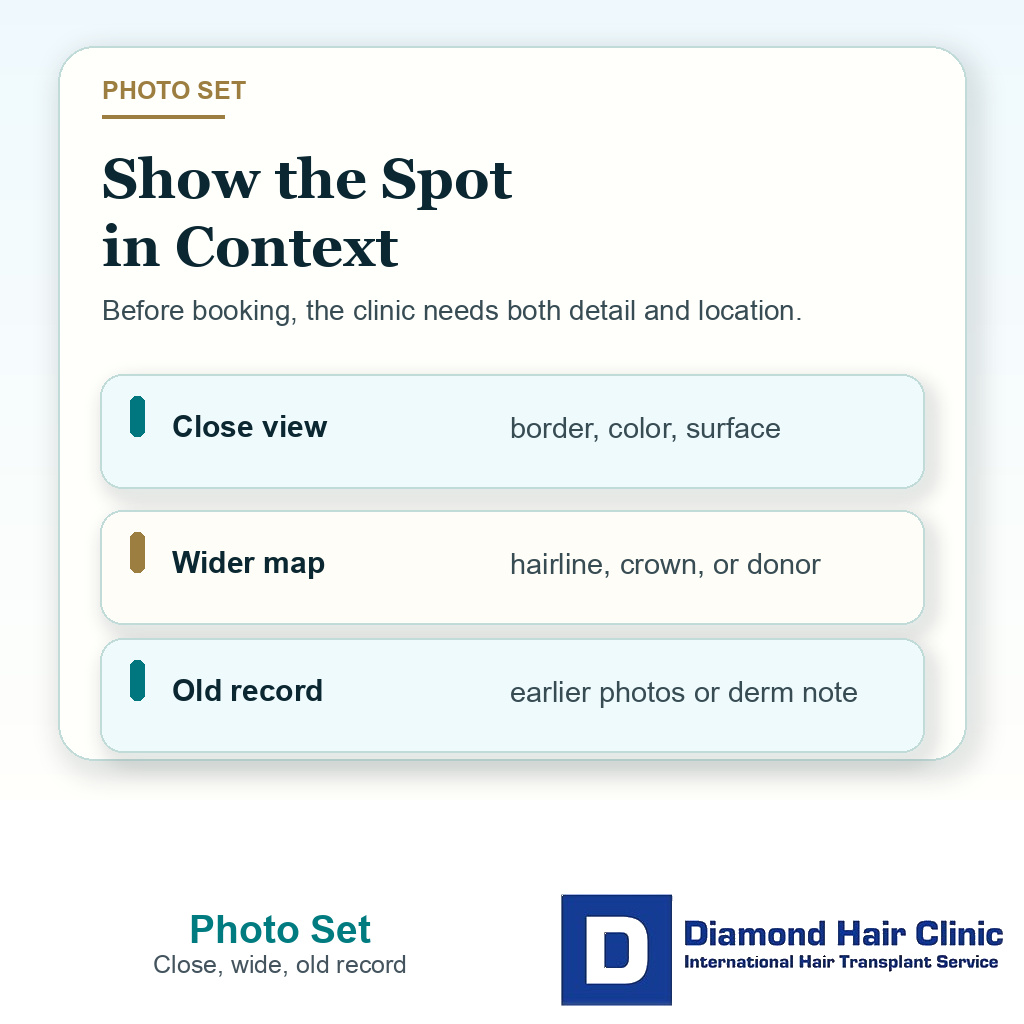
For mole review before booking, send both close detail and wider location photos, plus older photos or dermatology notes if available.
Use the 8 scalp mole planning slides below to separate clearance history, photo evidence, dermatology review, incision planning, hairline design, donor area marks, consent details, and which details matter before booking. Swipe the carousel, use the arrows one step at a time, or choose a number below the image to jump to that point.


A mole can change the hairline plan
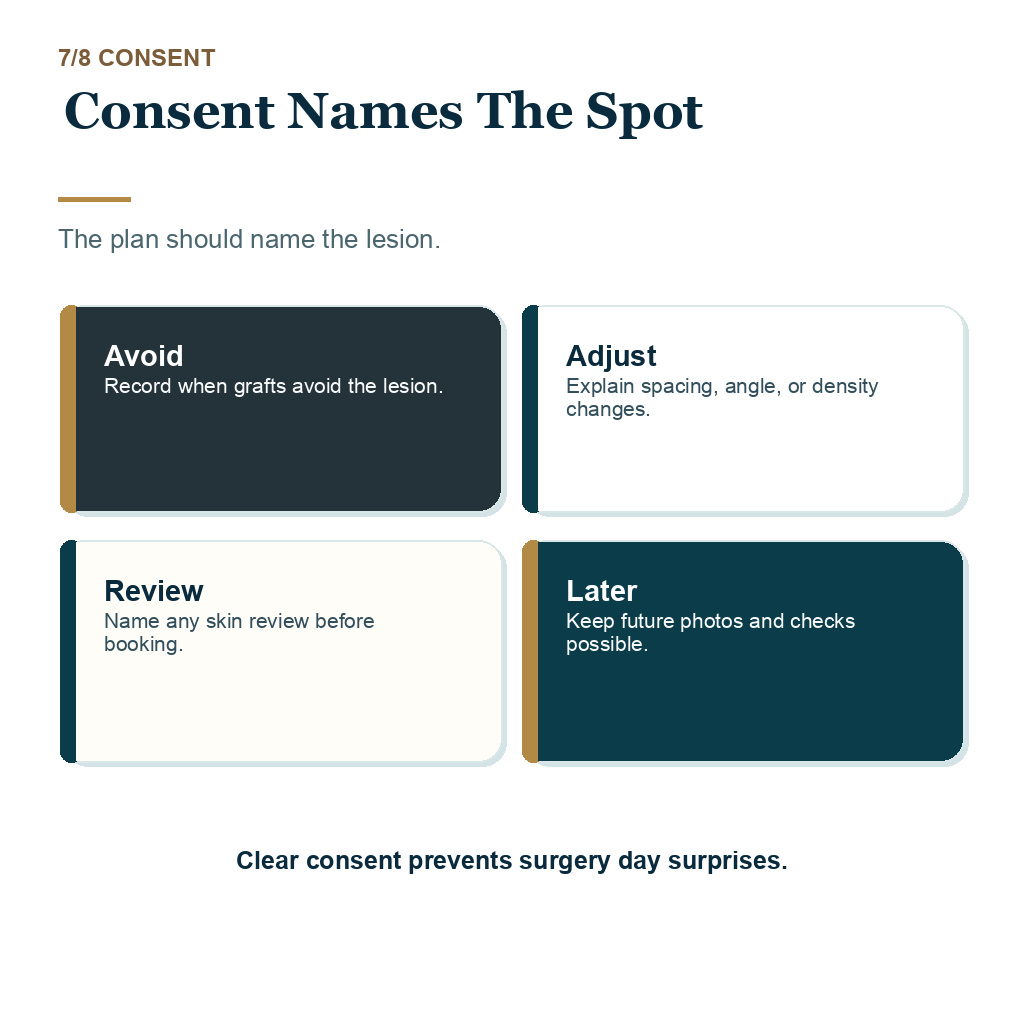
A mole or raised spot near the hairline can change placement, density, and direction. If the lesion is exactly where the planned hairline would sit, I may soften the line, leave a tiny unplanted margin, change the angle of nearby grafts, or recommend dermatology clearance before final design. The hairline must look natural on day one while still protecting future monitoring or removal if the lesion ever needs it.
This belongs in the consent discussion. Hair transplant consent before surgery needs to say whether the mole will be avoided, grafted around, removed first, photographed for monitoring, or left unchanged. It also needs to record whether the spot was cleared by dermatology or only noted for surgical avoidance. Consent is weaker when the hairline looks approved on a screen but a real skin finding has not been discussed.
A small adjustment can protect both the cosmetic result and the medical record. That is better than pretending the skin issue does not exist until you notice it in the mirror after surgery.
Reasons surgery should be delayed
I delay the procedure if the lesion is changing, bleeding, painful, crusting, irregular, unexplained, recently removed but not healed, or awaiting pathology. I also delay when there is active scalp inflammation around the area, recent infection, sunburn, or a skin condition that makes healing unpredictable. Sunburned scalp and hair transplant timing belongs in that skin readiness review. The skin needs to be able to heal predictably before grafts are placed.
A delay can protect donor hair from being spent through uncertain skin. Hair transplant surgery can be rescheduled. A missed skin diagnosis, poor scar placement, or avoidable graft loss is harder to undo.
The right order is skin diagnosis first, stable healing second, hair transplant design third. If the skin is safe and the cosmetic plan still makes sense, the operation can move forward with a clearer map.
A mole has to stay visible to the doctor
A scalp mole or raised spot should be shown clearly before booking, especially if it has changed, bled, crusted, grown, or sits inside the planned recipient or donor area.
Some moles only need to be avoided during graft placement. Others need dermatology review or removal before surgery timing can be trusted. The unsafe choice is hiding the spot with hair, fibers, filters, or selective photographs.
FUE is planned through living skin that still needs future monitoring. A careful delay for skin clearance is not wasted time when it protects diagnosis, graft placement, and long term scalp safety.
Read this review excerpt
I asked two questions at all the clinics: how many patients will you take in a day and how much of the work will be done by the doctor.