


Scalp Itching Needs Review Before Surgery
If your scalp is mildly itchy before a hair transplant, surgery may still be possible. I do not judge the decision from the word itch alone. I need to see whether the skin is stable enough for surgery. Mild dry flaking is different from red, painful, crusted, bleeding, pustular, wet, hot, or repeatedly scratched skin. When I see active inflammation, I treat the scalp first instead of placing grafts into a reactive surgical field.
Itching after a new product
On this page I separate mild itch from red, painful, crusted, bleeding, pustular, wet, hot, or scratched skin. If the itch began after a shampoo, serum, oil, dye, or topical treatment, product irritation before FUE gives that product timeline a clearer place in the surgery review.
A hair transplant is elective surgery. The scalp should be clear enough to examine, clean safely, open precisely, and heal predictably. If the itch is mild and controlled, the plan may continue. If it points to seborrheic dermatitis, eczema, psoriasis, folliculitis, infection, or an unclear inflammatory disease, the timing has to be reviewed before travel and before surgery day.
Bring the product timeline with the symptom. A new minoxidil formula, dandruff shampoo, styling product, or oil can matter as much as the itch itself.
Mild scalp itch can still allow surgery
Mild dryness, controlled dandruff, or occasional itching does not by itself make you a poor candidate. Before I decide, the visible scalp condition, diagnosis, recent pattern, and treatment history need to fit the surgery plan.
The scalp does not need to be perfect. It needs to be stable enough for the procedure. If the skin is quiet, there is no broken surface, no spreading redness, no pus, and no uncontrolled scratching, surgery may remain reasonable. If the itch is intense enough that you keep touching or scratching the scalp, the early recovery period becomes harder and riskier.
The worst approach is hiding the symptom because the date or flight is already booked. Send the clinic a clear description of what is happening. Clear photos, the shampoo or medicine name, how long it has been present, and whether it is improving all matter more than one word like dandruff or itch. An itchy thinning area also does not prove that hair loss is suddenly accelerating. I judge the visible skin first, then the hair loss pattern. If the itch started after color, bleach, or developer, review hair dye before hair transplant before assuming the scalp is ready for FUE.
If itching makes you scratch without noticing, say that clearly. Surgery planning changes when the skin looks mild but the hands keep reaching the planned donor or recipient area.
Lower risk itchy scalp signs
Itching is lower risk when it is mild, short lived, and not linked to visible inflammation. The scalp may feel a little dry after a shampoo change, seasonal weather change, travel stress, or hair product irritation. There may be a few small flakes, but the skin is not raw, wet, swollen, hot, painful, or covered with thick scale.
A recent new product still matters. If the itch began after hair dye, bleaching, cosmetic oil, fiber spray, fragrance, or a medicated scalp product, I want to know the exact timing. Contact irritation can look small at first, then become more obvious after shaving, disinfecting, and several hours of surgical handling.
Even a small symptom belongs in the review before surgery because it can become bigger after the scalp is shaved, washed differently, disinfected, and handled for several hours. If the scalp looks quiet and you can avoid scratching, this is often a planning detail rather than a reason to cancel the procedure. The clinic should know about it before travel, not only on the morning of surgery.
The clinic may adjust the washing plan, ask for updated photos, or advise a gentler routine before travel. That is different from giving medical clearance to ignore an active flare.
Itching can delay surgery when signs are active
Itching becomes more concerning when it comes with visible inflammation. I pay close attention to spreading redness, thick scale, bleeding from scratching, wet crusts, pus, painful bumps, heat, bad smell, fever, or a flare that keeps returning. Those signs suggest that the skin may not be ready for thousands of small surgical openings.
Delay can feel frustrating, especially when flights, hotel dates, and time away from work are already arranged. But operating through unstable scalp skin can create more uncertainty than postponing. It can make the surgical field harder to read, increase discomfort, confuse early healing, and make you panic over every red spot after surgery.
If the scalp needs treatment, settle it first, document the improvement, and then return to the transplant plan with a quieter skin surface.

Itching is judged by the condition of the skin. Mild dry flakes are different from active inflammation.
Dandruff, seborrheic dermatitis, and timing
Dandruff and seborrheic dermatitis before hair transplant surgery are common reasons people worry before their operation. Mild controlled flakes are one thing. Heavy oily scale, redness, soreness, and repeated itching are another.
Seborrheic dermatitis tends to come and go, so I plan around a controlled window rather than a permanent cure. If the scalp has been quiet for a reasonable period and the patient knows how to maintain it without harsh product use, surgery may be possible. If the scalp flares whenever treatment pauses, I need the treatment plan clarified before surgery.
Dandruff alone does not predict graft failure. Scalp control is the real issue. Mild dry flakes on quiet skin are very different from a red, greasy, itchy scalp that is being scratched every day.
Pimples, folliculitis, pus, and medical review
Pimples, pustules, pus, painful bumps, and recurrent scalp acne need a more careful review. For folliculitis and hair transplant timing, active infection or active follicle inflammation should be controlled before elective hair surgery.
Folliculitis can be mild, but it can also be stubborn, recurrent, or part of a deeper scalp condition. If there are many bumps, drainage, crusting, tenderness, or donor area involvement, I do not treat it as a cosmetic nuisance. I want to know whether it is bacterial, related to yeast, triggered by a product, connected with acne, or a sign of another inflammatory diagnosis.
Pus or painful active bumps on the scalp should be reviewed before grafts are moved. You may need photos, examination, prescription treatment, or a dermatologist’s input before a transplant date is considered safe.
Suspected contagious or spreading scalp disease is different from simple dandruff. Ring shaped scaling or patchy hair breakage may raise the question of tinea capitis before hair transplant. Visible nits, spreading tender plaques, swollen neck nodes, or symptoms shared by family members should also be checked before travel. With these signs, diagnosis and treatment come first, not hiding the scalp long enough for surgery.
Medicated shampoo changes before surgery
Medicated shampoo routines should stay consistent during the final days before surgery unless the clinic or prescribing doctor gives a reason to change them. A shampoo that helps one scalp may irritate another, especially when it is used too often or close to surgery day. Ketoconazole, selenium sulfide, zinc pyrithione, coal tar, salicylic acid, and steroid scalp solutions all need context.
If you already use a prescription or strong dandruff product, share the exact name, strength, frequency, and last use. Product permission is only part of the decision. The more useful detail is whether the skin is stable without it, whether stopping it triggers a flare, and whether using it too close to surgery could irritate the scalp.
New hair dye, bleach, keratin treatment, heavy oils, strong fragrance products, or several new shampoos are poor tests in the final days before surgery. If one of them triggered the itch, stopping the irritant and documenting improvement is more useful than adding multiple new treatments at once.
If ketoconazole is part of your routine, ketoconazole shampoo after hair transplant has stricter timing rules after grafts are placed than it has before surgery. Before surgery, the decision is more individual and the goal is to keep the scalp controlled without creating new irritation.
Psoriasis, eczema, scarring alopecia, and planning
Scalp eczema, scalp psoriasis, and inflammatory scarring conditions do not all behave the same way. The word itch can hide very different diagnoses.
Psoriasis may create thick scale, bleeding from scratching, soreness, and flare cycles. Eczema may mean a weak skin barrier, contact allergy, or product sensitivity. Scarring alopecia, including lichen planopilaris and other scarring alopecia patterns, can destroy follicles and change candidacy completely.
Burning, tenderness, shiny skin, loss of follicle openings, expanding patches, eyebrow loss, or symptoms that keep returning despite treatment change the plan. I do not handle that like ordinary male pattern hair loss. The diagnosis must be clear first.
Photos to send before travelling
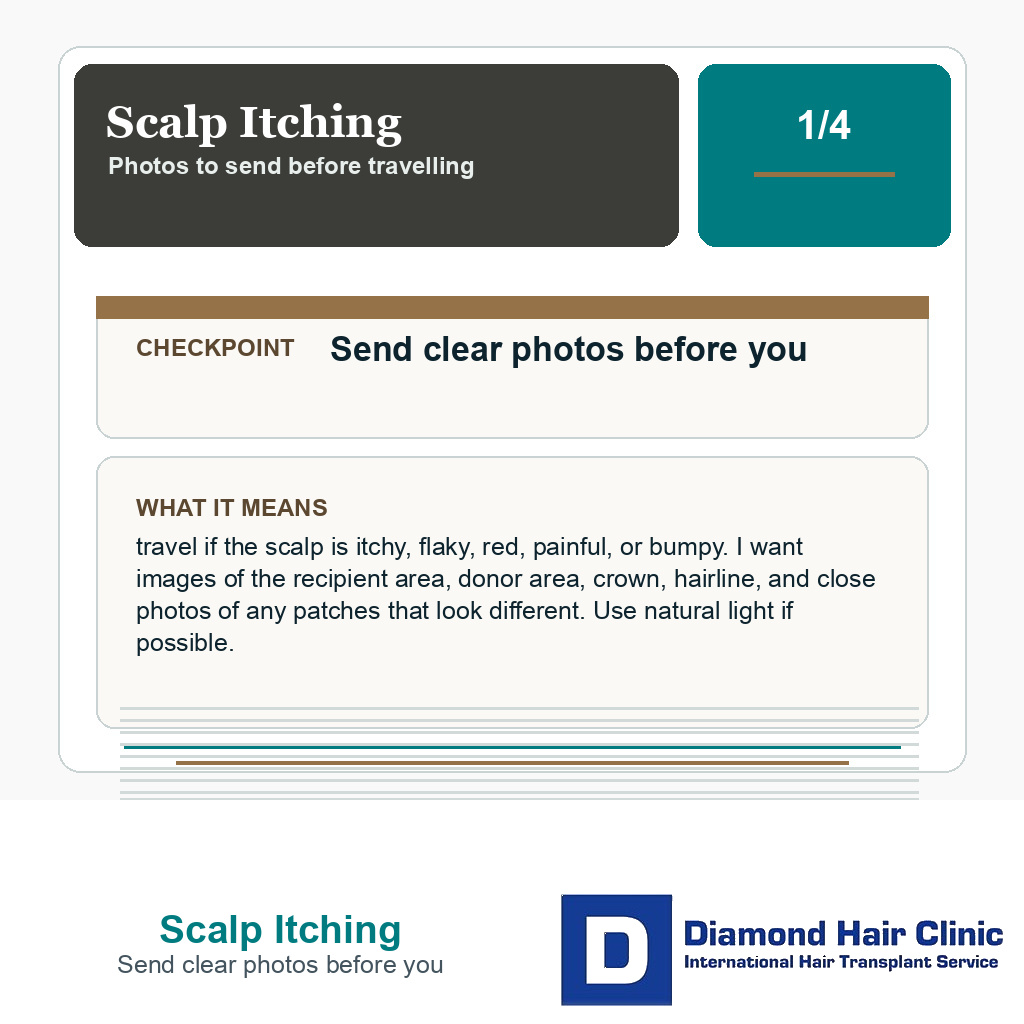
Share clear photos before travel if the scalp is itchy, flaky, red, painful, or bumpy. I want images of the recipient area, donor area, crown, hairline, and close photos of any patches that look different. Use natural light if possible. Do not hide the problem with wet hair, styling product, heavy oil, fibers, or a hat. If the trip is close, send the photos the same day the flare appears rather than waiting until arrival in Istanbul. For product residue on that same morning, FUE morning starts with clean skin explains why disclosure and photos are better than extra scrubbing.
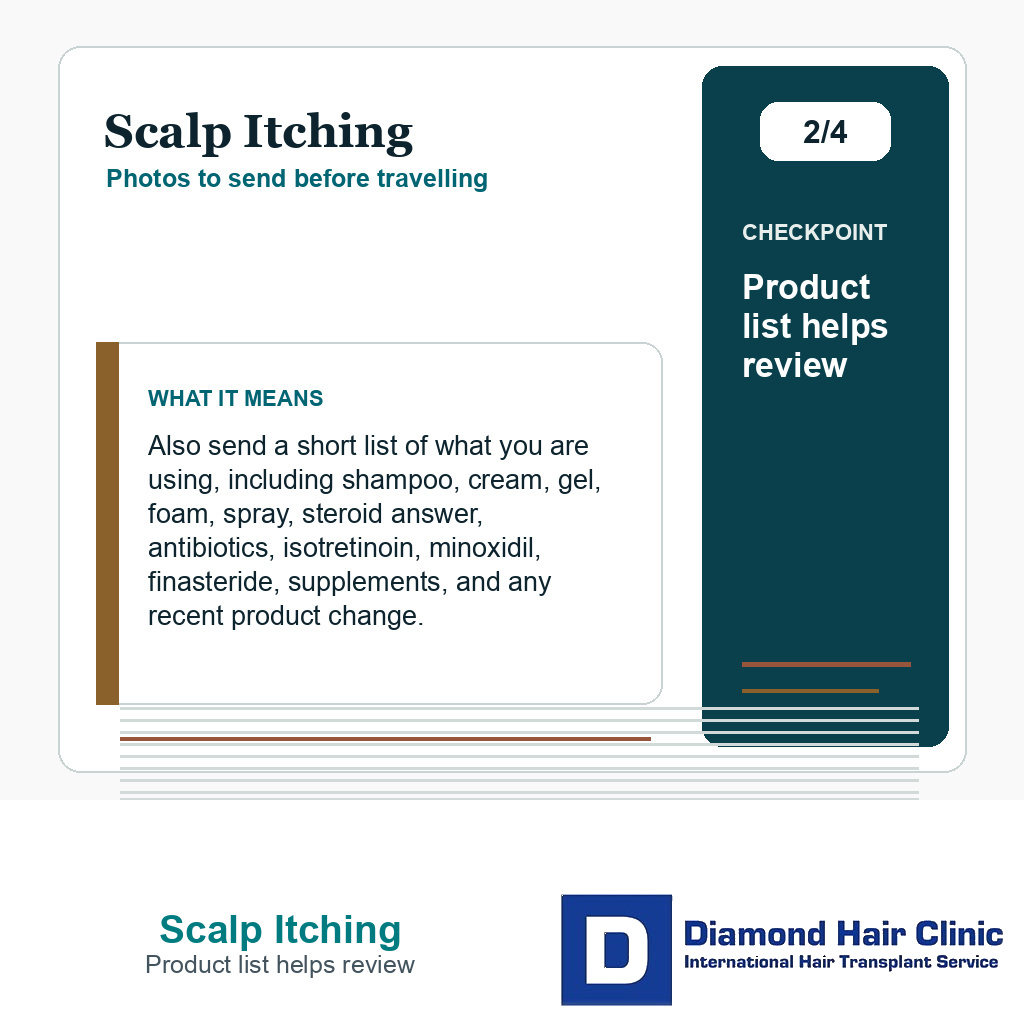
Also send a short list of what you are using, including shampoo, cream, gel, foam, spray, steroid solution, antibiotics, isotretinoin, minoxidil, finasteride, supplements, and any recent product change. If another doctor prescribed the treatment, include the diagnosis and timing.
These details can prevent you from flying with an active scalp problem that needs treatment first. A clear photo set can also show whether the concern is mainly dandruff, dermatitis, folliculitis, psoriasis, eczema, or a pattern that deserves in person dermatology review.
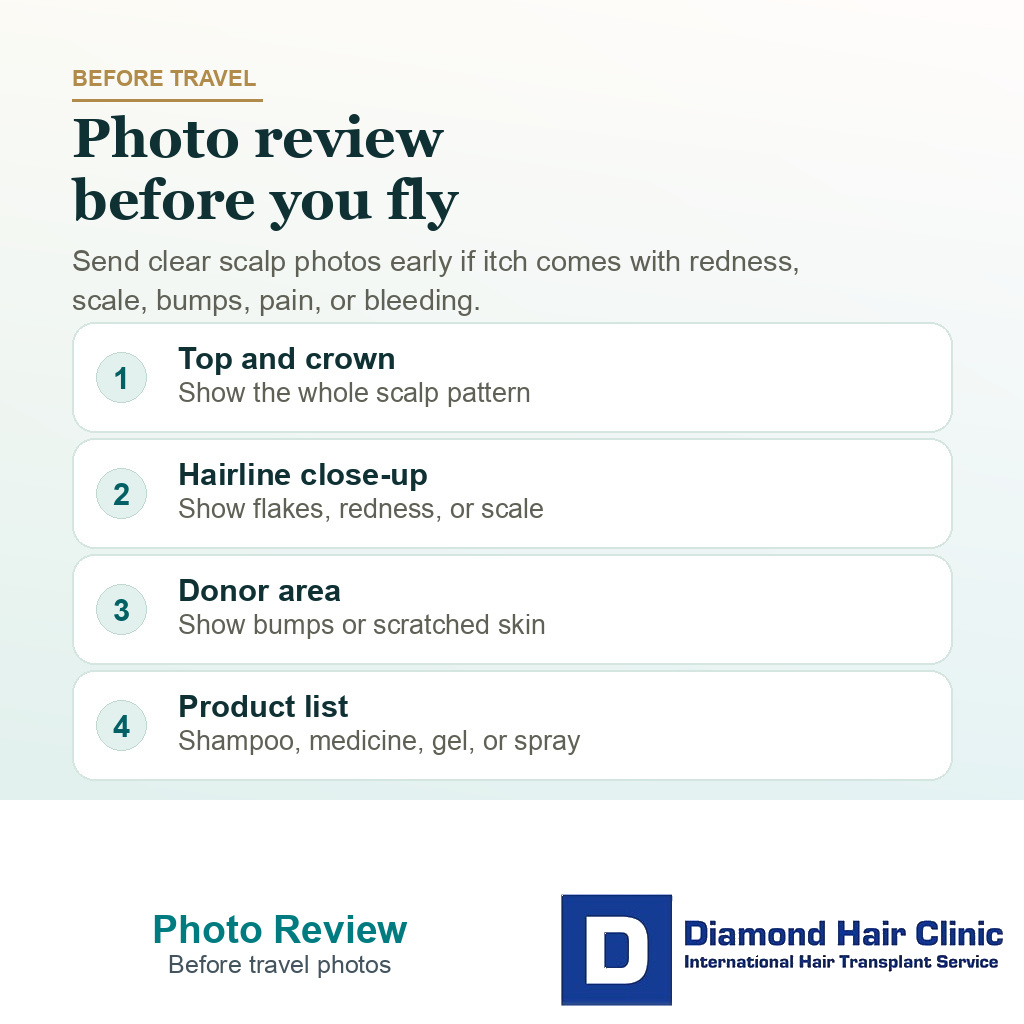
Clear photos before travel help separate mild irritation from a flare that needs treatment first.
Scalp itching before surgery matters when the skin is irritated, and these 4 slides connect scratching, products, diagnosis, and timing. Swipe sideways, use the arrows, or choose a number below the image.

The donor area needs stable skin
The donor area matters as much as the hairline. In FUE, grafts are removed from the donor region. If that area is inflamed, full of bumps, scratched, infected, or scarred, extraction becomes less predictable.
I need the donor area to be clean, visible, and stable. You may be focused on the frontal hairline, but the donor area is the limited resource. If the donor skin is irritated, the decision is not only about comfort. It also affects how accurately grafts can be selected and how the area may heal after extraction.
Acne medication and skin drying medicines also matter. Isotretinoin and hair transplant timing can change the planning discussion when dryness, acne, or folliculitis is active.
A flare close to surgery can change timing
If the scalp flares close to surgery day, ask for clinic review before you arrive for the operation. Do not scratch harder, scrub aggressively, add leftover antibiotics, or start a strong new product without guidance. Those actions can make the scalp harder to interpret.
If the flare involves pus, a wet crust, fever, a rapidly spreading red area, or a painful donor site, the timing may need to change before you travel. A late transplant date should not force an infected or actively inflamed scalp into surgery just because flights are already arranged.
A mild flare may lead to a modified washing plan or closer review. A stronger flare can lead to postponement. I pay special attention to fever, spreading infection, draining bumps, painful crusts, bleeding scale, or a flare that affects the planned donor or recipient area.
If antibiotics are involved, antibiotics before hair transplant surgery are judged by the diagnosis more than the tablet name. I need to understand the reason for treatment, not only the product being used.
Itching before surgery versus itching after transplant
Itch before surgery is a candidacy and timing question. It tells me about the condition of the skin before we start. Itching after surgery is usually a healing and graft protection question, which is covered separately in itching after hair transplant recovery.
After surgery, itching often happens because crusts dry, the donor area heals, and nerves recover. Before surgery, itching may come from dermatitis, product irritation, folliculitis, psoriasis, eczema, or infection. These are different problems even though the symptom sounds similar.
That distinction matters because transplant surgery can make an uncontrolled scalp problem harder to manage. The cleaner decision is to treat active scalp disease before grafts are placed, then protect the scalp during recovery.
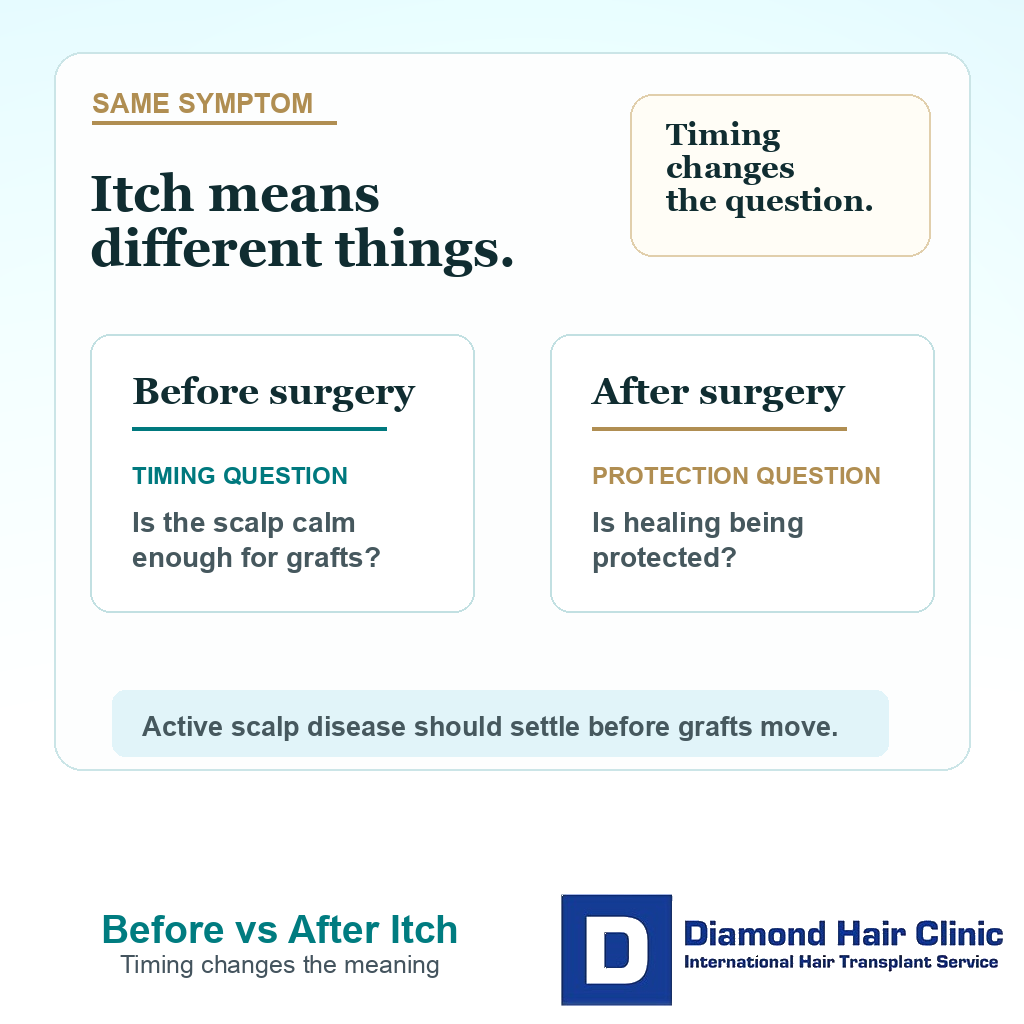
Itching before surgery and itching after surgery can sound similar, but they are judged for different reasons.
An itchy scalp should be quiet before grafts move
My decision is based on the scalp in front of me, not on anxiety, travel pressure, or the desire to keep a booked date. If the scalp is mildly itchy but clean, stable, and controlled, we can often continue with a careful plan. If there is active inflammation, broken skin, pus, bleeding, painful scale, repeated scratching, or an uncertain diagnosis, waiting is usually the more responsible choice.
The scalp should be quiet enough for precise surgery and predictable healing. A previous skin problem does not block a hair transplant by itself. Timing still has to respect the skin.
If your scalp is itchy before surgery, send photos early, list every product and medicine, and be clear about scratching, pain, bleeding, dandruff, bumps, or recent flares. A short delay to settle the skin is easier than trying to repair a rushed decision after grafts have already been moved.

Read this review excerpt
Upon arriving home, I sent 4 photos (of each side of head) after every washing process to doctor for checking where I was given personal advice for how to take care of my healing head.