



Isotretinoin, Accutane, and Hair Transplant Timing
If you are taking isotretinoin, often known by the older brand name Accutane, a hair transplant is not impossible by itself, but I would not plan it casually. I look at why you are taking the medicine, your dose, how your skin is reacting, whether your scalp has active acne or folliculitis, and whether your dermatologist agrees that surgery can be timed safely. If those details are unclear, I delay the operation rather than asking the scalp to heal under uncertain conditions.
The key distinction is the state of the skin. A patient taking a stable low dose for facial acne with settled scalp skin is very different from a patient who has just started treatment, has active scalp acne, painful folliculitis, cracked dryness, repeated nosebleeds, mood changes, or unclear dermatologist instructions. A dry, cracked, inflamed, or recently irritated scalp can change timing even when the hairline design itself looks straightforward. For isotretinoin, useful disclosure is more than the word Accutane. Include the dose, current schedule, why it was prescribed, and whether the scalp still has acne, cracks, scabs, or irritation.
Topical retinoids need timing based on scalp tolerance. The timing for topical tretinoin after FUE depends on whether the scalp surface is calm enough for an irritating active.
This is not caution for its own sake. Hair transplantation depends on controlled skin healing. Isotretinoin changes oil production, skin dryness, inflammation, and sometimes how patients tolerate procedures. A patient may look like a good transplant candidate from the hairline, while the scalp itself is not ready for thousands of small surgical openings.
The unsafe decision is treating acne medication as unrelated to hair surgery. I review every medication that affects the skin, the scalp, bleeding, immunity, or healing. A hair transplant needs planning around the patient in front of me, not around a standard checklist.
There is also an emotional side to this question. Acne and hair loss can both affect how a person feels in daily life, and many patients are tired of waiting. But when two cosmetic concerns overlap, rushing is not the answer. I first need to know which problem should be stabilized so the final result has the best chance of healing cleanly.
Isotretinoin can change the transplant decision
Isotretinoin is a powerful medicine. It can be very helpful for severe acne, but it also tells me that the skin history matters. A patient who needs isotretinoin may have had inflamed acne, cysts, oily scalp, folliculitis, or scarring. These are not small details when we are planning surgery on the scalp.
I first review why the patient is taking it. Is it for facial acne only, scalp acne, recurrent folliculitis, oily skin, or a severe inflammatory skin pattern? A patient taking a low dose for maintenance is not the same as a patient who started treatment recently for active cystic acne. The surgical risk is different.
The second question is how the skin is behaving now. Dryness, cracking, irritation, active pimples, scabs, infection, or inflamed scalp skin can change the plan. I try not to implant grafts into skin that is already irritated. The recipient area needs a stable environment. The donor area also needs predictable healing.
For that reason, broad advice about medication before a hair transplant must be made specific to the patient. Some medications mainly affect hair loss strategy. Others affect the surgical day, skin behavior, or healing. For many patients, isotretinoin falls into that second category because it can change surgical timing, scalp behavior, and healing.
I also review any skin procedures the patient has already had while taking isotretinoin. Some patients have had minor dermatological treatments without difficulty. Others have been told to avoid procedures until their course is finished. Those details do not always decide the hair transplant, but they help me understand how cautious the plan should be.
A stable dose and a calm scalp do not erase the need for coordination. I still want the dermatologist’s reason for treatment, recent skin behavior, and any planned restart to fit the surgical timeline.
Another point is dryness. A dry scalp is not always unsafe, but excessive dryness can make aftercare uncomfortable. If the patient is itching, peeling, or cracking before surgery, I expect more anxiety after surgery. A good surgical plan should reduce preventable anxiety, not create a situation where the patient feels they must scratch a healing scalp.
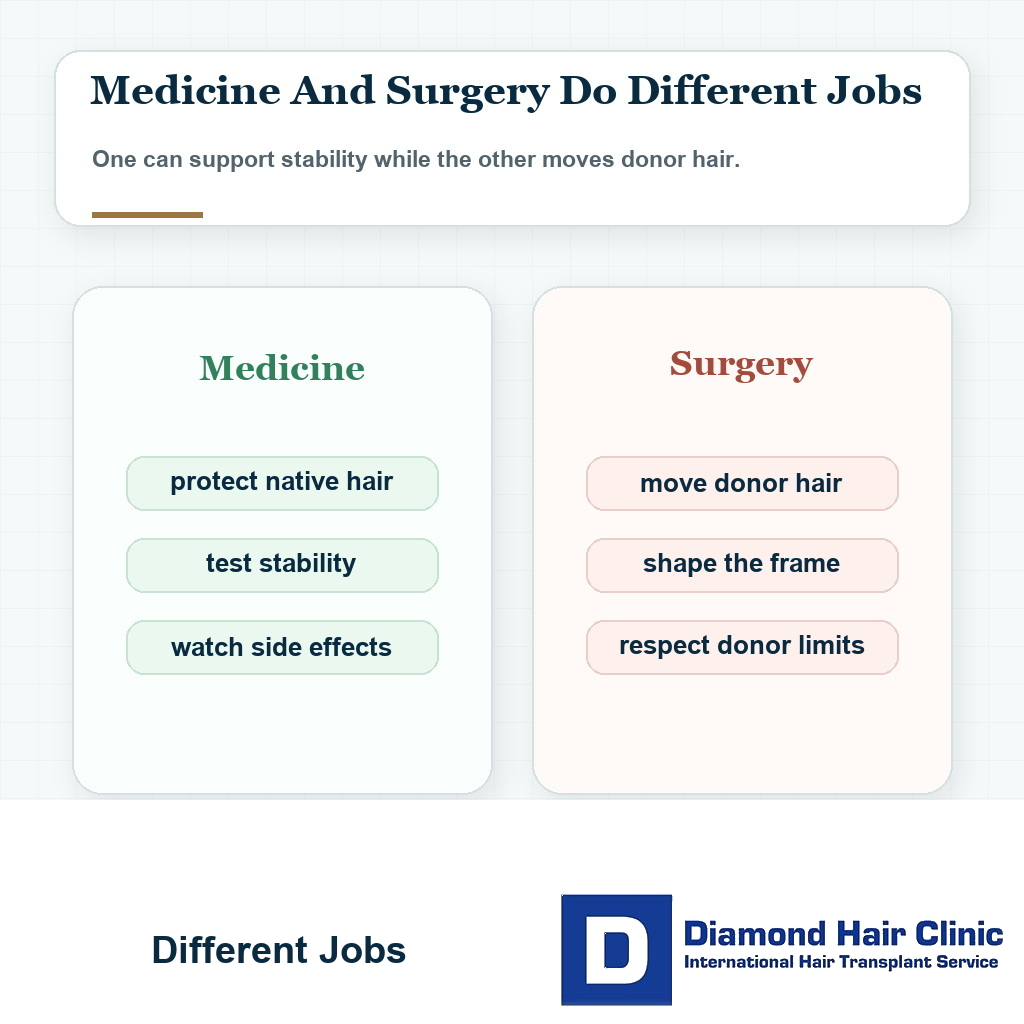
Scalp safety depends on skin condition and dose
Both extremes are weak. One extreme rejects every patient on isotretinoin without looking at the scalp. The other ignores the medicine and promises that it makes no difference. The responsible answer sits between those two positions.
If the scalp is settled, the acne is controlled, the patient is medically stable, and the dermatologist agrees with the timing, surgery may be discussed carefully. The plan may still need to be conservative. I may avoid a very large session because predictable healing matters more than proving how much the skin can tolerate.
If the scalp is actively inflamed, painful, infected, crusted, very dry, or covered with acne lesions, I do not rush. Active skin disease can make implantation harder and healing less predictable. It can also confuse the recovery period because the patient may not know whether redness or bumps are normal healing, acne, folliculitis, or irritation.
Old advice often turned isotretinoin into a fixed calendar rule, such as waiting three months or six months. That can be too simple. The safer question is whether the skin, medication plan, and prescribing doctor all support surgery. In some patients, delay is wise. In others, a carefully timed operation may be reasonable.
At the same time, I do not copy advice from small skin procedures and apply it blindly to hair transplantation. Some dermatology procedures may be acceptable earlier in patients whose case fits, but a hair transplant creates thousands of donor and recipient area openings. That makes the size of the session, scalp irritation, and aftercare behavior more important.
I try not to give a universal waiting period because that can become false precision. A patient on a low dose maintenance plan with settled skin and dermatologist approval is different from a patient on a high dose with active scalp lesions and severe dryness. The calendar matters less than the condition of the skin and the medical reason for the treatment.
Very dense packing also needs caution when the skin status is uncertain. Dense work asks more from the recipient area. If I am not fully confident in the scalp environment, the plan has to respect healing first. A natural result that heals well is better than an ambitious plan that creates prolonged irritation.
Waiting six months after isotretinoin is not always automatic
Patients often ask about the old six month waiting rule after isotretinoin. I do not treat that rule as an automatic ban for every patient and every skin procedure, but I also do not ignore the medication. Modern dermatology practice is less absolute for many procedures, yet hair transplantation is still different from a small facial treatment. It creates many donor and recipient area wounds, so the scalp condition still matters very much.
Six months is not a magic safety switch. In some cases, waiting that long is sensible. In others, the more important question is whether the scalp is settled, the acne is controlled, and the dermatologist is comfortable with the timing. A calendar date alone should not rush the operation, and it should not force a mechanical delay when the medical situation is already stable.
Do not let quick reassurance clear surgery after isotretinoin. The real clearance has to come from the skin itself, the reason the medicine was prescribed, and agreement between the dermatologist and the surgeon responsible for the operation.
My decision is based on the dose, timing, skin dryness, acne control, scalp inflammation, dermatologist advice, and the size of the planned transplant. A patient who finished a low dose course and has settled skin is not the same as a patient on a high dose with active scalp acne and painful lesions.
If I delay, I explain why. It may be because the scalp is still inflamed, because the dermatologist wants the course completed first, because dryness would make aftercare difficult, or because a large session would ask too much from uncertain skin. I would not aim to obey an old rule blindly. The purpose is to choose the safest biological moment for surgery.
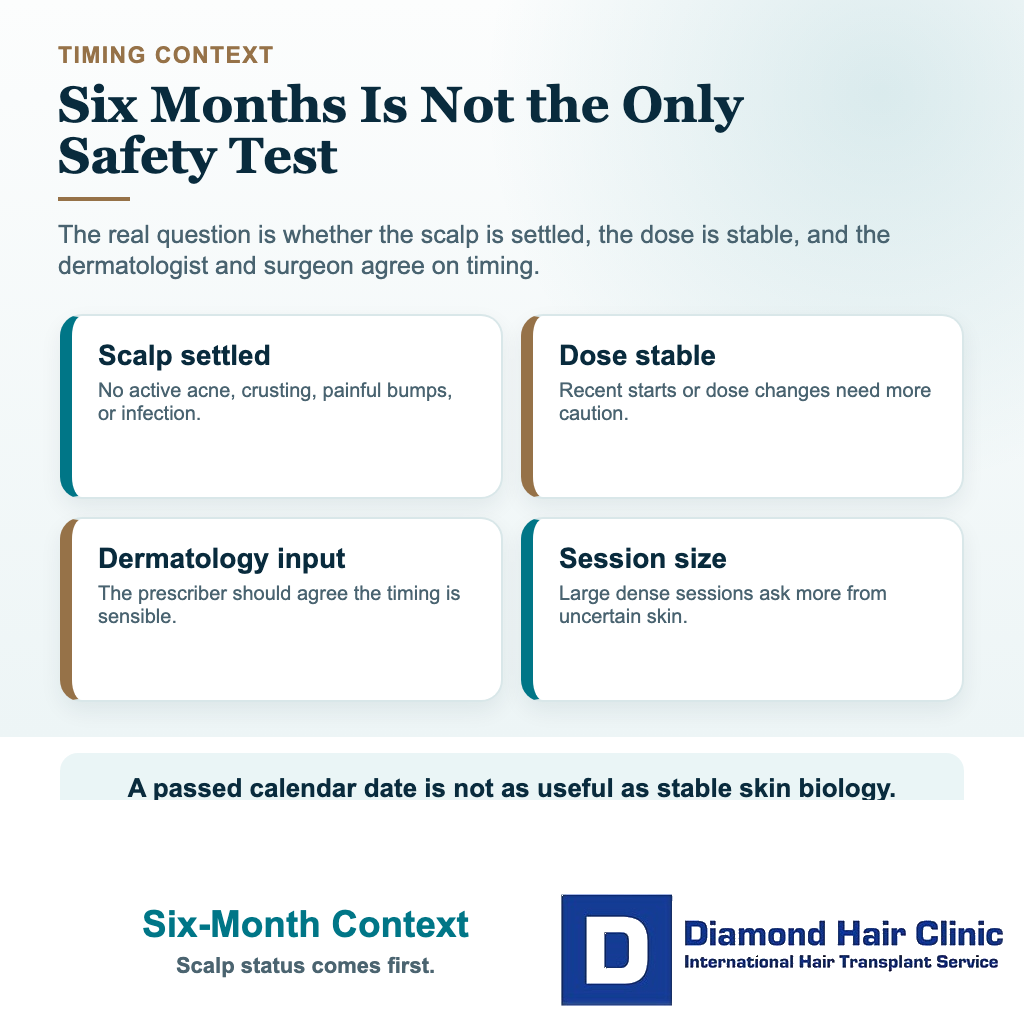
I would delay the operation when the scalp is not ready
I delay if isotretinoin was started recently, the dose was just changed, or the patient is still adjusting to the medicine. Early treatment can bring dryness, irritation, nosebleeds, mood changes, acne flares, and changes in skin sensitivity. I try not to add surgical trauma while the skin response is still uncertain.
I also delay if there are active pustules, painful scalp bumps, draining lesions, crusts, or signs of infection. Hair transplantation is elective. There is no benefit in operating through an irritated scalp when waiting may make the operation cleaner and safer.
Another reason to delay is unclear communication between the patient, dermatologist, and hair transplant surgeon. If the dermatologist recommends continuing the medicine without interruption, that needs to be understood. If the dermatologist recommends a pause, that instruction needs to be documented. The patient must not be trapped between conflicting instructions.
Sometimes the right decision is explained well by the broader idea of delaying a hair transplant because of medication. Delay does not mean the patient has failed. It means we are choosing a better biological moment for surgery.
I also delay if the patient is taking isotretinoin without medical supervision or is changing the dose alone. That tells me the medication plan is not stable. Hair transplant surgery should not be added to a situation where the patient is already experimenting with a strong prescription drug.
Another reason to delay is unrealistic pressure. Some patients say they want the transplant now because they are finishing university, changing jobs, or planning a wedding. I understand these life reasons, but skin biology does not adjust itself to a deadline. If the scalp is not ready, the safest surgeon should say so.
Acne or folliculitis can be a bigger issue than the medication
In some patients, the reason for taking isotretinoin matters more than the medicine itself. If the patient has severe scalp acne, recurrent folliculitis, or inflamed bumps in the donor or recipient area, that condition can be the real surgical issue.
Folliculitis can look small at first, but it can disturb the scalp environment. If the scalp is repeatedly inflamed, the surgeon must ask whether grafts will be placed into healthy skin. Hair transplantation is not only about moving follicles. It is also about choosing tissue that can accept those follicles reliably.
In practice, I separate acne, seborrheic dermatitis, psoriasis, and other scalp conditions. They can look similar to the patient, but they do not always require the same plan. Patients with greasy inflammation may benefit from reading about seborrheic dermatitis and hair transplant, while patients with immune driven plaques may need a different discussion about scalp psoriasis and hair transplant.
The point is diagnosis. If a clinic sees bumps and says no problem without asking what they are, that is a reason to be careful. If a clinic sees isotretinoin and rejects surgery forever without checking the scalp, that can also be too simplistic. The right path is careful diagnosis, not fear and not denial.
I assess distribution. A few old acne marks on the face are different from active pustules in the donor area. A patient with scalp folliculitis exactly where grafts will be extracted is a different case from a patient with facial acne only. The location of the disease changes the surgical risk.
Patients sometimes send close up photos after applying oil, gel, powder, or strong light. That can hide the true scalp condition. Clean, dry scalp photos are better when remote review is needed. Even then, I explain that photos cannot replace medical history when a prescription medicine is involved.
Restarting isotretinoin after hair transplant
This decision should be made with the dermatologist and the surgical team. I avoid patients restarting isotretinoin on their own immediately after surgery because they are worried about acne returning. The grafts and scalp need a quiet early healing period.
The practical difference is one small pimple versus a recurrent acne pattern that genuinely needs treatment. I avoid oral isotretinoin restarted for every small bump, but I also do not want severe acne ignored if the dermatologist believes control is needed.
The first days after surgery are about protecting the grafts, controlling swelling, washing correctly, and avoiding irritation. If the scalp becomes too dry, itchy, or inflamed, the patient may scratch, pick, or panic. Those behaviors can disturb healing more than the original acne concern.
After the early healing period, the decision depends on how the scalp looks, why the medicine is needed, and how urgent acne control is. If the patient has severe recurrent acne, delaying treatment too long may also be unwise. Coordination matters here. The answer should come from the surgical and dermatology context, not from a random instruction sheet.
Patients often read general lists about medications after hair transplant, but isotretinoin is not a casual add on. It is a prescription medicine with a specific dermatological reason. The restart plan should be individualized.
Patients should know what not to do. Do not restart isotretinoin because one pimple appears after surgery. Early bumps can have many causes, including irritation, trapped hairs, folliculitis, or normal skin reaction. Treating every bump aggressively can make the recovery more confusing.
If acne returns after surgery, the clinic and dermatologist should decide whether topical treatment, waiting, or restarting oral medication is best. The answer may change depending on whether grafts are still fragile, whether scabs have cleared, and whether the scalp is irritated. Communication matters more than a fixed online rule.
Pregnancy prevention rules still apply
If pregnancy prevention rules apply to the patient, isotretinoin must be managed strictly by the dermatologist. Hair transplant surgery cannot be used as a reason to loosen those rules. The medication plan, testing, contraception requirements, and timing belong under medical supervision.
This may sound separate from hair restoration, but it is not separate from patient safety. No elective hair transplant is worth rushing while the safety rules of a powerful prescription medicine are being ignored.
When that happens, the safest order is clear. The dermatology plan comes first, the scalp condition is reviewed, and the hair transplant decision waits until the medication timing is medically appropriate.
If testing windows, prescription timing, contraception rules, travel, or surgery dates conflict with each other, medication safety comes first. Moving the transplant is better than pushing the patient into a confused schedule around a medicine known to cause severe birth defects if pregnancy occurs.
Checks before surgery is scheduled
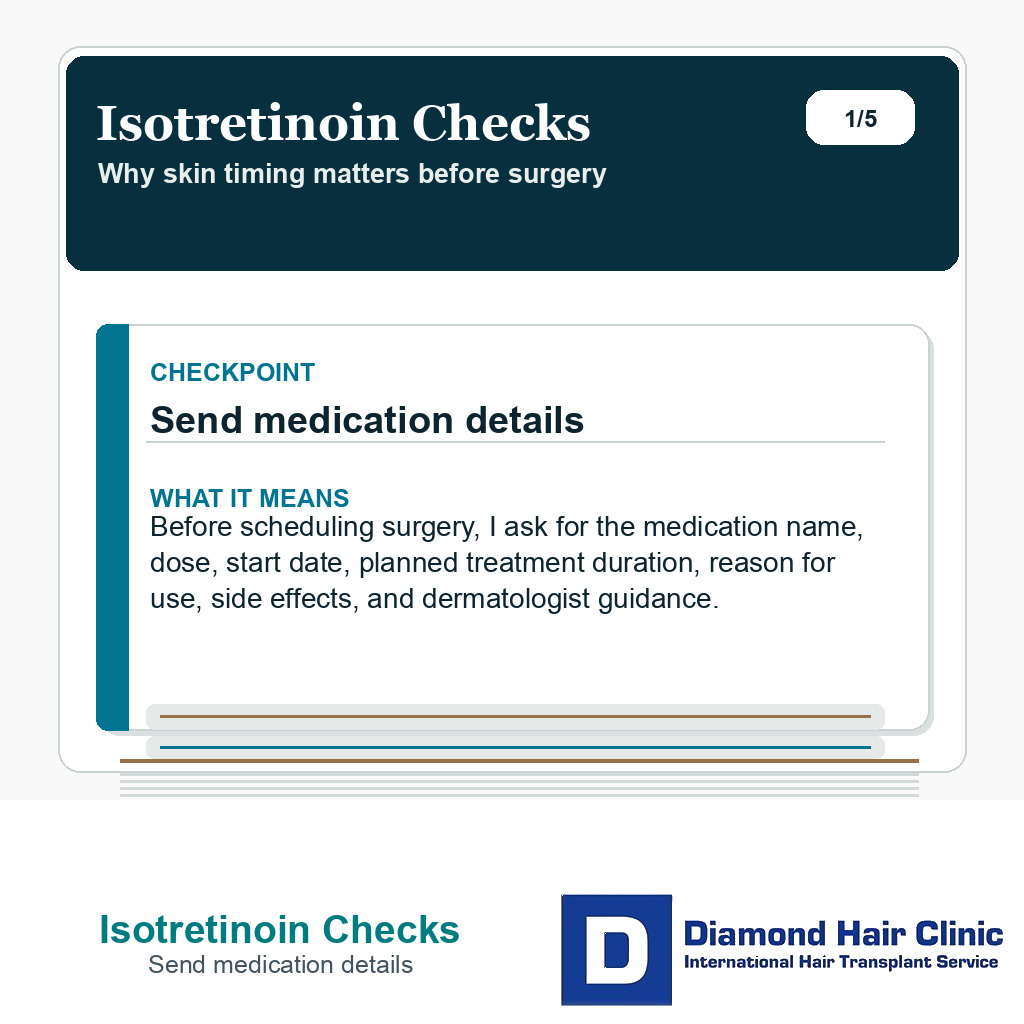
Before scheduling surgery, I ask for the medication name, dose, start date, planned treatment duration, reason for use, side effects, and dermatologist guidance. I ask about previous wound healing, scarring, nosebleeds, severe dryness, mood changes, vision symptoms, muscle or joint pain, and any history of infection.
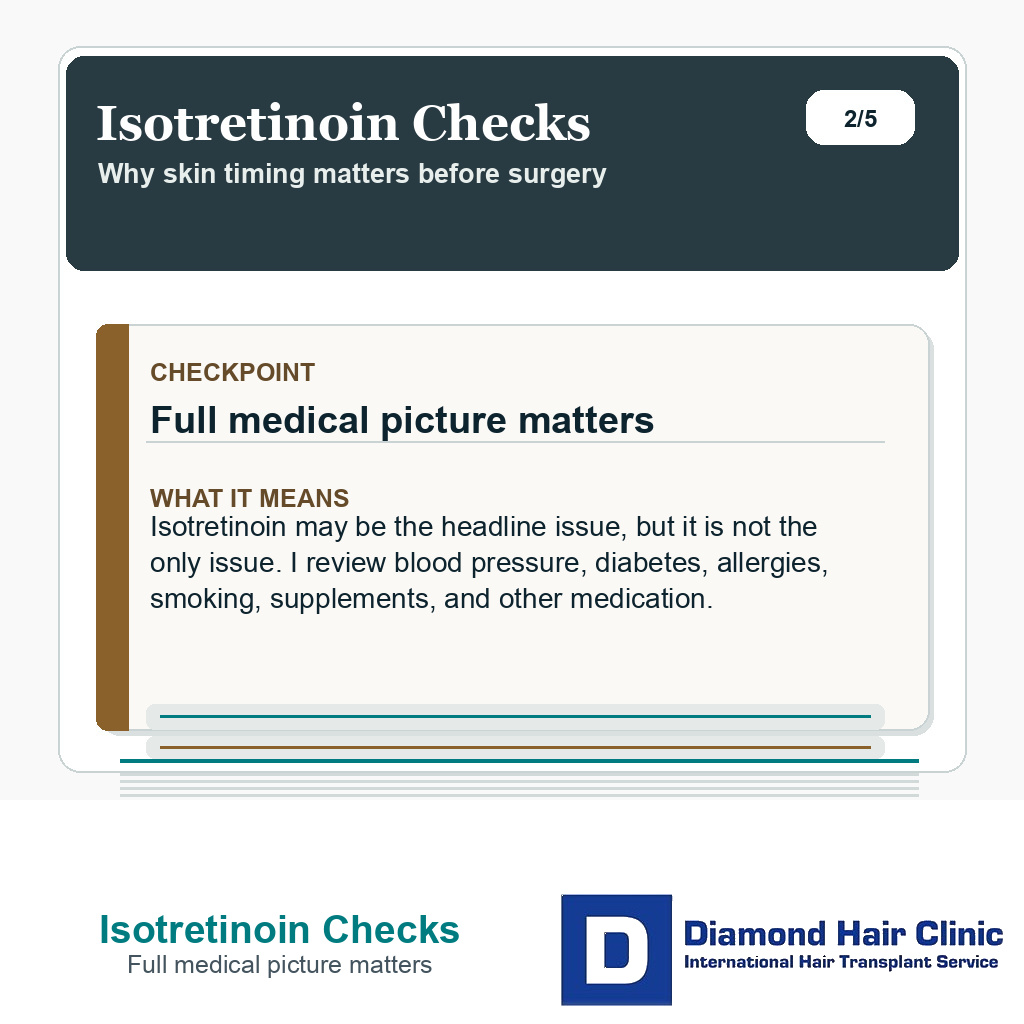
I still need the full medical picture. Isotretinoin may be the headline issue, but it is not the only issue. I review blood pressure, diabetes, allergies, smoking, supplements, and other medication. Blood tests before a hair transplant can be part of a safer preoperative process.
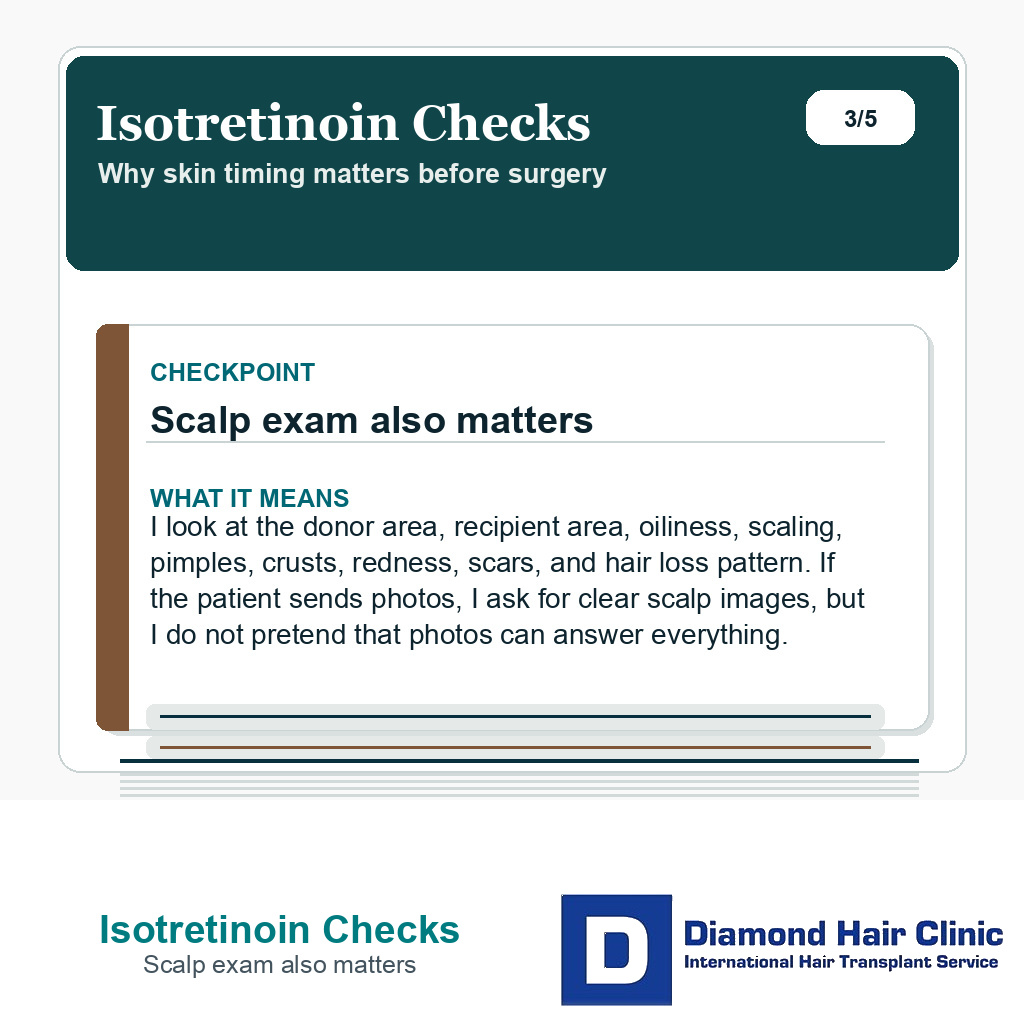
The scalp examination carries the same weight. I look at the donor area, recipient area, oiliness, scaling, pimples, crusts, redness, scars, and hair loss pattern. If the patient sends photos, I ask for clear scalp images, but I do not pretend that photos can answer everything.
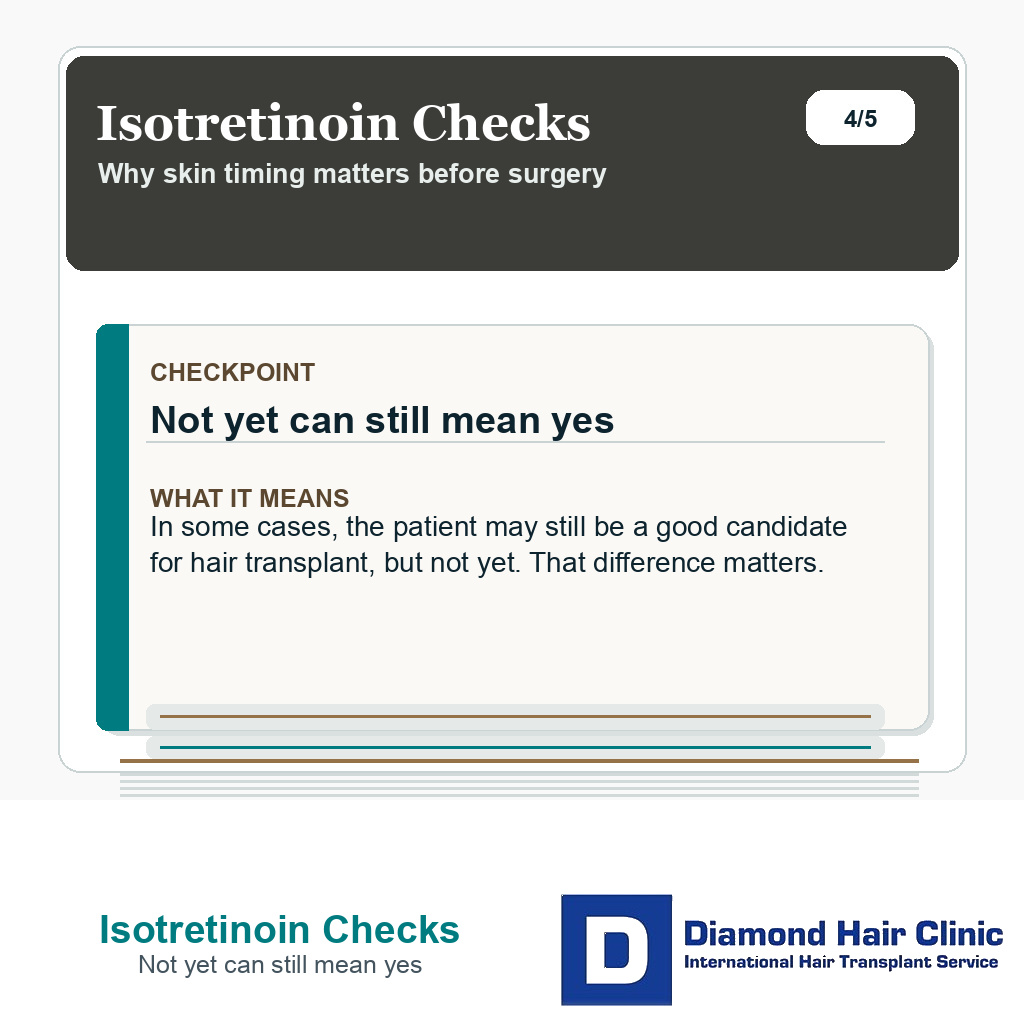
In some cases, the patient may still be a good candidate for hair transplant, but not yet. That difference matters. A patient can be a good future candidate and a poor candidate today because the scalp condition or medication timing is not ready.
I also look for scarring from previous acne. If the scalp or forehead has thick scars, pitted scars, or repeated inflamed areas, the plan may need adjustment. Scarred or inflamed skin can accept grafts differently than normal skin. This does not always prevent surgery, but it changes the discussion.
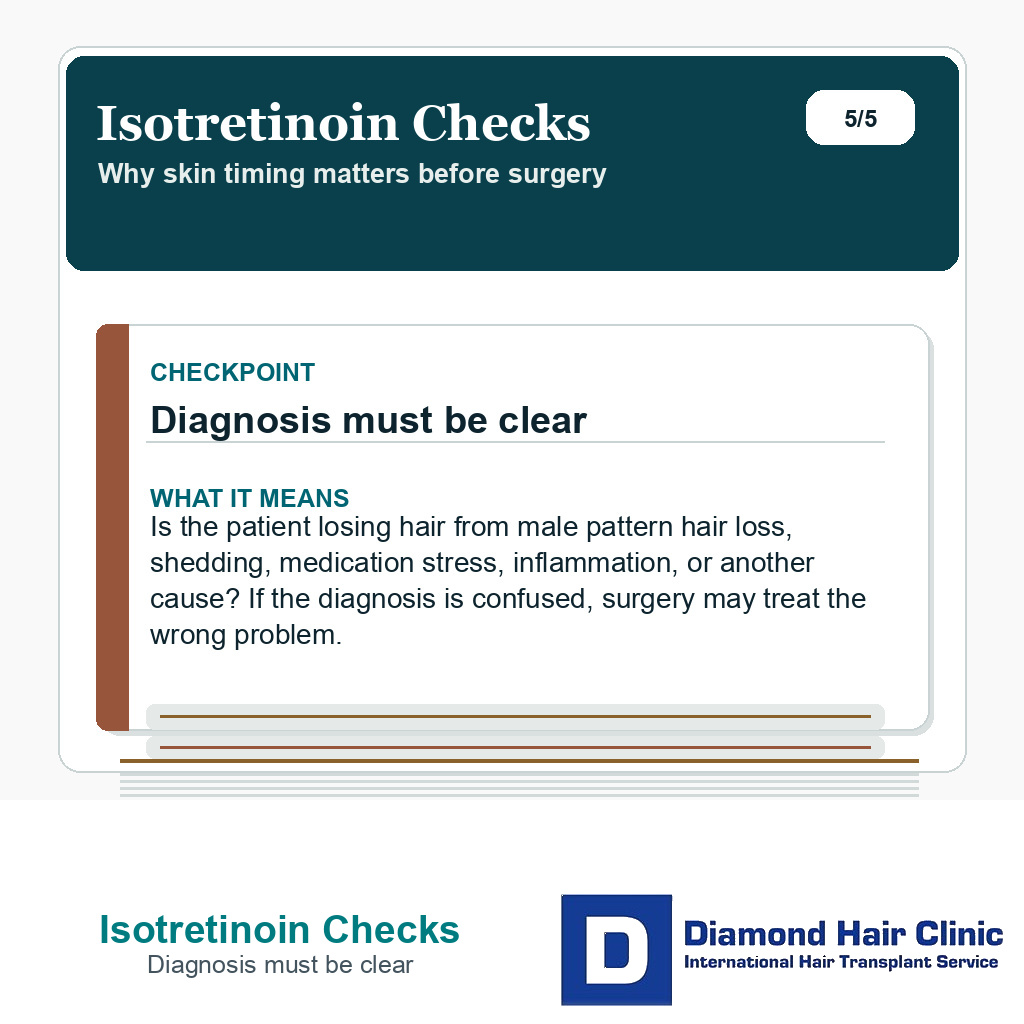
Hair loss diagnosis must also be clear. Is the patient losing hair from male pattern hair loss, shedding, medication stress, inflammation, or another cause? If the diagnosis is confused, surgery may treat the wrong problem. Here, surgeon judgment protects the patient from spending donor grafts on an unstable situation.
If shedding started or worsened during isotretinoin, I slow down. It may be temporary shedding, active inflammation, stress, or active hair loss becoming more visible. Donor grafts should not be spent while we are still asking whether the hair loss is medication related, acne related, or true patterned progression.
The 5 slides here show why isotretinoin timing needs skin stability before hair transplant planning. Swipe across the image, use an arrow, or pick a number below the carousel.
Photos alone can miss this risk
Photos can show hairline shape, thinning pattern, donor density, and some visible scalp problems. They cannot reliably show the full behavior of the skin. A photo may hide oiliness, tenderness, dryness, small bumps, scalp sensitivity, or the history behind the medication.
Complex medical cases should not be approved from photos alone. A patient on isotretinoin may send excellent hairline photos, but the details I need may sit outside the image. I need to understand why the medicine is being used, whether the scalp is stable, and what the dermatologist advises.
A visual plan can be useful only when it is connected to history. This is the same wider problem behind whether a hair transplant plan can be trusted from photos alone. Photos are a starting point. They are not a complete medical evaluation.
Patients sometimes feel reassured when a clinic gives a graft number quickly from photos. In a simple case, that may start the discussion. In a medication and skin case, it can be misleading. Fast reassurance is not the same as careful planning.
I have seen patients focus only on the front hairline because that is what bothers them most. But with isotretinoin, I ask what is happening behind the hairline, in the donor area, and across the scalp. The parts the patient does not photograph may be the parts that decide whether surgery is safe.

Clinic promises can mislead patients on acne medication
A weak clinic may say that isotretinoin does not matter because the procedure is minimally invasive. That is not enough. A minimally invasive procedure still creates many small wounds. The skin still has to heal. The patient still has to follow aftercare without dryness, irritation, or infection getting in the way.
Another weak promise is that acne will improve after surgery because the scalp has been cleaned or treated. Hair transplantation is not acne treatment. If the patient has a real dermatological condition, that condition needs its own management. Surgery should not be used as a shortcut for skin control.
I am also cautious when clinics promise a large session while ignoring active scalp inflammation. Large graft numbers can sound attractive, but they may be poorly matched to a scalp that is not settled. A careful plan means choosing the right timing and skin environment, not simply filling every visible thinning area.
After surgery, the patient needs clear guidance for washing, dryness, itching, and medication. The wider hair transplant aftercare routine needs extra attention when a patient is prone to skin irritation or acne flares.
A clinic may also use the word minimally invasive to make the patient feel that medication history does not matter. I disagree with that framing. FUE is less invasive than older strip surgery in many ways, but it is still thousands of tiny surgical actions. A strong medicine that changes skin condition deserves to be part of the plan.
I am also cautious with packages that include many lotions, sprays, tablets, or add ons without explaining how they interact with the skin. More products do not necessarily mean better healing. In a patient prone to dryness or irritation, too many products can create more confusion.
Dermatologist and surgeon coordination
Before making the decision, the dermatologist and surgeon should look at the same problem from different sides. The dermatologist can clarify why isotretinoin is being used, whether acne or folliculitis is controlled, and whether the scalp is too dry, irritated, or inflamed for surgery.
The hair transplant surgeon should judge whether the donor area and recipient area are suitable, whether a smaller session or later date would be safer, and how healing will be reviewed if bumps or irritation appear after surgery. The restart plan for medication should also be clear before the operation, not guessed during recovery.
If either side only gives a reassuring sentence without a plan, I am not satisfied. A patient on isotretinoin deserves coordination, not just reassurance.
The dermatologist does not need to design the hairline, and the hair transplant surgeon does not need to manage acne alone. Each doctor has a role. The dermatologist helps judge the skin disease and medication plan. The hair transplant surgeon judges donor management, recipient area safety, graft placement, and timing. When both sides are clear, the patient is safer.
Surgery may be reasonable after isotretinoin in stable cases
Surgery is reasonable only when the scalp is settled, the acne condition is controlled, the medication plan is clear, and the dermatologist and surgeon are not giving conflicting instructions. If those conditions are not met, waiting is usually wiser.
If surgery goes ahead, I keep the plan measured. I avoid aggressive graft numbers if I am not fully confident about the skin environment. A smaller, natural, well healed result is better than pushing the scalp when it is not ready.
Patients should know what to do if bumps appear during recovery. Not every bump is dangerous. Some can be normal irritation or trapped hairs. But if the patient has a history of acne or folliculitis, the clinic should review concerns carefully. Clear guidance on bumps or ridges after a hair transplant can help patients understand why diagnosis matters.
Do not hide isotretinoin from your hair transplant clinic, and do not let a clinic ignore it. The medicine may not forbid surgery, but it changes the conversation. A safe result begins with clear medication history, settled scalp condition, and surgical discipline.
Pausing to collect the right information is safer than forcing a date. A hair transplant uses grafts from a limited donor supply. Those grafts should be used when the scalp is ready to receive them. Waiting for a safer moment is not losing time. It is protecting the result.

Read this review excerpt
Every single one of my questions was answered and they made sure I had all the details I needed to make an informed decision.