


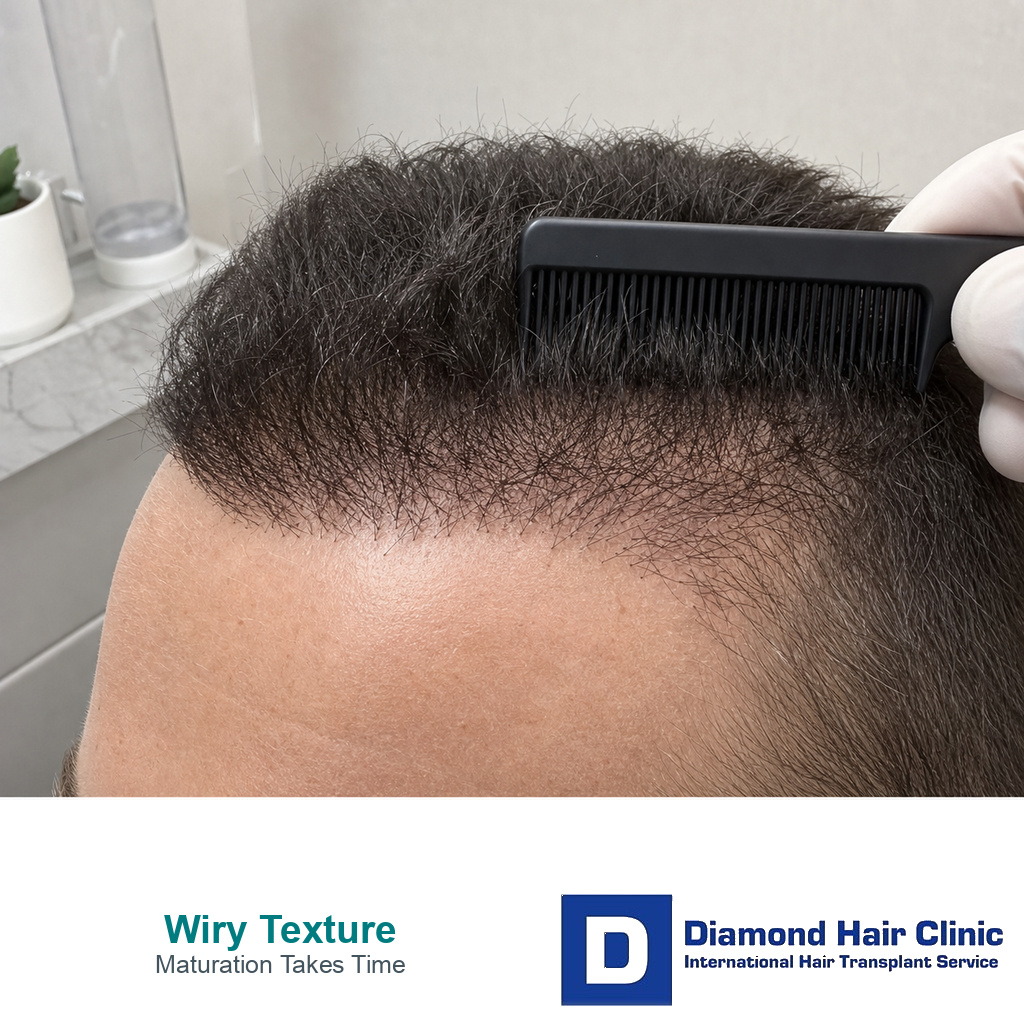
Wiry Transplanted Hair Needs Maturation Time
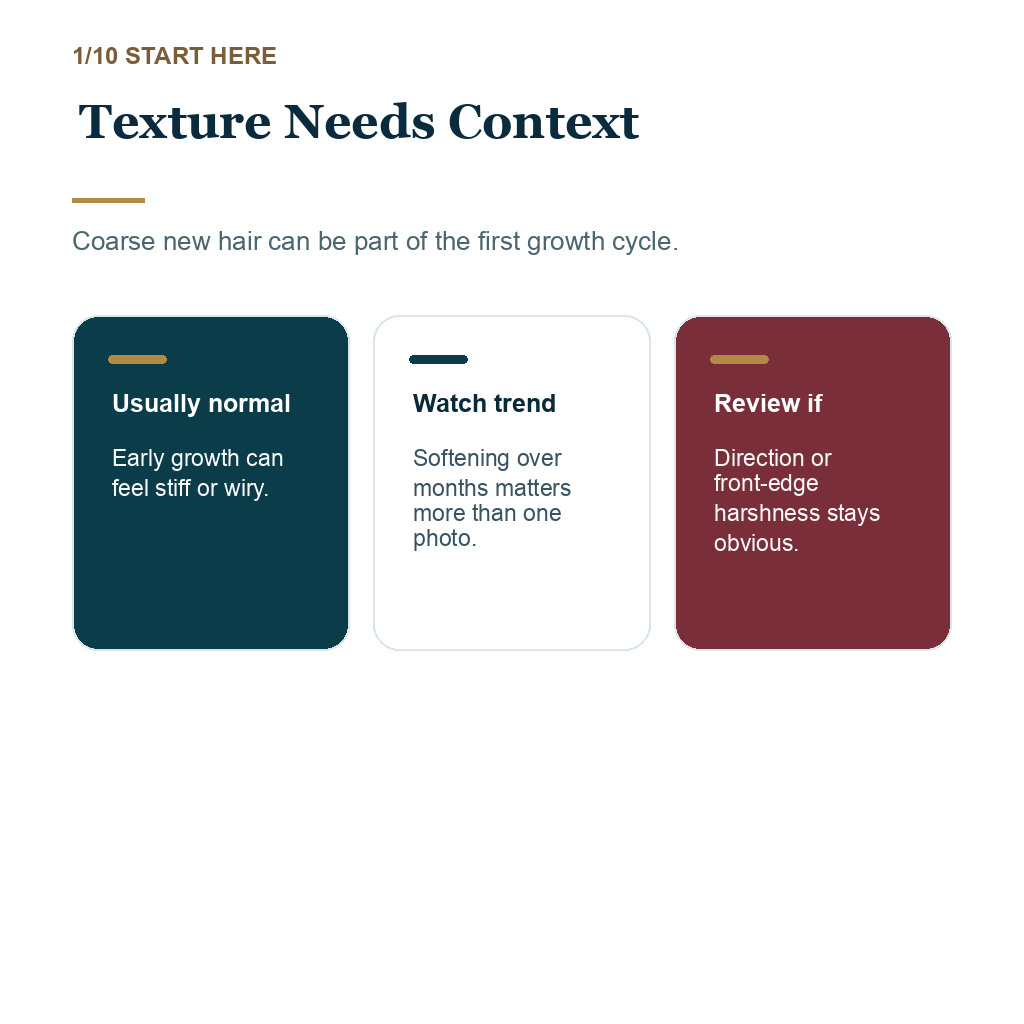
Transplanted hair can feel wiry, coarse, darker, or difficult to style during the first growth cycle, and this can still be normal. For many patients, texture starts to improve between 6 and 12 months, the mature result is usually judged around 12 to 18 months, and some refinement can continue up to 18 to 24 months. The deciding detail is to separate immature hair from a true surgical problem.
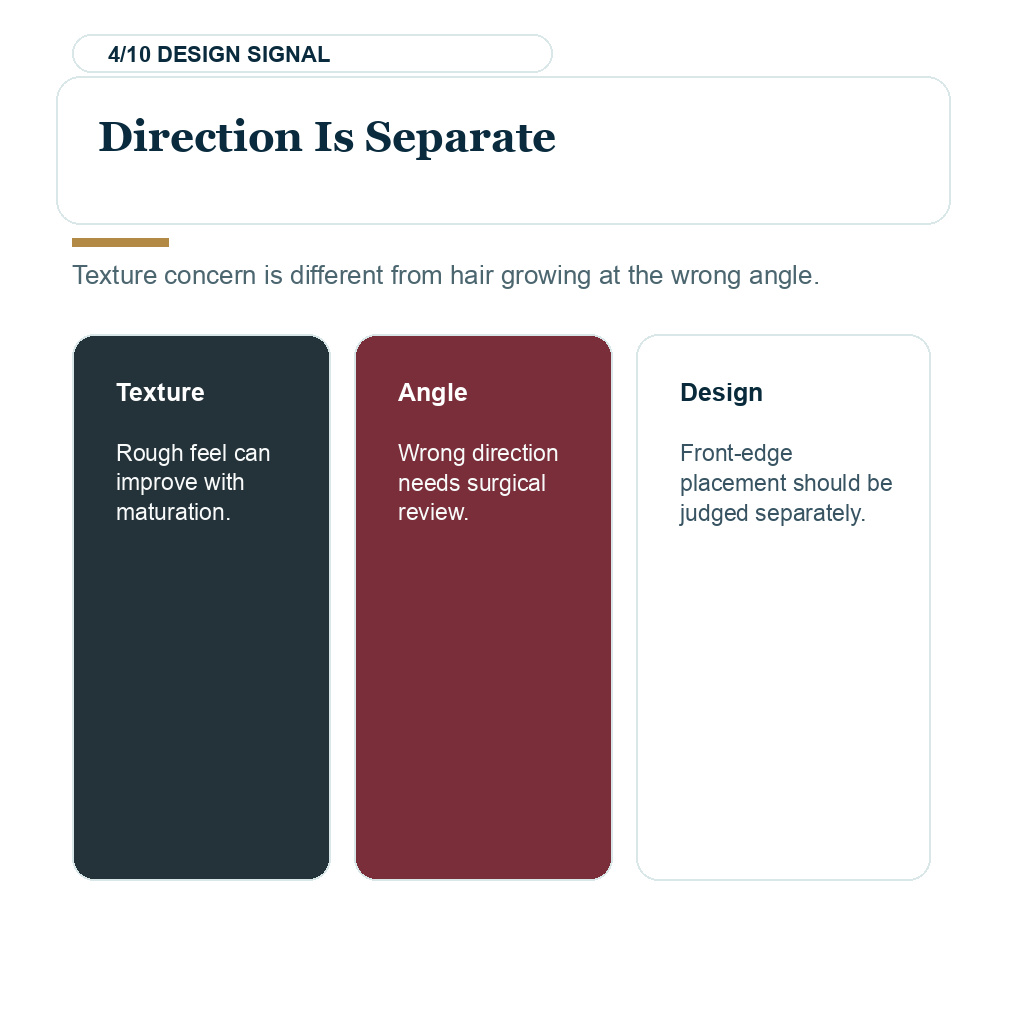
If the hair is growing, the scalp looks settled, and the texture is slowly improving, patience is usually reasonable. If the hair is pointing in the wrong direction, standing unnaturally, growing from thick grafts in the front edge, or staying very harsh after maturation, the case needs a closer review. At that point, the question is no longer only whether the transplant has failed or it is too early to judge. The design, direction, or graft selection may need review.
One practical distinction helps here. A short new hair can feel sharp between the fingers before it truly looks wrong in the mirror. A surgical problem is more about a repeated visual pattern such as wrong angle, thick grafts at the front edge, raised skin, or hair that still refuses to blend after enough time has passed.
Before adding oils, straightening, or more styling products, compare the rough area clean and dry. If the shaft itself feels coarse but follows the correct direction, maturation and hair care are a different issue from grafts that point wrongly, form a thick front row, or leave a visible density break. One description of wiry hair should not decide all three problems.
Texture and color can worry patients at the same time. A darker or thicker new hair can still be maturing, while a hair that grows at the wrong angle or sits as a coarse front row needs a different review.
Styling difficulty is part of the review, but it is not the whole diagnosis. Length, lighting, direction, shaft maturity, and front row graft choice all change what rough hair means.
Before pulling out a rough hair or trying to force it flat every day, first separate timing from direction, graft choice, hair source, and scalp irritation.
When you send texture photos, include one view from normal conversation distance and one close view at the same hair length. A very close photo can exaggerate roughness, while the wider view shows whether the hair blends in daily life.
Growth is only one part of the judgment. Transplanted hair also has to blend, behave naturally, sit correctly in the recipient area, and fit a plan that respects the donor area and future hair loss pattern. Hair that grows but looks artificial can still be a disappointing result.
Texture questions deserve attention. They may sound small compared with graft survival, but they are often the difference between a result that simply exists and a result that feels natural to the patient. A patient does not only want hair on the scalp. They want hair that moves, rests, and frames the face without constantly asking for attention.
Texture maturation sorter
Is the coarse texture still maturing or asking for review?
Use this before judging one bad photo or rushing into touch up. Texture is read by timing, trend, hair direction, graft choice, scalp comfort, and the hair source used.
Start with the closest pattern, then decide whether to track, style, contact the surgeon, or wait for maturity.
This usually fits maturation. Compare the same lighting and length each month, and look for softer feel, easier styling, and better blending rather than judging one harsh closeup.
Slowly improving texture can be watched. Wrong direction, poor graft choice at the front edge, warning scalp signs, or harsh texture after maturity needs a surgeon review.
Wiry transplanted hair usually starts to soften as growth matures
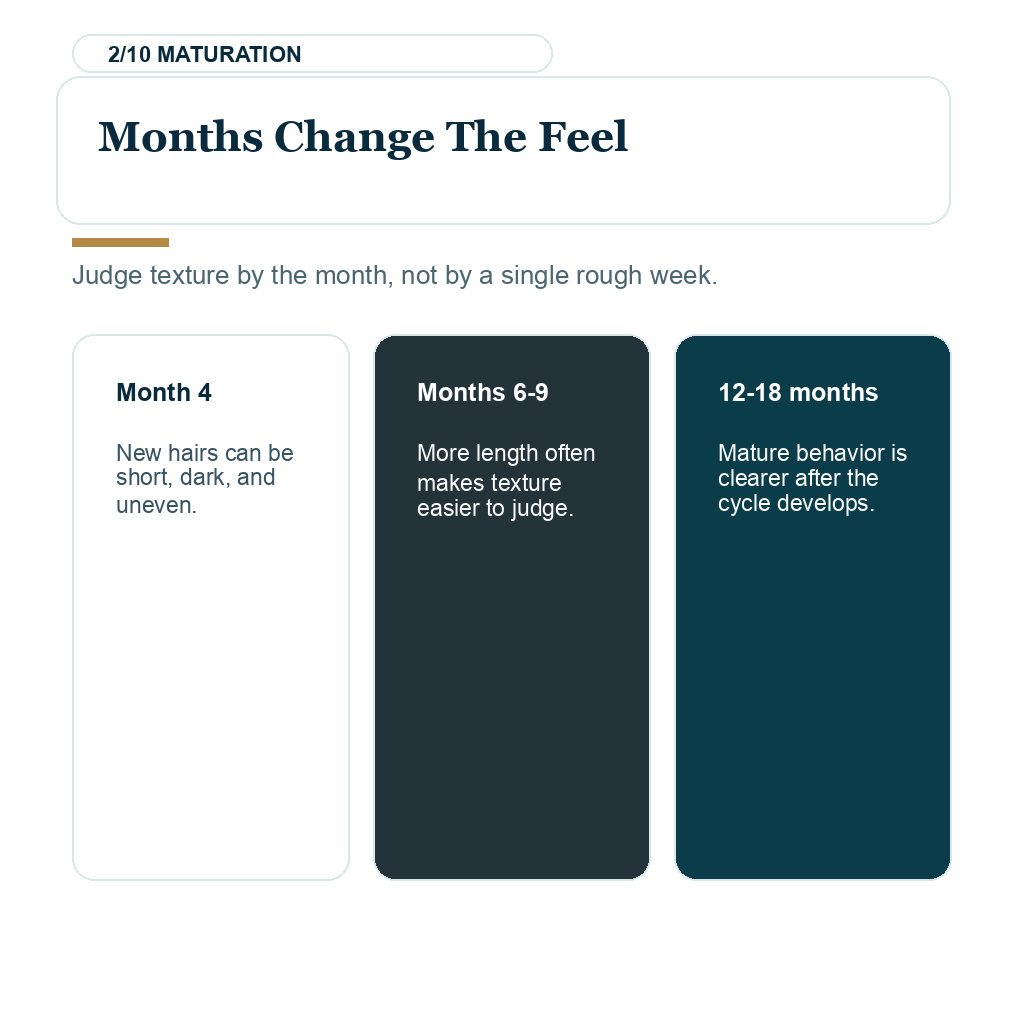
The first new transplanted hairs often begin to appear around month 4. At that stage, the hair is often thin, short, uneven, and not cosmetically mature. It may feel rough because the shaft is still changing and the hair is too short to lie naturally. Before judging texture, first decide whether the visible strands behave like fine new hairs after FUE or static short shafts.
Between months 6 and 9, patients usually see clearer growth, but this is also when many become anxious. The hair is visible enough to judge, but not mature enough to behave well. A patient may think the transplant looks coarse, patchy, or strange, even when the biology is still moving in the right direction.
By months 12 to 18, I expect a much fairer assessment. The hair has usually gained more diameter, length, flexibility, and styling behavior. In some patients, especially those with crown work, strong caliber hair, or slower maturation, the final softening can continue toward 18 to 24 months.
This timing is why early panic can be misleading. The same patient who worries about low density at 4 months after a hair transplant may later worry that the new hair feels too wiry at month 7. Both worries can be emotionally real, but neither one proves that the surgery failed.
One side may also mature faster than the other. If a patient sees one area looking thicker, softer, or more cooperative than the opposite side, I compare it with the pattern I explain in one side growing slower after a hair transplant. Asymmetry during growth is common, but it still deserves proper follow up when it does not improve.
The calendar is not the only thing that matures. Hair shaft diameter, length, surface smoothness, scalp sensitivity, and styling behavior all change at different speeds. A patient may see growth at month 6 but still dislike the way it feels in the fingers. That does not always make the result poor.
Small monthly signs are more useful than one dramatic photo. Hair that brushes more easily, lies flatter after washing, sticks up less, and blends better with native hair when dry often tells more than one anxious image. If the roughness makes you think about salon smoothing, keratin, perms, and relaxers after FUE need a separate timing check because product contact and heat change the risk.
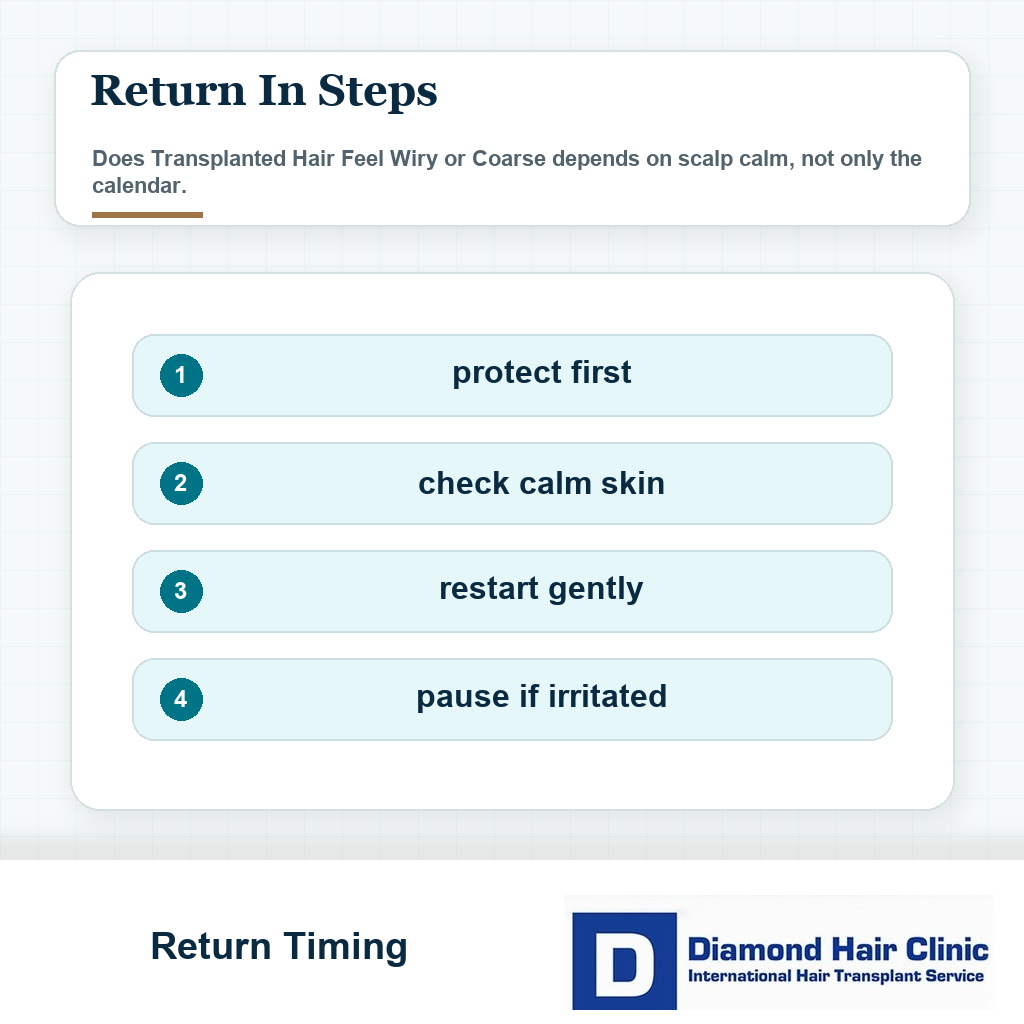
New transplanted hair can look darker or thicker
Transplanted hair keeps the character of the donor hair. If the donor hair from the back of the scalp is thicker, darker, more wavy, or stronger than the fine hairs around the front, the difference can be visible during the early months. This is not always a mistake. It is part of the reality of moving hair from one area to another.
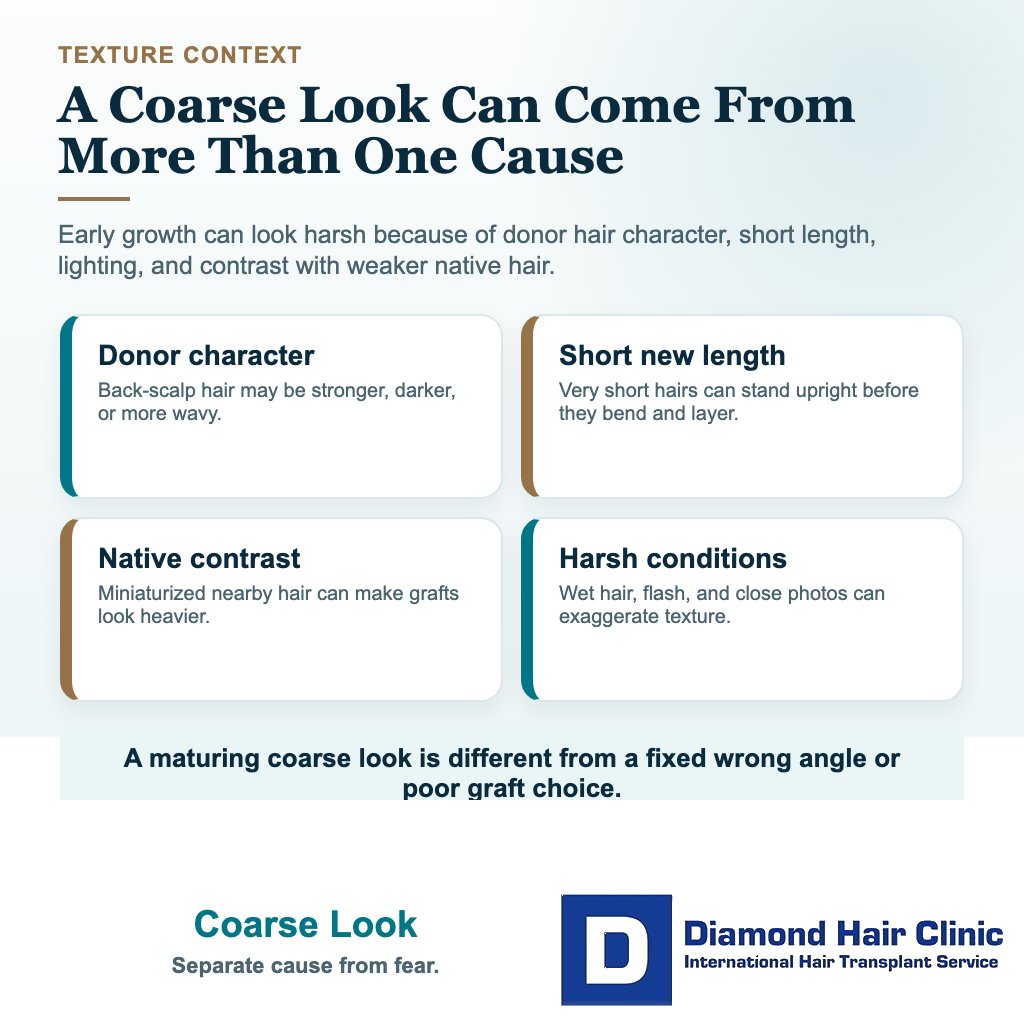
The weak point is that patients often compare a new graft to the soft miniaturized native hair around it. Miniaturized hair can be thin, light, and weak. Donor hair may be stronger. When the strong new hair first appears, it can look as if it does not belong yet.
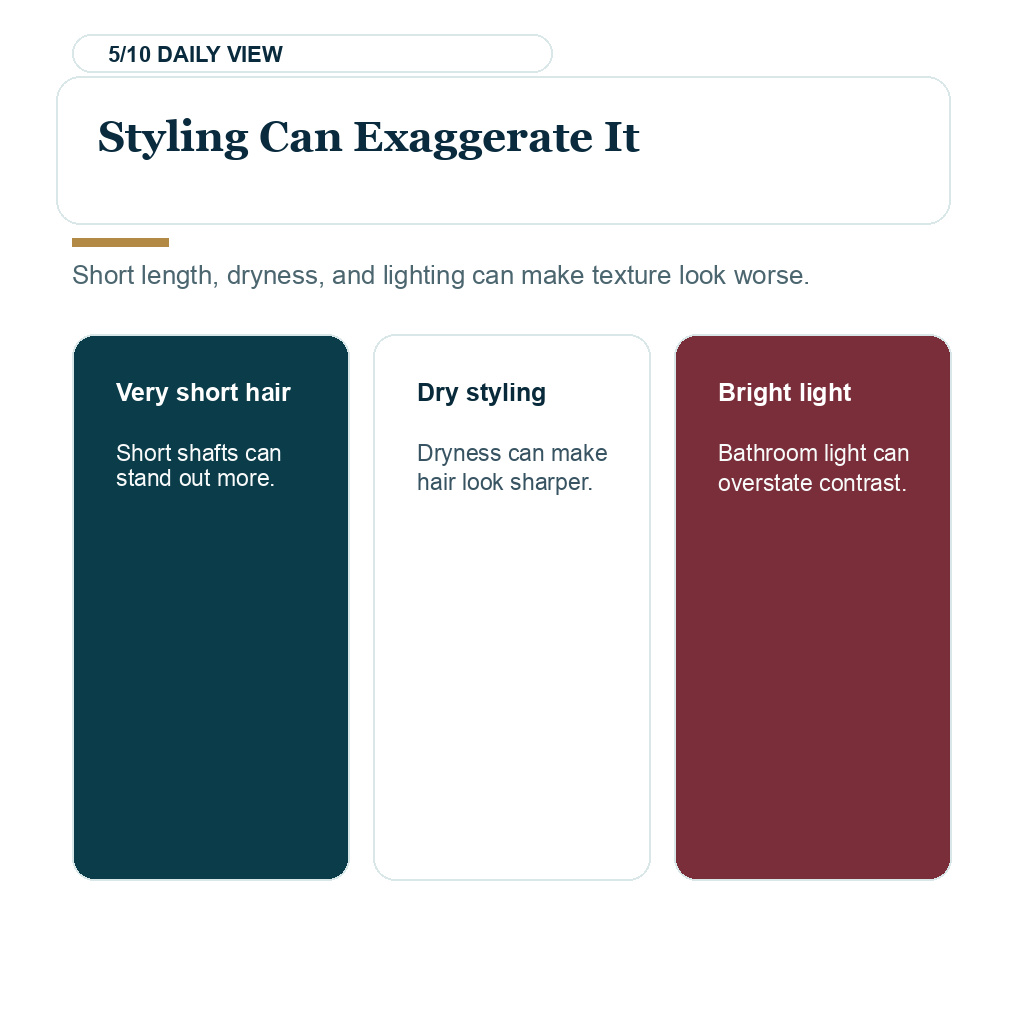
Length also matters. Very short growing hair can stand upright and look harsher than it will later. Once it has enough length, it can bend, layer, and blend with nearby hair. A 1 centimeter hair and a 5 centimeter hair can behave very differently even if they come from the same follicle.
The practical explanation is this. New transplanted hair is not only appearing. It is gaining enough length, diameter, and flexibility to sit inside the hairstyle. That process takes time, and the mirror can be unforgiving before the hair has enough length and maturity.
Still, donor hair selection matters. The surgeon must think about caliber, curl, number of hairs per graft, and where each graft belongs. A strong graft that is useful behind the hairline can look too heavy if it is placed at the very front.
This matters especially in patients whose donor hair is naturally stronger than their frontal native hair. In those cases, a slightly more robust transplanted hair may be acceptable, but the design still needs to soften that difference. The aim is not to pretend every hair is identical. The purpose is to place stronger hairs where they support coverage without becoming the detail the eye notices first.
Normal maturation versus a surgical problem
Start with one question. Is the problem improving month by month, or is it fixed in the same unnatural pattern? Normal maturation changes over time. A structural surgical problem often remains recognizable.
If the hair is wiry but gradually softening, that is reassuring. If the scalp looks settled, the redness is improving, and new hairs continue to appear, continued observation is usually reasonable. Standardized photos are more useful than random bathroom photos, because random photos can create unnecessary fear.
If the hair exits the skin at a wrong angle, grows against the natural flow, or stands sharply away from the scalp, the concern is different. That is closer to wrong hair direction after a hair transplant. Time may soften the shaft, but time usually cannot fully correct an angle that was created incorrectly during implantation.
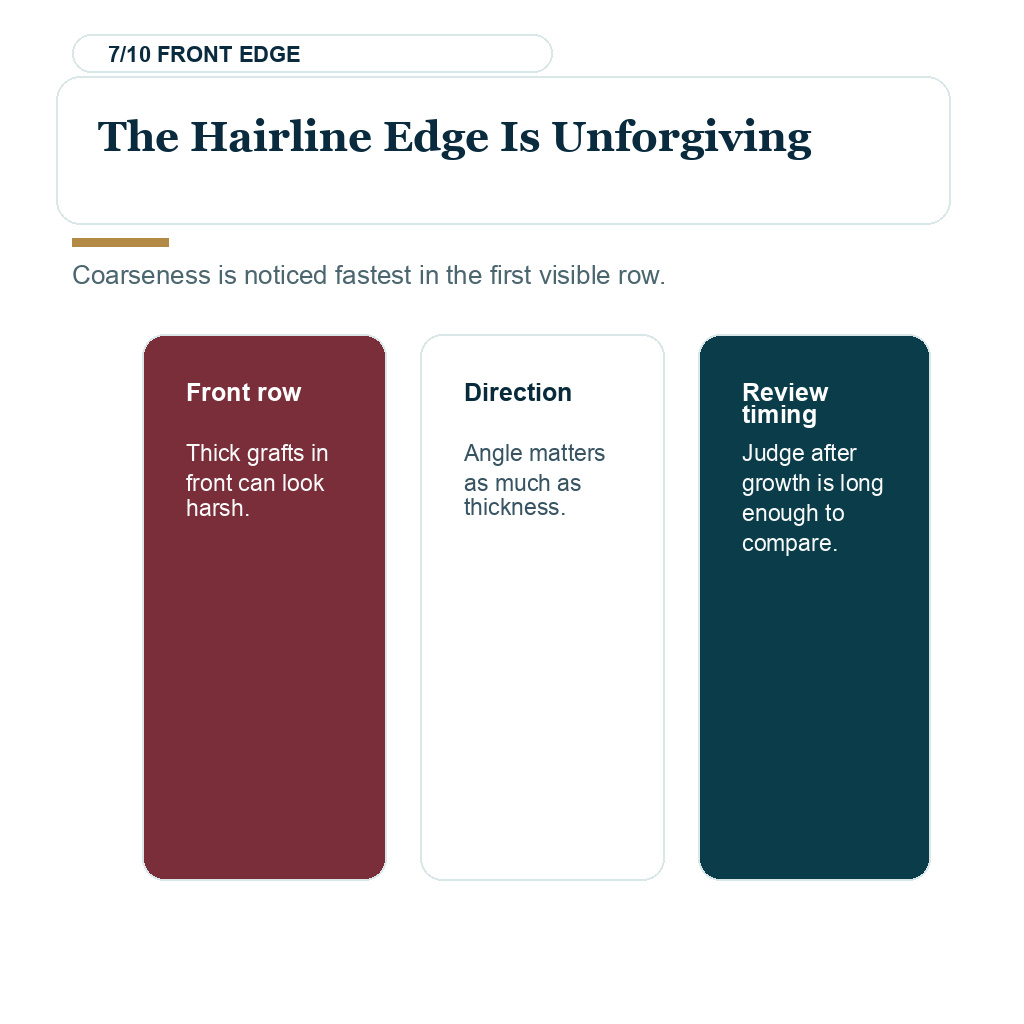
Another issue is a pluggy front edge. If thick multi hair grafts were placed in the first line, the hairline can look coarse even when the grafts survive well. Growth alone is not enough in the frontal hairline. Softness is part of the surgery.
Concern increases if the texture problem is combined with persistent inflammation, painful pimples, heavy scarring, or poor distribution. These signs do not by themselves mean disaster, but simple reassurance is not enough. The case needs proper examination.
This is a case by case judgment. A rough feeling at month 7 with improving growth is very different from a harsh, low, straight hairline at month 15 with thick grafts pointing forward. The first may need patience. The second may need repair planning.
The exact location of the complaint matters. Coarse hair behind the hairline may be acceptable if it supports coverage. Coarse hair in the first few millimeters of the front edge is much less forgiving. The closer the hair is to the face, the more delicate the graft selection should be.
Patients sometimes ask whether they can feel the difference with their hands before they can see it clearly. Sometimes they can. But the hand can exaggerate concern because short new hairs feel sharp and stiff when they first emerge. I place more weight on the visual trend and the angle of growth than on touch alone.
Styling, hair length, and lighting can make texture look worse
Styling, hair length, lighting, and camera distance can make wiry transplanted hair look worse than it really is. Short hair often exposes every direction change. Wet hair separates into strands. Harsh light increases scalp contrast and makes each irregularity easier to see.
Do not judge the result only under bathroom light, flash photos, or wet hair. Those conditions can be useful for documentation, but they should not be the only way the patient understands the result. Real life is not one close photo under the strongest light.
Harsh light, wind, and wet hair can exaggerate every angle change. Use hair transplant appearance under harsh conditions as a separate comparison, not as the only judgment. A transplant should hold up in normal daily life, but it should not be judged only by the most punishing possible angle.
Texture and density also interact. Wiry hair can make a result look messy, while fine immature hair can make it look thin. Understanding why some hair transplant results look thin helps patients avoid mixing different problems together.
A modest haircut may improve the look because the new hair gains enough length to blend. Cutting too short can make the same problem more visible. Styling products can hide stiffness in one view and reveal spacing in another, so compare the hair clean as well as styled. During maturation, styling should be patient and practical, not aggressive.
A recent close trim can also change how the hair feels. Blunt, short ends may feel stiffer without the follicle having changed or the graft becoming thicker. Compare the same zone at a similar length before deciding that the texture has worsened. Cutting the shaft does not correct its exit angle, so a persistent direction problem still needs a separate assessment.
Hair length changes what a texture check shows. In a short style, regular trims remove the older ends sooner. With longer hair, compare the newer growth near the scalp with the older lengths before deciding that texture has stopped improving.
Compare the same area under similar conditions each month. Same light, same distance, same hair length if possible, and dry hair when judging normal appearance. This gives a clearer view than emotional daily checking. This point also matters when you track hair transplant growth. Repeatable photos matter more than daily moods.
Constant combing tests during the early months can make recovery harder emotionally. Pulling the hair in different directions, wetting it repeatedly, or checking it every hour can turn a normal maturation phase into a daily problem. The scalp needs time, and the patient needs a less obsessive rhythm during recovery.
Beard or body hair can make texture differences more obvious
Beard or body hair can make texture differences more obvious because those hairs do not always behave like scalp hair. Beard hair is often thicker and stronger. Chest or other body hair can have a different curl, length, and growth cycle. These differences may be useful in selected cases, but they must be placed with judgment.
Stronger non scalp hair needs careful placement. It may help support coverage in the crown or behind the front, but it should not be used casually in the first hairline rows. If coarse hair sits at the front edge, the patient may notice it every time they look in the mirror.
When beard hair for crown transplant planning or body hair as a donor source is being considered, texture matching matters as much as growth. These sources are support tools, not magic replacements for a careful scalp donor plan.
Hairline planning affects how coarse hair is seen
The hairline is the least forgiving part of a hair transplant. It is the frame of the face. If the front edge is built with the wrong grafts, wrong angles, or an overly straight design, coarse hair becomes much more visible.
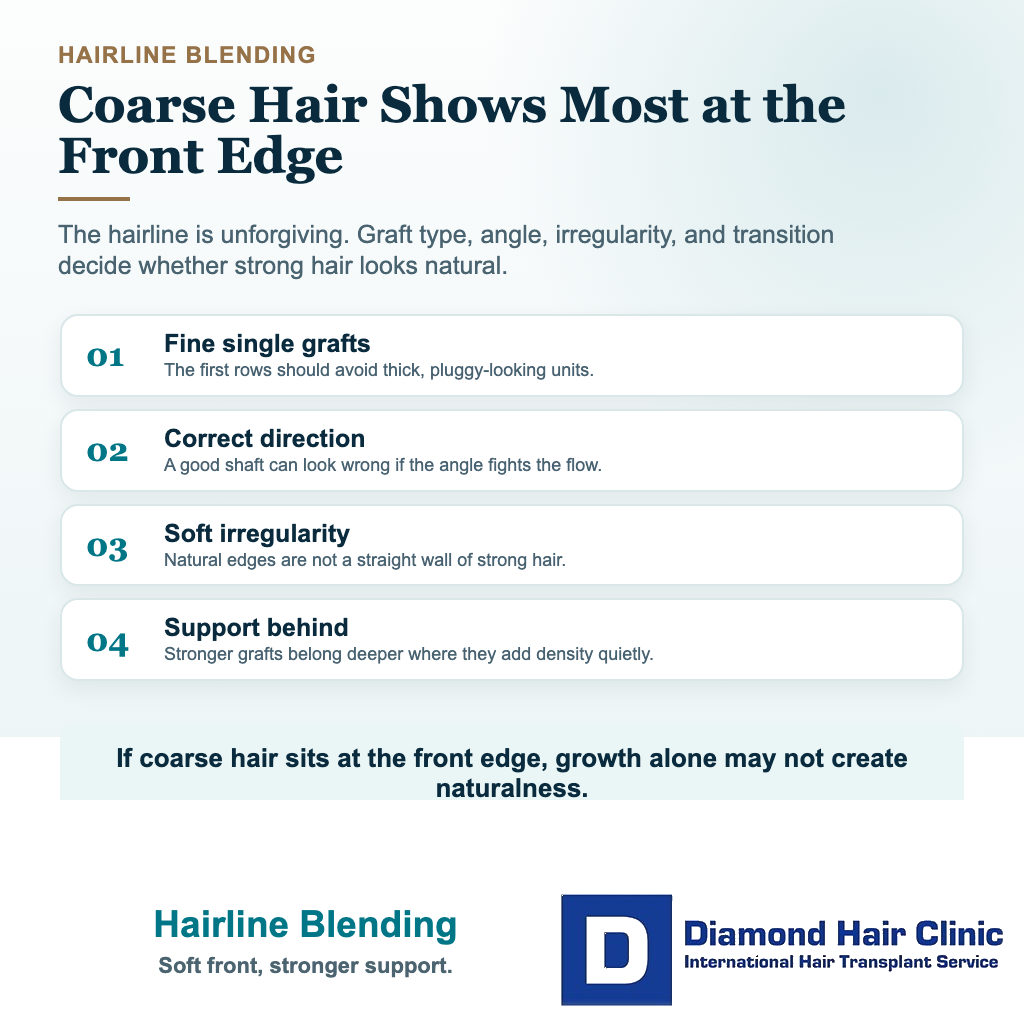
Hairline design in hair transplant is more than drawing a line. Height, shape, direction, density transition, and graft type decide whether the front edge looks soft or artificial. A natural hairline is not a wall of hair.
In the front edge, soft single hair grafts and careful irregularity matter. Behind that, stronger grafts can support density. If this order is ignored, the patient may get growth but lose naturalness.
The wish for maximum density at the front often comes from fear of thinness. The fear is understandable, but too much force in the wrong place can create the opposite problem. A hairline that is too dense, too low, too straight, or too coarse may look impressive in early photos and unnatural in daily life.
Close inspection is where graft selection and placement matter most. Graft count is only one part of the plan. The way those grafts are selected and placed decides whether the hair looks like it belongs there.
Another point matters. A mature male hairline should fit the face now and later. If a surgeon creates a juvenile line with coarse grafts, the patient may feel happy for a short time, then become uncomfortable as the face ages or native hair continues to thin.
A hairline should not be designed only for the first year or the first photograph. It should still make sense in the years that follow. If the plan needs perfect density, perfect styling, and perfect lighting to look acceptable, it is not a strong plan. A careful plan allows some biological imperfection and still looks natural.
Medication and native hair stability change the interpretation
Medication does not usually change the basic character of a transplanted follicle. A transplanted hair from the donor area remains donor hair. But medication can change the environment around the transplant, especially by protecting native hair and reducing the contrast between transplanted and non transplanted areas.
If native hair continues to miniaturize around the grafts, the transplanted hair may look harsher by comparison. The patient may think the new grafts became too coarse, when the real problem is that surrounding hair became weaker. Medical planning and surgical planning cannot be separated.
For many male patients, finasteride, dutasteride, minoxidil, or other carefully selected treatments may be discussed depending on the medical profile. I do not give every patient the same instruction because side effects, age, family history, risk tolerance, and expectations matter. The patient still needs a clear explanation of why medications after a hair transplant are often part of long term result protection.
Medication can also create temporary shedding or changes in the early months. When this happens near the same time as transplant growth, patients may become confused. They may blame the transplant texture, when the whole scalp is actually passing through more than one biological change at once.
In consultation, I separate the transplanted hair from the native hair. Graft growth, native hair stability, continuing miniaturization, and the difference between donor and recipient hair caliber all change the interpretation.
A strong transplant is not only the hair placed on surgery day. It is also the plan for what happens as the patient keeps aging. If native hair is ignored, even a technically good transplant can become harder to blend over time.
Caution is needed when a patient wants surgery but refuses to discuss stabilization at all. Surgery can move permanent hair, but it cannot stop the rest of the scalp from changing. When the surrounding hair weakens, the transplanted hair may appear more obvious, more isolated, and sometimes more coarse by comparison.
Contact the surgeon when texture changes come with warning signs
Waiting is useful only when the situation looks like normal maturation. It is not useful when the patient has warning signs that need examination. That difference matters.
A follow up should happen if the scalp has persistent pain, strong redness, repeated infection, thick scarring, sudden worsening, or areas that remain completely empty while the surrounding transplant matures. The case also needs review if the hairline direction looks clearly wrong or the grafts at the front look too thick and pluggy.
If the main issue is wiry texture at month 6 or month 7, with visible growth and a settled scalp, documentation and observation are usually reasonable. If the issue is unchanged harsh direction at month 12, it deserves more serious investigation. The timing and the pattern both matter.
Hair transplant aftercare also matters because early inflammation, crust problems, scratching, infection, and poor scalp management can make recovery more complicated. Aftercare does not replace surgical skill, but it protects what was done during surgery.
Bring or send useful photos. A few clear photos are better than 50 emotional ones. Use front, both sides, top, donor area, dry hair, normal light, and the same distance each time.
Do not panic early, but do not ignore a pattern that stays abnormal. Good follow up means reviewing the case, explaining what is normal, and identifying what is not.
If a patient is far away, structured communication is better than silence. Clear photos, the operation date, graft number, medication history, and any symptoms help the surgeon understand the case. Vague fear is difficult to answer. A well documented concern can be addressed much more responsibly.
Scalp healing and graft depth can change how hair feels
Sometimes the hair itself is not the only issue. The skin around the graft can affect how the hair emerges and how it feels. If the recipient area has persistent bumps, ridges, thick scar like texture, or repeated inflammation, the new hairs may appear harsher or less cooperative.
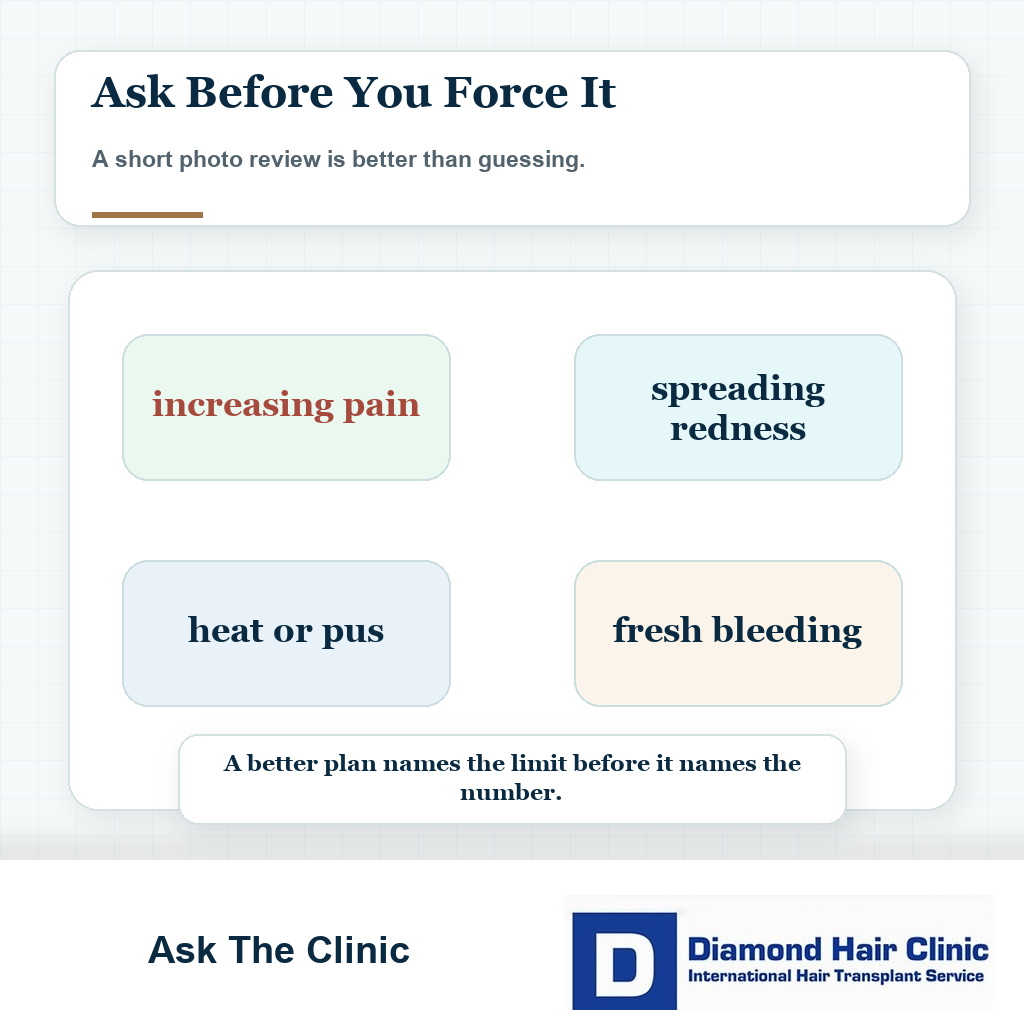
Not every wiry hair is a scar or graft depth problem. Most early texture changes are part of maturation. But if the texture concern comes together with raised or pitted skin, pain, persistent redness, pimples, or an uneven surface, the scalp needs closer examination.
Raised skin is a separate concern from texture alone. Bumps or ridges after a hair transplant need their own assessment. A smooth scalp with immature hair is very different from a raised surface with hair growing through it. The plan should respond to the cause, not only to the word wiry.
Touch up can help only after the cause is clear
Sometimes a touch up can help, but only after the first result has matured and the real problem is clear. Planning a second procedure too early because the patient dislikes the look at month 7 can create the wrong solution. At that stage, the hair may still change substantially.
If the texture problem is mainly immature hair, a touch up is not the answer. Time, length, and maturation may do more than surgery. If the weak point is low density in a focused area after maturation, then adding grafts may be reasonable.
If the weak point is coarse grafts in the front edge, the solution may not be simply adding more hair. The surgeon may need to soften the front with fine single hair grafts, remove or redistribute larger grafts, or create a better transition zone. This is repair work, not just extra density.
If the issue is wrong angle, more grafts can sometimes make the hairline look heavier instead of better. In some cases, poorly angled grafts need to be removed or camouflaged carefully. Repair decisions must be conservative and surgeon led.
Before considering hair transplant touch up grafts, first define what problem the surgery is trying to solve. Thinness, direction, texture, pluggy grafts, and ongoing native hair loss are not the same problem. They may look similar to the patient, but they require different planning.
The donor area must also be protected. A patient may want immediate improvement, but every graft used for repair is part of the lifetime graft supply. Careful diagnosis needs to come before another surgery.
In repair work, the emotional pressure can be very high. The patient has already waited, paid, and hoped once. But that is exactly why the second decision must be more measured than the first one. A rushed repair can turn a correctable texture concern into a larger donor and design problem.
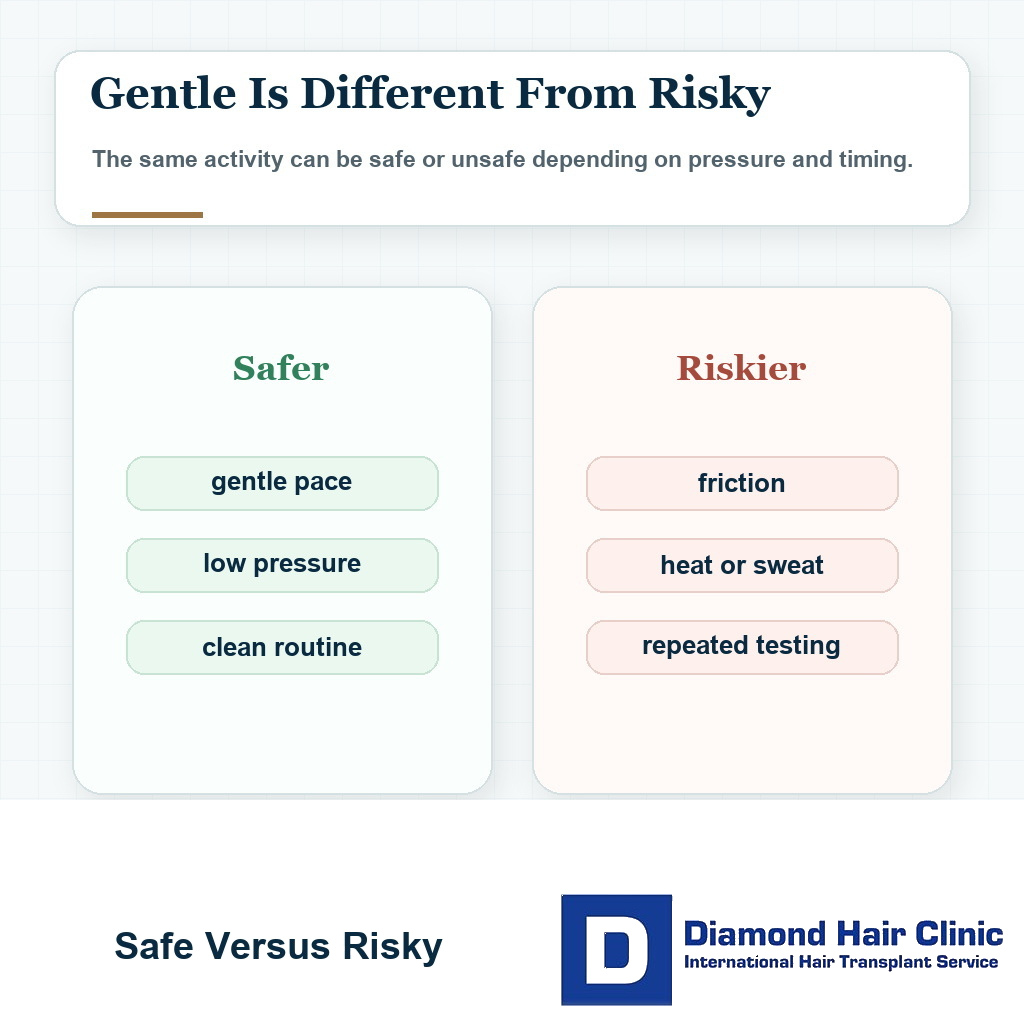
Use the 10 texture review slides below to separate normal maturation, darker looking new hair, direction problems, styling effects, beard or body hair texture, hairline edge softness, native hair context, warning signs, and when not to rush a touch up. Swipe the carousel, use the arrows one step at a time, or choose a number below the image to jump to that point.





Coarse texture often softens as the hair matures
Judge the result by trend, not by one bad photo. At month 4, the main question is whether growth has started. At months 6 to 9, check whether growth and texture are progressing. At months 12 to 18, the question becomes much more serious because the result should be close to mature.
Use the same lighting and distance when you compare. Look at dry hair and normal daily appearance, not only wet hair or flash photos. Progress means the hair is becoming easier to style, the texture is softening, and the area looks more integrated month by month.
The weak point may not be texture. Sometimes the issue is low density, wrong direction, a hairline placed too low or too straight, or native hair loss behind a transplant that is actually growing well.
Self diagnosis after surgery can be stressful because one visual problem may have several possible causes. A proper evaluation protects the patient from both panic and false reassurance.
If you are only a few months into growth, do not make a repair decision from fear. If you are beyond 12 months and the hair still looks harsh, unnatural, badly directed, or poorly blended, then a proper surgical review is reasonable. Not every concern needs action, but every persistent concern deserves a clear explanation.
Wiry transplanted hair is often a stage, but unnatural planning is not a stage. The important step is knowing which one you are looking at.
The most dramatic early photo is not the goal. The result should mature gradually, frame the face naturally, respect the donor area, and still make sense years later.
If your transplanted hair feels wiry today, do not judge the whole result from that feeling alone. Look at the month, the trend, the scalp, the direction, and the original plan. When those details are read together, the answer becomes much clearer and much less frightening.
Read this review excerpt
We also had a levelled conversation about my hairline and results I could expect based on my donor density area.