


ISHRS Meaning for Hair Transplant Patients
Many people notice the name International Society of Hair Restoration Surgery, usually shortened to ISHRS, when researching hair transplant doctors. They see it on clinic websites, doctor profiles, and sometimes in patient discussions, then they ask how much it needs to influence their decision.
My answer is yes, but only with a clear limit. ISHRS can be a meaningful sign that a doctor is connected to the international hair restoration community. It can show interest in education, ethics, and professional exchange.
Membership can support trust, but it cannot replace real patient cases, surgeon responsibility, and a plan for the actual case.
A hair transplant is not a logo. It is a surgical plan made on a real scalp, with a limited donor area, permanent design decisions, and consequences you will carry for many years.
ISHRS in practical terms
The International Society of Hair Restoration Surgery is an international nonprofit medical society focused on hair loss treatment and hair restoration surgery. It was incorporated in 1993, and today it represents a large international group of physicians and related professionals from many countries.
ISHRS and IAHRS are different organizations. IAHRS stands for International Alliance of Hair Restoration Surgeons. When you check a surgeon’s claimed affiliation, use the full name and the organization’s own website so you are checking the right membership.
For doctors, ISHRS is mainly a place for medical education, congresses, discussion, research, ethics, and public awareness. It brings surgeons together so they can learn from each other, compare techniques, discuss complications, and keep improving the standards of the field.
For someone choosing a clinic, that public awareness matters most when it helps them question unsafe clinic models, misleading advertising, black market style surgery, and operations performed without proper medical responsibility.
This context matters because hair transplant surgery has changed enormously over the years. The older plug style results that many people still fear are not the standard of modern, careful surgery.
Modern hair restoration depends on understanding natural follicular units, donor management, graft handling, hairline planning, density limits, and the long-term progression of hair loss. These are not small details. They are the difference between a result that looks natural and a result that creates another problem.
The development of the field is also explained in the history of hair transplantation. It helps explain why modern technique is not only about moving hair from one place to another. It also depends on planning with careful judgment.
International education in hair transplant surgery
Hair transplant surgery can look simple from the outside. You see small grafts, a shaved donor area, tiny channels, and a result that slowly grows over months. But from the surgeon’s side, every step is a medical and artistic decision.
I need to protect the donor area because it is limited. I need to design a hairline that respects your face, age, future hair loss, and ethnic features.
I need to decide how many grafts are enough, where they should be placed, and when it is wiser to be conservative. I need to think not only about the first year, but also about how you may look five, ten, or twenty years later.
International education matters. A serious surgeon cannot work in isolation.
He needs to keep learning, keep comparing his thinking with other experienced surgeons, and remain humble enough to improve. A society like ISHRS can support that culture.
But education only has value when it reaches the operating room. A congress, a certificate, or a membership name cannot replace the daily practice of careful case selection, clear consultation, and surgical judgment.
Membership alone does not guarantee a natural result
I never tell anyone that any membership alone guarantees a good result.
This point is easy to miss, but it matters. ISHRS membership can be a positive sign, but it is not the same as personally examining the surgeon’s results, understanding who performs the surgery, and knowing how the clinic makes decisions.
You should not choose a surgeon only because a logo appears on a website.
A reliable transplant result is not created by membership alone. It comes from planning, surgical skill, donor protection, and follow-up.
ISHRS can be useful, but only as one part of a larger evaluation.
You still need to ask who will design your hairline, who will make the recipient area incisions, who will perform or supervise the key surgical steps, how many people are treated on the same day, and whether the doctor can show consistent results on cases with similar hair loss, hair type, and goals.
I often point people toward how to judge a transplant result properly. The quality of a result is not only density. It is naturalness, survival, donor condition, age-appropriate planning, and the absence of an obvious surgical look.
Using ISHRS when comparing surgeons
Use ISHRS as one useful signal, not as the whole decision. If a doctor is connected to serious professional education, that is positive. But you still have to ask practical questions about the surgery itself.
The most important question is who actually evaluates you and who performs the key surgical steps. A clinic can display respected memberships and still run a system where you mostly meet sales staff or technicians. You need to know who actually performs the hair transplant surgery.
The second question is whether the surgeon can explain the plan for your own donor area, hairline, crown, medication history, and future hair loss. A membership does not replace a personal surgical plan.
The third question is proof of judgment. Look at natural results, donor area views, long-term growth, and cases that resemble your own hair type and loss pattern. Do not rely only on perfect promotional photos. My article on whether you can trust hair transplant before and after photos explains why this matters.
The fourth question is whether the clinic can say no. A serious surgeon needs to be able to refuse a low hairline, an excessive graft number, or a plan that would damage the donor area. That clear communication protects you more than a logo does.
Use professional membership as a starting point for questions, not as permission to stop asking questions.
Keep professional membership and medical licensing as separate checks. A society can set membership and ethics rules for its members, but it does not replace the authority that issues and regulates a doctor’s medical license. Before relying on any badge, verify the surgeon’s current license with the authority for the place where the operation will happen, then judge the clinic’s case planning, surgical roles, and results separately.
ISHRS can feel closed from outside
I also want to say something directly, because this subject deserves a balanced view. My respect for education and professional societies does not mean I agree with every part of their structure.
My concern is that ISHRS can feel too closed to many surgeons in the field.
At times, the pathway for other hair transplant surgeons to enter, participate, and be recognized may appear more like a closed club than an open professional society.
In a field that changes quickly and includes skilled surgeons from many countries, this can create distance between the society and the wider reality of modern hair restoration.
A society does not become stronger by feeling unreachable. It becomes stronger when serious surgeons with real experience, ethical standards, and good patient outcomes can take part in the conversation.
Hair restoration is already vulnerable to marketing and clinic branding. Package selling can create another layer of confusion, and professional organizations need to be careful not to create a hierarchy where visibility depends too much on who already knows whom.
This does not remove the value of ISHRS. It simply means professional recognition is more complex than a logo on a website.
Some excellent surgeons may not be deeply involved in one society, and some visible members may still need to be judged by their actual surgical work. For you, the final question remains the same.
Who will take responsibility for my result?
The Turkey context for patient decisions
Because I work in Istanbul, I know very well why people look at Turkey. Many come here because Turkey has experienced doctors, developed medical tourism, and more accessible pricing than many countries.
But I also know the other side of the story. A country can become famous for a procedure, and that fame can attract both serious surgeons and aggressive marketing clinics.
This is not a simple question of whether Turkey is good or bad. The deciding detail is whether the clinic is surgeon-led, medically responsible, transparent, and careful with the donor area.
Some people make the mistake of comparing only prices or graft numbers. They ask which package includes the most grafts, which clinic can do the operation fastest, or which advertisement looks most impressive.
This is exactly where the risk begins. More grafts are not always better, faster surgery does not make the operation safer, and a lower price is not helpful if the donor area is damaged or the hairline looks unnatural.
If you are comparing clinics in Istanbul, I recommend reading my guide on how to choose a hair transplant clinic in Turkey and my article about the red flags of Turkish hair mills. These pages are more practical than any badge because they help you ask the questions that protect you.
International standards in my surgical thinking
At Diamond Hair Clinic, careful planning matters more to me than doing the biggest possible case. The best plan is not always the biggest plan.
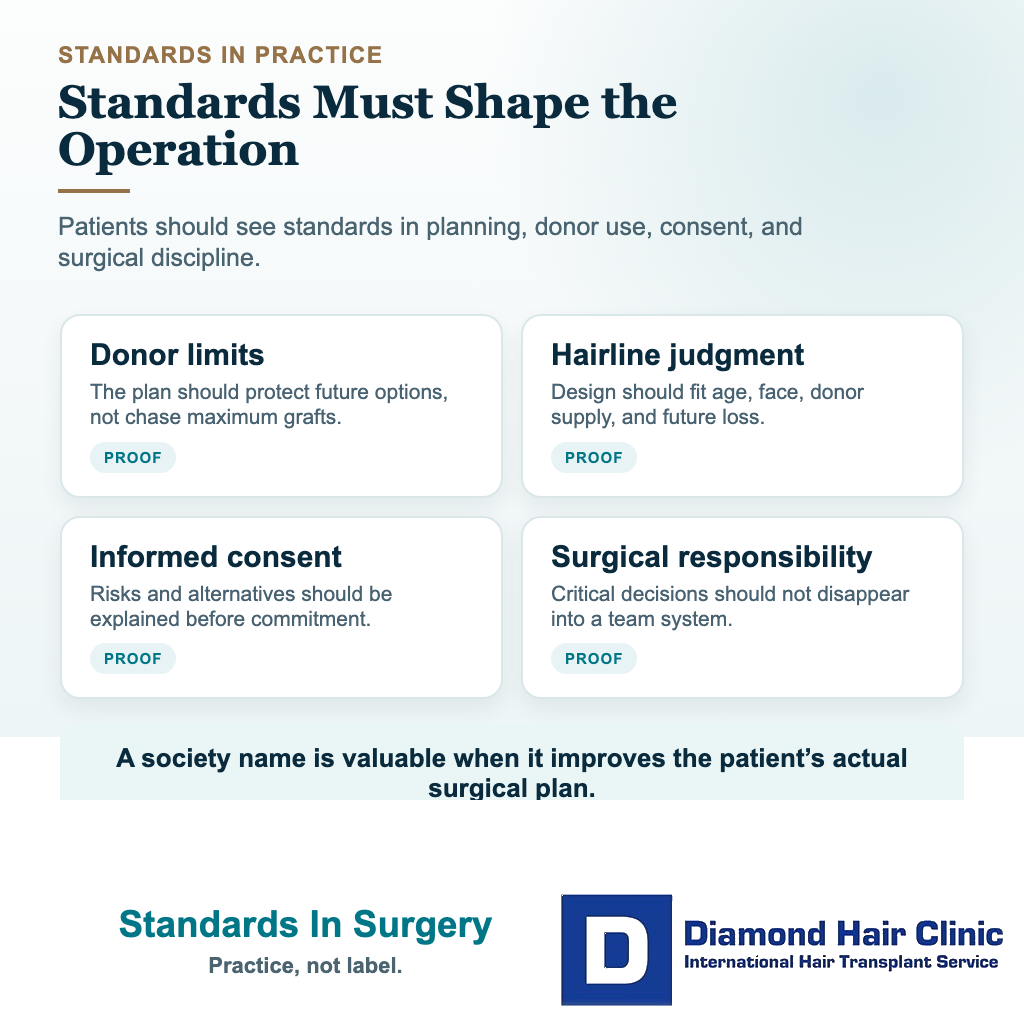
Sometimes someone needs fewer grafts placed with better judgment, a slightly more mature hairline, or a more cautious crown plan because the donor supply must be protected for future years. Sometimes someone is not ready for surgery at all, and the responsible answer is to wait, treat the hair loss medically, or reconsider the goal.
At this point, international education and personal surgical philosophy meet. A responsible surgeon needs to know the techniques, but he also needs to know when not to overuse them.
FUE, DHI, sapphire blades, implanter pens, and other tools can all be useful in the right case. But the tool is not the surgeon. The plan is what matters.
If you are trying to understand this better, my article on how a surgeon calculates graft numbers explains why graft planning must be connected to donor capacity, hair caliber, balding pattern, and realistic coverage.
Questions before trusting any clinic
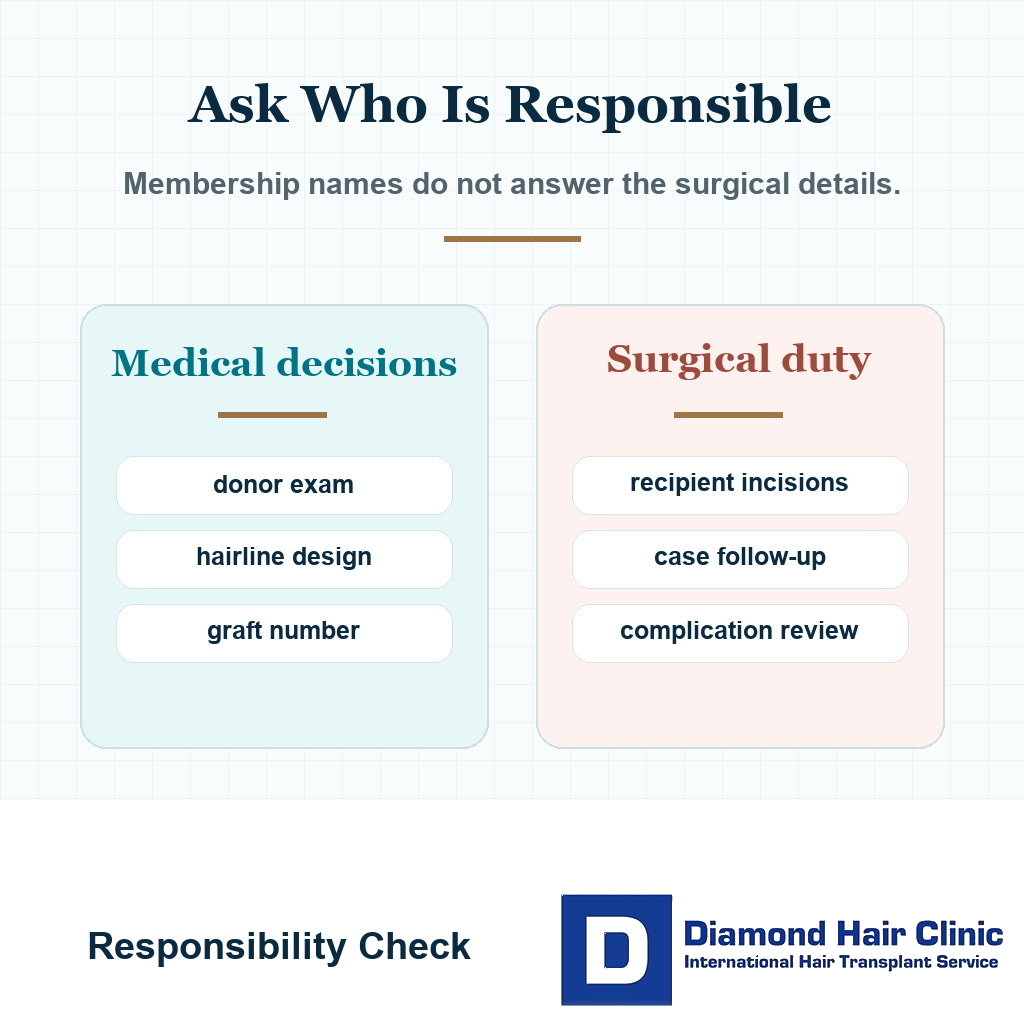
Before choosing a hair transplant clinic, make responsibility plain. The consultation needs to make clear who examines the donor area, who designs the hairline, who decides the graft number, who creates the recipient area incisions, and who follows the case if healing becomes more complicated than expected.
Daily patient volume and whether the plan is based on the donor area or on a package price should be clear.
These questions may feel uncomfortable, but an ethical clinic needs to welcome them. You have the right to know who is operating, what role the doctor has, and whether the surgical plan is realistic.
I also encourage you to look beyond perfect promotional photos. Good research includes full journeys, different lighting, donor area views, wet hair, close photos, and updates after enough time has passed.
A beautiful early photo can be encouraging, but it is not the whole story.
If you are still unsure whether you are suitable for surgery, you can read my article on who is a good candidate for hair transplant. Candidacy is the first safety filter. Without it, even a technically clean operation can still be the wrong decision.
My view on World FUE Institute and ISHRS
I am an active member of the World FUE Institute (WFI), and I respect professional organizations that encourage learning, refinement, and ethical discussion.
ISHRS and WFI are similar but not exactly identical organizations. They also have many members in common, and both are connected to a larger idea that I value.
Hair restoration surgery is a medical specialty that requires training, judgment, and accountability, so membership in any professional organization must not be used as decoration.
It should remind the surgeon to keep improving, remind people considering surgery that education matters, and remind the whole field that hair transplant surgery is not a beauty service performed on a production line. It is surgery.
Still, I am very clear about this. A professional organization does not examine your scalp, design your hairline, or protect your donor area during surgery.
The surgeon and the clinic team do that. The real decision must always return to the doctor, the plan, the ethics, and the proven quality of work.
Membership is only one part of the decision
ISHRS or WFI can be a useful sign of professional involvement, but it is not a shortcut for your own research.
A careful person needs to look for surgeon involvement, natural results, transparent planning, donor protection, realistic promises, and a clinic culture that does not rush the operation. These things matter more than any single membership name.
When I plan a hair transplant at Diamond Hair Clinic, you need to understand the reason behind every decision. The hairline must suit the person, not the advertisement. The donor area must remain healthy. The result needs to look natural years later, not only impressive on the first day after surgery.

Read this review excerpt
Every single one of my questions was answered and they made sure I had all the details I needed to make an informed decision.