



A Transplanted Hairline That Is Too Low
A very low transplanted hairline has to be judged by how it will age, not just how it looks today. A better prevention step is to slow down before surgery and treat low straight hairline planning as a donor and movement decision, not only a shape preference. One reason is the forehead muscle and hairline lowering limit, which can make a low line look unnatural in motion. A low line can spend donor grafts early, make the temples harder to balance, expose future thinning behind the front, and make repair more difficult than the first surgery. Raising a transplanted hairline is not the reverse of lowering it. It may require laser, electrolysis, FUE punch out, camouflage grafting, or acceptance of limits. I cover the removal decision in more detail in the guide to removing transplanted hair, because electrolysis, laser, and graft removal are not interchangeable. When selected front grafts may need to be destroyed or extracted, bad hairline graft removal planning deserves a separate method review before repair is chosen.
Forehead height alone is not enough. I judge the design from age, face shape, native hair stability, temple points, hair caliber, graft direction, density, and remaining donor reserve. A low hairline can be suitable in selected cases, but it becomes risky when it ignores long term hair loss and locks you into a design that may not age well.
Use a relaxed expression when you judge the line in photos. Raised eyebrows, wet hair, and a close camera angle can make the border look lower or harsher than it does in normal conversation.
Add a side view and a short relaxed face video to the review, not only a straight front photo. A low line can look acceptable in one still image and too heavy when the face moves. Before a correction is planned, name the exact concern. It may be the height, straightness, density, temple connection, or the way the line moves with the face. A repair proposal should identify the feature it changes and the feature it leaves alone.
Low hairlines can become a long term problem
A low hairline uses grafts in the most visible part of the scalp. That front edge must look natural under bright light, wet hair, short hair, and close conversation. If too many grafts are placed too low, you may lose donor capacity that could have protected the mid scalp, crown, or future repair needs.
The second issue is future native hair loss. Surgery moves donor hair into a new position, but it does not stop the original hair loss pattern. If the native hair behind a low transplanted front continues thinning, you can be left with an isolated wall of transplanted hair and weak coverage behind it. For suitable cases, medical treatment before surgery can be part of the planning discussion.
The third issue is repair. A hairline that is too high can often be lowered with careful planning if donor reserve allows. A hairline that is too low has already placed permanent follicles into the wrong zone. Those grafts may grow well, but their position can still be wrong for the face.
Early healing can make the line look lower
Do not judge the final height from the first days after surgery alone. Redness, scabs, swelling, shaving, wet hair, and close phone photos can make the front look sharper, lower, or heavier than it will look after early healing. The day one line is useful evidence, but it is not the same as judging the mature result.
If the drawn design or immediate postoperative photos clearly show that grafts were placed lower than agreed, keep those records and discuss the concern with the clinic. Still, repair decisions should usually wait until the scalp has settled enough for the surgeon to see graft position, skin texture, growth direction, and the surrounding native hair. A top view can help show density behind the line, but it cannot prove by itself that the front border was placed too low. I judge hairline height from relaxed front and side views, with the face at rest and the original marking photos beside the current photos. Acting too early can turn anxiety into unnecessary repair work. If the first concern appears around month eight, a month eight hairline check can organize the evidence before low hairline repair is considered.
A low hairline can still look natural in selected cases
A lower hairline can look natural when it matches your facial proportions, age, temple shape, hair caliber, and long term pattern. Some men naturally have a lower frontal point. Some cases have stable hair loss and strong donor capacity. Some forehead lowering plans can be reasonable when the design still respects the rest of the scalp.
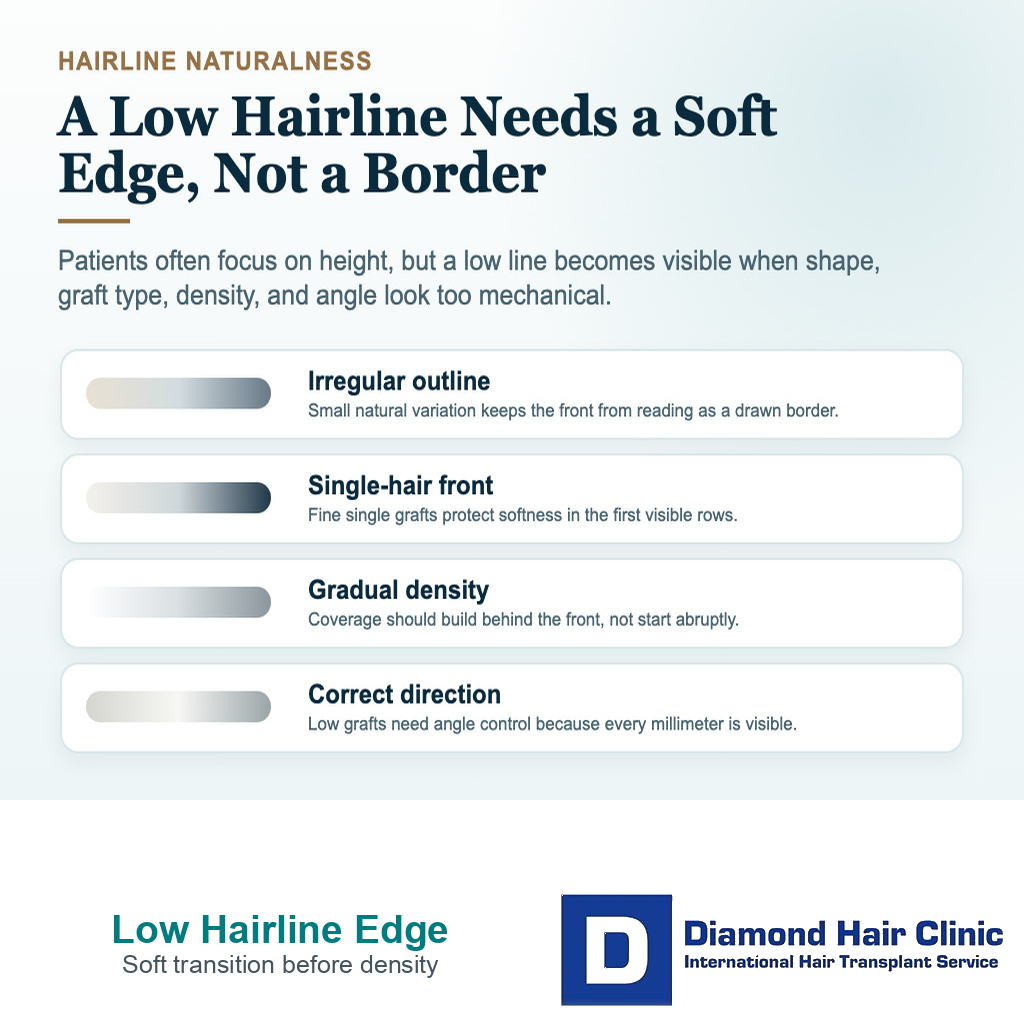
The line becomes less convincing when it looks like a flat border instead of a living transition. Natural hairlines have irregularity, soft single hair grafts in the front, gradual density behind the first rows, and direction that follows your original growth. The hairline design has to belong to the whole face, not only to a drawing made before surgery.
I separate “low” from “too low.” A low line may still be balanced. A too low line makes the upper face look compressed, makes the temples look disconnected, or makes the transplant obvious when you change hairstyle.
Straight hairlines often look artificial after surgery
A straight line attracts attention because the human eye reads it as a border. In a transplant, the front edge is already under scrutiny. If the line is low, straight, and dense, it can look drawn on even when the grafts survive.
Naturalness comes from several small details working together. The front needs irregular macro shape, soft feathering, single hair grafts in the first rows, correct angle, and a density gradient that does not start too abruptly. If multi hair grafts are placed at the very front, or if the angle points forward too aggressively, the result can look harsh. In a pluggy hairline repair case, graft type and placement can matter as much as hairline height.
A low straight line leaves very little room for visual forgiveness. A slightly higher line can often tolerate small imperfections. A very low line needs nearly perfect planning, because every millimeter is visible.
Temple points change the whole frame
The frontal hairline cannot be judged separately from the temples. If the middle is brought down but the temple points stay weak, the hairline may look like a rounded cap. If the temples are rebuilt too aggressively, the face may look overdesigned or older than expected in a different way.
Temple points are technically demanding because the hair is finer, flatter, and more angled than central scalp hair. A low frontal line may need subtle temple support, but the donor quality and facial structure still have to support that choice. Temple point restoration only helps when the angle, density, donor quality, and facial structure can support the new frame.
When the temples do not match the new front, you may sense that something is wrong even before you can describe it. You may say the hairline looks too straight, too round, too dense, or too separate from the sides. The mismatch usually sits in the relationship between the center, corners, temple points, and future thinning pattern.
Raising a low transplanted hairline later
Sometimes it can be improved, but it must not be presented as easy. The surgeon must first identify why the hairline looks wrong. Is the center too low, are the temples too closed, is the line too straight, too dense, pluggy, wrongly angled, or mismatched with the sides? Each problem needs a different repair path.
Possible options include laser hair reduction, electrolysis, FUE punch out, graft recycling, camouflage with finer single grafts, or a staged redesign. These options can soften the appearance, but they also have tradeoffs. Laser or electrolysis may reduce hair but cannot guarantee perfect skin texture. Punch out can remove grafts but may leave tiny scars. Camouflage can improve softness but may use more donor hair.
Repair planning has to measure the damage created by the fix, not only the visible line. Removing grafts can change the outline, but it cannot always return the skin to an untouched surface or recover the donor grafts already spent. A repair plan must protect the remaining donor supply and avoid turning one visible problem into two.



Laser or electrolysis for misplaced transplanted hair
Laser or electrolysis may be considered when the aim is to reduce misplaced hair in a low or unnatural line. This can be useful when the unwanted grafts are too far forward, when you want to shave or wear a shorter style, or when adding more grafts would make the design heavier instead of more natural.
The limitation is that transplanted hair sits in skin that was surgically altered. Removing the hair may still leave small marks, texture change, pale dots, darker pigment, or an uneven transition. Skin tone, graft size, hair color, and previous scarring all change the risk. Laser should not be chosen only because it sounds less surgical.
If laser or electrolysis is considered, the endpoint has to be clear. Is the aim to fully remove the low line? Thin it enough to soften it? Prepare the area for a later redesign? Each endpoint changes the number of sessions, the risk, and the chance that another transplant will still be needed.
FUE punch out and graft recycling
FUE punch out can be considered when individual grafts need to be removed from an unnatural hairline. In some cases, those grafts can be reused in another area. In other cases, removal is mainly done to reduce a visible mistake. The decision depends on graft size, spacing, depth, skin healing, and how much donor reserve remains.
Graft recycling sounds attractive because it feels less wasteful, but it is still repair surgery. The removed graft may not be ideal for the new location. The punch out area may need time to settle. The recipient area may need a staged plan. If the same session tries to remove, redesign, and densify too aggressively, the repair can become less predictable.
After previous removal work, raising a low hairline becomes a narrower decision. The aim is to remove or soften the hairs that still break the facial balance while avoiding extra skin marks in the most visible zone.
This overlaps with broader bad hair transplant repair, but a too low hairline has its own difficulty. The surgeon is working in the most visible part of the face, where tiny scars, wrong direction, and density errors are harder to hide.
Checks before adding more grafts
Adding grafts can help when the low hairline is not the main problem. If the real problem is pluggy texture, poor density transition, or weak blending behind the first rows, careful single hair grafting may soften the result. If the line is simply too low for the face, adding more grafts can make the design heavier. Before placing more grafts, I check whether added density would only make the low border darker.
In this review, the donor area, remaining native hair, frontal density, temple points, and your styling goal all matter. I also check whether the hair direction itself is wrong, because wrong hair direction cannot be solved by density alone.
More grafts should not be used to hide a design mistake until the design itself has been judged. The repair may be softening, removal, or waiting until growth is mature enough for a dependable decision.
Younger patients need lifetime planning
Younger people often want the hairline they had before hair loss began. I understand the emotional reason. But early male pattern hair loss can continue for years, and the donor area has to serve you for life.
A low hairline at 22 may look attractive in a drawing and still become a problem at 32 or 42 if the mid scalp and crown thin behind it. A design that looks slightly conservative today may be easier to maintain later. Before a young person commits to an aggressive front, lifetime graft planning has to be part of the decision.
A younger person can still be a surgical candidate. The plan has to be judged against pattern stability, family history, medication tolerance, donor capacity, and future sessions. A transplant should not spend the future to create a one year photo.
Review before accepting a low hairline
Before accepting a low design, the consultation needs to show more than a marker line. It should review facial proportion, current and expected hair loss pattern, donor density, hair caliber, temple balance, and the number of grafts required to make the line look soft rather than harsh.
A few photos cannot show donor miniaturization, scalp elasticity, hair direction, and the texture of the existing frontal hair with enough certainty. If a clinic promises a low dense hairline from a few photos, that is a reason to slow the decision down.
The consultation should also cover what happens if the design feels too low later. If repair limits are vague before surgery, the original plan is probably not being judged carefully enough.
First confirm where the hairline was placed
At Diamond Hair Clinic, the hairline is not planned as an isolated cosmetic line. It is planned with the donor area, future hair loss, facial proportions, and your long term appearance in mind. A low line is accepted only when the full case supports it.
If the design has already been made too low elsewhere, I would first separate the visible problems. You may need help with position, density, graft size, direction, or temples. A touch up graft plan is very different from a removal plan. Dense packing into the same wrong zone can create the same problem again, especially when too many grafts are used to chase instant coverage.
My preference is to make the first hairline conservative enough to age naturally, but not so high that you feel untreated. That balance is the work. A natural hairline should still make sense when you are older, under harsh light, and without styling tricks. If the proposed line only looks good in one posed photograph, it is not ready to be accepted.
Read this review excerpt
We also had a levelled conversation about my hairline and results I could expect based on my donor density area.