Laser Hair Removal for Transplanted Hair Has Limits
When a poor transplant leaves dark hairs below the right hairline, the simplest answer can feel like erasing them. Laser can reduce some transplanted hairs, but it should not be treated like a precise hairline repair tool. It works best when the target hair is dark enough and the scalp is fully healed. The result still depends on hair color, skin type, graft depth, scalp healing, scarring risk, and whether the real goal is thinning, complete removal, individual graft selection, or a better hairline design.
I see this question most often when a hairline was placed too low, too straight, too dense, or with thick grafts at the front. The patient hopes a laser session will simply erase the problem. Sometimes laser can help reduce visible hair, especially when the hairs are dark enough for the device to target. Sometimes it is the wrong tool because the repair needs individual graft judgment.
The final hairline matters more than the device. Before anyone starts treatment, I want to know whether removing hair with laser will make the result look more natural or simply create a different repair problem.
Before laser, decide which hairs would still be useful in a repair plan. A hair that looks too low today can sometimes soften the final line later, so permanent reduction should follow the design rather than the first impulse to erase it.
Laser Can Reduce Hair, But It Cannot Redesign a Hairline
Laser hair removal works by targeting pigment in the hair shaft and follicle. That makes it useful for reducing dark hairs in a treatment zone. It does not choose one graft, one angle, or one unnatural hair group with the same precision that a surgeon uses during repair planning, and one session should not be expected to erase every visible transplanted hair.
Hair removal laser should not be confused with fractional or ablative CO2 resurfacing. One is intended to reduce hair. The other is used to remodel skin or scar texture. If raised skin is the main problem, I review the scalp bumps and ridges separately because reducing the hair may leave the surface change visible.
Resurfacing has a different purpose from hair removal, but that does not guarantee that every follicle in the treatment zone will be spared. Device settings, treatment depth and density, scar tissue, and the exact area being treated all affect that risk. Before treatment, mark the native and transplanted hairs that should remain and agree whether the aim is redness, texture, or hair reduction. That makes follicle preservation part of the treatment plan instead of an assumption made from the device name.
In transplanted hair, the concern is often not only that hair exists. The hairline may be too low, the angles may be wrong, the density may be heavy, or thick follicular units may have been placed where single soft hairs should have been used. A laser may reduce density, but it will not redesign direction or rebuild the front edge.
Removing transplanted hair is a repair decision first. The plan has to separate hairs that should be reduced from hairs that may still be needed for the final hairline. When individual graft selection matters, bad hairline graft removal is one surgical option that may give more control than laser.
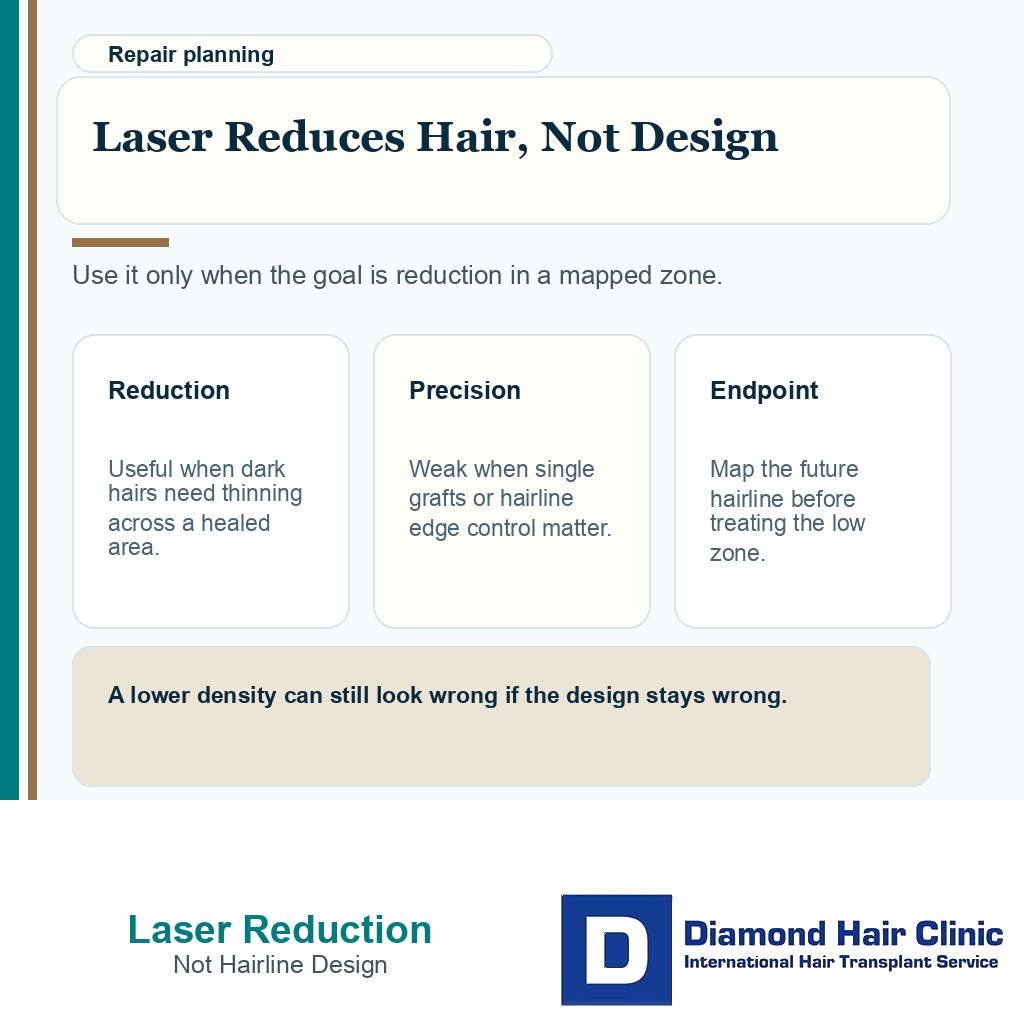
Laser may reduce unwanted density, but the hairline design still has to be planned like a repair case.
Transplanted Hairs Behave Like Donor Hair
Transplanted hairs are usually taken from the permanent donor area, so they can continue growing in the recipient area for many years. If the grafts were placed in the wrong position, those hairs may also keep revealing the mistake for many years.
Some front hairline problems are caused by grafts containing multiple hairs. Multiple hairs in the hairline can make the front look pluggy or artificial when thick graft groupings sit too close to the edge. Laser may thin some of those hairs, but it may not remove the whole visual problem evenly.
A pluggy hairline can also involve spacing, angle, caliber, and skin texture. If those are the main defects, pluggy hairline repair is a planning question, not only a hair reduction question. The method has to match the defect.
Timing After Surgery Matters Before Laser
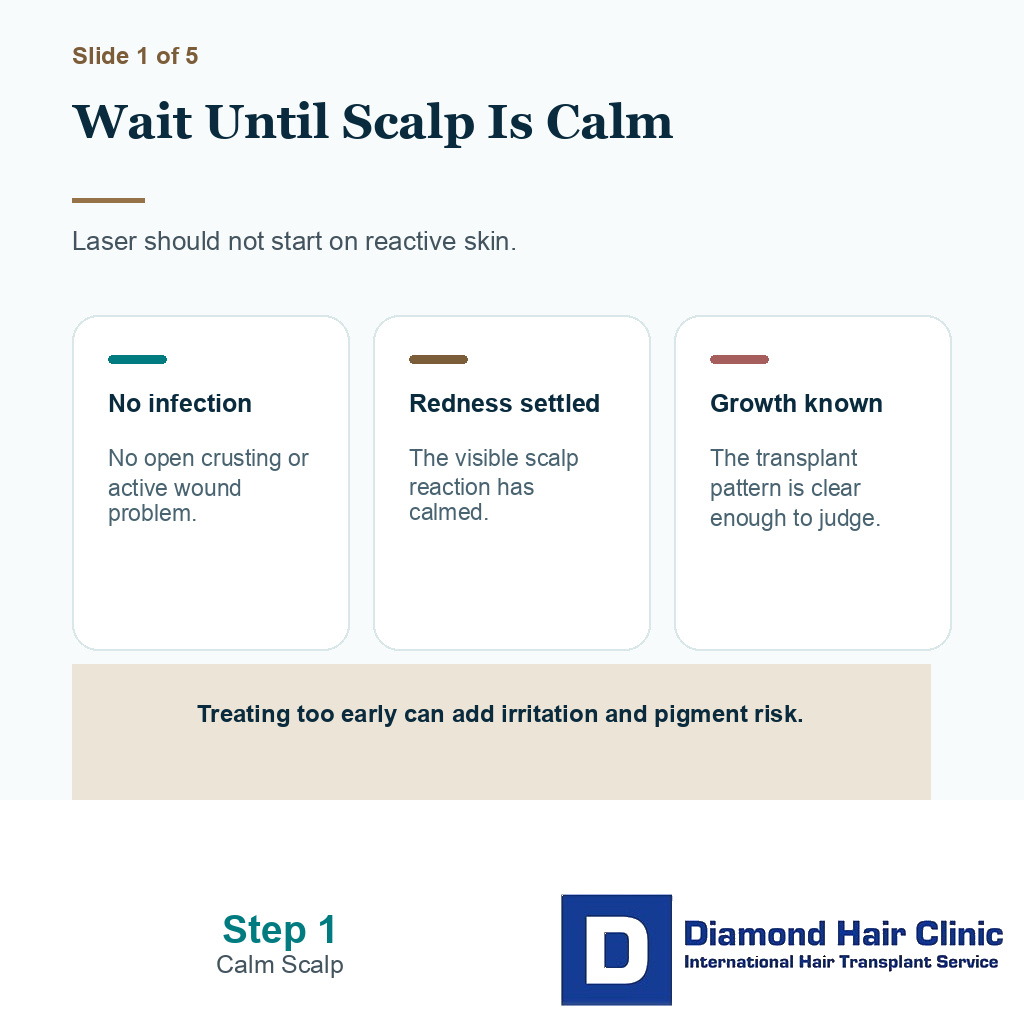
Laser should not be rushed onto an inflamed or recently operated scalp. After a hair transplant, the skin goes through redness, crusting, vascular recovery, texture change, and sometimes prolonged sensitivity. If the scalp is still reactive, another laser treatment can add irritation and pigment risk.
The scalp should be fully settled before considering laser. That means no active infection, no open crusting, no unstable redness, no unexplained bumps, and no recent wound problem in the treatment zone. The surgeon should also understand whether the final transplanted growth pattern has already declared itself.
When a hairline was placed too low, the emotional pressure to remove it quickly can be strong. A patient with a transplanted hairline that is too low needs careful design diagnosis before repair. A rushed laser plan can replace one problem with another.
Skin Color and Pigment Risk Need Respect
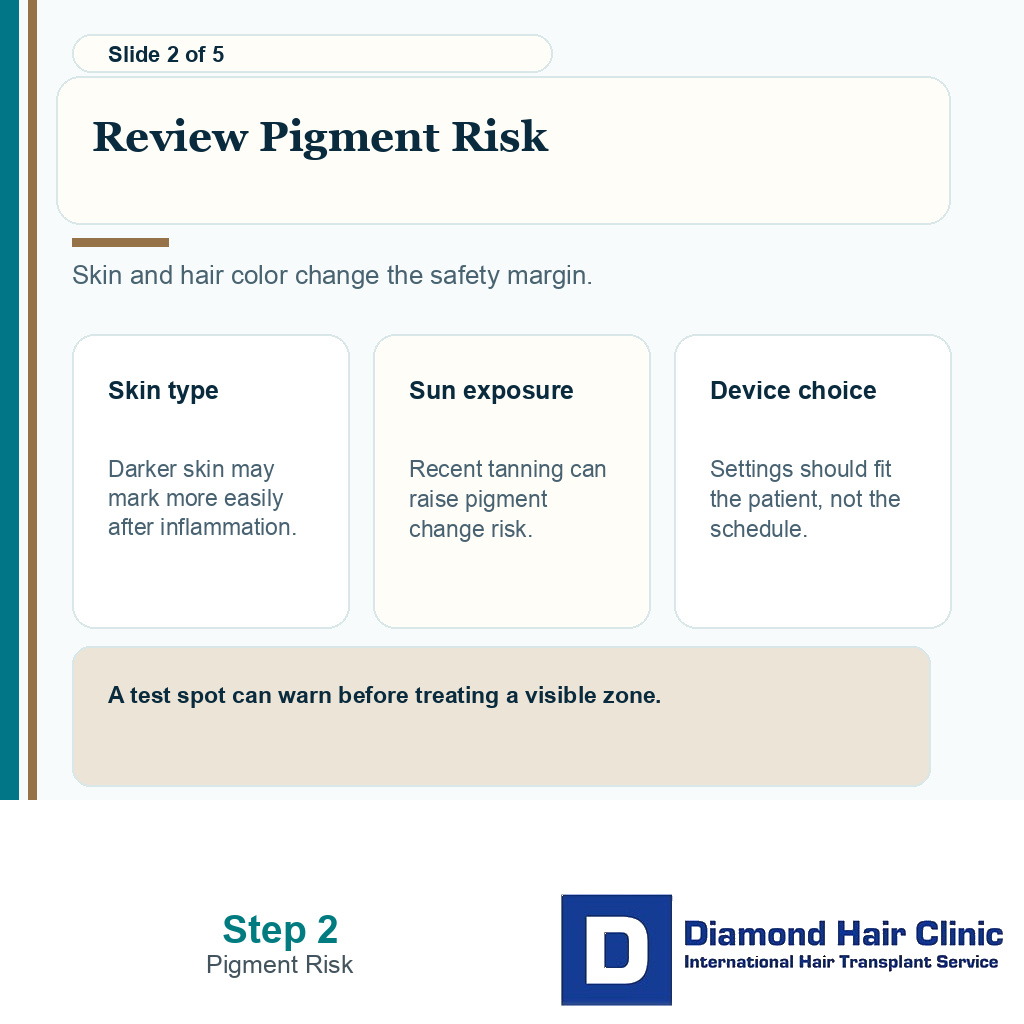
Laser energy is not only interacting with the hair. It also passes through skin that has its own pigment, healing history, and tendency toward inflammation. Darker skin types, recently tanned skin, irritated skin, and skin that marks easily need more conservative settings and more careful device selection.
Possible side effects include redness, swelling, blistering, crusting, darker patches, lighter patches, texture change, and rarely scarring. These risks are not the same in every patient. They depend on the laser type, operator skill, skin color, hair color, sun exposure, and whether the scalp has already been injured by surgery.
A test spot is not a guarantee, but it can be a sensible warning step when pigment risk is meaningful. It may show how the skin reacts before a larger visible hairline zone is treated.
Laser, Electrolysis, and Punch Out Solve Different Problems
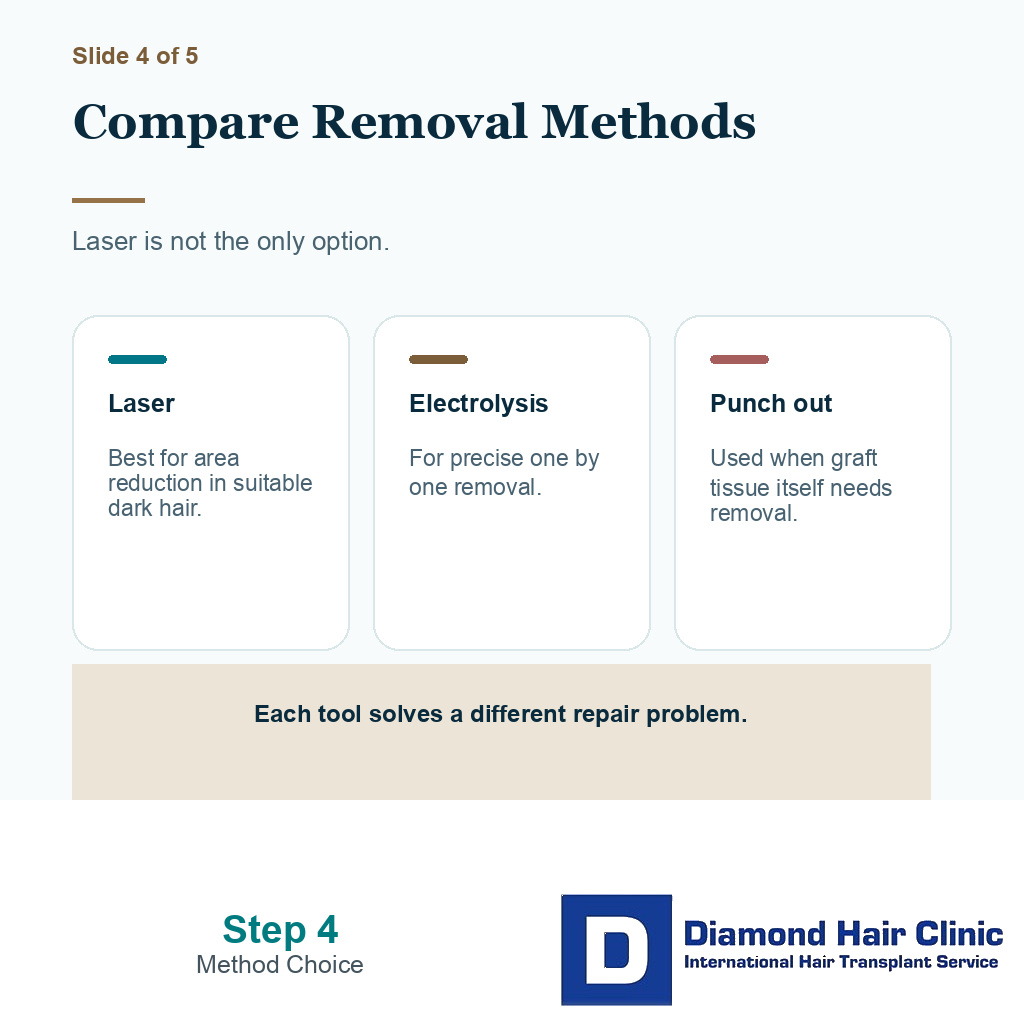
Laser is an area reduction tool. Electrolysis treats follicles one by one. FUE punch out physically removes selected grafts and can sometimes allow the surgeon to reuse some grafts elsewhere if they are suitable. These methods should not be described as interchangeable.
A wide band of dark transplanted hair that simply needs density reduction may lead to a laser discussion. A few wrong grafts on the hairline edge may be better suited to electrolysis or punch out. A row of thick pluggy grafts may need punch out because the tissue and graft grouping both matter.
Laser does not remove old extraction scars, and punch out does not make every skin mark disappear. A realistic repair plan should explain what each tool can improve and what may remain visible. For someone who may shave the scalp later, laser can reduce unwanted hair but it cannot undo the skin marks from the original surgery.
After several removal attempts, chasing every remaining hair with laser can become the wrong goal. I first decide whether the remaining hairs are still damaging the design, or whether more treatment would mostly add skin and contrast risk.
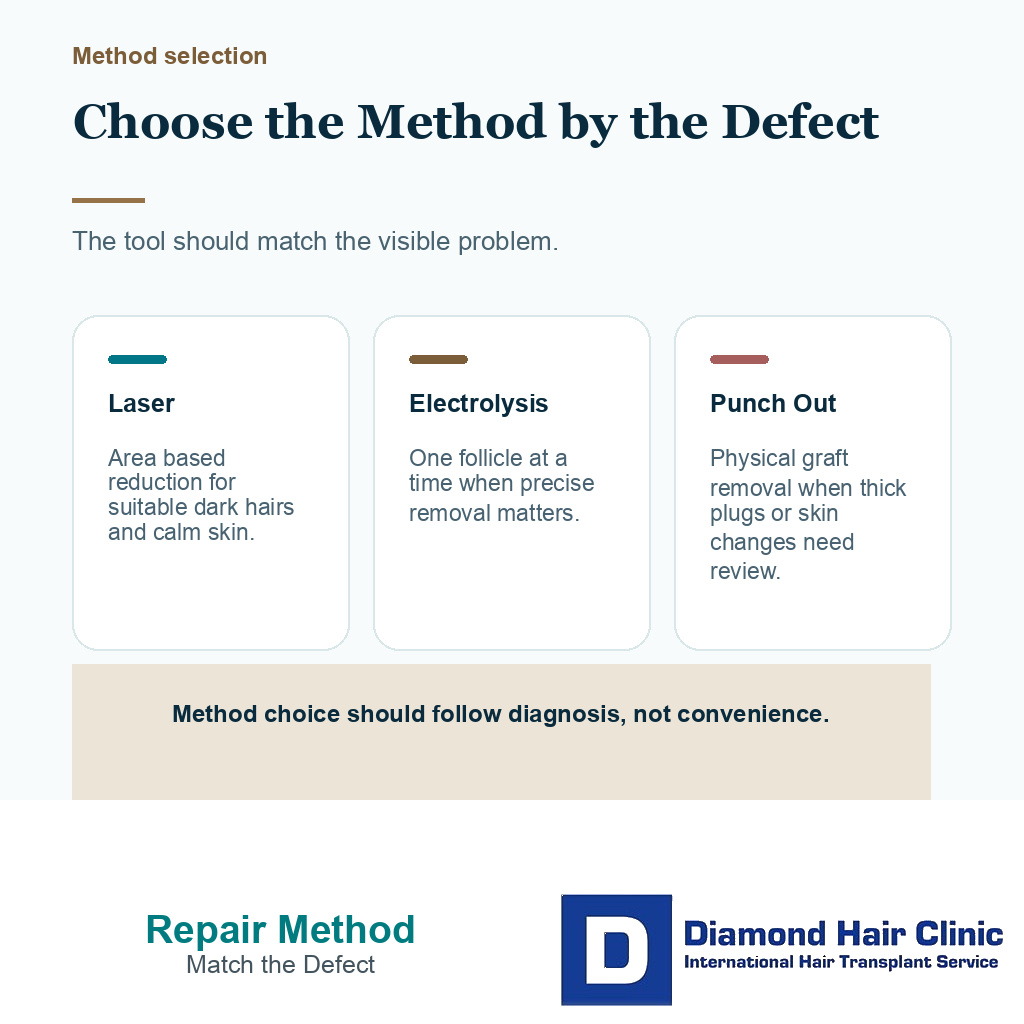
The best method depends on whether the goal is reduction, single follicle removal, or physical graft removal.
Situations Where Laser May Make Sense
Laser may be reasonable when the unwanted transplanted hairs are dark enough for the device to target, the scalp is fully healed, the patient understands that several sessions may be needed, and the goal is reduction rather than a sharply sculpted new hairline.
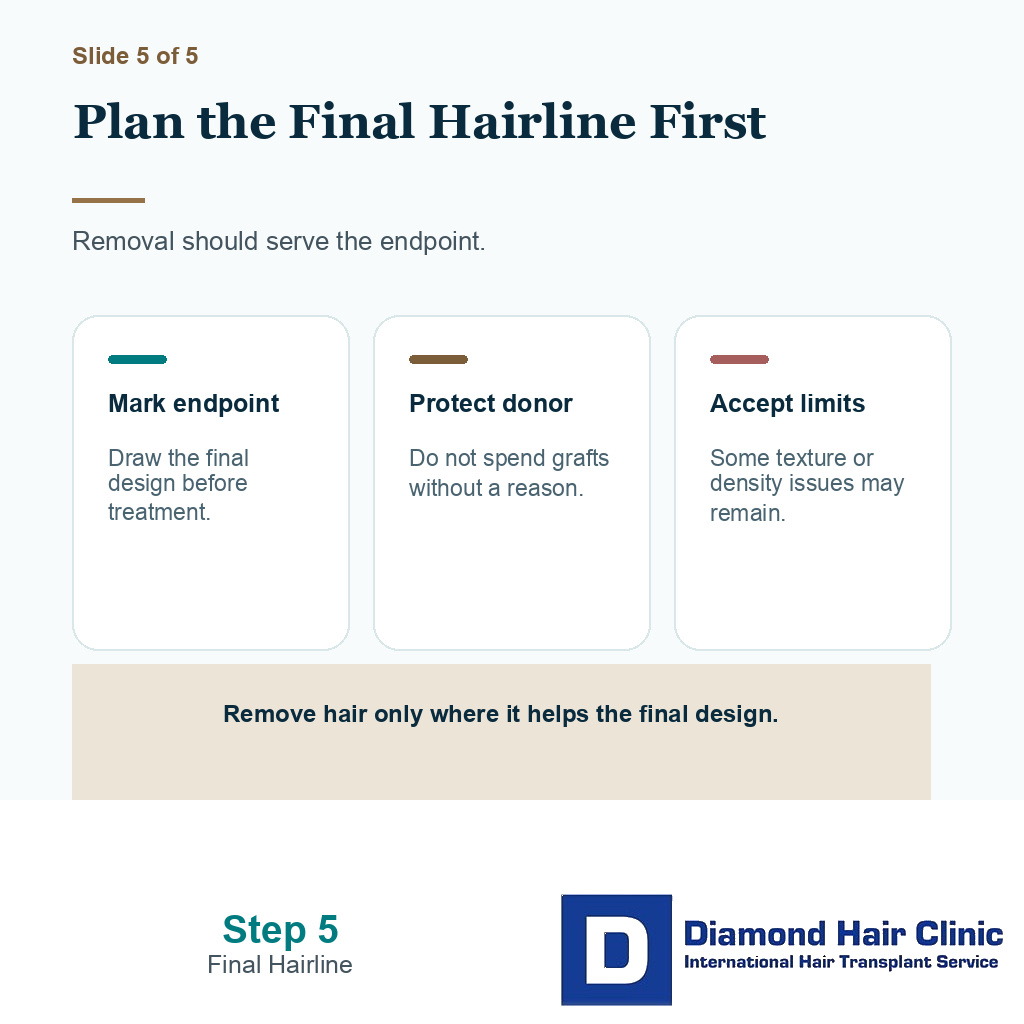
It may also be useful when a patient wants to soften a dense low zone before a later repair plan. Even then, the desired future hairline should be mapped first. Removing too much from the wrong place can make the next repair more difficult.
If a patient has a history of poor repair planning, I would not begin with the device. I would begin with photos, donor assessment, recipient area assessment, and a clear discussion of what the final hairline should look like.
Situations Where Laser Should Not Be First
Laser needs caution when the patient has light blond, gray, red, or very fine transplanted hair because many devices target dark pigment more effectively. It also needs caution if the hairline edge needs selection of individual grafts, if the skin is bumpy, if graft direction is wrong, or if old scarring is already visible.
Patients with raised or bumpy hairline texture may need the skin itself reviewed before more treatment is added. Patients with wrong hair direction after transplant need a plan that addresses angle, because laser does not correct the angle of a remaining hair.
If the case is a broader failure, the starting point should be a full bad hair transplant repair assessment. Laser can be one part of that plan, but it should not become a shortcut that skips diagnosis.
Decision points before a test spot
Before treating a visible hairline area, ask what exact zone will be treated, which laser will be used, why that device fits your skin and hair type, what settings are planned, how many sessions may be needed, and what side effects should make you stop.
Bring a normal distance photo with the unwanted hairs marked, not only a close view of single grafts. The provider needs to see what should be removed and what should stay soft around the hairline.
Ask whether the provider has experience treating transplanted hair, not only normal body hair. The depth, angle, density, and surrounding scar tissue can be different from routine laser hair removal on the body.
Do not test a home IPL or beauty laser device on transplanted hair just to see what happens. Around a hairline, the treatment zone has to be mapped first, the skin type has to be judged, and the hairs that still belong in the design have to be protected.
The test area should be chosen as part of a hairline plan, not as a random patch. If the test patch responds badly, it should not sit in the most visible part of the frontal edge.
The 5 slides below separate the laser decision into practical checks for broad reduction, single graft control, pigment risk, pluggy texture, and whether the final hairline map should come first. Use the arrows or numbered controls to move through the checks one by one.

Read this review excerpt
told me the quality of my donor hair and what he could take out and advised me what will the be best outcome with what donor hair I had.