


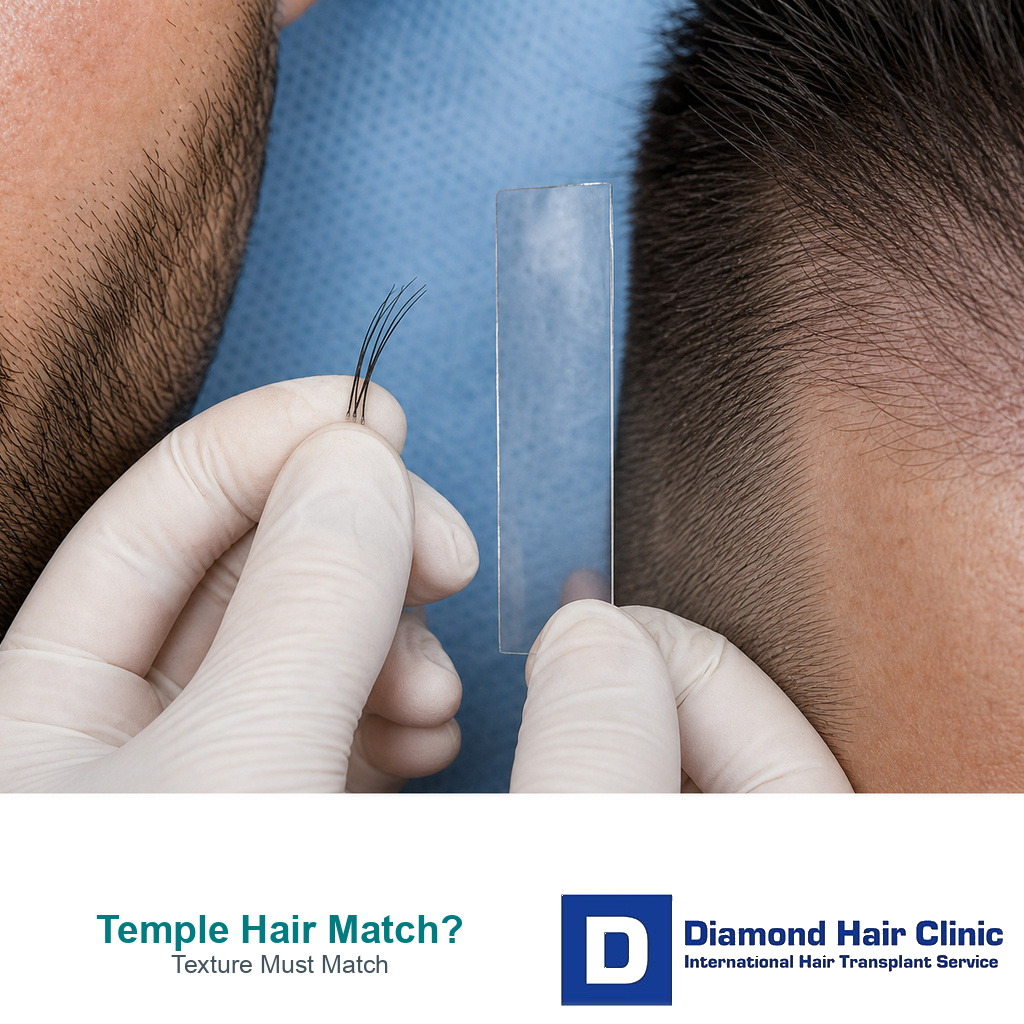
Beard or Body Hair for Temples Needs Cautious Planning
The side edge of the hairline is one of the least forgiving places to use hair that does not behave like nearby scalp hair. The temple edge is one of the most visible parts of the face frame. A hair can grow well there and still look wrong if the caliber, curl, color, length, angle, or texture does not match the surrounding scalp hair.
I treat nonscalp hair as support hair, not as the hair that should draw the first visible temple edge or hairline corner. Beard hair may help behind scalp hair that blends better in selected cases. Chest or back hair is even less predictable. The first visible temple border usually needs the softest, finest scalp hairs that match the surrounding hair.
In temple work, the visible edge needs the softest suitable donor hairs and stronger hairs belong behind it as support. That detail can matter more than the total graft number.
Donor hair should be checked at the length you would actually wear the temple area. Hair that blends when left longer can look too strong when the side is kept short, and one close photo is too narrow for that decision.
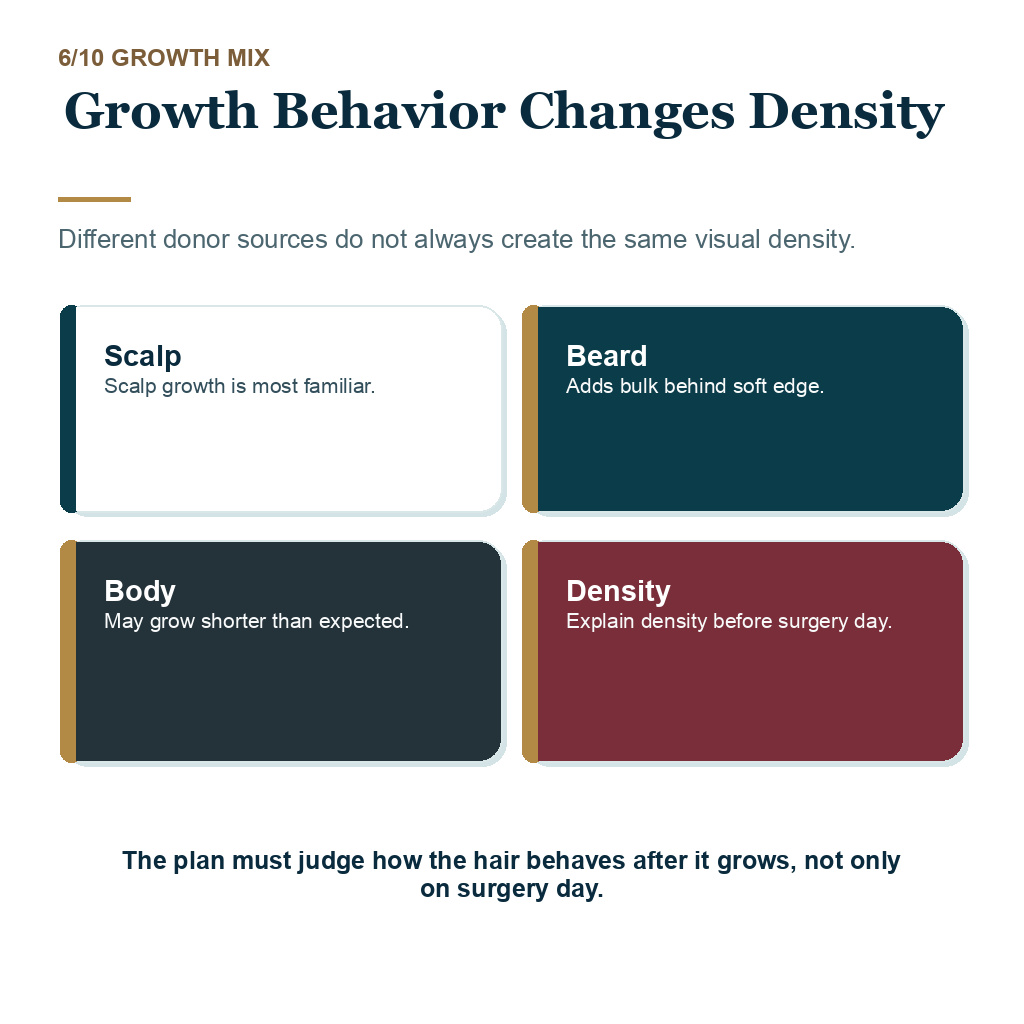
Also plan how the area will be groomed. Beard or body hair may keep a different curl, thickness, growth speed, or maximum length after transplantation. A source that blends when the temples are longer may need separate trimming when the sides are worn short.
This is different from using beard or body hair deeper in the scalp. In the mid scalp, crown, or selected repair zones, surrounding hair can hide some texture difference. The temple point does not give the surgeon that forgiveness. It frames the side of the face, so small mismatches are noticed quickly.
I also separate temple corners from true temple points. A small corner behind the frontal hairline is not the same as rebuilding the side outline of the face. Using stronger nonscalp hair as hidden support behind scalp hair is very different from using it to draw the first visible border.
Growth alone is not enough here. The result has to look as if it belongs to the patient when the hair is short, wet, blown by wind, or seen from the side.
Patients ask when scalp donor supply feels limited
Patients usually ask because scalp donor reserve feels limited. They may want to save scalp grafts for the top, protect future reserve, or correct a previous operation that already used too much donor hair. The question is reasonable because temples often seem small. If beard or body hair may matter later, discuss laser hair removal before future donor planning before reducing that reserve.
A small number of grafts in the temple can have a large visual effect. One mismatched hair on the side of the face can be more visible than several imperfect hairs placed deeper in the scalp.
Temple hair has to be soft, fine, low angled, and distributed with a gradual transition. Some patients ask about nape hair for soft hairline work for a similar reason, but even nape hair has to be judged carefully because donor border reliability matters.
For me, body hair as a donor source is not a direct replacement for scalp hair. It can expand options in selected cases, but the temple area needs a stricter standard because the eye has almost no tolerance for mismatch there.
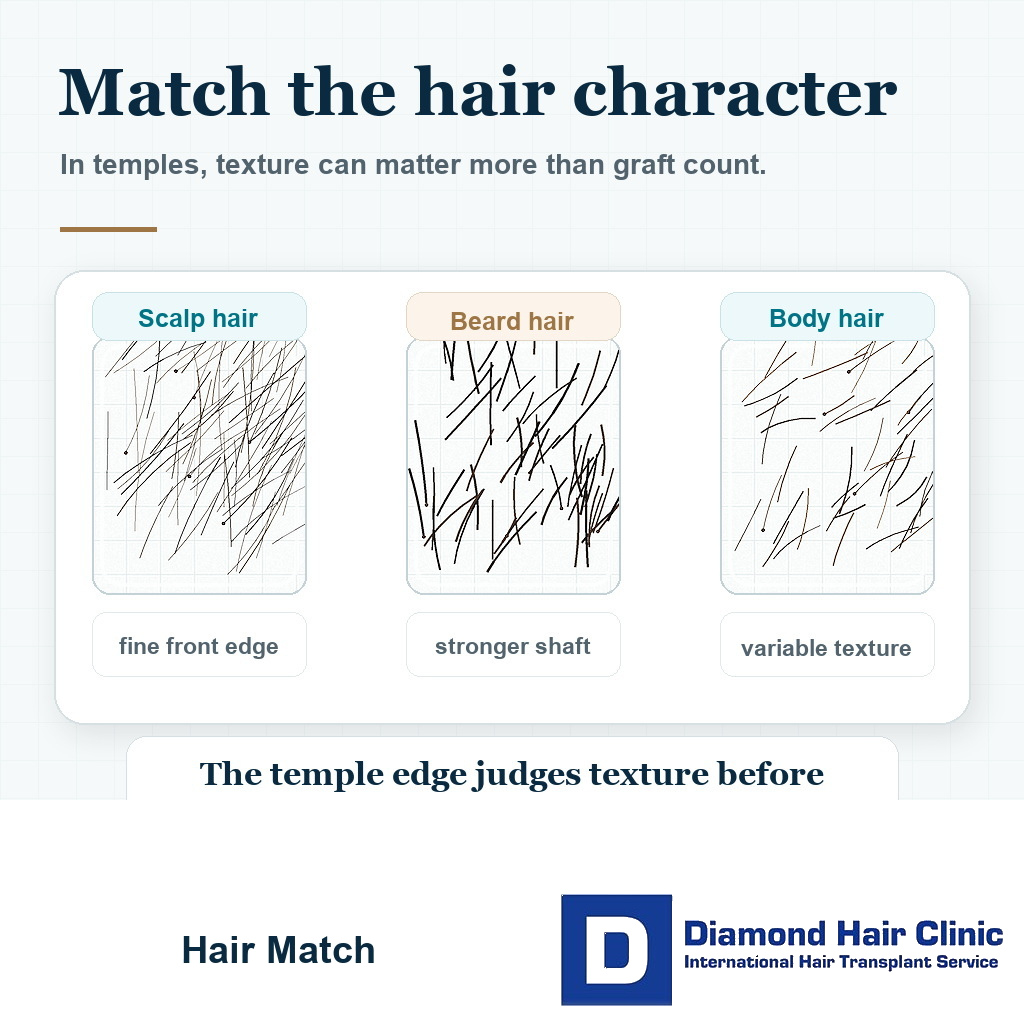
Temple source matching lens
Four checks before using beard or body hair in the temples
Temple work is a visibility test. A stronger donor source may help selected deeper zones, but the first visible edge needs softness, direction control, and a close match to nearby scalp hair.
Visible edge
Will the first border look soft enough?
The temple edge is seen from the side and in movement. Coarse or mismatched hair can stand out quickly.
Usually it is safer away from the first border because beard hair can look too strong in a delicate temple transition.
Use this as a planning frame, not a diagnosis or approval for surgery. The final plan still depends on donor reserve, recipient area anatomy, hair type, medical history, and future hair loss risk.
The temple edge has very little room for mismatch
Temple points look small, but they frame the side of the face. If the point is too low, too sharp, too dense, too rounded, or built with coarse hairs, the face can look heavier or artificial.
Natural temple hair does not behave like a painted line. It has a soft edge, a gradual transition, and a direction that changes as the hair moves from the frontal hairline into the sideburn region. Hairline design in hair transplant cannot be reduced to drawing an outline and filling it.
A temple point that grows but looks wrong is not a good result. Growth is the first requirement. Naturalness is the real test. I look at hair caliber, direction, curl, color contrast, age, future loss, donor reserve, and whether temple work is truly needed at all.
Chest and back hair are risky at the visible temple border
In most patients, chest or back hair is not my first choice for a temple point. These hairs may be shorter, curlier, more irregular in growth cycle, lighter or darker in color, and less predictable in final length than scalp hair.
Keeping the temple short can reduce mismatch, but it does not remove it. A short, coarse, curly, or differently colored hair can still catch the eye if it sits on the visible edge.
Chest hair can sometimes help in selected repair cases or as support in less visible zones. It can be more acceptable where surrounding scalp hair hides some texture difference. The visible temple outline is not that kind of area.
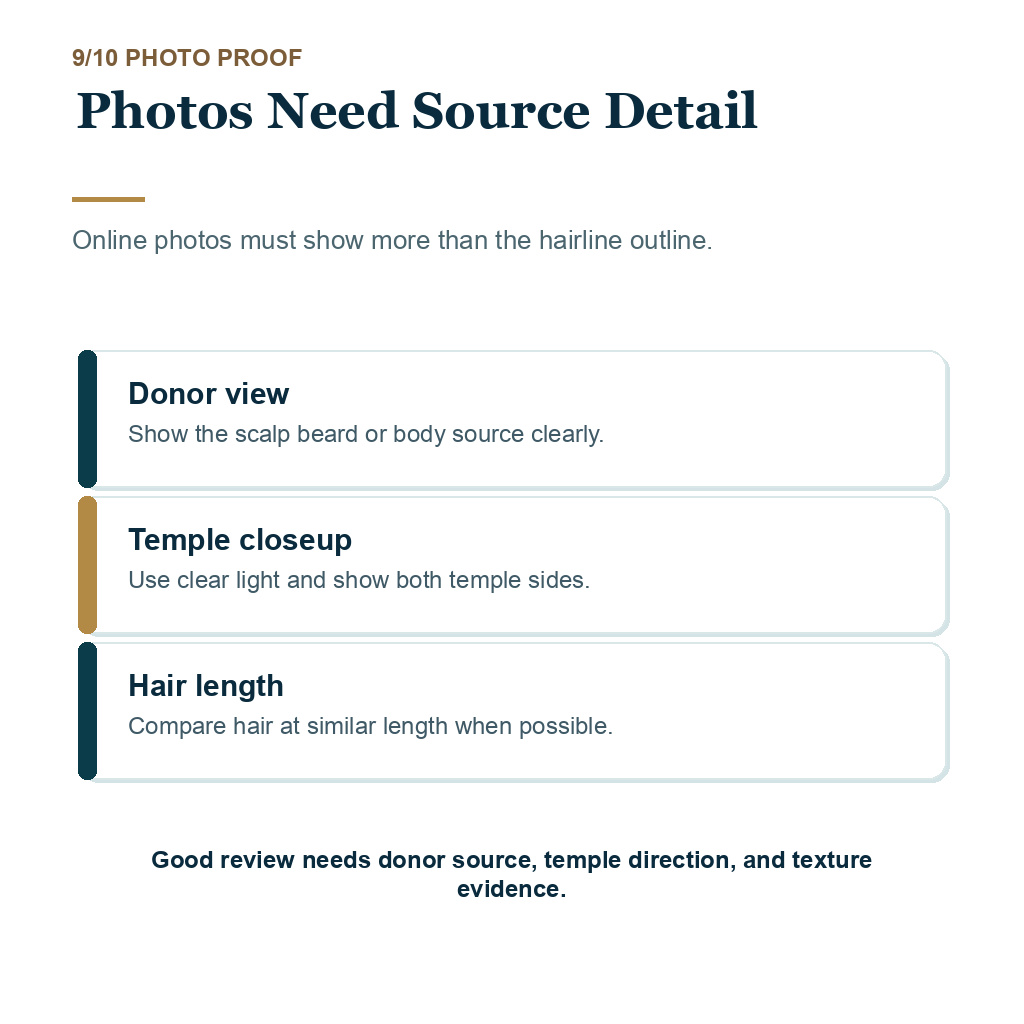
If someone has unusually fine body hair that closely resembles scalp hair, the decision becomes more individualized. Even then, photographs are not enough. The hair has to be compared in person for caliber, curl, color, length behavior, and whether the visual benefit is worth the risk.
Beard hair can overpower temple and hairline work
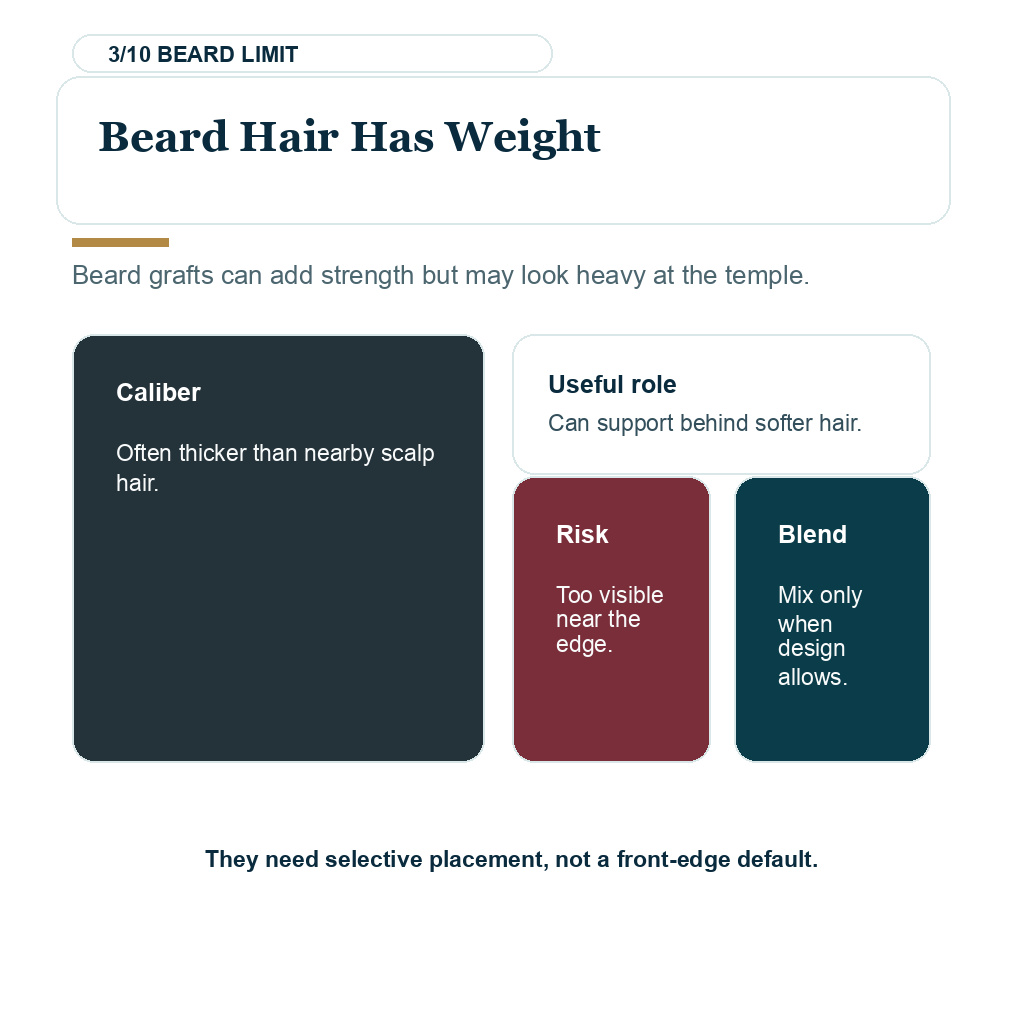
Beard grafts can be useful in the right patient because they often have stronger shafts and better growth than chest or back hair. In the wrong place, that strength becomes the problem.
Beard hair is often thicker and more rigid than fine scalp hair. If it is placed in a soft visible zone, it can stand out, especially when the patient’s scalp hair is fine, straight, or lighter in color.
Beard hair may help when it is used behind the most visible transition, in the middle scalp, in the crown, or in selected repair work where scalp donor hair is limited. Using it to create the first impression of the temple or hairline is a different decision.
The safest visible hairline and temple edge usually need fine single hair scalp grafts from the most suitable donor region. I treat the front hairline as a separate high visibility decision, where nonscalp hair should not be treated as a simple reserve.

Beard hair is safer away from the finest edge
If beard or body hair is considered, I first separate the visible edge from the support zone behind it. The first hairs that draw the temple outline need to match the native scalp hair as closely as possible.
When nonscalp hair is suitable, it is usually safer behind that border. It may sit behind finer scalp hair, in a less visible transition area, or in broader coverage zones where caliber difference is less exposed. That is a support plan, not an edge drawing plan.
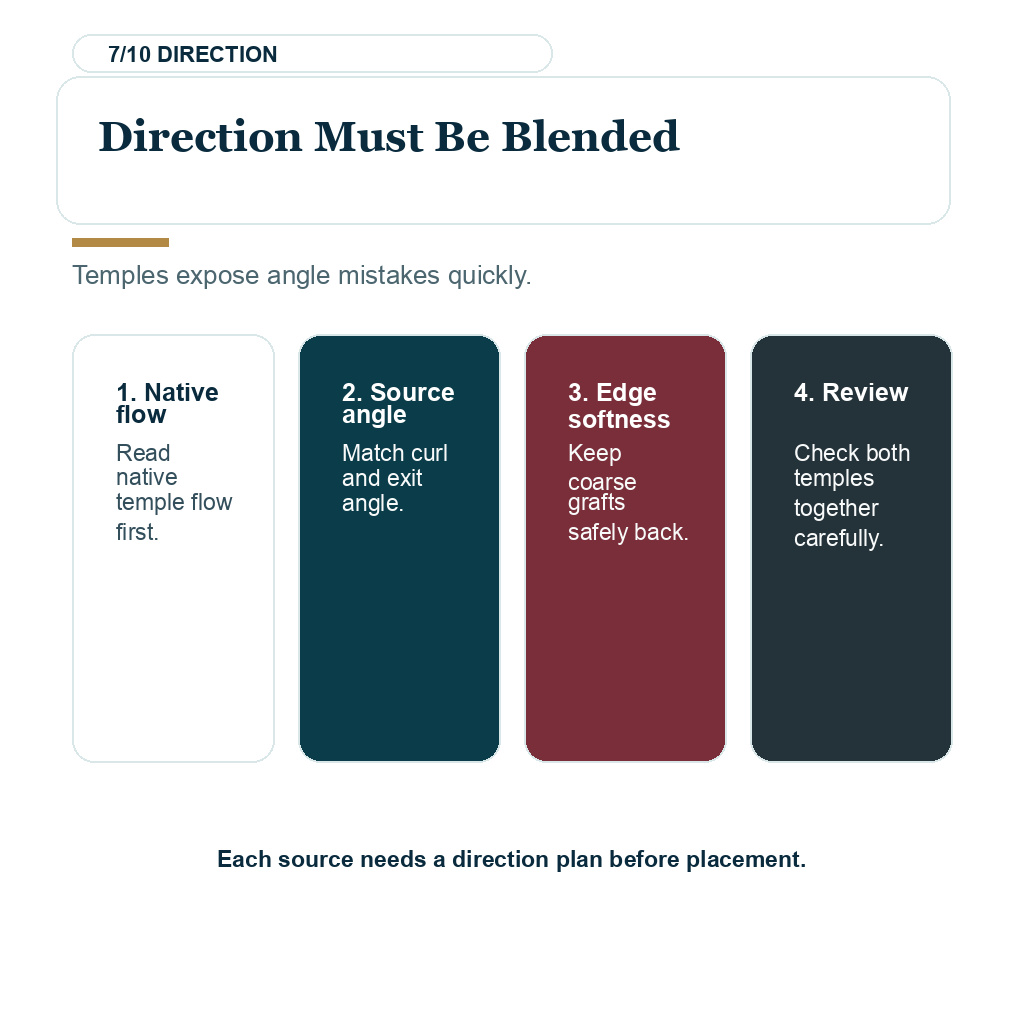
Direction matters as much as hair source. A thick hair placed at the wrong angle can look artificial even when it survives. Poor angle control is one reason wrong hair direction after a hair transplant becomes so visible in repair work.
Body or beard hair may still help in selected zones
Body or beard hair can be valuable when the placement is right. Nonscalp hair can help when the scalp donor is limited, when previous surgery caused donor overharvesting, or when the goal is to improve broader coverage rather than draw a delicate frontal outline.
The middle scalp and crown are usually more forgiving than the temple point. Hair layering, viewing angle, and surrounding density can hide some texture difference there. Even then, each case needs judgment.
The patient still has to be a good surgical candidate. Body hair cannot turn the wrong diagnosis, weak donor reserve, unrealistic expectation, or excessive coverage promise into a sound plan.
Donor expansion sounds easier in marketing than in surgery
A common problem in hair transplant marketing is that difficult surgical choices are made to sound simple. A patient with limited scalp donor supply may hear that beard or chest hair can solve the shortage. A patient focused on temples may hear that a few extra nonscalp grafts will complete the face.
Those statements may contain a small truth, but the missing details matter. Suitability depends on how that specific hair will look in the exact visible area on that face, not only on whether it can be extracted.
A plan built around sales can make donor expansion sound exciting. Surgical judgment asks quieter questions about texture, direction, growth cycle, visibility, future loss, and whether doing less would protect the patient more.
If a clinic promises to use any available hair anywhere on the scalp without explaining blending and placement, be careful. That concern sits close to the broader red flags of Turkish hair mill clinics. The issue is not that every clinic using body hair is wrong. The issue is whether the decision is specific, careful, and medically responsible.
The temple point may not need surgery at all
Sometimes the best temple decision is to do less. The first question is not which donor source to use. The first question is whether the temple point truly needs restoration.
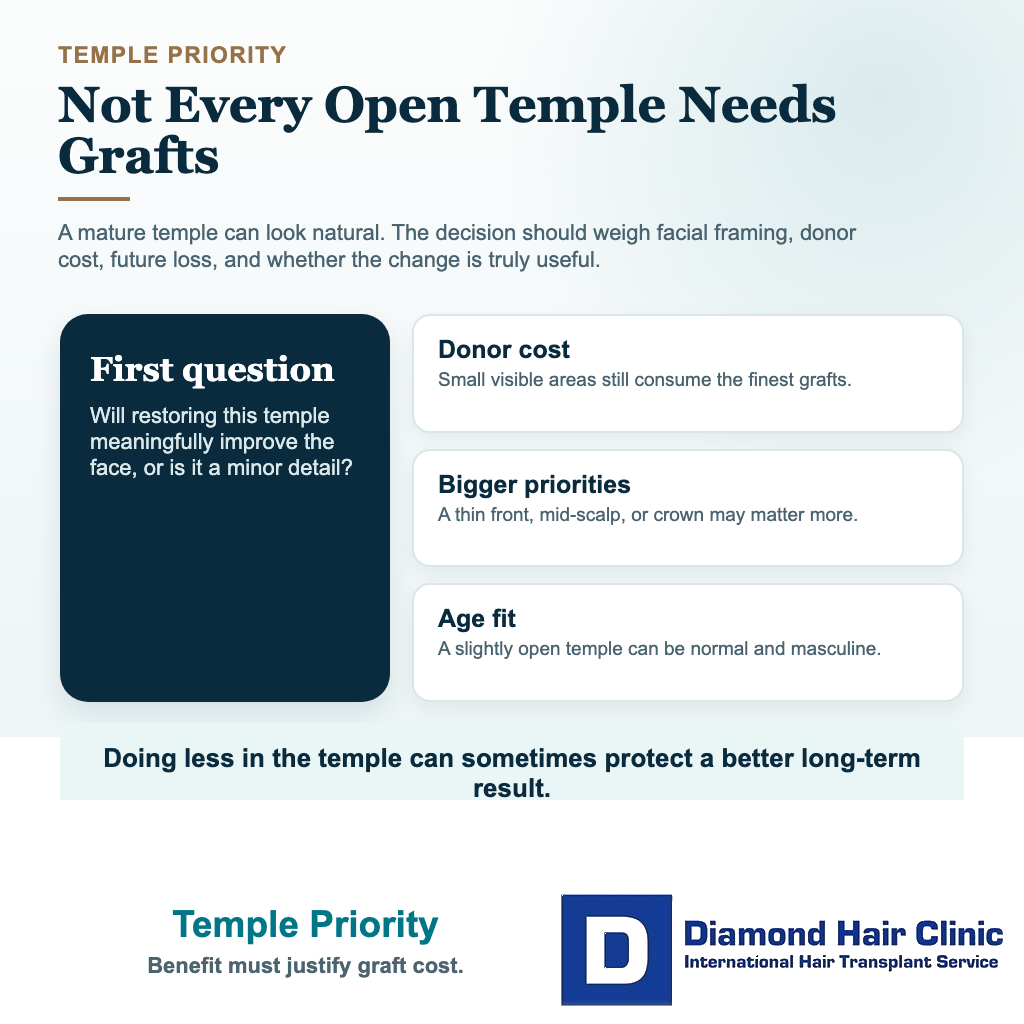
A mature temple is not always a defect. In many men, a slightly open temple area looks normal, masculine, and age appropriate. If the frontal hairline is thin, the middle scalp is weak, or the crown is progressing, spending grafts on a minor temple refinement may not be the right priority.
A small temple change can spend important grafts. When temple work is truly needed, I usually look for the best matching scalp hairs first. Fine single hair grafts, careful angle control, soft density, and an age appropriate design matter more than simply finding another donor supply.
Tools do not decide this result. I use Sapphire FUE, but the blade does not replace judgment. Incision angle, distribution, hair choice, and design philosophy decide whether the result looks natural.
That difference often explains why some results look natural and others look strange. A technically advanced tool cannot rescue a poor aesthetic decision. For me, what makes a strong hair transplant result is not only density. It is whether the result looks natural in real life, from different angles, over time.

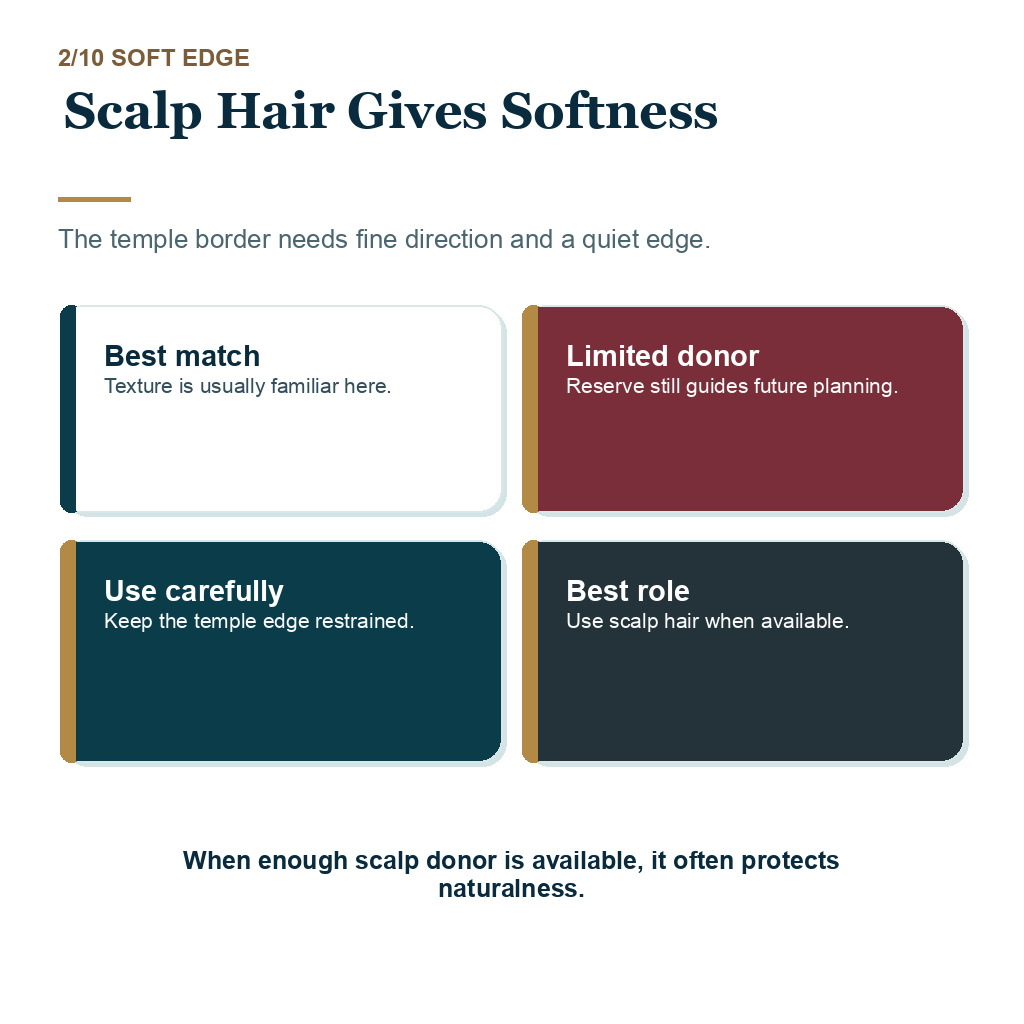



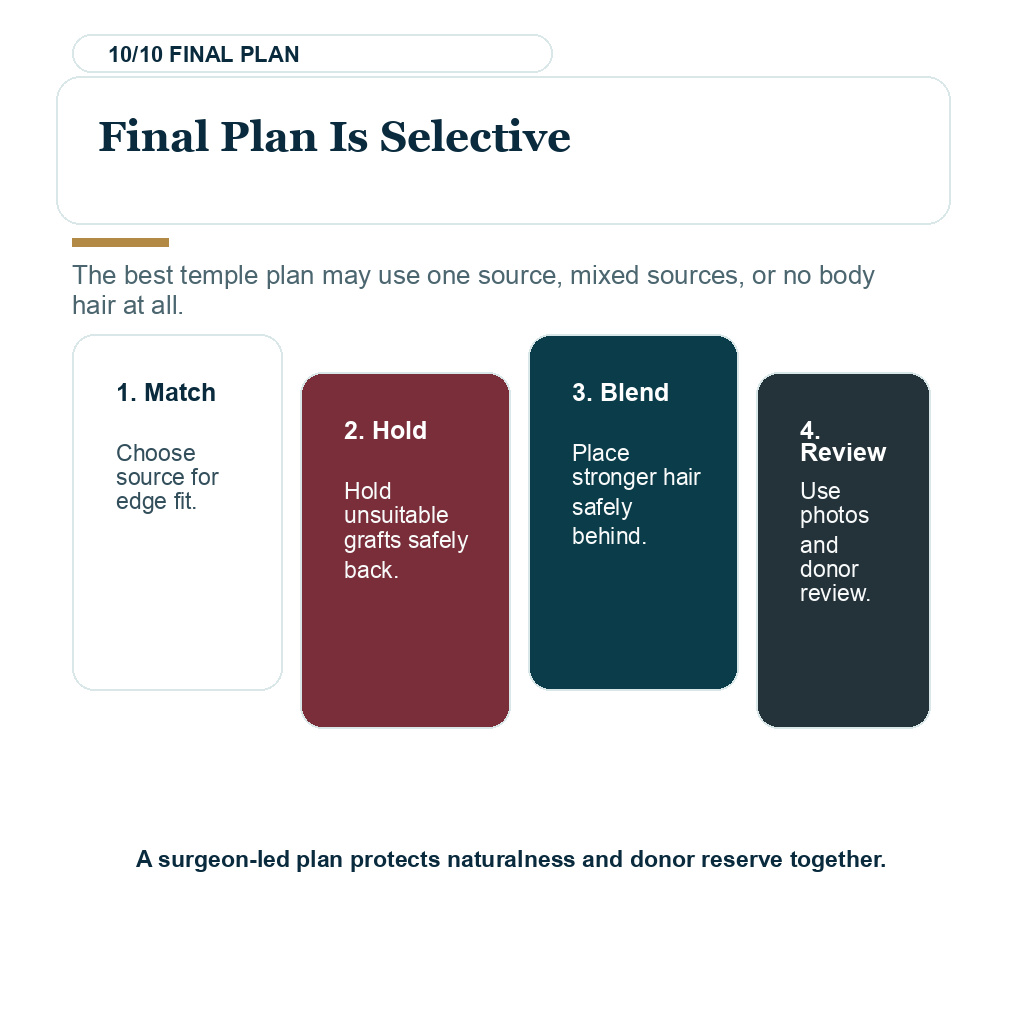
Questions before accepting beard or body hair in the temples
If a clinic suggests body hair or beard hair for your temples, do not panic, but do not accept the idea casually either. Ask why scalp hair is not being used at the visible edge first.
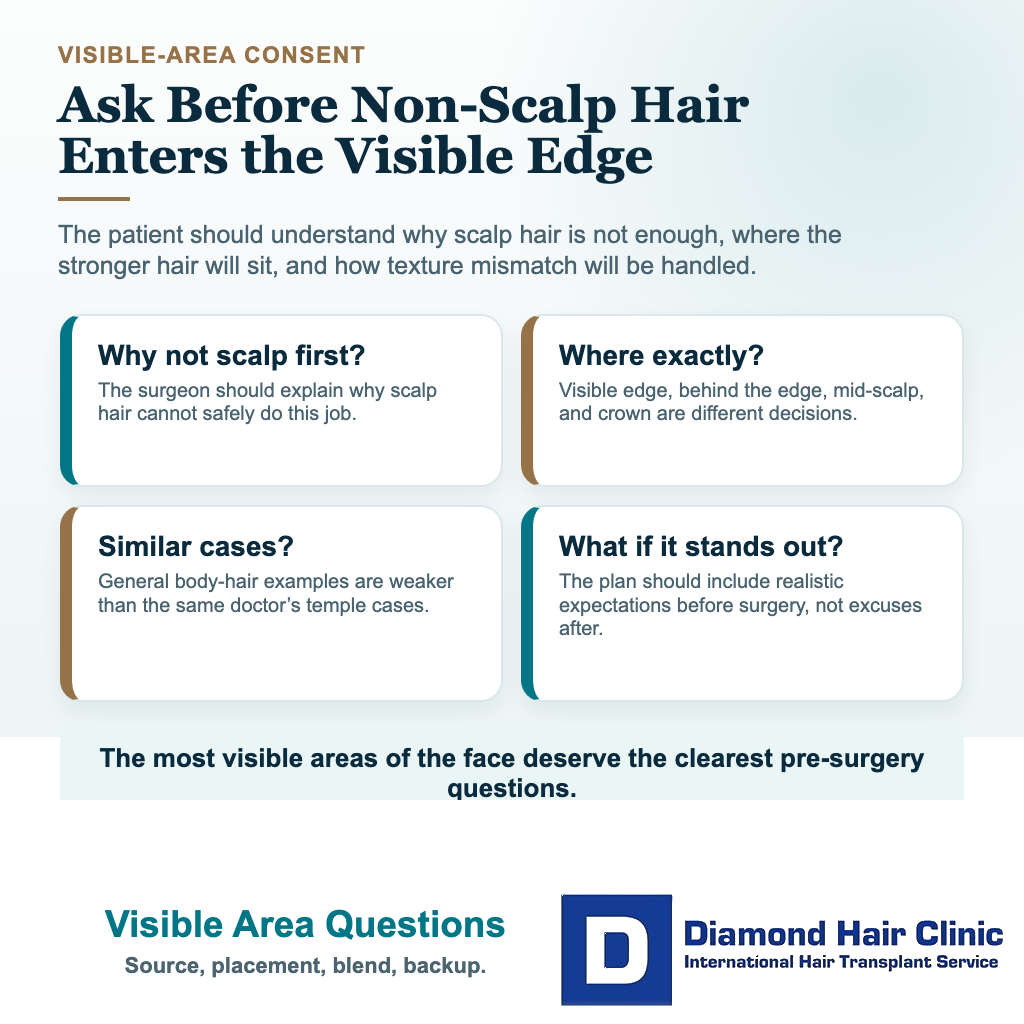
Ask where each hair type will be placed. It is very different to hide nonscalp hair behind scalp hair than to use it as the first visible line. Similar cases from the same doctor matter more than general examples of body hair transplantation.
Beard or body hair should be compared with scalp hair in caliber, curl, color, and growth behavior. Texture mismatch, placement depth, and whether the temple area truly needs transplantation now decide whether the plan is sensible.
Saving scalp donor hair matters, but not if the price is an unnatural hairline that the patient sees every day in the mirror. In selected cases, body or beard hair can support a hair restoration plan. In the temple and hairline area, I treat it as a cautious exception, not a routine shortcut.
Read this review excerpt
We also had a levelled conversation about my hairline and results I could expect based on my donor density area.