


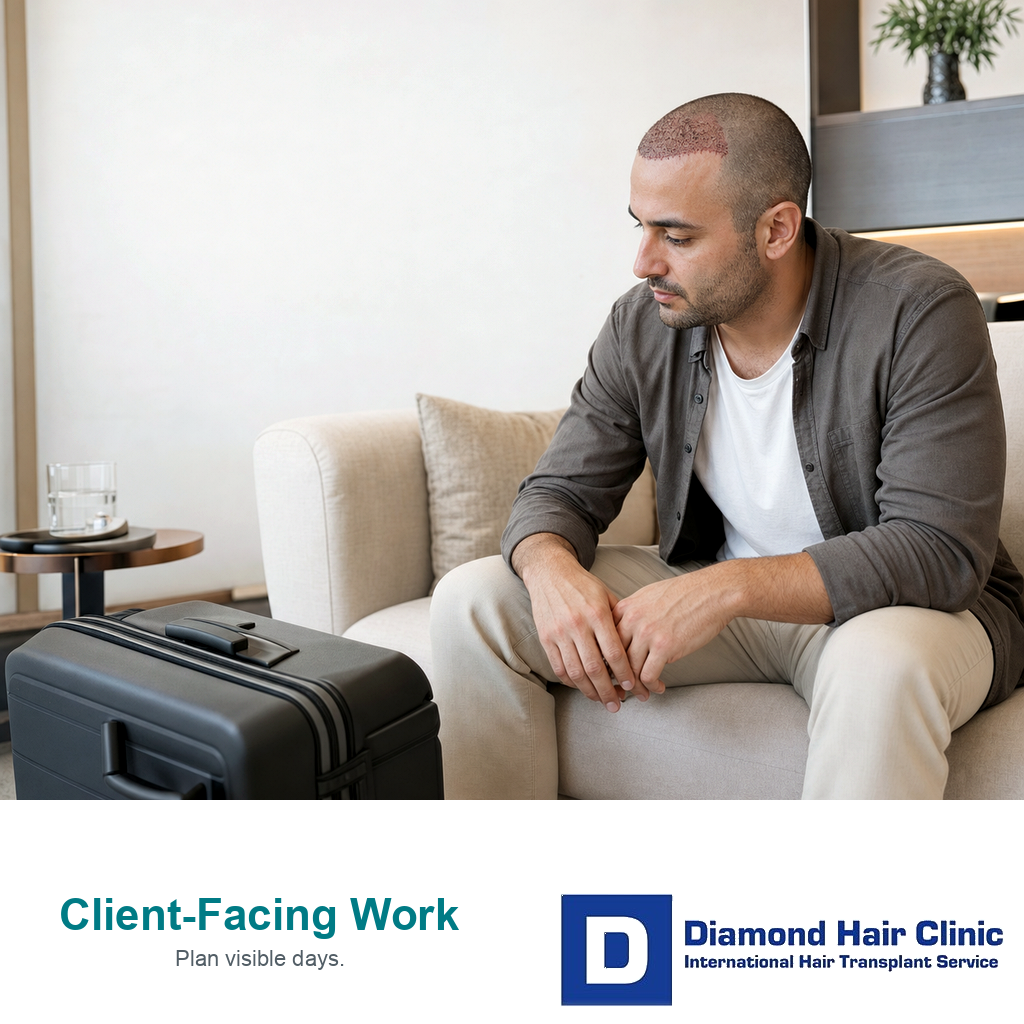
Seeing Clients Again Needs a Visibility Plan
If your work is private, quiet, and mostly seated, returning after a hair transplant can often be planned earlier. If your work puts you in front of clients, cameras, patients, students, or close colleagues, the calculation changes. You may feel well enough to answer emails after a few days, but bright office lighting, travel, hats, shaving changes, scabs, and redness can make the surgery visible before the scalp has settled. If headwear is part of the privacy plan, soft headwear after transplant helps separate appearance management from graft risk.
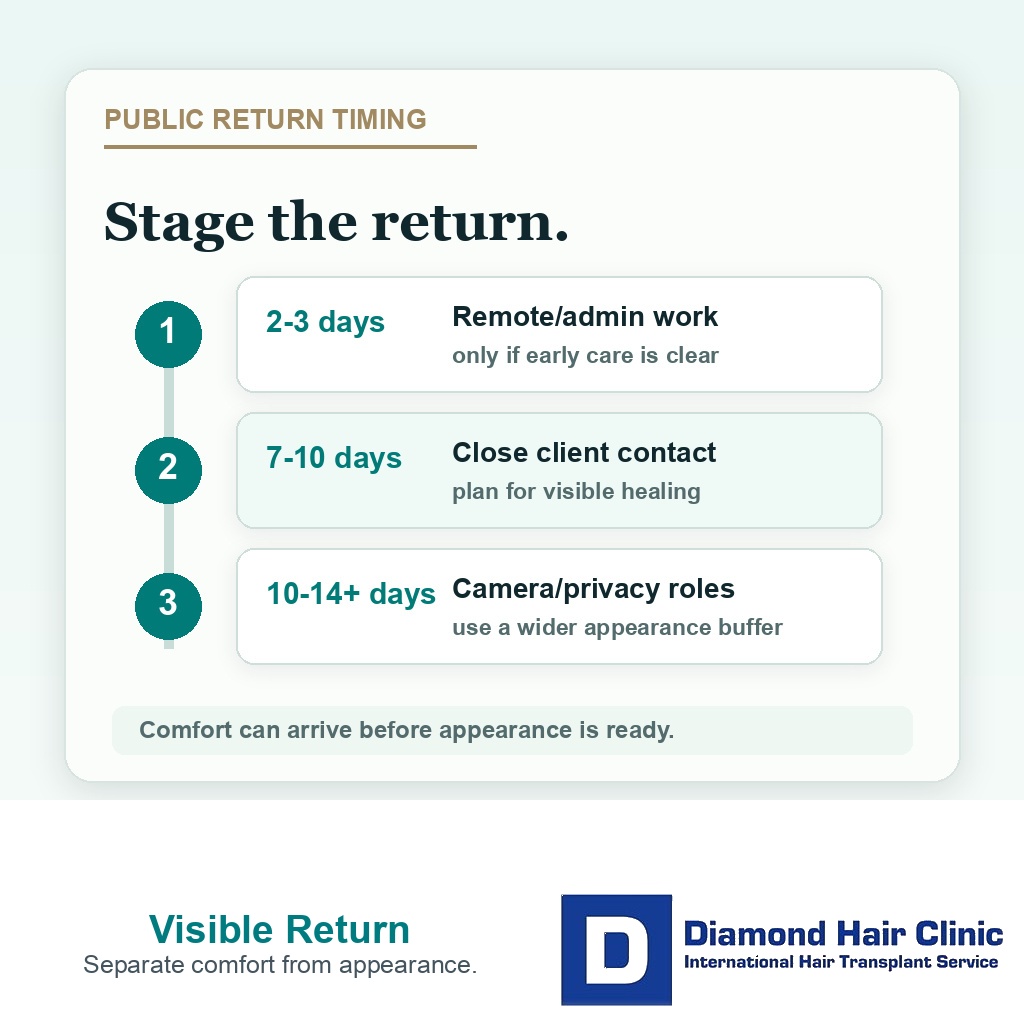
Light desk work is realistic for many people after 2 to 3 days when there is no complication and the clinic has cleared the early instructions. Client work needs a second decision. Being physically able is not the same as being ready to be seen. If you must meet clients closely, you may need around 7 to 10 days. If you must look socially normal, speak on camera, or keep the procedure private from colleagues, you may need 10 to 14 days or longer, with the clear understanding that redness can last for weeks in some scalps.
Seeing clients again depends on visibility and graft safety
Work timing has to protect the grafts, the donor area, your swelling, and your privacy. A quiet laptop day at home is different from standing under lights, speaking to customers, wearing a helmet, shaking hands all day, or explaining why the hairline looks red.
If the job can be done remotely, I often separate the return into stages. The first step is administrative work from home. The second step is lower pressure internal calls. The third step is close client exposure. That is usually better than choosing one return date for everything. I use time off work after hair transplant as the base window, then adjust it for public exposure because appearance can lag behind comfort. I do not want the first visible day to be the most important meeting, recording, presentation, or client visit.
Scabs clearing does not mean your appearance will keep improving every week. Transplanted hairs can shed later, so even after a comfortable return to client work, you may notice a thinner look. Leave some flexibility for photographs, recordings and important presentations while growth is still developing.
The months before a new office role can give you breathing room, but I would not treat them as a promise about exactly how the hair will look on the first day. New colleagues may have no earlier haircut to compare with, although the pressure to make a good first impression can still be real. Plan the first week so it works whether the hair is easy to blend, still looks different, or falls somewhere between.
When privacy matters, one extra quiet week is often better than an uncomfortable public week. The surgery is usually not dangerous to talk about, but it is also not something you may want to explain at work.
Public work differs from desk work
Client work adds pressure that a normal desk job does not create. You may have to maintain eye contact at close distance. You may be under bright lighting. You may be expected to look polished. You may have no control over camera angle, meeting length, room temperature, or whether someone comments on your scalp. Before your first full day back, check how the scalp looks under the same bright lights you work in.
The main issue is visibility under pressure. You may be medically stable, but still visibly healing. In sales, teaching, hospitality, media, consulting, clinic work, barbering, and management meetings, appearance needs as much planning as pain and swelling.
If the public role also involves overnight or rotating shifts, the plan should protect visibility in front of people and the sleep block needed for night shift work after a hair transplant.
Some people can accept a visible recovery phase. Others cannot. Neither choice is wrong. The planning changes with your privacy needs, hair length, skin tone, graft distribution, donor area shaving, swelling tendency, and whether the work can be done remotely for the first days.
Visible signs in the first week
In the first week, the most visible signs are usually small scabs in the recipient area, redness around the grafts, a shaved or partially shaved look, mild swelling, and donor area redness or dots. These signs can be mild for one person and very obvious for another. A dense frontal hairline case is usually more visible than a small crown case hidden by surrounding hair.
The first days are also the period when graft protection is strict. Scratching, rubbing, squeezing, scraping scabs, pulling clothing over the scalp roughly, or letting a tight cap press on the grafts can create unnecessary risk. If scabs, redness, pimples, or swelling are spreading, painful, draining, or getting worse instead of settling, I stop thinking only about privacy. I review the problem medically, using the warning sign approach in redness, scabs, and pimples after hair transplant guidance.
Privacy cannot be guaranteed in the first week. Even if the healing is normal, a close colleague or client may notice the hairline, the donor area, or a change in shaving. A public return is possible for some people, but it should be planned with realistic expectations about visibility.
 Arrange an audio backup before the first client call in case the camera view is not ready.
Public work should be staged by appearance, privacy needs, washing, headwear, and early graft protection.
Hats can make the return easier
A hat can help with privacy, but only when it is allowed by the clinic and suitable for the stage of healing. The cap must not rub the grafts, trap heat, press tightly on the recipient area, or make you remove it repeatedly during the day. A loose, clean hat that does not touch the grafts may be useful after the clinic has cleared it, but it is not a way to ignore early graft protection. A hat worn only during a commute is different from a hat worn under lights for eight hours. Heat, sweat, and repeated removal can change the plan.
If a hat is part of your privacy plan, test the practical side before surgery. Confirm that headwear is allowed, wear it on an ordinary workday, and notice whether your role forces you to remove or adjust it. A hat that is forbidden, unusual in that workplace, or likely to come off during a meeting is not a reliable concealment plan. Build the return date around remote work, duties with less public exposure, or a short privacy sentence instead.
Work rules also matter. Some offices, restaurants, hospitals, clinics, and settings with customers do not allow hats. Some uniforms require a cap, hard hat, hairnet, or headset. For a required hygiene cover or uniform cap, hairnet or work cap fit after FUE should be planned before the first shift back. If a required item touches the graft area, the return plan may need to change. I treat clothing and headwear choices as part of the broader what to wear after hair transplant discussion, not as a small styling detail.
Do not hide a medical warning sign under work pressure. Do not use a hat to cover a scalp that is becoming hot, painful, wet, or increasingly swollen. A delayed review can turn a small problem into a bigger one.
Concealers, fibers, and surgery visibility
Concealers, sprays, and hair fibers need careful timing, just like makeup after a hair transplant. They should not be used on fresh recipient area unless the clinic has approved the timing and the scalp surface is ready. The early graft area is not ordinary skin. It has tiny healing channels, crusts, and inflammation. Covering it too early can irritate the area, trap debris, or make cleaning harder.
Hair fibers may be useful later for some people, especially when the scalp is closed and the shedding phase has started, but they do not solve the first week visibility problem. Makeup on normal forehead skin away from the grafts is different from product placed on the recipient area. Timing, product contact, washing, and donor area exposure all shape the decision around hair fibers after hair transplant guidance.
Do not use concealers on fresh recipient area. My rule is conservative because the early graft area is still healing. If public visibility is a major concern, plan time away from close exposure instead of trying to cover a healing scalp too early.
Handling camera meetings
Camera meetings are easier than in person meetings, but they still need planning. Overhead lighting, sharp webcams, and a low camera angle can make redness and shaving more obvious. You may look better in natural side light with the camera slightly above eye level. The aim is not to create a perfect disguise. It is to avoid making every small red area or shaved patch more visible than it is in normal life.
For the first few days, audio only meetings are often the cleanest option. If video is required, shorter meetings, soft lighting, a stable camera angle, and no tight headphones over the recipient area are better choices. Test the camera and lighting before the meeting. Do not discover the angle for the first time in front of a client. A short private camera test on the same platform is more useful than checking a bathroom mirror. Headsets can press or rub, especially around the front hairline and temples. A private rehearsal should include the headset or uniform, because the item that hides the scalp can also rub it.
When video is required mainly so people can see your face, the camera does not need to be sharper than the meeting needs. Normal video quality, soft light, and a stable angle are usually more useful than a very sharp image that makes every scab, shaved edge, or red area feel important.
If you have swelling around the forehead or eyes, camera work may be harder than expected. Social visibility has its own timing. The guidance on looking normal in public after hair transplant can matter as much as physical comfort if you see clients.
Long trip home before work
Travel adds fatigue, swelling, airport exposure, hotel sleep issues, and hygiene variables. If you fly home for many hours and then return directly to public work, you may look more swollen, tired, or red than expected. The scalp may be healing normally, but the body has had no quiet time.
Long flights and layovers can also make the first nights harder. The head position, swelling tendency, and sleep quality all influence how ready you look for public work. If you are flying soon after surgery, I plan around both flying after hair transplant and sleeping normally after hair transplant guidance, because travel fatigue can make a normal recovery look harder in public.
For international travel, I try to protect the first public workday. A long travel day followed by a client meeting the next morning is rarely ideal. A quiet buffer day after returning home, once washing is back under control and swelling has been checked in normal light, can prevent avoidable stress.

Returning to client work should account for headwear, skin signs, camera exposure, and travel fatigue.
Unshaven surgery and the privacy problem
Unshaven surgery can reduce visibility in selected cases, but it does not remove every privacy issue. The recipient area may still show redness, crusting, or early density changes. The donor area may still need partial shaving or show small extraction marks. The operation can also take longer or require a narrower graft plan when long hair must be preserved.
A smaller or more limited partial shave FUE case may be easier to blend than a full shave, especially when surrounding hair can cover the donor window. I still do not treat it as invisible. Close client work can reveal small scabs, donor dots, uneven hair length, or redness in bright light, so the return date should be planned from how the scalp actually looks, not from the fact that the case is limited.
Privacy is one reason to consider an unshaven method, but it should not be chosen only because you have a public job next week. Donor safety, graft number, hair length, surgical access, and long term planning still matter in unshaven hair transplant planning.
An unshaven plan can be excellent when the indication is right. It can also be the wrong compromise if it limits the quality of the surgery. Plan the return before you book the surgery date. Do not leave the visibility question until after the operation is finished.
Privacy planning still needs medical planning
A small frontal case can look like an easy privacy problem, especially when the patient has long hair, a naturally high hairline, and no crown thinning. I do not judge it that way. First I separate a hairline that has always been high from active recession, then I decide whether the proposed change will still look natural if native hair behind it keeps thinning.
This is especially important when the patient does not want finasteride or another DHT blocker. I handle that choice respectfully, not as a reason to pressure the patient or ignore future loss. I also cannot design the hairline as if medication will hold every native hair in place. The plan may need a more conservative hairline, fewer grafts, stronger donor reserve, and a clear follow up plan. The same planning conversation includes hair transplant without finasteride and mature hairline versus recession.
No shave planning can still help the right patient return to clients with less haircut shock. It should not become the reason to rush surgery, lower a widow’s peak too much, or choose DHI only because it sounds more discreet. The method has to fit the hairline design, graft number, donor access, washing, and public return plan.
When to delay a public return?
Delay a public return if there is worsening pain, spreading heat, increasing redness, discharge, fever, strong swelling, bleeding, a wound opening, or a donor area that is not settling. Close contact work also needs delay when the job requires sweat, dust, helmet pressure, repeated bending, or a head covering that touches the grafts. I also delay it when the workday prevents washing instructions, medicine timing, clean headwear, or a scheduled photo review.
Touching and friction are common hidden risks. If you are under stress at work, it is easy to adjust a hat, scratch a scab, press the hairline, or rub the donor area without thinking. This makes touching grafts after hair transplant part of any public return plan.
Physical jobs need an even more conservative plan. A public role in a clean office is not the same as a public role on a building site, in a kitchen, on a stage, or under a hard hat. If the work includes sweat, dust, lifting, or protective headgear, I bring manual labor and hair transplant recovery into the return decision. For construction site exposure specifically, construction work after hair transplant needs its own dust, helmet, and light duty plan.
What to say if someone notices?
Some people want to be open. Others want privacy. Both are reasonable. What helps is preparing one short sentence before returning to work. You do not need a long explanation. “I had a minor medical procedure and I am healing well” is enough for many workplaces. If you are comfortable being open, you can say you had hair restoration and are following aftercare instructions.
You control the level of detail. Work pressure should not force you to disclose medical information, and embarrassment should not push you into unsafe concealment. There is a middle ground. Protect the grafts, keep the scalp clean, and choose a simple privacy boundary before the first colleague or client asks.
If you feel anxious about being seen, that emotion deserves attention before surgery. The first public week can feel longer than expected. A good plan reduces the chance of panic, rushed hiding, and unnecessary touching.
If possible, make the first visible workday a lower pressure return rather than your longest client, camera, or presentation day. A short internal meeting, shorter shift, or private camera test gives you a chance to see how swelling, lighting, headwear, and confidence behave before the day that matters most. When hats are not allowed, the plan has to rely more on distance, softer lighting, and shorter exposure instead of last minute covering.
Visible work should follow visible healing
Before I give a return date, I separate light work from close exposure. A quiet remote day is different from client meetings, bright studio lights, a headset, a uniform, or standing close to patients, students, customers, or colleagues.
The surgery plan also matters. A frontal hairline, shaved donor area, swelling risk, graft number, and privacy need can all change the calendar. Hair transplant follow up after surgery is where normal healing is separated from a problem that should not be hidden under work pressure.
Choose the surgery date around the first duty where people will see you closely. Work can often restart before confidence returns in public, and that difference should be planned before the operation.

Read this review excerpt
Every single one of my questions was answered and they made sure I had all the details I needed to make an informed decision.