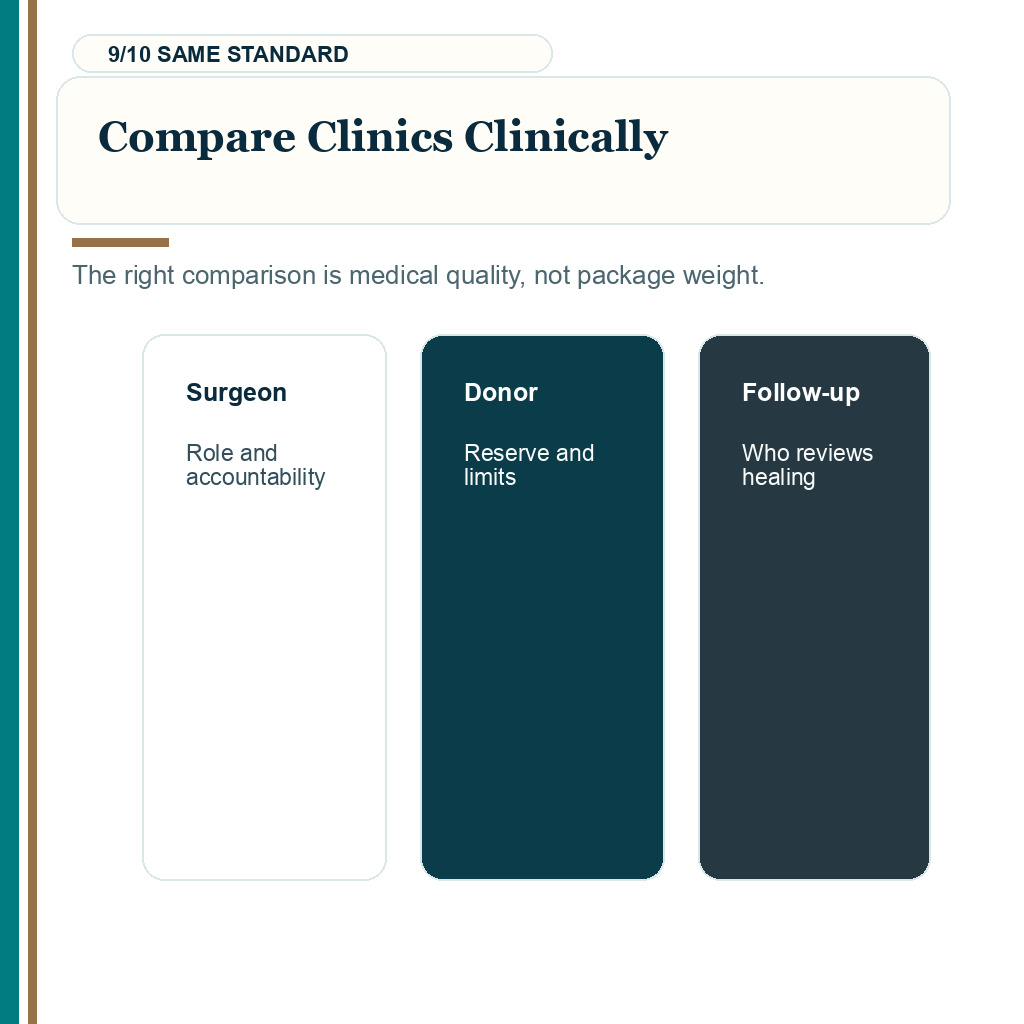
Turkey Hair Transplant Needs Medical Judgment
A Turkey hair transplant can be a sensible medical trip, but only when the clinic can explain the medical plan before the travel package. I judge the offer by surgeon responsibility, donor limits, hairline reasoning, graft handling, and follow-up first. Hotel, transfer, graft count, and discount matter only after the medical points are clear.
Before booking flights, strip the offer down to clinical facts. Who reviewed your case? Who makes surgical decisions? What can the donor area safely give? What will deliberately stay thinner? Who answers after you fly home? The package can organize travel, but it cannot replace surgical judgment.
The medical plan should come before the travel plan
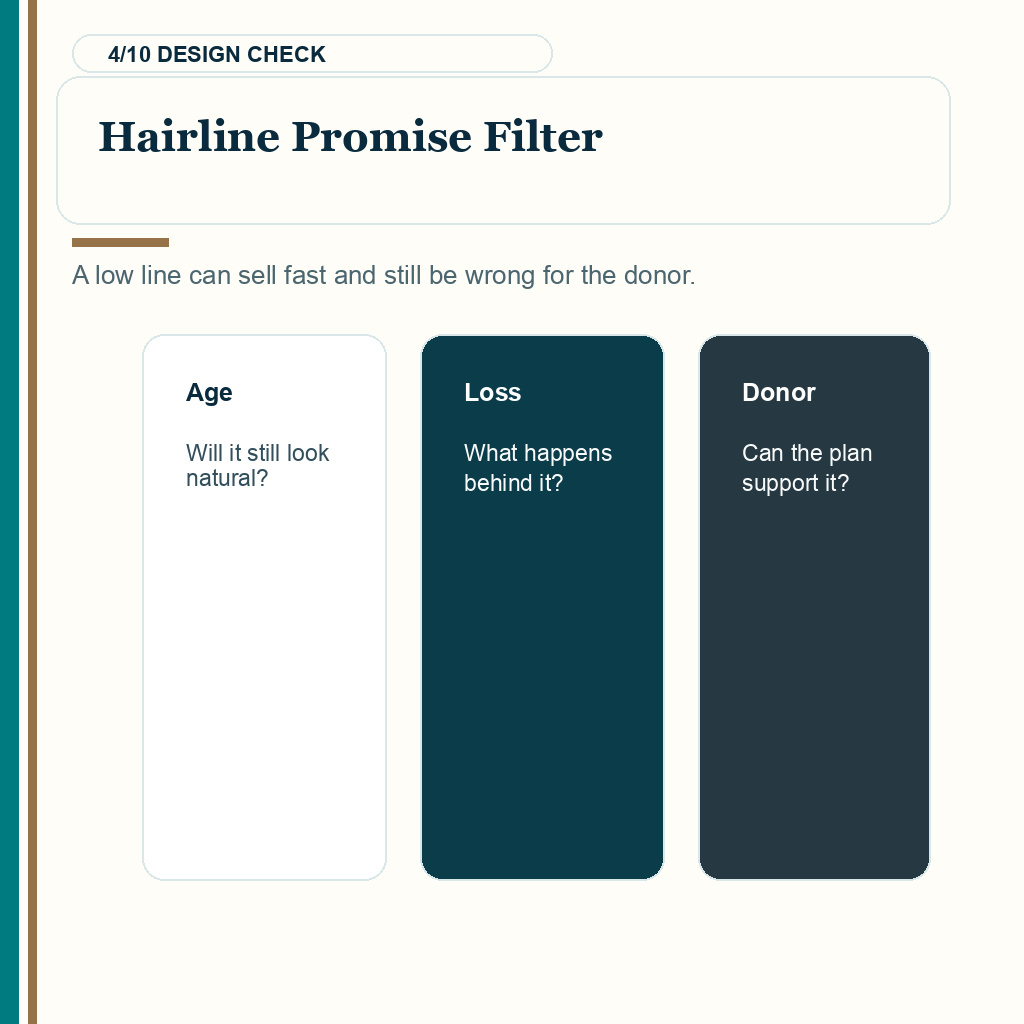
Medical tourism becomes risky when the trip is clearer than the surgery. You may know the hotel name, transfer time, number of nights, and quoted graft count, but still not know who examined the donor area or who will create the recipient area incisions. That is the wrong order. If transfers and hotel details are clearer than recipient site design, surgeon review, and graft planning, the travel package is being explained more clearly than the surgery itself.
Travel should depend on whether the remote review is strong enough to justify the trip, not whether the package sounds complete. Clear photos, medical history, medication use, family history, donor quality, hair loss pattern, and realistic expectations all matter before the trip is treated as settled. Case review before travel gives that remote assessment step its own detail, but the principle is simple. The travel plan should follow the medical answer, not force it.
A good Turkey hair transplant plan can still include help with logistics. The risk starts when logistics become the product and the surgery becomes a line item inside it. If the clinic cannot explain the medical reason for the graft range, hairline shape, donor limit, and follow-up route, the trip is not ready.
Package details should help, not distract
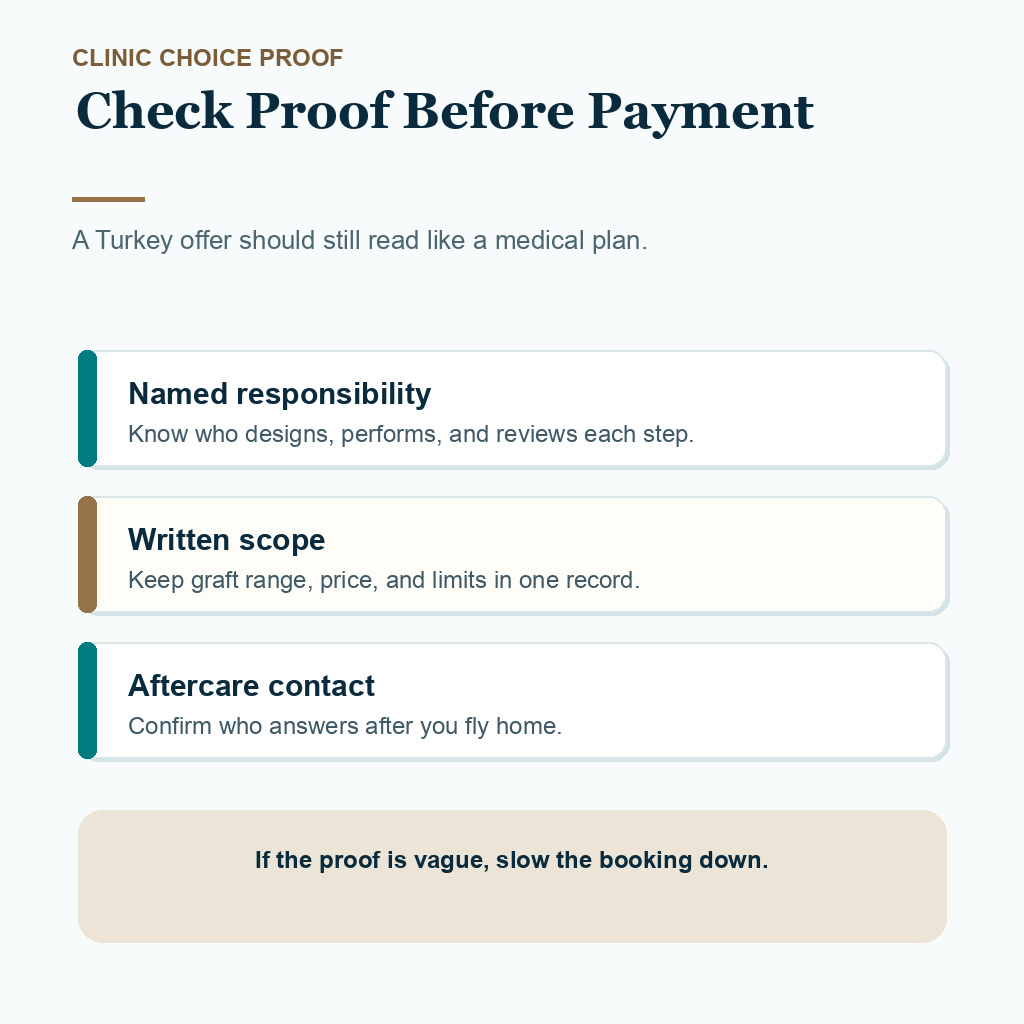
Hotels and transfers are not bad. For someone traveling internationally, they can reduce stress and make the day easier. I only object when package language makes you compare the wrong things. A more impressive hotel does not protect graft survival. A free transfer does not correct an overused donor area. A discount does not make a rushed plan safer.
Hair transplant packages in Turkey deserve their own careful review, but my basic rule is stricter. Do not treat package items as proof of medical quality. They are support details. They should sit behind surgeon responsibility, donor management, hairline design, graft handling, and follow-up.
If two offers look similar on price, I do not choose the one with more extras. I choose the one that gives clearer medical reasoning. If neither offer explains the medical plan, the comparison has not really started.
Recommendation noise becomes safer only when it turns into questions. The clinic still has to show who reviews the donor, who can change the plan, and who answers after you leave Istanbul.
Surgical responsibility must be clear before you travel
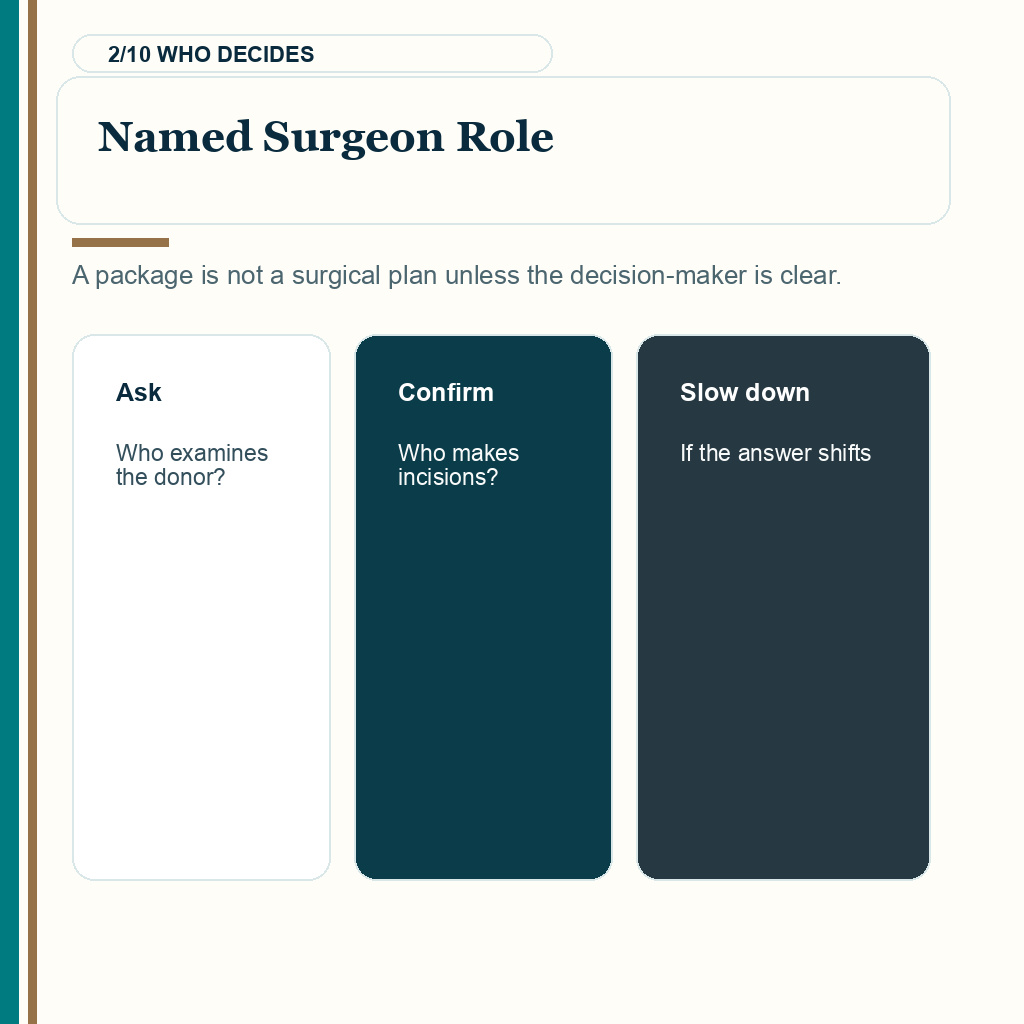
For me, the most important question is not whether a doctor exists somewhere in the clinic. The question is which decisions the surgeon will personally make for your case. Who reviews the donor area? Who designs the hairline? Who creates or directs the recipient area incisions? Who changes the plan if the donor does not match the remote photos?
Fast coordinator replies can be useful for scheduling and documents, but speed is not the same as surgical accountability. If the person selling the plan cannot clearly name the medical decision maker, slow the process down. Surgeon involvement in hair transplant changes the value of the operation, not only the reputation of the clinic.
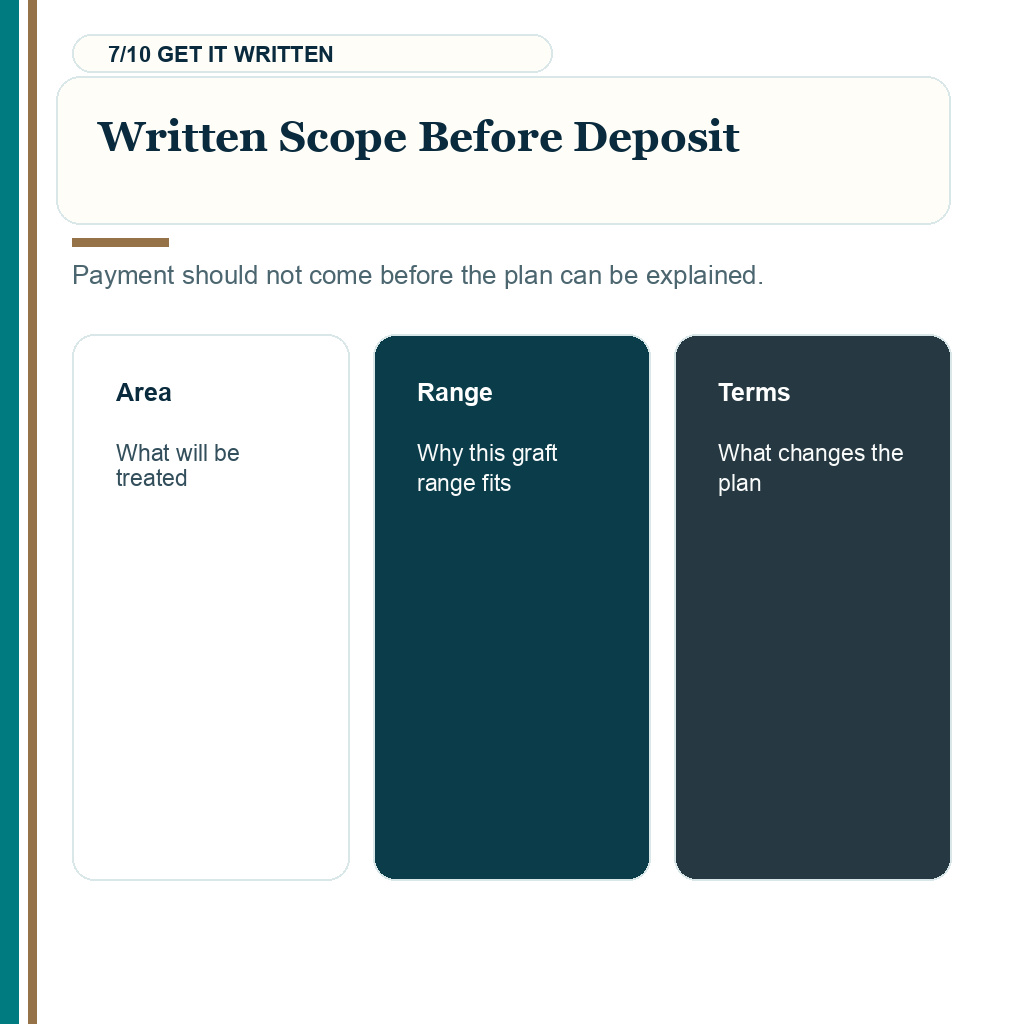
Before international travel, written clarity matters because you cannot easily leave the clinic, get another local review, and come back the next day. If the role map is vague before travel, it may become more stressful on surgery day.
Donor protection comes before the quoted graft number
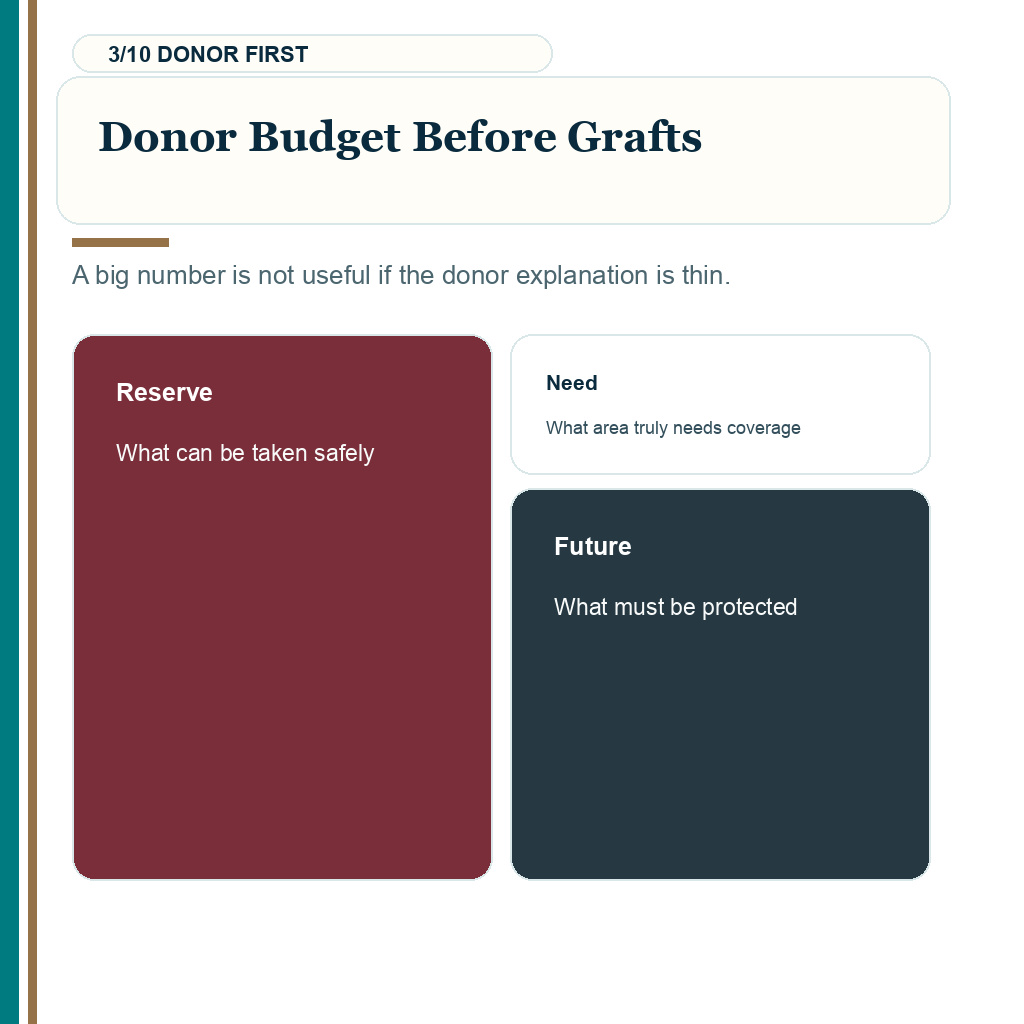
The donor area is not part of the travel package. Once grafts are removed, the donor area has to live with that extraction pattern for life. For that reason, I do not read a high graft number as proof of confidence. I read it as a claim that needs evidence.
A responsible plan should explain donor density, safe zone limits, hair shaft quality, miniaturization risk, scalp laxity or scarring when relevant, previous extractions, haircut preference, and future loss. Thick donor hair may tolerate more extraction than fine, low-density, or miniaturizing donor hair. The same graft number can be reasonable in one person and careless in another.
Donor area overharvesting risk matters because overharvesting is often easier to prevent than to repair. If an offer uses the graft count as the main selling point, ask what the graft number spends. The safer question is not how many grafts they can take. It is how much donor reserve should be left untouched.
Translate the offer back into medicine
Choose the part of the offer that is being emphasized. The filter shows the medical question that should come before that detail drives a travel decision.
A package line cannot prove the operation is right
If the package is clear but the diagnosis is vague, slow it down. The medical plan should say what will be treated, what will stay thin, and why the graft range fits the donor area.
- Use the package for logistics after the plan is clear.
- Do not let hotel and transfer details replace surgical reasoning.
The medical owner should be visible
A named surgeon role matters before travel because you need to know who accepts responsibility for design, recipient area incisions, donor limits, and case changes.
- Ask which steps the doctor personally performs.
- Pause if every answer comes only through sales language.
The donor reserve should limit the promise
A high graft quote is only safe when it passes the donor reserve test. Ask how the number was chosen and what reserve remains for future hair loss.
- Question very high numbers without measurements.
- Protect the safe zone before accepting density claims.
Follow-up must still work after the flight home
Routine photo checks and urgent medical answers are different. You need to know who reviews healing, how quickly concerns are triaged, and when local medical help is needed.
- Keep aftercare instructions in writing.
- Confirm the route for symptoms that should not wait.
Pressure changes the meaning of the offer
A limited slot, fast discount, or deposit request is not the same as informed consent. If urgency appears before the medical limits are written, treat that as a warning sign.
- Ask for the plan first.
- Travel only when the explanation still makes sense without the pressure.
Follow-up must still work after you fly home
Many people leave Turkey before the full emotional part of recovery begins. Swelling, scabs, redness, shedding, donor sensitivity, washing anxiety, and photo concerns can all appear after you are back home. A clinic offer should say how follow-up works when you are no longer nearby.
I separate routine follow-up from urgent medical review. Routine follow-up can be photo based when the photos are clear and the concern is expected. Urgent review is different. Increasing pain, spreading redness, fever, unusual discharge, medication reaction, or heavy bleeding concern should not sit in a normal message queue. Hair transplant follow-up after surgery needs that practical split between routine photo review and symptoms that should not wait.
Travel insurance can also matter, but it should not be treated as the clinic’s follow-up plan. Insurance wording, local doctor access, and emergency routes need to be understood before the trip. Travel insurance for hair transplant abroad belongs to that separate layer.
Compare price without losing surgical limits
Turkey can be more accessible than many countries, and cost is one reason people look abroad. I understand that. You still have to separate cost advantage from medical shortcut. A lower price can be reasonable when the clinic model is responsible. A lower price becomes dangerous when it hides rushed planning, weak surgeon involvement, poor graft handling, or limited follow-up.
The same warning applies to price per graft. It can make offers look easy to compare, but the value of a graft depends on where it was taken, how it was handled, where it was placed, and whether the patient will still be happy with the donor area later. Price per graft in hair transplant can hide that problem when it is used as the main comparison.
If one clinic quotes a lower number and another quotes a much higher number, the answer is not to choose the more optimistic offer. Ask what each plan assumes about your donor area. Weak donor warnings and high graft quotes show why disagreement between clinics should slow the decision, not turn it into a bidding contest.
The visual checklist below separates the medical plan, surgeon role, donor budget, hairline promise, travel package, price pressure, written scope, follow-up route, clinic comparison, and the point where a Turkey plan is clear enough to book. Use it as a pressure test, not as a substitute for the written medical plan.