Case Review Before Travel Protects the Surgical Plan
Before I advise an international patient to travel, I need more than a date and a few attractive photos. The case has to be strong enough to justify flights, time away from home, and a permanent change to the donor area.
A remote review is useful when the photos are clear, the medical history is complete, and the question is specific. It becomes risky when it is treated as a final surgical promise. From photos I can often give a direction, but the final plan still depends on donor examination, scalp condition, hair caliber, and what I see in Istanbul.
Before flights are booked, the medical answer needs to be clear enough to justify travel. The review should say what looks reasonable now, what still has to be confirmed in person, and whether the travel plan should stay changeable until I examine the patient in Istanbul.
Travel should wait until the medical answer is clear
Case review starts with whether surgery belongs in the plan now. Some cases look suitable from the beginning. Some need better photos, medical history, or a slower conversation. Some should wait because the hair loss pattern is still changing, the donor area looks weak, the diagnosis is unclear, or the expectation is not medically realistic.
If the plan only looks attractive on paper, I do not want the patient building flights around it. Before travel, the patient still has to be a good candidate for hair transplant surgery, the donor area has to support the request, and the result goal has to age safely.
When those points are still uncertain, I slow the travel conversation down. The date should follow the medical reason for surgery, not start leading it.
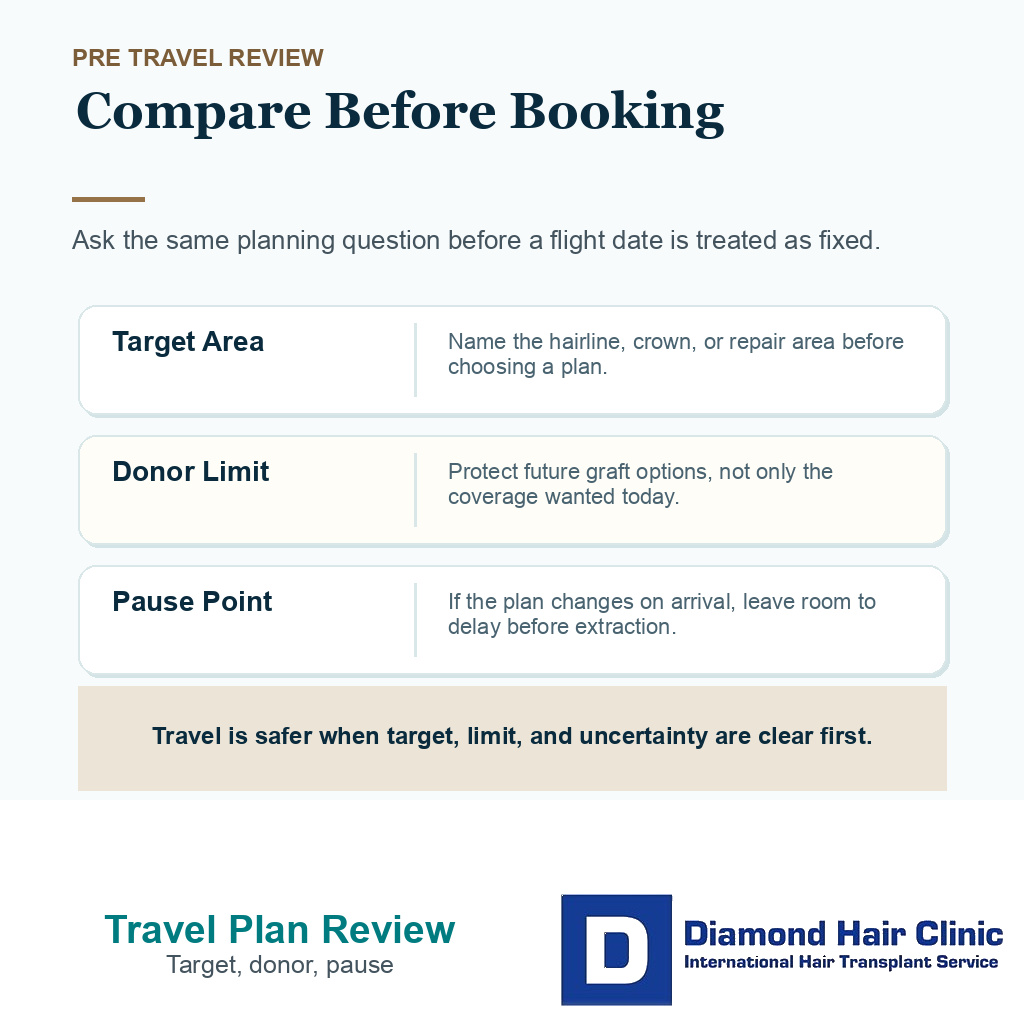
Before travel, the review needs to clarify suitability, donor reserve, design fit, and what remains provisional. If the answer is only “come and we will see,” the patient is carrying too much uncertainty into the trip.
Photos give direction, not a final promise
Photos can show the visible hair loss pattern, the rough size of the recipient area, the current hairline position, the crown condition, and sometimes signs that the donor area needs caution. They also show whether the request matches the pattern, or whether the patient is asking for a result the donor area may not support.
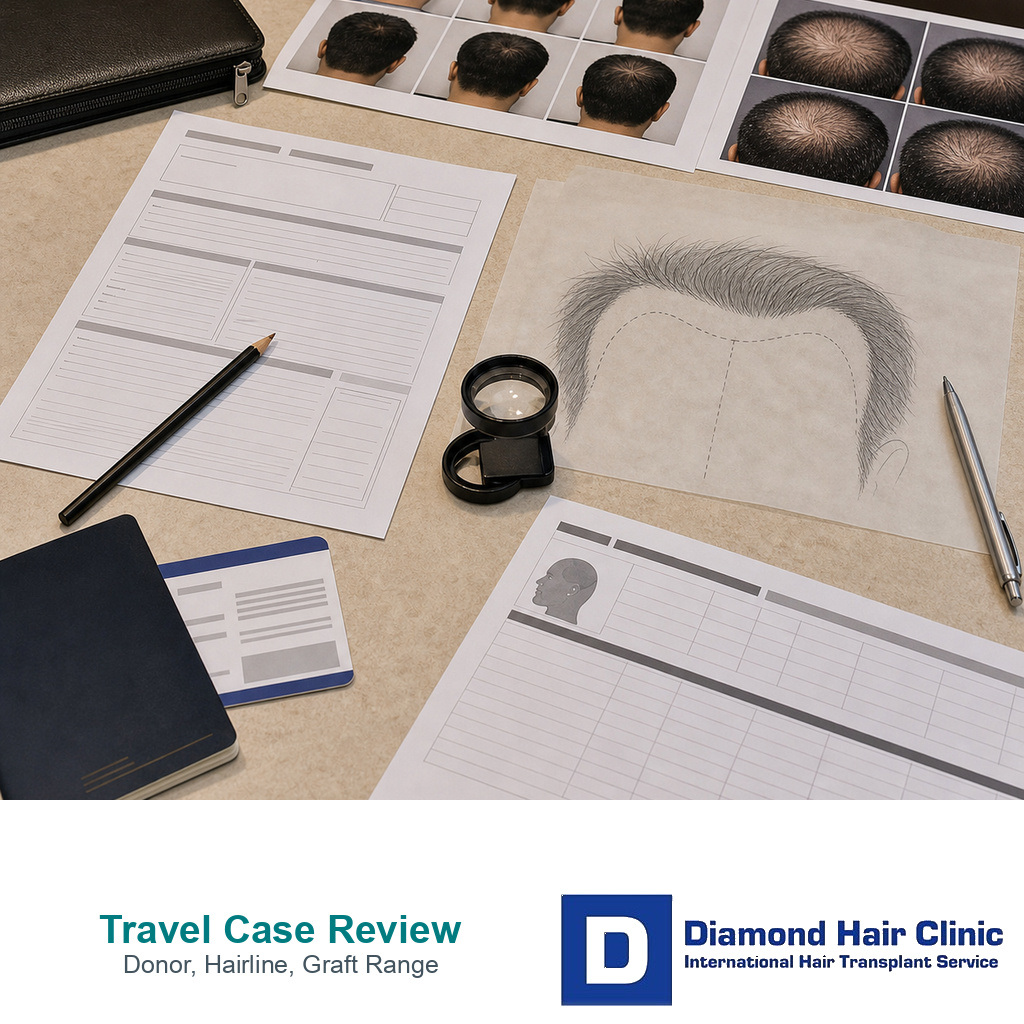
For a useful review before travel, send recent photos of the front, top, crown, both temples, both sides, and the donor area when the case is not simple. Dry, clean hair is more useful than styled hair, fibers, or lighting that hides the pattern.
A short movement video can help when still photos hide the donor area. Move the hair slowly at the back and sides in normal light, then send still photos too, because the video shows movement while the photos give a stable record.
If the video looks worse than the still photos, do not treat that as a problem to hide. It may be the exact detail that prevents an unnecessary trip or changes the plan before flights become fixed.
Also send the history behind the photos. Previous surgery, scalp disease, medication changes, sudden shedding, recent illness, and any recent blood or plasma donation can change whether travel is sensible.
Still, photos have limits. They do not reliably show donor density, miniaturization, scalp condition, hair shaft thickness, previous extraction marks, or how the hair behaves under different lighting. I keep hair transplant planning from photos alone provisional for that reason.
When I review photos before travel, I am looking for a direction and for the missing pieces. The case may look suitable, unsafe, incomplete, or better suited to a smaller goal. A useful review says which of those it is, instead of turning a few images into a fixed surgical contract.
REVIEWS.io patient review
The first assessment, in a patient’s words
 Read this review on REVIEWS.io
Read this review excerpt
“I found it reassuring that all of my questions were answered and that I was given a detailed treatment plan that was compiled based on the photos and videos that I provided.”
The donor area comes before the graft number
Donor supply is the budget of the operation. If it is spent carelessly, the patient may lose short haircut options, future repair options, and the ability to treat later hair loss. I review donor capacity before I talk seriously about a large graft number.
I look at the safe zone, apparent density, hair caliber, color contrast, curl, possible miniaturization, previous surgery marks, and whether the patient may need grafts later. A weak donor area does not always mean surgery is impossible, but it does mean the plan must become smaller, more selective, or sometimes delayed.
A clinic can make a high number sound generous. I read it differently. The question is how many grafts can be taken without creating a second problem. The donor limit decides the ambition of the plan, not the other way around.
The recipient area shows what can realistically change
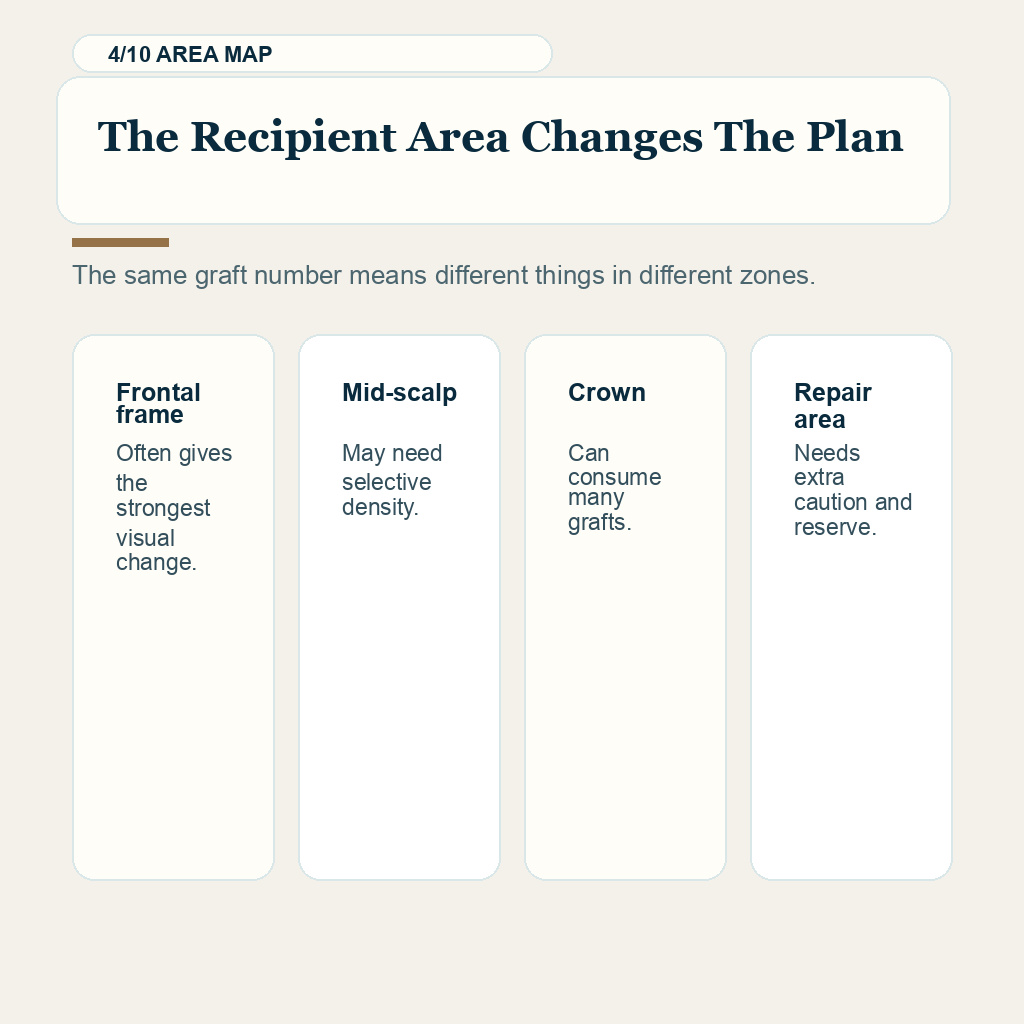
After the donor review, I look at the recipient area. The size of the frontal zone, middle scalp, crown, temples, and any scar or repair area changes the plan. A small frontal hairline correction is different from rebuilding a wide frontal zone and crown in the same trip.
Coverage is also affected by hair caliber, curl, contrast between skin and hair, existing native hair, and the density that can be safely placed. Surgeon graft calculations turn those details into a number that protects the donor area. The calculation is not only area multiplied by density. It has to be adjusted by donor safety and by what the patient may still lose in the future.
In some cases, I do not try to cover every thin area. It may be better to frame the face well, protect the donor, and accept that the crown will remain thinner or be handled later.
Hairline, crown, and future loss are planned together
Hairline design is one of the places where an international patient can be misled by a quick online drawing. A lower line can look exciting before surgery, but it can spend too much donor hair and age badly if the patient continues to lose hair behind it.
When I design a hairline, I think about age, face shape, forehead muscle movement, temple pattern, donor reserve, hair caliber, and future hair loss. The choice between hairline or crown first depends on that balance. The front may matter more for facial framing, while the crown can consume many grafts for less visible change.
A safer design may be slightly higher, softer, or less dense than the patient first imagined. That is not a weaker plan. Careful hairline design in hair transplant surgery keeps the front natural as the patient ages and protects the donor from a repair problem later.
A graft range must explain what will be treated and what will stay thin
Before travel, I give a reasoned graft range instead of a single impressive number. The range should explain which area is the priority, what density is realistic, what may be left untreated, and what could change after examination in Istanbul.
This matters when two clinics give very different quotes. One clinic may be planning only the frontal zone. Another may be trying to include the crown. A third may be overusing the donor area. A different number may be reasonable, but different graft numbers need careful comparison.
If a patient receives a very high quote, I ask what the number is trying to solve. Is it matching the recipient area, or is it being used to make the offer look stronger? Is the donor safe, or is the plan trying to create maximum change in one travel window? The number must answer those questions before it deserves trust.
Medical history and scalp condition can change the timing
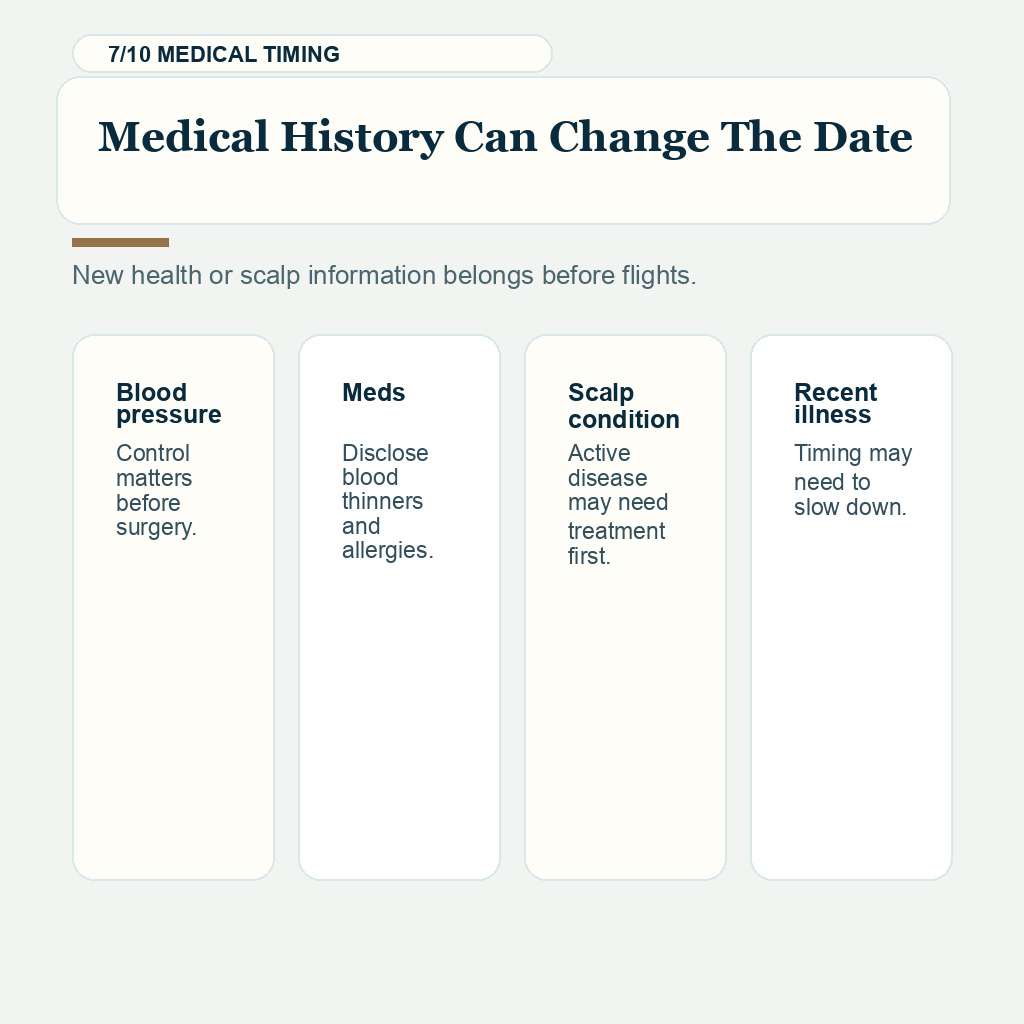
A hair transplant is elective, but it is still surgery. Before travel, medical history has to be part of the decision, not a formality. I review blood pressure, diabetes, heart disease, bleeding history, blood thinners, allergies, medications, recent illness, active infection, autoimmune disease, and any scalp condition that is not settled.
I also ask about active shedding, sudden diffuse thinning, low ferritin or thyroid concerns when relevant, and whether the patient is using or avoiding medical treatment for ongoing loss. Diffuse thinning, unstable loss, or a scalp diagnosis that is not clear can change candidacy and timing.
If something changes after the plan is discussed, I want to know before travel. Medical changes after booking a hair transplant can change whether the date still makes sense.
Reducing, delaying, or declining a case
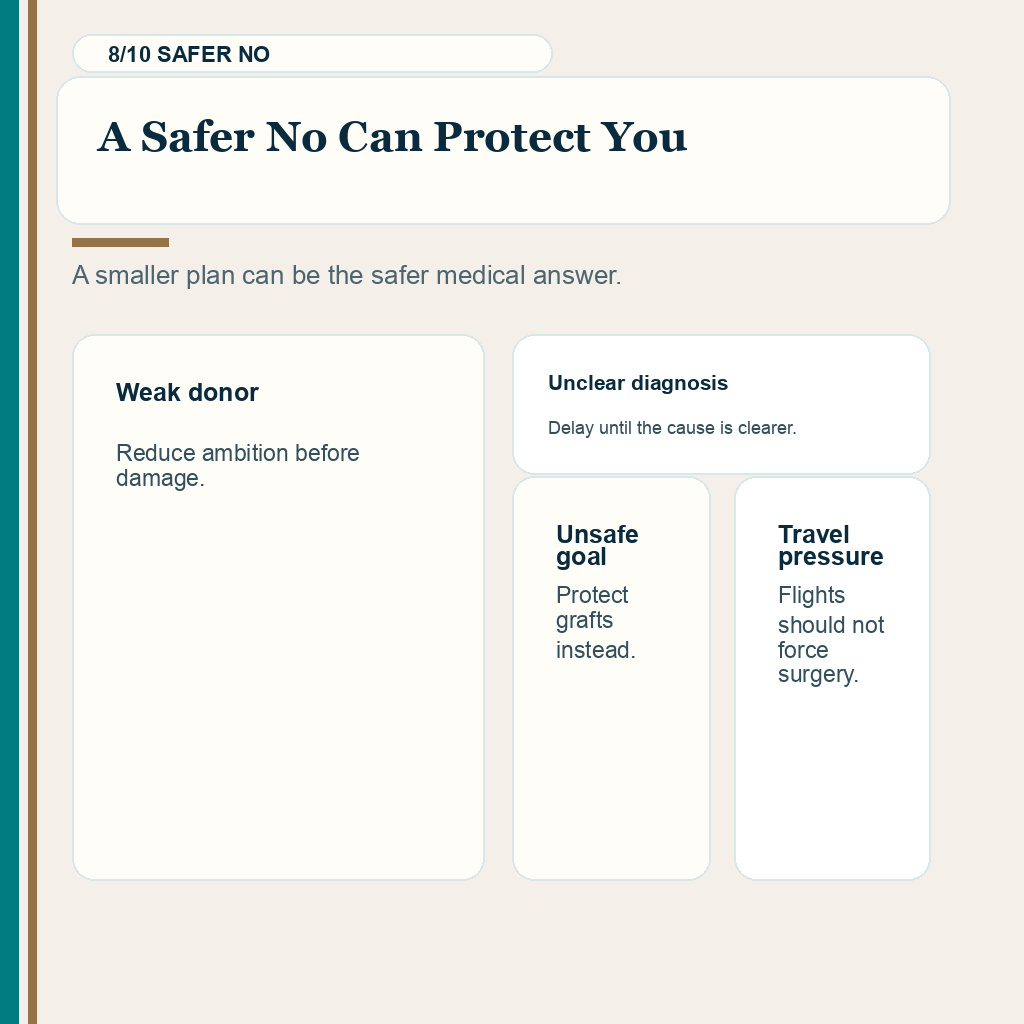
In some cases, safety means a smaller plan. In others, it means a delay or no surgery for now. I may reduce the graft range when donor reserve is weaker than the patient expects, when the crown request would spend too much reserve, or when the hairline request is too low for the future.
I may delay surgery when hair loss is active, a medical issue needs review, the scalp condition is not controlled, or the patient needs time to understand what surgery can and cannot do. I may decline surgery when the donor area cannot safely support the request, when expectations are unrealistic, or when the operation would create a repair problem instead of solving the main concern.
A refusal should not be a vague “no.” It should explain what is being protected. I may decline hair transplant surgery when the donor area, medical history, age, expectations, or future loss pattern would make surgery harmful. The purpose is to prevent a decision that cannot be undone.
These 10 review slides before travel show what needs to be settled before booking flights. Swipe the carousel, use the arrows for one slide at a time, or choose a number below the image to jump to that point.




Clarity before booking flights
Before booking flights, I want the review to make the medical basis visible. I want the patient to know who reviewed the case, what the provisional plan is based on, what photos still cannot prove, and what may change after direct examination.
The review should also name the priority zone, the graft range being discussed, the areas that may stay thin, and the result that should not be promised. Flights, hotels, transfers, and a surgery date are logistics. They should follow those medical points.
Before a flight is booked, I want four answers to be easy to find. The written review should name the surgical aim, the provisional graft range and donor limit, the surgeon role that controls the decision, and the point where direct examination would make surgery smaller, staged, delayed, or refused. A safer decision can still change in Istanbul, but declining, delaying, or reducing the session must remain an acceptable medical option.
Surgeon involvement has to be visible in the case review, not only in marketing. The patient needs to see the doctor’s judgment in donor review, hairline design, graft planning, suitability, and the surgery day limits that may reduce, delay, or stop the procedure.
If a patient is comparing clinics and the plan feels rushed, a second opinion before hair transplant surgery can be useful. The purpose is not to collect the answer that sounds easiest. The purpose is to understand the risk before travel makes the decision feel harder to change.
Possible changes after examination in Istanbul
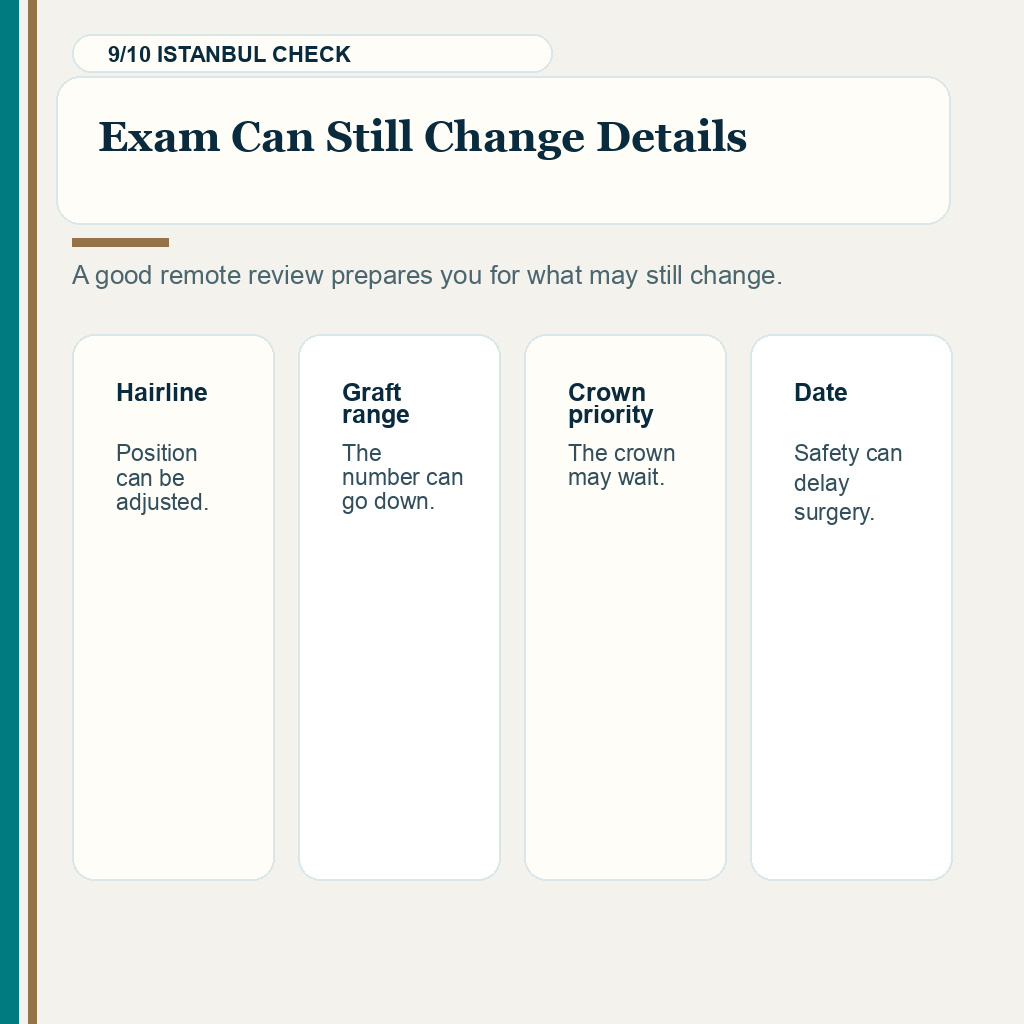
The examination in Istanbul can change the plan. The hairline may need to be adjusted. The graft range may become smaller. The crown may need to wait. The donor area may show miniaturization or previous extraction damage that was not clear in photos. The scalp may show a condition that needs treatment first.
This does not mean the remote review was useless. It means the remote review stayed properly limited. A proper plan before travel should prepare the patient for the parts that are likely and the parts that remain uncertain until examination.
A small adjustment after examination is normal. A major change is different. If donor safety, scalp disease, or hairline realism changes the whole plan, the patient needs space to pause instead of feeling forced to continue because the trip has already happened.
This has to be clear before travel. If the examination in Istanbul changes the plan in a major way, the choice should still be medical, not emotional pressure created by flights, hotels, or a reserved date.
Travel timing should also respect that uncertainty. The question of how many days to stay in Turkey for a hair transplant should be planned around the medical process, not only around the cheapest flight window.
Follow-up planning starts before the operation
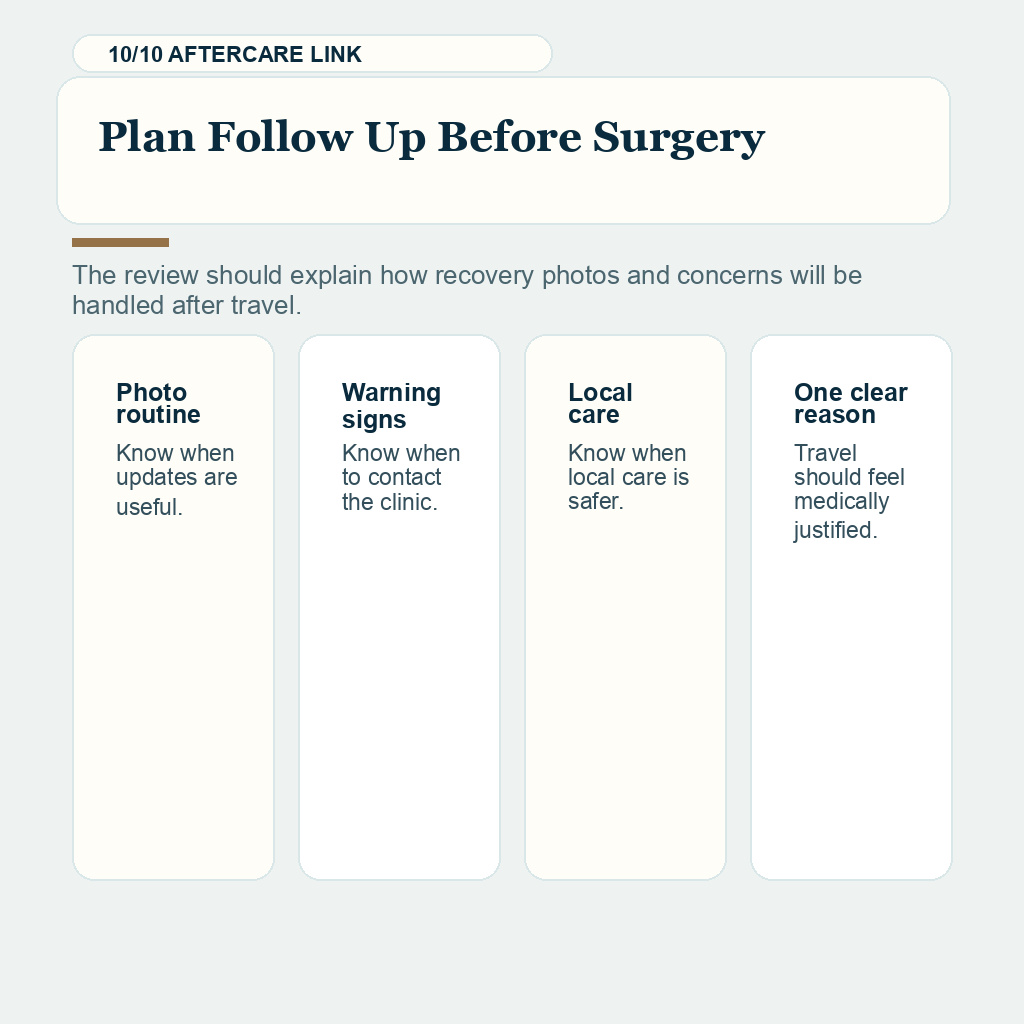
For an international patient, follow-up is part of the decision before surgery, not something added later. Before the operation, the patient needs to know how routine photos will be reviewed, which symptoms need urgent contact, when local medical care is safer than waiting for a message, and how long the clinic will continue to guide recovery.
The plan I make before travel affects follow-up months later. If the donor reserve, graft distribution, hairline design, crown decision, and risk to native hair are recorded clearly, I can read recovery photos with that context.
After the patient flies home, hair transplant follow-up after surgery should be clear enough for routine recovery photos and warning symptoms. Distance should not turn a specific concern into a vague answer. The communication plan should be part of the operation, because the patient will be asking questions from another country.

Read this review excerpt
Dr. Demircioglu made me feel so comfortable with everything and answered all of my questions before I left to go back home to the States.
The review continues after the patient returns home
The notes from the travel review should still be useful months later. When photos arrive from home, I read them against the original graft distribution, donor condition, hairline design, crown decision, and any area we deliberately left thin.
That record helps me separate normal healing anxiety from a concern that needs faster attention. It also prevents vague reassurance when the patient is asking a specific question about swelling, redness, shedding, donor appearance, or uneven early growth.
For an international patient, aftercare is not a separate courtesy. It is part of the surgical plan that started before the flight.
Photos cannot justify the trip alone
A good case review before travel does not promise perfection from photos. It tells the patient what can be judged remotely, what still needs in person examination, and what would make the plan smaller or unsafe.
The strongest reason to travel is a specific case review, not the biggest graft number. When the review shows donor limits, medical history, and the surgical goal clearly, the trip rests on surgical judgment rather than a sales estimate.
If the remote review says the plan is provisional, keep flight and hotel choices flexible until the in person exam confirms the donor and design. A cheap nonrefundable itinerary can pressure the medical decision.