



Travel Insurance Needs Written Checks for Surgery Abroad
The mistake I see is treating a travel policy as the whole safety plan. It is not. A policy may help with lost bags, cancellations, unrelated illness, emergency transport, or evacuation, but a planned cosmetic procedure is different. Before you fly for a hair transplant, you need written confirmation about whether the policy covers the procedure and complications linked to it. Insurance is not a replacement for medical follow up. You still need to know who reviews your scalp, where you go if symptoms worsen, which records you receive, and which costs remain yours.
This matters even when the surgery itself is well planned. Most hair transplant recovery is straightforward, but swelling, bleeding anxiety, infection concern, medication reactions, flight changes, or a delayed operation feel very different when you are abroad and the policy wording is unclear.
Insurance policy is only one part of the safety plan
A travel insurance policy can look reassuring because it uses words such as medical, emergency, hospital, and evacuation. But a hair transplant abroad is not the same as becoming ill on holiday. It is a planned operation. Many policies treat planned treatment, elective surgery, cosmetic surgery, medical tourism, or complications related to that procedure differently from an unexpected illness.
I am not asking you to become an insurance expert. I am asking you not to confuse a general travel policy with a medical plan after surgery. Before paying a clinic or booking flights, ask the insurer direct questions and save the written answers. If the answer is vague, assume you may be paying for that situation yourself. Also separate trip cancellation, travel health, and medical evacuation cover. A policy that helps with flights or hotels may still not pay hospital bills, and evacuation cover may require a separate assistance line, pre authorization, or a decision by the insurer’s medical team.
The clinic still matters. A strong policy cannot fix weak surgical planning, poor records, unclear consent, or no follow up contact. If you are comparing hair transplant packages in Turkey, insurance should be one line in a bigger safety review, not the reason you accept a rushed plan. Keep refund and rescheduling terms separate from insurance promises, because clinic choice and follow up still matter more than a policy document.
Planned cosmetic surgery is different from a normal travel illness
If you break an ankle while sightseeing, the event is unexpected. A problem after an operation you travelled to receive is different. Some policies exclude planned treatment. Some may cover unrelated emergencies but not the transplant or any complication connected to it. Some may cover only life threatening events, not a wound review, extra medication, a hotel extension, a companion’s change of plans, or a changed flight because the scalp needs another clinic visit. Flight home changes after FUE then become a medical communication issue, not only a ticket issue.
Get the coverage answer before the surgery, not after the complication. The wording needs enough detail for you to know whether it covers emergency hospital treatment, ambulance transfer, medical evacuation, complications from planned surgery, extra accommodation, flight changes, and a travel companion’s changes if needed. If possible, save the policy clause or written answer, not only the name of the person on the phone.
Do not rely on the clinic coordinator, a friend, or informal travel advice to interpret the policy. The insurer is the party that decides coverage. If the policy excludes elective procedures or travel for treatment, a hair transplant complication may still be treated as linked to that planned procedure even if the clinic describes the operation as minor.
Questions to ask the insurer before you pay
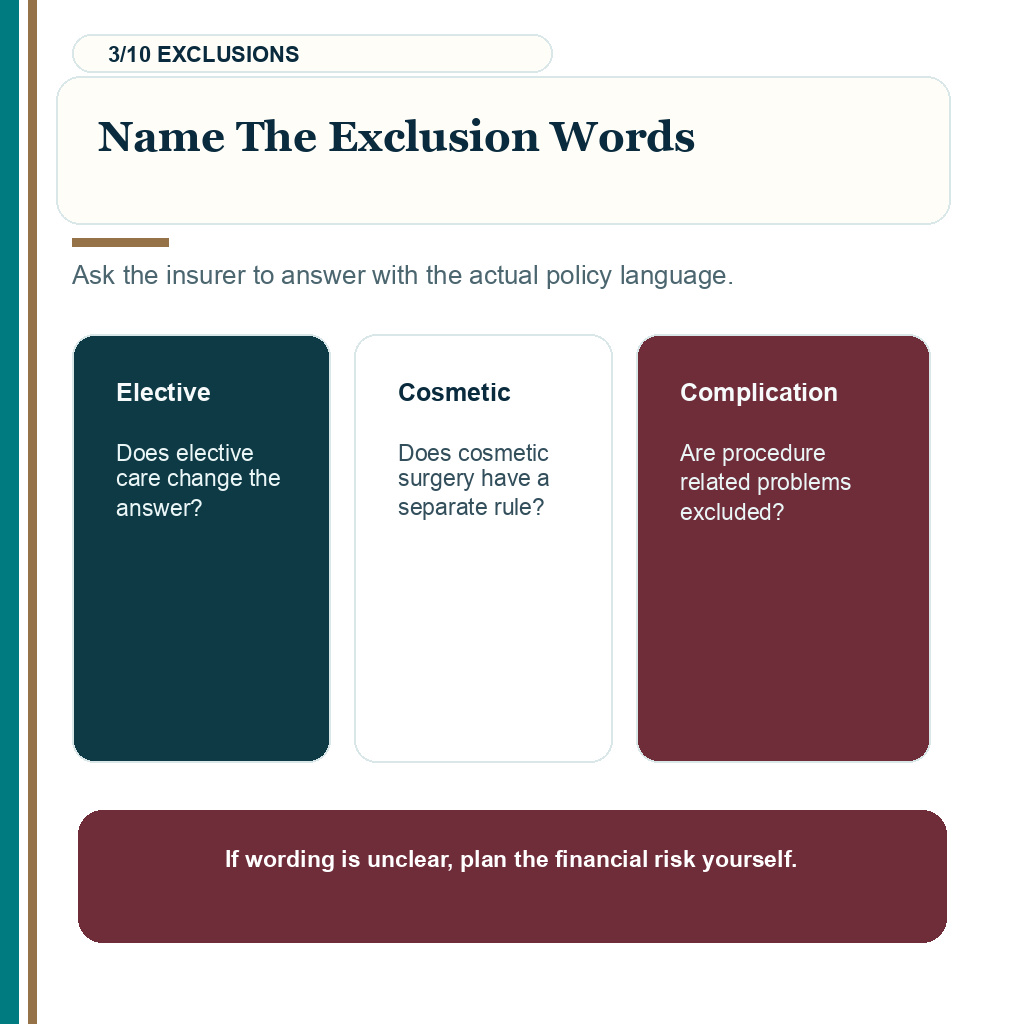
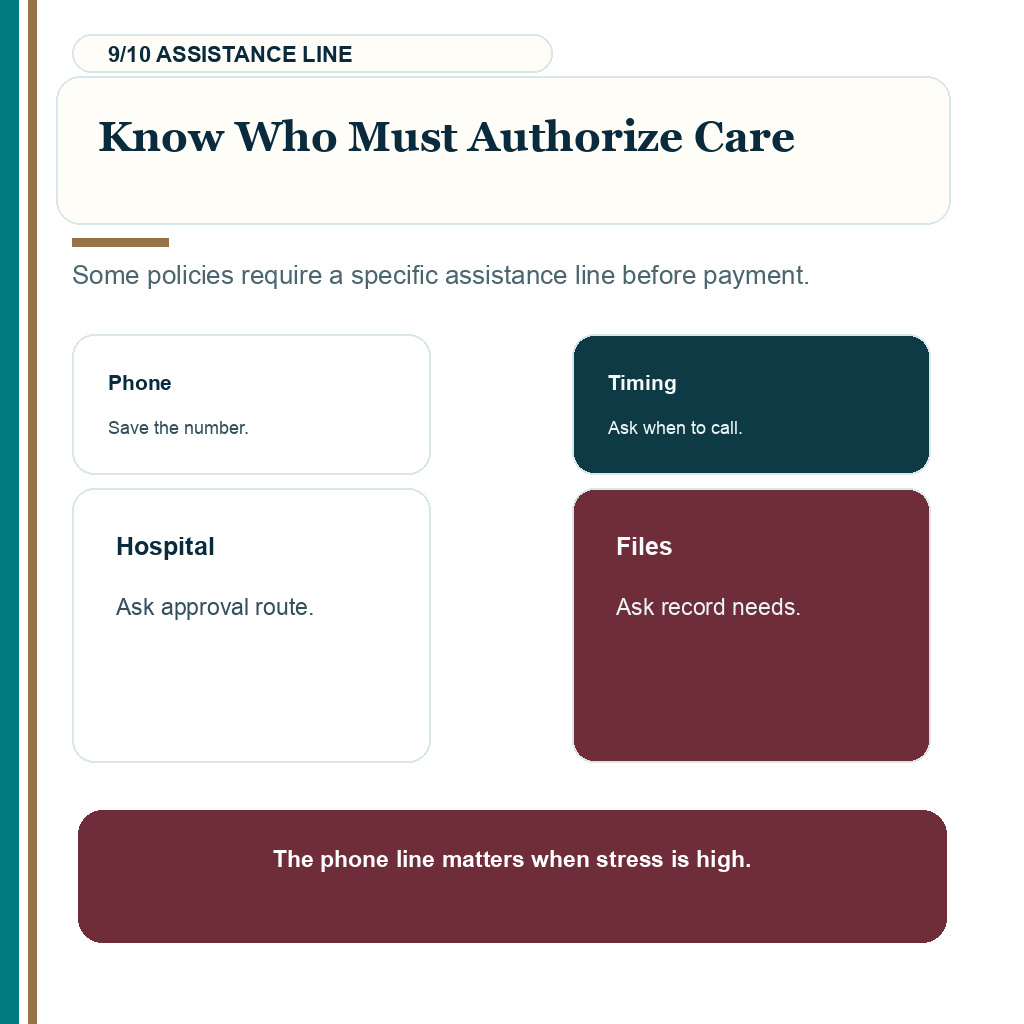
When you are travelling for surgery, vague policy language is not enough. Ask whether the policy covers complications from a planned hair transplant abroad. Ask whether it covers emergency treatment only, or also non life threatening review after surgery. Ask whether evacuation is included, who authorizes it, and when you must call the assistance line. Ask whether hotel extension and flight change costs are covered if the operating doctor advises delay. Also ask whether unused flights or accommodation are covered if the final scalp or donor assessment leads the surgeon to postpone or decline the operation before it starts.
Then ask what documents are required for a claim. Some policies need medical reports, receipts, discharge papers, medication names, clinic contact details, proof of travel dates, and evidence that the procedure was disclosed before travel. Ask whether the procedure must be named as cosmetic surgery, medical tourism, elective treatment, or planned treatment. Ask whether the insurer must be contacted before hospital treatment unless it is unsafe to wait. If the insurer asks about the purpose of travel or says the procedure must be declared, declare it. Do not buy an ordinary holiday policy and keep the hair transplant private if the policy depends on disclosure.
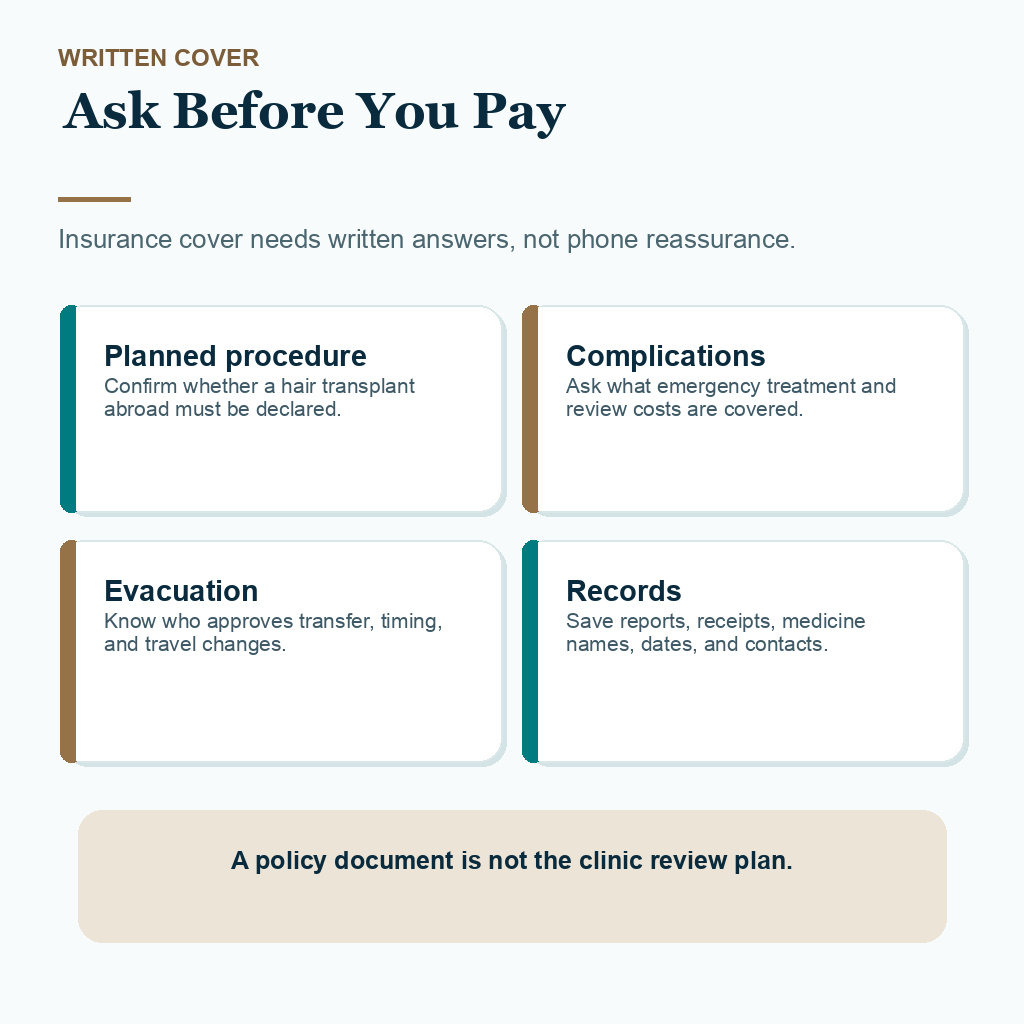
Insurance questions should be answered in writing before flights, clinic payments, and surgery dates are treated as fixed.
Name the operation plainly in the insurance record. A reply about medical cover in general is not enough if it never answers planned cosmetic surgery, procedure complications, hotel extension, or ticket change.
A clinic advised flight delay after elective surgery can sit outside ordinary emergency cover. Hotel extension, ticket change, companion costs, and medical documentation may be treated as separate benefits.
Keep the questions simple and written. Ask about planned procedure complications, not only emergency medical cover. A policy that sounds strong for ordinary travel illness may still be weak for a planned hair transplant.
Follow up after insurance questions
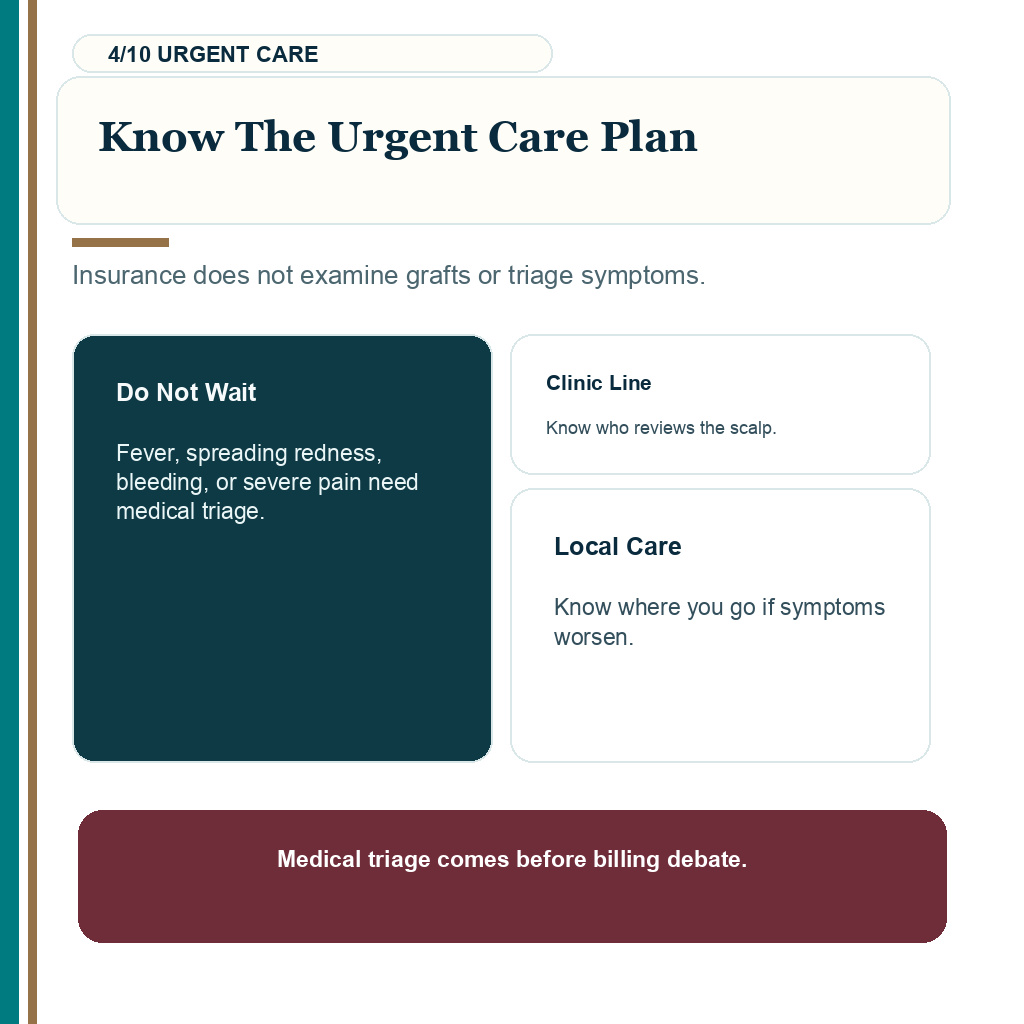
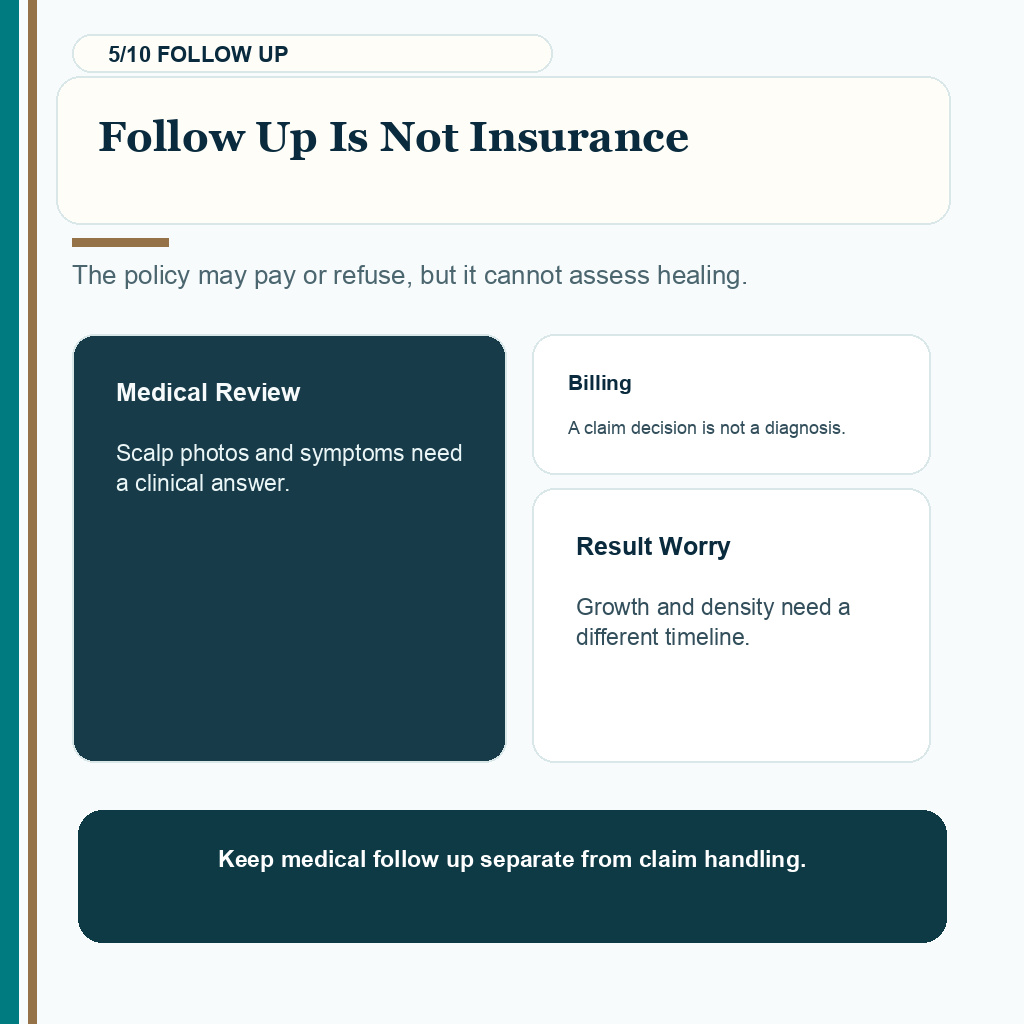
Insurance can pay or refuse a bill. It cannot examine the grafts. It cannot tell whether swelling is expected or worsening. It cannot decide whether redness is irritation, folliculitis, allergy, infection, or trauma. You still need hair transplant follow up after surgery that answers medical questions, not only billing questions. Also ask your home health insurer, public health system, or local doctor what urgent medical help or follow up after overseas surgery may involve when you return.
Before surgery, confirm the clinic’s real follow up route in writing. You should know who answers messages, which photos to send, what time zone applies, what happens on weekends, and when local medical attention is needed without waiting for a remote reply. If the only answer is a coordinator saying everything will be fine, that is not a medical follow up plan.
I also separate medical follow up from result reassurance. Early swelling, bleeding, pain, discharge, fever, or spreading redness is a health question. Density, hairline shape, and final coverage are longer term result questions. Insurance and follow up planning must protect both categories without mixing them together.
Short overseas trips less forgiving
Many medical travel packages are built around a tight schedule. You arrive, have surgery, have the first wash, and fly home. Some people tolerate that well. Others swell more than expected, feel dizzy, need a medication change, bump the head, or become anxious when the donor area looks more dramatic than expected. The shorter the stay, the less room there is for a second review.
A flight is transport, not a recovery plan. If you have a long haul flight the day after surgery, the clinic may technically finish its package, but you are now managing the earliest recovery period in airports, hotels, and cabin air. If something feels wrong, you may need to choose between remote messaging, local urgent medical help, a changed flight, or returning to the clinic. The same decision becomes harder after you are home, so I separate recovery concerns after flying home from a hair transplant from ordinary travel planning. That decision is easier when the plan was made before the operation, not during a stressful night after it.
Travelling alone to Turkey for a hair transplant changes the practical risk picture. A travel companion is not a doctor, but practical help matters when there is swelling, sleep difficulty, paperwork, transport, or a hospital visit.
What records make follow up easier after travel?
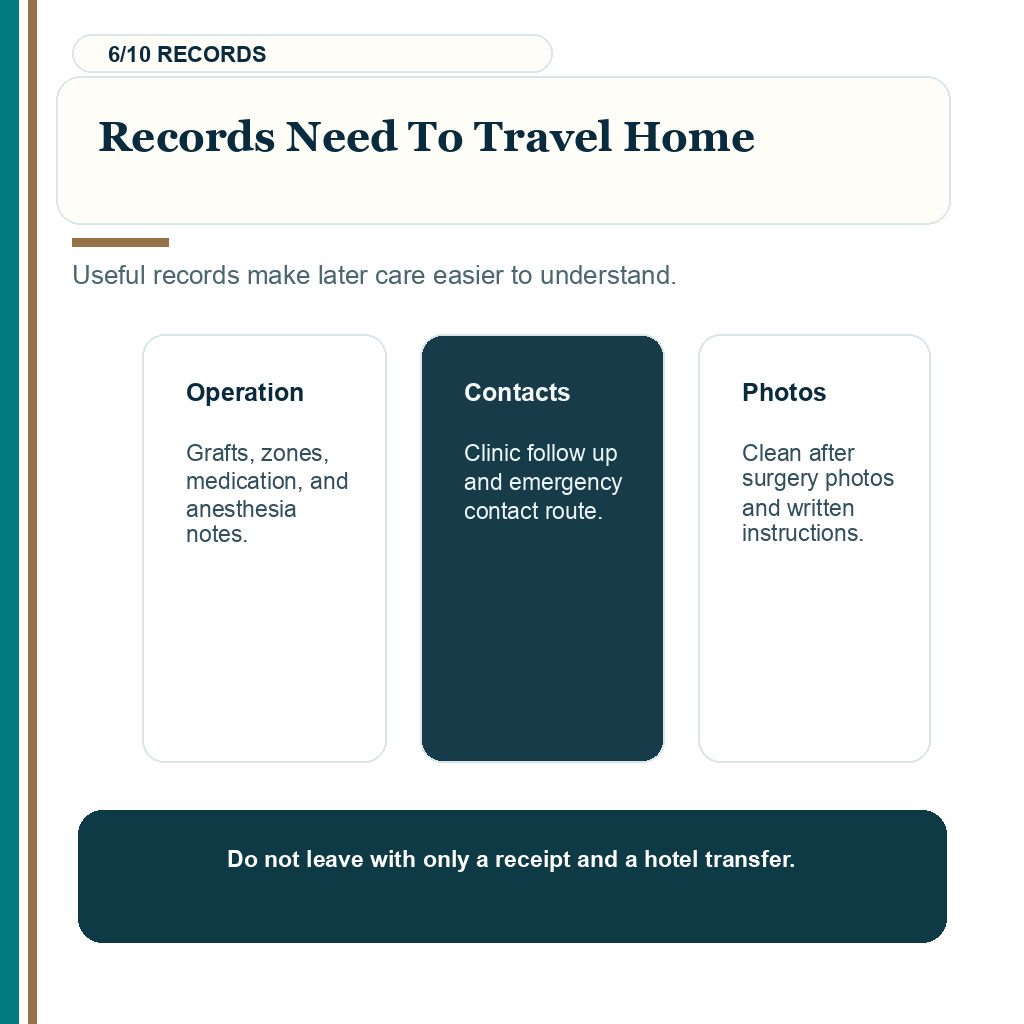
Insurance can help with some travel or emergency questions, but follow up depends on records a doctor can actually use. Before leaving Turkey, the patient needs the surgery date, surgeon name, treated areas, graft number, medicines, anesthesia notes, aftercare instructions, and the route for urgent contact.
I also like patients to know what insurance may not solve. Dissatisfaction with density, a planned revision, expected swelling, normal shedding, or a result that can only be judged months later may sit outside an emergency travel policy.
Good records keep the clinic, the patient, and any local doctor from guessing. They make it easier to decide whether a concern can wait for remote review or needs local medical care after the patient returns home.
Records that need to come home with you
Before flying home, you need more than a receipt and a few messages. Keep the clinic name, surgeon name, date of surgery, graft number, donor and recipient areas treated, medication list, allergies, anesthesia details, aftercare instructions, emergency contact, consent or discharge summary, and any complication notes. If the documents are not in a language your home doctor can use, ask for a clear English or translated summary before leaving, while the clinic can still provide it quickly.
If another doctor has to review you at home, vague statements are not helpful. The doctor needs to know what was done, what medicine was used, what antibiotics or painkillers were prescribed, and what the clinic considered expected. Clear records also help if an insurer asks why you sought medical help. Do not hide the surgery, destination, or travel dates from a local doctor. They can change how infection, swelling, fever, blood clot concern, or medication reactions are assessed.
Good records protect you and the clinic. They also prevent confusion when the issue is not the transplant itself, such as a new illness, fever, medication allergy, or travel related problem. If your health changes after booking, the logic in medical changes after booking a hair transplant applies before you get on the plane, not only after arrival.
Emergency treatment separate from result dissatisfaction
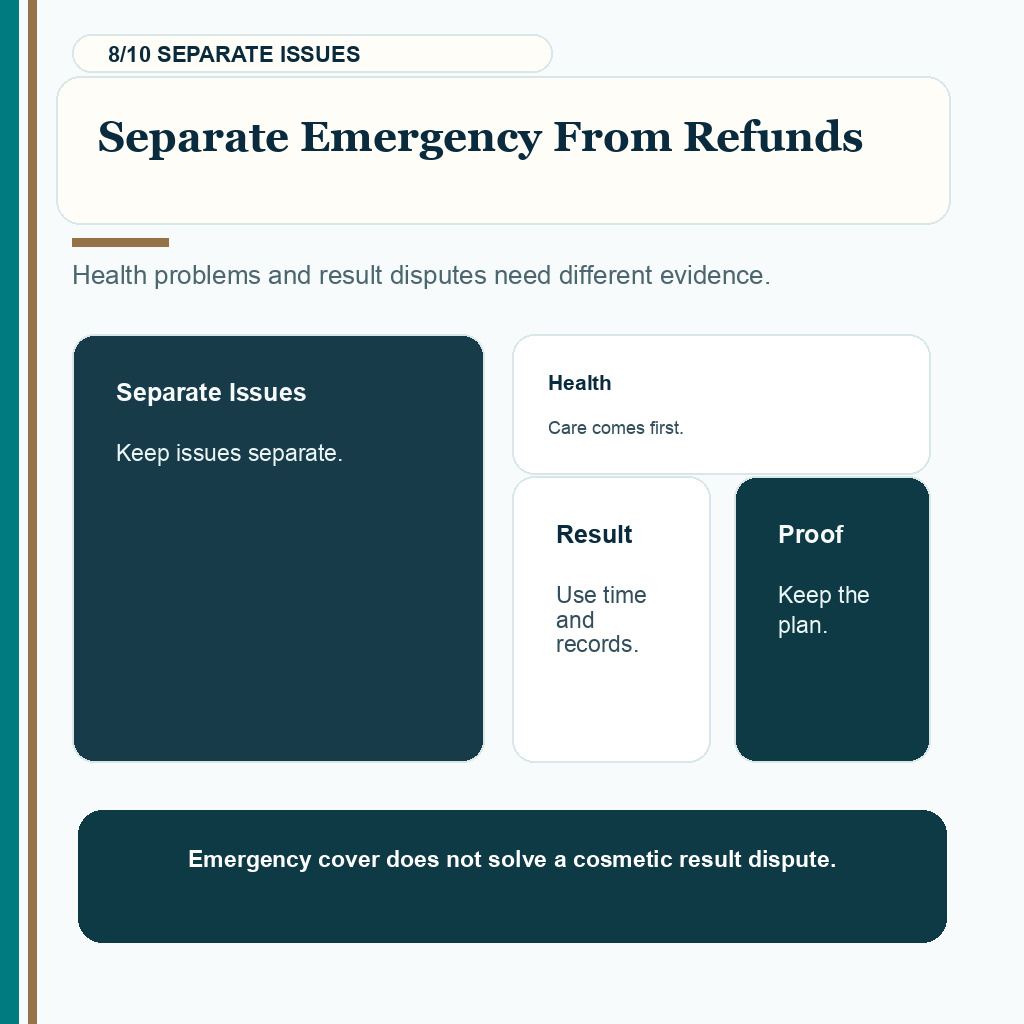
Insurance planning should not be confused with refund planning. A medical emergency, infection concern, allergic reaction, or bleeding problem is different from being unhappy with density, hairline design, or growth at month ten. Insurance may look at emergency treatment. A refund or repair dispute usually needs different evidence, timing, and responsibility.
When the concern is poor growth, poor design, overharvesting, or repair planning, records still matter, but the path is not the same as an urgent hospital claim. A poor hair transplant result refund and repair discussion depends on photos, operative details, donor condition, and timeline before anyone can talk responsibly about correction.
Do not expect emergency insurance to solve a cosmetic result dispute. It may not. Clinic choice, consent, surgeon involvement, and realistic graft planning matter before the first payment is made.
Package prices can hide medical responsibility
A low package price can make the insurance question feel secondary. It is easy to think that airport collection, hotel booking, a fixed operation date, and a policy document mean everything is controlled. That can create a false sense of order. Medical responsibility is not the same as logistics, and a package schedule does not replace a complication plan.
Before paying, the consultation should clarify who designs the plan, who performs the surgical steps, what happens if the operation must be postponed, and how complications are handled. A strong consent process matters here because hair transplant consent before surgery only protects the patient when the final plan is clear before the treatment room.
Payment details matter too. Deposits, card charges, cash balances, and refund language should be understood before travel. If you are still comparing offers, settle the deposit terms and read about paying for hair transplant in Turkey before assuming a low price leaves enough safety margin.
Language clarity during insurance problems
Insurance problems often become worse when documents, symptoms, or instructions are unclear. If you cannot explain the operation, medication, warning signs, or doctor’s advice in the language needed for an insurer or local hospital, small problems become harder to manage. Written records reduce that risk more than memory does.
I take language barriers during hair transplant abroad seriously because everyday conversation is not the same as medical communication. If the policy requires a medical report, the words in that report matter. If a local urgent clinic asks what was done, the answer needs to come from records, not from memory.
Before travel, save the clinic’s emergency number, the hotel address, the nearest hospital route, the insurer’s emergency assistance number, your policy number, passport and travel dates, and a translated summary of medication names if needed. This is a simple step, but it can reduce panic if something changes at night or on a weekend. Keep one screenshot in the phone gallery so weak airport internet does not hide the policy answer.
Staying longer may be the better decision
There is no single correct number of days for every case, but staying a little longer can be sensible when you are travelling far, have medical history, take important medication, feel anxious about early recovery, have limited help at home, or choose a larger graft session. Staying longer can allow another scalp check, more confidence with washing, better swelling observation, and less pressure to make medical decisions in an airport.
The early problems that matter are practical situations such as bleeding that does not settle, swelling that worsens, fever, spreading redness, discharge, strong pain, dizziness, medication reaction, or a head bump. For example, after transplant bleeding, significant swelling, and infected hair transplant warning signs each need triage, not panic.
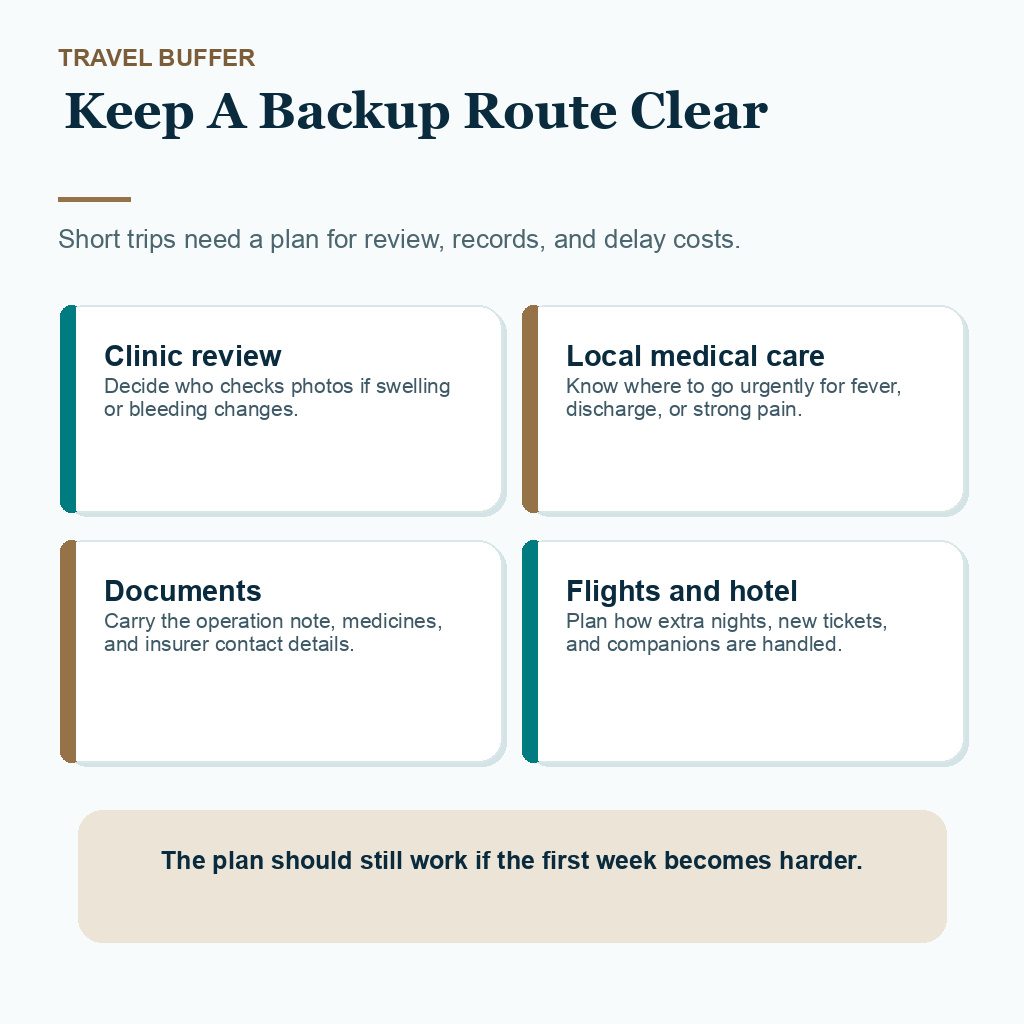
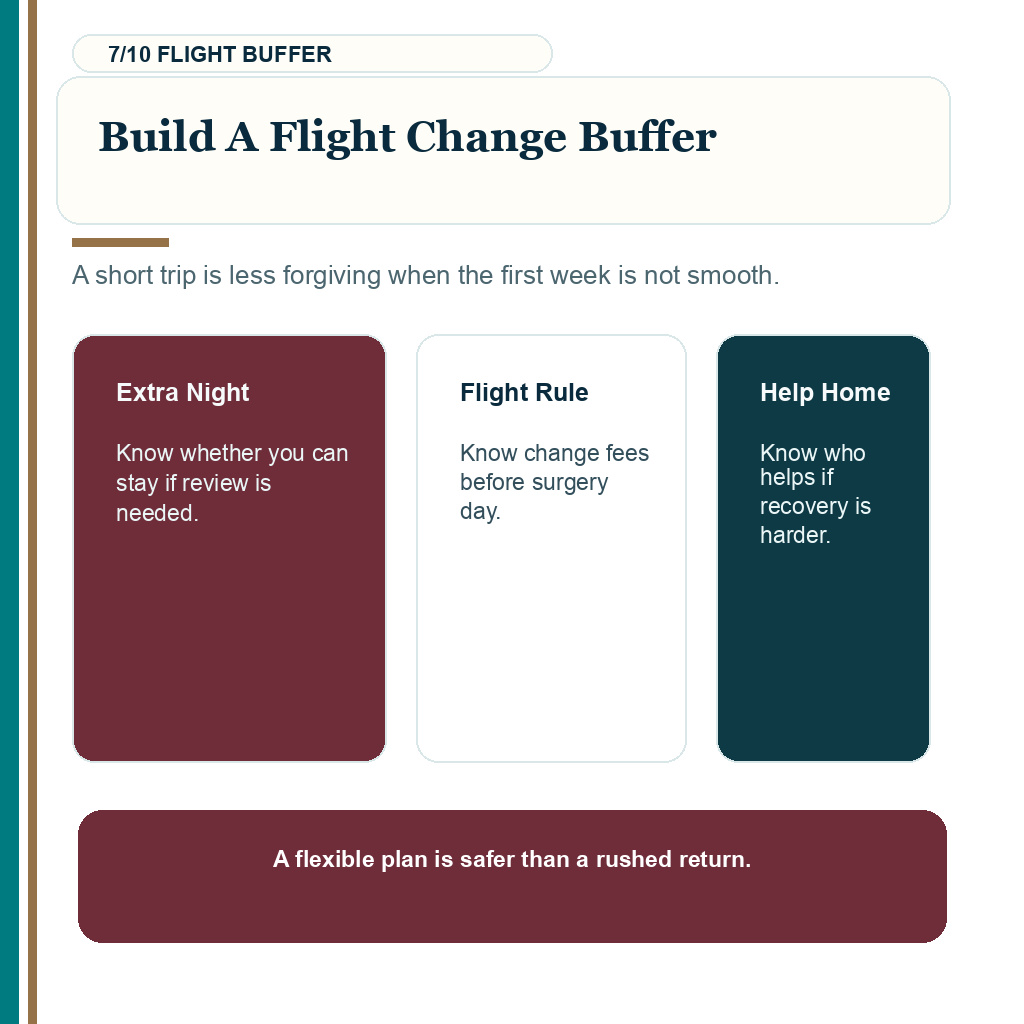
A short overseas stay needs a clear plan for clinic review, emergency treatment, documents, and flight changes.
Flying home quickly is easier when everything goes smoothly. Test the plan against a harder first week with swelling, bleeding concern, fever, extra medication, or a flight that needs to change.
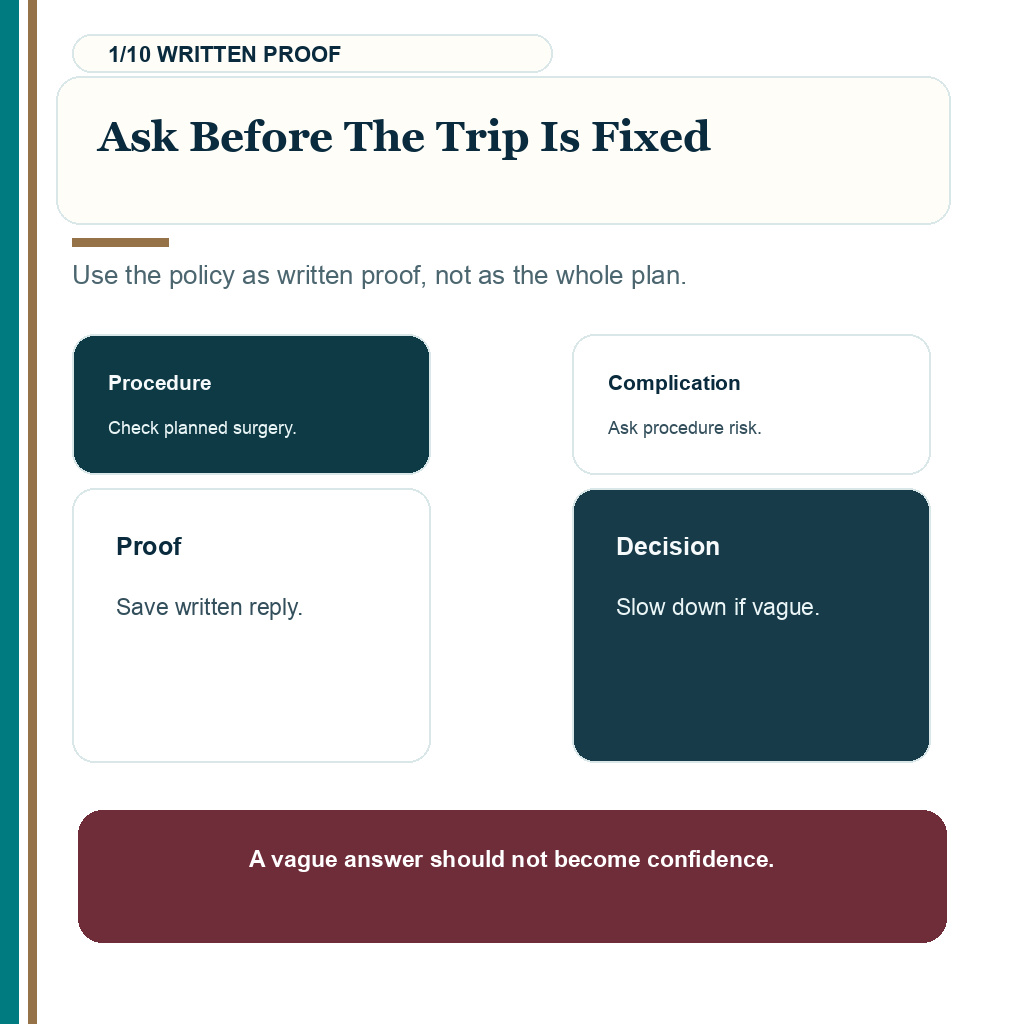
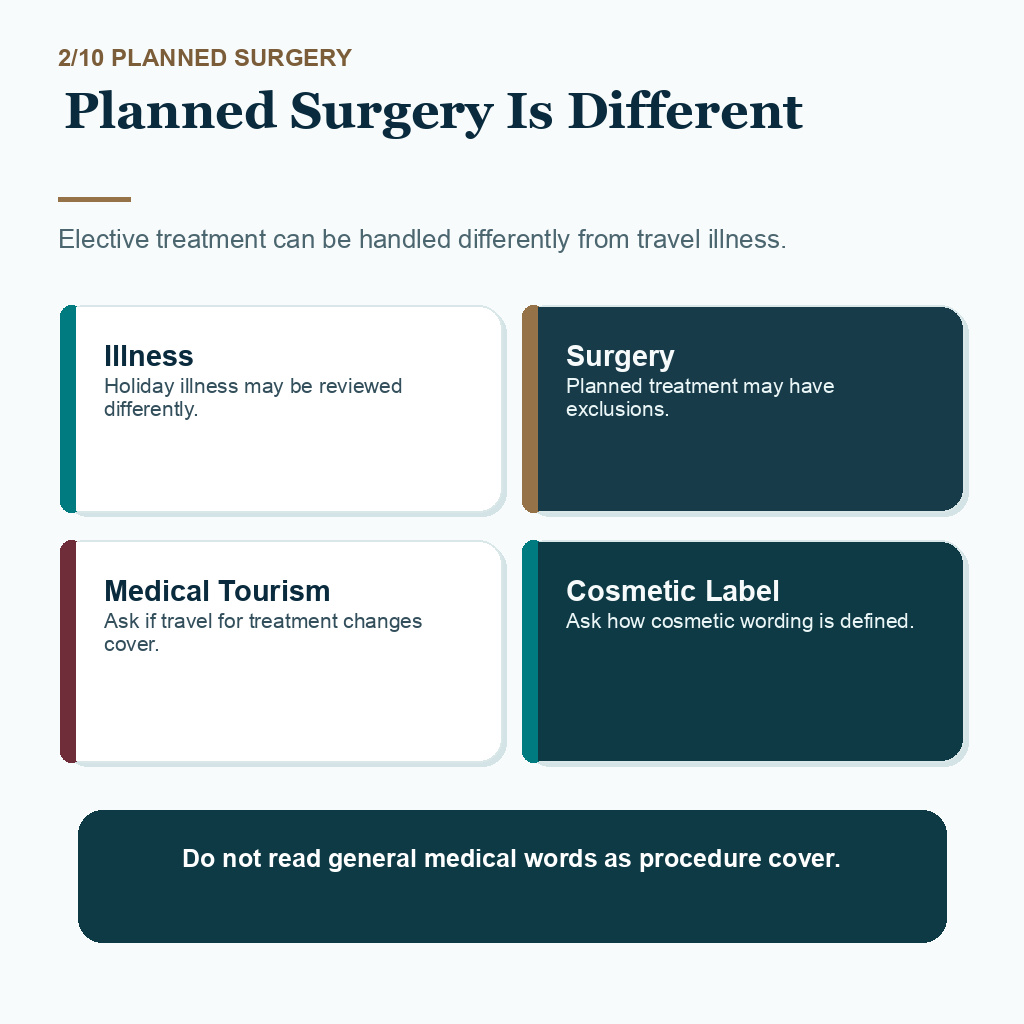
Travel insurance should be checked around planned surgery, exclusions, complications, written proof, emergency care, records, flight changes, and result disputes. Swipe sideways, use the arrows, or choose a number below the image.
Insurance discussion with international patients
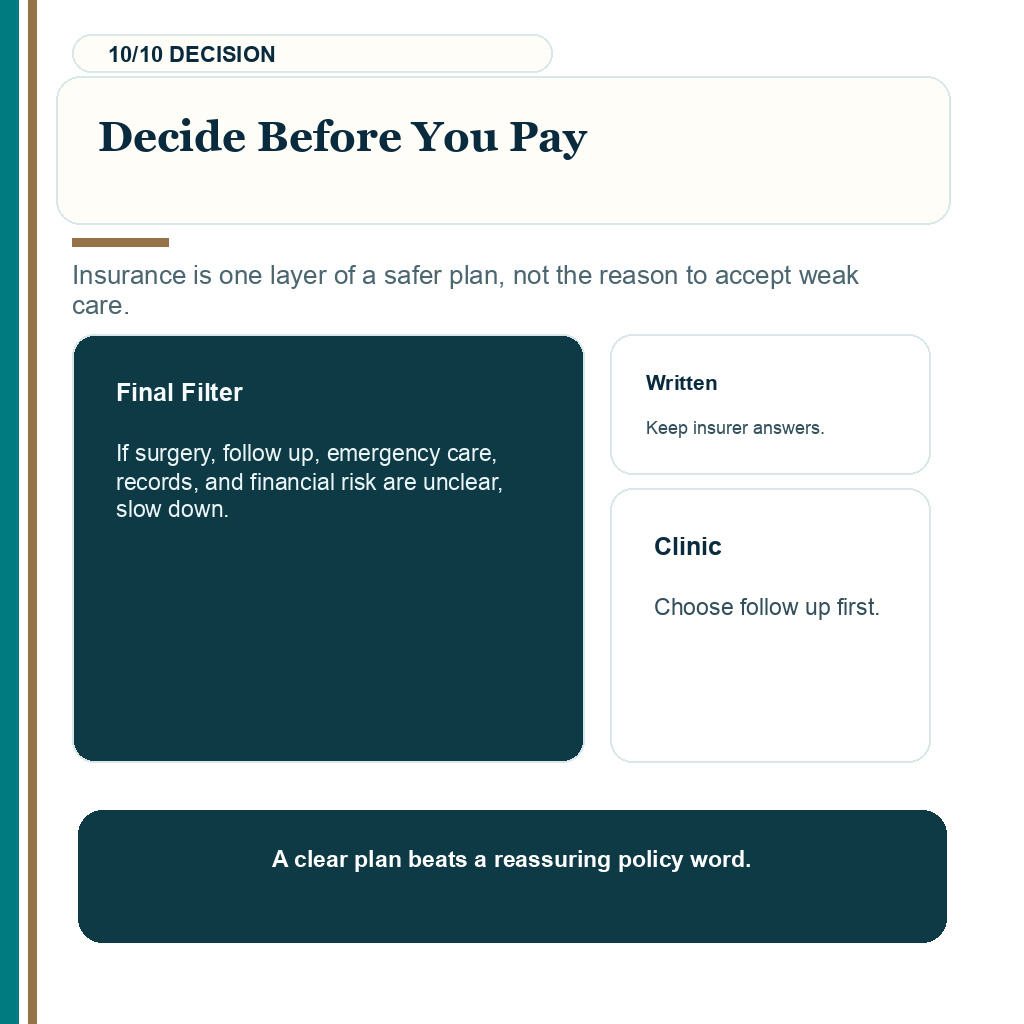
I do not sell insurance, and I do not tell anyone that one policy is enough. I ask them to separate the trip into connected parts. Surgery planning, clinic follow up, emergency care, documents, and financial risk all need clear answers before travel. If each part is clear, the trip is easier to judge. If one part is vague, the policy document alone should not create confidence.
The surgical plan covers candidacy, donor management, graft number, hairline design, anesthesia, and realistic coverage. The follow up plan covers photos, messages, warnings, washing, and review. The emergency medical plan covers where to go if symptoms are concerning and how to contact the insurer if medical help is needed. The financial risk plan covers what the policy may or may not pay and what you can afford if coverage is refused.
Istanbul arrival essentials are part of medical preparation. Preparation is not a formality. It helps the patient arrive with fewer unknowns and fewer last minute decisions.
Insurance should be checked against the real delay scenario
The important question is not only whether you bought travel insurance. It is whether the written policy fits the kind of problem a hair transplant patient may actually face, including a planned elective procedure, extra hotel nights, ticket changes, companion costs, medical documents, and a flight that may need to move if early recovery is not calm enough.
Insurance can help with cost or paperwork in some situations, but it cannot create recovery margin after the trip has been built too tightly. A better plan leaves enough calendar and financial room for swelling, bleeding, a clinic advised delay, or a local medical check that changes the return journey.
For surgery abroad, the safest travel plan is the one that still works if the first nights after surgery are slower than expected. That is where insurance, flexible tickets, hotel planning, and medical follow up need to support each other instead of replacing each other.

Read this review excerpt
Absolutely everything regarding logistics was conveyed in a clear and timely manner via WhatsApp by Dr. Mehmet’s office.