- Written by Dr. Mehmet Demircioglu
- Estimated Reading Time 13 Minutes
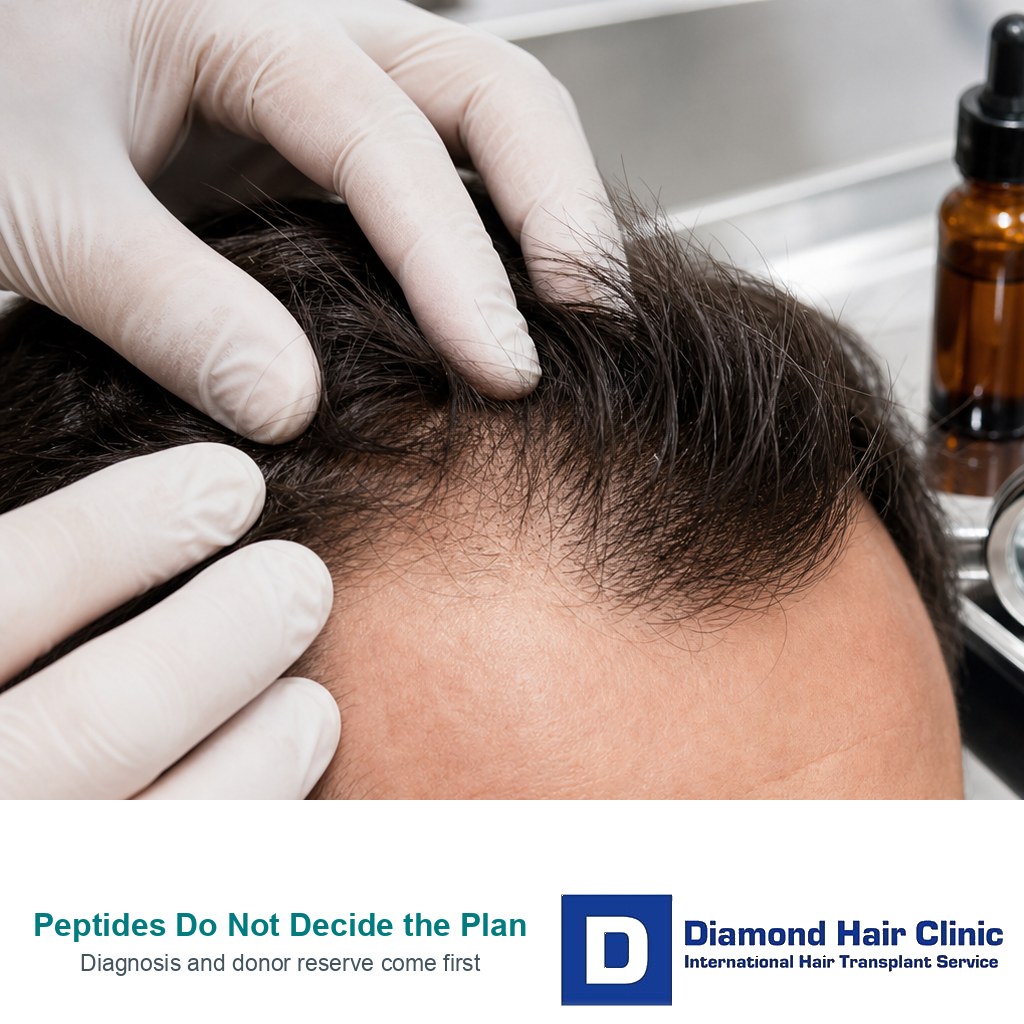
Hair Growth Peptides Cannot Replace a Real Hair Loss Plan
Peptides can be interesting, but they should not become the whole hair loss plan. A serum, injection, or powder may support scalp comfort or hair shaft quality in selected patients, yet it cannot replace diagnosis, proven treatment, donor reserve planning, or surgery when follicles are already gone.
When I see a patient considering peptides, I do not start with the product name or the marketing claim. I first ask what type of hair loss we are treating, which hairs are still miniaturizing, whether the scalp can tolerate another product, and whether the donor area can safely support the design. If those questions are not answered, a peptide claim can make the plan less clear instead of more advanced.
The word peptide sounds precise, and that is exactly where the confusion starts. It feels scientific. But in practice it is a very broad label. Some peptides are used as signaling molecules in the body. Some are studied in skin repair. Some appear in cosmetic serums. Some are sold as injections in wellness markets. Some are simply digested like dietary protein. Putting all of these under one hair growth promise is where patients get misled.
The peptide label is only the starting point
A peptide is a short chain of amino acids. That tells me something about the molecule, but it does not tell me whether it reaches the hair follicle, whether it changes the hair cycle in a living patient, whether the dose is meaningful, or whether the product is safe around surgery. The route matters. A topical serum is not the same clinical question as an injection. A collagen powder is not the same question as a copper peptide serum. A gray hair pigment product is not the same problem as male pattern hair loss.
For that reason, I am cautious when a patient says, “I am using peptides for hair growth.” I need to know which peptide, which route, which concentration, what else is in the formula, whether the scalp is irritated, and what the patient expects it to replace. If the expectation is slightly better hair texture or less scalp irritation, the discussion is different. If the expectation is to replace finasteride, dutasteride, minoxidil, or a transplant plan, the standard must be much higher.
Bring the exact peptide name, route, source, dose, and start date instead of describing it as a hair growth blend. Those details separate a product label from a medical planning decision. If the label is vague, take a photo of the bottle or prescription before the consultation.
The most common mistake is to treat a plausible mechanism as a clinical result. A molecule can look promising in a laboratory model and still fail to create a visible result on a real scalp. Hair loss is not only a growth signal problem. It can involve androgen sensitivity, miniaturization, inflammation, scarring disease, nutritional issues, thyroid disease, medication changes, stress shedding, previous surgery, and poor donor planning. A product that speaks only about “activating follicles” may be skipping the most important diagnosis.
Can topical peptide serums support scalp quality without replacing treatment?
Topical copper peptides such as GHK Cu and AHK Cu are the peptide group patients ask me about most often. I understand why. They have a more plausible biological rationale than many cosmetic ingredients. Copper peptides are discussed around tissue repair, skin quality, inflammation, and signals around the dermal papilla. There are laboratory and limited early signals that make them worth watching.
But that is not the same as saying a copper peptide serum can rebuild a frontal hairline, stop active androgenetic loss, or protect future native hair after surgery. In a transplant patient, the scalp surface also matters. A product that is reasonable on a settled scalp can be a bad idea on a newly operated or irritated scalp. If the question is specifically when a serum can touch the scalp after surgery, the answer has to come from healing status, not from the product’s growth promise. I treat copper peptide serum timing after a hair transplant as a healing question. The recipient area has to be closed, settled, and not irritated before extra products make sense.
Other peptide serums often contain names such as biotinyl tripeptide 1 or acetyl tetrapeptide 3. These ingredients are usually packaged in combination formulas with caffeine, botanicals, vitamins, humectants, or scalp conditioning agents. That makes the product hard to judge. If the hair feels thicker, is it because of a biological follicle effect, better cosmetic coating, less breakage, less scalp irritation, or simply better styling? A patient can still like a serum, but liking the cosmetic effect should not be confused with stopping miniaturization.
For androgenetic hair loss, proven treatments still have a clearer job. Minoxidil is not perfect, and it can irritate some scalps, but its role is more defined than a peptide serum. Around surgery, even minoxidil has to be timed according to scalp tolerance. I discuss minoxidil after a hair transplant as a timing and scalp tolerance decision, not only as a growth product. If a better studied medication still needs timing, an optional peptide serum should not be treated more casually.

Injectable peptide stacks need stricter caution
The conversation changes when peptides move from a serum to an injection. BPC 157, TB 500, injectable GHK Cu, injectable AHK Cu, KPV, MOTS C, growth hormone secretagogues, and similar stacks are often promoted with healing language. Patients see injury recovery stories and then ask whether those claims also apply to hair growth, donor healing, redness, scarring, or graft survival.
I do not use that shortcut in surgical planning. A hair transplant is not a tendon injury, and graft survival is not decided by one inflammation control story. The survival of grafts depends on extraction quality, graft handling, time out of the body, recipient area incision planning, placement, blood supply, early trauma after surgery, infection control, and patient healing. A peptide injection cannot compensate for poor surgical planning or careless graft handling.
There is also a safety and quality control problem. With injected products, the question is not only “does it grow hair?” It is also what the vial contains, how it was manufactured, whether the peptide is pure, whether it can trigger immune or systemic reactions, whether it interacts with other medications, and whether the surgeon or medical doctor knows about it. Some injectable peptide products are promoted without the same evidence, manufacturing clarity, or human safety record expected from approved medicines. I need that history before I plan surgery.
A documented, medically supervised treatment is different from a vial bought without medical supervision or a hidden injection stack. If a patient has already used injectable peptides, I need the route, dose, source, start and stop dates, medical reason, side effects, and whether any doctor is supervising it before I plan surgery.
If a patient is already asking about BPC 157 and TB 500 after a hair transplant, I direct them toward medical review rather than casual experimentation. An injectable peptide stack should never be the reason to accept a weak donor plan, rush surgery, or ignore proper aftercare.
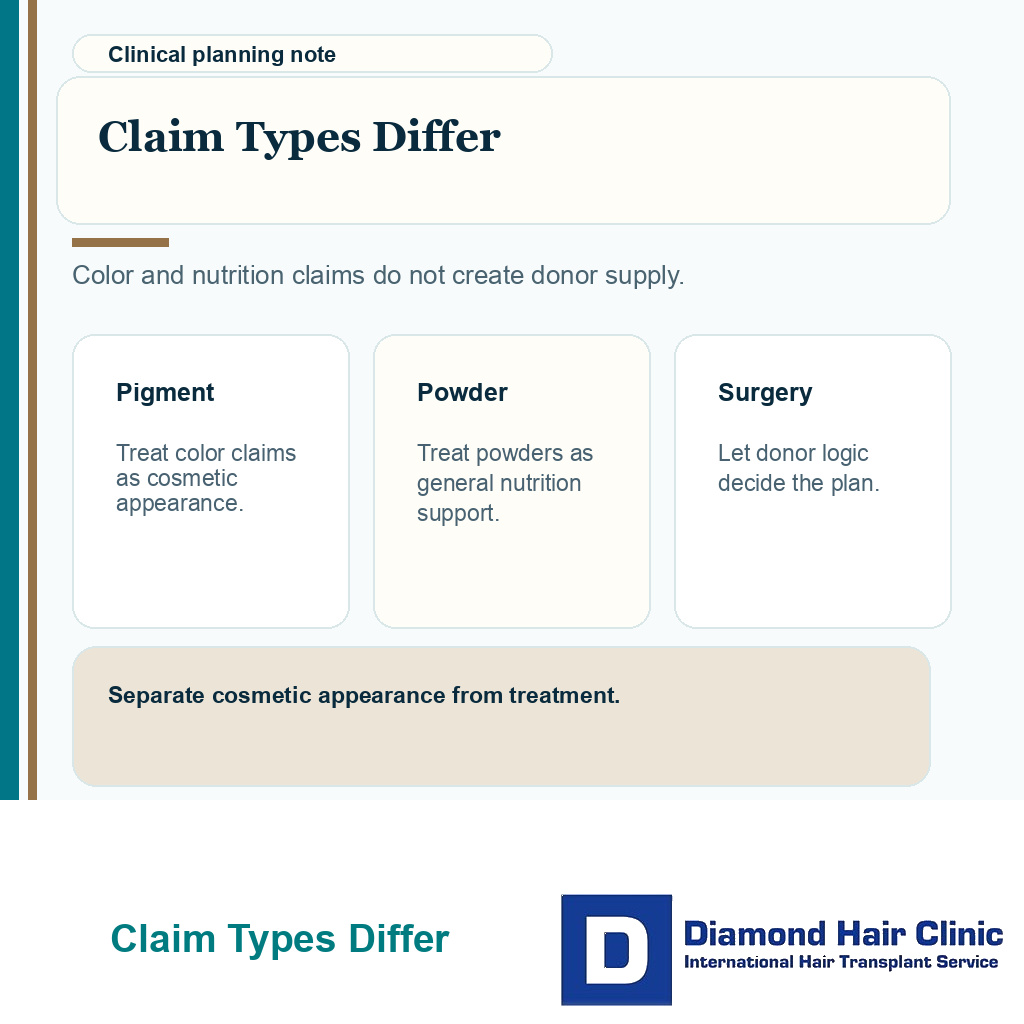
Pigment claims are not density proof
Some peptide products are marketed around gray hair rather than hair loss. That is a separate problem. Pigment is produced by melanocyte activity in the follicle. Hair density depends on the presence, size, cycling, and survival of follicles. A product that tries to influence pigment signaling is not by itself a treatment for androgenetic miniaturization.
This distinction matters because patients can see before and after language and assume all hair claims are the same. They are not. A strand that looks darker is not proof that a thinning hairline has been rebuilt. A pigment claim should not change the number of grafts planned, the hairline height, the crown strategy, or whether native hair needs medical support.
I also become more careful when a product claims to manipulate pigment biology too aggressively. The skin and pigment system need respect. Cosmetic improvement is one thing, and careless claims about reversing aging biology are another. For a transplant candidate, the priority remains diagnosis, scalp health, donor reserve, and realistic design.
Oral collagen and keratin peptides are nutrition support, not follicle medicine
Oral peptide powders are another source of confusion. Collagen peptides, keratin peptides, and protein supplements may support general nutrition when the diet is poor or protein intake is low. They may help some patients with hair shaft quality if a nutritional gap exists. But they are digested. The body breaks them down and uses amino acids according to its needs. They do not travel to one thinning temple and instruct it to become dense again.
If a patient has sudden shedding, brittle hair, crash dieting, anemia symptoms, thyroid symptoms, or a restrictive diet, nutrition deserves attention. But even then, the answer is not to guess with a peptide powder while active loss continues. The answer is to look for the cause. If the cause is androgenetic miniaturization, a supplement will not replace follicle directed treatment. If the cause is scarring disease, a supplement will not make an unsafe recipient area safe. If the cause is poor donor planning, a powder will not create new donor hair.
Many patients lose time here. They start a powder because it feels harmless, then delay proper evaluation for another six months. By the time they come in, the hairline, midscalp, or crown has changed, and the donor plan has to be more conservative. Seeing the patient earlier lets us decide what is truly optional.
Peptides fit only after diagnosis and timing are clear
There is a narrow place for peptides in the conversation. A topical product may be acceptable as extra support for scalp comfort or hair quality after the scalp has healed and the ingredient list has been reviewed. A patient who cannot tolerate a certain medication may still discuss other supportive options. A nutrition supplement may be reasonable when diet is genuinely weak. But these are side notes. They do not become the plan.
If you are already using peptides, do not hide them and do not start a new serum, injection, microneedling mixture, or powder in the final weeks before surgery without review. Bring the product name, ingredient list, route, dose, source, start date, stop date, and any reaction. If the scalp becomes red, itchy, inflamed, or irritated after a topical product, the product should pause and the scalp needs review before the transplant plan is trusted. I do not add a peptide stack just because a middle month transplant looks thin. Changing several products at once can make it harder to know whether the issue is maturation, medication shedding, scalp irritation, native hair loss, or weak surgical yield.
The plan starts with the pattern of loss. I assess active thinning, donor stability, diffuse miniaturization, age, crown involvement, and medication tolerance. Those findings decide whether surgery is wise, how many grafts can be used, and where they should go. When native loss is likely to continue without medical support, the design has to remain more conservative.
If hair loss is active, a peptide product should not distract from timing. A patient who is still losing native hair may need stabilization and follow up before surgery, which is why active hair loss before surgery can change the whole plan. Even after surgery, native hair can keep thinning, and hair loss can continue after a hair transplant if the underlying process is not controlled.
Some patients look at peptides because they want to avoid finasteride. I understand that discussion, especially when there are side effects or fertility concerns. But avoiding a medication does not make a peptide into the same thing. A hair transplant without finasteride can still be possible, but it often changes the hairline, crown, density, and donor reserve strategy. If a patient had side effects, I first separate medication risk from surgical planning. That medication boundary matters in finasteride side effects and transplant planning. I do not treat a peptide product as a simple swap.
Sort the route before the claim changes the plan
Choose the route first. The product name matters less than the decision it is trying to replace.
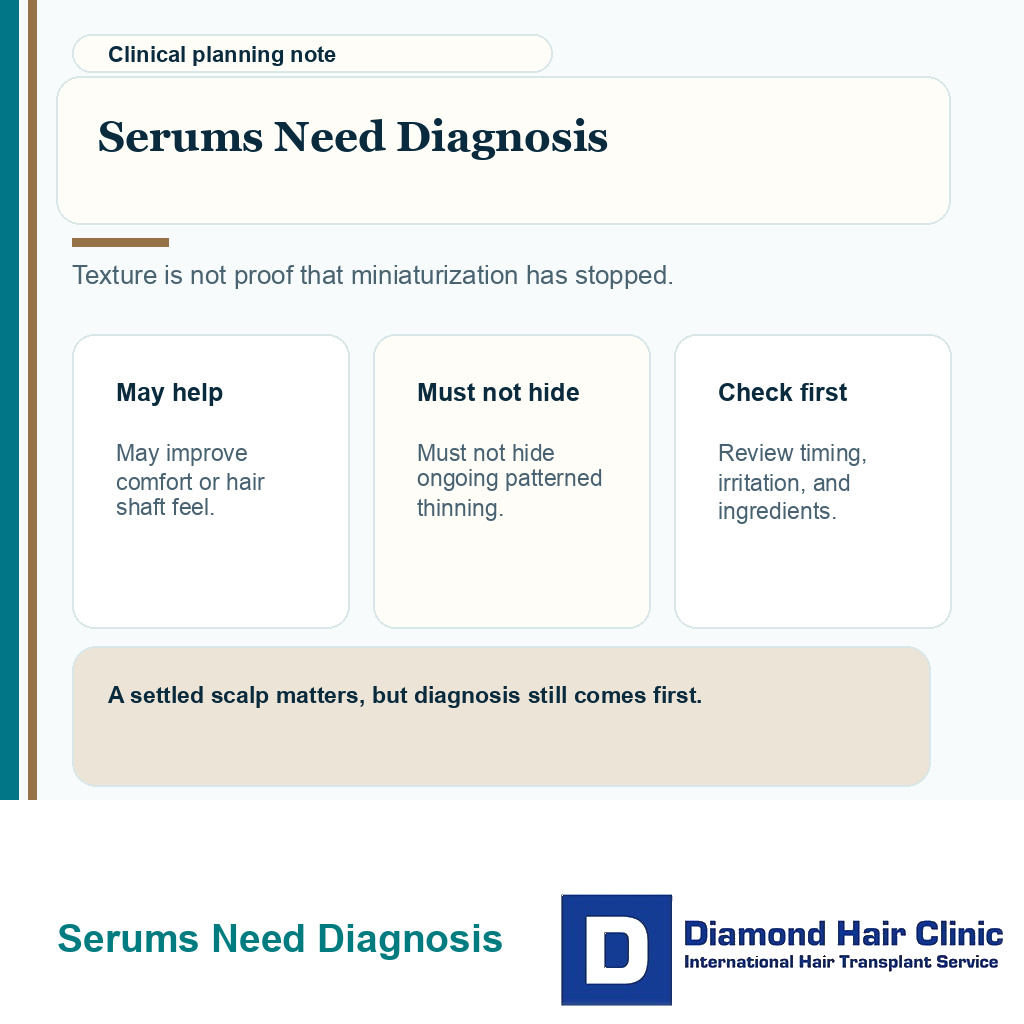
Serum claims belong below diagnosis
A topical peptide may support scalp comfort or hair shaft quality, but it does not decide whether androgenetic loss is active or whether surgery is timed correctly.
Useful question
Is the scalp settled enough for another topical product?
Wrong use
Stopping medication because a serum sounds biological.
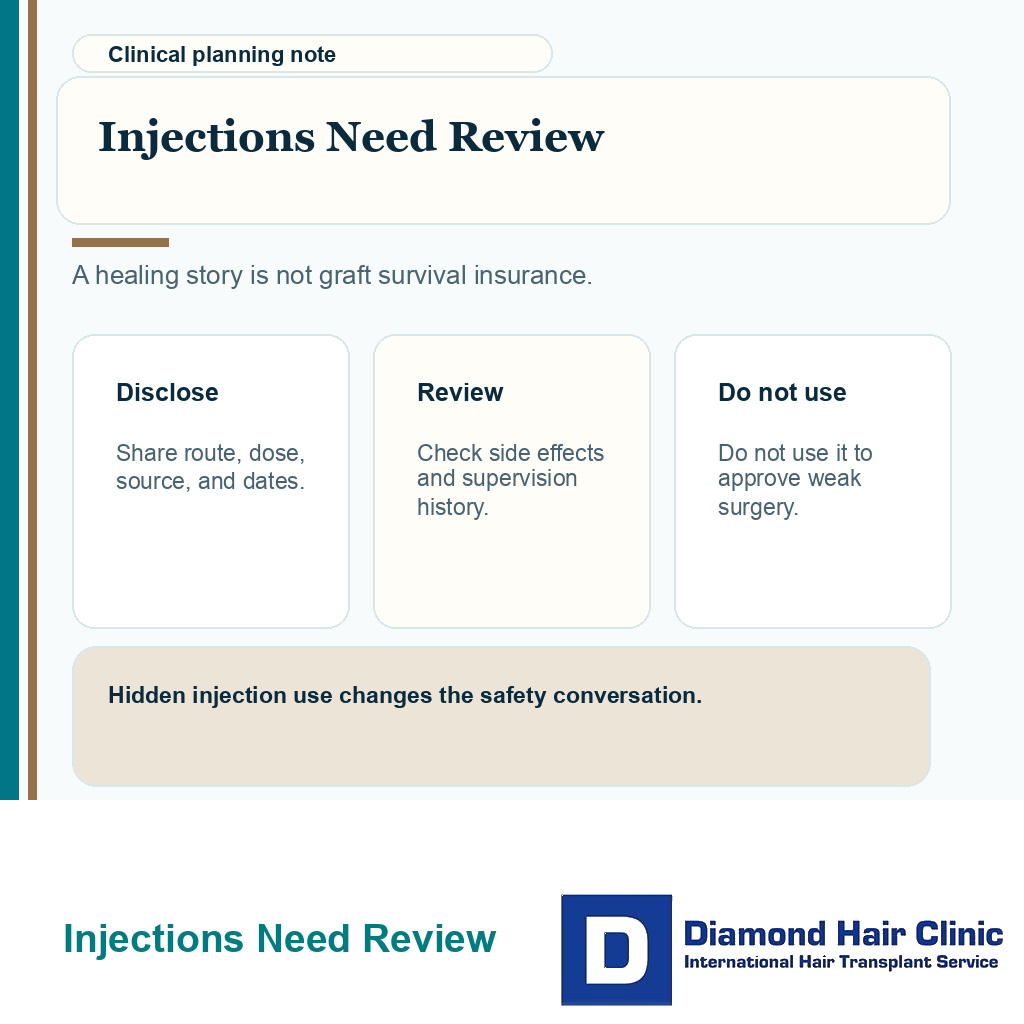
Injections raise a safety question first
BPC 157, TB 500, injectable GHK Cu, and AHK Cu are not graft survival insurance. The route, purity, medical history, and timing around surgery matter before any possible benefit.
Useful question
Do the surgeon and medical doctor know the exact injection history?
Wrong use
Using a healing story to justify a weak donor or graft plan.
Pigment is not density
A gray hair peptide claim may aim at color signaling. It does not prove that miniaturized follicles will recover or that donor planning can be more aggressive.
Useful question
Is the product speaking about color, density, or shedding?
Wrong use
Reading darker strands as proof of true regrowth.
Powders are not targeted follicle medicine
Collagen or keratin peptides are digested like protein support. They may help nutrition when intake is poor, but they do not command one thinning area to regrow.
Useful question
Is there a real diet, protein, iron, thyroid, or shedding issue?
Wrong use
Delaying evaluation while active miniaturization continues.
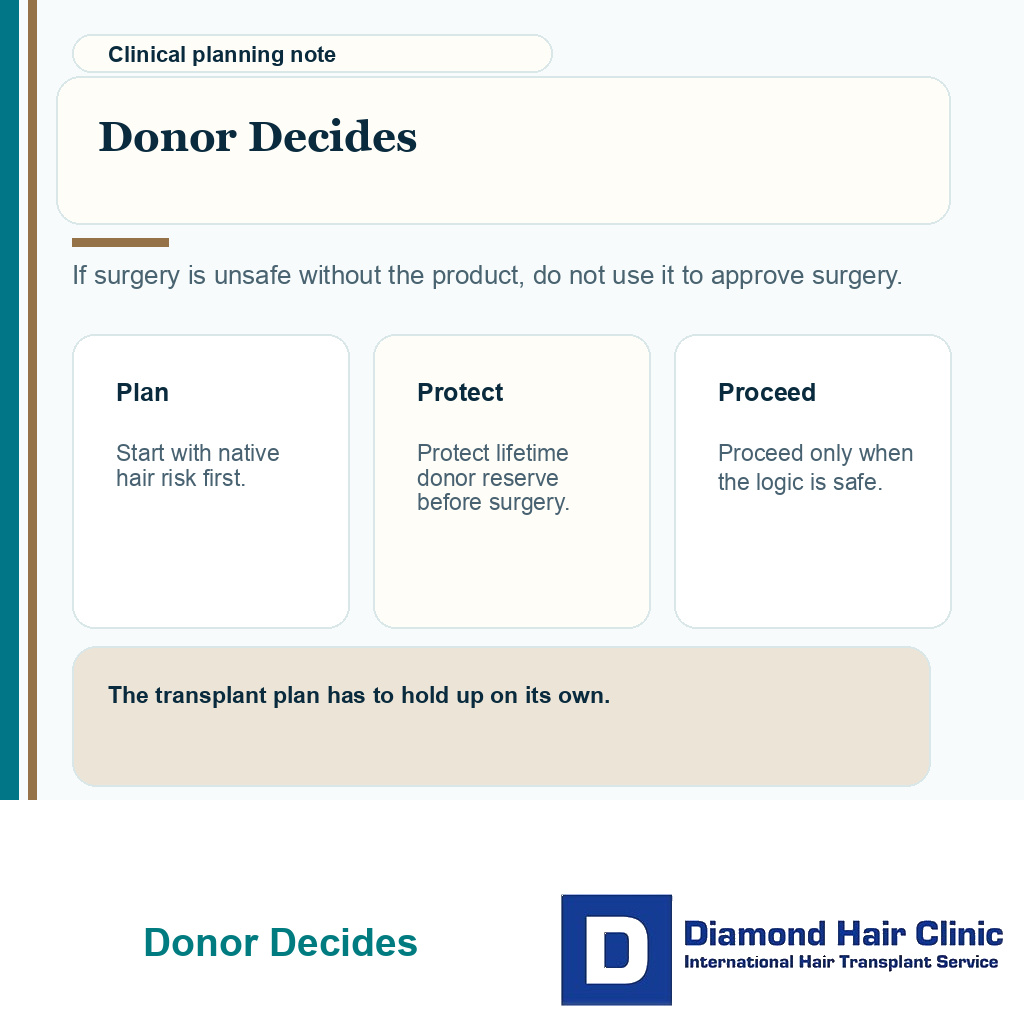
No product should spend donor grafts
If a peptide claim makes a weak donor plan sound safer, the claim is being used incorrectly. Donor reserve, miniaturization, age, and design still decide the surgical plan.
Useful question
Would the same surgery still be wise if the product did nothing?
Wrong use
Letting marketing make an aggressive graft number feel safer.
Which planning test does the peptide claim need to pass?
When a patient brings me a peptide product, I check three things. The route comes first because a topical product, an injection, and an oral powder do not share the same risk. I then look at what the claim is trying to replace. Replacing shampoo is a minor choice, while replacing medication review, donor planning, or diagnosis carries much more risk. Finally, I judge the evidence. A laboratory mechanism, an animal wound healing story, a social photo, a small human signal, a controlled hair loss trial, and regulatory approval are not equal.
Fourth, what could it confuse? This is the question patients often miss. A serum can make hair feel fuller and hide ongoing miniaturization if the pattern is not being checked with photos, examination, or trichoscopy when needed. A supplement can make the patient feel proactive while the crown keeps thinning. An injection can make fast healing sound more important than surgical quality. A pigment product can make darker strands feel like density improvement. None of these are harmless if they delay the correct decision.
That standard applies to medical treatments. Oral minoxidil, for example, is not simply a stronger cosmetic product. It has blood pressure and side effect considerations, so oral minoxidil timing needs medical review. A peptide injection with far less hair transplant evidence should not be held to a lower standard just because it is marketed as regenerative.
A peptide claim should not spend donor grafts
Treat peptides as a product claim until the consultation proves otherwise. Bring the ingredient list, route, dose, source, timing, and any skin or body reaction so the risk can be reviewed without guessing.
The important test is what the product would change. A calmer scalp alongside proper treatment is different from stopping medication, delaying diagnosis, injecting near surgery, or accepting a larger graft session because a peptide sounds promising.
Donor hair is finite. A product can be interesting and still not strong enough to replace diagnosis, medication tolerance, donor reserve, and a conservative surgical design.