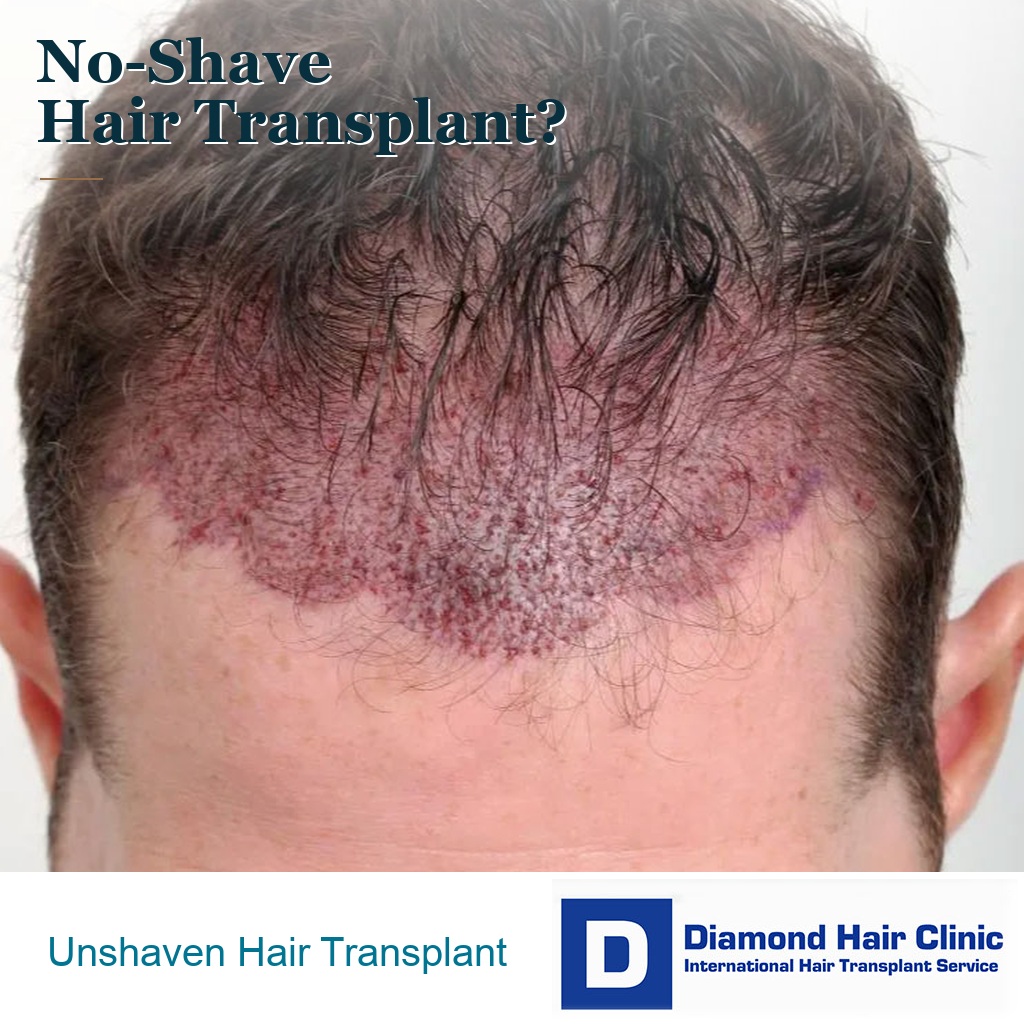
Can an Unshaven Hair Transplant Be Done Safely?
Keeping the hair unshaven can be safe in selected cases, but it is not always the best surgical choice. I only consider it when the graft number is limited, the donor area can be seen clearly enough, the recipient area can be handled without fighting through long hair, and the patient understands that discretion should never come before graft survival, donor protection, or natural placement.
The main risk of unshaven surgery is not that the idea is wrong. The weaker point is that the technique is used for the wrong patient. Long hair can hide the operation from other people, but it can also hide the scalp from the surgical team. When visibility becomes weaker, extraction, angle control, density planning, washing, and early monitoring all become harder.
I do not treat unshaven hair transplant as a luxury upgrade. I treat it as a technical decision. Sometimes it helps the patient socially. Sometimes it makes the operation less clean, less efficient, and less predictable. The correct answer depends on the scalp, the graft number, and the surgical field, not on the marketing name.
The practical difference is simple. A hidden donor window can protect privacy while still giving the team a clear field. A fully unshaven plan can limit both donor and recipient area control, so it needs a much stronger reason.
Unshaven hair transplant means several different plans
An unshaven hair transplant is a hair transplant plan where some or all of the visible hair is left long instead of shaving the entire scalp. The goal is usually privacy. Patients want to return to work, family, or public life without the obvious appearance of a shaved head.
In practice, the word unshaven can mean several different things. One patient may have only a small donor window shaved and hidden under longer surrounding hair. Another patient may keep the recipient area long while the donor area is shaved. A smaller group may be considered for a more complete no shave approach.
These are not the same operation. A hidden donor window is very different from trying to extract and implant grafts while almost all hair remains long. Before agreeing, ask exactly what will be shaved, where it will be shaved, and how visible it may be after surgery.
Patients may hear no shave, non shaven, unshaven, long hair FUE, or DHI as if they mean the same thing. They do not. I first separate what stays long, what is trimmed, and whether the donor and recipient areas can still be seen clearly. If the name hides that detail, it is marketing, not a surgical plan.
The method usually still uses FUE hair transplant principles. Some clinics describe the implantation as DHI, but DHI is a way of placing grafts within the FUE family rather than a separate guarantee of better results. The tool matters less than whether the surgeon can see, protect, and place the grafts correctly.
Privacy is the main reason patients ask for no shave surgery
Most patients ask for no shave surgery because they want privacy. They do not want coworkers, relatives, clients, or friends to notice a sudden change in hairstyle. Women and patients with long hair often have an especially strong reason to avoid a visible shave.
I understand this concern. Hair transplantation is personal. Some patients cannot easily explain surgery to coworkers, clients, relatives, or people who see them every day. A discreet recovery can reduce stress, especially in public work or when long time away from daily life is not realistic.
But privacy is only one part of the decision. The operation still has to be safe. The donor area still has a limited supply. The grafts still need careful handling. The recipient area still needs correct angle, direction, spacing, and depth.
For many patients, the hardest part is not vanity. It is walking into work, family life, or a public role with an obvious shaved scalp. I take that seriously, especially for women and patients with long hair, but I still separate emotional comfort from what the grafts need.
If no shave surgery is chosen only because of embarrassment, without understanding the surgical compromise, the decision can become risky. A short period of feeling exposed is usually safer than accepting a weaker surgical field that may affect the final result for years.
Main unshaven hair transplant options
The most common practical option is a partial donor shave. The surgeon clips one or more small donor windows, extracts grafts from those areas, and the longer surrounding hair covers the shaved zones. This can work well when the patient has enough length and the graft number is modest.
Another option is an unshaven recipient area with a shaved donor area. This may be considered when the recipient area still has enough native hair to hide early redness or scabs, while the donor area is prepared more traditionally for extraction.
The most technically demanding option is a fully unshaven approach. In this plan, both the donor and recipient areas remain largely unshaven. I consider this only in very selected cases because it can reduce visibility, slow the operation, and increase the chance of technical compromise.
There is also long hair FUE, where grafts are extracted with longer hair shafts attached. This can sometimes give a preview of direction or coverage, but it is not a magic result. The visible shafts can still shed after surgery, and the operation remains technically demanding.
Unshaven and long hair FUE methods can work in specific cases and experienced hands. That does not mean keeping the hair long is safer for every case. For me, the practical lesson is careful selection, not routine no shave surgery for everyone.
Do not accept a vague promise of invisible surgery. Ask which version is being offered, how many grafts are realistic, and what tradeoff is being made for discretion.
Why does a partial shave often give better control?
A partial shave often gives the best balance between privacy and surgical control. The patient may keep enough surrounding hair to cover the donor area, while the surgeon still works through a clean and visible donor window.
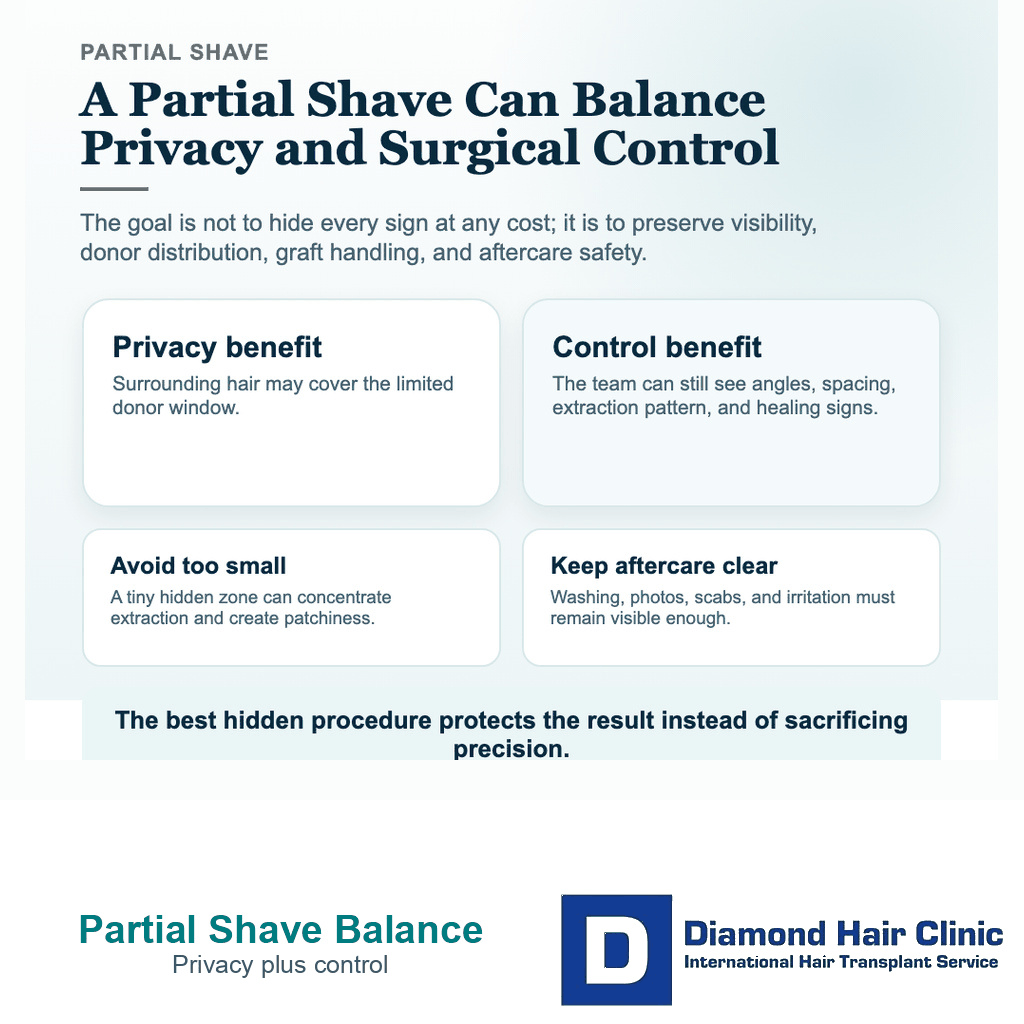
It matters because donor extraction should be spread responsibly. If the shaved window is too small for the requested graft number, the surgeon may be tempted to take too many grafts from one limited area. That can create a patchy donor appearance even if the first week looked discreet.
A partial shave also makes the plan more reliable. The patient knows where the work will happen, the team can see the donor field clearly, and aftercare is easier than in a fully unshaven plan.
This is the compromise I look for when discretion is important but surgical precision should not be sacrificed. The best hidden procedure is not the one that hides every sign at any cost. It is the one that protects the result while reducing unnecessary visibility.
Shaving can make the surgical field safer and cleaner
Shaving gives the surgeon a clearer surgical field. In the donor area, it helps me see exit angles, spacing, density changes, and the pattern of extraction. In the recipient area, it helps me control angle, direction, depth, and distribution.
Hair transplantation is not only placing hairs into empty skin. It is a series of small decisions repeated thousands of times. If visibility is reduced, the margin for error becomes smaller.
A shaved field also makes cleaning and early monitoring easier. After surgery, the patient and clinic can see scabs, redness, irritation, folliculitis, or unusual healing more clearly. It matters because early aftercare is not only cosmetic. It protects the grafts and the skin.
This point does not say every patient must be fully shaved. It means shaving is not a punishment or an outdated habit. Often, it is the safer and more precise way to perform the operation.
Risks created by reduced visibility
The first risk is reduced visibility. If the surgical team cannot clearly see the donor area, extraction may become less controlled. This can increase the risk of transection, uneven extraction, or unnecessary trauma to nearby follicles.

The second risk is less precise recipient area work. Long native hair can fall into the field, obscure the angle of existing hair, and make it harder to create a soft natural pattern. This matters most in the frontal hairline, where even small direction mistakes can become visible after growth.
The third risk is harder cleaning. Hair can trap crusts, dried serum, and products. If the patient is afraid to separate the hair and wash properly, scabs may stay longer or irritation may increase. I connect no shave surgery with very clear washing after hair transplant instructions.
The fourth risk is false reassurance. The patient may look less operated on, but do not read that as proof the surgery was easier or safer. A discreet first week is not the same thing as a better long-term result.
The fifth risk is cost and time pressure. Unshaven work can take longer and may cost more. That extra time is only worthwhile if it protects the patient socially without weakening the surgical quality.
Sapphire FUE and DHI do not remove visibility risk
Technique names do not remove the need for visibility and careful planning. Sapphire FUE can be useful for recipient area work when it is selected correctly, and DHI hair transplant can help in certain implantation situations, but neither one makes every no shave case safe.
The tool does not decide the hairline. The tool does not protect the donor by itself. The tool does not know whether the patient has diffuse thinning, weak donor density, or unrealistic density expectations.
I become more careful when a clinic presents DHI or Sapphire FUE as a way to make an invisible transplant easy. These tools can be valuable in the right hands, but the surgeon still needs to control depth, angle, spacing, graft handling, and donor distribution.
For the patient, the decision is not which label sounds more advanced. The practical issue is whether the chosen method gives the surgical team enough access to do the work well. DHI may help implantation between existing hairs in selected areas, but it does not solve poor donor visibility, weak graft distribution, or an unrealistic graft number.
Patients who may be suitable for an unshaven plan
A better candidate usually needs a smaller or moderate number of grafts, enough hair length to hide a limited donor shave, stable hair loss, and a realistic goal. The donor area should be strong enough to allow careful extraction without overusing one hidden zone.
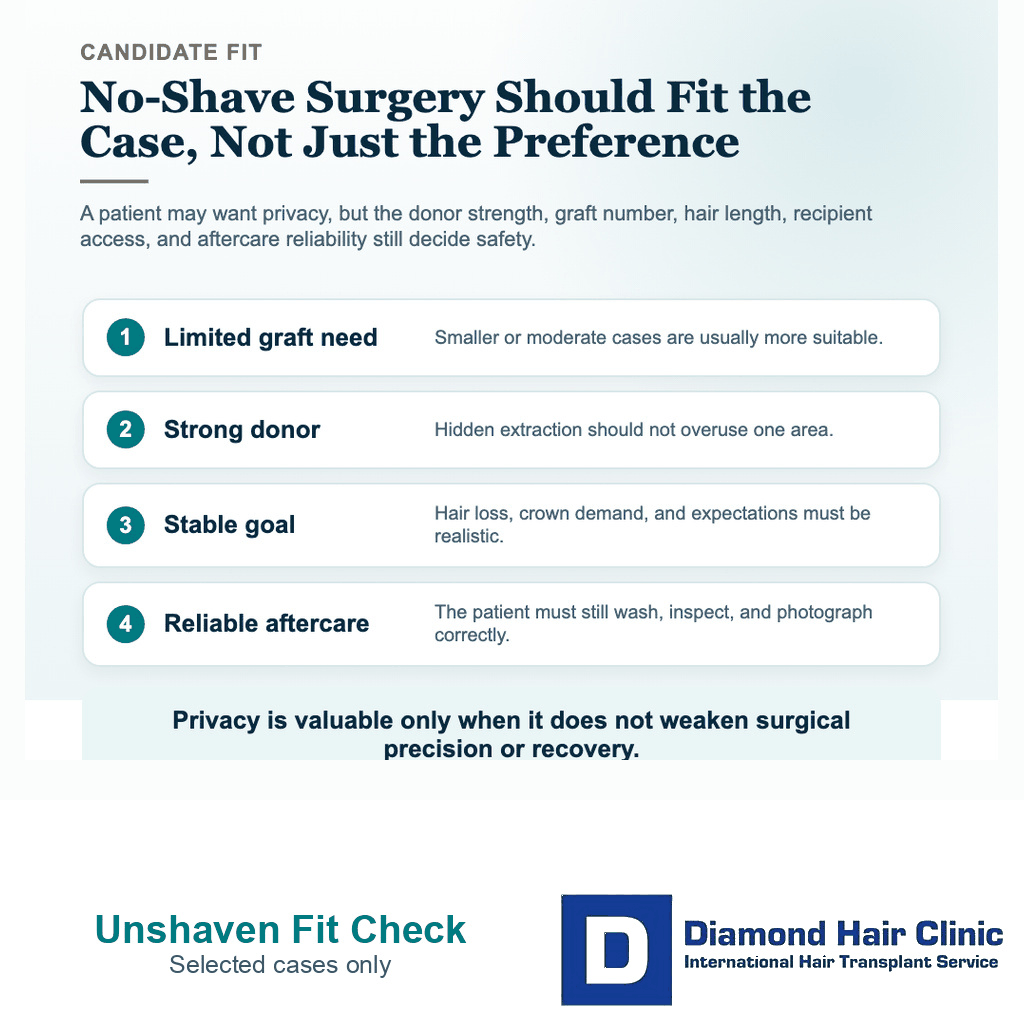
Women and patients with long hair can sometimes benefit from a partial shave plan because the surrounding hair may hide the donor window well. This can be emotionally important, especially when the patient cannot comfortably appear with a shaved head.
For female patients, I do not treat long hair alone as suitability. Diffuse thinning, active shedding, weak donor density, or a wide recipient area can make no shave planning less safe even when the hair covers the scalp well.
Patients who need a small hairline refinement may also be candidates if the recipient area can be accessed clearly. The practical detail is not only the number of grafts. The practical detail is whether the surgeon can still work with precision.
I check personality and aftercare. A patient who is extremely anxious about anyone noticing the surgery may become too afraid to wash properly or send clear photos. In those cases, the desire for privacy can interfere with recovery.
Suitability is case specific. It should be decided after examining hair length, donor density, hair caliber, recipient area needs, skin condition, and future hair loss risk.
Patients who need caution with no shave surgery
Patients with extensive baldness, high graft needs, diffuse thinning, weak donor density, or unstable hair loss should be cautious. These cases often need maximum visibility and careful long-term donor planning.
Diffuse thinning is especially important. When native hairs are spread throughout the recipient area, the surgeon must protect existing hair while placing grafts between them. Long hair can make this more difficult, and the patient may also be more vulnerable to native hair shock loss.
Patients who need major crown work need caution as well. Crown hair transplant planning already requires discipline because the crown can consume many grafts. If the unshaven approach limits visibility or graft distribution, the result may become weaker.
Patients with scalp inflammation, heavy dandruff, folliculitis, poor hygiene during recovery, or a history of difficult healing may also be better served by a clearer surgical field and easier aftercare.
If a clinic says everyone is suitable for no shave surgery, slow down. That is not surgical judgment. That is marketing.
Natural results still depend on design and execution
It can look natural if the patient is suitable and the surgery is planned well. Naturalness does not come from shaving or not shaving. It comes from correct hairline design, graft selection, angle, direction, distribution, and donor management.
For the frontal hairline, the plan needs soft irregularity, fine single hair grafts at the front edge, and a transition that does not look drawn. If long hair blocks visibility, the surgeon may lose some control over the details that make the hairline natural.
Hairline design in hair transplant still matters in a no shave plan. A private recovery is not enough if the final hairline looks artificial.
A good no shave result is not simply hidden in the first week. It still has to look natural after the hair grows, after shedding, under daylight, and with normal styling.
Less visible recovery does not always mean easier recovery
It can make the recovery less visible, but not always easier. These are different things.
Long hair may help cover a donor window or reduce the shock of a new appearance. Even so, it can make washing slower, make scab removal more awkward, trap products, and make it harder to see whether the skin is healing normally.
Long hair also needs careful handling. Brushing, pulling, tying, clipping, or moving long hair around the grafts can create avoidable friction during the early period.
If the patient wants to use hats, fibers, or styling for privacy, timing matters. A loose hat may be reasonable at the right stage, but tight pressure is not safe early. The same timing caution applies to wearing a hat after hair transplant. Hair fibers after hair transplant should not be used too early over healing skin.
The practical distinction is between hiding a haircut change and disturbing healing skin. One is social planning. The other can affect grafts, scabs, and irritation.
The responsible answer is that no shave surgery may make you look less changed, but it does not remove the need for careful aftercare and clear follow up.
Scabs, washing, and early checks can be harder through long hair
Long hair can make the first days feel more private, but it can also make basic handling more awkward. The patient may be afraid to separate the hair, touch the scalp correctly, or clean crusts when the time is right.
Scabs can hide under longer hair. Redness can be harder to see. Small areas of irritation may be noticed later than they would be on a shaved scalp. This is not a reason to panic, but it is a reason to receive very clear aftercare instructions.
When scabs begin to loosen, patients sometimes worry that the hairs inside the crusts are lost grafts. I explain this separately in the article about scabs coming off after hair transplant, because this fear is common even after an ordinary shaved procedure. With longer hair, the fear can be stronger because everything is harder to see clearly.
Good no shave aftercare has to explain how to wash, how to dry, how to move the surrounding hair, what photos to send, and what warning signs need medical review. A discreet operation still needs clear medical follow up.
Graft numbers need careful limits
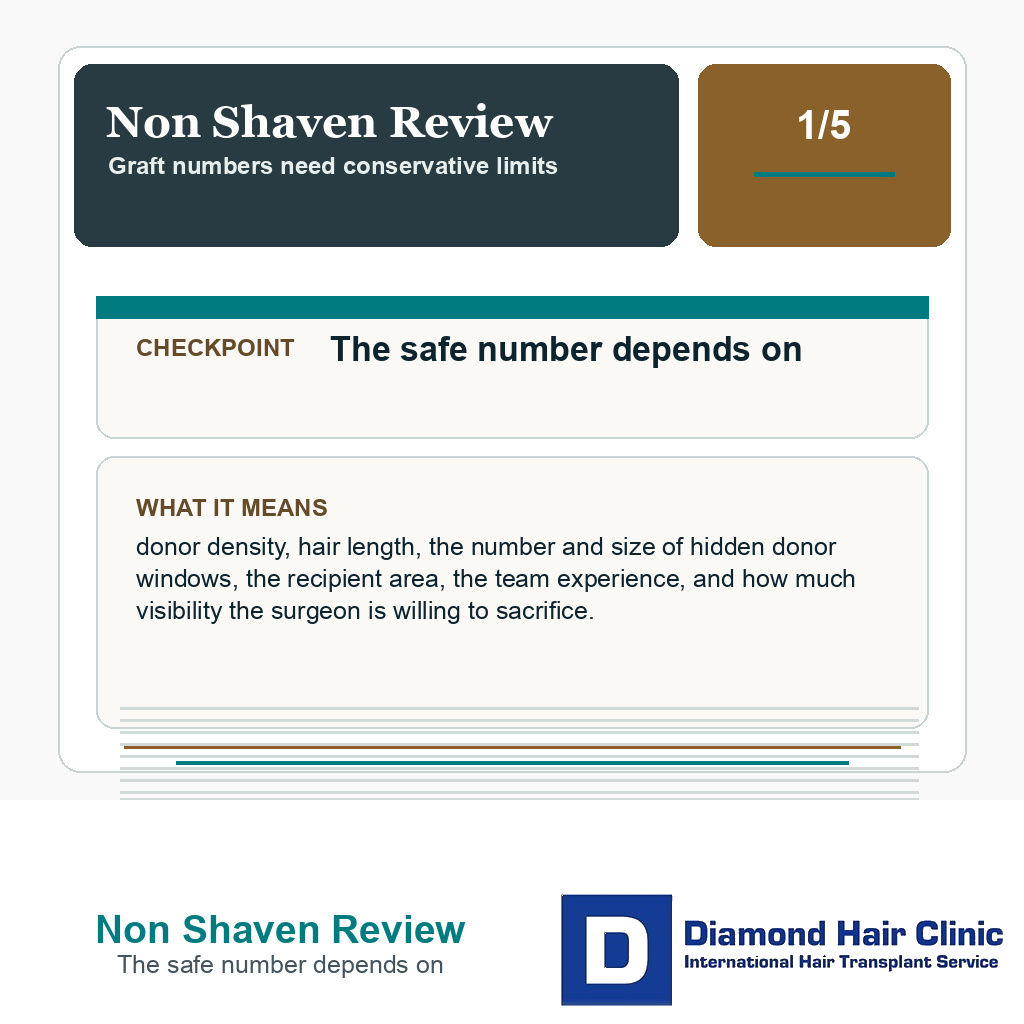
There is no accurate universal number. The safe number depends on donor density, hair length, the number and size of hidden donor windows, the recipient area, team experience, and how much visibility would be lost by keeping hair long.
In general, smaller cases are more suitable. As graft numbers rise, the hidden donor area may become too large, extraction may become concentrated, and the operation may take longer than is ideal.
When the requested number needs several donor zones, a hidden window can become the wrong compromise. Then a wider shave, staged work, or a reduced goal is more responsible than concentrating extraction in one discreet area.
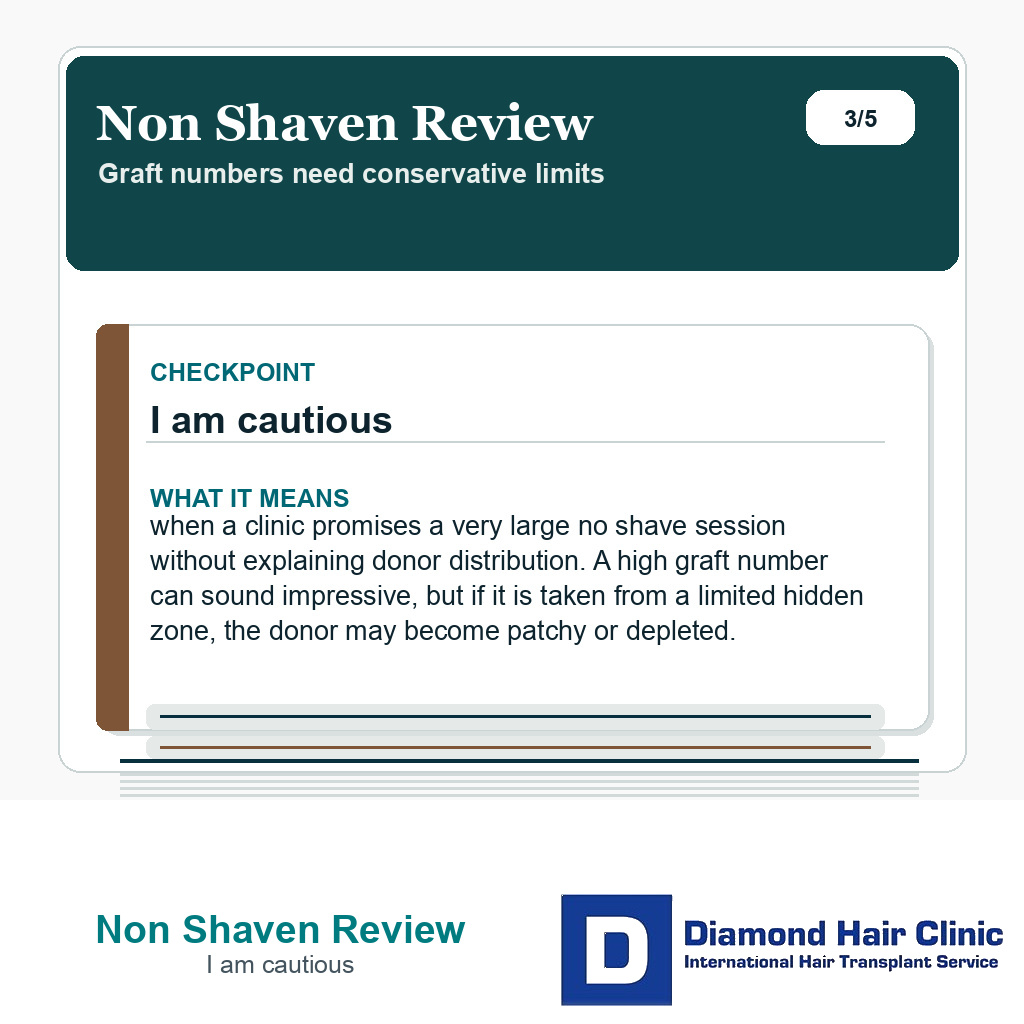
Be cautious when a clinic promises a very large no shave session without explaining donor distribution. A high graft number can sound impressive, but if it is taken from a limited hidden zone, the donor may become patchy or depleted.
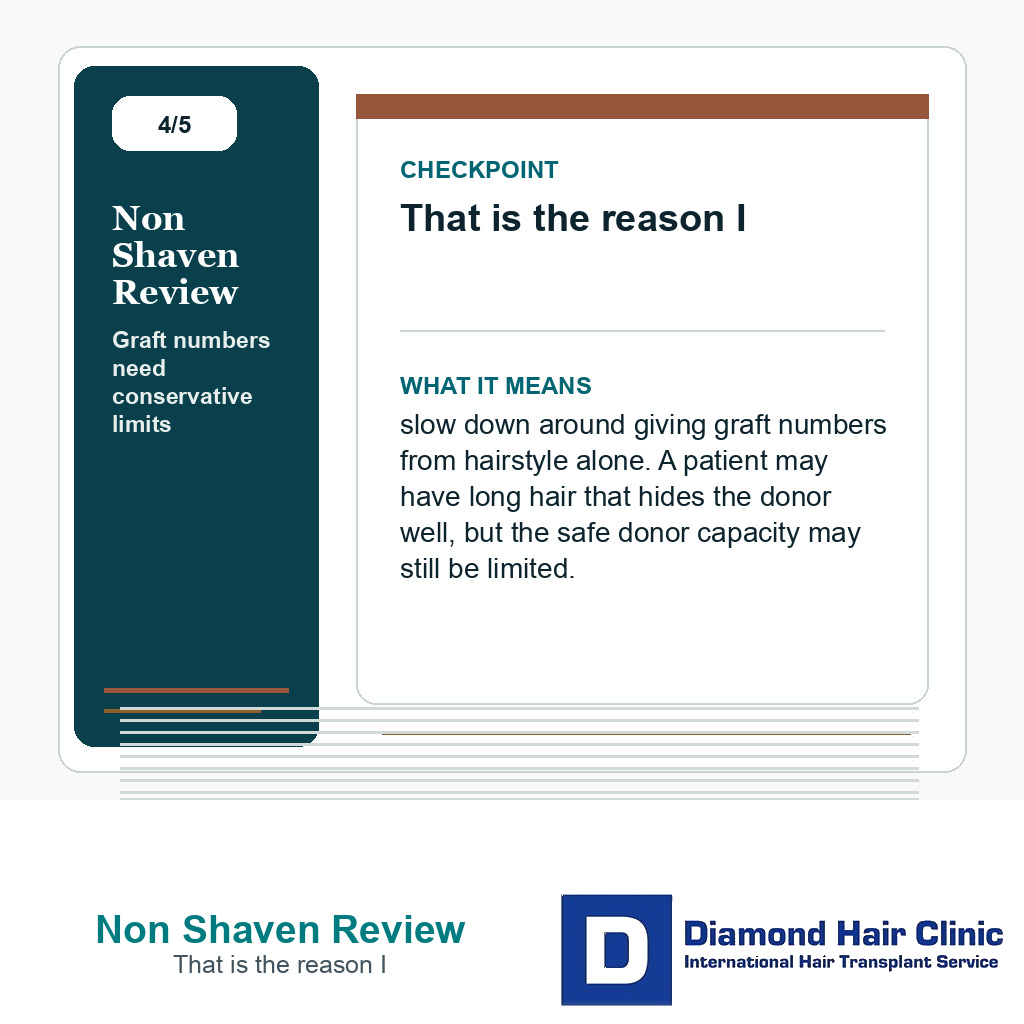
Hair length alone is not enough for a graft estimate. A patient may have long hair that hides the donor well, but the safe donor capacity may still be limited. Another patient may have shorter hair but excellent donor strength. The visual cover is only one part of the calculation.
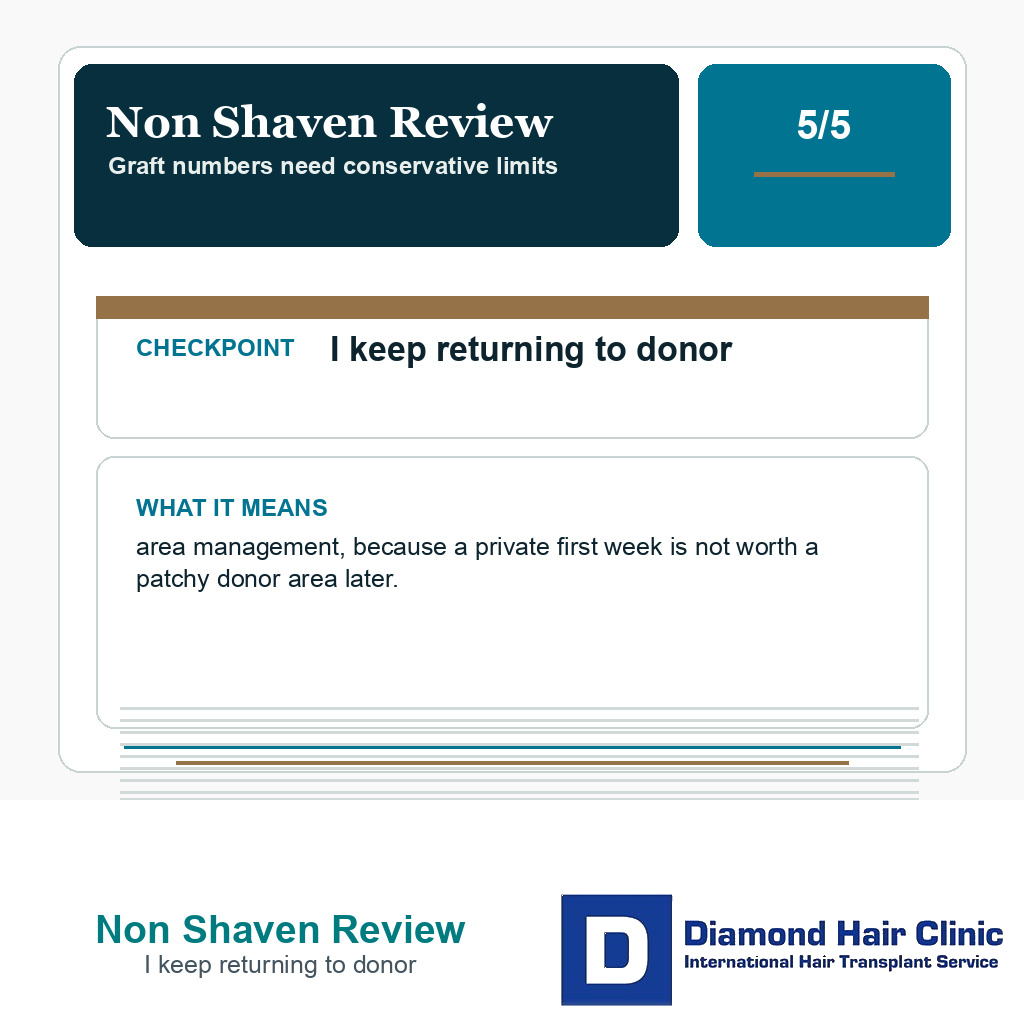
Donor area management stays central, because a private first week is not worth a patchy donor area later.
The 5 slides below keep the graft number decision tied to donor visibility, hidden donor windows, and realistic privacy. Swipe across the image, use the arrows, or choose a number below the carousel.