



Before Booking a $3,000 to $4,000 Hair Transplant in Turkey
When price becomes the first filter, the clinic list is already narrowed before the patient realizes it. The issue is whether that number still buys real surgical responsibility, donor planning, and follow up.
A $3,000 to $4,000 budget may bring many replies in Turkey. The number alone is not the danger. A safer way to read that budget is to ask whether it still includes a clinic where the surgeon leads the plan. In many searches, that budget becomes the filter that moves the patient away from surgeon planning and toward a high volume package model.
I would not start by handing over clinic names. First I would challenge the premise. With that ceiling, a patient may believe careful surgery from a responsible Turkish surgeon is still the default. That assumption can mislead the patient before any clinic is even contacted.
The answer before you ask for clinic names
My answer is direct, but it is not always what patients want at the beginning. A low budget should not lead you to ask, “Which clinic will accept me?” It should lead you to ask, “What parts of medical responsibility disappear at this price?”
There are excellent surgeons in Turkey. There are also clinics that use Turkey’s reputation, low travel cost, and aggressive package pricing to sell operations where the doctor is barely involved or not meaningfully involved. Those are different realities, even when the advertisement uses the same words.
For a patient searching from abroad, the danger is not being budget conscious. The danger is assuming the budget still gives access to the same care model. It often does not. Before a low price decides the shortlist, choosing a hair transplant clinic in Turkey still has to start with surgeon responsibility, donor planning, and follow-up. The proof should include the surgeon role, donor planning, graft number logic, a written follow up route, and what happens if healing is not typical after travel. For Afro or tightly curly hair, that proof also belongs inside the Afro hair transplant travel budget, not after the deposit.
Price alone does not tell you the clinic model. Daily patient volume, who opens the channels, and what happens when the donor plan changes after examination matter more than the package label.
So Turkey hair transplant cost should be understood as a medical planning issue, not only a travel shopping issue.
Is a 2,500 to 3,000 Euro hair transplant in a hair mill always unsafe?
No. A lower price is not the problem by itself. A hair mill result can still be good when the case is favorable and the patient is treated by a well trained team. Daily case count should prompt a closer look at who examines you, who operates, and whether the named surgeon is available when the plan changes. It does not establish your chance of a good result. If the surgeon role, donor measurement, graft number logic, and follow-up responsibility are unclear, waiting or choosing a smaller, more controlled plan is safer than letting the budget choose the surgical model.
The budget can choose the clinic model for you
Patients often believe they are choosing between Turkish hair transplant doctors. In reality, at the $3,000 to $4,000 level, many are choosing between clinics where the sales process leads before the medical plan is clear. The person replying quickly may be a coordinator. The package may be fixed before donor capacity is understood. The graft number may be part of the sales offer rather than the result of a careful examination.
A no doctor hair mill does not always look careless from the outside. It may have polished photos, fast replies, hotel transfer language, and confident promises. The risk is how the operation is actually run. If the surgeon does not examine you properly, does not design the plan, does not create the recipient area incisions, and does not control the surgical judgment, the patient is not buying the care they think they are buying.
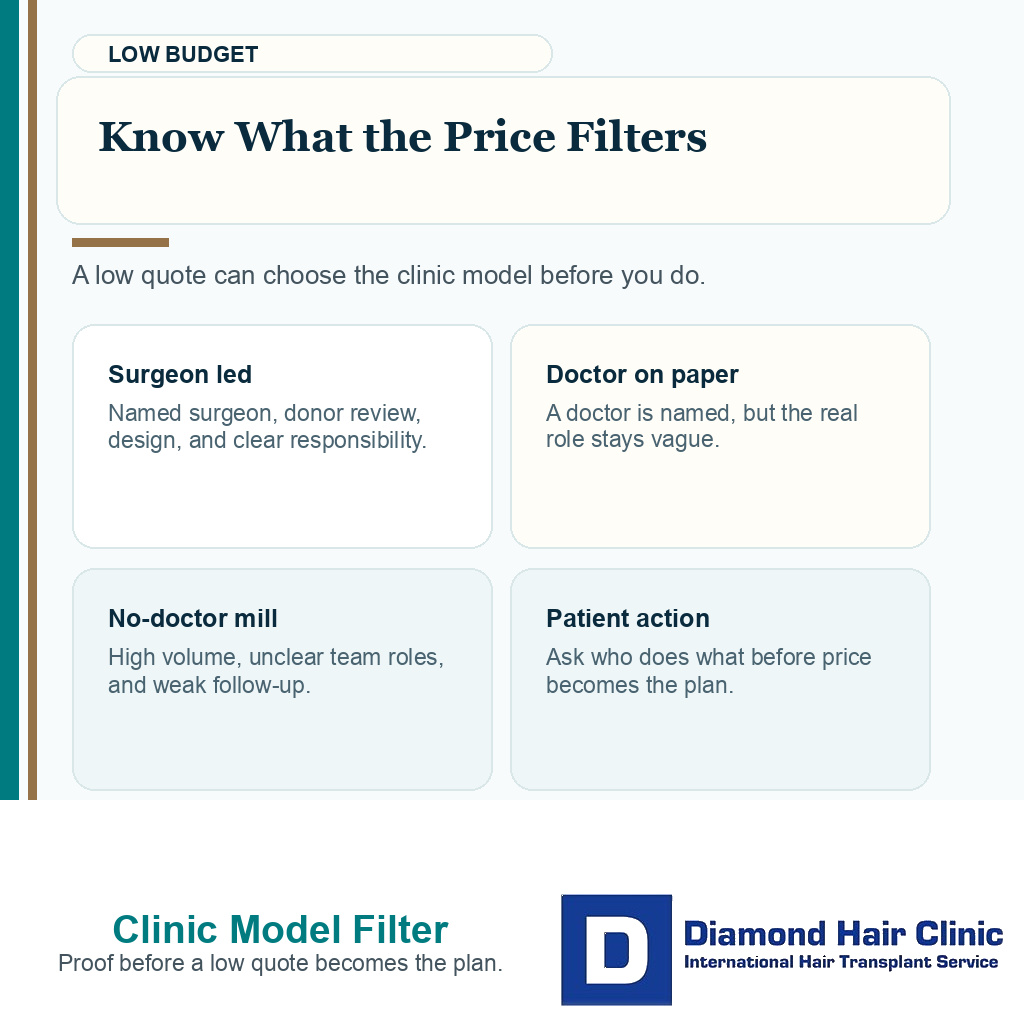
This is the boundary to check before booking. A cheap quote can feel like access. Sometimes it is only access to a system designed to move many patients through the same package.
A low budget is easier to judge when its limits are visible early. If careful surgeon planning sits outside the price, the patient needs to know that before the package feels like a bargain. A budget that depends on fast booking can take away safer choices, such as waiting, reducing the first goal, or getting a narrower review led by the surgeon.
Some patients do get results they like from lower cost clinics. A 2,500 to 3,000 Euro hair transplant in a hair mill treating 10 to 20 patients in one day can still look good when the case is favorable and the patient happens to be treated by a well trained team. I do not deny that possibility.
That possibility does not tell me whether the plan is suitable for another patient. I would look at the named surgeon’s assessment of donor reserve, the proposed hairline, and the allowance for future hair loss. The higher price is not proof by itself. The difference is whether the price still includes surgeon judgment, case selection, donor planning, graft handling control, and follow up responsibility.
Hair mill success story versus consistent surgical planning
| Hair mill success story | Consistent surgical planning |
|---|---|
| The result may be real, but it may depend on a favorable case and the team assigned that day. | The process is built so donor limits, graft choices, and hairline judgment are controlled before surgery starts. |
| The photo tells you one patient had a good visible outcome. | The planning tells you whether your own donor area and future hair loss are being protected. |
| The price may feel like the main advantage. | The advantage is time, medical judgment, and accountability when the plan needs to change. |
Can a hair mill still give good results?
Yes. One patient’s good result is still worth acknowledging, but it does not show who will examine you, plan your donor use, or remain responsible for follow-up in your own case.
Before you compare package prices, make sure surgeon involvement in your hair transplant is clear enough that you know who is accountable for the decisions that affect the final result.
When the cheapest safe option seems hard to find
If every very low quote starts to look like a hair mill, pause before treating the price search as the problem. The budget may be pushing the patient toward a model where surgeon time, donor measurement, and follow-up responsibility are thinner than the advertisement suggests. That may mean delaying surgery, reducing the first goal, or saving longer until the surgical model is clear. The bargain is not the lowest number. It is the plan that protects the donor area and still has an accountable medical decision behind it.
What may disappear when the price looks attractive?
Time can disappear first. Careful donor review, hairline design, medical suitability, graft planning, and expectation setting take time. When the package price is very low, the business model often depends on volume, and volume changes how much time can be spent on one patient.
Accountability can disappear next. A patient may hear that a doctor is present, but presence is not the same as responsibility. You need to know who makes the medical decisions and who performs the parts of the operation where judgment matters.
Surgical discipline can disappear too. If the offer is built around maximum grafts for a low price, the clinic may present a high number as value. In hair transplantation, value is not the biggest number. Value is the number that matches the donor area, the recipient area, the future loss pattern, and the long-term plan.
That risk explains why hair transplant packages in Turkey can mislead patients. A package can be convenient, but it should never hide who is responsible for the surgery.
Cheap grafts are expensive when donor hair is wasted
Hair transplantation moves hair. It does not create unlimited donor supply. If too many grafts are taken, if they are taken from the wrong zones, or if the plan ignores future hair loss, the cost is paid later in a donor area that cannot support the next decision.
Price per graft can become dangerous when it is used as the main comparison. A low price per graft can make a larger number feel like a bargain. But if the grafts are poorly planned or the donor area is overused, the cheap graft becomes expensive because it spends a limited resource.
If your budget pushes you toward a clinic that promises a large graft count without careful donor explanation, pause. Review why price per graft can mislead hair transplant patients and ask how the number was chosen.
Donor protection is not a luxury detail. It is the foundation of the plan. A high graft number can be correct only when the donor can safely support it. It becomes a sales problem when the number is chosen before the donor area, hairline, crown need, and future loss pattern are examined together.
A patient can recover from waiting longer to save more money. A patient cannot easily recover from an operation that damages donor reserve. Repair surgery is not a reset button. If the donor area has been overused, if grafts were taken from weak zones, or if the hairline was placed badly, the correction may need stages and may still be limited by the donor hair that remains.
Test the quote before you book
A low quote is not unsafe by itself. It becomes unsafe when it cannot prove medical responsibility. The quote is safer when it names what the surgeon personally does, what the team does, what is written before travel, what record you receive after surgery, and who reviews healing questions after you return home.
Use the quote as a test. If the answers become vague, if the clinic avoids naming the surgeon’s role, if the graft number is fixed before a proper review, or if the coordinator pressures you with a deposit deadline, treat that as information. The quote is showing you the clinic model.
Be more cautious when a clinic is eager to operate on a very young patient, a diffuse thinning pattern, or a case that is still changing on medication after seeing only a few photos. A fast graft quote can sound decisive, but in these cases the safer sign is often a surgeon who slows the decision down, checks the donor area, and explains when surgery should wait.
Use the low quote as a pause point
Slow down when more than one of these signs appears.
- The clinic is comfortable operating while you are still very young and the pattern is not stable.
- The top looks diffusely thin, but nobody explains which hairs are reliable enough to plan around.
- Hair loss is still changing on medication, yet the graft number is already fixed.
- The quote comes from photos only and no one explains what would make surgery wait.
- You are given a package, deposit deadline, or travel date before a refusal point is discussed.
A slower answer can feel frustrating, but it shows that the clinic is testing the plan before using your donor area.
Budget Proof Radar
Check the missing proof before a low quote becomes your plan.
Surgeon role proof
Who performs the medical decisions?
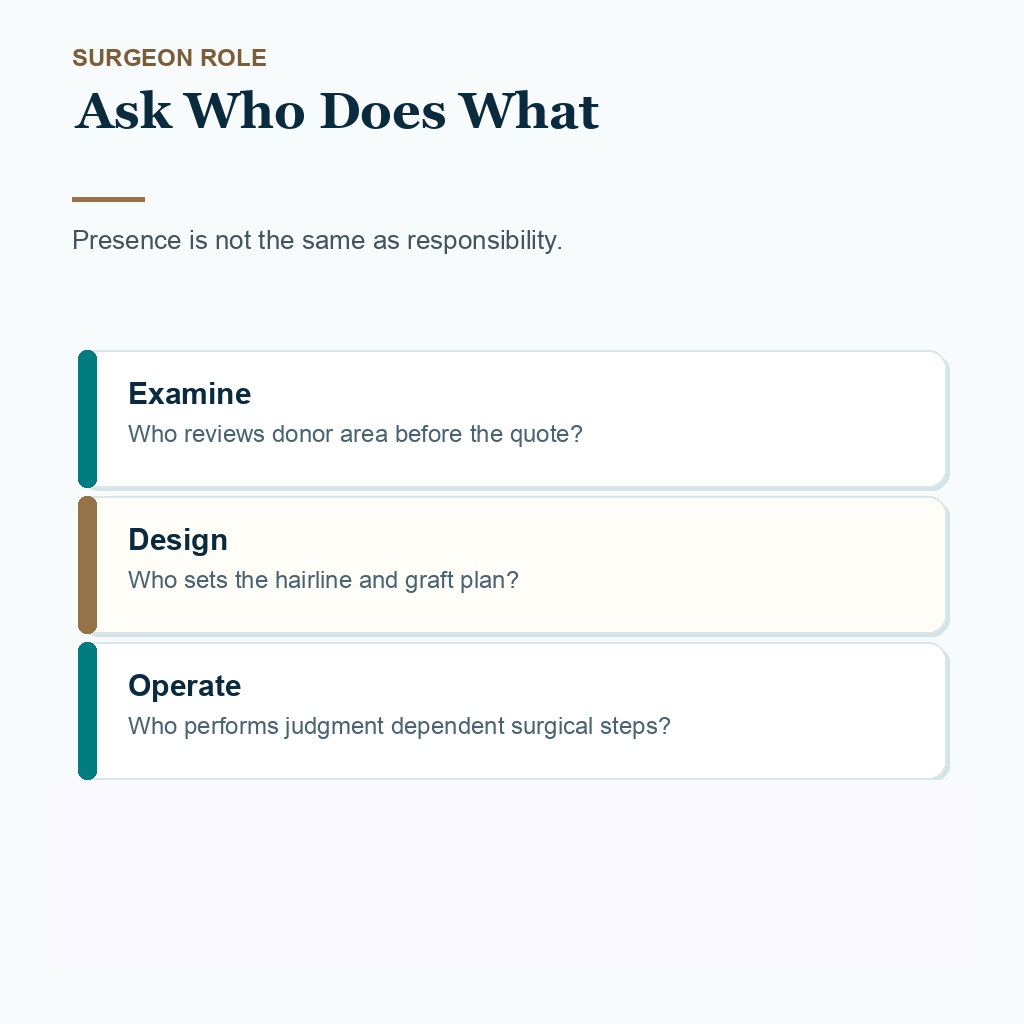
Ask who examines the donor area, designs the hairline, creates the recipient area incisions, and changes the plan if the donor capacity is weaker than expected.
Ask for proof of the named surgeon, surgical steps, consultation timing, and direct accountability.
The warning is a named doctor who exists on paper while the real surgical decisions are left to technicians.
These questions are not complicated. They are basic protection. A clinic that cannot answer them clearly is asking you to trust a price more than a medical plan.
The same pattern is one of the red flags of Turkish hair mills. Turkey is not the weak point. The weak point is a model where marketing and volume replace surgeon accountability.
When would I delay instead of forcing the budget?
In my view, delaying is safer than forcing surgery through a weak budget. Delay is not failure. It may be the most protective decision if the only clinics responding inside the budget cannot prove surgeon responsibility, donor safety, and follow-up.
There are several ways to slow down without losing control. You can reduce the first surgical goal, ask for a smaller and safer first stage, save more before booking, seek a second opinion, or decide that surgery is not appropriate yet. What you should not do is let a flight date or a discount window make the decision for your donor area.
A one patient per day model is not magic by itself. Its value is time. One surgeon has space to examine, adjust, and remain responsible for one plan instead of moving between several rooms.
At Diamond Hair Clinic, after a patient accepts the plan, we do not require an advance payment or deposit to reserve the surgery date. Purchased flight ticket details are enough for reservation. I mention this because pressure around deposits can make patients move too quickly when the plan itself is not proven.
Before you pay or travel, read paying safely for hair transplant surgery in Turkey and make sure the financial step comes after the medical plan, not before it.
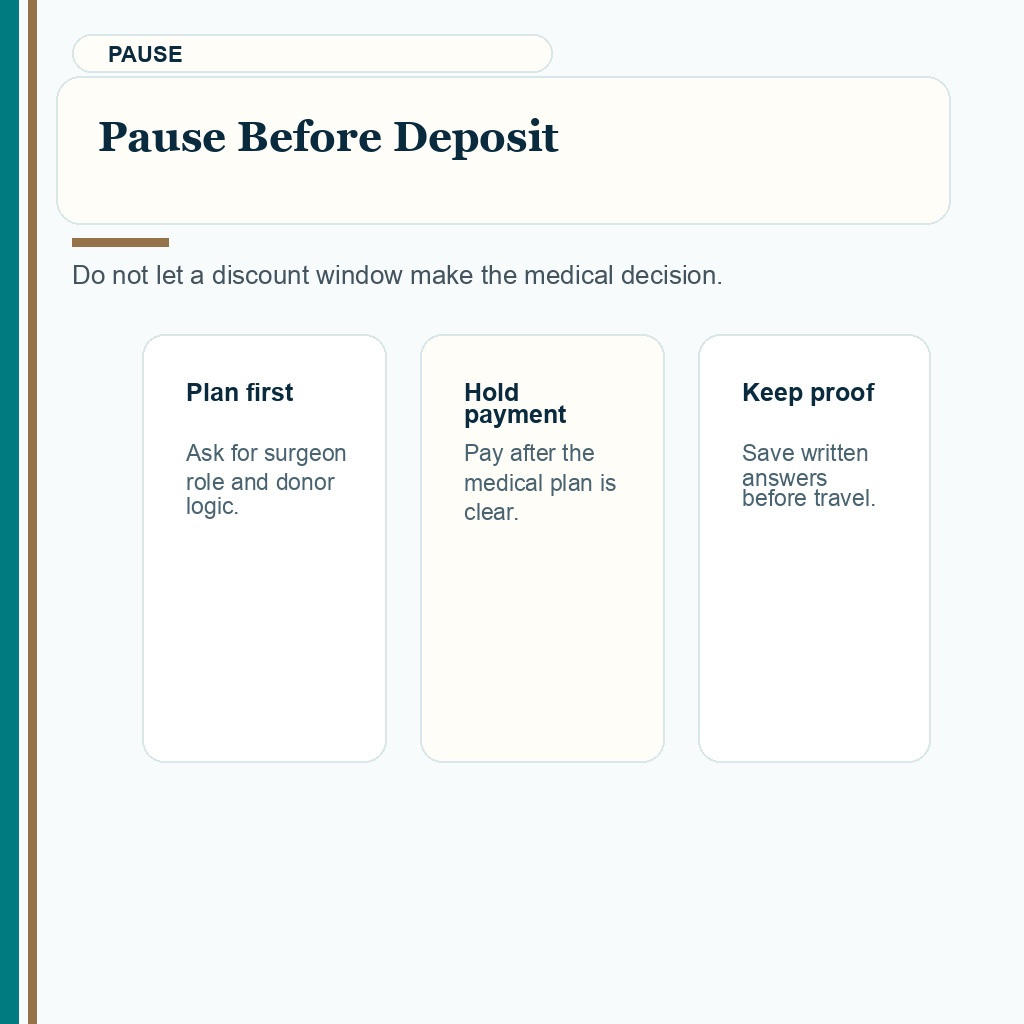
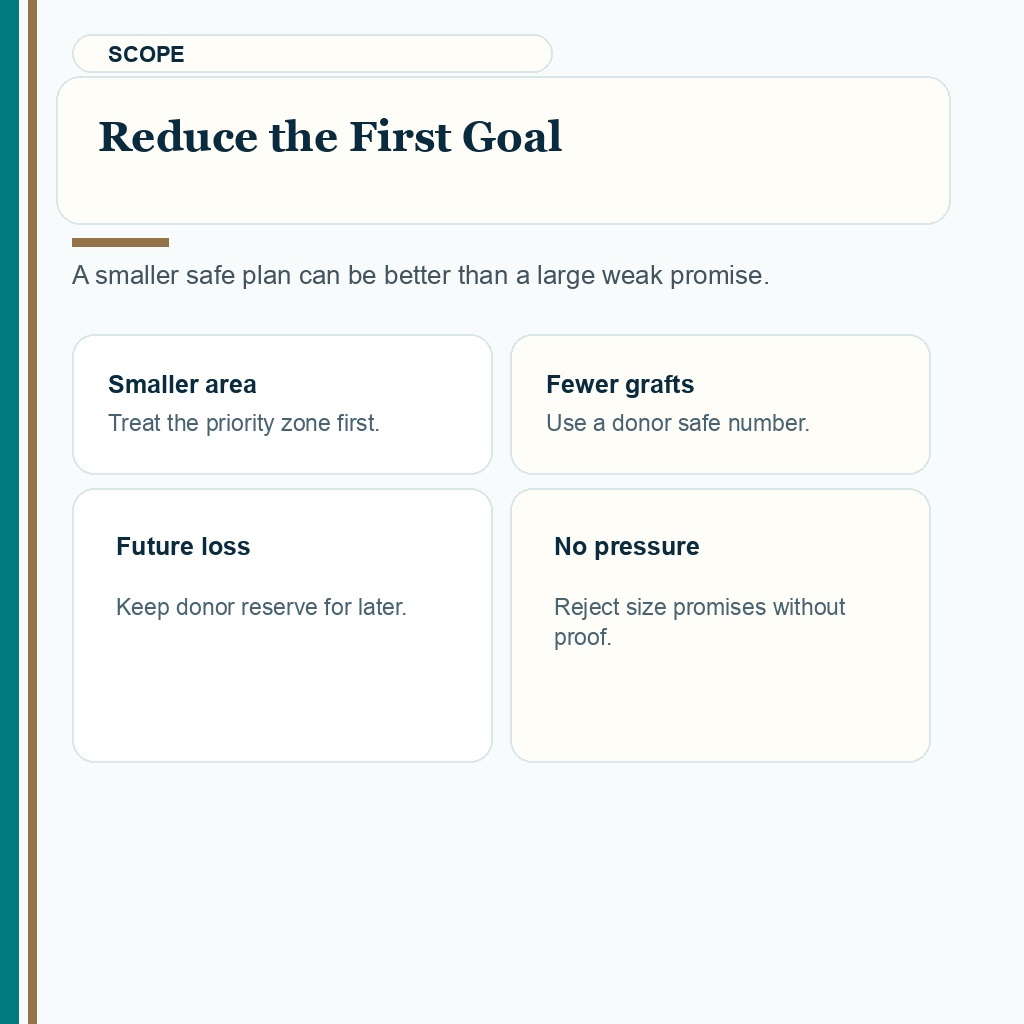
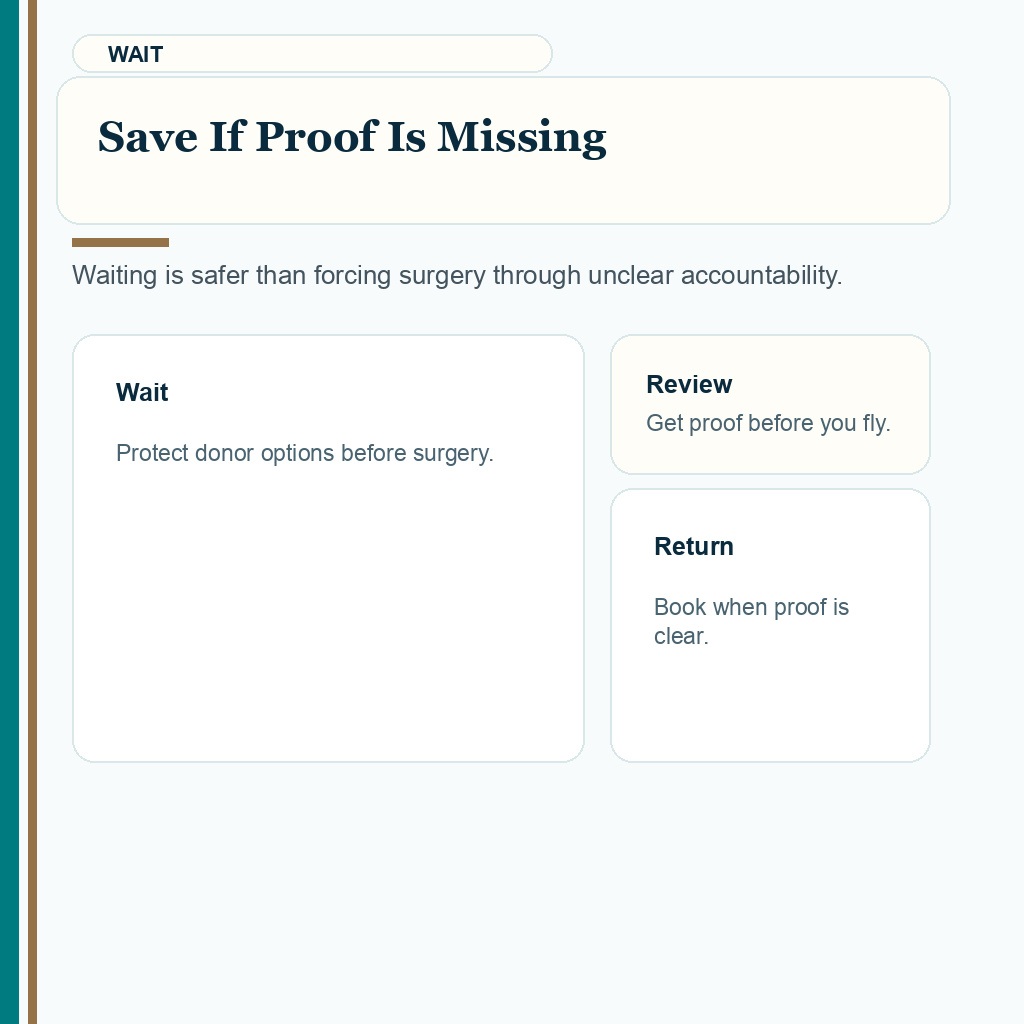
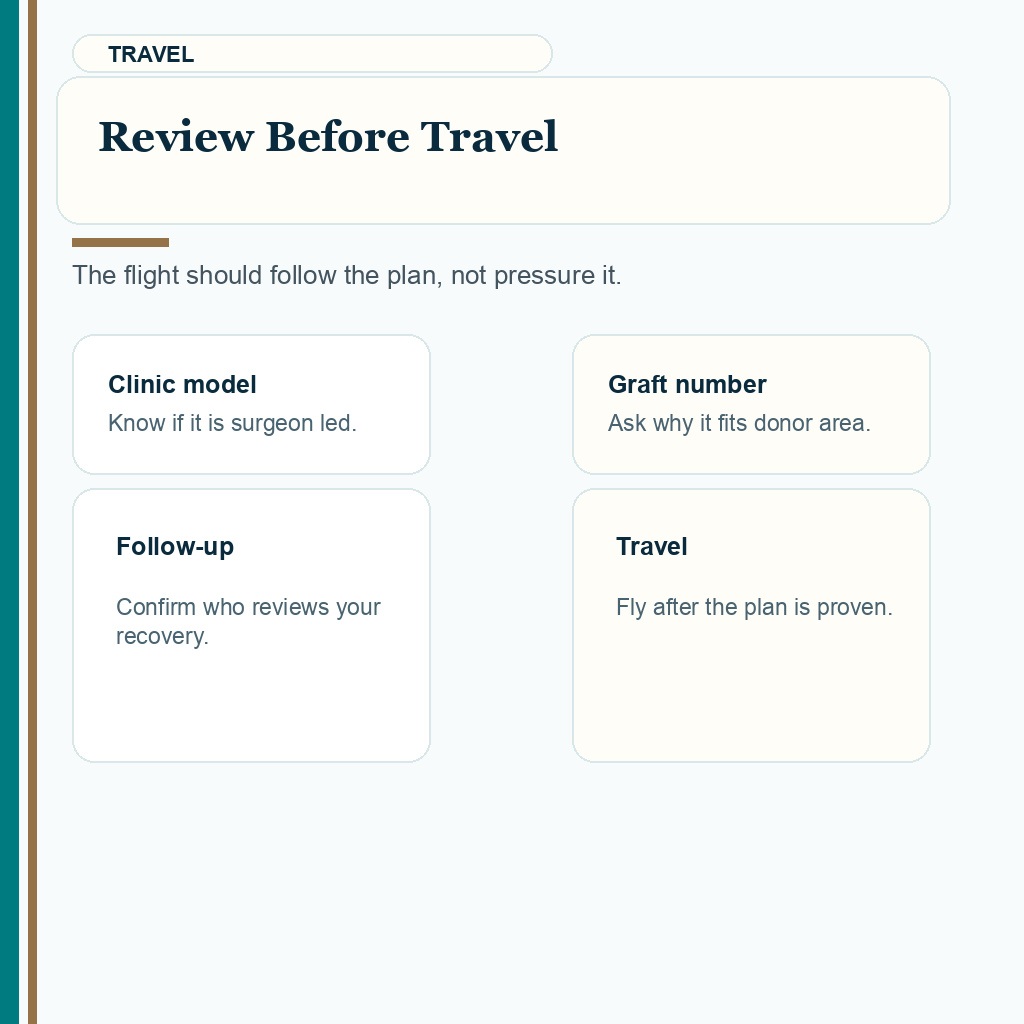
If the quote cannot survive the questions, waiting may protect the donor plan. If the donor area is weak, if the expectation is unrealistic, or if the clinic role is unclear, waiting protects options that a rushed operation can damage.
Low price still has to show medical responsibility
The issue is not that every lower priced clinic is unsafe. The issue is when the package makes medical responsibility invisible. A budget offer still has to show who examines the donor area, who designs the hairline, who performs the steps where judgment matters, and who remains responsible after surgery.
Before a deposit, the proof should be concrete. The plan should explain the safe extraction limit, the proposed graft range, where the grafts will go, what would make the surgeon reduce the number, and how aftercare is handled if the early recovery is not straightforward.
A second opinion before a hair transplant is most useful when it tests one narrow risk, such as whether the donor area can support the proposed number or whether the surgeon role is clear enough. A cheap trip should never spend donor hair that the medical plan has not earned.

Read this review excerpt
Absolutely everything regarding logistics was conveyed in a clear and timely manner via WhatsApp by Dr. Mehmet’s office.