


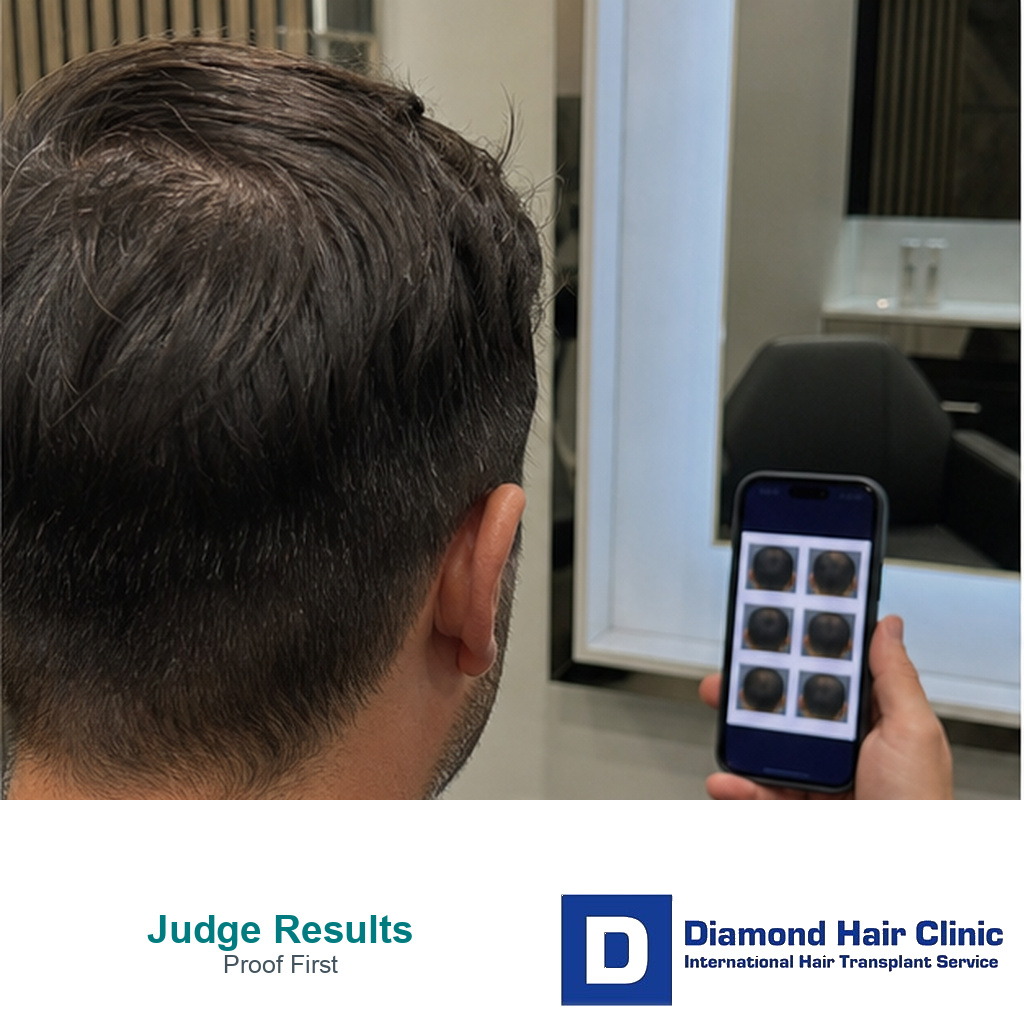
Can You Judge Hair Transplant Results Before Choosing a Clinic?
You can judge a clinic’s hair transplant results before choosing it, but only if you read the result as evidence, not as a promise. A strong gallery case may be useful, but it has to be close enough to your own donor area, hair loss pattern, hair caliber, scalp contrast, graft plan, and follow-up timing. Without those details, the photo should start better questions rather than decide the clinic for you. It cannot answer the whole decision for you.
I want patients to judge clinic results with the same seriousness that we use when planning surgery. A hair transplant moves living tissue. Even a healthy patient with strong donor hair and good quality surgery can still underperform because graft growth, healing response, native hair loss, donor behavior, scalp biology, and genetics cannot be fully controlled. Good planning lowers preventable risk. It does not remove uncertainty from the human body.
Before choosing a clinic, the densest gallery result should not be the main filter. A more useful review is whether the clinic can explain why a result happened, what was planned, where the limits were, and how a similar plan would be assessed if growth later looked weaker than expected.
Start with proof, not the strongest gallery result
A strong gallery result can show technical taste. It can show natural angles, hairline discipline, donor management, and consistent follow-up photography. But the strongest result is also the easiest result to misunderstand. You may be seeing a patient with thick hair, low scalp contrast, a smaller bald area, stable native hair, and a graft plan that would not fit your donor supply.
Beard and eyebrow results can give you a sense of a surgeon’s work, but they are not a substitute for scalp transplant cases. I would still want to see how that surgeon handles the scalp hairline, coverage and healed donor area in patients whose needs resemble yours.
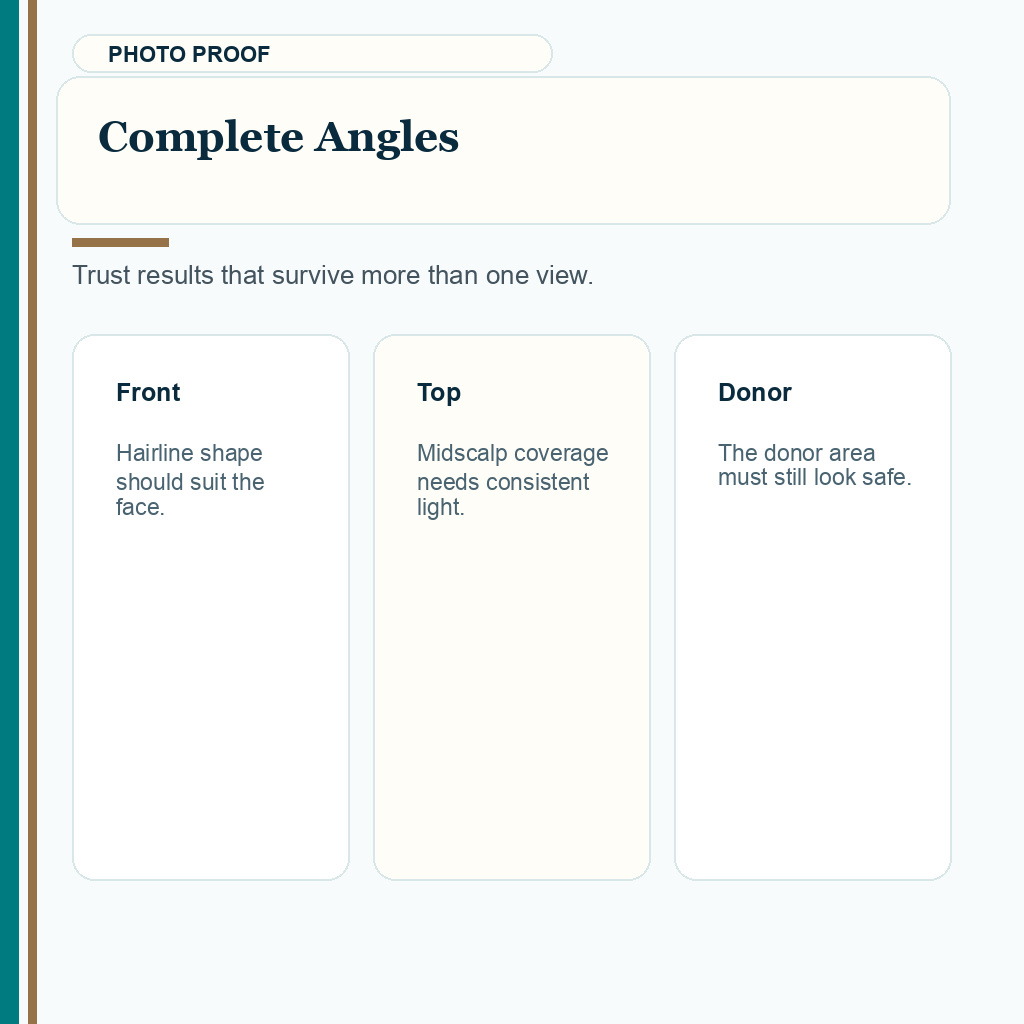
My review of a hair transplant result that looks strong does not stop at the front photo. I look at whether the hairline suits the face, whether the density makes sense for the graft number, whether the crown plan is clearly documented, whether the donor area still looks safe, and whether the result would age well if native hair continues to thin.
The clinic should be able to explain the case without turning it into a sales story. A photo that cannot survive basic questions about graft number, treated zones, donor supply, hair characteristics, timing, and who was medically responsible for the plan should not be the main reason you choose surgery.
A hospital name or partnership tells you where the procedure is offered, not who is responsible for the transplant. When hair restoration is outsourced, identify the surgeon and team before treating the hospital brand as evidence. The written plan should state who examines the donor, designs the hairline, creates the recipient sites, performs extraction and placement, keeps the surgical record, and manages follow-up. Those names and roles matter more than the logo above the operating room.
Clinic galleries are selected after the result is known. Add independent patient journeys that began before the outcome was clear. Look for preoperative photos, immediate postoperative donor and recipient views, then dated updates from the same person. One complete journey still cannot prove a clinic’s average, but it can expose gaps that a final comparison hides.
A result photo is useful only when the same planning standard fits the new patient. The useful comparison includes case difficulty, surgeon role, and follow up record, not just a similar photo from the clinic.
Online review lists and “best surgeon” spreadsheets can be useful as maps, not recommendations. Use them to find cases to inspect, then check whether those cases actually match your hair type, donor reserve, treated zones, growth timeline, healed donor appearance, and the visible surgeon role. A list should lead to better evidence, not replace your own review.
If a list earns money from memberships, sponsored placement, advertising or referrals, check whether that affects who appears or how the names are ordered.
A good hair mill result is still one result
Some patients get stuck here. They see a 2,500 to 3,000 Euro hair transplant from a clinic people call a hair mill, and the result looks good. Then they compare it with a surgeon-led, one patient per day boutique clinic that may cost 7,000 to 8,000 Euro, and they ask whether the difference really matters.
I do not deny the good result. It may be real. A high-volume clinic treating 10 to 20 patients in a day can still have a well trained team, and a favorable donor case can heal well. The mistake is treating one result as proof that the system protects every patient. The next patient may have weaker donor hair, diffuse thinning, a larger crown demand, a different hairline need, or a case that should be delayed.
Probability language keeps the decision fair. A lower price is not unsafe by itself, and a higher price is not medical proof by itself. When the higher fee genuinely means named surgeon responsibility, full planning attention for one patient, conservative donor use, and a clear review route after surgery, the path to a good result is usually more controlled. It also becomes easier to slow down, reduce the graft goal, stage the plan, or refuse surgery when the case is not ready.
Hair mill success story versus repeatable planning evidence
One strong hair mill result
The patient may have been an easy case, had strong donor hair, or matched with a capable team that day. It is useful evidence, but it is still only one case.
Repeatable planning evidence
Stronger proof includes named responsibility, donor measurement, graft number logic, hairline design, complete photos, and follow-up that remain clear across different patients.
Cheap is not the diagnosis
A low quote should make the patient test what medical responsibility is included. It should not make the patient accept vague roles, rushed consent, or a graft number chosen before donor review.
Expensive is not the proof
A higher fee only matters when it includes real surgeon time, case selection, donor restraint, accountable surgical steps, and follow-up after the patient goes home.
Can a hair mill still give good results?
Yes. Some do. A good result can happen when the case is favorable and the team performs well. But if the result depends on being lucky with one team on one busy day, I would not read it the same way as a result backed by a named surgeon, measured donor plan, clear graft map, complete photos, and follow-up the patient can use later.
Can a reputable surgeon still have a poor result?
Yes. Biology still matters. Healing, graft survival, native hair loss, scalp health, hair caliber, medication consistency, and aftercare can affect the final appearance even after careful planning. A reputable clinic should not promise certainty. It should reduce avoidable risk and leave enough records to review a weak result fairly.
When a clinic openly shows a correction of its own earlier work, that is useful context, but the repair does not settle the judgment by itself. Read the two operations as one record. Check what fell short in the first plan, how much additional donor hair the correction used, what changed, and whether the clinic explained the shortcoming before proposing another procedure. Openness deserves credit. The donor cost and the reason a correction became necessary still belong in your decision.
For broader warning signs, compare this result with the red flags of Turkish hair transplant clinics. If price is the main reason you are considering a high-volume option, read the budget hair mill risk before letting one strong example decide the surgical model.
Public feedback can be incomplete or selective, so review volume is not the whole truth. Traceable case evidence, healed donor photos, surgeon responsibility, and follow up behavior matter because they can still be checked outside a sales conversation.
Treat negative public feedback as pattern evidence, not as a verdict. One unhappy report can be incomplete, and one excellent result can hide a favorable starting case. I slow down when different patients describe the same unclear surgeon role, weak donor explanation, rushed consent, poor follow-up, or photos that never show the donor area. That pattern has to be answered before a shortlist becomes a booking decision.
A case like yours is more useful than a perfect case
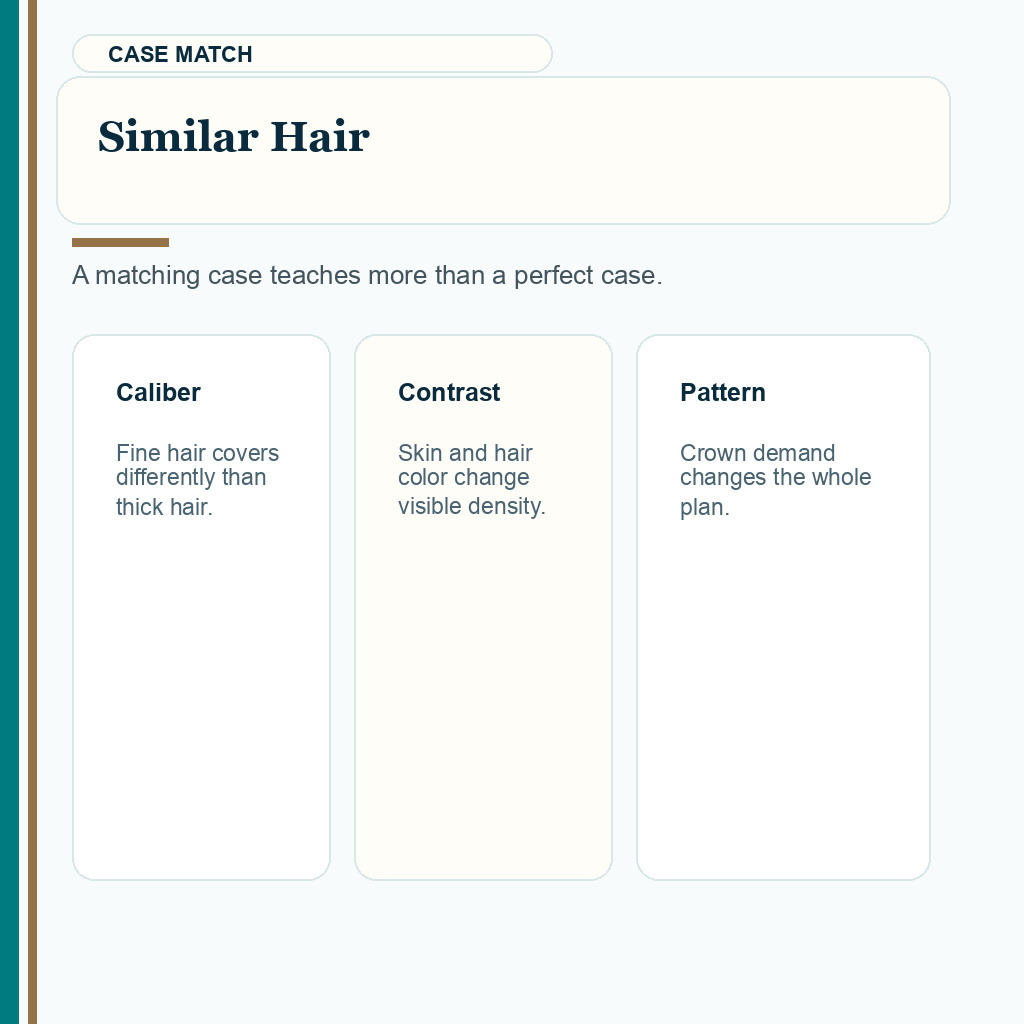
If your hair is fine, straight, and light against pale skin, a result from thick dark wavy hair may overpromise visible density. If your crown demand is large, a hairline only case may not answer your problem. If you have diffuse thinning, a result from a sharp Norwood 3 pattern may not show the same risk. Similarity matters because visual density comes from more than the number of grafts.
For that reason, I like patients to compare results with hair like yours. Look for similar hair caliber, curl, color contrast, scalp tone, hair loss pattern, age range, donor strength, crown demand, and medical treatment history. A less dramatic case that matches your biology can be more useful than a beautiful case that has nothing to do with your limits.
The gallery result should not become a promise for your case. The more useful comparison is what must be different in your plan, because that answer says more about the clinic than the photo itself.
Build the evidence packet before you pay or travel
The records that let you judge the result should be created before a deposit, flight, or surgery date, not reconstructed after disappointment starts. If the result later looks weak, those records decide whether the review is clear or confused. A careful plan cannot guarantee biology, but it should leave enough evidence to judge what was planned, what changed, and whether the clinic’s explanation is consistent.
For patients who receive a clinic plan before travel, this review standard also applies to a hair transplant plan from photos. The clinic needs more than flattering pictures. It needs comparable views, enough donor information, a realistic graft discussion, and a record of what the surgery is meant to achieve.
- Start with examples of patients with similar hair caliber, curl, scalp contrast, pattern, crown demand, and age range.
- Use a photo standard with front, top, side, crown, and donor views under consistent light, with dry hair and similar length when possible.
- Keep the surgery record clear, including how many grafts were planned for the hairline, midscalp, crown, or repair area, and why.
- Review the donor record, including how donor density, miniaturization risk, extraction spacing, safe zone use, and future reserve were judged.
- Include medications, native hair risk, scalp health, and future hair loss in the medical context.
- Decide how the clinic would review a result that looks weaker than expected.
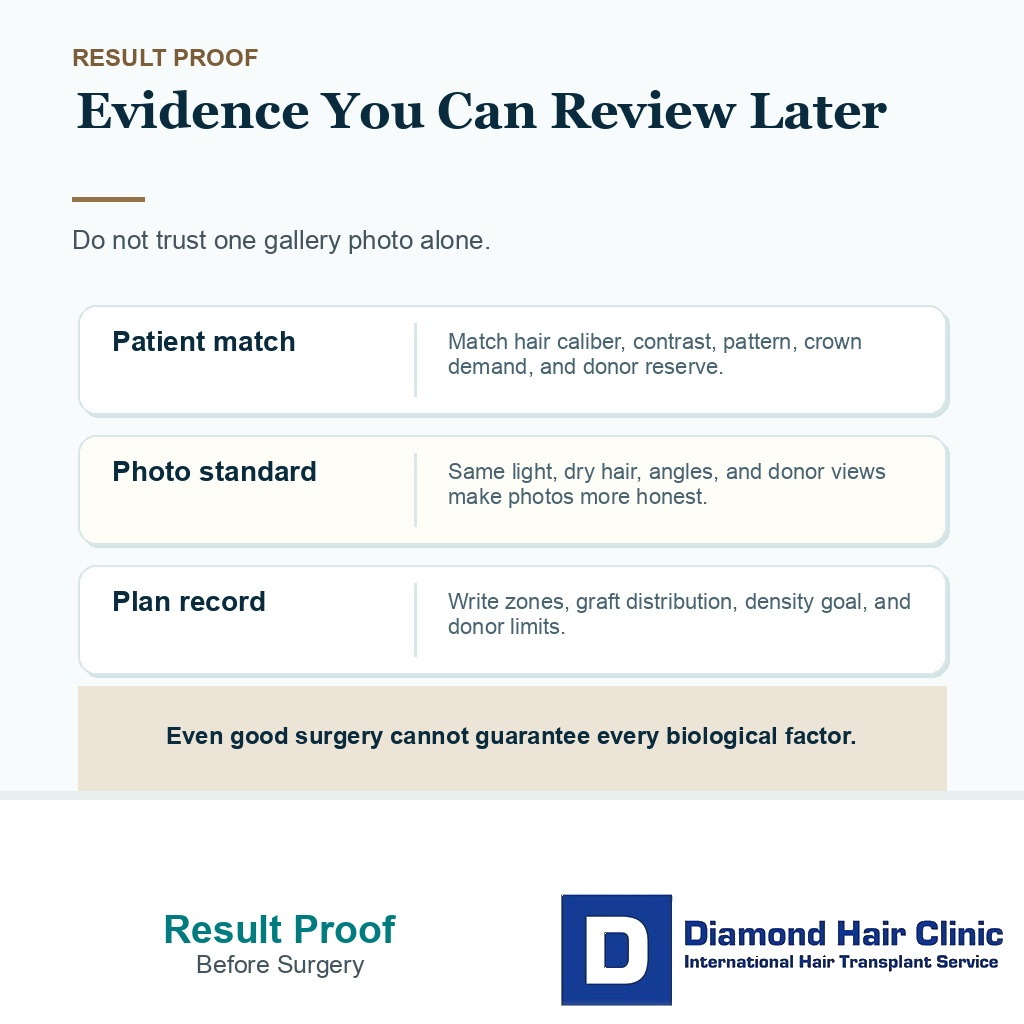
Useful result evidence is not a sales packet. It is the record that lets the result be judged clearly later.
A good plan still cannot promise growth
This point matters because many patients think a strong candidate and a careful clinic should remove all risk. It does not work that way. Careful extraction, clean handling, correct placement, good density planning, and the surgeon’s judgment reduce the avoidable risks. They do not control every graft once it is back in the scalp.
A hair transplant guarantee can sound comforting, but no guarantee can make living follicles obey a contract. Healing, blood supply, inflammation, shock loss, native hair loss, donor miniaturization, medication consistency, scalp disease, and genetic behavior can all affect what the patient sees. That is one reason a carefully planned hair transplant can still underperform.
A clinic worth choosing will not use uncertainty as an excuse for poor work. It should still explain graft handling, hairline design, donor protection, density goals, and follow-up review. But it should also say clearly that no clinic can guarantee every biological factor. I trust that sentence more than certainty that sounds too easy.
Density photos can mislead you
Density is easy to manipulate without obvious editing. Different hair length, wet hair, dry hair, styling product, strong overhead light, soft side light, camera distance, angle, and scalp contrast can change the result dramatically. A photo taken at the best angle may not be fake, but it may still be incomplete.
A fair photo set should make the hair harder to hide, not easier. It should include front, top, side, crown, and donor views, dry hair, similar length, similar camera distance, similar light, an exposed hairline, and no fibers, concealer, hair combed forward, or wet hair tricks. A video with the hair combed through is not perfect evidence, but it often reveals more than one still image.
Concern that hair transplant results look thin can come from graft survival, hair caliber, contrast, spacing, native hair loss, or unrealistic expectations. The same factors matter before surgery when you compare clinic galleries. A result with lower visible density but consistent lighting may be more useful than a photo that looks dense but hides the crown, donor area, or scalp contrast.
The donor area also needs its own evidence. Healed donor photos from the back and both sides, at a comparable hair length, should come with an explanation of extraction pattern and future reserve. You cannot diagnose every donor overharvesting risk from a public photo, but a beautiful recipient result without donor evidence is incomplete.
Before you trust a set of before and after photos, ask when the after photos were taken and whether the same patient is shown under comparable conditions. Be careful if the clinic cannot show front, top, side, crown, and donor views, cannot say which month after surgery the photo was taken, or only shows styled hair under flattering light. Also pause if the plan is offered before donor miniaturization, scalp disease, medication history, and future native hair loss have been discussed. Those missing details do not prove the clinic is unsafe, but they mean the gallery result is not enough evidence to choose surgery.
That evidence caution applies to results shown on social media. A reel can show movement, confidence, and good styling, but it rarely gives you the full timeline, donor view, crown view, graft map, or native hair risk. Treat it as a reason to ask better questions, not as proof by itself.
An influencer or VIP result can be a useful lead, but it should not become a shortcut to trust. I still want to see ordinary cases that resemble your hair type, donor condition, age, and goal, with clear donor evidence, surgeon responsibility, and follow-up timing.
Use the clinic result proof filter
This check is not a calculator. It does not predict your growth. It helps you find the weak point in the evidence before you trust a clinic claim. Choose the part of the case that feels least clear, then ask that question before choosing a clinic.
Clinic Result Proof Filter
Which part of the evidence is weakest?
A clinic result is stronger when the result photo, patient similarity, donor record, graft plan, and clear limits all point in the same direction.
Ask for a case that behaves like yours
A perfect result with thick dark hair does not predict the same coverage in a patient with fine hair, pale scalp contrast, larger crown demand, or unstable native hair.
- Compare hair caliber.
- Compare pattern and crown demand.
- Ask what would be different in your plan.
Make the photo set complete
One flattering angle can hide the hairline, crown, donor area, or scalp contrast. A useful clinic result can survive more than one lighting condition.
- Ask for front, top, side, crown, and donor views.
- Compare dry hair and similar length.
- Be cautious with harsh flash or soft light tricks.
Protect the donor before chasing density
The donor area is finite. A strong clinic result should make sense with the donor supply, not only with the recipient area photo.
- Ask how donor density was judged.
- Ask whether miniaturization was checked.
- Ask what reserve remains for future loss.
Look for a plan you can review later
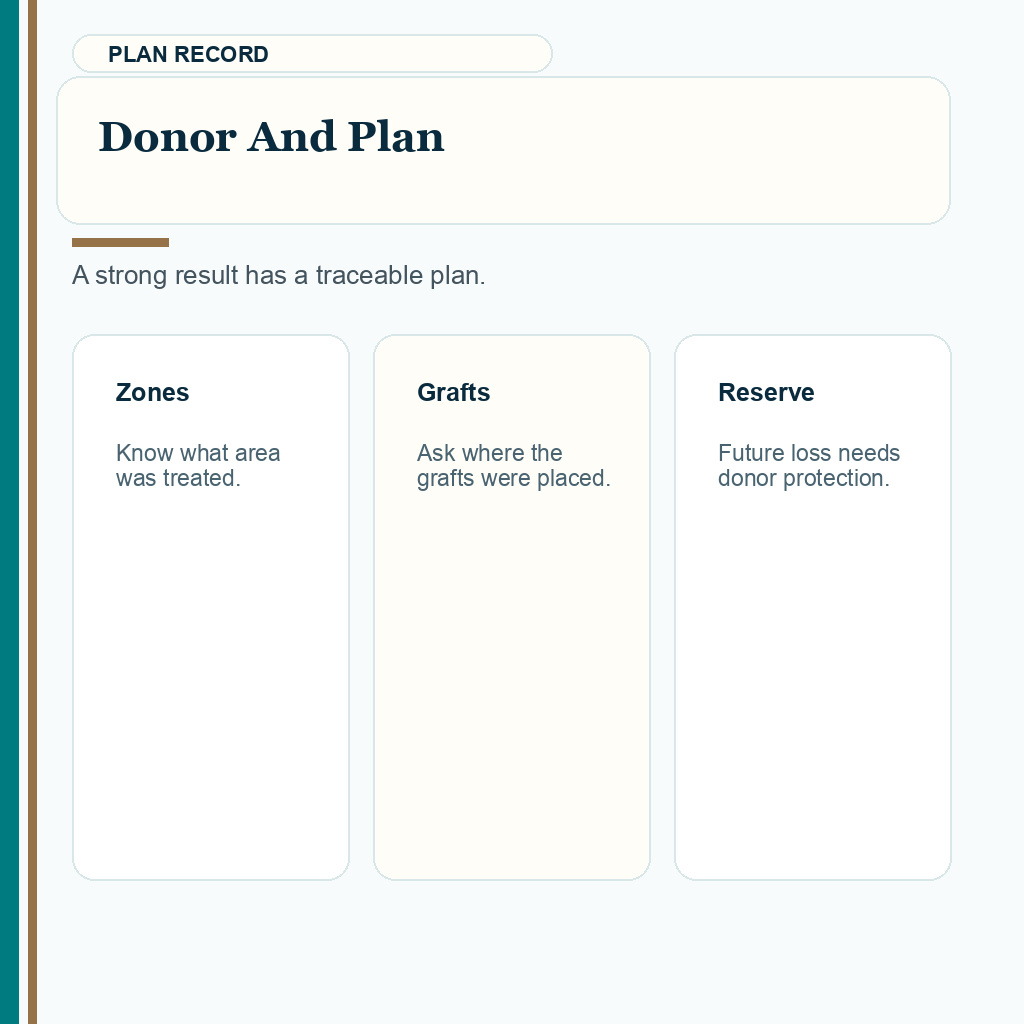
The result is easier to judge when the treated zones, graft distribution, hairline design, and crown decision were recorded before surgery.
- Separate hairline, midscalp, and crown.
- Ask for the density goal by zone.
- Record what was not treated.
Do not buy a promise that biology cannot keep
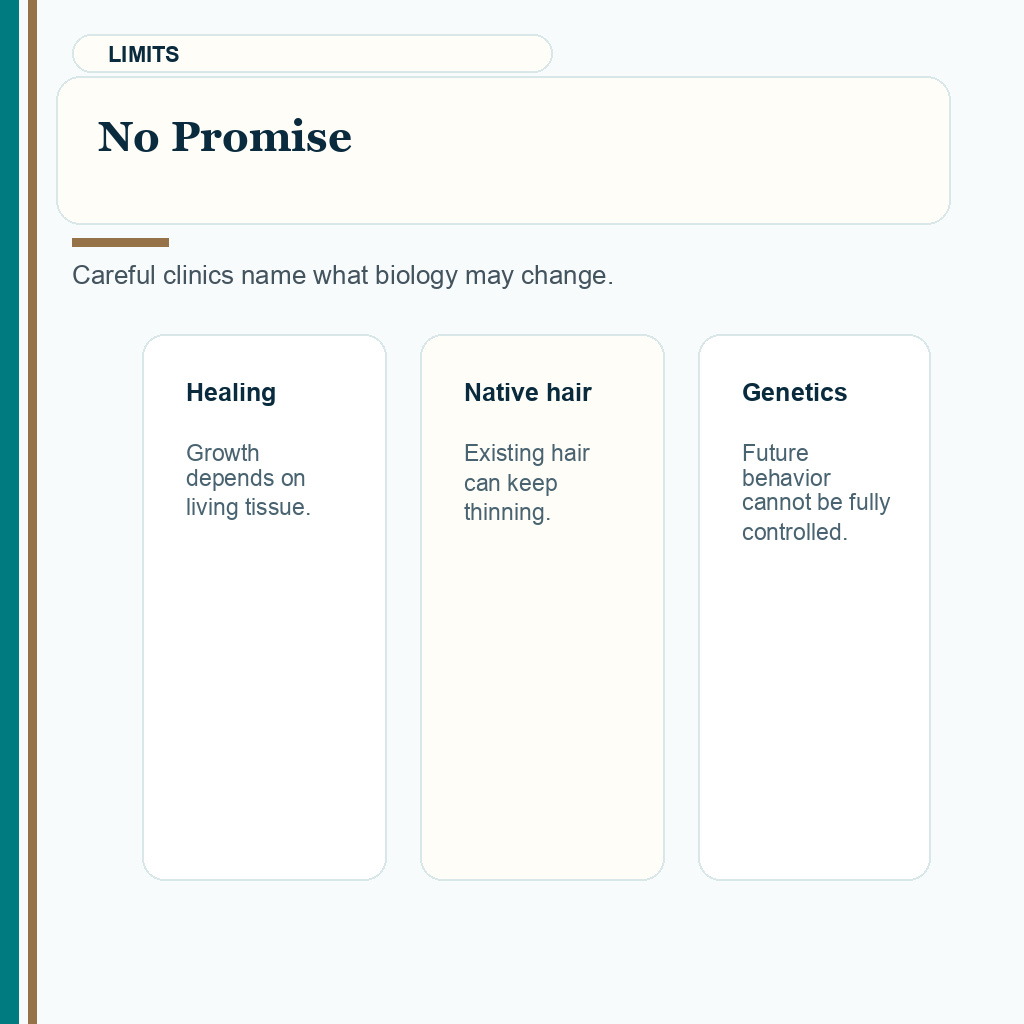
Even with good conditions and careful surgery, graft growth, healing response, native hair loss, donor behavior, scalp health, and genetics cannot be fully controlled.
- Ask how weak growth would be reviewed.
- Ask what cannot be guaranteed.
- Choose clear limits over certain language.
Ask questions that can be answered later
Useful clinic questions are not aggressive. They are practical. You are asking whether the plan can be judged later if the result disappoints you. That is different from demanding a perfect result before surgery. A clinic that documents the plan well is easier to trust because its reasoning can be reviewed.
If you are unsure, a second opinion before a hair transplant can help you test whether the proposed graft number, donor use, crown plan, and hairline design are realistic. Hairline planning also deserves its own attention because hairline design can make a technically growing result look natural or exposed.
The carousel below separates four parts of clinic result evidence that should be clear before you pay a deposit or travel for surgery.
A gallery should explain the result, not sell it
A result gallery is useful when it helps you ask better questions. Look for patient similarity, lighting, hair length, graft distribution, donor record, and what the clinic says cannot be promised.
If careful questions are brushed aside before payment or travel, that belongs with the red flags of Turkish hair transplant clinics rather than being treated as normal sales pressure.
Clear records also matter if repair is ever needed. A bad hair transplant repair is easier to prepare when the first operation documented what was placed, where it was placed, and what donor reserve remains.
The gallery should not ask you to trust one perfect image. It should help you understand why a result worked and whether a similar approach could safely fit your scalp.

Read this review excerpt
told me the quality of my donor hair and what he could take out and advised me what will the be best outcome with what donor hair I had.